
To build Agile teams that deliver sustainable value, organizations need more than daily stand-ups, Agile tools or pressure to work faster. Effective Agile teams combine clear goals, cross-functional skills, appropriate autonomy, customer feedback, visible work, manageable work in progress and continuous improvement.
The result is a team that can respond to change without falling into chaos, collaborate across disciplines and repeatedly deliver useful outcomes.
Agility therefore depends as much on team design, leadership, trust and organizational environment as it does on Scrum, Kanban or any particular delivery framework. This broader organizational environment is a core part of business agility across the organization.
This guide explains what makes a team Agile, how to build one step by step, how leaders should support it, which metrics are useful, what commonly goes wrong and how Agile teams can remain effective in hybrid, remote and AI-enabled workplaces.
If you are new to Agile itself, start with our complete guide to Agile principles and methods.
What Is an Agile Team?
An Agile team is a group of people organized to deliver value through collaboration, short feedback loops, learning and adaptation.
The team does not become Agile simply because it uses Jira, runs Sprints or holds a daily meeting.
Instead, agility is reflected in how the team behaves:
- It understands the outcomes it is trying to achieve.
- It collaborates rather than relying on excessive handoffs.
- It makes relevant decisions close to the work.
- It delivers and learns frequently.
- It responds to useful feedback.
- It makes work and problems visible.
- It limits unnecessary work in progress.
- It continuously improves how it works.
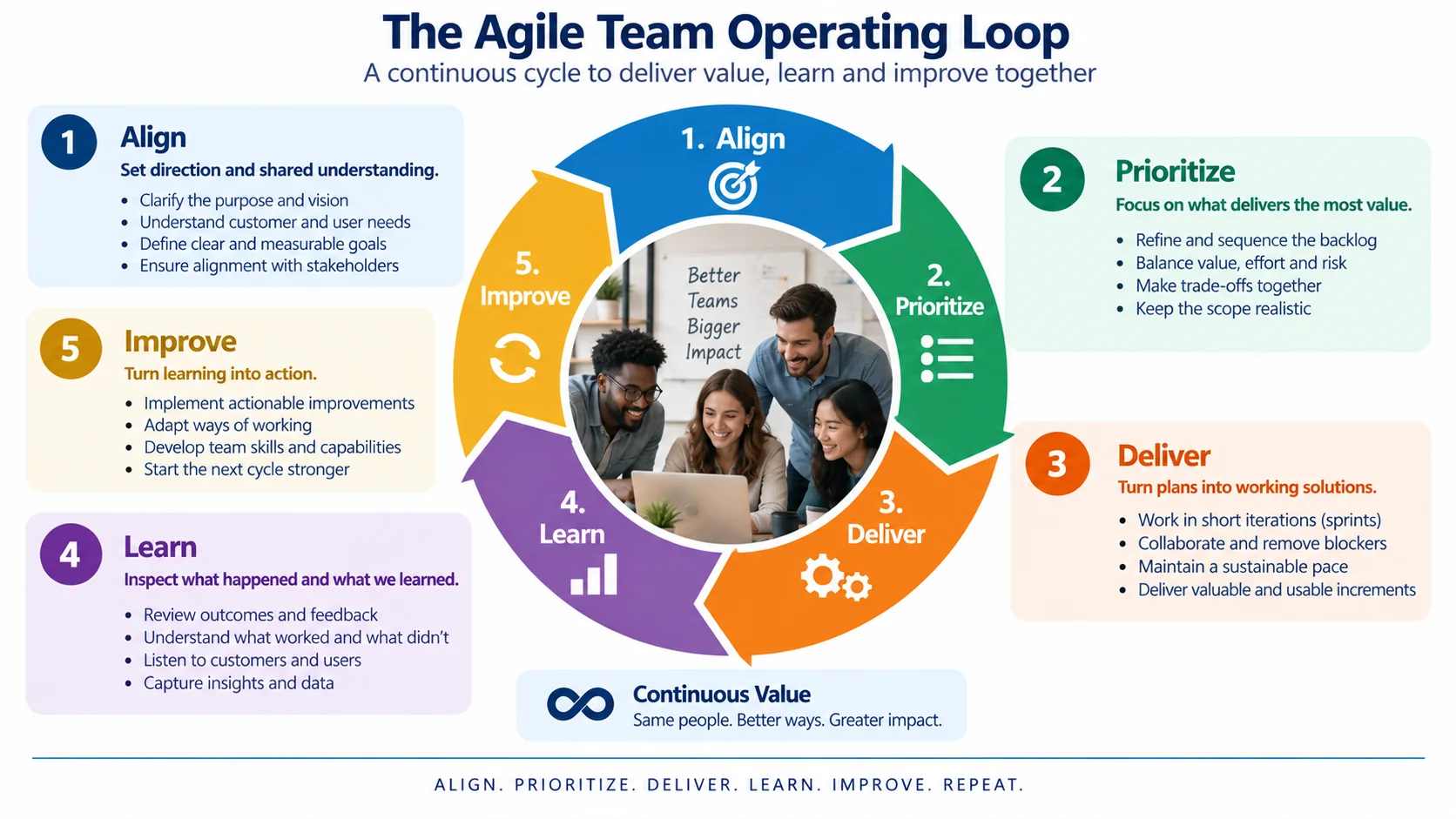
A useful way to summarize the operating cycle is:
Align → Prioritize → Deliver → Learn → Improve → Repeat
Agile Team vs Scrum Team: What Is the Difference?
Agile represents a broader set of values and principles.
Scrum is a specific framework that defines a Scrum Team, accountabilities, events and artifacts.
According to the official Scrum Guide, a Scrum Team consists of:
- One Product Owner
- One Scrum Master
- Developers
The Scrum Guide describes these teams as cross-functional and self-managing.
That means the team collectively has the skills required to create value and internally decides who does what, when and how.
But not every Agile team needs to use Scrum.
A team can use Kanban, another Agile approach or a fit-for-purpose combination of practices.
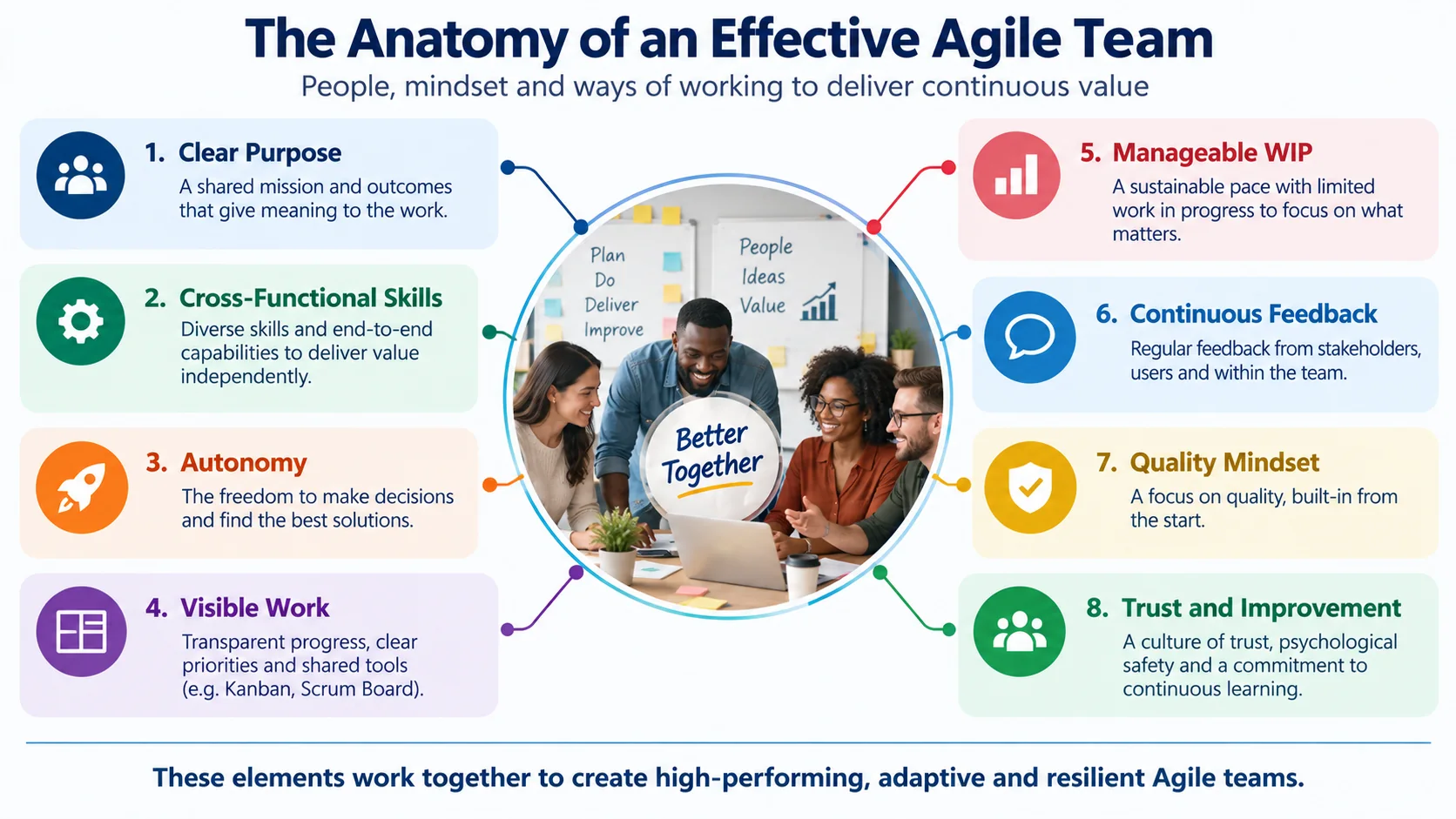
The 10 Characteristics of Effective Agile Teams
Frameworks differ, but organizations that build Agile teams successfully tend to see several shared characteristics.
1. A Clear Purpose
Teams need to understand more than their current task list.
They should understand:
- Who they serve
- What problem they are solving
- What outcome matters
- How their work contributes to broader objectives
A team without a clear purpose may deliver a large amount of work while still creating little value.
2. Cross-Functional Capability
A cross-functional team contains enough complementary capabilities to move valuable work toward completion without depending on excessive external handoffs.
Depending on the product or service, capabilities could include:
- Product management
- Engineering
- Design
- Testing
- Operations
- Security
- Data
- Business expertise
Cross-functional does not mean every team member must know how to perform every discipline.
It means the team collectively has the capabilities required to deliver.
3. Appropriate Self-Management
Agile teams need enough autonomy to decide how best to achieve their objectives.
This does not mean teams operate without boundaries or accountability.
Leadership can still define:
- Strategy
- Business outcomes
- Budget constraints
- Security requirements
- Legal constraints
- Architecture guardrails
Within appropriate boundaries, however, teams should be trusted to make operational decisions close to the work.
4. Customer and Stakeholder Feedback
Agility depends on learning.
A team that delivers quickly but rarely receives meaningful customer feedback may simply become efficient at building the wrong things.
Feedback can come from:
- Users
- Customers
- Business stakeholders
- Usage analytics
- Support data
- Experiments
- Operational information
The team then uses that information to reconsider assumptions and priorities.
5. Visible Work
Teams should be able to see what is:
Waiting → Ready → In Progress → Blocked → Finished
Visibility reduces ambiguity and makes bottlenecks easier to identify.
A Kanban board can help, but the board itself does not create agility.
It becomes useful when it reflects the team’s real workflow and helps the team make better decisions about flow.
6. Limited Work in Progress
One of the most common causes of slow delivery is starting too much work simultaneously.
Excessive work in progress can create:
- Longer queues
- More context switching
- More unfinished work
- Hidden dependencies
- Delayed feedback
Controlling WIP encourages teams to finish valuable work before continuously starting more work.
This is a central principle in modern Kanban guidance.
7. Short Feedback Loops
Agile teams create frequent opportunities to inspect both the product and the process.
Feedback loops may include:
- Product demonstrations
- Customer testing
- Automated tests
- Operational monitoring
- Stakeholder reviews
- Retrospectives
- Flow metrics
Shorter feedback loops help problems become visible while they are still relatively inexpensive to address.
8. Technical and Operational Quality
Agility cannot be sustained if every new change makes the system harder to modify.
Quality practices may therefore include:
- Automated testing
- Continuous integration
- Peer review
- Refactoring
- Security automation
- Observability
- Clear quality standards
The Agile Manifesto principles explicitly identify continuous attention to technical excellence and good design as contributors to agility.
9. Psychological Safety and Trust
Teams need an environment where people can raise concerns, challenge assumptions, admit uncertainty and discuss mistakes without unreasonable fear of blame or humiliation.
Psychological safety also connects with inclusion and meaningful participation. For the broader workplace perspective, see our Diversity, Equity and Inclusion guide.
Psychological safety does not mean avoiding disagreement. For practical ways to encourage speaking up during retrospectives and team decisions, see our psychological safety at work guide.
Effective Agile teams need constructive disagreement.
People should be able to say:
- “I think this assumption is wrong.”
- “I don’t understand this.”
- “We may be taking too much risk.”
- “I made a mistake.”
- “There may be a better approach.”
When those conversations are suppressed, important information remains hidden.
10. Continuous Improvement
An Agile team should not assume that its current process is permanently correct.
The Agile Manifesto explicitly encourages teams to regularly reflect on how they can become more effective and adjust their behavior accordingly.
Improvement can involve:
- Workflow
- Team agreements
- Tools
- Quality practices
- Meetings
- Decision-making
- Dependencies
- Skills
Continuous improvement is therefore part of normal delivery rather than a separate transformation project.
How to Build Agile Teams Step by Step
To build Agile teams effectively, start with the work and desired outcomes rather than with a framework.
Step 1: Define the Mission
Clarify why the team exists.
A useful mission should help answer:
- Who are our customers?
- What value do we provide?
- What outcomes are we responsible for?
- What boundaries define our area of responsibility?
This prevents the team from becoming a collection of people completing unrelated requests.
Step 2: Build Around Value
Where possible, organize the team around a customer, product, service or value stream rather than around a narrow technical function.
For example, a team responsible for a customer journey may be more adaptable than one that controls only one step and must wait for several other departments before anything can reach the customer.
Step 3: Identify Required Capabilities
List the capabilities needed to deliver the team’s outcomes.
Then ask:
Which dependencies are unavoidable, and which exist only because of organizational design?
Not every dependency can be eliminated.
But unnecessary dependencies create waiting and coordination cost.
Step 4: Define Clear Responsibilities
Self-management should not be confused with unclear accountability.
Teams still need clarity around:
- Product decisions
- Technical decisions
- Quality
- Risk
- Customer interaction
- Delivery
- Escalation
If the team uses Scrum, use the accountabilities defined by Scrum.
If it uses another approach, establish responsibilities appropriate to that model rather than copying Scrum terminology unnecessarily.
For example, the team can decide how to implement and test a solution, a Product Owner (in Scrum) is accountable for product value and backlog ordering, management establishes investment and compliance guardrails, and stakeholders provide feedback. These are context-specific examples rather than a universal hierarchy. When decision ownership is unclear, consult our RACI vs RASCI vs DACI comparison, while preserving the Scrum accountabilities if your team uses Scrum.
Step 5: Establish Goals
Goals give autonomy direction.
Weak:
“Complete 25 tickets this month.”
Stronger:
“Reduce the time customers need to complete onboarding while maintaining required security controls.”
The second statement creates more room for learning and problem solving.
Step 6: Make the Workflow Visible
Map how work currently moves from request to completion.
Include waiting states, reviews and external dependencies rather than drawing only the ideal process.
Then define:
- What counts as a work item
- Where work starts
- Where work finishes
- The main workflow states
- How WIP will be controlled
- Policies for moving work
This aligns well with the current Kanban Guide.
Step 7: Control Work in Progress
Look at where work accumulates.
If the team continually has ten activities started and only two finishing, adding an eleventh may make the situation worse.
Agree on reasonable WIP controls and encourage people to collaborate on finishing work.
Step 8: Establish Feedback Loops
The team needs feedback about two things:
Are we building the right thing?
and
Are we working effectively?
Product reviews, analytics and customer conversations can help answer the first question.
Retrospectives, flow data and team conversations help answer the second.
Step 9: Create Team Working Agreements
Working agreements clarify how the team wants to collaborate. Our team communication strategies guide provides practical approaches to channel norms, decision documentation, and escalation paths.
They can cover:
- Meeting expectations
- Communication channels
- Focus time
- Availability
- Decision-making
- Escalation
- Code or document review
- Handling disagreements
- Remote collaboration
Working agreements should evolve as the team learns.
Step 10: Improve One Constraint at a Time
Do not try to transform every team behavior simultaneously.
Identify the most important constraint and improve it.
Then inspect the impact before moving to the next major problem.
Practical Example: Building a Cross-Functional Customer Onboarding Team
Imagine a fictional B2B technology company where customer onboarding takes 18 days on average and requests frequently pass between sales, engineering, security and support. The organization assembles a cross-functional team with a clear mission: make onboarding faster without weakening security or reliability.
First 30 days: map the workflow, identify waiting time, agree on who prioritizes requests and define a shared outcome. Days 31–60: limit simultaneous onboarding work, run weekly customer feedback reviews and automate one repeated handoff. Days 61–90: inspect cycle time, onboarding completion, rework and customer feedback; adapt the process based on evidence.
A realistic improvement target might be a reduction from 18 to 12 days, with no increase in security exceptions. These figures are illustrative, not measured results. The point is to combine flow, quality and customer outcomes rather than declare success because more tickets were completed.
Project managers supporting such cross-functional work can also draw on our PMP certification and project leadership guide for stakeholder alignment, risk and governance considerations.
Should Agile Teams Use Scrum or Kanban?
There is no universal answer.
Scrum and Kanban should not be interpreted as sequential maturity stages.
Scrum May Be Useful When
A team benefits from:
- A consistent Sprint cadence
- Explicit Product Goal and Sprint Goal
- Defined Scrum accountabilities
- Regular inspection and adaptation events
- Incremental product development
The official Scrum Guide remains the authoritative definition of Scrum.
Kanban May Be Useful When
A team benefits from:
- Continuous flow
- Explicit WIP control
- Flow measurement
- Visual workflow management
- Managing unpredictable incoming work
Operations, platform, service-management and support environments frequently contain work patterns where continuous flow can be particularly useful.
Can Scrum and Kanban Be Combined?
Teams can use flow practices alongside Scrum, provided they understand what each practice is intended to improve.
The goal should not be creating a fashionable hybrid label.
The goal is improving the delivery system.
Leadership’s Role in Agile Teams
Team agility does not mean leadership becomes unnecessary.
Leadership changes from controlling every decision toward creating the conditions in which teams can make effective decisions.
Provide Direction
Teams need clarity around strategy and outcomes.
Autonomy without direction can create local optimization and conflicting priorities.
Create Boundaries
Leaders should make constraints explicit.
For example:
- Security policies
- Budget limits
- Regulatory obligations
- Architecture standards
- Strategic priorities
Clear guardrails can actually support autonomy because teams understand where they are free to decide.
Delegate Decisions Intelligently
Not every decision needs senior approval.
Ask:
Where can this decision be made effectively with the information closest to the work?
Decentralizing appropriate decisions can shorten feedback loops and reduce waiting.
Remove Systemic Obstacles
Many Agile-team problems are actually organizational problems.
Examples include:
- Slow procurement
- Long security approvals
- Shared environments
- Conflicting priorities
- Excessive dependencies
- Unclear ownership
Leadership can often address these constraints more effectively than the team can.
Protect Sustainable Performance
The Agile Manifesto emphasizes sustainable development. In practice, sustainable team performance also depends on protecting employee wellbeing and mental health so delivery pace does not come at the expense of people.
Agility should not be based on permanent urgency, continual overtime or unrealistic capacity assumptions.
A system that depends on repeated exhaustion is not sustainably Agile.
Psychological Safety in Agile Teams
Agile delivery depends on transparency.
Transparency is difficult when people believe speaking honestly will create personal risk.
Healthy team environments allow people to:
- Raise blockers early
- Ask questions
- Challenge ideas respectfully
- Admit mistakes
- Request help
- Offer alternatives
Trust does not remove accountability.
It improves the quality of information on which accountability and decisions depend.
Practical actions include:
- Critique ideas rather than personalities.
- Avoid blame-focused incident discussions.
- Invite disagreement before finalizing important decisions.
- Make it acceptable to say “I don’t know.”
- Recognize people who raise risks early.
- Address disrespectful behavior consistently.
How Agile Teams Handle Conflict
An effective Agile team is not a team that always agrees.
Product development requires trade-offs.
Healthy conflict might involve:
- Customer value versus technical investment
- Speed versus risk
- Short-term delivery versus architecture
- Feature work versus reliability
The objective is to make those disagreements productive.
Teams can establish simple rules:
- Start with the shared goal.
- Separate facts from assumptions.
- Listen to competing perspectives.
- Identify the decision owner when necessary.
- Document significant decisions.
- Commit to the decision once it is made, while remaining open to new evidence.
Agile Teams and Innovation
Innovation should not be treated as the automatic result of running Sprints.
Teams are more likely to experiment effectively when several conditions exist:
- A meaningful problem
- Access to customers
- Fast feedback
- Technical capability
- Psychological safety
- Time to learn
- Low-cost experimentation
A useful innovation cycle is:
Hypothesis → Experiment → Evidence → Decision
The objective is not to celebrate failure.
It is to design experiments where unsuccessful assumptions produce useful learning without excessive cost.
How to Build Agile Teams for Remote and Hybrid Work
Organizations can build Agile teams that collaborate effectively without requiring everyone to be physically co-located.
Remote and hybrid environments do, however, require more deliberate communication design.
Make Work Visible
Information should not exist only inside private meetings or individual inboxes.
Use Asynchronous Communication Appropriately
Not everything needs a meeting.
Written decisions, shared documentation and workflow tools can reduce unnecessary interruption across time zones.
Reserve Synchronous Time for Interaction
Live conversations are particularly useful for:
- Complex decisions
- Problem solving
- Planning
- Retrospectives
- Conflict resolution
Document Important Decisions
Remote teams need a shared source of truth so information does not depend on who attended a particular call.
How to Measure Agile Team Performance
When leaders build Agile teams, a common mistake is reducing team performance to a single number.
No single metric adequately represents value, flow, quality and team sustainability.
Flow Metrics
Useful operational metrics include:
- Cycle time: how long started work takes to finish.
- Throughput: how many work items finish in a period.
- Work in progress: how many items are currently started but unfinished.
- Work item age: how long current unfinished items have been in progress.
Quality Metrics
Depending on the environment:
- Defect trends
- Escaped defects
- Reliability
- Failed changes
- Rework
Outcome Metrics
Outcome measures may include:
- Customer adoption
- Customer satisfaction
- Conversion
- Operational cost
- Processing time
- Business impact
Team Health
Teams can also periodically examine:
- Goal clarity
- Trust
- Collaboration
- Workload sustainability
- Decision autonomy
- Skills and capability
The purpose is not surveillance.
The purpose is identifying constraints to healthy performance.
Why Velocity Should Not Be a Productivity Target
Velocity can be useful within some teams for planning when the team uses relative estimation.
It should not automatically be used to:
- Compare teams
- Rank individuals
- Measure productivity
- Set organizational performance targets
If management rewards higher story-point totals, teams can unintentionally optimize the estimate instead of customer value.
The important question is not:
“How many points did we produce?”
It is:
“Are valuable outcomes flowing through the system effectively?”
Example: Interpret Agile Team Metrics Together
Consider a fictional team that finishes 12 work items per week, with a median cycle time of 9 days and four customer-reported defects in a month. A month later, throughput rises to 15 items weekly, median cycle time drops to 6 days, and customer-reported defects rise to eight. Speed improved, but quality deteriorated: this is not a clear overall success.
The team should inspect why defects increased, compare like-for-like work items, review customer outcomes and select one focused improvement. Use these measures for learning, not for ranking individuals or teams. All values in this example are illustrative.
Common Mistakes When You Build Agile Teams
Mistake 1: Starting With Tools
Jira, Azure DevOps, Trello and other tools can support work management.
They cannot create collaboration, trust or customer focus.
Mistake 2: Calling Meetings Agile Ceremonies
Adding daily meetings does not make a team Agile.
Scrum defines specific events, but teams using other approaches should use only meetings that have a useful purpose.
Mistake 3: Treating Scrum as Agile Itself
Scrum is one framework within a much larger Agile landscape.
Mistake 4: Confusing Autonomy With No Direction
Teams need clear objectives and boundaries.
Autonomy should describe how teams achieve those goals, not an absence of strategy.
Mistake 5: Too Much Work in Progress
Starting many initiatives at once creates queues and slows feedback.
Mistake 6: Constantly Changing Priorities
Agility does not mean interrupting teams whenever a new idea appears.
Teams require enough stability to finish work.
Mistake 7: Ignoring Technical Quality
Accumulating technical debt can progressively reduce the team’s ability to adapt.
Mistake 8: Measuring Individuals Instead of the System
Optimizing individual utilization can damage collaboration and overall flow.
Mistake 9: Forcing Every Team Into the Same Framework
A product team, operations team and support team may have very different work characteristics.
Mistake 10: Expecting the Team to Fix Organizational Problems Alone
A team cannot independently solve dysfunctional funding, conflicting priorities or enterprise-wide dependencies.
Leaders need to improve the environment surrounding the team.
How Agile Teams Scale
As organizations build Agile teams at scale, multiple teams may need to coordinate around shared products, platforms or value streams.
New challenges appear:
- Cross-team dependencies
- Shared architecture
- Portfolio priorities
- Investment decisions
- Common platforms
- Large-scale planning
This is a different problem from building one effective team.
For enterprise-level coordination, see our complete Scaled Agile Framework guide.
If your organization already uses SAFe, our SAFe PI Planning guide explains how multiple teams align around a Planning Interval, while the PI Planning readiness checklist provides a practical way to validate team readiness, capacity, dependencies and follow-through. You can also use the PI Planning agenda template to structure the coordination sessions.
How AI Changes How We Build Agile Teams
As organizations build Agile teams in AI-enabled workplaces, AI tools are increasingly assisting with activities such as:
- Research
- Software development
- Testing
- Documentation
- Analysis
- Knowledge discovery
Faster content or code generation does not remove the need for effective teams.
It can actually increase the importance of:
- Clear goals
- Customer understanding
- Review
- Quality control
- Governance
- Human accountability
If output becomes easier to generate, selecting the right problems and outcomes becomes even more important. For a project-team perspective on AI-enabled coordination, see our AI agents for project management guide. Keep people accountable for validating AI-supported work.
A Practical Agile Team Health Check
A practical way to build Agile teams is to periodically assess these ten questions:
- Do we understand our purpose and goals?
- Can we deliver useful value without excessive external dependencies?
- Can we make appropriate decisions ourselves?
- Is our work visible?
- Are we limiting work in progress?
- Do we receive useful customer feedback?
- Can team members safely raise problems and disagreements?
- Is our quality good enough to support continued change?
- Is our pace sustainable?
- Are we regularly improving how we work?
Do not use the exercise to score or rank teams.
Use it to identify the next improvement opportunity.
Turn the health check into action: ask team members to identify the three questions that reveal the largest obstacles. Choose one improvement experiment for the next two weeks, assign an owner, state the expected outcome and agree on a review date. Record what changed, what was learned and whether to keep, adjust or stop the experiment.
A 30-60-90 Day Agile Team Improvement Plan
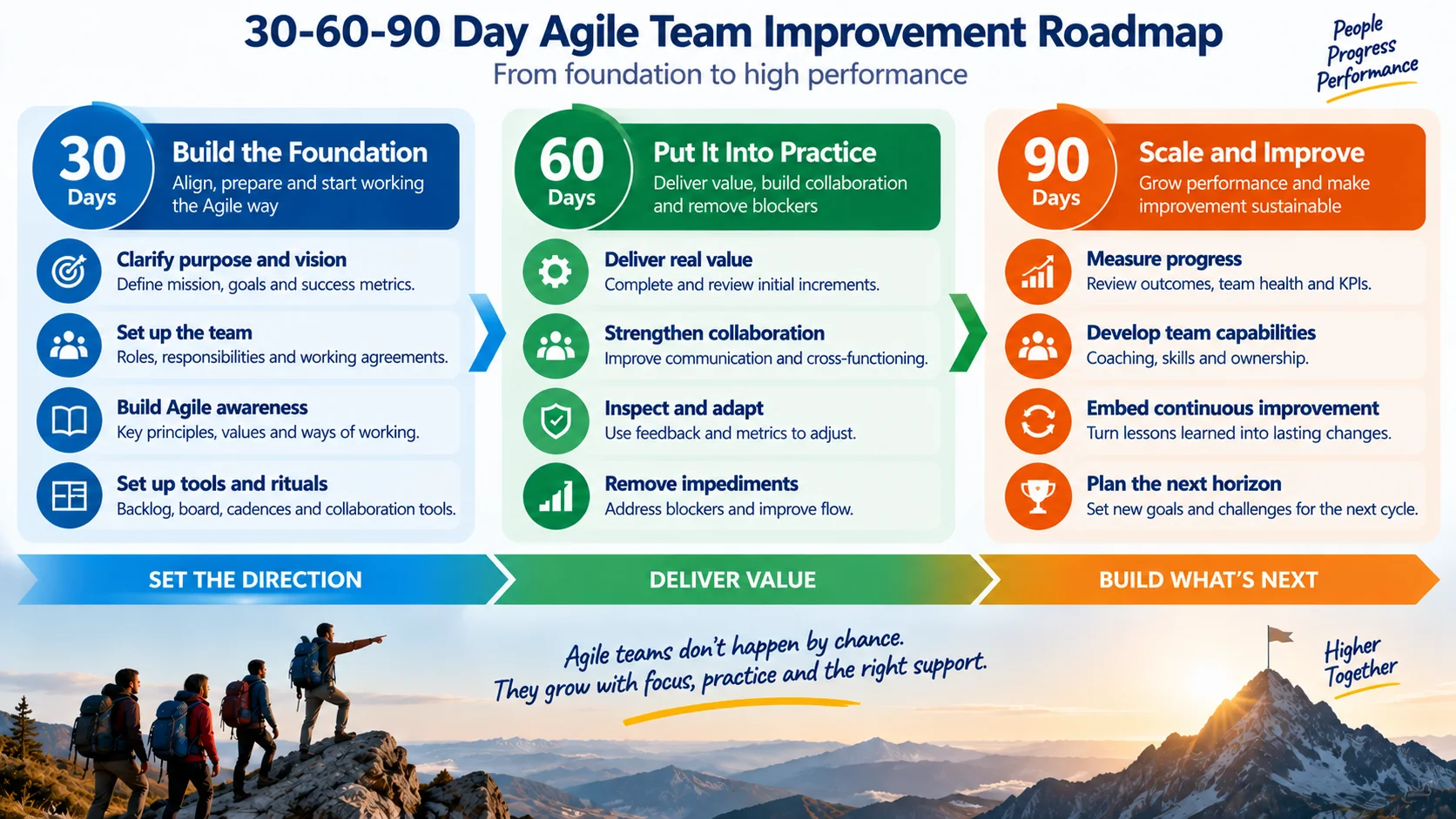
First 30 Days: Create Clarity
- Clarify team mission and customers.
- Define outcomes.
- Map current workflow.
- Identify major dependencies.
- Create working agreements.
- Establish baseline metrics.
Days 31-60: Improve Flow
- Introduce appropriate WIP controls.
- Remove unnecessary handoffs.
- Strengthen customer feedback.
- Clarify responsibilities.
- Address the largest recurring blocker.
Days 61-90: Strengthen the System
- Review cycle time and throughput trends.
- Improve automation and quality practices.
- Evaluate team autonomy.
- Address organizational dependencies.
- Run a deeper team-health review.
- Select the next improvement experiment.
The objective is not to declare the team “Agile” after 90 days.
The objective is to establish a sustainable system of learning and improvement.
Frequently Asked Questions About Agile Teams
What makes a team Agile?
An Agile team can deliver value incrementally, learn from feedback and adapt. Effective Agile teams typically combine clear goals, cross-functional capability, appropriate autonomy, visible work, manageable WIP and continuous improvement.
How big should an Agile team be?
Agile itself does not prescribe one universal team size. Scrum specifically describes Scrum Teams as typically ten or fewer people. The appropriate size depends on the work, capabilities and coordination needs.
Are Agile teams self-organizing or self-managing?
The original Agile principles refer to self-organizing teams. Current Scrum terminology uses self-managing and states that Scrum Teams internally decide who does what, when and how.
Does every Agile team need a Scrum Master?
No. Scrum defines the Scrum Master accountability. Teams not using Scrum do not automatically require that role.
Does every Agile team need a Product Owner?
No. Product Owner is a Scrum accountability. Every team needs clarity around product and prioritization decisions, but organizations using other approaches may structure those responsibilities differently.
Do Agile teams need daily stand-ups?
No universal Agile rule requires every team to hold a daily stand-up. Scrum includes a Daily Scrum for Developers. Other teams should design communication practices appropriate to their workflow.
Should Agile teams use Scrum or Kanban?
It depends on the nature of the work. Scrum provides a structured Sprint-based framework. Kanban focuses on defining workflow, controlling WIP and improving flow. Neither is universally superior.
What is psychological safety in an Agile team?
Psychological safety describes an environment where people can raise concerns, ask questions, challenge assumptions and acknowledge mistakes without unreasonable fear of humiliation or retaliation.
How do Agile teams measure performance?
Teams can combine flow, quality, outcome and team-health measures. Useful metrics may include cycle time, throughput, WIP, defects, customer outcomes and indicators of team effectiveness.
Is velocity a measure of team productivity?
Velocity should not automatically be used as a productivity metric or to compare teams. It can be useful for planning within teams that use relative estimation, but higher story-point totals do not necessarily mean greater customer value.
Can Agile teams work remotely?
Yes. Remote and hybrid Agile teams can work effectively when goals, workflows, decisions and information are visible and communication practices are designed intentionally.
Can Agile teams work outside software development?
The Agile Manifesto originated in software development. However, practices involving feedback, visualizing work, limiting WIP, collaboration and continuous improvement are now used in many forms of knowledge work.
Conclusion: How to Build Agile Teams for Sustainable Performance
Building an Agile team is less about introducing Agile terminology and more about creating a system in which people can collaborate, deliver, learn and improve.
Strong Agile teams combine:
Purpose → Cross-functional skills → Autonomy → Visible work → Flow → Feedback → Quality → Trust → Learning.
Scrum or Kanban can help teams establish useful structures, but neither framework can substitute for clear goals, healthy leadership, customer understanding or a supportive organizational environment.
The objective is also not maximum activity.
It is sustainable value delivery.
A useful question for leaders is therefore not simply:
“Is this team doing Agile?”
Instead ask:
“Does this team have the clarity, capability, trust and feedback needed to deliver value and adapt effectively?”
That is a much stronger foundation for building genuinely Agile—and consistently effective—teams.
Continue Learning
Continue exploring Agile teams, leadership and scaled delivery with these related TechTeamSynergy guides.
Comments are closed.