
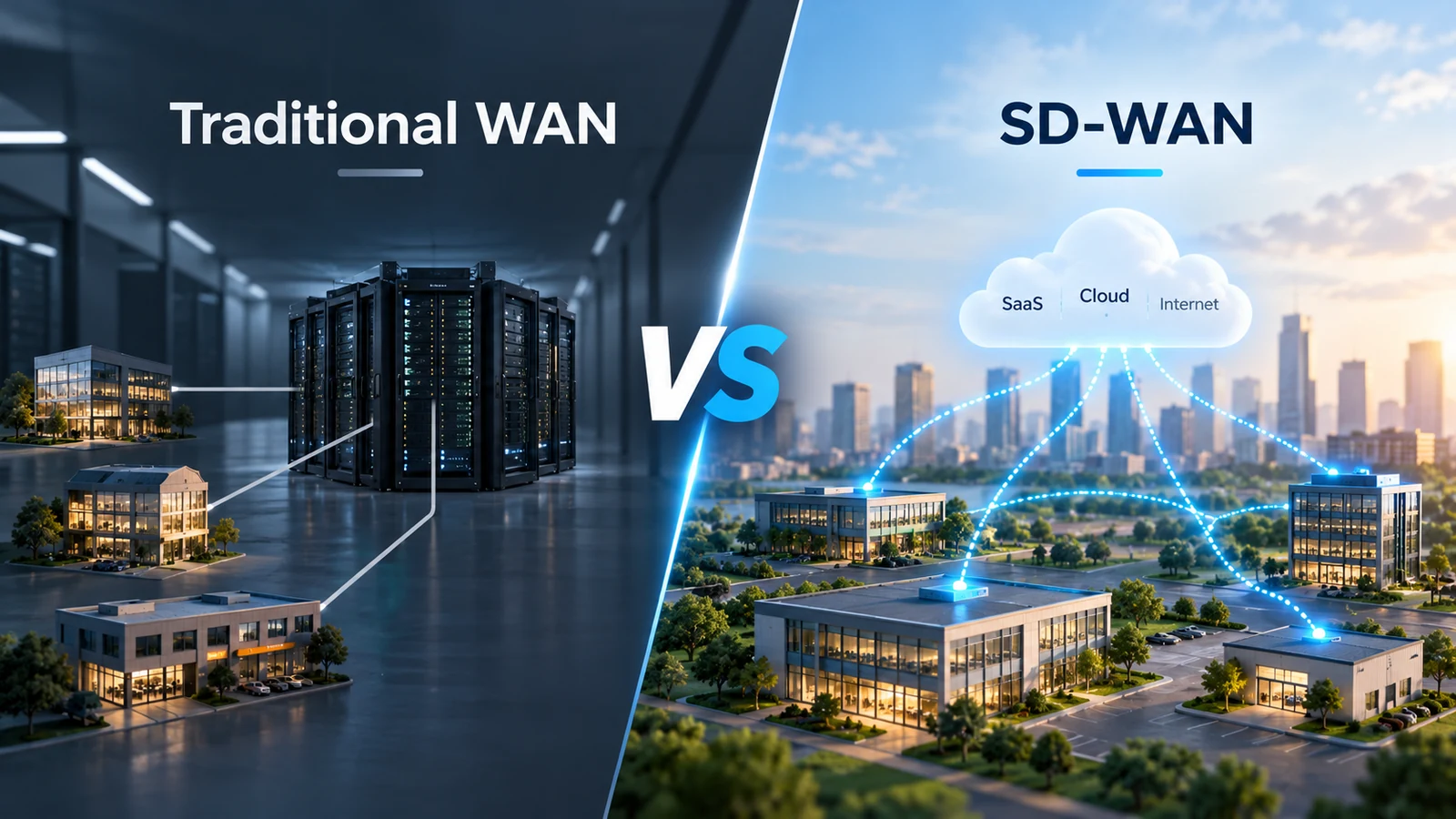
SD-WAN vs traditional WAN comes down to more than choosing between internet and MPLS. Traditional WAN architectures primarily rely on conventional routing and individually managed network infrastructure, while SD-WAN adds a software-defined, policy-driven overlay that can intelligently use multiple WAN connections.
For enterprises moving applications to SaaS, public cloud and distributed environments, this architectural difference can significantly affect network flexibility, application performance, operations and scalability.
However, SD-WAN does not automatically make traditional WAN technologies obsolete. MPLS, dedicated internet, broadband and cellular services can all remain part of a modern WAN because they can operate as underlying connectivity for the SD-WAN overlay. Our enterprise architecture guide explains how to approach choosing MPLS, Internet and SD-WAN underlays for different applications and sites.
This guide compares SD-WAN vs traditional WAN across architecture, traffic steering, MPLS, application performance, cloud connectivity, security, resilience, management and cost. It also explains when a traditional or hybrid WAN may still be appropriate and how organizations can approach migration.
If you are new to the technology, start with our complete guide to SD-WAN, which explains SD-WAN architecture, underlay and overlay networks, edge components and application-aware routing in greater detail.
SD-WAN vs Traditional WAN: Quick Answer
The primary difference between SD-WAN and traditional WAN is how network connectivity is controlled and how traffic is managed.
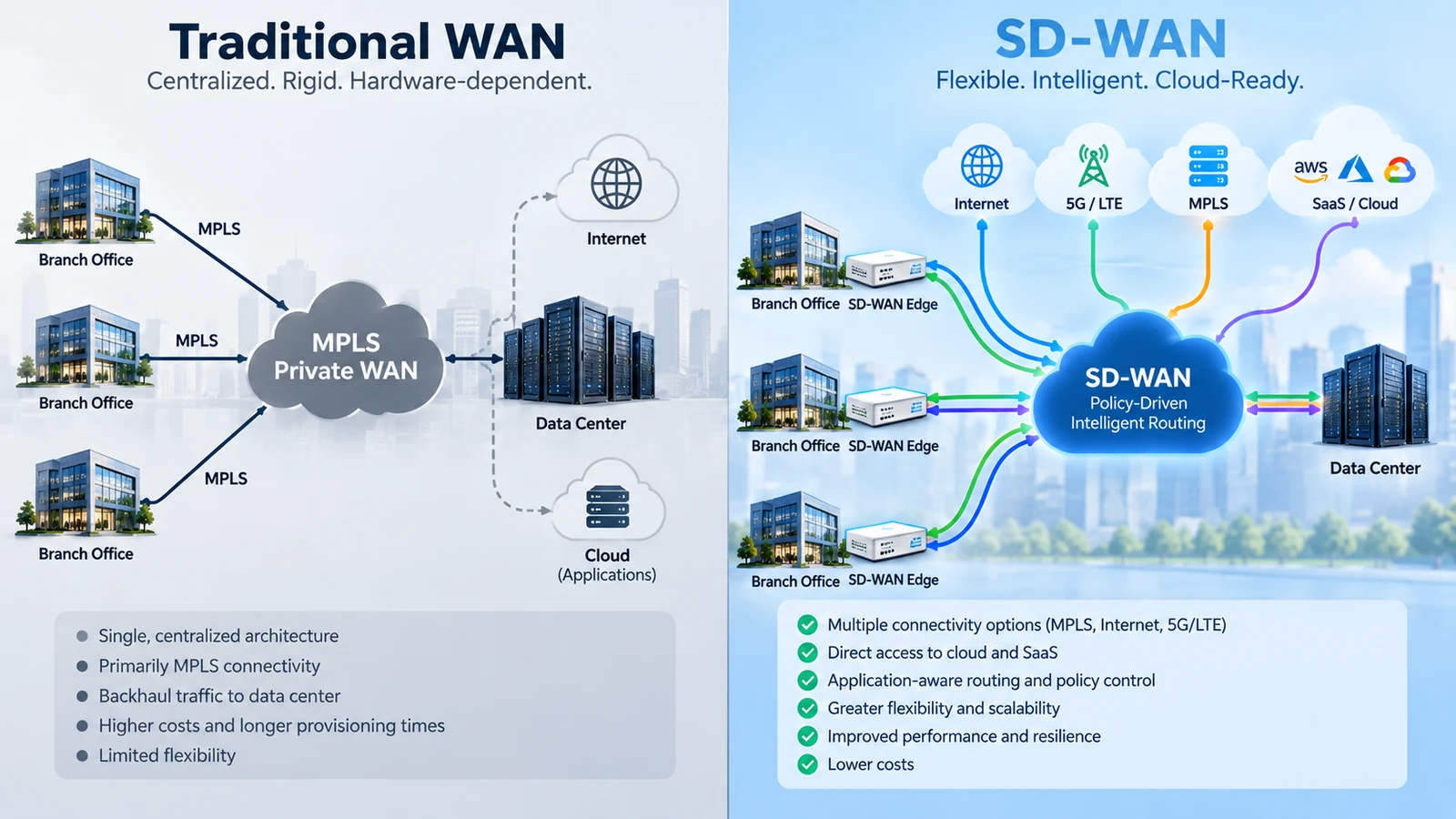
A traditional WAN typically relies on distributed routing decisions and individually configured network devices. Enterprises may use private WAN services such as MPLS, internet connectivity, Carrier Ethernet, or combinations of several transport technologies.
SD-WAN introduces a software-defined overlay and centralized policy framework above these connections. Our SD-WAN architecture guide explains how the underlay, overlay, control functions and edge components fit together.
This allows network teams to apply business and application policies across multiple WAN transports without treating every connection purely as an independent network.
Instead of asking only:
“Which route should this packet take?”
a software-defined WAN can consider a broader question:
“Which available network path best meets the business and performance requirements of this application?”
Therefore, this distinction is fundamental to understanding the comparison.
SD-WAN vs Traditional WAN Comparison Table
| Area | Traditional WAN | SD-WAN |
|---|---|---|
| Architecture | Primarily device- and routing-centric | Software-defined, policy-driven overlay |
| WAN connectivity | Can use MPLS, internet, Ethernet and other connectivity | Can combine multiple underlay technologies within one logical WAN architecture |
| Management | Often more distributed and device-centric | Centralized management and orchestration |
| Traffic steering | Primarily based on routing protocols, topology and metrics | Can incorporate application policy and measured path conditions |
| Application awareness | Possible through additional mechanisms and policies | Typically a core feature of the platform |
| Path monitoring | Depends on routing and network-management tools | Can continuously monitor multiple paths for SLA-related conditions |
| Cloud/SaaS access | May use centralized or direct internet designs | Designed to facilitate flexible direct or optimized cloud access |
| Internet breakout | Possible but often configured separately | Commonly integrated into policy-driven architectures |
| Provisioning | Can require more individual device configuration | Often supports centralized and automated provisioning |
| Resilience | Uses traditional routing and failover mechanisms | Can combine failover with application-aware path selection |
| Security | Implemented through WAN, firewall, VPN and security architectures | Can include encrypted overlay connectivity and integrate with broader security services |
| Scalability | Can become operationally complex across many sites | Centralized policy and automation can simplify large distributed environments |
| Operating model | Enterprise-managed or carrier-managed | DIY, co-managed or fully managed |
How Does a Traditional WAN Work?
A Wide Area Network (WAN) connects geographically separated locations such as headquarters, branch offices, data centers, factories and retail sites.
Traditional enterprise WANs have historically used a combination of technologies such as:
- MPLS
- Carrier Ethernet
- Leased lines
- Dedicated internet access
- Business broadband
- IPsec VPNs
- 4G and 5G
It is therefore inaccurate to define a traditional WAN as simply an “MPLS network.” MPLS has been extremely important in enterprise networking, but WAN architecture and WAN transport are not the same thing.
In many conventional environments, routing protocols determine traffic paths using network information such as:
- Network prefixes
- Routing metrics
- Administrative preferences
- Link availability
- Routing topology
Engineers then combine routing with technologies such as QoS, VPNs, traffic engineering and redundancy mechanisms to meet application requirements.
However, these architectures can be highly reliable and technically sophisticated. Their main challenge in large modern environments is often operational complexity, especially when businesses need to connect hundreds or thousands of sites to rapidly changing cloud applications.
How Is SD-WAN Different?
SD-WAN adds a logical, policy-driven layer above the underlying network connectivity.
MEF’s SD-WAN service framework distinguishes an SD-WAN service from the underlay connectivity services on which it operates.
This is an important distinction.
The underlying network might still consist of MPLS, internet access, Carrier Ethernet, broadband, 5G or other services. SD-WAN does not magically replace the physical network.
Instead, the overlay provides additional intelligence and centralized policy.
According to MEF’s SD-WAN service model, SD-WAN Edge functions apply policies to traffic and determine how application flows are forwarded across available underlay connectivity services.
As a result, this abstraction is one of the main reasons software-defined WANs can simplify distributed enterprise networking.
SD-WAN vs Traditional WAN: 8 Key Differences
1. Architecture: Routing-Centric vs Software-Defined Overlay
Traditional WAN architectures are fundamentally built around network devices, links and routing.
Routers exchange information and select paths based on routing protocols and configured policies.
SD-WAN does not eliminate routing. Routing still exists underneath and within the architecture.
The difference is that SD-WAN adds a software-defined overlay and centralized policy layer.
This separates business-level traffic policy from many of the individual configuration details of each physical WAN connection.
For large enterprises, this can make it easier to apply consistent networking policies across hundreds of locations.
2. Connectivity: Single-Transport Thinking vs Multi-Transport Flexibility
A conventional enterprise WAN may already use multiple transport technologies. However, managing them as an integrated application-aware environment can require considerable engineering.
SD-WAN is designed specifically to abstract multiple transports underneath a common overlay.
A branch might simultaneously connect using:
- MPLS
- Dedicated internet access
- Business broadband
- Fiber
- 4G/LTE
- 5G
In turn, the software-defined layer can apply policies across those available paths.
This concept is sometimes called a hybrid WAN.
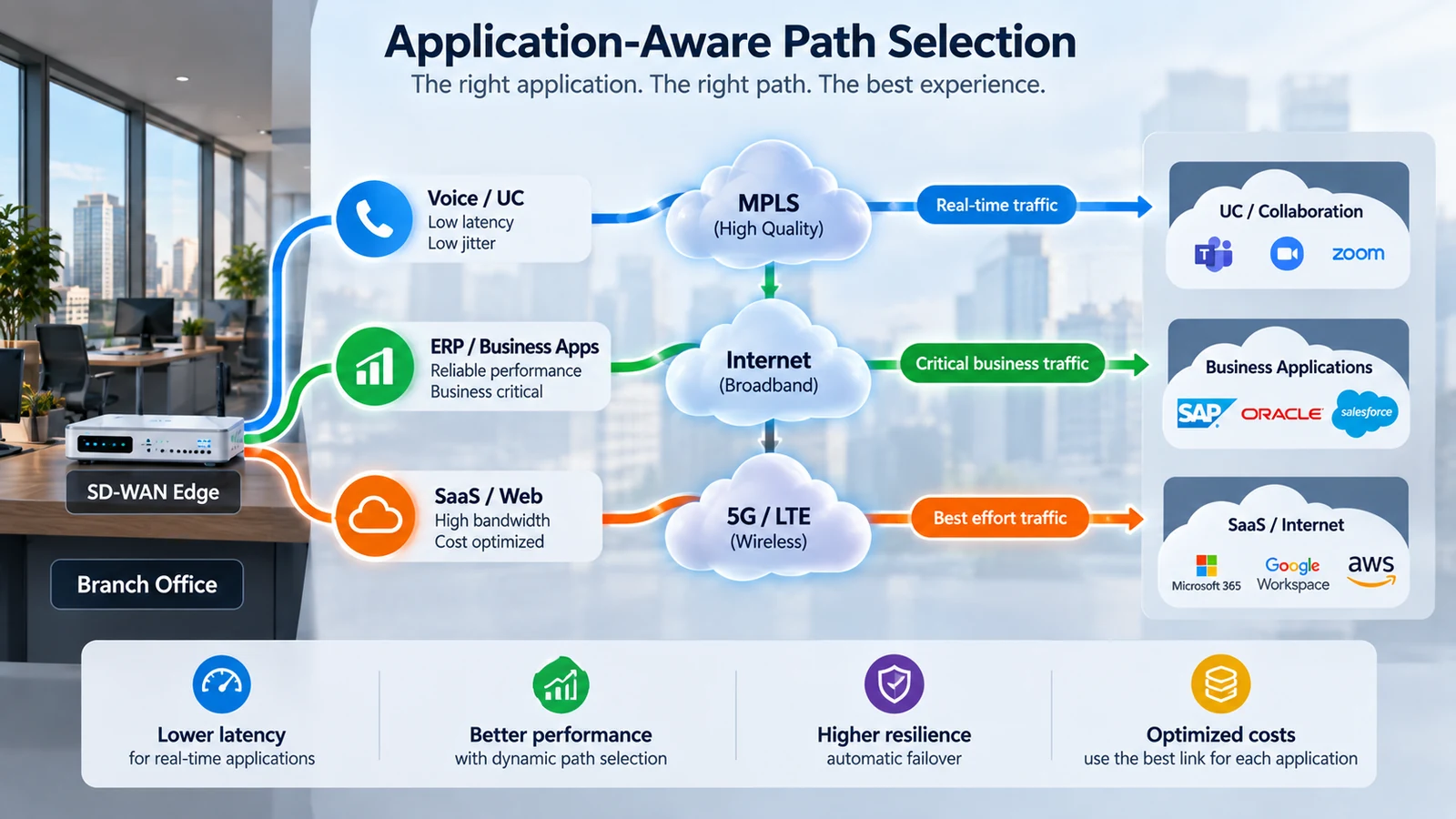
3. Traffic Steering: Routing Metrics vs Application-Aware Policies
Traditional routing protocols are extremely effective at determining network reachability and selecting paths according to network topology and configured metrics.
But applications do not all have identical performance requirements.
A video conference, ERP transaction, cloud backup and operating-system update may tolerate very different network conditions.
By contrast, application-aware routing allows a software-defined WAN to consider those differences.
For example, Cisco’s current application-aware routing documentation describes monitoring characteristics such as:
- Packet loss
- Latency
- Jitter
For example, policies can use these measurements when determining whether a path satisfies an application’s defined SLA requirements.
If a path experiences degradation rather than a complete outage, traffic can potentially be redirected to another suitable link.
This ability to respond to a brownout, rather than only a hard failure, is particularly valuable for real-time applications.
4. Application Performance: Network Availability vs Application Experience
Traditional WAN monitoring often focuses heavily on whether links and devices are available.
But a link can technically be “up” while providing poor performance.
For example:
- Latency may increase significantly.
- Packet loss may appear.
- Jitter may make voice calls unstable.
- Congestion may affect cloud applications.
SD-WAN platforms can collect network performance information and relate forwarding decisions more closely to application requirements.
That does not mean software-defined WAN guarantees excellent application performance in every situation.
If all available WAN links are experiencing poor performance, software cannot create bandwidth or network quality that does not exist.
Therefore, the advantage is better visibility and more intelligent use of the paths that are available.
5. Cloud and SaaS Access
One of the biggest changes in enterprise networking has been the movement of applications away from private data centers.
Employees now routinely use services hosted across:
- Microsoft 365
- Google Workspace
- Salesforce
- AWS
- Microsoft Azure
- Google Cloud
- Other SaaS and cloud platforms
Some traditional WAN architectures were designed around centralized data-center access and therefore backhauled branch internet traffic through central security locations.
This architecture still has valid use cases, but it can create inefficient paths for cloud applications.
Software-defined WAN architectures commonly support local internet breakout, allowing selected internet or SaaS traffic to leave directly from a branch when policy and security requirements permit it. For a Microsoft 365-specific application of this approach, see our SD-WAN for Microsoft 365 guide on egress decisions, Teams traffic and performance validation.
MEF specifically defines Internet Breakout as part of its standardized SD-WAN service concepts.
However, direct internet access also changes the security architecture. Traffic should not simply bypass centralized security without equivalent controls being available elsewhere.
6. Management: Device-by-Device Operations vs Centralized Policy
Traditional network operations can require engineers to configure and maintain many individual routers and associated policies.
Modern network-management tools already reduce much of this complexity, so the difference should not be exaggerated.
Nevertheless, centralized orchestration is a core architectural principle of SD-WAN.
For example, network teams can typically define policies centrally and distribute them across large numbers of sites.
This can simplify:
- Configuration consistency
- New branch deployment
- Policy changes
- Application policies
- Monitoring
- Troubleshooting
- Software upgrades
- Network automation
The operational benefit becomes particularly significant as the number of branches increases.
7. Resilience: Failover vs Performance-Aware Path Selection
Traditional WANs have supported resilient networking for decades through routing protocols, redundant links, first-hop redundancy and traffic-engineering technologies.
Therefore, it would be incorrect to say that resilience is unique to SD-WAN.
The difference is how the software-defined architecture can combine link monitoring with application-aware policy.
Consider a branch with two links:
- MPLS
- Business internet
If the MPLS connection goes completely down, traditional routing can redirect traffic.
But suppose the MPLS circuit remains operational while latency and packet loss increase significantly.
Application-aware routing can potentially detect that the path no longer meets a defined application’s SLA and select the alternative internet path while the original link remains technically available.
Cisco documents this type of behavior for application-aware routing, including redirecting traffic when network conditions deteriorate.
8. Cost Model: Private WAN Dependency vs Connectivity Choice
Cost is frequently presented as one of the biggest advantages of SD-WAN, but the argument requires nuance.
Software-defined WAN can allow an enterprise to use lower-cost broadband or internet connectivity alongside private WAN services.
This may enable organizations to reduce their dependence on expensive private circuits at some sites.
However, deploying SD-WAN also introduces costs including:
- Platform licensing
- Edge hardware or virtual appliances
- Internet access
- Security services
- Cloud connectivity
- Implementation
- Migration
- Training
- Operations
- Managed-service fees
Therefore, organizations should evaluate total cost of ownership rather than assuming that SD-WAN automatically reduces networking costs by a particular percentage.
SD-WAN vs MPLS: Why This Is Not the Same Comparison
SD-WAN vs MPLS and SD-WAN vs traditional WAN are not exactly the same question.
MPLS is a networking technology and commonly a managed WAN service.
SD-WAN is an overlay architecture and service model that can operate across different underlying connectivity services.
This means MPLS can actually be used inside an SD-WAN architecture as an underlay.
For example, an enterprise could deploy:
- MPLS + SD-WAN
- MPLS + internet + SD-WAN
- Dual internet + SD-WAN
- Fiber + 5G + SD-WAN
- MPLS + broadband + 5G + SD-WAN
This is why the statement “SD-WAN replaces MPLS” is too simplistic.
Organizations should instead determine where MPLS still provides business value and where internet-based connectivity may provide an acceptable alternative.
Read our analysis of whether MPLS is dead and how its role is changing.
Traditional WAN vs SD-WAN for Cloud Connectivity
Cloud adoption is one of the strongest drivers behind WAN modernization.
A WAN designed primarily around branch-to-data-center traffic may become inefficient when a large proportion of application traffic is destined for SaaS and cloud services.
For example, a centralized architecture could result in a path such as:
Branch → Private WAN → Data Center → Internet → SaaS Application
With appropriately designed direct internet access, the path may instead become:
Branch → Local Internet Access → SaaS Application
Reducing unnecessary backhaul can improve efficiency and potentially improve user experience.
However, cloud access decisions must consider:
- Security inspection
- Identity
- Access control
- Data protection
- DNS security
- Logging
- Compliance
- Application policies
For this reason, modern WAN transformation increasingly overlaps with security transformation.
SD-WAN vs Traditional WAN Security
Security is often oversimplified in SD-WAN comparisons.
Neither traditional WAN nor SD-WAN should automatically be considered “secure” simply because of the WAN technology being used.
A complete enterprise security architecture may include:
- Encryption
- Network segmentation
- Firewalls
- Secure web gateways
- DNS security
- Intrusion prevention
- Identity-based access
- Zero Trust Network Access
- Cloud Access Security Broker capabilities
- Security monitoring
SD-WAN solutions commonly use encrypted tunnels for overlay connectivity and can support segmentation and policy enforcement.
However, advanced security capabilities differ between vendors and platforms.
SD-WAN should therefore not be treated as synonymous with SASE.
Where Does SASE Fit?
SASE, or Secure Access Service Edge, extends beyond WAN connectivity by bringing networking and cloud-delivered security capabilities together within a broader architecture.
A SASE architecture can combine SD-WAN with security functions such as:
- Secure Web Gateway (SWG)
- Cloud Access Security Broker (CASB)
- Firewall-as-a-Service
- Zero Trust Network Access (ZTNA)
For enterprises modernizing both networking and security, moving from traditional WAN toward SD-WAN may therefore form part of a larger SASE transformation. For the remote-access side of that transition, our traditional VPN vs SASE comparison explains when VPN, ZTNA and SASE can coexist or replace specific access patterns.
Learn more in our complete guide to SASE.
When Does Traditional WAN Still Make Sense?
SD-WAN should not be presented as the correct choice for every location, organization or application.
Nevertheless, traditional WAN technologies can remain valuable when an organization has:
- Highly predictable private connectivity requirements
- Strict application service-level requirements
- Existing MPLS contracts that continue to provide business value
- Sites where internet connectivity quality is limited
- Specialized regulatory requirements
- Stable network architecture with little requirement for rapid change
- Legacy applications designed around private WAN connectivity
In practice, some enterprises also prefer private WAN connectivity for critical traffic while using internet services for less sensitive or less demanding applications.
That leads to one of the most practical approaches to WAN modernization: hybrid WAN.
When Is SD-WAN the Better Choice?
For example, a software-defined WAN becomes particularly attractive when an organization needs greater flexibility across a distributed environment.
Common scenarios include:
- Many branch offices
- Rapid business expansion
- High SaaS usage
- Multi-cloud adoption
- Increasing internet traffic
- Hybrid MPLS and internet connectivity
- Need for centralized policy management
- Frequent network changes
- 4G or 5G integration
- Greater application visibility
- Automated branch deployment
- More granular application steering
Organizations should base the decision on measurable business and technical requirements rather than deploying SD-WAN simply because it is newer technology.
Hybrid WAN: You May Not Need to Choose One or the Other
One of the most important conclusions in the SD-WAN vs traditional WAN debate is that enterprises do not necessarily need to replace everything at once.
A hybrid architecture can combine existing private WAN services with newer internet connectivity.
For example:
| Application | Preferred Transport | Alternative Transport |
|---|---|---|
| Real-time voice | MPLS | Business internet |
| Microsoft 365 | Direct internet | Secondary internet link |
| Critical ERP | MPLS | Encrypted internet overlay |
| Cloud backup | Internet | Secondary broadband |
| Guest Wi-Fi | Internet | Secondary internet |
However, these are illustrative policies rather than universal recommendations.
Therefore, the correct path depends on application requirements, connectivity performance, security architecture and business priorities.
As a result, this hybrid model allows organizations to modernize gradually rather than treating WAN transformation as a “big bang” replacement project.
SD-WAN vs Traditional WAN for Different Business Scenarios
Branch-Heavy Enterprises
Organizations with hundreds or thousands of sites can benefit significantly from centralized policy, automation and simplified deployment.
Examples include:
- Retail
- Banking
- Hospitality
- Healthcare
- Manufacturing
- Logistics
Cloud-First Organizations
Businesses with significant SaaS and public-cloud adoption may benefit from more flexible internet breakout and cloud connectivity.
Organizations with Critical Private Applications
Companies that still depend heavily on private data centers or applications with strict connectivity requirements may choose to retain MPLS while adding the software-defined layer.
Small Distributed Organizations
Businesses without large network operations teams may prefer a managed or co-managed SD-WAN service rather than operating the technology themselves.
International Enterprises
Global organizations often face variations in access technologies, carrier availability, regulations and network performance across countries.
A common software-defined overlay can simplify policy consistency while allowing different underlay providers in different markets.
DIY vs Managed SD-WAN
Choosing SD-WAN technology is only one part of the decision.
In addition, enterprises must decide who will operate the environment.
DIY SD-WAN
The enterprise selects and operates the platform itself.
This model can provide strong control but requires internal expertise in:
- WAN architecture
- Routing
- Security
- Cloud networking
- Automation
- Monitoring
- Troubleshooting
Managed SD-WAN
By contrast, a provider can take responsibility for some or most aspects of the service, including connectivity, deployment, monitoring, configuration and incident support.
Co-Managed SD-WAN
A co-managed approach divides responsibility between the provider and enterprise.
For example, the provider may operate infrastructure and handle incidents while the enterprise retains visibility and selected policy controls.
For a full operating-model comparison, read our guide to SD-WAN vs Managed SD-WAN.
How to Migrate from Traditional WAN to SD-WAN
WAN modernization should normally be treated as a transformation program rather than simply replacing routers.
Therefore, a structured migration can reduce operational risk. For a practical execution sequence from assessment and pilot through cutover, rollback and validation, use our SD-WAN migration checklist from MPLS to hybrid WAN.
Step 1: Assess the Existing WAN
Create an accurate inventory of:
- Sites
- Circuits
- Providers
- Routers
- Firewalls
- IP addressing
- Routing
- Application dependencies
- Traffic patterns
- Security requirements
- Existing SLAs
Step 2: Understand Application Requirements
Not every application needs the same network characteristics.
Identify business-critical applications and determine requirements such as:
- Availability
- Latency
- Jitter
- Packet loss
- Bandwidth
- Security
Step 3: Define the Target Architecture
Decide which transport technologies will remain in the target WAN.
For example:
- MPLS + internet
- Dual internet
- Internet + 5G
- MPLS + broadband + cellular
Step 4: Define Security Architecture
Determine how security controls will be delivered at branch, cloud and remote-user locations.
This is particularly important if the target architecture includes direct internet breakout.
Step 5: Define Application Policies
Determine how business applications should use available transports.
Policies should reflect application requirements rather than arbitrary technical preferences.
Step 6: Run a Pilot
Select representative sites for an initial deployment.
A useful pilot should test different conditions, such as:
- Small and large offices
- Different carriers
- Different countries or regions
- Cloud-intensive sites
- Sites with critical applications
Step 7: Establish Success Criteria
Measure whether the deployment improves the intended outcomes.
Metrics might include:
- Application performance
- Incident volume
- Provisioning time
- Change lead time
- Network availability
- Operational effort
- User experience
- Total WAN cost
Step 8: Migrate in Waves
As a result, a phased deployment allows teams to learn from early sites and improve the migration process before scaling globally.
Step 9: Optimize After Migration
However, the initial rollout is not the end of the transformation.
Network teams should continuously analyze:
- Application paths
- Underlay performance
- Internet breakout
- Security policies
- Bandwidth utilization
- Application SLAs
The goal is to use the platform’s intelligence rather than simply recreating the old WAN on new equipment.
SD-WAN vs Traditional WAN Decision Checklist
Before choosing an architecture, ask the following questions:
- Where are our applications hosted today?
- How much traffic is going to SaaS and public cloud?
- Which applications require predictable performance?
- Do we still need MPLS at every location?
- How reliable is business internet in each geography?
- Do we need local internet breakout?
- What security controls will protect internet-bound traffic?
- How many branch locations do we operate?
- How quickly do we need to open new locations?
- How much manual WAN configuration do we perform?
- Do we need greater application-level visibility?
- Should the solution be DIY, co-managed or fully managed?
- Do we have the internal skills to operate it?
- How does WAN modernization align with our cloud strategy?
- How does it align with our SASE and Zero Trust strategy?
- What is the total cost of the target environment?
The answers to these questions should guide the architecture more than any individual product feature.
Turn the checklist into a decision: if the current WAN still meets application, resilience and operational needs, KEEP THE CURRENT DESIGN. Selected sites or applications may instead justify ADOPTING A HYBRID WAN. Where centralized policy, multi-transport steering and cloud access are clear priorities, PILOT SD-WAN. Organizations with limited internal operating capacity should evaluate MANAGED OR CO-MANAGED SD-WAN. When requirements or underlay quality remain unclear, INVESTIGATE FURTHER BEFORE MIGRATING.
Is SD-WAN the Future of Enterprise WAN?
SD-WAN has become an important architecture for enterprise WAN modernization, but the future is unlikely to consist of SD-WAN operating in isolation.
Moreover, the broader direction of enterprise networking includes convergence across:
- SD-WAN
- SASE
- Zero Trust
- Cloud networking
- 5G
- Network automation
- AI-assisted operations
- Network-as-a-Service models
MEF’s work also reflects this convergence, with SD-WAN increasingly discussed as part of a broader networking and security transformation that includes SASE.
Consequently, the strategic question is becoming less about whether an enterprise should replace “traditional WAN” with a single new technology.
Instead, organizations increasingly need to design a cloud-ready, secure and automated connectivity architecture that can evolve with their applications and users.
For a deeper discussion of this trend, see Is SD-WAN the Future of Enterprise Networking?
Frequently Asked Questions
What is the main difference between SD-WAN and traditional WAN?
The main difference is the control architecture. Traditional WANs primarily use conventional routing and network-device configuration, while SD-WAN adds a centralized, policy-driven overlay capable of managing traffic across multiple underlay connections.
Is SD-WAN better than traditional WAN?
It depends on the organization’s requirements. SD-WAN can provide greater flexibility, automation, application awareness and multi-transport management. Traditional WAN technologies can still be appropriate for specific applications, locations and service-level requirements.
Does SD-WAN replace MPLS?
No. MPLS can operate as an underlay within an SD-WAN architecture. Some organizations reduce their use of MPLS, while others combine MPLS and internet connectivity in a hybrid WAN.
Can SD-WAN use the public internet?
Yes. Internet connectivity can be one of the underlying network services used by an SD-WAN solution. Many deployments combine internet access with other connectivity such as MPLS, fiber or cellular networks.
What is hybrid WAN?
A hybrid WAN combines multiple types of WAN connectivity, such as MPLS, internet and cellular services. SD-WAN can provide a common policy-driven overlay across these transports.
Does SD-WAN improve application performance?
It can improve how available network resources are used. Application-aware routing can select paths based on application policy and measured network characteristics such as latency, jitter and packet loss. It cannot, however, compensate for situations where every available connection has inadequate performance.
Is SD-WAN more secure than traditional WAN?
Not automatically. SD-WAN commonly supports encrypted overlay connectivity, segmentation and security integration, but the overall level of security depends on the platform and broader enterprise security architecture.
Is SD-WAN the same as SASE?
No. SD-WAN focuses primarily on WAN connectivity and traffic management. SASE combines networking capabilities with a broader range of cloud-delivered security services such as ZTNA, SWG, CASB and firewall services.
Is traditional WAN obsolete?
No. Traditional technologies such as MPLS, dedicated internet and Carrier Ethernet continue to provide useful enterprise connectivity. What is changing is how organizations combine and manage those services.
Should I use managed or DIY SD-WAN?
Organizations with strong internal networking and security capabilities may prefer greater operational control through a DIY model. Organizations wanting to reduce operational responsibility may prefer managed or co-managed services.
Conclusion: SD-WAN vs Traditional WAN
The debate between SD-WAN vs traditional WAN should not be reduced to “new technology versus old technology” or “internet versus MPLS.”
In other words, the real difference is architectural.
Traditional WANs rely primarily on conventional routing, network devices and underlying transport services to connect enterprise locations.
SD-WAN adds a software-defined overlay that can apply centralized business policies across multiple connections and make application-aware forwarding decisions.
For organizations adopting SaaS, cloud applications, distributed branches and multiple connectivity options, this can provide significant advantages in flexibility, visibility and operations.
But MPLS and other traditional WAN technologies are not necessarily disappearing. They can continue to operate underneath the software-defined overlay where they provide business value.
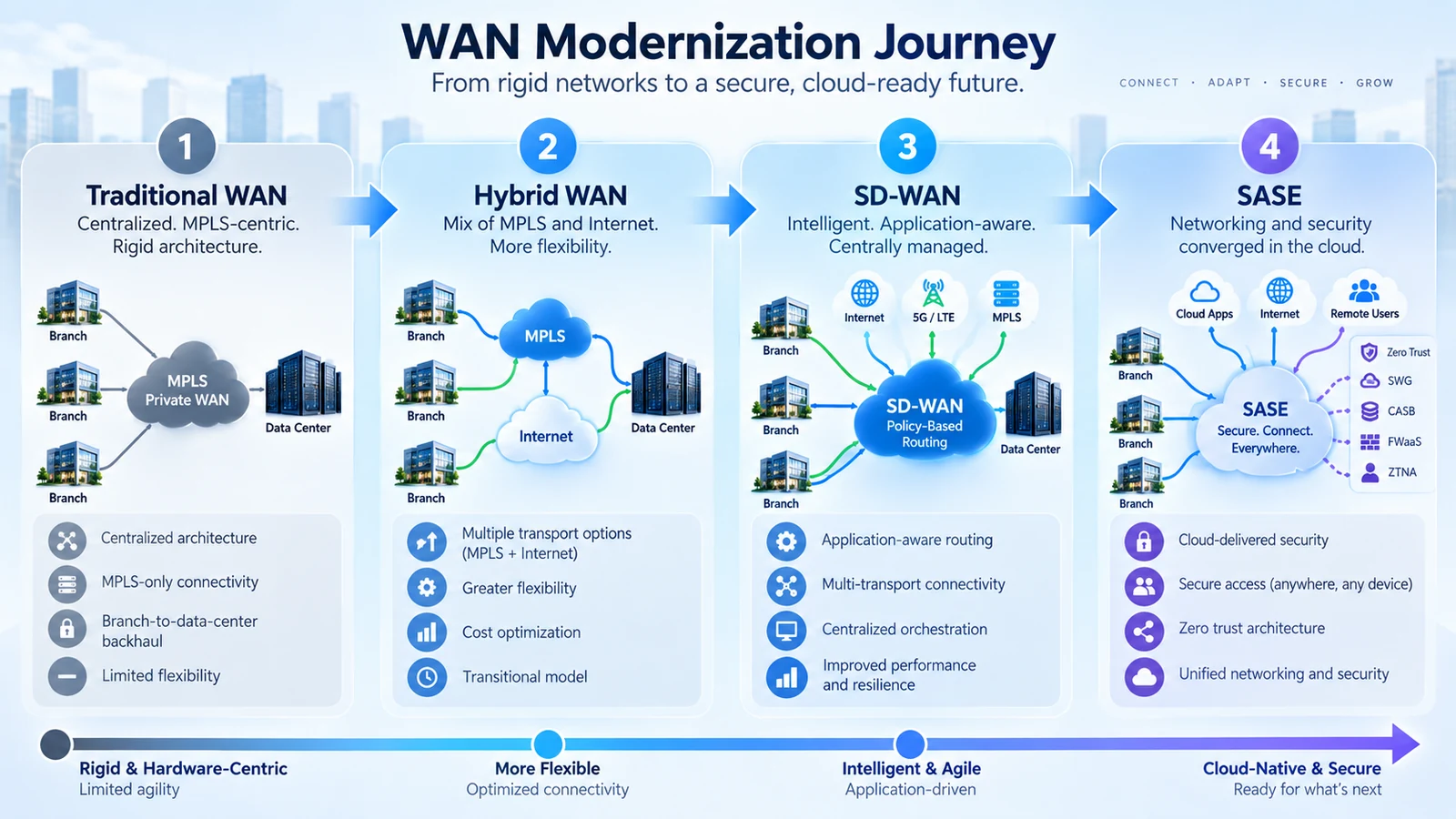
Therefore, for many enterprises, the most realistic evolution is:
Traditional WAN → Hybrid WAN → SD-WAN → Integrated SASE and cloud-centric networking.
The objective is not simply to replace one WAN technology with another.
The objective is to build a network architecture capable of supporting how the business actually uses applications today—and how that usage will evolve tomorrow.
Continue Learning
Continue exploring the TechTeamSynergy SD-WAN, enterprise networking and SASE cluster with these related guides.
Comments are closed.