

Is MPLS dead? No. But its role in enterprise networking is changing.
MPLS remains relevant for organizations that value managed connectivity, predictable service characteristics, mature quality-of-service capabilities and established service-level agreements. What has changed is that MPLS is no longer the automatic answer for every enterprise WAN requirement.
Cloud computing, SaaS, hybrid work, direct internet access, SD-WAN, SASE and increasingly distributed applications have reduced the need to build every location around the same private WAN model.
SD-WAN has also changed the debate. MPLS can provide underlying connectivity, while SD-WAN provides a policy-driven overlay across MPLS, internet, broadband, cellular and other transports.
The real question is therefore not whether MPLS is disappearing, but where it still creates enough business, technical and operational value to remain part of the enterprise WAN.
Authoritative references: This guide aligns its terminology with IETF RFC 4364 for BGP/MPLS IP VPNs, MEF SD-WAN standards, and NIST SP 800-207 for Zero Trust architecture.
Is MPLS Dead? The Short Answer
No, MPLS is not dead.
However, the way enterprises use MPLS is evolving.
For many years, MPLS VPN services became an important foundation for enterprise WANs, particularly for organizations connecting large numbers of offices, data centers and international locations through managed provider networks.
Today, enterprises have more options.
Business-grade internet access has expanded. Applications have moved toward SaaS and cloud platforms. SD-WAN provides centralized policy and application-aware traffic management across different WAN transports. Cellular technologies provide additional connectivity choices. SASE is changing the relationship between networking and security.
As a result, some enterprises are reducing their reliance on MPLS. Others continue to use it extensively. Many are adopting a hybrid model.
A better conclusion is therefore:
MPLS is moving from being the default enterprise WAN choice toward becoming one of several connectivity options inside a broader hybrid architecture.
Why Do People Think MPLS Is Dying?
The “MPLS is dead” discussion did not appear because MPLS suddenly stopped working.
It appeared because enterprise application and traffic patterns changed.
Several trends contributed to this shift.
Cloud and SaaS Changed Traffic Flows
Traditional enterprise WAN architectures were often designed when important applications were hosted in corporate data centers.
In architectures where internet access and security inspection were centralized, branch traffic destined for cloud or SaaS applications could be transported through corporate hubs before reaching the internet.
As applications moved toward platforms such as Microsoft 365, Salesforce and other SaaS services, these traffic patterns became less attractive for some organizations.
The issue was not MPLS itself. It was the architecture built around centralized application hosting and internet access.
Internet Connectivity Became More Capable
Enterprises gained access to more fiber, broadband and dedicated internet services across many markets.
This created alternatives for locations and applications that did not necessarily require private WAN connectivity.
Internet connectivity also became increasingly important simply because so many enterprise applications are now reached through the internet.
SD-WAN Changed How Enterprises Use Connectivity
SD-WAN introduced a policy-driven overlay that can use multiple underlying transports.
Instead of designing the entire WAN around a single type of connectivity, enterprises can potentially combine MPLS, internet and cellular services and apply policies according to application requirements and path conditions.
For a detailed explanation of the technology, see our complete guide to SD-WAN architecture and how it works.
Security Architecture Is Changing
Users and applications increasingly operate outside the traditional enterprise perimeter.
This has encouraged organizations to rethink architectures that depend heavily on sending traffic through centralized corporate security locations.
SASE and Zero Trust approaches are part of this broader evolution. If your WAN transformation also includes remote-access modernization, see our VPN vs SASE guide for a practical comparison of VPN, ZTNA and cloud-delivered secure access.
Enterprises Want Greater Flexibility
Organizations increasingly want the ability to choose connectivity according to site requirements rather than applying the same WAN design everywhere.
A headquarters, manufacturing plant, small retail location and temporary project site may have very different connectivity requirements.
This is one of the strongest arguments for hybrid WAN architecture.
What MPLS Still Does Well
Declaring MPLS obsolete ignores why enterprises adopted managed MPLS VPN services in the first place.
Depending on the service and provider, MPLS can continue to offer useful characteristics.
Managed Private WAN Connectivity
MPLS VPN services can provide managed connectivity between enterprise locations across a service provider’s network.
This remains attractive for organizations that prefer clearly defined provider responsibility for the WAN service.
Quality of Service
MPLS-based services can support provider-managed classes of service and QoS mechanisms.
This can be valuable where enterprises want defined treatment for different traffic classes.
However, QoS should not be confused with guaranteed application performance. End-to-end application experience also depends on access networks, application architecture, endpoints, cloud platforms and other parts of the path.
Established Service-Level Agreements
Managed MPLS services may come with contractual commitments covering parameters such as service availability, restoration and performance.
The exact SLA depends on the provider and service.
For organizations with mature operational processes built around carrier-managed WAN services, these arrangements can remain valuable.
Operational Stability
If an enterprise already has an MPLS network that performs well, replacing every circuit simply because SD-WAN exists may provide little business value.
Network transformation should solve an actual business or technical problem rather than follow a technology trend.
Where MPLS Can Be Less Suited to Modern Requirements
MPLS remains useful, but it is not always the most appropriate connectivity option for every site or application.
Cloud-Centric Traffic
If an enterprise architecture sends large amounts of SaaS and internet-bound traffic through centralized locations, the resulting traffic path may be inefficient.
Direct or regionalized cloud and internet access can be more appropriate in some designs.
Site Diversity
A global enterprise may have hundreds or thousands of sites with very different connectivity needs.
Using the same premium connectivity model everywhere can be unnecessary.
Provisioning Flexibility
Private WAN circuits can have different delivery timelines depending on geography, access availability and provider infrastructure.
Internet or cellular connectivity can sometimes provide faster or more flexible alternatives, although this varies considerably by location.
Cost Structure
Private WAN services may be more expensive than certain internet connectivity options, particularly at higher bandwidths or in some markets.
But the comparison should be made carefully.
Internet connectivity, redundancy, SD-WAN licensing, managed services, security and operations all contribute to total WAN cost.
Comparing only the price of an MPLS circuit with the price of broadband can therefore produce a misleading business case.
MPLS vs SD-WAN: They Are Not Direct Substitutes
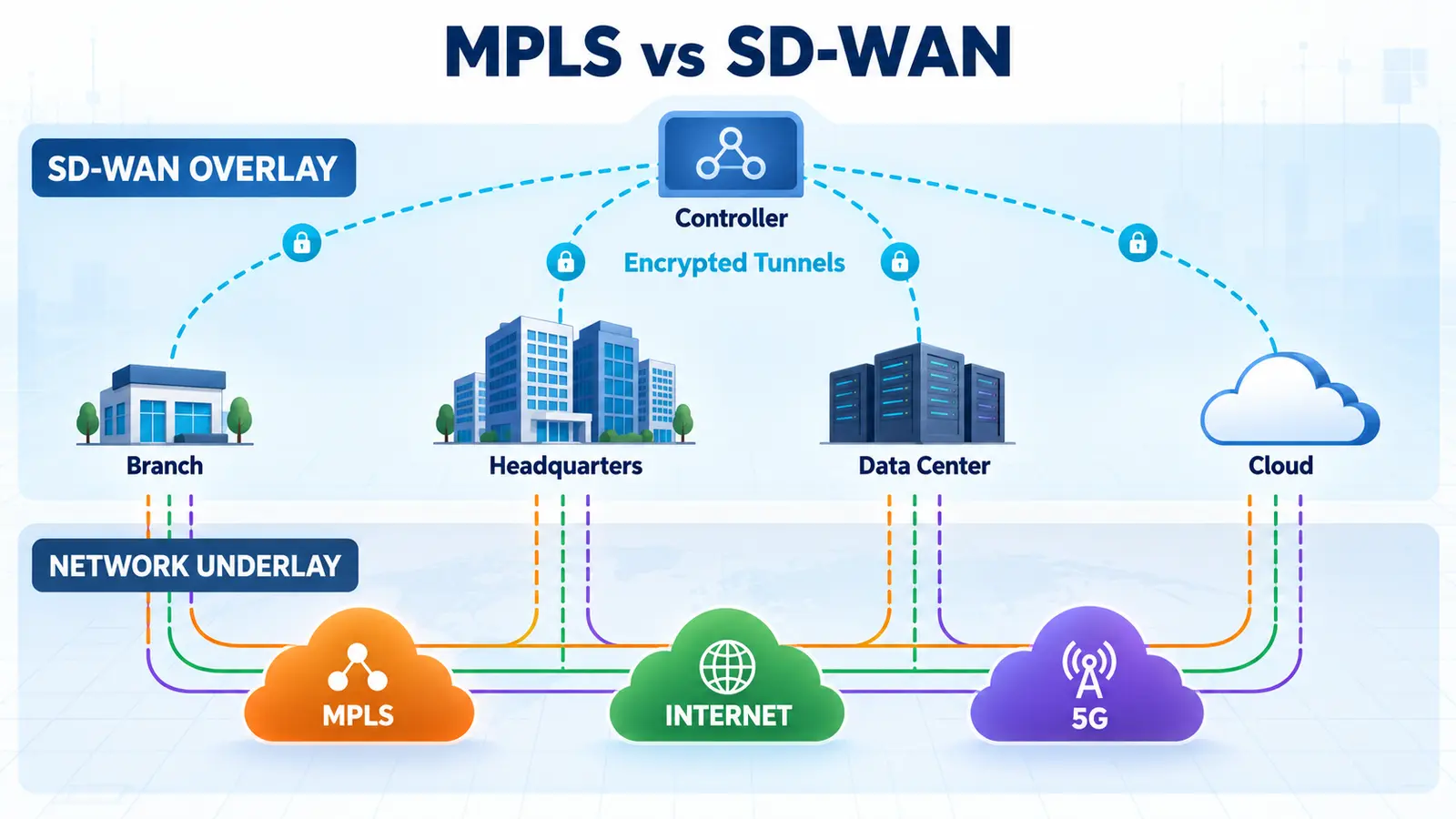
Important distinction: MPLS is an underlay transport service, while SD-WAN is an overlay and orchestration architecture. They can coexist. Predictable performance, QoS and service guarantees depend on the provider’s managed service design and contract—not on the MPLS label alone. For a deeper component and traffic-flow view, see our SD-WAN underlay and overlay architecture guide.
This is the most important concept in the entire MPLS vs SD-WAN discussion.
MPLS and SD-WAN are not equivalent technologies.
MPLS is used within networks and services that can provide enterprise WAN connectivity.
SD-WAN provides an overlay architecture that applies centralized policy across one or more underlying connectivity services.
MEF’s SD-WAN service framework distinguishes the SD-WAN overlay from the underlay connectivity services supporting it.
An SD-WAN deployment can therefore operate over:
- MPLS VPN services
- Dedicated internet access
- Business broadband
- Fiber connectivity
- 4G/LTE
- 5G
- Other appropriate connectivity services
This means an enterprise can deploy SD-WAN without removing MPLS.
In fact, MPLS and internet connectivity are frequently discussed as possible components of the same hybrid WAN.
MEF’s SD-WAN Service Attributes and Service Framework provides a useful standards-based reference for understanding this separation between the SD-WAN service and its underlying connectivity.
That distinction explains why an enterprise can adopt SD-WAN without automatically removing MPLS. For a deeper comparison of software-defined and conventional WAN control models, see our SD-WAN vs Traditional WAN guide.
Why Hybrid WAN Keeps MPLS Relevant
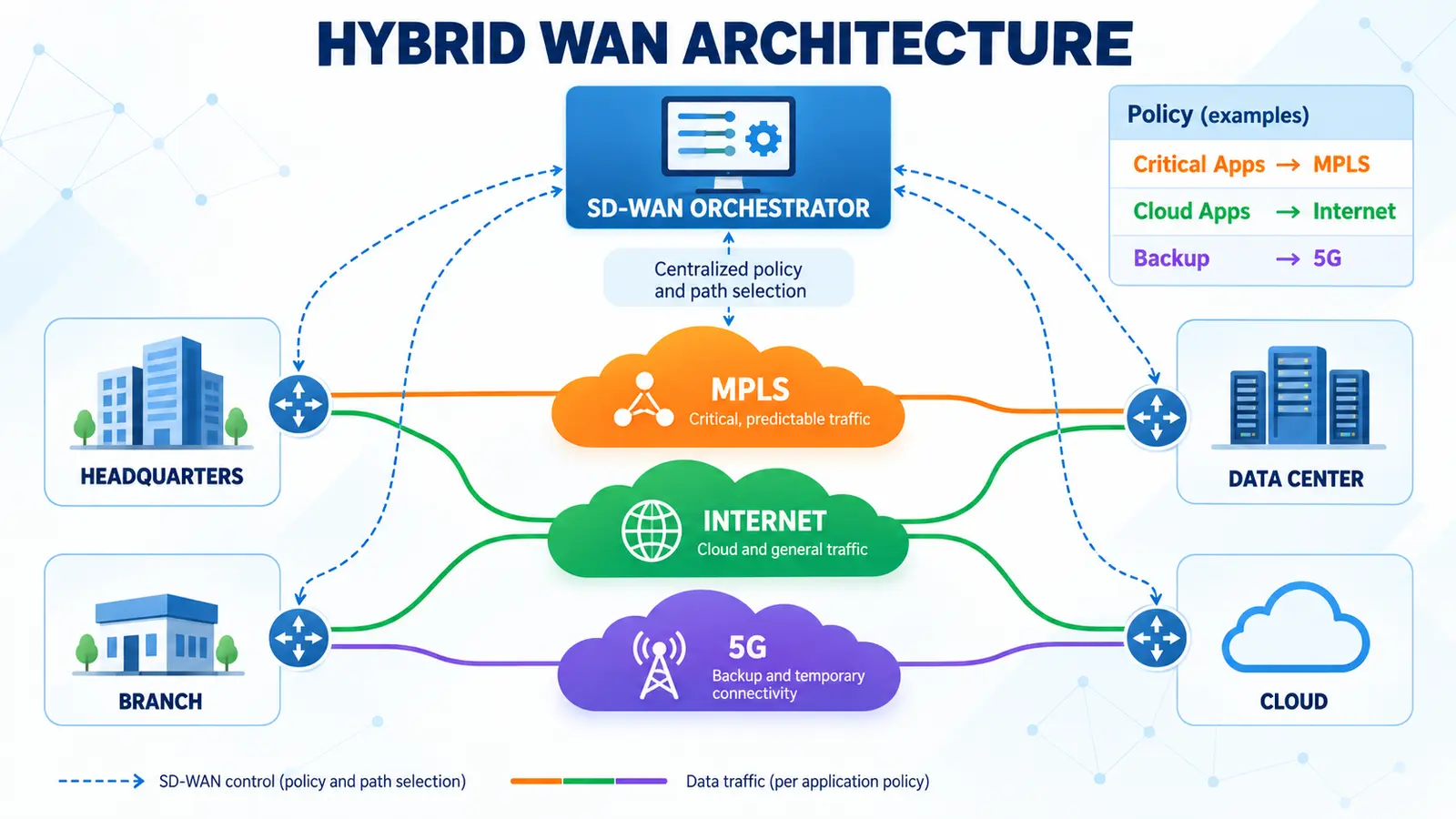
Hybrid WAN is one reason MPLS can remain relevant without remaining universal.
Enterprises no longer need to use the same connectivity model at every location. MPLS can remain where its managed service characteristics, QoS, SLAs, availability or operational model provide clear value, while other sites increasingly use internet or cellular connectivity.
SD-WAN can provide a common policy layer across those transports. The strategic change is therefore not that MPLS disappears, but that it becomes one possible underlay within a broader WAN portfolio.
How SD-WAN Changes the Role of MPLS
SD-WAN does not inherently replace MPLS.
An enterprise can deploy an SD-WAN overlay across existing MPLS connectivity and introduce additional internet or cellular paths where they make sense.
Over time, this gives the organization the option to retain MPLS where it continues to provide measurable value and reduce it where alternative connectivity better supports business requirements.
The important shift is from treating MPLS as the default WAN foundation to evaluating it selectively as part of the wider connectivity portfolio.
Why Cloud and SaaS Reduced MPLS Dependence
Cloud and SaaS changed where enterprise traffic needs to go.
When applications were concentrated in corporate data centers, private WAN connectivity toward those locations often matched the dominant traffic pattern. Today, users increasingly access SaaS, public cloud and internet-hosted services directly.
That change does not make MPLS obsolete. It means enterprises have fewer reasons to route every application through the same private WAN architecture.
MPLS can therefore remain valuable for selected applications and locations even when internet connectivity carries a larger share of overall enterprise traffic.
MPLS and Internet Can Coexist
Direct internet access does not automatically replace MPLS.
An enterprise may retain private connectivity where it provides business value while using internet access for cloud, SaaS or other suitable traffic. For the detailed architecture decision, see our guide to MPLS, Internet and SD-WAN architecture options; this article stays focused on whether MPLS still has a strategic role.
MPLS, SD-WAN and SASE
SASE extends the enterprise networking discussion beyond connectivity.
Modern users can access applications from branches, homes, mobile devices and other locations. Applications can exist in SaaS platforms, public clouds and private infrastructure.
Security therefore cannot depend only on a traditional corporate network perimeter.
SASE addresses this broader environment by bringing networking and cloud-delivered security capabilities into a more integrated architecture.
SD-WAN can provide an important connectivity component, while the broader SASE architecture addresses secure access for distributed users, devices and applications.
MPLS can still exist underneath this architecture where appropriate.
In other words, an enterprise architecture could contain:
MPLS + Internet underlays → SD-WAN overlay → SASE/security services → cloud and enterprise applications.
These technologies therefore do not need to be positioned as mutually exclusive generations.
For a deeper look at where this architecture is heading, see Is SD-WAN the Future of Enterprise Networking?.
Does MPLS Provide Better Security?
This question is often oversimplified.
MPLS VPN services can provide traffic separation within a service provider environment, but traffic separation is not the same thing as encryption.
Enterprises should therefore avoid treating MPLS as a complete security solution.
Security requirements may include:
- Encryption
- Authentication
- Identity-aware access
- Segmentation
- Firewalls
- Threat prevention
- Secure web access
- Endpoint security
These controls need to be designed according to the enterprise’s threat model and architecture regardless of whether the underlying WAN uses MPLS, internet connectivity or both.
Similarly, SD-WAN should not automatically be described as “more secure.”
Specific security capabilities vary by platform and service.
The correct comparison is therefore not:
MPLS = secure, internet = insecure.
It is:
What security architecture is required for the applications, users and connectivity model we are designing?
Performance, QoS, Latency and SLAs
Performance is another area where MPLS discussions often become too simplistic.
MPLS does not automatically mean “low latency,” just as internet connectivity does not automatically mean poor performance.
Actual performance depends on many factors, including:
- Physical distance
- Provider topology
- Access technology
- Congestion
- Peering
- Routing
- Bandwidth
- Application location
- End-to-end architecture
Where MPLS services can remain attractive is in the ability of providers to offer managed service characteristics, QoS and SLAs.
SD-WAN addresses a different problem.
It can monitor available paths and apply application-aware policies based on configured objectives and measured conditions.
But SD-WAN cannot create physical diversity, bandwidth or low latency if the underlying connectivity does not provide it.
This principle is important:
A smart overlay does not make underlay quality irrelevant.
Cost Alone Does Not Make MPLS Obsolete
Reducing MPLS dependency can lower connectivity costs in some environments, but the business case should not be based on circuit price alone.
Internet connectivity, redundancy, SD-WAN, security, managed services, operations and migration all contribute to the economics of the target WAN.
The strategic question for this article is simpler: does MPLS still provide enough service, operational or commercial value to justify its cost?
If the answer is yes, retaining it may remain rational. If not, alternative connectivity deserves evaluation.
When to Keep, Reduce or Replace MPLS
Keeping MPLS can remain a rational decision in several situations.
The Existing Service Performs Well
Replacing reliable infrastructure without a clear business benefit can create unnecessary risk and cost.
Provider SLAs Are Important
Some organizations place significant value on established managed-service commitments and operational processes.
QoS Requirements Are Important
Provider-managed traffic classes may remain valuable for selected applications and sites.
Alternative Connectivity Is Limited
Not every location has access to multiple high-quality internet providers or diverse fiber routes.
The Organization Wants a Hybrid Architecture
MPLS can remain one transport within an SD-WAN deployment rather than being removed.
Existing Contracts Affect the Business Case
WAN transformation needs to consider commercial commitments as well as technical architecture.
When Reducing MPLS May Make Sense
Conversely, reducing MPLS dependency may be attractive when:
- Most applications are SaaS or cloud-based
- High-quality internet connectivity is widely available
- The organization needs significantly more bandwidth
- Sites have different connectivity requirements
- Direct cloud and internet access is part of the target architecture
- SD-WAN provides a common policy layer across transports
- The economics of private WAN services no longer match business requirements
The key is to evaluate each decision based on the target architecture rather than starting with the assumption that MPLS must either remain everywhere or disappear everywhere.
MPLS in a Multi-Underlay Future
The growing availability of internet, fiber and cellular connectivity reinforces an important trend: enterprises increasingly have several possible WAN underlays.
That does not mean every organization should adopt every transport. It means MPLS no longer needs to be the universal choice.
Its future role is increasingly selective—retained where its characteristics provide value and combined with other connectivity where business requirements justify a more diverse WAN.
Self-Managed vs Managed WAN
Technology is only part of the decision.
Organizations also need to determine who will operate the environment.
A modern hybrid WAN can involve:
- Multiple carriers
- SD-WAN platforms
- Cloud connectivity
- Security services
- LAN/WLAN integration
- Observability
- 24/7 incident management
Some enterprises want direct control over these components.
Others prefer a service provider to manage much of the lifecycle.
Co-managed models provide a middle ground.
This decision can be just as important as the choice of underlay technology.
For a detailed comparison, see our SD-WAN vs Managed SD-WAN guide.
Moving Beyond an MPLS-Centric WAN
Reducing MPLS dependency does not require a single global cutover.
A safer approach is to evaluate the current service, validate realistic alternatives, pilot representative locations and remove MPLS only where application performance, resilience, security, operations and commercial evidence support the change.
For the execution steps—including assessment, pilot, cutover, validation and rollback—use the SD-WAN Migration Checklist.
The Future of MPLS in 2026 and Beyond
MPLS is unlikely to disappear suddenly from enterprise networking.
Instead, its role is likely to continue evolving.
MPLS Moves From Default WAN to Selective Underlay
Organizations increasingly have alternatives, so MPLS needs to justify its role according to specific requirements rather than simply being the default design.
Hybrid WAN Continues
Different transports will coexist across large enterprise environments.
SD-WAN Abstracts Transport Choices
As the overlay becomes more important, individual underlay technologies become components of a larger policy-driven architecture.
SASE Changes the Security Model
Cloud-delivered security and identity-aware access become increasingly important as traffic moves directly toward cloud and internet applications.
Automation Changes Operations
Network teams will increasingly manage policy, automation and application outcomes rather than configuring individual circuits and devices manually.
5G Expands Connectivity Options
Cellular connectivity adds another potential underlay for selected enterprise scenarios.
MPLS Remains Where Its Characteristics Matter
Organizations will continue to use MPLS where its service characteristics, existing infrastructure, availability, commercial model or operational maturity provide sufficient value.
Should MPLS Still Be Part of Your WAN?
Instead of asking whether MPLS is dead globally, test whether it still creates measurable value in your environment.
- Is the existing MPLS service meeting important business requirements?
- Do provider-managed QoS, SLAs or operational responsibilities provide meaningful value?
- Are credible alternative connectivity services available at the affected locations?
- Would removing MPLS improve the business outcome rather than simply modernize the technology stack?
- Do contracts, migration risk or operational maturity materially affect the timing of a change?
If MPLS continues to solve a real business or technical problem, there is no architectural requirement to remove it.
If its value has diminished, the next question is which target WAN architecture should replace or complement it.
Frequently Asked Questions
Is MPLS dead in 2026?
No. MPLS remains in use across enterprise and service-provider networks. Its enterprise role is changing as organizations adopt SD-WAN, internet connectivity, cloud services and hybrid WAN architectures.
Will SD-WAN replace MPLS?
Not necessarily. SD-WAN is an overlay that can operate over MPLS as well as internet, broadband and cellular connectivity. Some organizations use SD-WAN to reduce MPLS dependency, while others retain MPLS as part of the underlay.
Can MPLS and SD-WAN work together?
Yes. An enterprise can deploy an SD-WAN overlay across an MPLS connection and combine it with additional underlays such as internet or cellular connectivity.
Is MPLS more secure than SD-WAN?
The comparison is not that simple. MPLS VPN services can provide traffic separation, but MPLS does not inherently provide encryption or a complete enterprise security architecture. SD-WAN security capabilities also vary by implementation. Security should be designed separately from the choice of WAN transport.
Is MPLS faster than the internet?
Not inherently. Latency and performance depend on topology, distance, access technology, congestion, routing and provider design. MPLS services can provide managed QoS and predictable service characteristics, while internet performance varies by provider and location.
Is SD-WAN cheaper than MPLS?
It can enable lower-cost connectivity options and reduce reliance on premium private WAN services, but overall savings are not guaranteed. Enterprises should compare total costs including connectivity, redundancy, licensing, security, managed services and operations.
What is hybrid WAN?
A hybrid WAN uses more than one type of connectivity across the enterprise or at individual sites. For example, a branch could combine MPLS and internet connectivity, with SD-WAN applying policies across both.
Does MPLS work with cloud applications?
Yes. MPLS does not prevent cloud connectivity. The important consideration is the overall network architecture and the path users take to reach cloud resources. Some cloud-centric environments benefit from more direct internet or cloud connectivity rather than centralized traffic paths.
Should every company migrate away from MPLS?
No. The decision should depend on application requirements, service availability, performance, cost, geography, security architecture and business priorities. A selective or hybrid migration is often more appropriate than a universal replacement strategy.
What will replace MPLS?
There is unlikely to be one universal replacement. Many enterprises are moving toward combinations of internet, MPLS, cellular and other connectivity services managed through SD-WAN and integrated with broader cloud and security architectures.
Conclusion: MPLS Is Not Dead—Its Role Is Becoming More Selective
MPLS is not disappearing from enterprise networking, but it is no longer the automatic foundation for every site and application.
Cloud and SaaS have changed traffic patterns. Business internet connectivity has improved in many markets. SD-WAN allows enterprises to apply common policy across multiple transports. Together, these changes give organizations more alternatives to an MPLS-everywhere model.
MPLS can still provide meaningful value where managed connectivity, provider QoS, contractual SLAs, operational maturity, availability or existing commercial arrangements matter.
Its future role is therefore increasingly selective.
Rather than serving as the universal enterprise WAN foundation, MPLS is becoming one possible transport within a broader hybrid or SD-WAN architecture.
The strategic question is no longer “When will MPLS disappear?”
It is: Where does MPLS still create enough measurable value to deserve a place in the future WAN?
Continue Learning
Continue exploring TechTeamSynergy with these related guides.
Comments are closed.