
Psychological safety at work is one of the foundations of effective teamwork. It creates an environment where employees feel comfortable asking questions, expressing concerns, challenging assumptions, and acknowledging mistakes without fearing humiliation or unfair consequences.
Yet psychological safety at work is often misunderstood. It does not mean avoiding difficult conversations, lowering performance expectations, or agreeing with every opinion. It means creating a workplace where honest communication and accountability can coexist.
For IT managers, project leaders, Agile coaches, and cross-functional teams, this distinction is particularly important. A concern raised early can prevent a costly project delay. A question asked during an architecture review can reveal a hidden risk. An incident discussed openly can become an opportunity to improve systems and processes.
In this practical guide, you will learn what psychological safety means, why it matters, how to recognize signs of low psychological safety, ten strategies for building safer teams, realistic IT and Agile examples, how to assess progress, and a 30-day action plan.
The goal is simple: make speaking up a normal part of how your team works.
What Is Psychological Safety at Work?
Psychological safety at work refers to a shared belief that people can take reasonable interpersonal risks within their team. These risks can include admitting uncertainty, asking for help, disagreeing with a manager, reporting an error, or suggesting a different approach.
The concept was developed in organizational research by Harvard Business School professor Amy Edmondson. In her influential 1999 study, Psychological Safety and Learning Behavior in Work Teams, Edmondson examined 51 work teams and found an association between team psychological safety and learning behavior. The research helped establish psychological safety as an important concept for understanding how teams learn, exchange information, and respond to challenges.
Psychological Safety vs Trust vs Comfort
| Concept | Main Question | Workplace Example |
|---|---|---|
| Psychological safety | Can I speak up or take an interpersonal risk here? | An engineer challenges a proposed technical decision. |
| Trust | Can I rely on another person’s intentions or behavior? | A colleague follows through on an important commitment. |
| Comfort | Do I feel at ease in this situation? | Employees enjoy a friendly team meeting. |
| Accountability | Are people responsible for commitments and actions? | A project owner explains a missed milestone and agrees on corrective actions. |
A team can be friendly without being psychologically safe. For example, colleagues may enjoy social activities together but hesitate to challenge a senior manager during a critical project meeting. Likewise, a psychologically safe team is not necessarily comfortable all the time. Constructive disagreement, difficult feedback, and challenging discussions remain part of daily work.
What Psychological Safety Is Not
- Avoiding conflict or disagreement.
- Protecting employees from all criticism.
- Accepting repeated poor performance.
- Removing deadlines or expectations.
- Requiring everyone to agree.
- Guaranteeing that every suggestion will be implemented.
Psychological safety supports open discussion within professional boundaries. A manager can reject an idea, enforce a deadline, or address inappropriate behavior while still treating employees fairly and respectfully. That balance is central to effective modern leadership.
Why Psychological Safety Matters for Team Performance
Psychological safety matters because modern organizations depend on information flowing between people. Managers rarely have complete visibility into every technical dependency, operational problem, customer concern, or emerging risk. They rely on employees to communicate what they know. When employees believe that raising problems will lead to embarrassment or blame, important information may remain hidden.
1. It Supports Team Learning
Learning often begins when someone admits that they do not know something. Consider an engineer who encounters an unfamiliar configuration during a network migration. If asking for help is viewed as incompetence, the engineer may delay the question or make assumptions. In a more psychologically safe environment, the same engineer can request clarification before implementation. The objective is not to eliminate uncertainty. It is to make uncertainty visible early enough to manage it.
2. It Encourages Constructive Innovation
New ideas frequently challenge existing assumptions. A team member proposing a different architecture, automation opportunity, or process improvement may worry about being dismissed. Psychological safety can make it easier for employees to contribute unconventional but potentially valuable ideas. This does not mean accepting every suggestion. Ideas still require technical evaluation, business justification, risk analysis, and appropriate governance.
3. It Helps Teams Surface Risks Earlier
In project management, silence can be expensive. Imagine a cross-functional delivery team preparing a major production deployment. A junior engineer identifies a dependency that may affect the planned release date but is reluctant to challenge the agreed schedule. If the concern is not raised, the organization loses an opportunity to assess the risk. A psychologically safer environment encourages the engineer to communicate the issue before it becomes a crisis.
4. It Supports Better-Informed Decisions
Teams benefit when people with different expertise can share their perspectives. Google’s Project Aristotle research identified psychological safety as an important dynamic associated with effective teams within the organization. The research also identified dependability, structure and clarity, meaning, and impact as relevant team dynamics. These findings provide management insights, but should not be treated as proof that psychological safety alone guarantees higher performance in every organization.
What Does the Broader Evidence Say?
A 2024 evidence review published by the Chartered Institute of Personnel and Development examines research on trust and psychological safety, including relationships with workplace behavior and organizational outcomes. The CIPD evidence review supports treating psychological safety as a meaningful workplace factor while recognizing that effects depend on context and other conditions. The practical lesson is that psychological safety at work complements clear goals, capable leadership, appropriate resources, effective processes, and accountability.
7 Signs of Low Psychological Safety at Work
Psychological safety is not always visible in dashboards or organizational reports. However, recurring patterns of communication and behavior can provide useful warning signs. These patterns should be interpreted carefully: a quiet employee, for example, is not automatically an employee who feels unsafe.
1. Silence During Important Meetings
Employees rarely ask questions, challenge assumptions, or contribute alternative ideas. Meetings may appear efficient, but relevant concerns remain unexplored.
2. Problems Are Reported Too Late
Issues become visible only after a deadline is missed, a customer complains, or an incident escalates. This may indicate weak communication channels, unclear expectations, excessive workload, or fear.
3. Mistakes Trigger Blame
When something goes wrong, the discussion immediately focuses on who made the mistake rather than what happened and how recurrence can be prevented.
4. Employees Avoid Asking for Help
People hesitate to acknowledge gaps in knowledge or experience and attempt to solve problems alone even when collaboration would be more appropriate.
5. A Few Voices Dominate Discussions
Senior or highly confident employees consistently shape conversations while others rarely contribute. Hierarchy may discourage participation.
6. Constructive Disagreement Is Viewed as Disloyalty
Questioning a proposal is interpreted as resistance, negativity, or lack of commitment. Employees learn that agreement is safer than critical thinking.
7. Feedback Produces No Visible Response
Team members raise concerns but never learn what happened afterward. Over time, they may stop contributing because they believe speaking up has little value.
Manager’s reflection: Think about your last three team meetings. Who raised concerns? Who challenged an assumption? What happened after someone expressed a different opinion? These questions are more useful than assuming that a quiet meeting indicates strong alignment.
How to Build Psychological Safety: 10 Practical Strategies
Building psychological safety requires consistent behavior rather than a single workshop or motivational presentation. Managers influence the process through how they communicate, make decisions, respond to uncertainty, and address problems.
1. Acknowledge Your Own Uncertainty
Leaders do not need to pretend they have every answer. When appropriate, admitting uncertainty demonstrates that learning is a normal professional responsibility. Instead of saying, “We already know this approach will work,” try, “We have a strong proposal, but what assumptions should we validate before implementation?” This encourages analytical thinking without weakening leadership authority.
2. Invite Questions and Constructive Disagreement
Do not limit meetings to asking whether everyone agrees. Silence is not reliable evidence of consensus. Ask what risks you might be overlooking, what could make the plan fail, whether a different technical approach exists, and what information would change the decision. Allow enough time to respond. For complex decisions, consider collecting written input before the meeting.
3. Respond Constructively to Mistakes
The first response to an error can influence whether future problems are reported. A manager who reacts with ridicule or immediate blame may discourage openness. A constructive response begins with what happened, which conditions contributed, which controls worked or failed, and what could improve. This does not remove individual responsibility: deliberate violations, repeated negligence, and serious misconduct may still require formal action.
4. Combine Psychological Safety With Accountability
Strong teams need both openness and performance expectations. Employees should feel able to discuss risks while remaining responsible for agreed work. For example, a project manager may say: “Thank you for raising the delivery risk early. Let’s review the impact, assign mitigation actions, and agree on an updated forecast.” The concern is welcomed, and the team remains accountable for managing it.
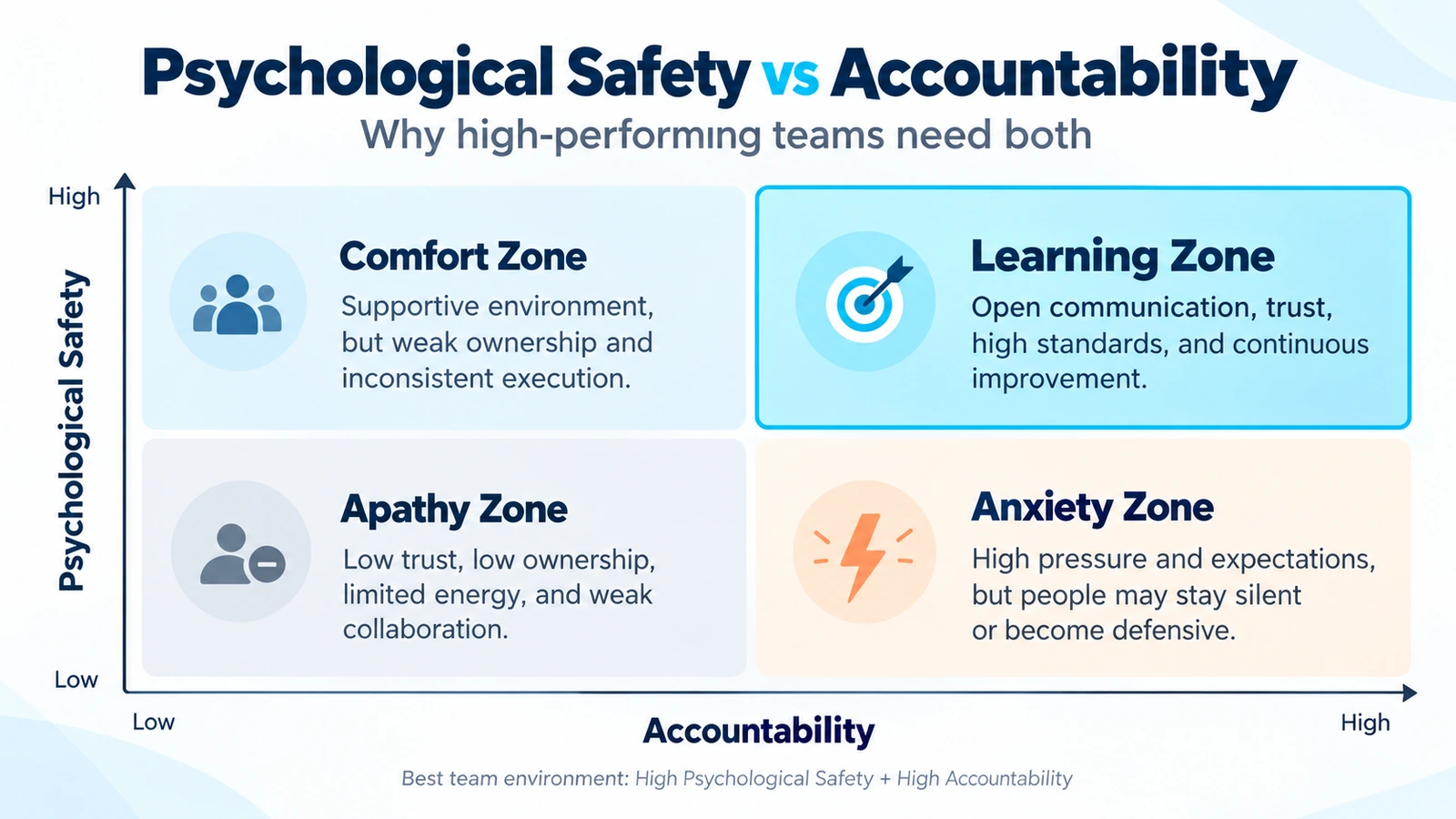
| Low Accountability | High Accountability | |
|---|---|---|
| High Psychological Safety | Comfort without consistent execution | Learning with clear expectations |
| Low Psychological Safety | Limited openness and weak execution | Pressure with potential silence and defensive behavior |
This simplified matrix is a management illustration, not a scientifically validated diagnostic model. The preferred environment combines high psychological safety with high accountability.
5. Make Meetings More Inclusive
- Share agendas and decision criteria in advance.
- Give participants time to reflect.
- Invite input without putting quieter employees under pressure.
- Prevent repeated interruptions.
- Provide asynchronous contribution options.
- Summarize disagreements fairly before making a decision.
For international teams, consider differences in language fluency, time zones, hierarchy, and communication preferences. Participation should not depend exclusively on speaking quickly or confidently in large meetings.
6. Recognize People Who Raise Risks
Organizations often recognize employees who solve visible problems. They should also acknowledge those who help prevent them. An engineer who identifies a security risk before deployment may have protected customers and reduced disruption. A manager might say: “Your review identified a dependency we had not considered. Thanks for bringing it into the discussion before the change window.”
7. Create Learning-Oriented Retrospectives
Retrospectives help teams examine how work actually happened. They are especially relevant for building Agile teams, where reflection and adaptation support continuous improvement. A useful retrospective explores what worked, what surprised the team, what made delivery difficult, what should change, and who owns each improvement. Avoid turning retrospectives into public performance evaluations.
8. Establish Clear Escalation Channels
Employees need to know how to raise issues and when escalation is appropriate. Define channels for operational risks, project blockers, security concerns, conduct issues, and other sensitive matters. Clarify who receives concerns, what information is needed, urgency thresholds, and how follow-up works. Escalation should not depend solely on whether an employee feels comfortable approaching their immediate manager.
9. Close the Feedback Loop
Collecting feedback is only the beginning. Explain what feedback was received, what action will be taken, what cannot be changed and why, and when progress will be reviewed. Not every suggestion needs to be accepted; respectful explanations help employees understand decisions. These practices can also improve the broader employee experience.
10. Address Disrespect and Retaliation
Psychological safety requires more than encouraging participation. Managers must respond appropriately to disrespect, intimidation, exclusion, or retaliation. Distinguish disagreement over ideas from attacks on individuals. Use proper organizational channels for harassment, discrimination, misconduct, and serious concerns. For everyday disagreements, our guide to managing difficult people at work explains how to focus on observable behavior, clear boundaries, and constructive communication.
Psychological Safety Examples in Real Workplace Situations
The following four scenarios are illustrative examples designed for managers and project professionals. They are not documented company case studies.
Example 1: An IT Incident Review
Situation: A network configuration change causes an unexpected service disruption. During the review, the engineer explains that a validation step was skipped under time pressure.
Low-safety response: The discussion focuses on blaming the engineer, making others reluctant to mention similar shortcuts.
More constructive response: The incident manager establishes the timeline, technical cause, impact, and recovery actions. The team examines change procedures, review requirements, workload, and monitoring. Any individual accountability is handled fairly and separately from technical learning.
Lesson: A constructive incident review can improve transparency while preserving operational discipline.
Example 2: An Agile Sprint Retrospective
Situation: A Scrum team repeatedly carries unfinished work into the next sprint. Developers suspect that commitments exceed available capacity but hesitate to challenge the product owner.
Low-safety response: Missed commitments are treated as evidence of insufficient effort.
More constructive response: The Scrum Master invites appropriate feedback, reviews capacity and dependencies, and helps the team revise planning assumptions. Results are inspected at the next retrospective.
Lesson: When employees can question unrealistic assumptions, Agile ceremonies become more effective learning opportunities.
Example 3: A Project Risk Escalation
Situation: During an international infrastructure rollout, a supplier dependency may delay a milestone. A specialist hesitates to raise it because the launch date has been announced.
Low-safety response: The manager criticizes the specialist for questioning the plan.
More constructive response: The manager thanks the specialist, requests evidence, updates the risk register, coordinates mitigation, and gives stakeholders a transparent impact assessment.
Lesson: Early escalation gives project leaders more options than discovering problems after a milestone fails.
Example 4: A Hybrid Team Meeting
Situation: In weekly architecture meetings, on-site employees dominate while remote participants rarely speak.
Low-safety response: The manager assumes remote employees have nothing to add.
More constructive response: Design documents are shared in advance. Participants may submit comments asynchronously, and the facilitator reviews remote contributions before final decisions.
Lesson: Psychological safety must be supported by inclusive working practices, not just positive intentions.
Across these examples, the principle is straightforward: make it easier to raise important information while maintaining responsibility for decisions and outcomes.
How to Measure Psychological Safety in Your Team
Psychological safety at work is a shared perception, not a technical system metric. It cannot be measured reliably through one dashboard indicator or a manager’s personal impression. A practical assessment can combine confidential feedback, observations, and structured discussion.
1. Use Carefully Designed Surveys
Short surveys can explore whether employees feel able to raise concerns, ask for help, express different opinions, discuss mistakes without automatic blame, and expect constructive leadership responses. Five-point agreement scales may be useful, but these illustrative statements are not scientifically validated instruments. Organizations seeking research-based measurement should consult established approaches described in the CIPD review and Edmondson’s research.
2. Protect Confidentiality
For small teams, anonymous surveys may not offer meaningful anonymity. Employees may be identifiable through role, seniority, location, or written comments. Avoid displaying individual-level responses, collecting unnecessary personal data, or applying pressure to participate. Use aggregated results only when confidentiality can be reasonably protected. Involve HR or a qualified facilitator when appropriate.
3. Observe Team Behaviors
| Indicator | Question to Explore |
|---|---|
| Participation | Are multiple perspectives represented in decisions? |
| Risk reporting | Are important concerns communicated early? |
| Learning | Do incident reviews result in useful improvements? |
| Feedback | Are suggestions considered and followed up? |
| Collaboration | Can employees request support without embarrassment? |
| Escalation | Are channels understood and trusted? |
4. Interpret Results in Context
A rise in reported problems could indicate improved openness rather than deteriorating performance. Fewer incident reports do not necessarily mean a safer or more effective team. Consider staffing, workload, role clarity, managerial behavior, and operational pressure. Avoid ranking teams with a single score. Measurement should support learning rather than surveillance or punishment.
A Practical 30-Day Psychological Safety Action Plan
Improving psychological safety takes sustained effort. However, managers can begin changing everyday practices within 30 days. The following roadmap is a proposed management exercise rather than a scientifically validated intervention.
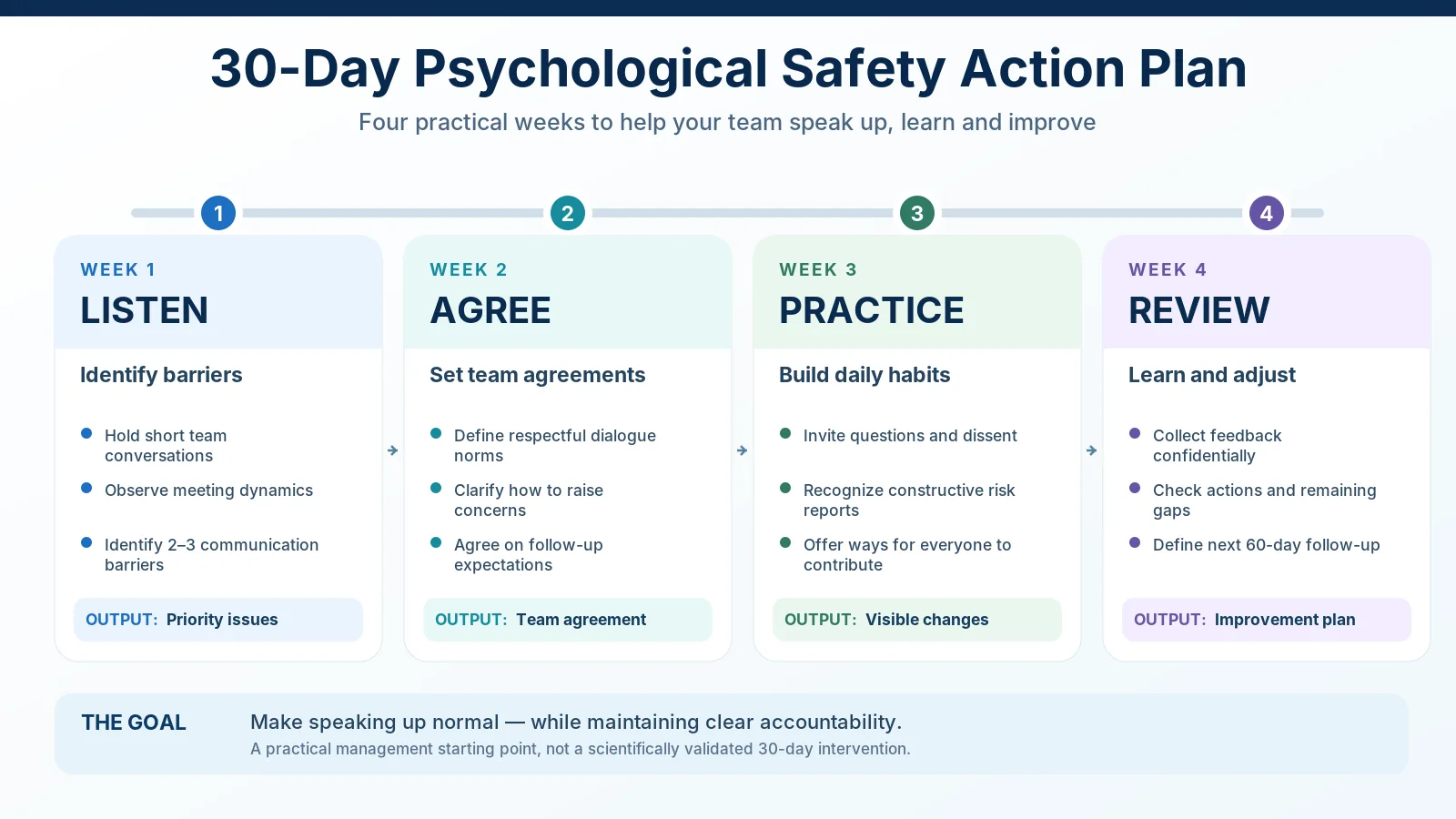
Week 1: Listen and Identify Barriers
Objective: Understand how the team currently communicates.
- Hold short individual conversations.
- Review how meetings are conducted.
- Ask when people find it difficult to raise concerns.
- Identify recurring communication barriers.
- Examine how mistakes and escalations are handled.
Deliverable: A short list of two or three behavioral barriers to address.
Week 2: Establish Team Agreements
Objective: Define practical expectations for respectful collaboration.
- Challenge ideas without attacking individuals.
- Ask for clarification when information is missing.
- Raise material risks as early as reasonably possible.
- Respect different communication styles.
- Share concerns through appropriate channels.
- Follow up on commitments.
Deliverable: A concise working agreement that complements organizational policies.
Week 3: Practice New Behaviors
Objective: Introduce observable changes to daily work.
- Start meetings with an opportunity to raise concerns.
- Invite alternative views during important decisions.
- Use learning-oriented questions in incident reviews.
- Recognize constructive risk identification.
- Offer asynchronous channels for participation.
- Address repeated interruptions.
Deliverable: Evidence that at least two new working practices have been adopted.
Week 4: Review and Adjust
Objective: Learn what is improving and what still requires attention.
- Ask whether concerns are easier to raise.
- Check whether meeting dynamics changed.
- Review whether problems are discussed earlier.
- Verify agreed actions were completed.
- Identify barriers that remain.
Deliverable: A 60-day follow-up plan with named owners and review dates.
30-Day Action Plan Summary
| Week | Focus | Main Action | Expected Output |
|---|---|---|---|
| 1 | Listen | Identify communication barriers | Priority issues |
| 2 | Agree | Define team behaviors | Working agreement |
| 3 | Practice | Apply inclusive leadership habits | Observable changes |
| 4 | Review | Gather feedback and adjust | Follow-up plan |
The first 30 days establish a starting point. Meaningful and sustainable improvement requires repeated action, visible leadership commitment, and appropriate organizational support.
Common Psychological Safety Mistakes to Avoid
Mistake 1: Confusing Safety With Avoiding Conflict
A team where nobody disagrees is not necessarily psychologically safe. Healthy disagreement can expose assumptions and inform decisions. The goal is respectful challenge, not artificial harmony.
Mistake 2: Expecting Immediate Trust
One workshop or team-building activity cannot erase a long history of negative experiences. Employees evaluate leaders through repeated interactions. Consistency matters more than promises.
Mistake 3: Using Surveys as Performance Rankings
Survey responses may be distorted when people believe feedback affects evaluations, promotions, or management judgments. Measurement should support improvement, not competition between teams.
Mistake 4: Ignoring Structural Problems
Psychological safety cannot compensate for every organizational challenge. Excessive workload, unclear responsibilities, understaffing, and contradictory priorities can undermine contribution. Managers should consider these conditions alongside interpersonal behavior. See our employee wellbeing and mental health guide.
Mistake 5: Encouraging Speaking Up Without Acting
Repeatedly requesting feedback and then ignoring it can discourage people. Explain what happens next, even when proposed changes cannot be implemented.
Psychological Safety Checklist for Team Leaders
Use this ten-point checklist during your next team review.
- I invite questions and alternative perspectives during important decisions.
- I acknowledge uncertainty when appropriate.
- I respond respectfully when employees raise concerns.
- I separate learning discussions from disciplinary processes.
- I maintain clear performance and accountability expectations.
- I make space for different voices in meetings.
- I provide appropriate channels for escalation.
- I follow up on feedback and explain decisions.
- I address disrespectful behavior consistently.
- I regularly review team practices and opportunities for improvement.
Free Resource — Psychological Safety Team Leader Checklist. Turn these ten practices into a repeatable monthly leadership review.
Editor’s note: The downloadable PDF and landing page are proposed assets and do not exist yet. No download CTA should be activated before creating them.
Frequently Asked Questions About Psychological Safety at Work
What are the main elements of psychological safety?
A shared belief that team members can raise questions, admit uncertainty, share ideas, request help, and discuss mistakes without inappropriate interpersonal consequences. Respectful communication, leadership behavior, and clear norms support it.
How is psychological safety different from trust?
Trust generally concerns confidence in another person’s reliability, behavior, or intentions. Psychological safety concerns whether people believe they can take interpersonal risks within a team. They are related but not interchangeable.
Can psychological safety coexist with accountability?
Yes. Psychological safety and accountability address different needs. Employees can speak up and acknowledge mistakes while remaining responsible for commitments, professional standards, and outcomes.
How long does it take to build psychological safety?
There is no universal timeline. A 30-day plan can introduce useful practices, but lasting improvements require sustained effort and consistent behavior.
How can remote teams improve psychological safety?
Remote and hybrid teams benefit from inclusive meeting facilitation, asynchronous feedback channels, clear expectations, respectful discussions, and transparent decision processes.
Can psychological safety improve innovation?
Psychological safety can make sharing ideas, challenging assumptions, and learning easier. However, innovation also requires expertise, resources, effective execution, and organizational support.
Conclusion: Build a Team Where Speaking Up Is Normal
Psychological safety at work is not about eliminating pressure, avoiding disagreements, or making every conversation comfortable. It is about creating an environment where people can contribute important information without unnecessary fear of embarrassment or unfair treatment.
For managers and team leaders, progress begins with daily behaviors: asking better questions, listening to alternative views, responding constructively to mistakes, and following through on concerns. The most effective approach combines openness with clear expectations.
Psychological Safety + Accountability + Continuous Learning = Better Conditions for Team Performance.
Start small. Choose one meeting practice to improve, one feedback barrier to remove, and one opportunity to recognize constructive risk reporting. Then continue learning from the results.
Continue Learning
Stay connected with TechTeamSynergy. Explore practical insights on leadership, teamwork, technology, and business transformation. Subscribe to the TechTeamSynergy Newsletter for actionable guides and tools.