

Employee wellbeing is shaped not only by individual health choices, but also by how work is designed, managed and experienced. Workload, role clarity, autonomy, leadership, relationships, organizational change, flexibility and access to support can all influence the quality of working life.
That makes employee wellbeing more than an HR benefit or wellness initiative. It is an organizational issue involving leadership, work design, management practices, culture, employee experience and occupational health and safety.
Organizations sometimes respond to workplace pressure by introducing meditation apps, fitness challenges or resilience workshops. These resources can be useful for some employees, but they cannot compensate for consistently excessive workloads, unclear priorities, poor management, harmful behavior or badly designed work.
A stronger approach begins with the working environment itself.
This guide uses a practical four-part framework:
Prevent → Protect → Support → Measure
It explains how organizations can build healthier working conditions, enable managers without turning them into clinicians, provide appropriate support and measure progress responsibly.
What Is Employee Wellbeing?
Employee wellbeing describes the broader experience of health, functioning and quality of working life within the workplace.
It is influenced by multiple dimensions, including:
- Physical working conditions
- Psychological and social working conditions
- Workload and work pace
- Autonomy and control
- Role clarity
- Relationships at work
- Management quality
- Fairness and respect
- Work-life boundaries
- Job security and organizational change
- Access to appropriate support
Employee wellbeing is therefore broader than whether employees feel happy at a particular moment.
It concerns whether work is designed and managed in ways that enable people to perform sustainably while maintaining a safe and supportive working environment.
Employee Wellbeing vs Employee Wellness
The terms wellbeing and wellness are often used interchangeably, but there is a useful distinction.
Employee wellness is frequently associated with programs or benefits focused on individual health, such as exercise, nutrition resources, wellness platforms or stress-management activities.
Employee wellbeing is broader. It includes individual resources, but also examines organizational factors such as workload, role clarity, management behavior, autonomy, workplace relationships, fairness and the ability to speak up safely.
This distinction matters because many workplace problems cannot be solved through wellness benefits alone.
Employee Wellbeing and Mental Health at Work
Mental health at work is an important component of the broader wellbeing picture.
Work can provide purpose, structure, social connection, income and opportunities for development. At the same time, poorly designed or poorly managed work can create psychosocial risks.
These can include excessive workload, long or inflexible working hours, lack of control, unclear roles, poor relationships, discrimination, violence or harassment, job insecurity and weak organizational support.
The World Health Organization guidelines on mental health at work recommend organizational interventions that assess and modify working conditions, alongside manager training, worker awareness, appropriate individual support and measures that enable people experiencing mental-health conditions to participate in work.
Do not make individual employees solely responsible for adapting to unhealthy working conditions.
Why Employee Wellbeing Is an Organizational Issue
Many workplace wellbeing programs start with the individual. Employees may be offered stress-management sessions, wellness applications, exercise initiatives, mindfulness resources or health-information campaigns.
These can form part of a broader strategy. However, imagine an employee who receives a stress-management course while simultaneously dealing with conflicting priorities, an unsustainable workload, constant after-hours requests, limited control and poor managerial communication.
The main opportunity for improvement may not be another individual intervention. It may be changes in the design and management of work.
A mature employee wellbeing strategy therefore combines individual resources with organizational action. This also connects directly with the broader employee experience strategy, which examines how employees experience the organization across the full work journey.
The Business Case for Employee Wellbeing
Organizations sometimes try to justify wellbeing programs through a single promised return-on-investment figure. That can be misleading because the value of employee wellbeing is broader and highly context-dependent.
Working conditions can influence employee experience, attendance, retention, engagement, team functioning, safety, quality of work and organizational reputation.
The World Health Organization’s mental health at work guidance also highlights the significant economic impact associated with depression and anxiety globally, including productivity losses.
Organizations should nevertheless resist turning this into a promise that every wellbeing initiative will automatically produce a specific financial return.
The stronger business case is that organizations depend on people being able to perform effectively and sustainably. Work design and management practices are therefore legitimate business concerns as well as people concerns.
The Main Workplace Factors That Affect Wellbeing
Workplace wellbeing is rarely determined by one factor. Organizations should examine the system of work rather than looking only for problems within individual employees.
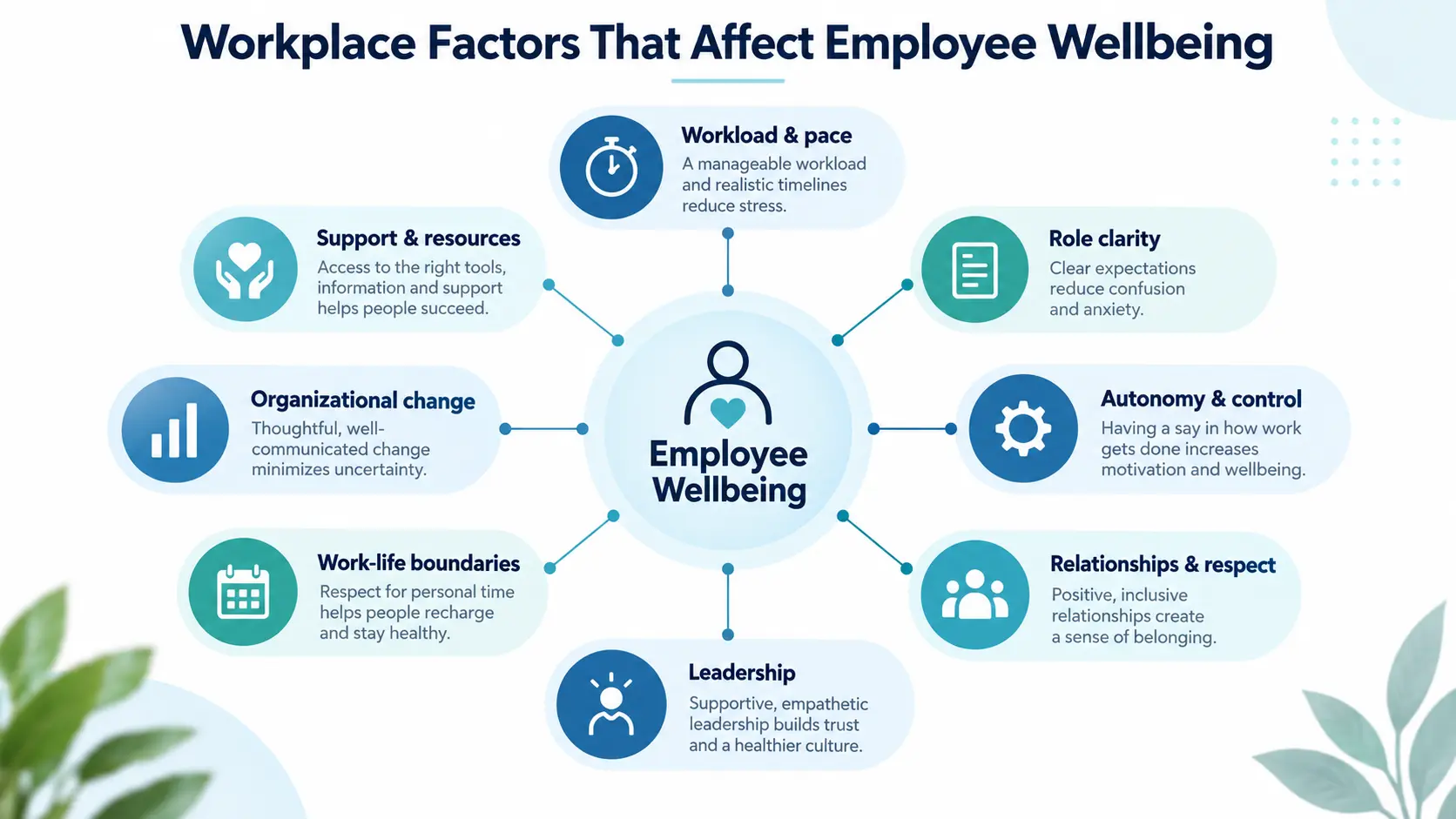
The International Labour Organization’s guidance on psychosocial risks and mental health at work identifies factors such as workload and work pace, job control, organizational culture, interpersonal relationships, role clarity, job security and the home-work interface as important areas of workplace risk.
Workload and Work Pace
Periods of high workload are sometimes unavoidable. The problem arises when excessive demand becomes persistent and employees have insufficient resources, time or control to manage it.
Managers should regularly examine whether workload matches capacity, deadlines are realistic, priorities are clear, low-value activities can be removed, workload is distributed fairly and employees have appropriate tools and resources.
The objective should not be to eliminate every form of pressure. It should be to prevent pressure from becoming chronically excessive or unmanaged. For a deeper treatment of causes, warning signs and prevention strategies, see our guide to managing stress at work.
Role Clarity
Employees work more effectively when they understand what is expected of them. Problems can occur when responsibilities overlap, priorities change without explanation, several managers provide conflicting instructions or accountability remains unclear.
Clear roles reduce unnecessary uncertainty and help people make better decisions about their work.
Autonomy and Job Control
Employees generally need an appropriate degree of control over how they carry out their responsibilities.
Too little autonomy can create frustration and unnecessary dependence on management. Too much autonomy without adequate direction can create a different problem: ambiguity.
Healthy work design balances autonomy with clear objectives, boundaries and support.
Working Hours and Boundaries
Digital communication tools have made work more flexible, but they can also make boundaries less visible.
Organizations should define expectations around after-hours communication, weekend work, response times, meeting schedules, time-zone differences, leave and recovery time.
A culture in which everything is treated as urgent can gradually turn occasional pressure into permanent pressure.
Relationships and Respect
Relationships with managers and colleagues strongly shape the experience of work. Organizations need clear standards concerning respectful behavior, discrimination, bullying, harassment and workplace conflict.
Employees should also know how concerns can be raised and how the organization will respond. Our guide to managing difficult people at work explores conflict, communication and boundaries in more detail.
Organizational Change
Transformation, restructuring, automation, mergers and changes in operating models can create significant uncertainty.
Organizations cannot always remove that uncertainty, but they can manage it better through transparent communication about what is changing, why it is changing, what is known, what remains uncertain and how employees can ask questions.
A Practical Employee Wellbeing Framework
A useful workplace strategy can be organized into four connected layers: Prevent, Protect, Support and Measure.
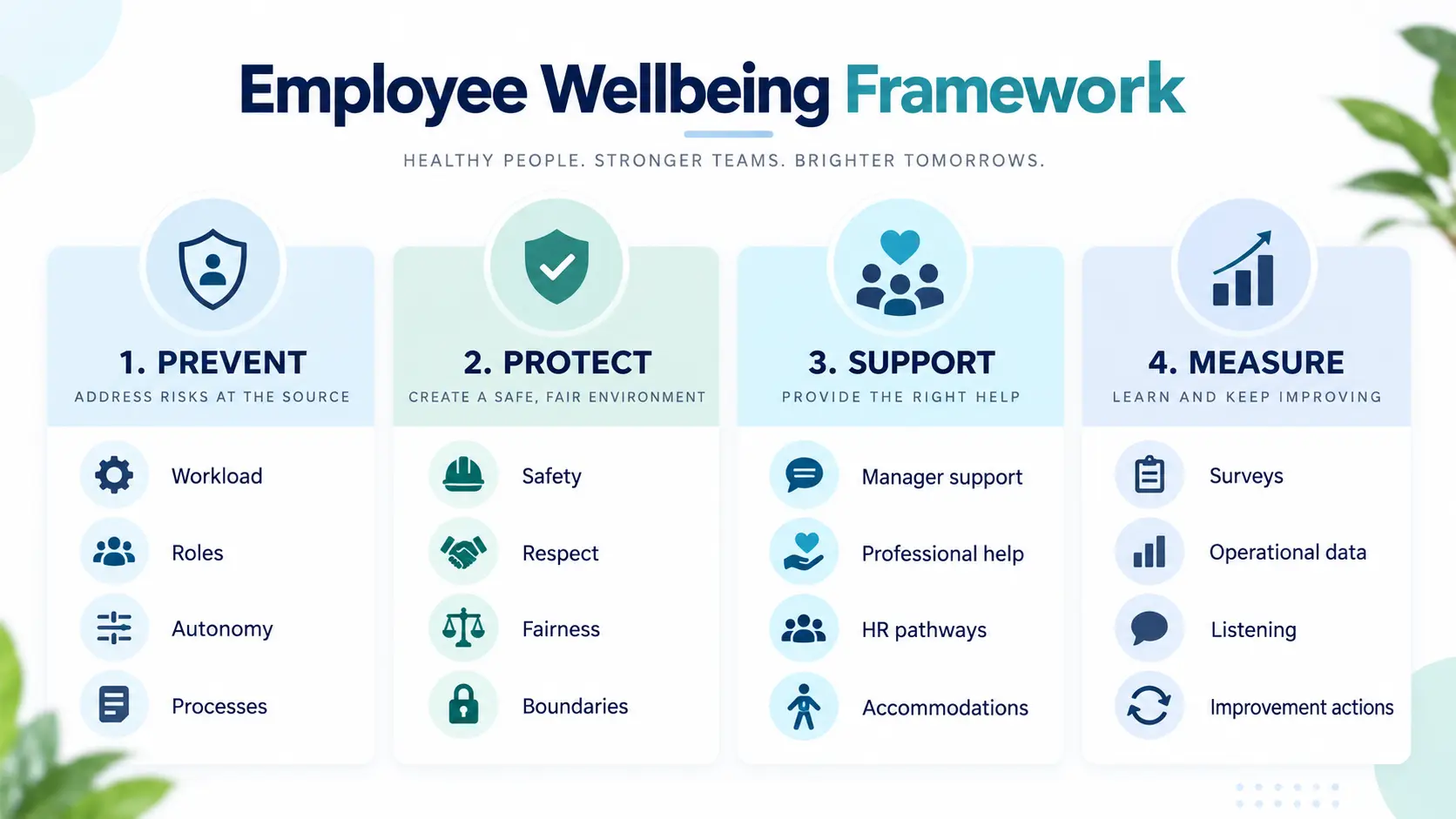
| Layer | Objective | Examples |
|---|---|---|
| Prevent | Reduce avoidable psychosocial risks in work design | Manage workload, clarify roles, improve staffing, redesign processes |
| Protect | Create a respectful and supportive working environment | Psychological safety, fair policies, manager behavior, anti-harassment measures |
| Support | Enable employees to access appropriate help | Employee assistance, occupational health, accommodations, clear support pathways |
| Measure | Understand working conditions and improve them | Employee listening, workload indicators, surveys, organizational data |
Organizations should resist implementing only the support layer. Providing counselling or wellness tools without addressing preventable problems in work design leaves underlying risks unchanged.
1. Prevent: Design Healthier Work
Prevention begins with understanding how work itself may create unnecessary pressure.
This can include examining workload, staffing, work schedules, role ambiguity, decision bottlenecks, poor processes, unnecessary meetings, conflicting objectives and constant organizational change.
The objective is not to create a workplace without challenges. Interesting work can be demanding. The objective is to identify avoidable organizational conditions that make sustainable performance unnecessarily difficult.
Use Employee Participation
The people doing the work often understand operational friction better than senior decision-makers. Employee participation can include surveys, focus groups, workshops, team discussions and process-improvement sessions.
Employee involvement should produce visible action where appropriate. Continuously asking for feedback without demonstrating what happens next can reduce trust in the process.
2. Protect: Build a Supportive Working Environment
Protection is about the environment in which work takes place. Employees should be able to expect respectful treatment, reasonable organizational processes and safe ways to raise concerns.
Psychological Safety
Psychological safety does not mean avoiding disagreement or making every conversation comfortable. It means creating conditions in which people can raise questions, admit uncertainty, discuss mistakes or challenge ideas without unnecessary interpersonal fear.
Managers contribute to this through how they respond when someone reports a problem, asks for help, admits an error or challenges an assumption.
Fairness and Consistency
Employees pay close attention to whether organizational decisions appear fair and understandable.
Fairness does not always mean treating every employee identically. Circumstances and legitimate accommodations may differ. But employees should understand how decisions are made. This principle also connects with broader workplace diversity, equity and inclusion practices.
3. Support: Create Clear Routes to Appropriate Help
Even a well-designed workplace cannot prevent every difficulty employees may experience. Organizations therefore need appropriate support pathways.
Depending on the organization and country, these may include employee assistance programs, occupational-health services, health benefits, professional counselling, workplace accommodations, return-to-work support and HR or people-support functions.
Employees and managers should know what support exists, how it can be accessed, what confidentiality rules apply, what the manager’s role is and when specialist functions should become involved.
Who Is Responsible for Employee Wellbeing?
Employee wellbeing is a shared organizational responsibility. Senior leaders influence priorities and resources, HR provides infrastructure, managers shape daily working conditions, specialist professionals provide appropriate expertise and employees can contribute to improving how work is organized.
The Manager’s Role in Employee Wellbeing
Managers have significant influence over employees’ daily experience of work. They affect workload, priorities, feedback, communication, role clarity, flexibility and team culture.
But managers should not be turned into mental-health professionals. Their role is to manage work well, communicate supportively and understand organizational pathways for additional help.
What Managers Should Do
- Set clear priorities
- Discuss workload
- Listen to concerns
- Communicate respectfully
- Provide regular feedback
- Support appropriate flexibility
- Understand available support pathways
- Address conflict and inappropriate behavior
What Managers Should Not Do
- Diagnose employees
- Act as therapists or clinicians
- Make assumptions about someone’s health
- Promise confidentiality they cannot guarantee
- Ignore workload or organizational causes of pressure
Manager Training Matters
Organizations often tell managers to support employee wellbeing without explaining what that means operationally.
Useful development can include listening skills, supportive communication, workload management, conflict management, role clarity, understanding psychosocial work factors, knowing available support pathways and handling sensitive conversations appropriately.
Training should accompany good organizational policies. A trained manager cannot compensate indefinitely for structural problems such as chronic understaffing or unrealistic targets.
HR’s Role in Employee Wellbeing
HR can provide important infrastructure for workplace wellbeing, including policies, support pathways, manager training, employee-listening mechanisms, learning resources, accommodation processes and organizational data.
But responsibility should not sit with HR alone. Business leaders remain responsible for priorities, staffing, operating models and workload decisions.
Leadership and Workplace Wellbeing
Senior leaders shape wellbeing even when they never participate in a wellbeing program. They influence business priorities, resource allocation, organizational structure, performance expectations, management culture, change programs and communication norms.
Leadership behavior also signals what employees should believe. If leaders publicly encourage work-life boundaries but routinely send non-urgent requests late at night expecting immediate answers, behavior becomes more powerful than policy.
Wellbeing therefore needs to be visible in operational decisions, not only corporate communications. This is also a core principle of modern leadership, where priorities, communication and management behavior shape how teams experience change and performance expectations.
Why Wellness Perks Are Not Enough
Wellness platforms, fitness benefits, mindfulness sessions and similar resources can be useful, but they should not become substitutes for healthy work design.
An organization cannot sustainably compensate for chronic overload, unclear roles, poor management or unhealthy communication norms by adding more benefits around them.
The stronger question is not simply, “What new wellbeing benefit should we purchase?”
It is: “What aspects of our organization make it easier or harder for people to work sustainably?”
Employee Wellbeing in Hybrid and Remote Work
Hybrid and remote work can create benefits and challenges depending on the role, employee, team and organizational context.
Flexibility can help some employees manage their work more effectively. At the same time, distributed work can create challenges around work-life boundaries, communication overload, isolation, meeting volume, knowledge sharing, manager visibility and team connection.
People entering remote work for the first time may also benefit from understanding these expectations before they apply. Our guide to getting your first remote job provides a practical starting point.
Organizations should avoid assuming that one working model produces better wellbeing for everyone. Instead, consider the requirements of the work and the experiences of the people doing it.
Reduce Digital Overload
- Set reasonable response-time expectations
- Reduce unnecessary meetings
- Protect focus time
- Consider time zones
- Clarify which communication channel is used for which purpose
Workplace Wellbeing During Organizational Transformation
Transformation can intensify uncertainty. Employees may be learning new skills, adopting new technology, moving into different teams or seeing roles redesigned.
Organizations should therefore integrate employee wellbeing into transformation planning rather than treating it as a separate initiative.
- Clear and regular communication
- Realistic implementation capacity
- Employee participation
- Manager preparation
- Training and learning time
- Monitoring workload during transition
- Clear escalation routes
This is especially important in large digital or workforce transformation programs where employees may be expected to deliver today’s operations while simultaneously building tomorrow’s organization.
Employee Wellbeing and Burnout
Burnout is related to workplace wellbeing but should not be treated as a synonym for every form of stress or dissatisfaction.
A broad employee wellbeing strategy should focus on healthy working conditions and sustainable performance rather than trying to label individual experiences.
Organizations can pay particular attention to structural conditions such as chronic overload, insufficient resources, low role clarity, repeated organizational disruption, poor management and lack of recovery time.
For a deeper explanation of causes, warning signs and prevention, see our complete guide to workplace burnout.
4. Measure: Understand Workplace Wellbeing Responsibly
Employee wellbeing cannot be managed effectively through assumptions alone. Organizations need evidence about working conditions and employee experience, but measurement should remain proportionate and respectful.
Employee Surveys
Surveys can provide information about workload, role clarity, manager support, psychological safety, team climate, ability to recover from work and confidence in organizational support.
Operational Data
Depending on context, organizations may examine aggregate trends such as absence, turnover, working-hours patterns, employee-relations cases, workload indicators and internal mobility.
These data points should not be interpreted in isolation. A single metric rarely proves that a wellbeing problem exists or identifies its cause.
Qualitative Listening
Numbers can show that something is happening without explaining why. Organizations can complement quantitative data with focus groups, interviews, team discussions, exit feedback and employee representatives.
What Not to Do With Wellbeing Data
Wellbeing measurement should not become intrusive employee surveillance.
Organizations should be cautious about technologies that attempt to infer an individual’s emotional or health status from behavior, communications or productivity patterns.
Measure working conditions and aggregate organizational patterns rather than attempting to diagnose individual employees through data.
Privacy, data protection, employee trust and applicable laws should be considered whenever employee data is collected.
How to Build an Employee Wellbeing Strategy
Step 1: Establish Leadership Ownership
Define who is accountable for the strategy. Employee wellbeing should involve senior leadership, HR, managers and relevant health and safety functions.
Step 2: Understand the Current State
Use surveys, organizational data and employee participation to identify where the most important issues exist. Look for patterns rather than isolated anecdotes.
Step 3: Identify Psychosocial Work Factors
Examine workload, working hours, role clarity, autonomy, relationships, organizational change, job security and support.
Step 4: Prioritize Organizational Changes
Choose a limited number of high-value improvements rather than launching dozens of disconnected wellbeing initiatives.
Step 5: Strengthen Manager Capability
Prepare managers to communicate clearly, manage workload, listen and use organizational support pathways appropriately.
Step 6: Make Support Easy to Find
Employees should not need to search through multiple systems to discover what help is available.
Step 7: Involve Employees
Test proposed changes with the people who experience the work.
Step 8: Measure Outcomes
Use a combination of employee feedback and organizational indicators.
Step 9: Review and Adapt
Workplaces change. The wellbeing strategy should change with them.
A Practical 90-Day Employee Wellbeing Roadmap
A 90-day roadmap can help organizations move from broad intentions to focused, measurable action.
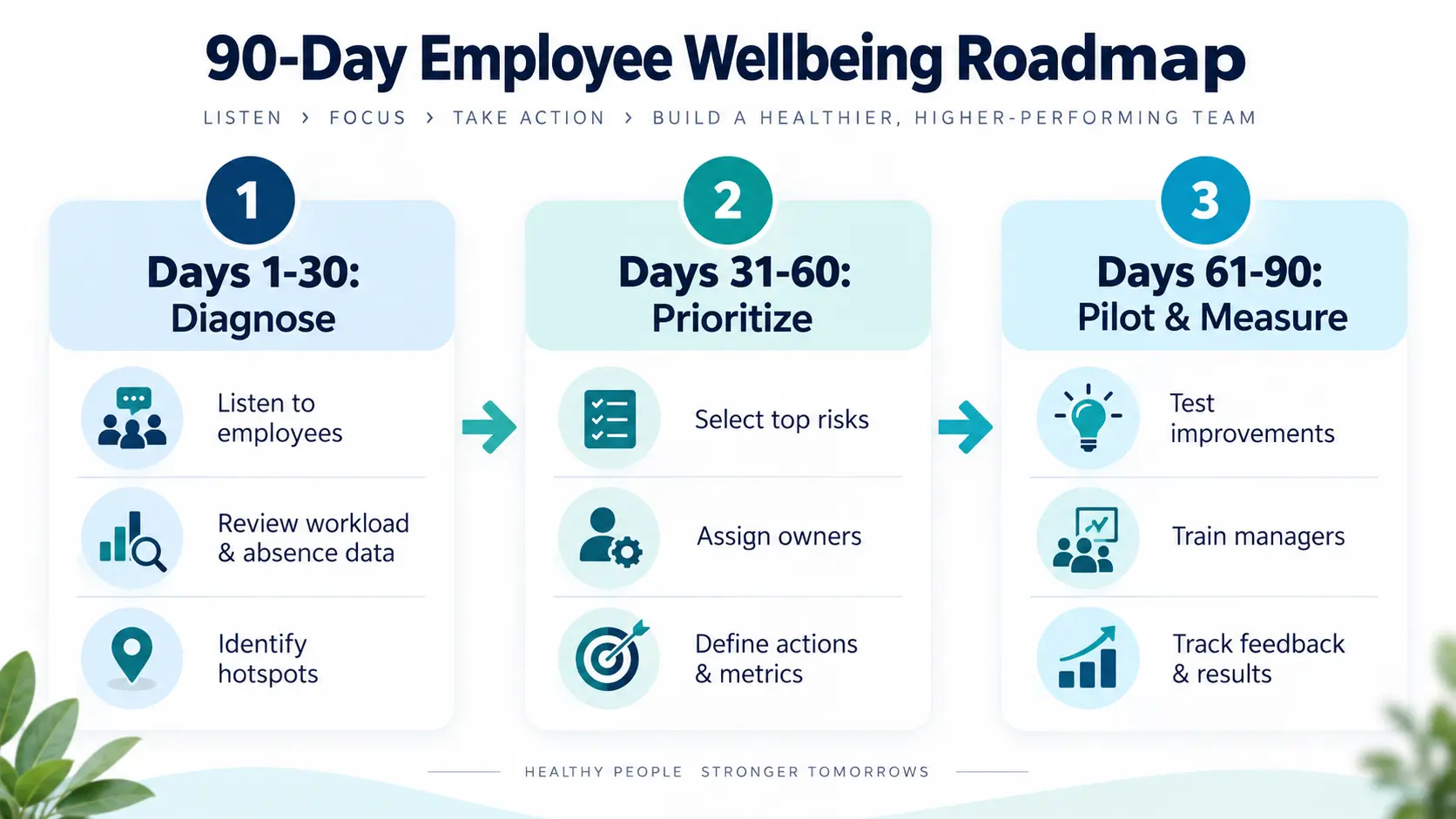
Days 1–30: Diagnose
- Confirm executive sponsorship
- Map existing wellbeing policies and resources
- Review available employee data
- Gather employee feedback
- Identify high-priority working-condition issues
- Map existing professional support pathways
Days 31–60: Prioritize
Use the evidence to select a manageable number of interventions, such as improving workload planning, clarifying roles, reducing unnecessary meetings, preparing managers, improving communication during change or making support resources easier to access.
Days 61–90: Pilot and Measure
Test improvements in selected teams or functions. Gather feedback, monitor relevant indicators and adjust the approach before scaling.
Listen → Diagnose → Act → Measure → Learn → Improve.
15-Minute Workplace Wellbeing Review
Use this short review with a team, manager or people partner when there is evidence that working conditions are creating avoidable friction. Keep the discussion focused on the work environment and organizational actions rather than attempting to assess or diagnose an individual’s health.
- 0–3 minutes — Identify the work signal. Select one concrete pattern such as repeated overtime, conflicting priorities, role ambiguity, meeting overload, recurring escalation, missed recovery time or a persistent process bottleneck.
- 3–6 minutes — Check the evidence. Use team feedback, workload data, process observations or other appropriate aggregate evidence to confirm that the issue is recurring rather than relying on assumptions.
- 6–9 minutes — Find the controllable cause. Ask whether the main lever sits in workload, staffing, priorities, role clarity, decision rights, meetings, technology, process design, communication or access to support.
- 9–12 minutes — Choose one organizational action. Define a specific change the team or manager can test, such as removing low-value work, clarifying priorities, redistributing workload, protecting focus time, simplifying an approval or making a support pathway easier to find.
- 12–15 minutes — Assign ownership and a review date. Record one owner, the expected change, the evidence that will show improvement and when the team will review the result.
Decision at the end: ACT NOW when the issue and owner are clear; INVESTIGATE FURTHER when evidence or root cause is insufficient; or ESCALATE when the issue requires action beyond the team’s authority or specialist organizational support.
Common Employee Wellbeing Mistakes
1. Making Employees Responsible for Fixing Workplace Stress
Individual coping resources can help, but organizations should also examine working conditions.
2. Treating Wellbeing as a Benefits Program
Benefits matter, but they are only part of the employee experience.
3. Asking Managers to Diagnose People
Managers should support employees and manage work—not practice medicine.
4. Launching Programs Without Employee Input
Senior leaders may misidentify the real causes of pressure if employees are not involved.
5. Ignoring Workload
A wellbeing strategy that refuses to discuss workload avoids one of the most important organizational variables.
6. Measuring Participation Instead of Impact
The number of people who download a wellness app tells you little about whether working conditions have improved.
7. Promising Complete Confidentiality
Organizations should explain accurately how information is handled rather than making commitments they may not be able to maintain in every circumstance.
8. Using One Global Solution Everywhere
Workforce expectations, regulations, support systems and working conditions vary between countries and types of work.
9. Treating Hybrid Work as Automatically Good or Bad
Different roles and individuals can experience hybrid work differently.
10. Running Wellbeing Separately From Transformation
Major organizational changes can alter workloads, responsibilities and uncertainty. Wellbeing should be considered during transformation design.
Employee Wellbeing KPIs: What Should Organizations Track?
The right measures depend on the organization’s objectives.
| Area | Possible Measures |
|---|---|
| Work Design | Workload perception, role clarity, autonomy, working-hours patterns |
| Management | Manager support, communication quality, trust |
| Culture | Psychological safety, fairness, ability to speak up |
| Support | Awareness of available resources, access barriers |
| Employee Experience | Engagement, experience surveys, qualitative feedback |
| Organizational Outcomes | Turnover, absence and other relevant aggregate trends |
These indicators should be interpreted together rather than converted into one simplistic “wellbeing score.”
Employee Wellbeing Is Not About Eliminating All Stress
A healthy workplace is not necessarily an effortless workplace. Deadlines, complex problems, difficult decisions and periods of high demand are part of many jobs.
The objective is sustainable performance.
- Temporary challenge vs chronic overload
- Constructive feedback vs disrespect
- Autonomy vs abandonment
- Healthy urgency vs permanent crisis
- Flexibility vs boundaryless work
This is why employee wellbeing is best understood through the design and management of work rather than through the unrealistic goal of removing every source of pressure.
Frequently Asked Questions About Employee Wellbeing
What is employee wellbeing?
Employee wellbeing refers broadly to the quality of employees’ working experience and the physical, psychological and social conditions surrounding work. It is influenced by factors such as workload, autonomy, leadership, relationships, role clarity and access to support.
What is the difference between employee wellbeing and mental health?
Mental health is one component of the broader employee wellbeing picture. Workplace wellbeing also includes work design, relationships, physical conditions, work-life boundaries and the overall employee experience.
What is the difference between wellbeing and wellness?
Wellness often refers to individual health programs or benefits. Wellbeing is broader and includes organizational working conditions, management, culture and employee experience as well as individual resources.
Who is responsible for employee wellbeing?
Responsibility is shared. Senior leaders influence organizational priorities and resources, HR establishes policies and support systems, managers shape daily working conditions, specialist professionals provide appropriate expertise and employees can participate in improving how work is organized.
What can managers do to support employee wellbeing?
Managers can create clear priorities, discuss workload, listen to employees, communicate respectfully, manage conflict, support appropriate flexibility and understand available organizational support pathways.
Should managers identify employees with mental-health conditions?
No. Managers should not diagnose employees. Their role is to manage work appropriately, listen supportively when concerns are raised and know how employees can access qualified or organizational support.
Do employee wellness programs work?
The value of individual programs depends on the intervention and context. They are best treated as one layer of a broader strategy rather than a replacement for improving working conditions.
How can organizations improve workplace mental health?
A strong approach includes identifying and managing psychosocial risks, improving working conditions, developing managers, involving employees and providing clear access to appropriate professional support.
What are examples of psychosocial risks at work?
Examples can include excessive workload, low job control, unclear roles, problematic working hours, poor relationships, discrimination, harassment, job insecurity and weak organizational support.
How should companies measure employee wellbeing?
Organizations can combine employee surveys, qualitative listening and relevant aggregate organizational data. Measurement should focus on understanding working conditions and organizational patterns while respecting employee privacy.
Conclusion: Build Wellbeing Into the Way Work Works
Employee wellbeing should not sit at the edge of the organization as a collection of optional wellness benefits. It should be reflected in how work is designed, how people are managed and how organizational decisions are made.
That means looking beyond individual resilience and examining workload, role clarity, autonomy, working hours, leadership behavior, organizational change, psychological safety, fairness and support systems.
A practical strategy can follow four principles:
Prevent. Reduce avoidable risks through better work design.
Protect. Create respectful, supportive and psychologically safer working conditions.
Support. Give employees clear access to appropriate organizational and professional resources.
Measure. Listen to employees, monitor working conditions and continuously improve.
Wellness resources can still have a place. But the strongest employee wellbeing strategy begins with a more fundamental question:
Are we designing an organization in which people can perform effectively and sustainably?
When leaders make that question part of everyday management, employee wellbeing becomes more than a program. It becomes part of how the organization operates.
Continue Learning
Continue exploring the TechTeamSynergy employee wellbeing and workplace cluster with these related guides: