
Learning how to become an IT project manager is a natural career direction for many technical professionals who want to move from solving individual technical problems to coordinating larger business and technology outcomes.
A network engineer might already coordinate migrations. A systems administrator may participate in infrastructure upgrades. A software or cloud specialist may manage technical dependencies. A support engineer may coordinate incidents involving several teams.
These experiences can provide a strong foundation for project management—but technical expertise alone does not automatically make someone an effective project manager.
The transition requires a shift from primarily asking:
“How do I solve this technical problem?”
toward asking:
“How do we deliver the required outcome through people, scope, time, risk, dependencies, decisions and stakeholders?”
This guide explains how technical professionals can make that transition systematically.
In this guide
The career path can be summarized as:
Technical Expertise → Project Exposure → Project Management Skills → Leadership & Stakeholder Skills → Evidence → Career Transition → IT Project Manager

What Is an IT Project Manager?
An IT project manager coordinates the planning and delivery of technology projects.
Depending on the organization and project, this might include:
- Network deployments
- Cloud migrations
- Cybersecurity programs
- Application implementations
- Data-center projects
- Software releases
- Infrastructure upgrades
- Telecommunications deployments
- Workplace technology transformations
- Automation initiatives
The IT project manager does not necessarily perform every technical task.
Instead, the role helps ensure that technical and business teams understand:
- What must be delivered
- Why it matters
- Who is responsible
- When work must happen
- Which dependencies exist
- Which risks need attention
- Which decisions are required
- Whether the project is progressing toward its intended outcome
What Does an IT Project Manager Do?
Responsibilities vary by organization, but an IT project manager may be involved in:
- Defining project objectives
- Clarifying scope
- Creating project plans
- Coordinating teams
- Managing milestones
- Tracking dependencies
- Managing risks and issues
- Coordinating suppliers
- Managing stakeholder communication
- Tracking budgets or costs
- Facilitating decisions
- Managing changes
- Reporting project status
- Supporting testing and deployment
- Coordinating project closure
The role combines technology understanding, project discipline and people leadership. Practical spreadsheet skills are also useful for budgets, trackers and status reporting; if you need a foundation, start with our Excel for Beginners guide.
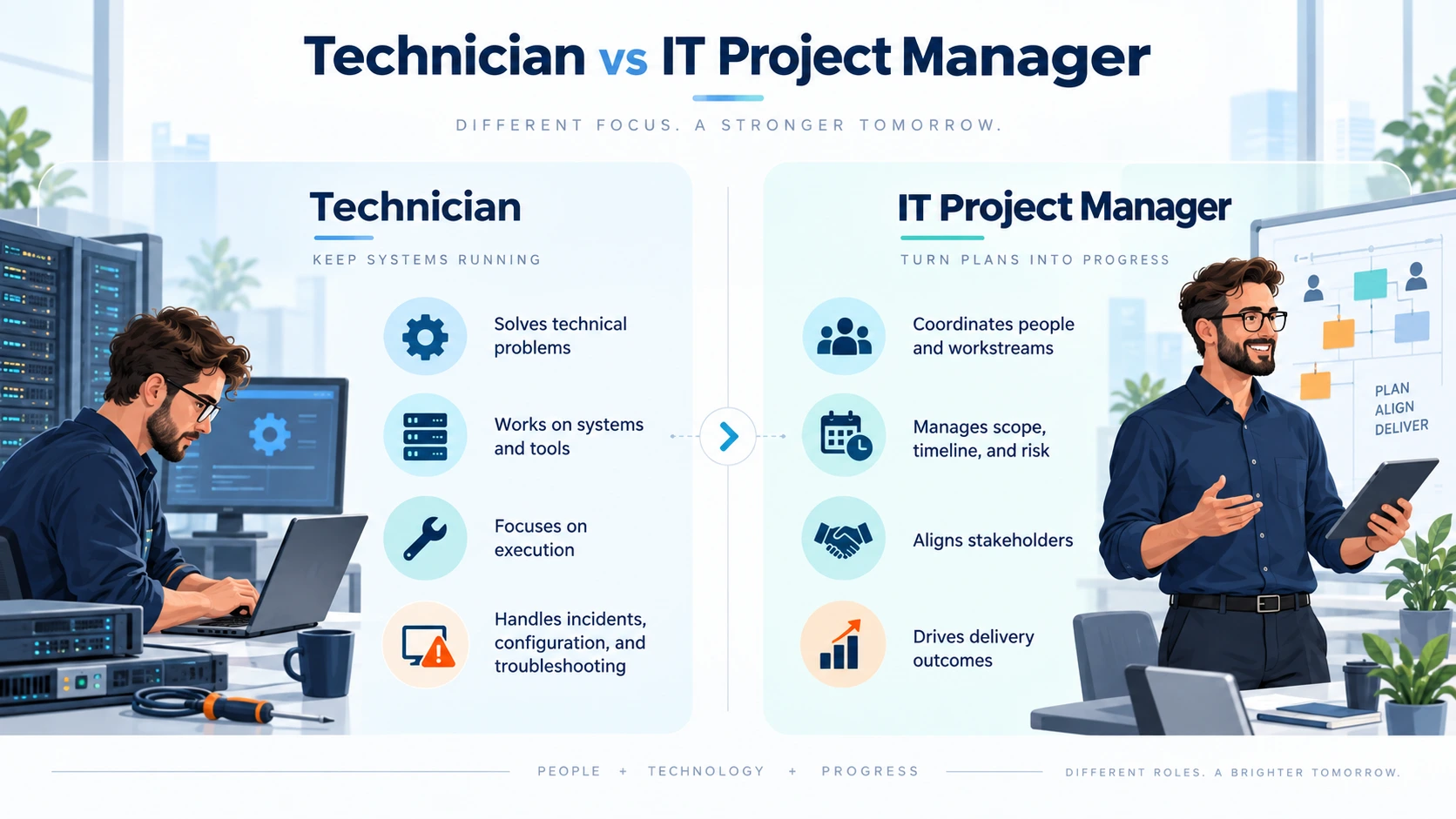
Technician vs IT Project Manager: What Changes?
Moving into project management requires more than changing your job title.
Your perspective changes.
| Technical Professional | IT Project Manager |
|---|---|
| Focuses deeply on technical tasks | Coordinates the overall project outcome |
| Solves technical problems | Coordinates resolution across teams |
| Owns technical activities | Coordinates scope, milestones and dependencies |
| Communicates mainly with technical peers | Communicates with technical and business stakeholders |
| Analyzes technical risks | Coordinates broader project risks |
| Optimizes a technical solution | Balances technical, business, time and resource constraints |
| Measures technical performance | Tracks delivery and business outcomes |
This does not mean abandoning technical expertise.
It means learning to use that expertise from a broader perspective.
Why Technical Experience Can Help You Become an IT Project Manager
A technical background can provide valuable context when managing technology projects.
You may already understand:
- Technical dependencies
- Implementation complexity
- Operational constraints
- Testing requirements
- Production risks
- Change windows
- Incident management
- Technical documentation
- Supplier dependencies
- Security considerations
This can help you ask better questions and recognize risks earlier.
However, the objective is not to become the project’s most senior technical expert.
Your value increasingly comes from helping specialists work together effectively.
Skills You Already Have vs Skills You Need to Develop
A useful first step is performing a career skills-gap analysis.
| You May Already Have | You May Need to Develop |
|---|---|
| Technical problem-solving | Project planning |
| Systems knowledge | Stakeholder management |
| Troubleshooting | Risk management |
| Technical communication | Executive communication |
| Operational discipline | Budget and cost awareness |
| Dependency awareness | Cross-team dependency management |
| Incident handling | Project governance |
| Vendor/product knowledge | Commercial and supplier management |
| Technical documentation | Project reporting |
Your actual gaps will depend on your experience.
Do not assume that every technician starts from the same place.
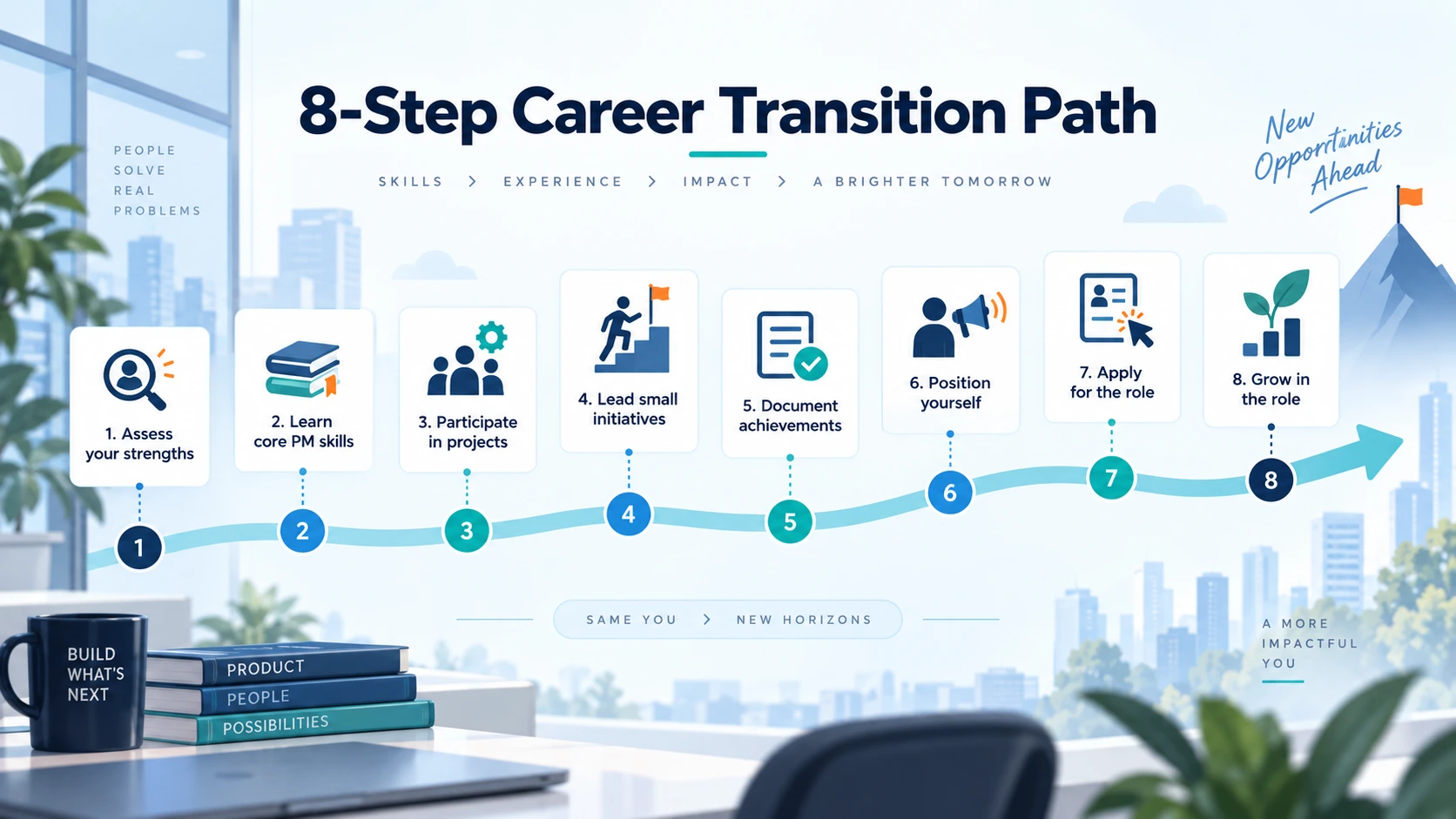
How to Become an IT Project Manager: 8 Practical Steps
A career transition is easier to manage when treated like a project itself.
Use this roadmap:
Assess → Learn → Participate → Lead → Document → Position → Apply → Grow
Step 1: Assess Your Existing Project Experience
Before looking for another certification or course, review what you have already done.
You may have more project exposure than you realize.
Ask yourself whether you have ever:
- Coordinated an upgrade
- Planned a migration
- Managed a technical change
- Coordinated several technical teams
- Worked with a supplier
- Managed a deployment schedule
- Participated in a customer implementation
- Tracked risks or issues
- Led a technical workstream
- Presented progress to management
- Coordinated testing
- Managed dependencies
These activities do not automatically mean you were a project manager.
But they may provide evidence of project-related responsibilities that can support your transition.
Step 2: Learn the Foundations of Project Management
Technical professionals moving into project management should understand the core concepts that structure project delivery.
Important areas include:
- Objectives
- Scope
- Requirements
- Stakeholders
- Deliverables
- Milestones
- Dependencies
- Risks
- Issues
- Resources
- Costs
- Communication
- Change
- Governance
- Benefits and outcomes
Learn to Define the Outcome
A project should not begin with a task list alone.
Start with:
Why → Outcome → Scope → Deliverables → Plan
Ask:
- Why does this project exist?
- What outcome should it create?
- What is included?
- What is excluded?
- What must be delivered?
- How will success be evaluated?
Step 3: Learn Project Planning
A project plan connects objectives with execution.
Depending on the project, planning may involve:
- Activities
- Milestones
- Dependencies
- Resources
- Responsibilities
- Risks
- Decision points
- Delivery dates
Planning does not mean predicting every detail perfectly.
It means creating enough shared structure for teams to coordinate effectively and adapting when reality changes.
Learn Dependency Management
Technical projects often contain complex dependencies.
For example:
Infrastructure Ready → Configuration → Testing → Security Approval → Migration → Validation
If one activity moves, several downstream activities may be affected.
A project manager needs to understand not only individual tasks but also how those tasks interact.
Step 4: Develop Risk and Issue Management Skills
Technical professionals often have an advantage here because troubleshooting and risk awareness are already familiar concepts.
But project risk is broader than technical risk.
A project might face:
- Technical risks
- Schedule risks
- Resource risks
- Supplier risks
- Financial risks
- Security risks
- Operational risks
- Organizational risks
- Stakeholder risks
A simple risk process is:
Identify → Assess → Assign → Respond → Monitor
A useful risk statement explains:
Cause → Uncertain Event → Potential Impact
For example:
If equipment delivery is delayed, the planned installation window may be missed, potentially affecting the migration milestone.
AI can now support parts of this workflow by helping project managers scan project information, improve risk statements and monitor changing signals. For a practical approach, see our guide to using AI for project risk management.
Risk vs Issue
A risk concerns uncertainty about something that may happen.
An issue is a problem that already exists and requires action.
Project managers need mechanisms for both.
Step 5: Develop Stakeholder Management Skills
This is one of the biggest transitions for many technical professionals.
A technically correct solution can still encounter problems when stakeholders:
- Do not understand the change
- Have conflicting objectives
- Were consulted too late
- Do not agree on priorities
- Have not made required decisions
- Do not understand the project impact
Stakeholder management begins by understanding:
Who → Interest → Influence → Needs → Engagement
Identify Your Stakeholders
Depending on the project, stakeholders might include:
- Project sponsor
- Customers
- Business owners
- Technical teams
- Operations
- Security
- Finance
- Procurement
- Suppliers
- Senior management
- End users
Communicate According to the Audience
A network engineer may want detailed information about routing or capacity.
A project sponsor may instead need:
- Overall status
- Major risks
- Required decisions
- Budget implications
- Business impact
The project manager translates between levels of detail.
Step 6: Develop Leadership Skills
Project management involves leadership even when project managers do not have direct hierarchical authority over everyone involved.
You may need to create alignment across people from:
- Different teams
- Different suppliers
- Different countries
- Different management structures
- Different technical disciplines
That requires influence, communication and credibility.
Our Modern Leadership guide explores leadership skills, styles and leading teams through change in more detail.
Move From Doing to Enabling
This transition can be difficult for highly experienced technicians.
Your instinct may be to solve technical problems yourself.
Sometimes that is useful.
But as project responsibilities increase, continually becoming the technical problem-solver can create a bottleneck.
A project manager should increasingly ask:
- Who owns this?
- What support do they need?
- What decision is blocking progress?
- Which dependency needs coordination?
- What risk does this create?
Step 7: Build Project Management Experience Before You Have the Title
You do not necessarily need to wait for someone to give you the title “Project Manager” before developing project-management skills.
Look for opportunities within your existing responsibilities to:
- Lead a small workstream
- Coordinate a technical migration
- Manage a project schedule
- Maintain a risk log
- Coordinate suppliers
- Run project meetings
- Prepare status reports
- Coordinate testing
- Manage dependencies
- Lead retrospectives or lessons learned
The objective is to accumulate genuine evidence of increasing project responsibility.
Start With a Small Project or Workstream
Your first project-management opportunity does not need to be a major transformation program.
A smaller project can provide experience with:
Plan → Coordinate → Monitor → Communicate → Deliver → Review
Examples might include:
- A network upgrade
- A tool deployment
- A software migration
- A security improvement
- An automation initiative
- An office technology deployment
The exact opportunity depends on your role and organization.
Use a RACI Matrix to Clarify Responsibilities
As projects involve more people, unclear ownership can create delays and conflict.
A RACI matrix can help distinguish who is:
- Responsible
- Accountable
- Consulted
- Informed
See our RACI Matrix guide for a practical explanation of how the model works.
If you want to see how those responsibilities look in real technology projects, explore our practical RACI matrix examples for IT projects, including infrastructure upgrades, network migrations, software delivery, cybersecurity and cloud migration.
Step 8: Build Evidence of Your Project Experience
Do not simply collect activities.
Document what you actually contributed.
For each project, record:
- Project objective
- Your role
- Scope
- Teams involved
- Your responsibilities
- Important risks
- Decisions you coordinated
- Problems you helped resolve
- Outcome
- Lessons learned
Only record results you can genuinely support.
Create a Project Portfolio
A project portfolio does not need to expose confidential company information.
You can document projects at an appropriate level.
A simple structure is:
Situation → Objective → Responsibility → Actions → Outcome → Learning
This gives you material for:
- Your resume
- Job applications
- Interviews
- Internal career discussions
- Certification applications where applicable
Learn Agile, Predictive and Hybrid Project Management
Modern IT projects do not all use the same delivery approach.
A project manager should understand multiple ways of working and choose or adapt them according to the environment.
Predictive Approaches
Predictive approaches place greater emphasis on planning the sequence of work and managing delivery against an established plan.
They may fit projects where scope and delivery stages are relatively stable.
For more detail, see our Waterfall vs V-Model guide.
Agile Approaches
Agile approaches emphasize iterative delivery, feedback and adaptation.
Our What Is Agile? guide explains Agile principles, methods and how Agile ways of working differ from traditional project approaches.
Hybrid Approaches
Many technology environments combine practices.
For example, a project may have:
- Fixed regulatory milestones
- Iterative software delivery
- Structured infrastructure deployment
- Agile application development
The objective is not to force every project into one methodology.
It is to understand which working practices fit the context.
Do You Need a Certification to Become an IT Project Manager?
No single certification automatically makes someone an effective IT project manager.
Certifications can help you:
- Learn structured project-management concepts
- Demonstrate knowledge
- Build professional vocabulary
- Support particular career requirements
But they should complement rather than replace real project experience.
CAPM vs PMP for Aspiring IT Project Managers
The appropriate certification depends on your current level of experience.
CAPM
The Certified Associate in Project Management (CAPM) can be relevant to people who want to demonstrate foundational project-management knowledge and do not yet have the experience required for PMP.
Check the current eligibility requirements directly with PMI before making a certification decision.
PMP
The Project Management Professional (PMP) is designed for professionals who already have qualifying project leadership experience.
PMI periodically updates its eligibility, training and examination requirements, so avoid relying on old articles for current requirements.
See the official PMI PMP certification page for current information. For a structured overview of eligibility, exam format, preparation and the certification journey, see our PMP Certification Guide 2026.
Certification Is Not the Career Strategy
A stronger career-development model is:
Knowledge + Experience + Evidence + Leadership + Professional Positioning
A certification can support this combination, but it should not become the entire plan.
How to Build an IT Project Manager Resume
One common mistake is writing a resume that still presents you entirely as a technician.
If you want to move toward project management, make your genuine project responsibilities visible.
Technical Resume Example
Technical:
Configured network equipment during infrastructure migration.
Project-Oriented Version
If accurate, a project-oriented description might instead explain:
Coordinated technical activities for an infrastructure migration, including dependencies, implementation planning and communication with participating teams.
Notice that this does not invent a project-management title.
It describes the broader responsibilities actually performed.
Use Real Results, Not Invented Metrics
Do not create impressive-looking percentages, budgets, user counts or delivery results that you cannot verify.
Use this structure:
Action + Scope + Responsibility + Verifiable Outcome
For example:
Coordinated [project/workstream], involving [real scope], with responsibility for [actual responsibilities], contributing to [verifiable outcome].
Replace the placeholders only with facts that are genuinely yours.
How to Position Your Technical Background as an Advantage
Do not present your technical career as something you need to escape.
Present it as part of your project-management value proposition.
For example:
Technical Knowledge + Delivery Experience + Leadership Development = IT Project Management Profile
Your technical background may help you communicate with engineers, understand dependencies and recognize implementation risks.
Your developing project-management skills help you connect that technical understanding with broader delivery outcomes.
Internal Promotion vs External Job Search
There are two common transition paths.
Internal Transition
An internal move can provide an advantage because the organization may already know your technical performance.
Potential steps include:
- Discussing your career direction with your manager
- Volunteering for project responsibilities
- Shadowing project managers
- Leading a workstream
- Supporting project governance
- Applying for internal project roles
External Transition
When applying externally, your challenge is demonstrating that your experience is relevant even if your previous title was technical.
Your resume and interview examples therefore become particularly important.
Roles That Can Bridge Technician and IT Project Manager
Depending on the organization, possible transition roles can include:
- Project Coordinator
- Technical Project Coordinator
- PMO Analyst
- Implementation Coordinator
- Junior Project Manager
- Technical Project Manager
- Workstream Lead
Job titles vary significantly between organizations, so evaluate responsibilities rather than relying on titles alone.
How to Prepare for an IT Project Manager Interview
Interviewers may want evidence that you can move beyond purely technical problem-solving.
Prepare genuine examples covering:
- A project you coordinated
- A difficult stakeholder
- A significant risk
- A delivery problem
- A changing requirement
- A dependency
- A conflict
- A decision you facilitated
- A lesson learned
Use a Clear Answer Structure
A useful structure is:
Situation → Objective → Actions → Outcome → Learning
Do not spend most of your answer explaining technical architecture unless the question requires it.
Make your role in coordination, decision-making and delivery visible.
Questions You May Face in an IT Project Manager Interview
Examples include:
- How do you manage conflicting priorities?
- How do you identify project risks?
- How do you handle a missed milestone?
- How do you manage difficult stakeholders?
- How do you communicate project status?
- How do you manage scope changes?
- How do you coordinate technical teams?
- How do you handle dependencies?
- How do you decide when to escalate?
- How do you define project success?
Learn to Escalate Effectively
Escalation should not simply mean forwarding a problem to senior management.
A useful escalation explains:
Problem → Impact → Actions Taken → Options → Decision Needed → Deadline
This makes it easier for the recipient to understand why their involvement is required.
Learn to Write Executive Project Updates
Senior stakeholders usually do not need every technical detail.
A concise project update might cover:
- Overall status
- Progress since the last update
- Upcoming milestones
- Major risks and issues
- Decisions required
- Changes affecting delivery
Good project communication reduces ambiguity rather than increasing reporting volume.
Project Management Tools: What Should You Learn?
Tools are useful, but knowing a particular platform is less important than understanding the management concepts behind it.
Depending on your environment, you may encounter tools for:
- Task management
- Scheduling
- Documentation
- Agile backlogs
- Reporting
- Risk management
- Collaboration
Learn the underlying concepts first:
Task → Owner → Date → Dependency → Status → Risk → Decision
Then adapt those concepts to the tool used by your organization.
Common Mistakes When Moving From Technician to Project Manager
1. Trying to Remain the Main Technical Expert
Your technical expertise remains valuable, but project management requires you to create space for other specialists to own their domains.
2. Focusing Only on Schedules
Project management includes people, scope, risk, decisions, stakeholders and outcomes—not only dates.
3. Assuming a Certification Guarantees a PM Role
Certification can support your development, but employers may also look for evidence of real project responsibilities.
4. Using Too Much Technical Detail With Executives
Adapt communication to the audience and decision required.
5. Avoiding Difficult Conversations
Project managers sometimes need to address missed commitments, unclear ownership, conflicting priorities or delivery risks.
6. Escalating Too Late
A problem should not remain hidden until recovery is impossible.
7. Reporting Activity Instead of Outcomes
“We held five meetings” is activity.
“The team resolved the dependency blocking testing” describes progress toward an outcome.
8. Inventing Project Achievements on Your Resume
Use genuine evidence. Credibility matters more than impressive but unverifiable numbers.
90-Day IT Project Manager Readiness Roadmap
A 90-day development plan can help you become more ready for an IT project management opportunity. It is a framework for building capability and evidence—not a guarantee that you will obtain a project manager role within 90 days.
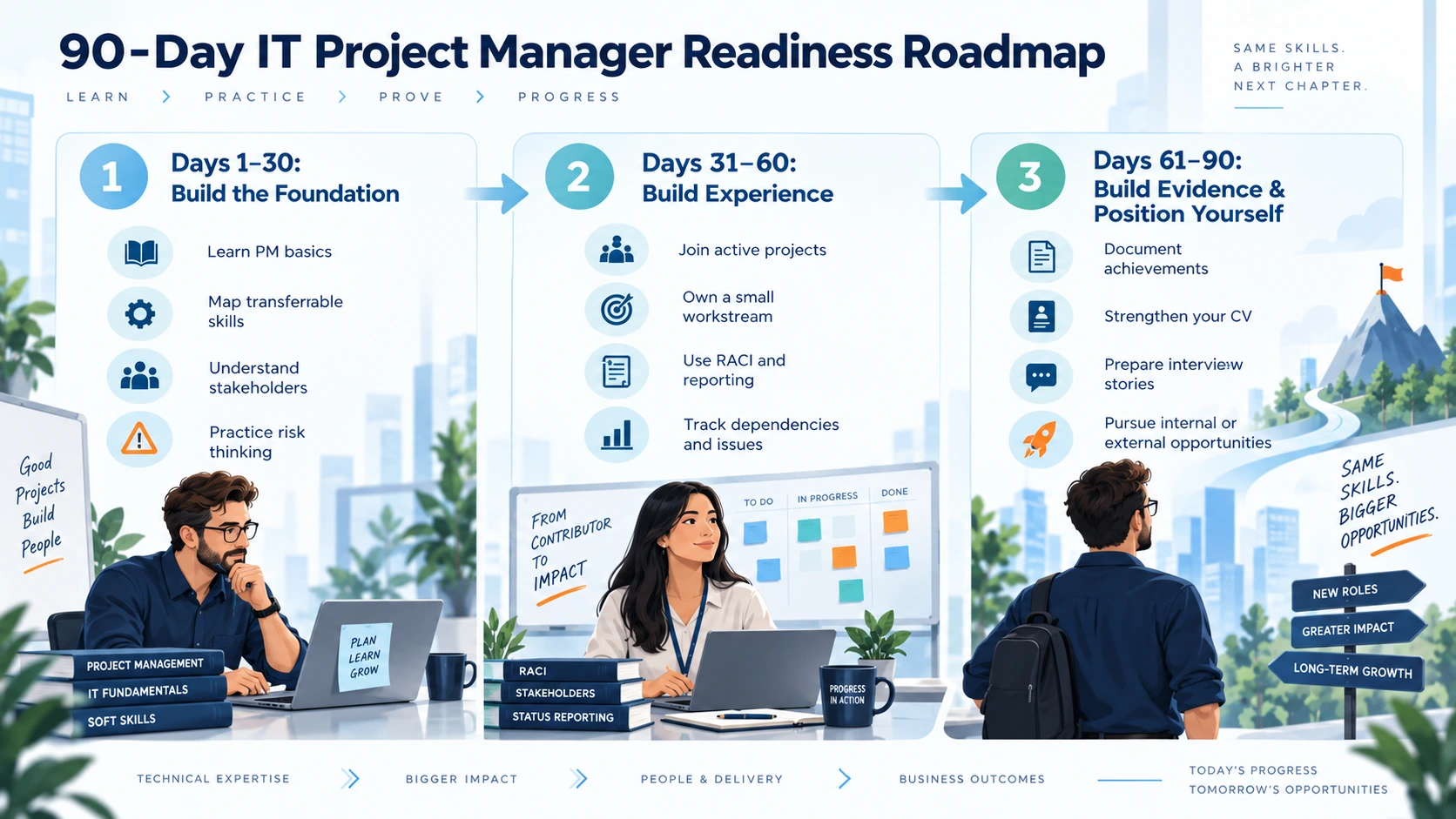
First Days 1–30: Build the Foundation
- Learn core project-management concepts and vocabulary.
- Map your transferable technical and coordination skills.
- Practice stakeholder mapping and communication.
- Start thinking beyond technical risk toward delivery, resource and organizational risk.
Then Days 31–60: Build Experience
- Participate actively in a real project or transformation initiative.
- Own a small workstream, milestone or coordination activity where appropriate.
- Use practical tools such as RACI, action logs, risk registers and status reporting.
- Track dependencies, issues and decisions across teams.
And Days 61–90: Build Evidence & Position Yourself
- Document genuine achievements and project responsibilities.
- Strengthen your CV around delivery, coordination and outcomes.
- Prepare interview stories using real situations, actions and lessons learned.
- Explore appropriate internal or external project-management opportunities.
At the end of 90 days, the goal is not simply to have studied project management. You should be able to show stronger knowledge, practical exposure and credible evidence of how you contribute to project delivery.
The First 90 Days as an IT Project Manager
Once you obtain your first project-management role, avoid trying to change everything immediately.
Days 1–30: Understand
Focus on:
- Business objectives
- Project scope
- Stakeholders
- Team structure
- Governance
- Current plan
- Major risks
- Dependencies
- Decision-making processes
Days 31–60: Stabilize
Improve visibility around:
- Ownership
- Milestones
- Risks
- Issues
- Dependencies
- Reporting
- Decisions
Days 61–90: Improve
Once you understand the environment, identify targeted improvements.
Ask:
- Where is coordination weak?
- Which meetings create value?
- Which reports are useful?
- Which risks require action?
- Where are decisions slow?
- What can be simplified?
How AI Is Changing IT Project Management
AI is increasingly becoming part of project-management workflows.
If you are considering this career path, our analysis of how AI may change the project manager role separates the activities AI can automate from the responsibilities that still depend on human leadership and accountability.
Depending on organizational policies and tools, AI may assist with:
- Drafting summaries
- Organizing meeting notes
- Analyzing project information
- Creating initial documentation
- Identifying patterns
- Supporting scenario analysis
- Preparing communication drafts
However, AI does not remove the need for:
- Judgment
- Accountability
- Stakeholder relationships
- Leadership
- Decision-making
- Context
Modern project managers should therefore develop both digital capabilities and human leadership skills.
To explore this evolution in more depth, see our complete guide to AI in project management, including practical use cases for planning, risk management, reporting, governance and decision support.
For hands-on examples, explore our 50 AI prompts for project managers for planning, risks, meetings, reporting and stakeholder communication. AI-generated outputs should still be reviewed using human judgment and your organization’s policies.
Technical Skills vs Human Skills in IT Project Management
Strong IT project management exists at the intersection of technology and people.
A useful model is:
Technology Understanding + Project Discipline + Human Leadership = Stronger IT Delivery
This is closely related to the broader relationship between technology and teamwork explored in our Technology and Teamwork guide.
A 6-Month Transition Plan From Technician to IT Project Manager
There is no universal timeline for becoming an IT project manager.
However, you can use a structured development plan to improve your readiness.
1st Month: Assess
- Review your existing experience
- Identify transferable skills
- Identify project-management gaps
- Choose a target role
2nd Month: Learn
- Study project-management fundamentals
- Learn risk and stakeholder management
- Understand Agile, predictive and hybrid approaches
- Practice project communication
3rd Month: Participate
- Join project activities
- Volunteer for coordination responsibilities
- Maintain a risk or action log
- Support status reporting
4th Month: Lead
- Lead a small workstream where appropriate
- Coordinate dependencies
- Facilitate meetings
- Track milestones
5th Month : Document
- Build your project portfolio
- Update your resume
- Prepare interview examples
- Document genuine outcomes
6th Month: Position
- Discuss internal opportunities
- Identify appropriate external roles
- Tailor applications
- Practice interviews
- Continue developing project experience
This is a development framework—not a promise that everyone can or should obtain a project-management role within six months.
Is IT Project Management a Good Career?
IT project management can be a strong career direction for technical professionals who enjoy combining technology knowledge with coordination, communication, leadership and business outcomes.
The role can broaden your exposure beyond a single technical domain. You may work across infrastructure, cloud, cybersecurity, applications, suppliers, operations and business teams while developing transferable skills in planning, stakeholder management, risk management and decision facilitation.
It is not the right path for everyone. Professionals who prefer deep hands-on technical work may choose to continue growing as architects, engineers or technical specialists. The better choice depends on the type of problems you want to solve and the responsibilities you want to own.
Career Path After Becoming an IT Project Manager
Project-management careers can develop in several directions depending on interests, experience and organization.
Possible paths include:
Technical Professional → Project Coordinator → IT Project Manager → Senior Project Manager → Program Manager
Other professionals may move toward:
- PMO leadership
- Portfolio management
- Product management
- Transformation leadership
- Technology leadership
- Consulting
Career paths are not always linear.
Frequently Asked Questions About Becoming an IT Project Manager
How Do I Become an IT Project Manager?
Start by assessing your existing project exposure, learning project-management fundamentals, developing stakeholder and leadership skills, taking on genuine project responsibilities and building evidence of your experience. You can then position that experience for internal or external project-management opportunities.
Can an IT Technician Become a Project Manager?
Yes. Technical professionals can transition into project management when they develop the broader planning, stakeholder, risk, communication and leadership capabilities required for the role.
Do I Need to Stop Being Technical to Become a Project Manager?
No. Technical knowledge can remain an advantage. The change is that your primary responsibility shifts toward coordinating the overall project rather than personally solving every technical problem.
Do I Need PMP to Become an IT Project Manager?
Not necessarily. Requirements vary between employers and roles. PMP is designed for professionals who meet PMI’s project leadership experience and training requirements. Other learning or certification options may be more appropriate earlier in your career.
Is CAPM Useful for IT Professionals?
CAPM may be relevant to people who want structured foundational project-management knowledge but do not yet have the project leadership experience required for PMP. Evaluate it against your specific career objectives and current PMI requirements.
What Skills Does an IT Project Manager Need?
Important capabilities include planning, stakeholder management, communication, leadership, risk management, dependency management, problem-solving, decision facilitation and sufficient understanding of the technology environment.
Can I Become a Project Manager Without Previous PM Experience?
You may be able to transition by gradually taking on project-related responsibilities such as workstream leadership, coordination, planning, risk management and reporting before moving into a formal project-manager position.
Is Technical Knowledge Important for an IT Project Manager?
It can be highly useful because it helps you understand technical dependencies, implementation risks and conversations with specialists. However, technical depth does not replace project-management and leadership skills.
Should I Learn Agile or Waterfall?
Learn the principles behind multiple approaches. Technology projects may use predictive, Agile or hybrid ways of working depending on the context.
How Long Does It Take to Become an IT Project Manager?
There is no universal timeline. It depends on your current experience, available project opportunities, skills, organization and target role. Focus on building genuine capability and evidence rather than chasing an arbitrary deadline.
Can AI Replace IT Project Managers?
AI can assist with parts of project work such as information organization, drafting and analysis, but project leadership also requires contextual judgment, accountability, stakeholder engagement, communication and decision-making.
Conclusion: From Technical Expert to IT Project Leader
Learning how to become an IT project manager is not about abandoning your technical background.
It is about building on it.
Your technical experience can help you understand systems, dependencies, risks and implementation challenges.
Project-management skills allow you to connect that expertise with people, planning, stakeholders, decisions and business outcomes.
The transition can be summarized as:
Technical Expertise → Project Exposure → PM Skills → Leadership → Evidence → Career Transition → IT Project Manager
Start by looking at the projects already happening around you.
Take responsibility for a small workstream.
Learn to manage risks and dependencies.
Improve your stakeholder communication.
Document genuine project outcomes.
Develop leadership skills.
And when you are ready, position your experience around what you have actually delivered—not simply the technical job title you previously held.
The most important shift is ultimately this:
From solving the technical problem yourself to enabling a team to deliver the right outcome together.
For professionals formalizing this career transition, our Project management certification guide explains the requirements, exam structure, preparation path and career value of the credential.
Continue Learning
Continue exploring TechTeamSynergy with these related guides.
Comments are closed.