
PMP certification is one of the world’s most recognized credentials for experienced project professionals. But the certification changed significantly in 2026, making it important for candidates to prepare against the current requirements rather than older PMP guides.
The Project Management Professional (PMP)® certification from the Project Management Institute (PMI) validates the ability to lead projects across predictive, Agile and hybrid environments. It is not limited to one industry or one project-management methodology. For the latest eligibility rules, exam structure and certification policies, check the official PMI PMP certification page.
The current PMP exam contains 180 questions completed in 240 minutes. Its three domains are People, Process and Business Environment, with considerably more emphasis on the business environment than the previous exam blueprint.
This complete guide explains the 2026 PMP certification requirements, eligibility pathways, application process, exam structure, preparation strategy, Agile and hybrid content, career considerations and how to maintain your certification after passing.
What Is PMP Certification?
PMP stands for Project Management Professional. It is a professional certification offered by the Project Management Institute.
PMP certification is designed for professionals who already have meaningful project-management experience and want to demonstrate their ability to lead projects, people and business outcomes.
Unlike certifications centered on one framework, PMP covers multiple ways of working, including:
- Predictive project management
- Agile approaches
- Hybrid delivery
- People and leadership
- Project processes
- Business and organizational context
PMI reports more than 1.7 million PMP certification holders worldwide.
For professionals moving from technical roles into project leadership, PMP can complement the practical skills discussed in our guide to becoming an IT Project Manager.
What Changed in PMP Certification in 2026?
The updated PMP exam launched in July 2026. This is particularly important because many PMP articles, courses and study notes online still describe the previous exam structure.
The revised exam places greater emphasis on:
- Business value
- Stakeholder engagement
- Artificial intelligence
- Sustainability
- Adaptive approaches
- Outcomes rather than outputs alone
The current domain weighting is:
- People — 33%
- Process — 41%
- Business Environment — 26%
You can review the official PMI information about the 2026 PMP exam update for the latest exam changes and preparation guidance.
This shift reflects an important evolution in project management. A modern project manager is not simply responsible for maintaining a schedule and tracking tasks. Project leaders increasingly need to understand organizational strategy, stakeholder expectations, business outcomes, technology and changing operating environments.
Is PMP Certification Worth It in 2026?
Whether PMP certification is worth pursuing depends on your experience, career direction and the type of project work you want to perform.
Professional credibility
PMP provides an externally recognized validation that you meet PMI’s project-management experience, training and examination requirements.
Transferability across industries
Project-management principles apply across technology, telecommunications, construction, financial services, healthcare, consulting and many other industries.
PMP is deliberately not tied to one specific industry.
Broader project-management knowledge
Preparing for PMP requires candidates to think beyond individual tools and methodologies.
You need to understand leadership, stakeholders, planning, delivery, risk, governance, Agile, predictive approaches and business outcomes.
Career development
PMP certification can be particularly relevant for professionals targeting positions such as:
- Project Manager
- Senior Project Manager
- Technical Project Manager
- IT Project Manager
- Program Manager
- Transformation Manager
- PMO roles
- Delivery Manager
Certification alone does not guarantee promotion or a particular salary. Experience, industry, geography, leadership capability and demonstrated results remain important.
Who Should Consider PMP Certification?
PMP is generally best suited to professionals who already participate significantly in project leadership.
You may be a good candidate if you:
- Lead projects or major workstreams.
- Coordinate multidisciplinary teams.
- Manage scope, schedule, cost or risk.
- Work with sponsors and stakeholders.
- Make project decisions.
- Are accountable for project delivery and outcomes.
- Want to move toward larger project or program responsibilities.
Technical professionals can also benefit. Engineers, developers, network specialists, cybersecurity professionals and architects frequently reach a point where career progression requires more than technical expertise.
They need to coordinate people, communicate with executives, manage dependencies and translate technical work into business outcomes.
PMP Certification Requirements in 2026
The current PMP certification requirements combine education, professional project-management experience and project-management training.
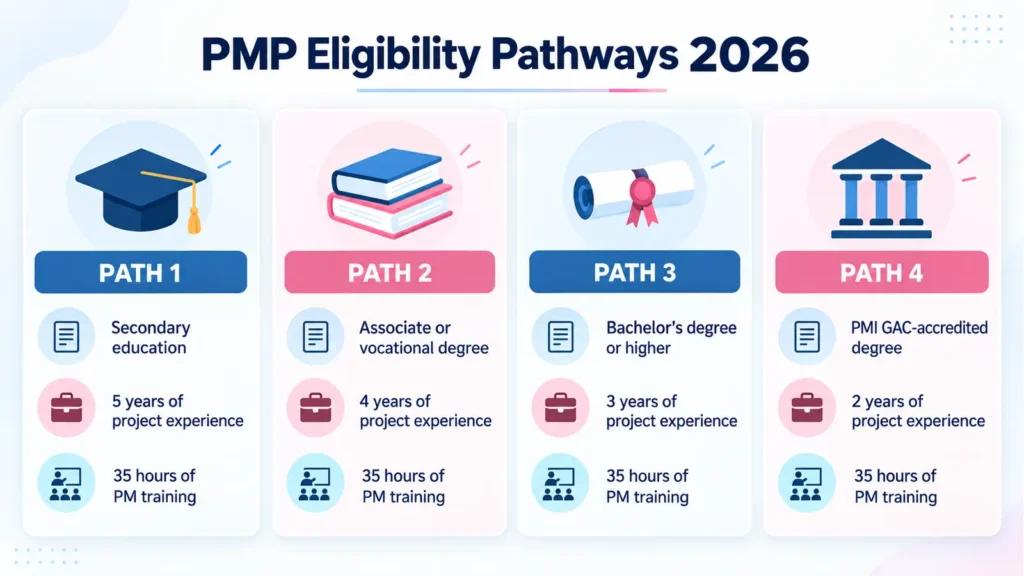
PMI currently provides four education and experience pathways.
PMP Eligibility Pathways at a Glance
| Education | Project experience | Training |
|---|---|---|
| Secondary education | 60 months (5 years) | 35 hours |
| Associate degree or vocational education | 48 months (4 years) | 35 hours |
| Bachelor’s degree or higher | 36 months (3 years) | 35 hours |
| PMI GAC-accredited degree | 24 months (2 years) | 35 hours |
An active CAPM certification or another currently accepted PMI route may satisfy the training requirement. Experience must fall within PMI’s applicable eligibility period.
What Counts as PMP Project-Management Experience?
One common misconception is that candidates must have held the formal job title “Project Manager.”
The important issue is what you actually did.
Qualifying professional experience can involve responsibility for areas such as:
- Planning
- Project decisions
- Delivery
- Project outcomes
For the current PMP certification requirements, qualifying experience should fall within the previous 10 years.
You should also avoid double-counting overlapping projects.
For example, suppose you managed Project A from January through June and Project B from March through August. You cannot simply add six months from Project A and six months from Project B and claim twelve months of experience. Overlapping calendar months cannot be counted twice.
The 35-Hour PMP Certification Training Requirement
In addition to project experience, candidates need 35 hours of qualifying project-management training.
Current options include qualifying self-paced and instructor-led learning. An active CAPM certification can also satisfy the PMP training requirement.
Important 2026 update: starting December 1, 2026, PMI states that live instructor-led PMP training, whether delivered online or in person, will qualify only when delivered through specified eligible providers. Self-paced courses can continue to come from any organization.
If you are enrolling in live PMP training close to or after that date, verify the provider’s eligibility directly with PMI before registering.
How to Apply for PMP Certification
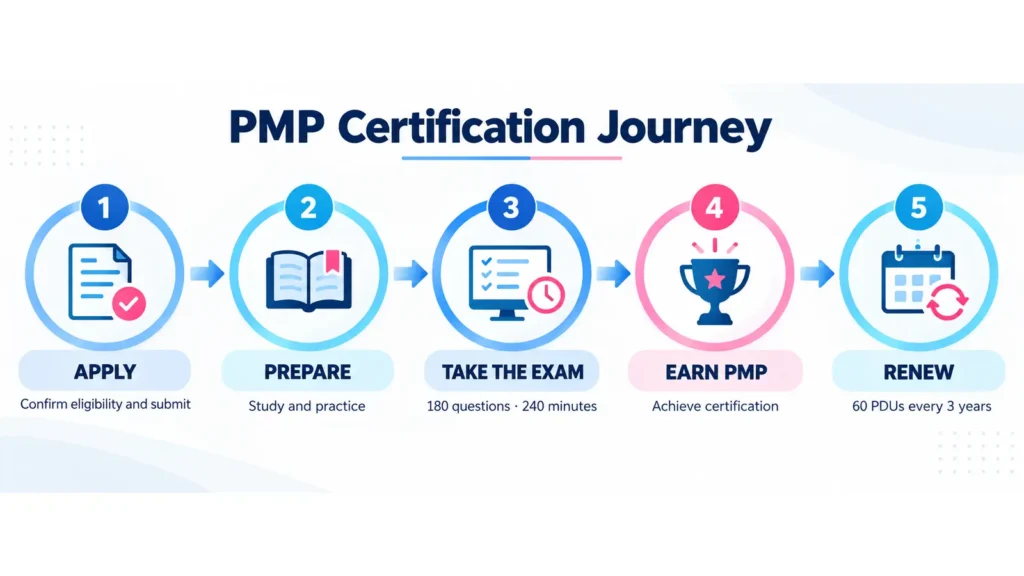
Step 1: Confirm your eligibility
Before starting the application, identify which eligibility pathway applies to you and confirm that you have the required project experience and training.
Step 2: Organize your project experience
Create a list of qualifying projects. For each project, identify:
- The organization
- Your role
- The project dates
- The project objective
- Your responsibilities
- Your involvement in planning, decisions, delivery and outcomes
Keep descriptions clear and factual. Do not inflate responsibilities or claim experience you cannot support.
Step 3: Document your training
Keep evidence of your qualifying project-management education.
Step 4: Complete the PMI application
Submit the required information through PMI’s certification application process.
Step 5: Be prepared for an audit
PMI may select applications for audit. Provide accurate information and retain supporting documentation.
Step 6: Pay and schedule the exam
After your application is accepted, you can complete the exam-payment and scheduling process.
PMP Certification Exam Format in 2026
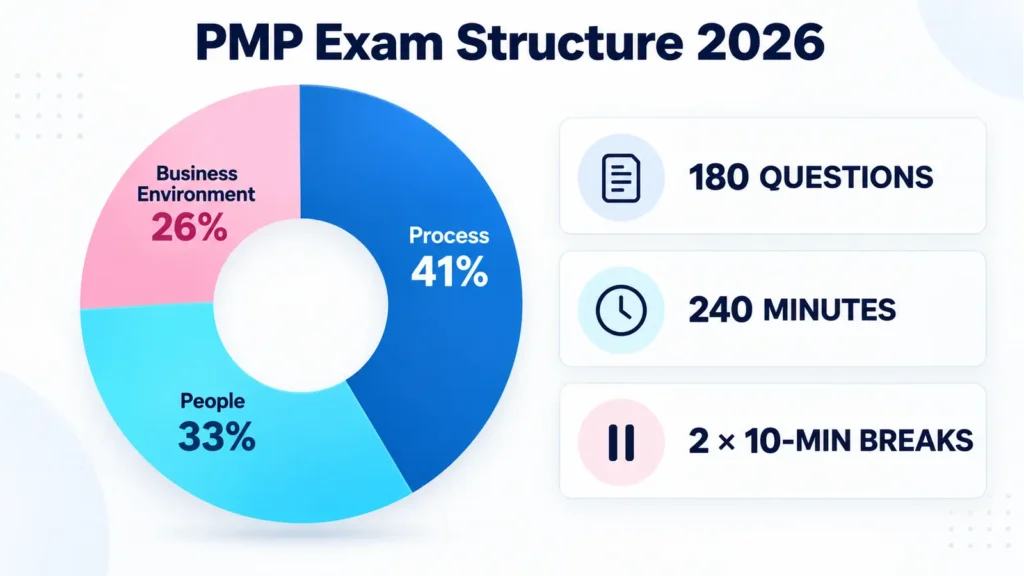
The current PMP certification exam has:
- 180 questions
- 240 minutes
- Two 10-minute breaks
- Three exam domains
- Predictive, Agile and hybrid project-management content
The exam is available through Pearson VUE testing centers and secure online delivery. PMI currently recommends test-center delivery.
PMP Certification Exam Domains
People — 33%
The People domain focuses on the human side of project leadership.
Topics can involve:
- Leadership
- Team performance
- Conflict
- Stakeholder relationships
- Communication
- Collaboration
- Coaching
- Empowerment
This is why memorizing project-management terminology is not enough. Candidates need to understand how an effective project leader should respond to realistic situations involving people.
Process — 41%
The Process domain covers the mechanisms used to plan, execute, monitor and deliver projects effectively.
Topics can include:
- Planning
- Scope
- Schedule
- Cost
- Quality
- Risk
- Procurement
- Change
- Issues
- Project delivery
Business Environment — 26%
The Business Environment domain has become significantly more important in the 2026 PMP certification exam.
Project managers increasingly need to understand how projects connect to:
- Business objectives
- Organizational strategy
- External changes
- Compliance
- Value delivery
- Sustainability
- Organizational change
This reflects a broader view of project management: successful project leadership involves connecting execution with organizational value.
Predictive, Agile and Hybrid Project Management
According to the official July 2026 PMP Exam Content Outline, approximately 40% of exam items represent predictive approaches, while the remaining 60% are split between adaptive/Agile and hybrid approaches. These approaches can appear in any exam domain; exact proportions vary by exam form.
PMP certification is not a “Waterfall certification.” Modern project managers need to understand multiple delivery approaches and determine which approach fits the situation.
Predictive
Predictive approaches emphasize planning the project and its major constraints in advance.
They can work well when requirements and delivery conditions are sufficiently understood and stable.
Our Waterfall vs V-Model guide explores structured predictive approaches in more detail.
Agile
Agile approaches emphasize iterative delivery, collaboration, feedback and adaptation.
They are particularly useful when requirements or solutions are expected to evolve.
See our complete guide to Agile for the underlying principles and ways of working. For clearer decision rights across teams, compare RACI vs RASCI vs DACI.
Hybrid
Hybrid project management combines elements of predictive and adaptive approaches.
For example, an organization might maintain structured governance, funding milestones and regulatory controls while product teams use iterative Agile delivery.
The PMP candidate should therefore avoid assuming one methodology is always correct.
The better question is: which approach best fits the project’s context, uncertainty, constraints and desired outcomes?
AI and PMP Certification in 2026
Artificial intelligence is increasingly becoming part of professional project work. Our AI in Project Management guide explores practical applications, governance and the skills project managers need in 2026.
AI can potentially support activities such as those below. For a practical workflow focused on uncertainty, ownership and human validation, see our guide to AI for project risk management.
- Analyzing project information
- Identifying patterns in project data
- Supporting risk analysis
- Summarizing meetings and documentation
- Generating draft communications
- Supporting planning and forecasting
- Improving knowledge access
But AI does not remove the project manager’s accountability.
Project leaders still need to evaluate information quality, protect sensitive data, consider organizational policies, understand limitations and apply professional judgment. For practical safeguards, explore our AI governance for project managers guide.
PMBOK and PMP Certification
Another common mistake is assuming the PMP exam is simply a test of whether you memorized the PMBOK Guide.
It is not.
The exam is based on the PMP Exam Content Outline and tests how candidates apply project-management principles to situations.
PMBOK remains an important project-management resource, but PMP preparation should focus on understanding concepts and applying them appropriately rather than memorizing pages or definitions.
How to Prepare for PMP Certification
Successful PMP certification preparation requires more than reading a book once.
A strong approach combines conceptual learning, scenario practice and review.
1. Start with the current Exam Content Outline
Use the current 2026 ECO as your map. This protects you from preparing against outdated exam weightings.
2. Understand the concepts
Learn why project-management practices exist rather than simply memorizing terminology.
3. Learn predictive, Agile and hybrid thinking
You should be comfortable switching between approaches. A question may describe a predictive project, an Agile team or a hybrid environment.
4. Practice scenario-based questions
Many PMP questions place you in a realistic project situation and ask what the project manager should do.
The challenge is often choosing between several plausible answers.
5. Review mistakes carefully
For every incorrect practice answer, determine:
- Why your answer was wrong.
- Why the correct answer was stronger.
- Which principle you misunderstood.
- Whether the mistake reflects a recurring knowledge gap.
A Practical PMP Certification Study Plan
Phase 1: Understand the exam
Review the current ECO, eligibility requirements, exam domains and question style.
Phase 2: Build core knowledge
Study leadership, project processes, business environment, predictive approaches, Agile and hybrid delivery.
Phase 3: Practice by topic
Use practice questions to identify weak areas.
Phase 4: Increase scenario practice
Move toward mixed questions where you must first identify the context before selecting an answer.
Phase 5: Simulate the exam
Complete longer timed practice sessions to develop both knowledge and concentration.
Phase 6: Final review
Review weak concepts rather than trying to relearn everything immediately before the exam.
How to Approach PMP Scenario Questions
Scenario questions often describe a problem and ask what the project manager should do first, next or most appropriately.
A useful reasoning process is:
- Identify the delivery environment: predictive, Agile or hybrid.
- Identify the actual problem.
- Determine whether more assessment is needed before acting.
- Consider stakeholders and team responsibilities.
- Check whether an established process or governance mechanism applies.
- Prefer responses that address root causes rather than symptoms.
- Avoid unnecessary escalation when the project manager can appropriately address the issue.
The exam is testing professional judgment, not merely vocabulary.
Applying PMP Principles in Practice
Project Governance and PMP Certification
Project managers operate within governance structures. They need to understand who is responsible, who approves decisions, who needs information and when escalation is appropriate.
One practical governance tool is the RACI matrix.
Our RACI Matrix guide explains how Responsible, Accountable, Consulted and Informed roles can clarify project responsibilities.
Measuring Project Success
Traditional project management frequently emphasizes scope, schedule and cost. These remain important, but modern project success increasingly considers outcomes and value as well. Project managers who need a stronger commercial foundation can continue with our finance for non-finance professionals guide.
A project delivered on schedule can still be unsuccessful if nobody uses the resulting product or if the expected business benefits never appear.
Project managers should therefore understand both delivery indicators and business outcomes.
Our KPI vs OKR guide provides a useful introduction to different approaches for measuring performance and outcomes.
Project Management Tools and PMP Certification
PMP does not certify expertise in one project-management application.
However, project managers need tools to support planning, collaboration, issue tracking, reporting and delivery. For teams that use spreadsheets for status and KPI reporting, an Excel project dashboard can provide a lightweight visual control layer alongside the main project-management system.
The appropriate tool depends heavily on the organization’s way of working.
For a practical comparison, see Asana vs monday.com vs ClickUp vs Jira.
PMP Certification Exam Day: What to Expect
The current exam contains 180 questions and allows 240 minutes. Two 10-minute breaks are included.
Before exam day:
- Confirm your appointment.
- Review identification requirements.
- If testing online, complete the required system checks.
- Understand the break structure.
- Get adequate rest.
During the exam, manage your time carefully. A difficult question should not consume so much time that you cannot complete the rest of the exam.
After PMP Certification: Renewal and Career Development
What Happens After You Earn PMP Certification?
Passing the exam is an important achievement, but PMP is not a lifetime certification requiring no further activity.
PMP holders need to maintain the credential through continuing professional development.
Maintaining PMP Certification: The 60-PDU Requirement
PMP certification holders currently need to earn 60 Professional Development Units (PDUs) during each three-year certification cycle.
Continuous professional development is particularly important because project management continues to evolve through Agile, AI, new technology, sustainability and changing organizational models.
PMP Certification and Career Development
PMP certification should be viewed as one part of professional development rather than the final destination.
Career progression also depends on your ability to:
- Lead people
- Communicate effectively
- Manage stakeholders
- Understand business priorities
- Resolve complex problems
- Deliver measurable outcomes
- Learn continuously
PMI reports higher median salaries among PMP-certified respondents than among non-certified professionals in its salary research. However, salary outcomes vary substantially by geography, industry, seniority and experience.
Certification should therefore be viewed as a credibility and capability signal rather than a guaranteed salary increase.
PMP Certification for IT and Technology Professionals
PMP certification can be particularly valuable for technology professionals moving into broader leadership positions.
Consider an experienced network engineer. Technical expertise may be sufficient for designing infrastructure, troubleshooting problems and making engineering decisions.
But leading a major network transformation can also require:
- Budget management
- Vendor coordination
- Stakeholder communication
- Risk management
- Migration planning
- Governance
- Cross-functional leadership
- Business-case understanding
The same applies to cloud, cybersecurity, AI, software and digital-transformation initiatives.
Technical knowledge remains valuable, but project leadership adds another capability layer.
PMP Certification vs Agile, Scrum and SAFe
Agile, Scrum, PMP and SAFe should not automatically be viewed as competing alternatives.
PMP
PMP validates broad project-leadership capability across predictive, Agile and hybrid environments.
Agile
Agile represents principles and ways of working centered on collaboration, feedback and adaptation.
Scrum
Scrum is a specific framework commonly used for iterative product development.
SAFe
SAFe provides an approach for coordinating Agile practices and value delivery across larger organizations.
Our SAFe guide explores the framework in more detail.
The right learning path depends on your role. A project manager may benefit from PMP while also developing Agile expertise, while transformation leaders may need broader knowledge of enterprise agility and scaled delivery.
Common PMP Certification Preparation Mistakes
Using outdated exam information
This is especially risky in 2026 because the PMP exam changed in July. Always check that study resources align with the current exam.
Memorizing instead of understanding
Knowing terminology is useful, but scenario questions require judgment.
Ignoring Agile and hybrid delivery
PMP is no longer appropriately understood as purely traditional project management.
Ignoring the Business Environment domain
With 26% of the current exam associated with Business Environment, candidates should not treat it as a minor topic.
Studying without practicing questions
Conceptual understanding and exam-question interpretation are different skills.
Focusing only on your own professional experience
Your workplace may manage projects differently from the principles and scenarios assessed by the PMP exam.
Choosing answers based only on authority
The project manager’s first response is not always to escalate. Effective project leadership often involves assessment, collaboration and appropriate problem-solving before escalation.
Frequently Asked Questions About PMP Certification
What is PMP certification?
PMP is the Project Management Professional certification offered by the Project Management Institute. It validates project-leadership capability across predictive, Agile and hybrid ways of working.
How many questions are on the PMP certification exam in 2026?
The current PMP exam contains 180 questions.
How long is the PMP certification exam?
Candidates currently receive 240 minutes, or four hours, to complete the exam.
What are the PMP exam domains in 2026?
The current domains are People at 33%, Process at 41% and Business Environment at 26%.
How much project-management experience do I need?
It depends on your education. Current pathways range from five years for candidates with secondary education to two years for candidates with qualifying PMI GAC-accredited degrees. Other pathways require three or four years.
Do I need 35 hours of PMP training?
Yes. PMP candidates need 35 hours of qualifying project-management training unless they satisfy the requirement through an active CAPM certification or another currently accepted PMI route.
Do I need the job title Project Manager to qualify?
No. Your job title is not the central issue. Your professional experience needs to demonstrate qualifying responsibility for managing projects.
Is PMP certification only for Waterfall project management?
No. PMP covers predictive, Agile and hybrid ways of working.
Does the PMP exam include AI?
Yes. The 2026 exam update increases attention to artificial intelligence as part of the changing environment in which project professionals work.
Is PMP certification worth it?
It can be valuable for experienced professionals seeking a recognized project-management credential, broader project-leadership knowledge or progression into more significant delivery responsibilities. Its value depends on your career goals and market.
How do I maintain PMP certification?
PMP holders currently need 60 PDUs during each three-year renewal cycle. PMI explains the categories and renewal process in its official certification-maintenance guide.
Can I take the PMP certification exam online?
Yes. PMI currently provides both testing-center and secure online delivery options, although PMI recommends Pearson VUE testing centers.
How many times can I take the PMP exam?
PMI currently permits up to three exam attempts within the applicable one-year eligibility period.
Conclusion: PMP Certification Is About Project Leadership
PMP certification remains an important professional credential for experienced project leaders, but the 2026 exam makes one point especially clear: modern project management is about much more than schedules, processes and documentation.
Today’s project manager needs to lead people, navigate uncertainty, understand different delivery approaches, engage stakeholders, manage risk and connect project execution to business value.
The revised PMP exam reflects that reality through its People, Process and expanded Business Environment domains, along with increased attention to AI, sustainability and adaptive delivery.
If you decide to pursue PMP certification, begin with the current requirements rather than old study material. Confirm your eligibility, complete the required training, understand the current Exam Content Outline and build your ability to reason through realistic project scenarios.
Most importantly, treat PMP preparation as an opportunity to become a stronger project leader rather than simply an exercise in passing an exam.
The certification may validate your knowledge, but your long-term career will depend on how effectively you apply that knowledge to people, projects and business outcomes.
Continue Learning
Continue exploring TechTeamSynergy with these related guides.