
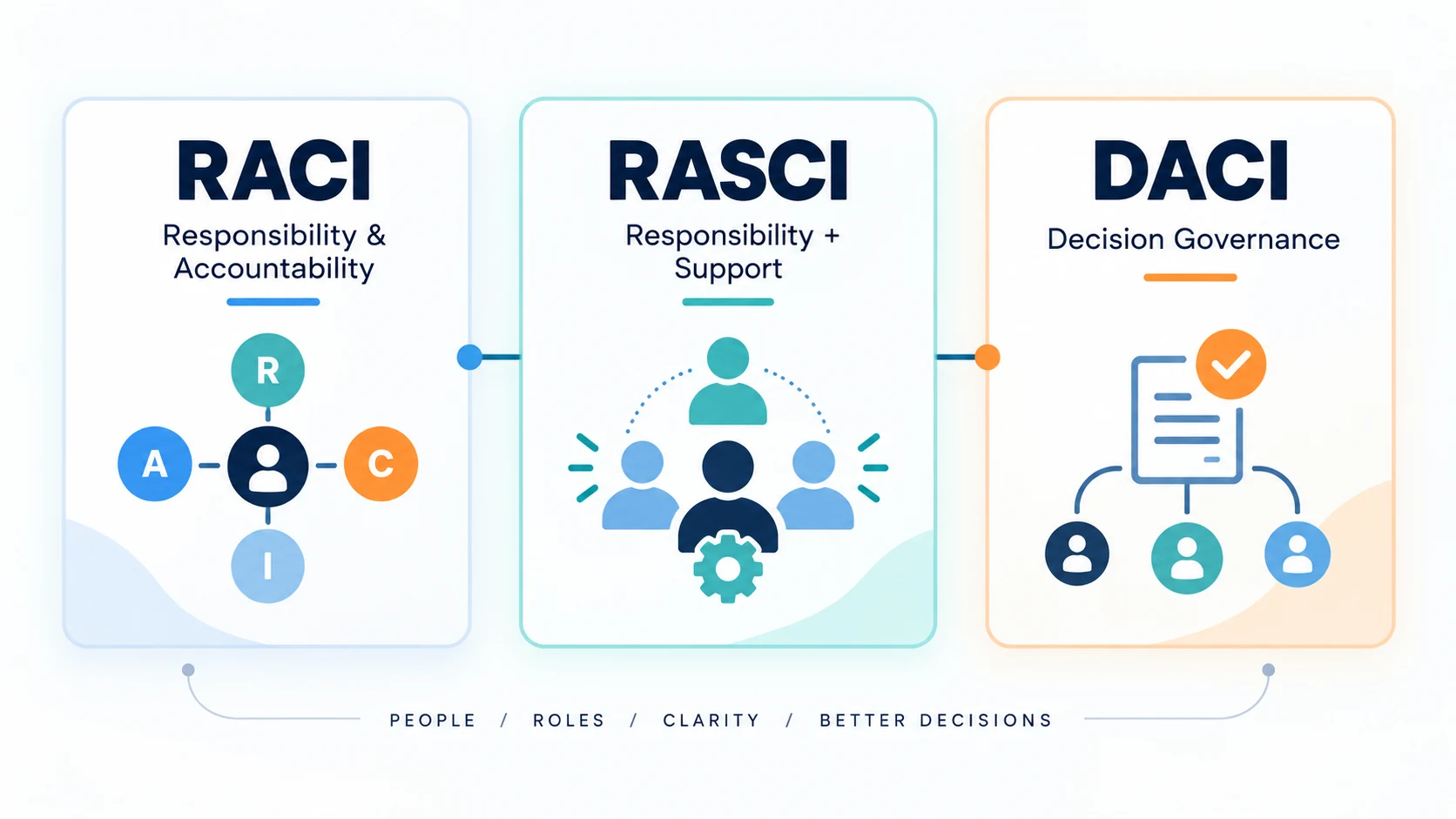
RACI vs RASCI vs DACI compares three related governance frameworks, but they are not interchangeable. RACI focuses on clarifying responsibility and accountability. RASCI extends that model by making recurring support explicit. DACI focuses more directly on how a decision is driven, informed and approved.
The right choice depends on the problem you are trying to solve. If delivery ownership is unclear, RACI may be enough. When support work is substantial and recurring, RASCI can add useful visibility. By contrast, DACI may be more appropriate when decisions are slow or authority is unclear. In complex initiatives, teams can also combine RACI or RASCI for delivery governance with DACI for selected high-impact decisions.
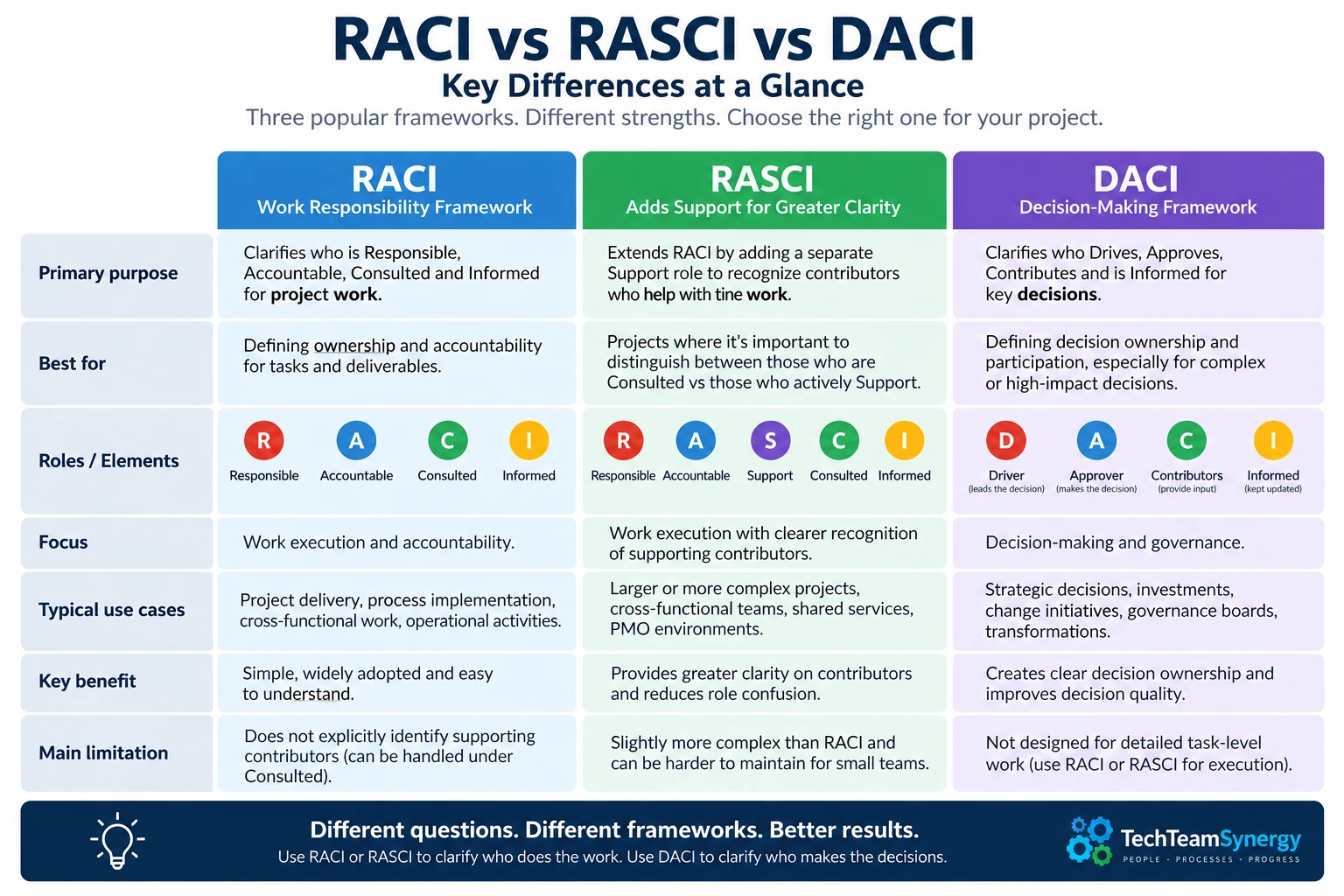
RACI vs RASCI vs DACI at a Glance
| Framework | Primary Purpose | Key Roles | Best For | Main Strength | Main Limitation |
|---|---|---|---|---|---|
| RACI | Responsibility and accountability clarity | Responsible, Accountable, Consulted, Informed | Cross-functional delivery and ownership clarity | Simple, widely understood responsibility model | Does not explicitly distinguish support or structure the decision process |
| RASCI | Responsibility plus explicit support | Responsible, Accountable, Support, Consulted, Informed | Work where recurring support roles matter | Makes hands-on support visible without assigning ownership to it | Extra role can create ambiguity if Support is poorly defined |
| DACI | Decision governance | Driver, Approver, Contributors, Informed | Important cross-functional decisions | Makes decision ownership and decision flow explicit | Not designed to assign every delivery task |
A quick way to choose is to ask what kind of ambiguity you have: ownership of work, visibility of support, or ownership of a decision.
The Core Difference: Responsibility, Support and Decision Authority
Responsibility and Accountability
RACI primarily makes execution relationships visible. It clarifies who performs work, who owns the outcome, whose input is required and who needs visibility. The Project Management Institute defines RACI as a type of responsibility assignment matrix using Responsible, Accountable, Consulted and Informed statuses to describe stakeholder involvement in project activities.
Therefore, RACI is especially useful when a project crosses functions, teams or organizational boundaries and people are unclear about who should do what.
Explicit Execution Support
RASCI is commonly defined as a RACI variant that adds Support or Supporting. Cornell University describes this role as people who provide assistance to the Responsible party but do not necessarily own the work or need to be consulted before every action.
As a result, the distinction matters when support is not occasional. Operations, shared services, vendor engineers or implementation specialists may repeatedly help execute work without owning the outcome.
Decision Ownership and Decision Flow
DACI centers more explicitly on the decision process. The Driver frames and moves the decision forward, the Approver makes the decision, Contributors provide expertise, and Informed stakeholders receive the outcome. Atlassian’s DACI play is a useful reference for this decision-oriented model.
RACI can also be applied to decisions; it should not be presented as a task-only model. Cornell explicitly notes that RACI can be mapped to tasks, deliverables or decisions depending on context. The difference is that DACI makes the mechanics of getting a decision prepared, informed and closed more explicit.
What Is RACI?
RACI uses four roles: Responsible, the person or team performing the work; Accountable, the person who owns the result; Consulted, people whose input is required; and Informed, people who need visibility.
For that reason, this article only summarizes those roles because TechTeamSynergy’s complete RACI Matrix guide owns the foundational methodology, including how to build and validate a responsibility matrix.
Where RACI Works Best
RACI is strongest when cross-functional delivery creates uncertainty around ownership, handoffs, approvals or shared activities. It can help project teams make accountability visible without forcing every stakeholder into active participation.
Where RACI Can Struggle
However, RACI becomes less useful when teams overload the Consulted role, confuse Responsible with Accountable, hide recurring support inside Responsible, or expect the matrix to solve a decision bottleneck that is really about approval authority and decision flow.
What Is RASCI?
RASCI is commonly used as a RACI variant with an added Support role. The basic idea is simple: some people actively help execution without becoming Responsible for the activity or merely serving as advisors.
Because organizations use RASCI terminology somewhat differently, teams should document what Support means locally rather than assume one universal formal standard. Cornell defines Support as people who provide assistance to the Responsible party, while other organizations may use slightly different wording or operating conventions.
When the Support Role Adds Value
In practice, Support is useful when help is material, recurring and operationally important. For example, engineering specialists may assist a rollout, Operations may support a migration, shared services may enable implementation, or vendor specialists may provide hands-on technical assistance without owning the outcome.
Support vs Responsible vs Consulted
Responsible performs or owns execution responsibility for the assigned work.
In practice, Support assists the Responsible role with meaningful execution effort.
Consulted provides expertise, advice or required input.
In other words, if all three labels describe the same behavior in practice, the matrix is too complicated.
When RASCI Becomes Too Complex
Do not add Support merely because a fifth role seems more complete. If assistance is occasional, informal or already clear from the way the team works, standard RACI may be easier to understand and maintain.
What Is DACI?
DACI is a decision-making framework built around four roles: Driver, Approver, Contributors and Informed.
Atlassian’s Team Playbook describes the Driver as the person who gathers the right people and information and gets the decision made by the agreed date. The Approver is the person with final decision authority. Contributors bring subject-matter knowledge and recommendations. Informed stakeholders are told the outcome because it affects their work.
What the Driver Actually Does
The Driver frames the decision, gathers input, coordinates contributors, resolves open information needs and keeps the decision moving toward closure. The role is active and process-oriented.
However, the Driver is not automatically the decision-maker.
Why the Approver Must Be Clear
For example, a DACI process loses much of its value if nobody knows who has the final say. In the commonly used Atlassian model, there is one Approver for the decision. As a result, teams can reduce situations where several stakeholders behave as if they each hold veto or approval authority.
Contributors vs Responsible Roles
By contrast, Contributors are not the DACI equivalent of RACI’s Responsible role. They provide expertise and recommendations to improve a decision. Although they may perform analysis, their role in DACI is to inform the decision rather than own delivery of the broader project work.
RACI vs RASCI: What’s the Real Difference?
The practical difference between RACI and RASCI is the explicit Support role.
| Question | RACI | RASCI |
|---|---|---|
| Who performs the work? | Responsible | Responsible |
| Who owns the outcome? | Accountable | Accountable |
| Is recurring hands-on support explicit? | Not as a separate role | Yes, through Support |
| Who provides required advice/input? | Consulted | Consulted |
Before adding S, ask four questions:
- Does the support remain substantial and recurring?
- Can it be clearly distinguished from execution ownership?
- Would a Consulted role already cover the input needed?
- Will the new role remove ambiguity, or simply create another vague category?
If Support has no distinct behavior or expectation, RACI is usually simpler.
RACI vs DACI: Responsibility vs Decision-Making
Although RACI and DACI overlap around governance, they ask different primary questions.
For RACI, the core question is: Who participates in and owns this work or outcome?
DACI asks: Who drives this decision, who approves it, whose expertise informs it and who needs the result?
Example: Enterprise CRM Implementation
Assume a program must choose its CRM integration architecture.
For example, a RACI model can clarify who is Responsible and Accountable for architecture work, security review, data migration, testing and deployment. It can also show which groups must be Consulted or Informed around those activities.
A DACI model can separately govern the architecture decision:
- Driver: Architecture Lead coordinating the decision.
- Approver: CIO or designated technology executive with final authority.
- Contributors: Security, Integration, Operations, Business and Vendor specialists.
- Informed: Delivery teams and stakeholders affected by the chosen architecture.
Therefore, the two models answer different questions and can coexist without creating a conflict.
RASCI vs DACI: Why They Are Usually Not Direct Alternatives
Although RASCI and DACI are often compared because both extend beyond basic RACI terminology, they usually solve different problems.
In practice, RASCI remains primarily an execution and responsibility model. It adds visibility for people who support the Responsible role.
By contrast, DACI is primarily a decision-process model. It clarifies who drives a decision, who can make it, who contributes expertise and who receives the outcome.
Therefore, a project can use RASCI for delivery and DACI only for selected decisions without contradiction.
When Should You Use RACI?
Use RACI when:
- deliverable ownership is unclear;
- responsibilities overlap across teams;
- cross-functional work creates ambiguity;
- handoffs repeatedly fail;
- people disagree about who owns an outcome;
- too many stakeholders are involved without clear participation expectations.
Reconsider RACI When the Main Problem Is the Decision Process
If everyone knows who performs the work but nobody knows who can make a decision, a responsibility matrix alone may not solve the bottleneck. The problem may require explicit decision governance instead.
When Should You Use RASCI?
Use RASCI when recurring support is important enough to deserve explicit visibility. For example, this can apply to shared services, technical specialists, operations teams, implementation partners and vendors that contribute hands-on effort without owning the final outcome.
When Plain RACI Is Enough
Therefore, stay with RACI when Support would simply mean occasional help. A new role should clarify behavior, not add administrative detail.
When Should You Use DACI?
Use DACI when:
- important decisions stall;
- approval authority is unclear;
- several people believe they have approval rights;
- nobody owns moving the decision toward closure;
- governance forums repeatedly defer the same issue;
- contributors and decision-makers are mixed together.
DACI Is Not a Delivery Task Matrix
However, DACI should not replace the project plan, work breakdown structure or responsibility matrix. Instead, use it for decisions important enough to require explicit roles and a visible path to closure.
Can You Use RACI and DACI Together?
Yes—selectively.
Delivery Governance
Use RACI or RASCI to clarify responsibility and accountability across workstreams, deliverables, handoffs and operational activities.
Decision Governance
Use DACI for significant decisions where the process itself needs structure: architecture choices, vendor selection, major scope trade-offs, investment decisions, go-live decisions or escalations.
Avoid Governance Duplication
Do not create a DACI for every row of a RACI matrix. Otherwise, you create duplicate governance and unnecessary maintenance overhead.
Instead, use RACI or RASCI as the delivery map and introduce DACI only where a decision is important, contested or repeatedly delayed.
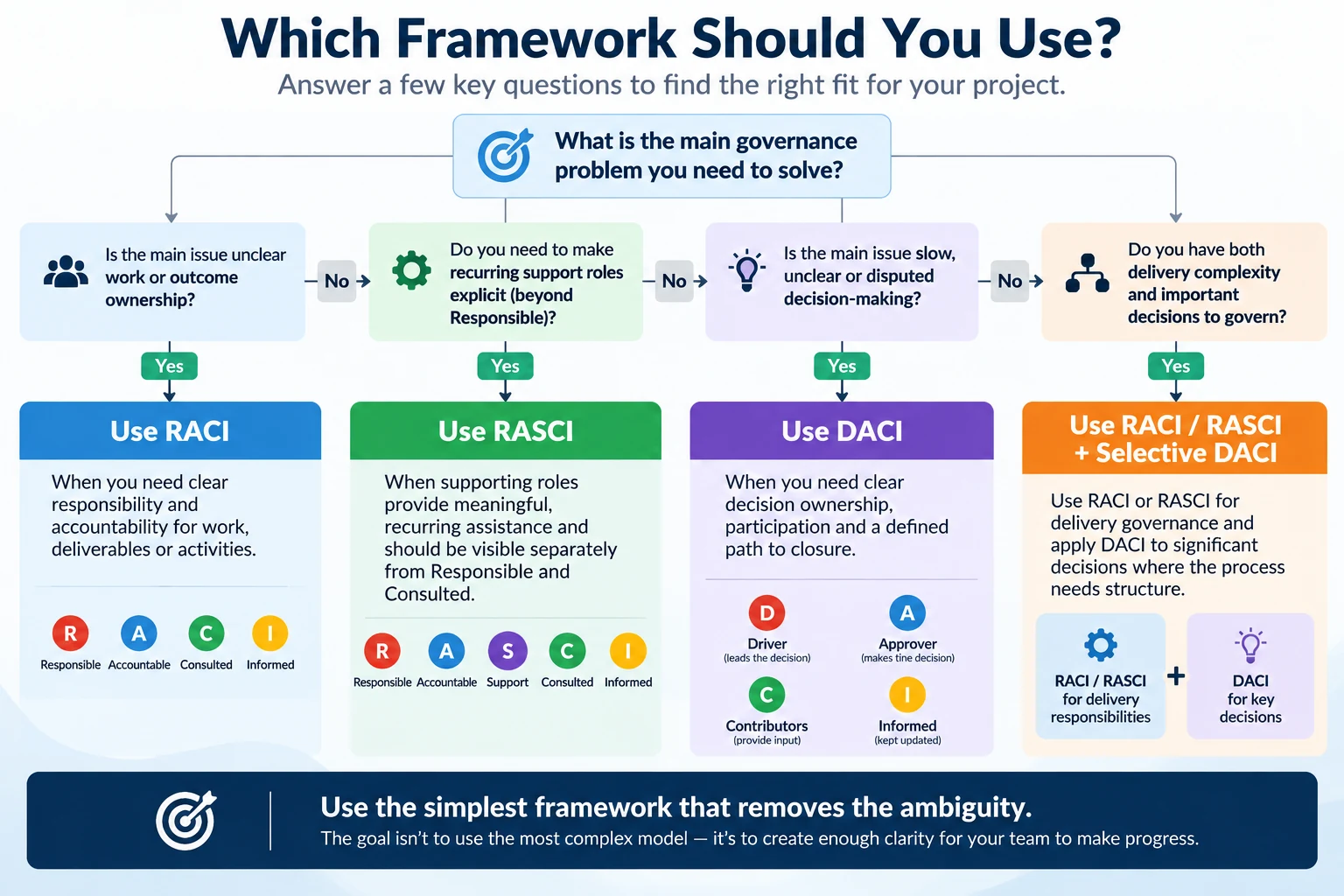
RACI vs RASCI vs DACI Decision Framework
- Is the main problem unclear work or outcome ownership? Start with RACI.
- Does recurring hands-on support need explicit visibility? Consider RASCI.
- Is the main problem slow or unclear decision-making? Consider DACI.
- Do you have both delivery complexity and important decision complexity? Use RACI or RASCI for delivery and selective DACI for major decisions.
The goal is not to deploy the most elaborate framework. It is to use the simplest governance mechanism that removes the ambiguity.
RACI vs RASCI vs DACI in Practice: One Project, Three Frameworks
The Project Situation
Consider an enterprise CRM implementation involving Business, IT, Architecture, Security, a software vendor and Operations. In this case, the program includes configuration, integration, data migration, security review, testing, cutover and transition to support.
What RACI Would Clarify
RACI can identify responsibility and accountability for major implementation activities. For example, IT may be Responsible for integration delivery while Architecture is Accountable for the technical design. Security may own security validation. Operations may own production acceptance.
For a broader library of worked scenarios, see TechTeamSynergy’s practical RACI matrix examples.
What RASCI Adds
Suppose the vendor’s engineers repeatedly assist IT with configuration, troubleshooting and migration, while Operations provides recurring environment support. RASCI can make those support relationships explicit without turning every supporting participant into a Responsible role.
What DACI Adds
Now consider a high-impact decision: whether to delay go-live because an integration risk remains unresolved.
DACI can identify a Driver who gathers the evidence and coordinates the discussion, one Approver with final authority, Contributors from Business, IT, Security, Architecture and the vendor, and the stakeholders who must be Informed once the decision is made.
One project can therefore use different frameworks for different governance problems.
Common Mistakes When Choosing a Framework
- Choosing RASCI because five roles look more complete. More labels do not automatically create more clarity.
- Using DACI for every task. DACI is designed around decisions, not routine work assignment.
- Treating the Driver as the Approver. The Driver moves the process; the Approver decides.
- Confusing Contributors with Responsible roles. Expertise in a decision does not automatically create delivery ownership.
- Assigning several unclear Accountables. Shared accountability often hides unresolved authority.
- Overloading Consulted roles. Too many mandatory consultations can slow execution.
- Using Support as a catch-all. Define what assistance is expected.
- Treating a matrix as an org chart. Governance roles should reflect the work or decision, not hierarchy alone.
- Mixing definitions without documenting them. Agree on local role meanings first.
- Creating artifacts nobody maintains. A stale matrix is worse than a simple current one.
- Expecting one model to solve every governance problem. Different problems may need different tools.
RACI, RASCI or DACI in Agile and SAFe?
These frameworks should supplement, not replace, established Agile or SAFe accountabilities. After all, Scrum, Product Owner responsibilities, Agile team accountability, ART roles and PI Planning mechanisms already provide important governance.
However, selective use can still help where work crosses organizational boundaries—for example supplier responsibilities, architecture, security, external approvals, shared services or major cross-team decisions.
Current SAFe guidance on PI Planning describes PI Planning as an ART-wide event for alignment, dependency management and fast decisions. TechTeamSynergy’s SAFe PI Planning guide and PI Planning readiness checklist provide the broader context. Use RACI, RASCI or DACI only where they add clarity beyond those existing mechanisms.
RACI vs RASCI vs DACI Selection Checklist
- Is the main problem execution ownership or decision ownership?
- Does the outcome already have clear accountability?
- Are several teams performing related work?
- Does recurring support differ materially from responsibility?
- Can Support be clearly distinguished from specialist consultation?
- Is final decision authority unclear?
- Does someone need to actively drive the decision process?
- Are too many stakeholders behaving as approvers?
- Do contributors need structured participation?
- Would RASCI add clarity or simply another role?
- Is DACI required only for selected major decisions?
- Would separate delivery and decision frameworks be clearer than forcing one model to do everything?
Therefore, if the answers point to more than one problem, combine frameworks only where the additional structure has a clear purpose.
Frequently Asked Questions
What is the difference between RACI and RASCI?
RASCI adds an explicit Support role to RACI. Use it when recurring hands-on assistance needs to be visible and is meaningfully different from both execution responsibility and consultation.
What is the difference between RACI and DACI?
RACI primarily clarifies responsibility and accountability around work, deliverables or decisions. DACI focuses more explicitly on the decision process by identifying a Driver, one Approver, Contributors and Informed stakeholders.
Is RASCI better than RACI?
No. RASCI is useful when Support is a genuinely distinct role. If support is occasional or already obvious, adding another category can make the model harder to maintain without creating more clarity.
When should you use DACI instead of RACI?
Consider DACI when the main problem is slow, disputed or unclear decision-making rather than delivery ownership. It is especially useful when no one is driving the decision or final approval authority is ambiguous.
Can RACI and DACI be used together?
Yes. RACI or RASCI can define delivery responsibility while DACI governs selected important decisions. The key is to avoid duplicating every responsibility in both models.
What does Support mean in RASCI?
Support commonly refers to people or teams that provide meaningful assistance to the Responsible role. The exact definition can vary by organization, so teams should document the term before using the matrix.
What does Driver mean in DACI?
The Driver organizes and moves the decision process forward. The Driver gathers information, coordinates Contributors, resolves open actions and keeps the decision on track, but does not automatically have final decision authority.
Does DACI replace RACI?
Not necessarily. DACI and RACI address different governance needs. DACI can supplement a responsibility model when selected decisions need more explicit process and authority.
Which framework works best in Agile projects?
There is no universal best framework for Agile projects. Use established Agile accountabilities first, then add RACI, RASCI or DACI selectively where organizational boundaries, external stakeholders or major decisions create ambiguity.
Can one project use more than one governance framework?
Yes. A complex program may use RACI or RASCI across delivery workstreams and DACI for selected architecture, investment, vendor or go-live decisions. The combination should remain simple enough to maintain.
RACI vs RASCI vs DACI: Choose Based on the Governance Problem
Choose based on the ambiguity you need to remove.
For responsibility and accountability clarity → RACI
When recurring support must be explicit → RASCI
If decision ownership and decision flow are unclear → DACI
For both delivery and decision governance → combine them selectively.
Ultimately, the objective is not to use the most sophisticated framework. Instead, use the simplest framework that makes ownership, support or decision authority clear enough for the team to act.
Continue Learning
Explore the TechTeamSynergy project management and governance cluster further with these related guides:
RACI Matrix: Definition, Example & How to Create One
Learn the RACI fundamentals, role definitions and how to create a practical responsibility matrix.
RACI Matrix Examples: 10 Practical Scenarios for Real Projects
See RACI applied across real project, IT, Agile and transformation scenarios.
PI Planning Checklist: Before, During & After
Use a practical checklist to improve readiness, alignment and follow-through across PI Planning.
How to Become an IT Project Manager
Explore the skills, responsibilities and transition path toward IT project management.