

A RACI matrix clarifies who is Responsible, Accountable, Consulted and Informed for important project tasks, deliverables or decisions.
It solves a simple but potentially costly project problem: people may understand what needs to be done while still having different assumptions about who should do the work, who owns the outcome, whose input is required and who simply needs to know.
RACI turns those assumptions into an explicit responsibility model:
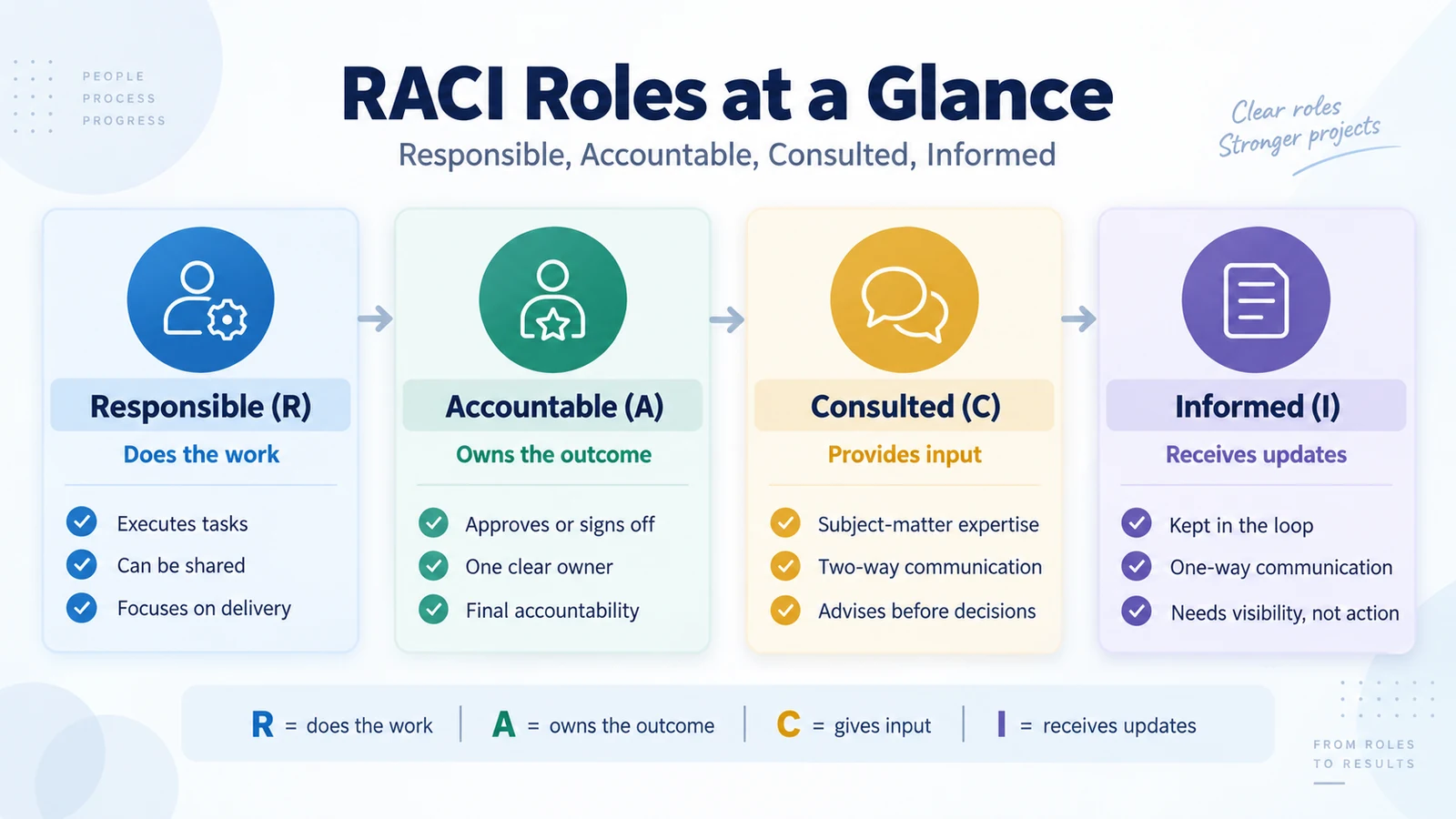
Responsible → Does the Work
Accountable → Owns the Outcome
Consulted → Provides Input
Informed → Receives Updates
The framework can be used in traditional projects, cross-functional initiatives and selected Agile or hybrid environments. It is particularly useful when work crosses organizational boundaries or involves multiple stakeholders.
This guide explains how a RACI matrix works, how to create one, common mistakes to avoid, practical RACI examples, alternatives such as RASCI and DACI, and how responsibility assignment is evolving as automation and AI become part of project workflows.
What Is a RACI Matrix?
A RACI matrix is a responsibility-assignment tool that maps project activities, deliverables or decisions against the roles involved.
RACI stands for:
- R — Responsible: performs the work
- A — Accountable: owns the outcome
- C — Consulted: provides input
- I — Informed: receives relevant updates
The matrix normally lists activities or deliverables down one side and project roles across the top.
Each intersection then indicates whether that role is Responsible, Accountable, Consulted, Informed or not directly involved.
RACI Matrix vs Responsibility Assignment Matrix
RACI is one form of a broader Responsibility Assignment Matrix (RAM).
The purpose is not to replace the project plan, organizational structure or job descriptions.
Instead, it answers a narrower question:
Who is involved in this specific project activity, and in what capacity?
Where RACI Fits Into Project Management
RACI is not a complete project-management methodology. For a broader view of project leadership, governance and delivery approaches, see our complete PMP certification guide.
It can complement:
- Project plans
- Work breakdown structures
- Governance models
- Stakeholder plans
- Risk-management processes
- Agile or hybrid delivery practices
- Traditional project approaches
Its value comes from making responsibility visible where ambiguity could otherwise create delays, duplicated work or missed decisions.
The Four RACI Roles Explained
Responsible (R)
The Responsible role performs or coordinates the work required to complete the activity.
For example, if the activity is preparing a technical design, the solution architect might be Responsible.
Depending on the activity, more than one person may contribute as Responsible.
However, excessive numbers of Responsible roles can make execution unclear.
Accountable (A)
The Accountable role owns the outcome and has the authority associated with its acceptance or approval.
A central RACI principle is:
One outcome → One Accountable owner
PMI guidance on roles, responsibilities and resources describes the Responsibility Assignment Matrix, commonly called a RACI chart, as a way to clarify stakeholder roles. Current PMI guidance also emphasizes having one Accountable owner for each outcome, while Responsibility can be shared.
If two roles both appear Accountable for the same activity, the project may need a governance decision rather than another spreadsheet column.
Consulted (C)
Consulted stakeholders provide relevant expertise, requirements or advice before the work or decision is completed.
Examples can include:
- Security specialists
- Legal or compliance teams
- Architecture teams
- Technical experts
- Business representatives
- Operations teams
Consultation is generally two-way communication.
Use this role selectively. If almost everyone is Consulted on everything, decision-making can become unnecessarily slow.
Informed (I)
Informed stakeholders need visibility but do not necessarily need to participate directly in the activity or decision.
Examples may include:
- Sponsors
- Adjacent teams
- Senior managers
- Customers
- Operational stakeholders
Communication is primarily about keeping these stakeholders appropriately updated.
RACI Matrix Quick Reference
| Role | Main Question | Typical Involvement |
|---|---|---|
| Responsible | Who performs the work? | Execution |
| Accountable | Who owns the outcome? | Ownership / approval |
| Consulted | Whose input is required? | Two-way input |
| Informed | Who needs visibility? | Updates |
Responsible vs Accountable in a RACI Matrix
This is the most common source of confusion when creating a RACI matrix.
Use this distinction:
Responsible = performs the work
Accountable = owns the outcome
For example, during a network migration:
- A network engineer might be Responsible for preparing a configuration.
- A technical lead might be Accountable for the approved technical implementation.
In some situations the same person can be both Responsible and Accountable, particularly for work that sits fully within one person’s authority.
Why Use a RACI Matrix?
A RACI matrix is most valuable when responsibility is genuinely unclear or distributed across several functions.
1. Clarify Ownership
The matrix makes it easier to see whether an important activity has a clear owner.
2. Reduce Responsibility Gaps
Activities without a Responsible role may have nobody clearly assigned to execute them.
3. Reduce Duplicated Ownership
When several people believe they own the same decision, unnecessary conflict or delay can result.
4. Improve Stakeholder Engagement
RACI distinguishes stakeholders who need active consultation from those who primarily need information.
5. Support Decision-Making
Clear accountability makes it easier to understand who has authority for an outcome.
6. Improve Cross-Functional Coordination
RACI can be especially useful when projects cross:
- Business units
- Technical teams
- Suppliers
- Countries
- Organizational reporting lines
7. Reduce Unnecessary Coordination
Clearer roles can help teams decide who genuinely needs to participate in a discussion and who simply needs an update.
This can reduce unnecessary meetings or communication overhead, although a RACI matrix alone will not automatically solve inefficient collaboration.
When Should You Use a RACI Matrix?
Consider RACI when:
- Several teams contribute to the same project
- Approval authority is unclear
- Work crosses organizational boundaries
- Responsibilities overlap
- Important activities are repeatedly delayed
- Stakeholders disagree about ownership
- A project involves multiple suppliers
- Governance requires explicit responsibility
It can also be valuable during project initiation, major organizational changes or when responsibilities shift during delivery.
When a RACI Matrix Is Not the Right Tool
RACI is useful, but it should not be applied to every activity.
A RACI matrix may add unnecessary overhead when:
- A task has one obvious owner
- A very small team already has clear responsibilities
- The work changes too rapidly for a detailed matrix to remain useful
- The matrix becomes larger than the project plan itself
- The real problem concerns decision rights rather than execution responsibility
For complex decision-making, frameworks such as DACI or RAPID may sometimes be more appropriate.
The objective is not to create the largest possible responsibility matrix.
The objective is to remove meaningful ambiguity.
How to Create a RACI Matrix in 6 Steps
A useful process is:
Activities → Roles → Assign → Validate → Agree → Maintain
Step 1: Identify Important Activities and Deliverables
Start with the project plan, work breakdown structure or major delivery process.
List activities at a level where responsibility genuinely needs clarification.
Avoid items that are so broad that they contain several different owners.
For example:
Too broad: Launch Product
Better:
- Approve product scope
- Complete technical build
- Complete security review
- Approve launch communication
- Authorize production release
Also avoid creating a separate RACI row for every minor administrative action.
Step 2: Identify the Roles
List the roles that genuinely participate in the work.
Using role names rather than individual names can make the matrix easier to maintain.
Examples:
- Project Manager
- Product Manager
- Technical Lead
- Security Lead
- Marketing Lead
- Operations Lead
- Project Sponsor
Step 3: Assign R, A, C and I
For each activity, determine:
- Who performs the work?
- Who owns the outcome?
- Whose input is required?
- Who needs to remain informed?
Leave cells blank where a role has no meaningful involvement.
Step 4: Validate Accountability
Review each row.
Ask:
Is there one clear Accountable owner?
If there is no Accountable owner, the outcome may lack clear ownership.
If several roles claim accountability, resolve the governance question rather than leaving ambiguity in the matrix.
Step 5: Validate Responsibility
Check that someone is actually responsible for executing each activity.
Also review workload vertically.
If one role is Responsible for almost everything, the matrix may reveal a capacity or delegation problem.
Step 6: Validate With Stakeholders
A RACI matrix should not simply be created by the project manager and distributed as a final decision.
Review important assignments with the people involved.
Ask:
- Do you understand your role?
- Do you agree with the accountability?
- Is any important stakeholder missing?
- Are there too many Consulted roles?
- Does anyone lack authority to perform their assigned role?
Once agreed, keep the matrix accessible and review it when meaningful project responsibilities change.
Free RACI Matrix Excel Template
Turn the six-step method into a working responsibility matrix with a ready-to-use Excel template you can adapt to your project, team or governance model.
Download the Free RACI Matrix Template →RACI Matrix Example: Product Launch
Consider a simplified product-launch project.
| Activity | Product Manager | Marketing Lead | Designer | Engineering Lead | Legal |
|---|---|---|---|---|---|
| Define launch timeline | A | R | I | C | I |
| Write launch copy | I | A/R | I | I | C |
| Prepare final designs | C | A | R | I | I |
| Review legal compliance | I | C | I | I | A/R |
| Build launch feature | C | I | I | A/R | I |
| Send launch announcement | I | A/R | I | I | I |
This example is illustrative. Actual responsibilities depend on the organization’s governance and project structure.
What to Look for in the Example
Notice that:
- Each activity has a clear Accountable owner
- Some roles can be both Responsible and Accountable
- Consulted roles are used selectively
- Not everyone needs involvement in every activity
RACI Matrix Example for an IT Project
RACI is particularly useful in technology projects where delivery crosses architecture, security, operations and business teams.
| Activity | Project Manager | Technical Lead | Security | Operations | Sponsor |
|---|---|---|---|---|---|
| Approve project scope | R | C | I | I | A |
| Create technical design | I | A/R | C | C | I |
| Security assessment | I | C | A/R | I | I |
| Migration planning | A | R | C | R | I |
| Production readiness | R | C | C | A | I |
Again, these assignments are examples rather than universal project-management rules.
Want to see how RACI changes across different project environments? Explore our 10 practical RACI matrix examples covering IT infrastructure, SD-WAN migration, software development, Agile governance, cybersecurity, cloud migration, transformation, vendor management and AI-enabled project teams.
How to Validate a RACI Matrix
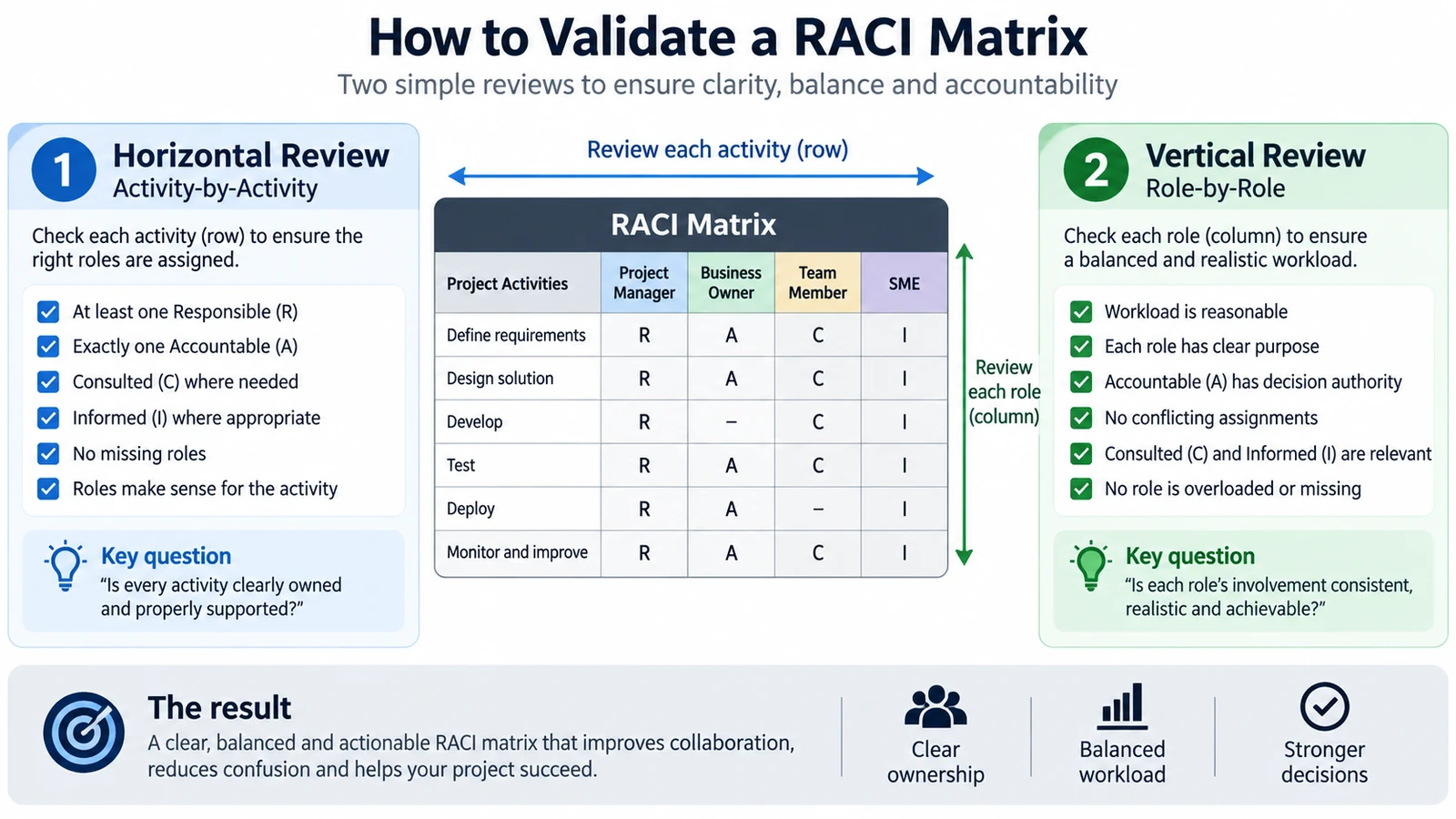
Review the matrix both horizontally and vertically.
Horizontal Review: Activity by Activity
For each row, ask:
- Is there a clear Accountable owner?
- Is someone Responsible for execution?
- Are too many people Consulted?
- Does everyone marked Informed genuinely need updates?
Vertical Review: Role by Role
For each column, ask:
- Does one person own too many activities?
- Is one role Responsible for an unrealistic amount of work?
- Is someone Consulted on almost everything?
- Does a key stakeholder have no meaningful role?
- Does accountability match actual authority?
This last question is particularly important.
Accountability without authority can create a governance problem.
Common RACI Matrix Mistakes
1. Too Many Accountable People
Shared accountability can create ambiguity about final ownership.
If several roles appear to own an outcome, clarify who ultimately answers for it.
2. No Accountable Owner
An activity without clear accountability can become difficult to govern.
3. No Responsible Role
An activity may have an owner but nobody assigned to perform the work.
4. Too Many Consulted Stakeholders
Consulting everyone can create slow decision-making.
Ask whose input is genuinely required before the activity can proceed.
5. Using RACI for Every Tiny Task
A massive matrix quickly becomes difficult to maintain.
Focus on meaningful activities, deliverables and decisions.
6. Confusing Responsibility With Accountability
The person doing the work does not always own the final outcome.
7. Creating the Matrix Without the Team
A matrix imposed without stakeholder discussion may not reflect how authority actually works.
8. Never Updating the Matrix
Projects evolve.
Roles can change after:
- Scope changes
- Organizational changes
- Supplier changes
- Major delivery transitions
- Changes in governance
RACI Matrix and Stakeholder Management
RACI and stakeholder management are related, but they are not identical.
Stakeholder management asks broader questions:
- Who can affect the project?
- Who is affected by it?
- What do stakeholders need?
- How should they be engaged?
RACI then helps clarify the role selected stakeholders play in particular activities or decisions.
A useful sequence is:
Identify Stakeholders → Understand Influence & Needs → Define Engagement → Clarify Responsibilities With RACI
RACI Matrix in Agile Projects
RACI can be used in Agile environments, but it should not be used mechanically.
Agile teams often already have established responsibilities, collaborative practices and decision mechanisms.
Adding a detailed RACI matrix to every backlog item could create unnecessary overhead.
RACI and Scrum Roles
RACI should not be used to redefine Scrum accountabilities. The official Scrum Guide defines the accountabilities of the Product Owner, Scrum Master and Developers, so RACI is best used to clarify responsibilities around cross-team or organizational work rather than overwrite those accountabilities.
Instead, it can be useful around work that crosses team or organizational boundaries, such as:
- External approvals
- Security reviews
- Procurement
- Architecture decisions
- Regulatory reviews
- Cross-team dependencies
Use RACI to clarify additional organizational responsibilities without replacing the responsibilities already defined by the team’s delivery framework.
For broader context, see our What Is Agile? guide.
RACI Matrix in SAFe and Enterprise Delivery
Large-scale delivery environments can involve many teams, suppliers and governance bodies.
RACI may be useful for responsibilities that sit outside or across established framework roles.
Examples include:
- Architecture approval
- Security governance
- Infrastructure readiness
- Procurement
- Production approval
- External dependencies
Our SAFe PI Planning guide explains planning intervals, dependencies, risks, PI Objectives and alignment in more detail.
RACI Matrix in Waterfall and Predictive Projects
RACI can fit naturally into predictive project environments because roles and major deliverables are often defined relatively early.
For example, imagine requirements are completed but development cannot begin because two departments each assumed the other was responsible for final approval.
A RACI matrix could have reduced this ownership ambiguity by making the approval responsibility explicit before development began.
See our Waterfall vs V-Model guide for more about predictive delivery approaches.
How a RACI Matrix Connects to KPIs and OKRs
A RACI matrix answers a responsibility question:
Who is involved, and in what capacity?
KPIs and OKRs answer different performance and strategic questions.
- RACI: clarifies responsibility and accountability
- KPI: monitors important performance
- OKR: defines an objective and measurable desired results
They can therefore complement one another.
For example, a team might use RACI to clarify who owns a service-improvement initiative, KPIs to monitor service performance, and an OKR to define the measurable improvement the organization wants to achieve.
A useful model is:
RACI = Who → KPI = Performance Signal → OKR = Desired Progress → Initiatives = Action
For a detailed explanation, see our KPI vs OKR guide.
RACI Matrix in the AI Era: Humans, Automation and AI Agents
As AI takes on more project activities, defining human accountability becomes increasingly important. See AI in Project Management for how responsibility should work in AI-enabled workflows.
AI tools and agents may support activities such as:
- Drafting project documentation
- Summarizing meetings
- Analyzing project information
- Identifying patterns in stakeholder feedback
- Generating status-update drafts
- Flagging potential risks
- Performing bounded workflow tasks
Current PMI guidance on RACI for human-plus-agent teams extends the model to AI-supported work while emphasizing that humans should retain accountability for decisions and outcomes. This is consistent with PMI’s broader Standard for Artificial Intelligence in Portfolio, Program and Project Management, which emphasizes structured governance, human review and accountable practice. For a broader cross-industry risk perspective, the NIST AI Risk Management Framework provides a voluntary framework for managing AI risks and incorporating trustworthiness considerations across the AI lifecycle.
A useful governance principle is:
AI May Perform Bounded Work → Human Accountability Remains Explicit
For practical examples of using generative AI to draft, review and challenge project responsibilities, see our practical AI prompts for project managers, including dedicated prompts for creating and auditing RACI matrices.
Can an AI Agent Be Responsible in a RACI Matrix?
For appropriately governed and bounded tasks, an AI agent can be represented as Responsible when it actually performs the defined work.
However, a human should remain Accountable for the outcome.
For example:
| Activity | AI Agent | Project Manager | Compliance | Sponsor |
|---|---|---|---|---|
| Draft weekly project update | R | A | C | I |
| Review and approve update | — | A/R | C | I |
| Flag sensitive content | R | A | C | I |
| Escalate unexpected AI behavior | — | A/R | C | I |
The assignments above are illustrative and depend on organizational governance, risk and the capabilities of the system.
Keep AI Accountability Human
When AI supports important project activities, define:
- Who reviews the output
- Who approves consequential actions
- What the AI system is permitted to do
- When human review is mandatory
- Who owns escalation
- How activity is logged and reviewed
This becomes particularly important when AI-supported work can affect customers, employees, security, compliance, budgets or important project decisions.
RACI therefore remains relevant in AI-enabled projects because automation does not remove the need for accountability.
RACI vs RASCI
RASCI adds an additional role:
S — Support
Support roles help the Responsible person complete the activity without being the primary owner of execution.
RASCI can be useful where substantial supporting work needs to be distinguished from direct responsibility.
RACI vs DACI
DACI is more focused on decision-making.
It commonly represents:
- D — Driver: coordinates the decision process
- A — Approver: makes the decision
- C — Contributors: provide expertise
- I — Informed: receive the decision
Use RACI when the primary question is responsibility for work.
Consider DACI when the primary problem is clarifying how an important decision gets made.
RACI vs RAPID
RAPID is another decision-rights framework.
It distinguishes roles involved in recommending, agreeing, performing, providing input and deciding.
RAPID can be useful for complex organizational decisions where a basic RACI matrix does not provide enough decision-governance detail.
RACI vs Organizational Chart
An organizational chart shows formal reporting relationships.
A RACI matrix shows responsibility for specific project work.
A senior manager on an organizational chart may only be Informed for a particular project activity, while a specialist deeper in the organization may be Responsible.
The two tools therefore answer different questions.
RACI vs Project Plan
A project plan typically answers questions such as:
- What must happen?
- When?
- In what sequence?
- With which dependencies?
RACI adds:
Who is involved, and how?
They should complement rather than replace each other.
Should You Use Names or Roles in a RACI Matrix?
For longer projects, role names are often easier to maintain.
For example:
Better for continuity: Security Lead
rather than:
Person-specific: Jane Smith
However, smaller projects may benefit from naming specific people when that makes ownership clearer.
The important requirement is that everyone can identify the actual person occupying the role.
How Detailed Should a RACI Matrix Be?
There is no universal number of rows or columns.
The appropriate level depends on:
- Project complexity
- Number of teams
- Governance requirements
- Risk
- Existing role clarity
A useful principle is:
Enough detail to remove ambiguity, but not so much that maintaining the matrix becomes a project of its own.
How Often Should a RACI Matrix Be Updated?
Do not update RACI simply because a calendar reminder appears.
Review it when meaningful changes occur, such as:
- Major scope changes
- New teams joining
- Supplier changes
- Organizational restructuring
- Governance changes
- Major delivery-phase transitions
The matrix should reflect how responsibility actually works—not how it worked six months ago.
RACI Matrix Tools and Templates
You do not need specialized software to create a useful RACI matrix. If you want a ready-to-use starting point, download our free RACI Matrix Excel template.
It can be built using:
- Spreadsheets
- Project-management platforms
- Collaboration tools
- Documentation platforms
- Whiteboards
The tool matters less than the quality of the responsibility discussion behind the matrix.
A beautifully formatted RACI chart with unresolved ownership is still a weak governance tool.
RACI Matrix Validation Checklist
Before finalizing the matrix, check:
- Does every important activity have clear accountability?
- Is someone responsible for executing each activity?
- Have unnecessary Consulted roles been removed?
- Are Informed roles genuinely necessary?
- Does accountability match authority?
- Are any roles overloaded?
- Have the relevant stakeholders reviewed the assignments?
- Is the matrix accessible to the project team?
- Is there a process for updating it when responsibilities change?
Turn the Review Into a Decision
After the review, assign one clear outcome to the matrix rather than simply marking the checklist complete:
- VALID: ownership, execution and stakeholder involvement are clear enough to use the matrix.
- FIX OWNERSHIP: resolve rows with no Accountable owner or multiple competing Accountable roles.
- REDUCE CONSULTATION: remove unnecessary Consulted roles that slow decisions without adding essential input.
- REBALANCE WORKLOAD: address roles that are Responsible for an unrealistic share of the work.
- ESCALATE AUTHORITY GAP: resolve situations where the Accountable role does not have the authority needed to own the outcome.
Record the action owner and review date for any issue that prevents the matrix from being treated as VALID.
Frequently Asked Questions About RACI Matrices
What Does RACI Stand For?
RACI stands for Responsible, Accountable, Consulted and Informed.
What Is a RACI Matrix Used For?
A RACI matrix clarifies the roles different people or teams play in project activities, deliverables or decisions. It helps distinguish execution, accountability, consultation and communication.
What Is the Difference Between Responsible and Accountable?
Responsible performs the work. Accountable owns the outcome and has the associated final ownership or approval authority.
Can One Person Be Both Responsible and Accountable?
Yes. In some situations, one person may perform the work and also own the outcome. This is commonly represented as A/R.
Can There Be More Than One Responsible Person?
Yes, Responsibility can be shared where several people genuinely perform the work. However, avoid assigning so many Responsible roles that execution becomes unclear.
Can There Be More Than One Accountable Person?
A standard RACI model aims for one clear Accountable owner per activity or outcome. Multiple Accountable roles can reintroduce the ownership ambiguity that RACI is intended to resolve.
Does Every Task Need R, A, C and I?
No. An activity does not necessarily need Consulted or Informed roles. Assign them only when they add genuine value.
Is RACI Useful in Agile?
It can be, particularly for responsibilities that cross team or organizational boundaries. However, RACI should not replace accountabilities already defined by the team’s Agile framework.
Is RACI Useful for Small Teams?
Sometimes. If responsibilities are already obvious, a formal matrix may add unnecessary overhead. Use RACI where meaningful ambiguity exists.
Can AI Be Responsible in a RACI Matrix?
In AI-enabled workflows, an AI agent may perform a bounded task and therefore be represented as Responsible. Human accountability should remain explicit, particularly for decisions, approvals, escalation and consequential outcomes.
What Is the Difference Between RACI and RASCI?
RASCI adds a Support role to the standard Responsible, Accountable, Consulted and Informed model.
What Is the Difference Between RACI and DACI?
RACI primarily clarifies responsibility for work, while DACI is designed more specifically around decision-making roles.
Conclusion: Use RACI to Remove Ambiguity, Not Create Bureaucracy
A RACI matrix works best when it makes responsibility simpler rather than more complicated.
The framework answers four basic questions:
Who does the work?
Who owns the outcome?
Whose input is required?
Who needs to know?
Remember:
Responsible → Does the Work
Accountable → Owns the Outcome
Consulted → Provides Input
Informed → Receives Updates
Start with the project’s important activities rather than every minor task.
Assign clear accountability.
Validate the matrix with the people involved.
Keep consultation focused.
Update responsibilities when the project changes.
And as AI agents and automation perform more project work, make the human accountability behind those workflows explicit.
The goal is not to fill every cell in the matrix. The goal is to make ownership clear enough that the project can move forward.
Continue Learning
Continue exploring the TechTeamSynergy project management and RACI cluster with these related guides and resources: