
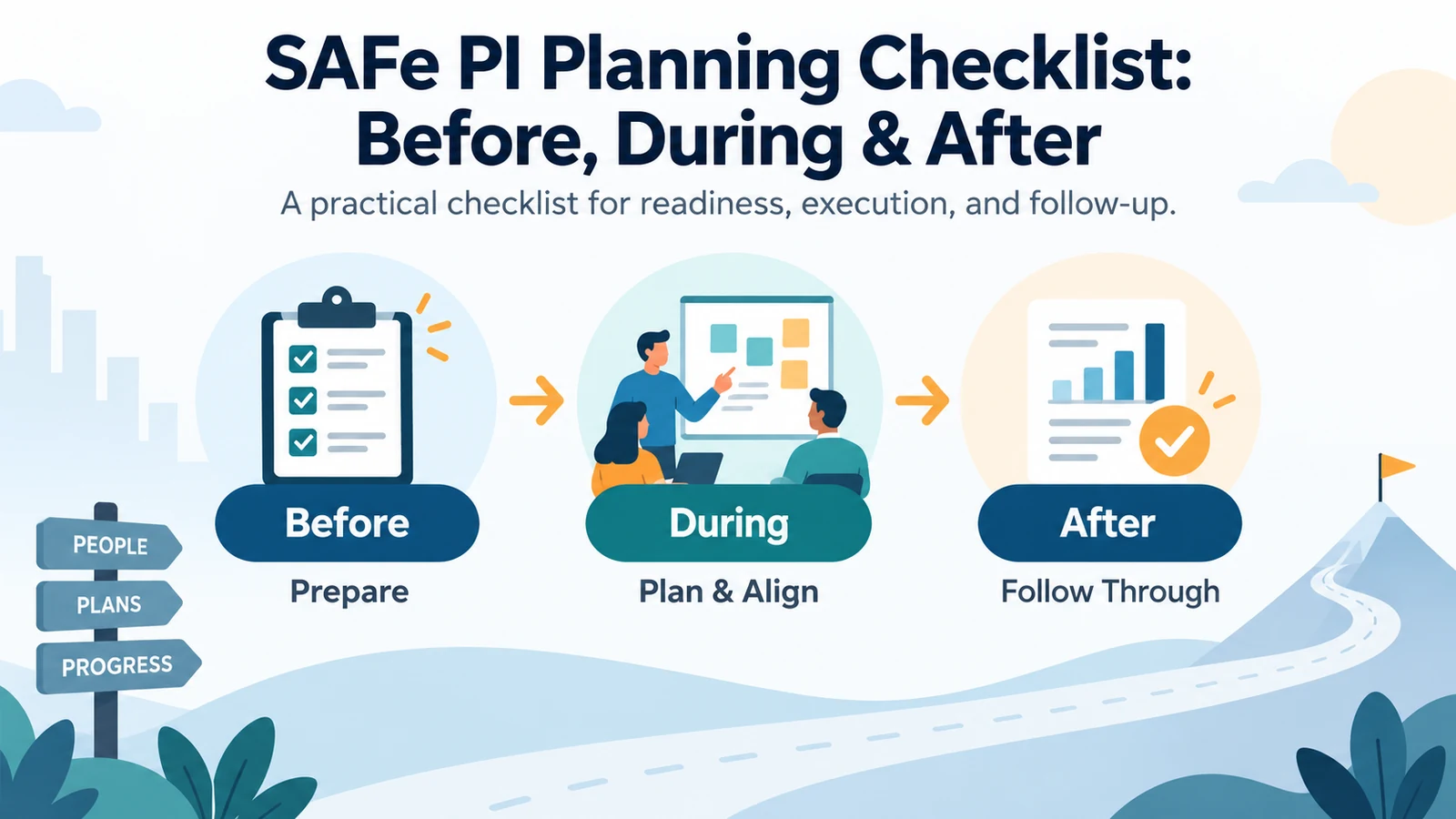
This PI planning checklist helps teams prepare for the event before planning begins, stay aligned during execution, and follow through after the event.
A calendar invitation, a populated backlog, and a two-day agenda do not necessarily mean an Agile Release Train is ready to plan. Teams may still arrive without clear priorities, realistic capacity, resolved architecture questions, visible dependencies, or the decision-makers required to address trade-offs.
The purpose of this PI planning checklist is not to explain PI Planning from scratch. It is to help Release Train Engineers, Product Managers, Product Owners, Scrum Masters, Agile Coaches, Business Owners, project and program leaders, and delivery teams answer a more practical question:
Are we genuinely ready to plan—and what must happen before, during, and after the event?
If you need the foundations first, read our complete guide to SAFe PI Planning. This checklist is its operational companion.
Current Scaled Agile guidance on PI Planning describes it as a cadence-based ART event that aligns teams and stakeholders around a shared mission and vision. It also emphasizes organizational, content, and logistics readiness—not simply event scheduling.
The operating model used throughout this checklist is simple:
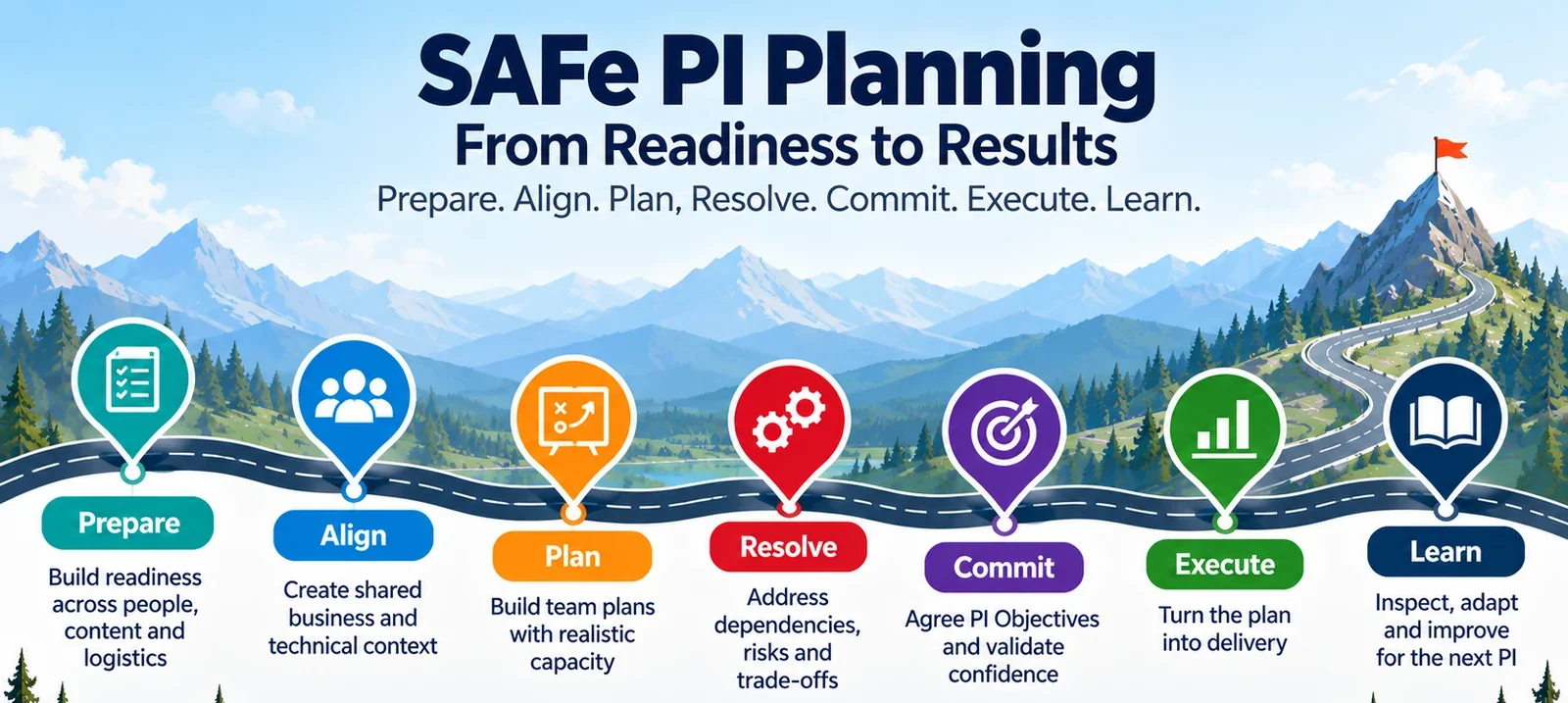
Prepare → Align → Plan → Resolve → Commit → Execute → Learn
PI Planning Checklist at a Glance
A strong PI planning checklist extends beyond the event itself and connects readiness, execution, and follow-through.
| Phase | Objective | Critical evidence or output |
|---|---|---|
| Before | Make the ART ready to plan | Business context, planning-ready backlog, realistic capacity, known dependencies, architecture guidance, stakeholder availability, working tools |
| During | Create and validate a credible integrated plan | Team plans, surfaced dependencies, managed risks, PI Objectives, resolved trade-offs, confidence |
| After | Convert planning decisions into execution | Published objectives, dependency ownership, active risks, updated tools, execution cadence, stakeholder communication |
The distinction matters. During PI Planning, the PI planning checklist should support teams as they discover new information and adapt their plans. But the event should not be consumed by issues that could reasonably have been identified beforehand: missing decision-makers, unavailable environments, unknown capacity, unclear priorities, or obvious cross-team dependencies.
A practical checklist creates visibility before those gaps become planning blockers.
Free PI Planning Readiness Checklist
Get the printable PDF checklist plus the editable Excel workbook to assess readiness, capacity, dependencies, ROAM risks, PI Objectives and post-planning actions.
Get the Free PI Planning Checklist →Before PI Planning — Readiness Checklist
Preparation should produce evidence that the ART is ready to make meaningful planning decisions. For each checkpoint below, ask four questions: What action is required? Who owns it? What evidence shows it is ready? What happens if it is missing?
Confirm Business Context and Planning Outcomes
Teams cannot build credible plans when strategic direction remains ambiguous. Use the PI planning checklist before PI Planning to confirm that the relevant business context has been prepared and that teams can understand what matters for the upcoming Planning Interval.
- Action: Clarify the business context, strategic priorities, product or solution direction, and intended outcomes.
- Typical owners: Business Owners, Product Management, ART leadership.
- Evidence: Current business context, understandable priorities, clear product or solution direction, expected outcomes, important constraints, and available decision-makers.
- Risk if missing: Teams may create internally coherent plans that are poorly aligned with actual business priorities.
The objective is not to provide every possible answer before planning. Teams still need room to collaborate and adapt. The objective is to establish enough context to make sensible trade-offs.
Make the Backlog Planning-Ready
A planning-ready backlog is not a backlog in which every future story has been fully specified. Instead, the work being considered for the upcoming PI should contain enough information for teams to understand intent, discuss feasibility, identify dependencies, and plan at an appropriate level.
- Action: Review the highest-priority features, enablers, and significant work expected to enter planning.
- Typical owners: Product Management, Product Owners, System Architect/Engineering, relevant teams.
- Evidence: Priority work is visible; intended outcomes and important acceptance information are available where needed; major assumptions and constraints are explicit; initial sequencing and major enablers are understood.
- Risk if missing: PI Planning becomes an extended requirements-discovery workshop instead of an alignment and planning event.
Do not chase false precision. The goal is planning readiness, not perfect specification.
Validate Team Capacity
One of the easiest ways to produce an unrealistic PI plan is to plan against theoretical team capacity. Actual capacity may be reduced by holidays, training, operational work, production support, maintenance, technical debt, other commitments, or known absences.
- Action: Build a realistic capacity view for each team.
- Typical owners: Agile Teams, Product Owners, Scrum Masters or Team Coaches, Engineering Managers where relevant.
- Evidence: Planned leave, absences, support duties, mandatory non-feature work, major technical debt or infrastructure work, team changes, and specialist constraints are visible.
- Risk if missing: Teams accept more work than they can realistically deliver, creating artificial predictability problems later in the PI.
Capacity should represent the team’s usable planning capacity—not simply the number of people assigned to the team. This is also where lessons from building effective Agile teams become operational: clarity, sustainable workload, collaboration, and realistic planning matter more than nominal headcount.
Surface Critical Dependencies Early
PI Planning is an important environment for discovering and negotiating dependencies, but the ART should not deliberately wait until the event to identify dependencies that are already visible.
- cross-team dependencies;
- shared platforms or components;
- architecture and infrastructure;
- cybersecurity or compliance;
- suppliers and vendors;
- external organizations or other ARTs;
- specialist resources.
For each known dependency, capture at least:
Provider → Receiver → Need → Expected timing → Initial owner → Potential impact
Action: Expose material dependencies early enough for them to influence planning. Evidence: Critical dependencies are visible and initial coordination owners are known. Risk if missing: Teams build plans that appear achievable individually but cannot work as an integrated ART plan.
Confirm Architecture and Technical Readiness
Architecture guidance should help teams make decisions—not force them to rediscover major technical constraints inside a breakout session.
- architecture direction is available;
- important enablers are visible;
- major nonfunctional requirements or constraints are known;
- platform and infrastructure prerequisites have been considered;
- environment constraints are understood;
- security and compliance requirements likely to affect planning are visible;
- unresolved architecture decisions that could block planning are identified.
The objective is not “architecture complete.” It is enough technical clarity to plan responsibly.
Prepare Business Owners and Key Stakeholders
A room full of teams does not create alignment if the people needed to make business decisions are unavailable. Confirm that expected participants understand their role, key decision-makers are available, important decisions have been anticipated where possible, and escalation paths are clear.
Stakeholder attendance should not be treated as ceremonial. Participation has value when stakeholders can answer questions and make decisions.
Validate Tools and Event Logistics
Poor logistics can consume planning energy that should be spent on alignment and decision-making. This is particularly important for distributed or hybrid PI Planning.
- planning tools are accessible;
- permissions have been tested;
- collaboration boards are prepared;
- physical rooms and breakout arrangements are clear;
- remote participants can connect;
- audio/video capability has been tested;
- facilitators understand their responsibilities;
- timeboxes are visible;
- backup communication options exist.
This checklist intentionally does not prescribe a detailed timetable. A dedicated PI Planning Agenda Template should address session sequencing, timing, facilitation, and reusable agenda design separately.
Run the Final PI Planning Readiness Review
Shortly before the event, consolidate the previous checks into one decision.
GREEN — GO
Critical readiness conditions are satisfied. Known minor gaps should not materially compromise planning.
AMBER — CONDITIONAL GO
Gaps remain, but each material gap has a known impact, an owner, a corrective action, a target date or decision point, and an agreed contingency where appropriate.
RED — NO-GO / ESCALATE
One or more material gaps make credible planning unlikely. Examples might include missing strategic direction, unavailable decision-makers for critical choices, major unresolved architecture constraints, unreliable capacity information, or prerequisites that fundamentally prevent teams from constructing a meaningful plan.
“NO-GO” does not automatically mean cancel the event. It means leadership should explicitly decide whether to postpone, adjust scope, resolve the blocker, or accept the consequences of proceeding.
Important: This GREEN / AMBER / RED model is a TechTeamSynergy operational readiness framework, not a formal SAFe maturity rating.
During PI Planning — Execution Checklist
Preparation establishes readiness. The event then tests whether those assumptions produce a coherent plan across the ART. The goal is not to rigidly execute a pre-written script. Teams should use collaboration and new information to adjust the plan.
The Manifesto for Agile Software Development emphasizes collaboration and responsiveness to change. Those principles remain relevant when planning across an ART: the plan should support learning and coordination rather than become a rigid constraint.
Confirm Shared Business and Product Context
Before detailed team planning progresses, ask: Do teams understand what outcomes matter and why? Look for evidence that teams understand major priorities, intended outcomes, relevant customer or business context, important constraints, and where meaningful trade-offs may be required.
Confirm Technical Guardrails
Teams need enough technical guidance to build compatible plans while retaining appropriate autonomy. Confirm architecture direction, important constraints, shared components, significant enablers, environment considerations, and security or compliance constraints affecting the upcoming PI.
Build Team Plans Against Real Capacity
During breakout planning, teams should continuously compare planned demand with actual capacity. Each plan should reflect realistic availability, priority work, necessary enablers, operational commitments, sequencing, major risks, dependencies, and emerging PI Objectives.
When demand exceeds capacity, the answer should be a planning conversation about priority, scope, sequencing, alternatives, and risk—not silent overcommitment.
Validate Cross-Team Dependencies
As plans develop, previously known dependencies should be confirmed and new ones should be surfaced. For every material dependency, teams should be able to answer: Who provides what? Who needs it? When is it needed? Who coordinates it? What happens if it slips?
This article intentionally stops at dependency readiness. A future TechTeamSynergy article will go deeper into how to manage cross-team dependencies in SAFe without creating a competing search intent here.
ROAM ART-Level Risks
Material ART-level risks should not remain as an unstructured list. Use ROAM to determine how risks will be handled: Resolved, Owned, Accepted, or Mitigated.
The practical test is not whether the correct label was entered into a tool. Ask: Does this risk now have a clear treatment and, where necessary, active ownership? For broader risk practices, see our guide to AI for Project Risk Management.
Validate PI Objectives
Scaled Agile’s PI Objectives guidance defines PI Objectives as summaries of the business and technical goals teams and trains intend to achieve in the upcoming PI, classified as committed or uncommitted.
- Use clear outcome language.
- Make the intent understandable to business and technology stakeholders.
- Expose meaningful dependencies or constraints.
- Keep important uncertainty visible.
- Use committed and uncommitted classification appropriately.
Avoid objectives that simply restate a backlog item. Prefer outcome-oriented language that makes the intended result understandable. Teams looking for structured AI-assisted reviews can also use our 50 AI prompts for project managers, which includes PI Planning readiness, dependency, objective, and ROAM prompts.
Resolve Planning Problems and Trade-Offs
Planning often exposes conflicts that could not be resolved beforehand: demand exceeding capacity, conflicting assumptions, architecture concerns, unavailable specialists, external dependencies, sequencing conflicts, or scope that cannot fit realistically.
These are not necessarily signs that PI Planning is failing. Surfacing them is valuable. The critical question is whether the right people can resolve or consciously manage them before teams are asked to stand behind the integrated plan.
Validate the Final Integrated Plan
- Are major dependencies represented?
- Are important milestones or timing constraints visible?
- Are material risks understood?
- Does planned demand broadly match capacity?
- Are PI Objectives coherent?
- Have major contradictions between team plans been resolved?
- Are significant assumptions still being treated as facts?
Use the Confidence Vote as a Decision Signal
A confidence vote should provide information, not simply close the event. If confidence is weak:
Investigate → Adjust → Resolve → Reassess
Do not pressure teams into increasing a score without addressing the reason for low confidence. The useful outcome is not a high number. It is a plan that participants can credibly support.
After PI Planning — Follow-Through Checklist
The PI planning checklist does not end when the final presentation closes. Its value depends on whether planning decisions survive contact with execution.
Publish Final PI Objectives and Planning Outputs
Confirm that PI Objectives are published, final changes are reflected, planning artifacts are accessible, unresolved assumptions are visible, and stakeholders know where to find the latest information. Avoid leaving multiple conflicting “final” versions across documents and collaboration tools.
Confirm Dependency Owners and Dates
A dependency captured on a planning board does not manage itself. Confirm provider, receiver, expected deliverable, timing, coordination owner, current status, and escalation path where relevant.
Turn ROAM Risks Into Active Follow-Up
“Owned” and “Mitigated” risks require work after the event. The PI planning checklist should keep these follow-ups visible by confirming that active risks have an owner, required mitigation or follow-up action, target timing, and visibility in the appropriate delivery or governance cadence.
Update ART Planning and Delivery Tools
The information agreed during planning should flow into the systems teams actually use. Objectives, dependencies, planned work, milestones, and known risks should not remain trapped in a one-off event artifact.
Activate the Execution Cadence
- ART Sync;
- Scrum of Scrums where used;
- PO Sync;
- System Demo;
- risk and dependency reviews;
- Inspect & Adapt preparation.
The meeting names matter less than the management questions they answer. Teams should know how they will detect emerging delivery issues, resolve dependencies, review integrated progress, and adjust plans as knowledge changes.
Communicate Decisions and Commitments
Not every stakeholder participates in the entire event. Communicate primary PI outcomes, key objectives, important commitments, major risks, significant dependencies, decisions made, decisions still pending, and relevant milestones.
Track Progress Against PI Objectives
Once execution begins, do not reduce progress monitoring to feature completion. Review PI Objectives to understand whether intended outcomes remain achievable, assumptions have changed, risks affect confidence, dependencies are progressing, or an objective requires adjustment.
Review the Quality of the Planning Process
Every PI Planning event should generate learning for the next one. Capture what was ready early, what arrived too late, which decisions caused delays, which dependencies surprised teams, which logistics created friction, and what should change before the next event.
This reflects the Agile principle of regular reflection and adjustment described in the principles behind the Agile Manifesto.
PI Planning Readiness Scorecard
A readiness scorecard turns a vague statement—“we think we are ready”—into a structured conversation.
| Readiness dimension | Key question |
|---|---|
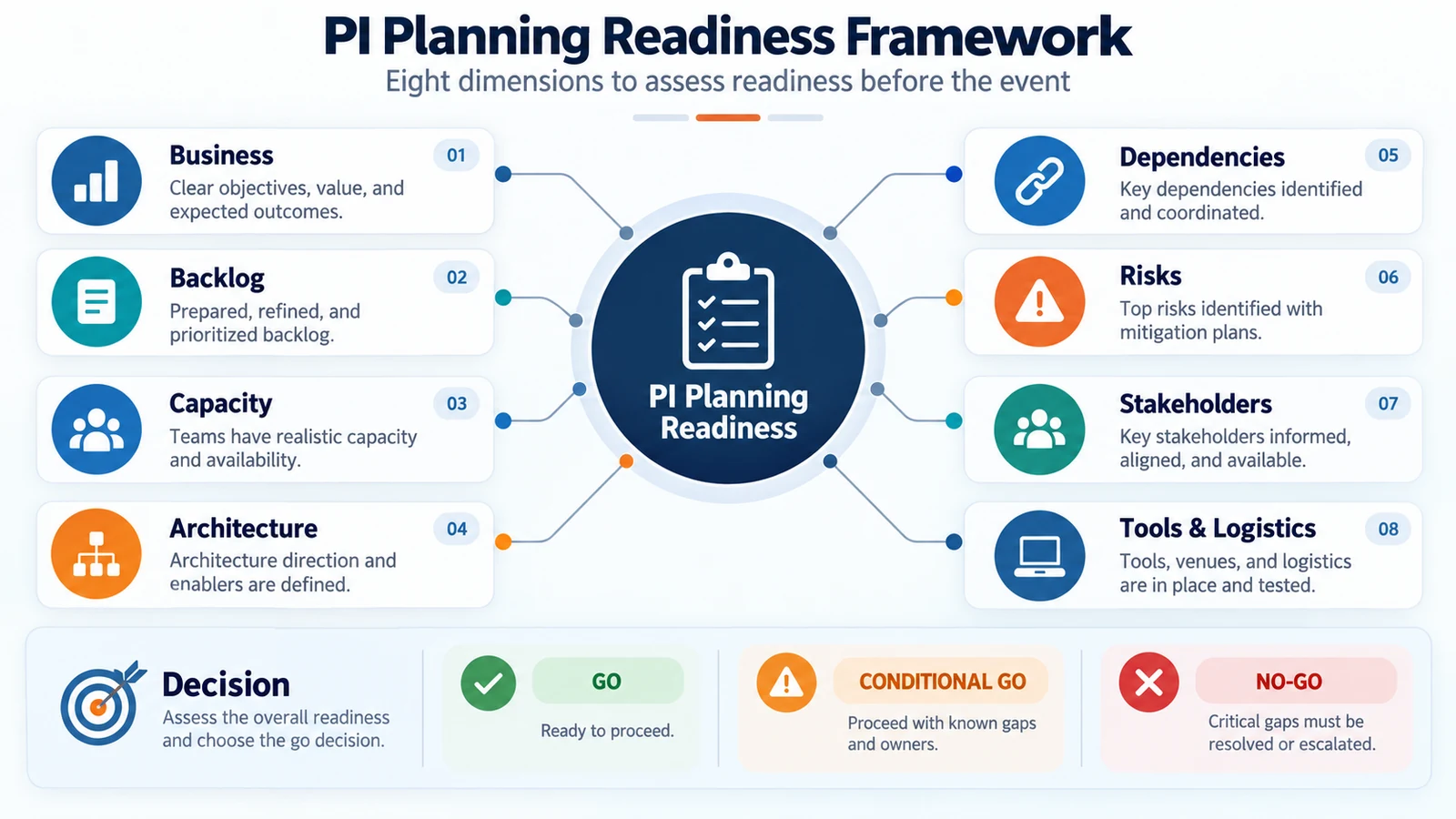
| Business | Are priorities, outcomes, context, and decision-makers sufficiently clear? |
| Backlog | Is priority work refined enough to support meaningful planning? |
| Capacity | Do teams have a realistic view of available capacity and non-project work? |
| Architecture | Are technical direction, enablers, constraints, and critical prerequisites understood? |
| Dependencies | Have major known dependencies been surfaced and initial owners identified? |
| Risks | Are material known risks visible enough to influence planning? |
| Stakeholders | Will the necessary Business Owners and decision-makers participate when needed? |
| Tools & Logistics | Are collaboration tools, rooms, access, facilitation, and remote arrangements working? |
GREEN — Ready
The ART has sufficient evidence to plan credibly. Minor issues may remain, but they should not materially compromise planning.
AMBER — Ready With Known Gaps
Important gaps exist, but each has an identified owner and recovery action. The ART consciously decides to proceed.
RED — Not Ready
One or more gaps materially prevent credible planning or timely decision-making. Leadership should resolve, escalate, re-scope, or explicitly accept the consequence before proceeding.
The scorecard should support judgment, not replace it. An ART with seven GREEN dimensions and one critical RED architecture blocker is not automatically “87.5% ready.” Criticality matters more than arithmetic.
Free PI Planning Readiness Checklist
Get the printable PDF checklist plus the editable Excel workbook to assess readiness, capacity, dependencies, ROAM risks, PI Objectives and post-planning actions.
Get the Free PI Planning Checklist →Common PI Planning Readiness Failures
| Mistake | Impact | Recommended action |
|---|---|---|
| Treating PI Planning as a calendar event | Preparation happens too late | Manage readiness as a process leading into the event |
| Bringing an immature backlog | Breakouts become clarification sessions | Refine priority work to planning-ready depth |
| Planning against theoretical capacity | Systematic overcommitment | Account for leave, support, BAU, technical work, and constraints |
| Waiting to discover obvious dependencies | Conflicting plans and lost planning time | Surface known dependencies beforehand |
| Writing vague PI Objectives | Stakeholders cannot understand intended outcomes | Express meaningful business or technical outcomes |
| Unclear Business Owner participation | Decisions and value discussions are delayed | Confirm attendance, decision authority, and expected involvement |
| Leaving major architecture questions unresolved | Team plans may be technically incompatible | Identify critical decisions and guidance before planning |
| Overloading teams | Confidence falls and predictability suffers | Force explicit priority and scope trade-offs |
| Recording risks without ownership | Risks disappear after planning | Apply ROAM and convert active risks into follow-up actions |
| No post-event follow-up | Objectives, dependencies, and risks become stale | Activate execution and governance cadence immediately |
Practical Example — From Planning Chaos to Readiness
Consider a fictional Agile Release Train supporting a cloud and digital transformation program. The ART has seven teams. Several teams depend on a shared cloud platform. A security requirement affects multiple features. One component is delivered by an external vendor, and a small architecture team supports several delivery teams.
Before — What Was Missing
Two weeks before PI Planning, the event appears ready on paper. The invitations are sent, the planning board exists, and priority features have been identified. But a readiness review exposes gaps.
- Two teams have not included upcoming support commitments in capacity.
- A vendor dependency has no confirmed delivery window.
- A new security control affects several features but has not been incorporated into planning assumptions.
- Three features depend on the same architecture component.
- Business Owners will attend the opening, but their availability during critical trade-off discussions is unclear.
Readiness Review — What Changed
Capacity becomes AMBER until teams incorporate support work. Dependency readiness becomes AMBER while Product Management confirms the vendor milestone. Architecture readiness becomes RED because one unresolved design decision could invalidate several team plans.
The RTE does not calculate an average score and declare the ART ready. The critical RED issue is escalated. The architect and affected teams hold a focused decision session before PI Planning and agree on sufficient technical direction to proceed. Architecture readiness moves to GREEN.
The vendor dependency remains AMBER, with an owner, decision deadline, and fallback planning assumption. The ART proceeds with known uncertainty rather than hidden uncertainty.
During — How Planning Improved
Teams enter breakouts with more realistic capacity. The security requirement is already visible. Architecture guidance is understood. The vendor dependency still requires monitoring, but teams know where it affects their plans.
New dependencies still emerge—that is normal—but the event is not overwhelmed by issues that could have been discovered earlier.
After — How Commitments Stay Visible
The vendor dependency has an owner and follow-up date. Security work is visible in team plans. The architecture component is tracked across affected teams. PI Objectives are published and reviewed during execution.
The difference was not a more elaborate PI Planning ceremony. It was better readiness discipline.
30-Minute PI Planning Readiness Review
Use this short review 3–5 working days before PI Planning to turn the checklist into a clear readiness decision. Keep the session focused on evidence, ownership and next actions rather than status reporting.
- 0–5 minutes — Confirm the eight readiness dimensions. Review business context, backlog, capacity, architecture, dependencies, risks, stakeholders and logistics. Mark each GREEN, AMBER or RED.
- 5–10 minutes — Challenge every AMBER and RED. Ask what evidence is missing, why it matters, and whether the gap can materially affect planning quality.
- 10–15 minutes — Assign an owner. Every material gap gets one named owner, one corrective action and one target date or decision point.
- 15–20 minutes — Check critical dependencies. Confirm provider, receiver, expected timing, coordination owner and fallback assumption for dependencies that could block multiple teams.
- 20–25 minutes — Validate capacity and decision support. Confirm known leave, support work and constraints are reflected, and verify that Business Owners or other decision-makers will be available when trade-offs arise.
- 25–30 minutes — Make the readiness decision. Record GO, CONDITIONAL GO or NO-GO / ESCALATE, together with the remaining actions and who will close them before the event.
Immediate next action: send the agreed readiness status and open actions to the RTE, Product Management, System Architect/Engineering, Business Owners and affected teams. Recheck any unresolved RED item before the event begins.
Who Owns What in PI Planning?
| Role | Key checklist responsibility |
|---|---|
| Release Train Engineer | Facilitation readiness, ART-level coordination, risks, logistics, escalation, integrated planning visibility |
| Product Management | Product/solution direction, priorities, feature readiness, business context alignment |
| System Architect/Engineering | Architecture direction, enablers, technical constraints, shared-component considerations |
| Business Owners | Business context, decision-making, value discussions, priority trade-offs |
| Product Owners | Team backlog readiness, clarification, team planning support, objective development |
| Scrum Masters / Team Coaches | Team readiness, facilitation, impediment visibility, realistic planning behavior |
| Agile Teams | Capacity, technical planning, dependencies, risks, estimation, achievable plans |
| PMO / Transformation Office where relevant | Governance alignment, cross-program visibility, organizational constraints without replacing ART ownership |
This is deliberately not a full RACI model. Where responsibilities are unclear across a broader transformation, use our RACI Matrix Examples to clarify Responsible, Accountable, Consulted, and Informed roles.
Frequently Asked Questions
What should be ready before PI Planning?
At minimum, teams should have enough business context, prioritized work, realistic capacity, technical direction, stakeholder availability, dependency visibility, and event infrastructure to create a credible integrated plan. “Ready” does not mean every detail is known.
How far in advance should PI Planning preparation start?
There is no useful universal number of days that fits every ART. Preparation should be continuous, with increasing readiness checks as the event approaches. Mature ARTs should avoid compressing backlog, architecture, capacity, stakeholder, and dependency preparation into the final few days.
Who should attend PI Planning?
The Agile Teams on the ART participate along with ART leadership and the stakeholders needed for alignment and decisions. Roles commonly involved include the RTE, Product Management, Product Owners, Scrum Masters or Team Coaches, System Architect/Engineering, Business Owners, and the teams themselves.
What are the main outputs of PI Planning?
Important outputs include team PI Objectives and an integrated view of the ART plan, including relevant feature timing and dependencies. Risks, planning decisions, assumptions, and follow-up actions should also be visible enough to support execution.
How do you know whether PI Planning is ready to start?
Use explicit readiness dimensions rather than relying on intuition. Review business direction, backlog, capacity, architecture, dependencies, risks, stakeholders, and logistics. Classify each as GREEN, AMBER, or RED and treat critical blockers individually.
What happens if teams are not ready?
Do not hide the gap. Identify its impact, owner, and corrective action. If the issue materially prevents credible planning, leadership should resolve it, adjust scope, escalate it, or consciously decide whether proceeding is still appropriate.
What is ROAM in PI Planning?
ROAM is a simple approach for determining how ART-level risks will be handled: Resolved, Owned, Accepted, or Mitigated. The important outcome is active treatment and ownership, not merely categorization.
What is a PI Planning confidence vote?
The confidence vote provides a signal about whether participants believe the integrated plan is achievable. When confidence is low, teams should investigate the causes, adjust the plan where appropriate, and reassess rather than simply pushing for a higher score.
What should happen immediately after PI Planning?
Publish PI Objectives and final planning outputs, confirm dependency and risk ownership, synchronize planning tools, communicate important outcomes, and activate the ART’s execution cadence.
Can this PI planning checklist be used for remote PI Planning?
Yes. The readiness logic remains applicable. Remote events require additional attention to collaboration tools, access, facilitation, breakout arrangements, communication channels, stakeholder availability, and technical resilience.
PI Planning Quality Starts Before the Event
The most visible part of PI Planning may be the event itself, but a practical PI planning checklist keeps readiness work and execution discipline connected before, during, and after the event.
A good PI Planning process does not attempt to eliminate uncertainty. It makes uncertainty visible enough for teams and leaders to make informed decisions.
Before the event, establish context, capacity, technical readiness, dependency visibility, and decision support. During the event, build realistic plans, surface conflicts, manage risks, clarify objectives, and test confidence. After the event, convert objectives, dependencies, risks, and decisions into active execution.
Prepare → Align → Plan → Resolve → Commit → Execute → Learn
PI Planning is more than a two-day event. It is a recurring discipline for turning strategy, capacity, technical realities, and cross-team coordination into an executable plan.
Free PI Planning Readiness Checklist
Get the printable PDF checklist plus the editable Excel workbook to assess readiness, capacity, dependencies, ROAM risks, PI Objectives and post-planning actions.
Get the Free PI Planning Checklist →Continue Learning
SAFe PI Planning: Complete Guide
Understand the PI Planning process, roles, Planning Interval concepts, risks, objectives, and key outputs.
What Is Agile?
Explore the Agile principles and practices behind iterative delivery, collaboration, adaptation, and continuous learning.
RACI Matrix Examples
Clarify responsibility and decision ownership across projects, Agile teams, and transformation programs.
What Is SAFe?
Understand how Agile Release Trains, Planning Intervals, enterprise coordination, and Lean-Agile practices fit together.