
SAFe dependency management is the continuous practice of identifying, negotiating, tracking and resolving dependencies between Agile Teams and other delivery contributors throughout a Planning Interval (PI).
In Core SAFe, PI Planning helps teams discover dependencies and establish an initial collaborative delivery baseline. But the real operational challenge continues afterward. Delivery forecasts change, technical problems emerge, shared-service capacity shifts and supplier commitments sometimes slip.
To manage these situations, teams need more than a dependency line on a planning board. They need clear providers and receivers, agreed dates, current status, visible impact and timely decisions.
This guide explains how to keep cross-team dependencies actionable before, during and after PI Planning—without making every dependency an escalation.
SAFe Dependency Management at a Glance
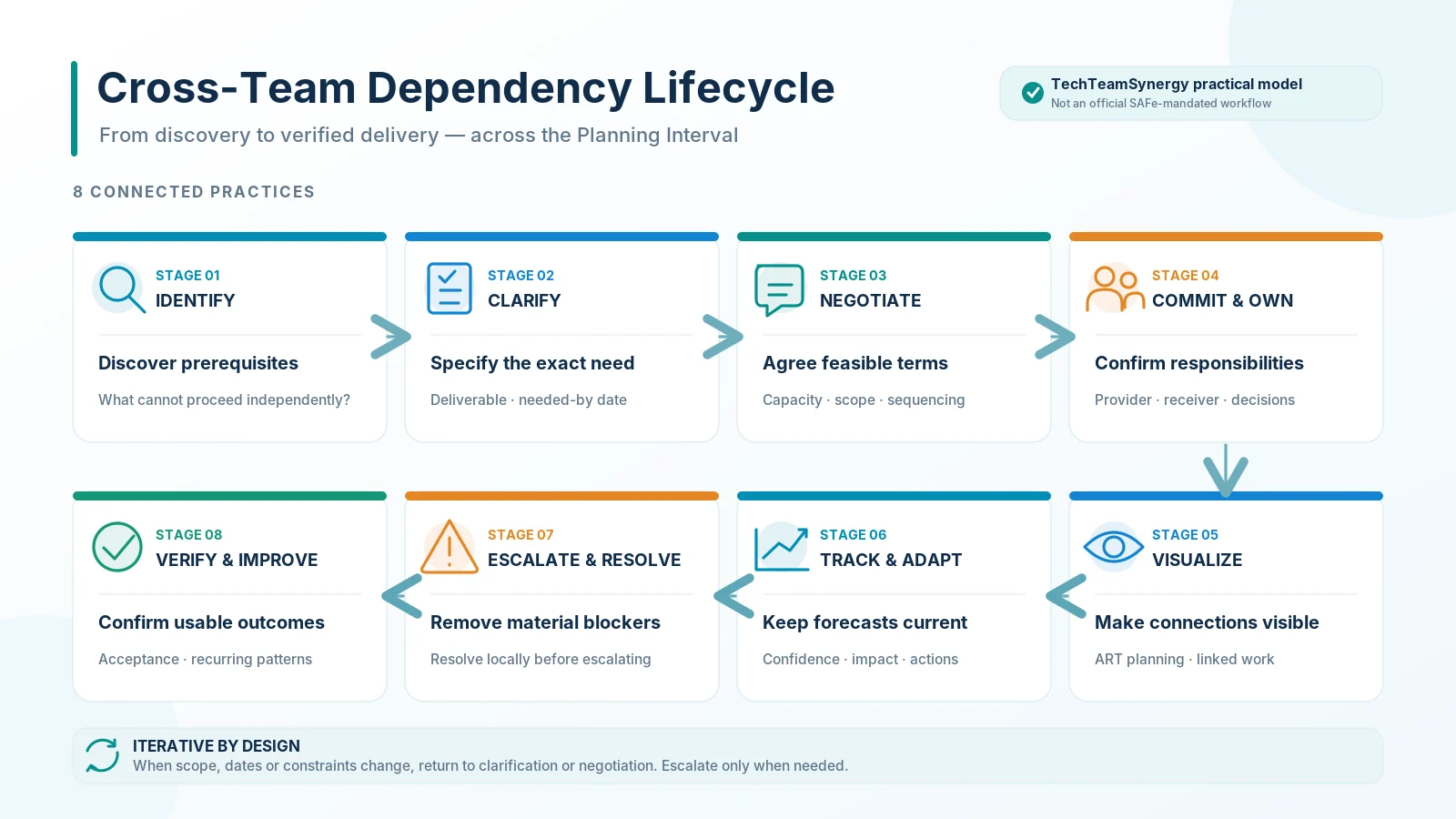
For practical SAFe dependency management, TechTeamSynergy recommends eight connected practices.
| Stage | Key Question | Primary Output |
|---|---|---|
| Identify | What do we need from another party? | Known dependency |
| Clarify | What exactly is required, and when? | Defined deliverable |
| Negotiate | Can the provider meet the need? | Feasible delivery agreement |
| Commit & Own | Who provides, receives and coordinates? | Clear responsibilities |
| Visualize | Can affected teams see the dependency? | Shared visibility |
| Track & Adapt | Is the commitment still credible? | Updated forecast and actions |
| Escalate & Resolve | What prevents resolution? | Decision or corrective action |
| Verify & Improve | Was the need satisfied, and what can improve? | Verified completion and lessons |
The TechTeamSynergy Cross-Team Dependency Lifecycle is a practical editorial operating model, not an official SAFe-mandated workflow.
Its stages are iterative. A changed delivery date, new architecture constraint or revised acceptance requirement may require teams to return to clarification or negotiation.
What Is a Cross-Team Dependency in SAFe?
A cross-team dependency exists when one team’s progress or completion depends on an input, deliverable, service or decision outside its direct control.
Examples include an application team waiting for a shared platform API, a feature requiring another team’s component, an integration environment that is not ready, a security approval or a supplier-provided system.
Dependencies may connect Agile Teams within the same Agile Release Train (ART), different ARTs, Shared Services or external organizations.
For context on ARTs and the broader framework, see our Scaled Agile Framework fundamentals.
Dependency vs Risk vs Issue
These concepts are related but not interchangeable.
| Concept | Meaning | Example |
|---|---|---|
| Dependency | Something needed from another party for progress | Team A requires an API from Team B |
| Risk | An uncertain event or condition that could affect objectives | Team B may deliver the API too late |
| Issue | A problem already occurring | The API is late and Team A’s testing is blocked |
A dependency can exist without becoming a serious risk. Risk exposure increases when timing, capacity or delivery confidence becomes uncertain. An issue exists when the problem is already happening.
The dependency itself may remain open while the associated risk or issue is managed separately.
For deeper risk-identification and analysis practices, see AI-assisted project risk management.
Internal and External Dependencies
Internal ART dependencies can often be negotiated directly between participating teams.
Dependencies across ARTs may require broader coordination, particularly when the teams operate with different priorities or delivery constraints.
Shared Services introduce specialist availability and approval considerations. Suppliers and external systems introduce lead times, contractual interfaces and factors outside the ART’s direct control.
The practical question is not only where the dependency originates, but who can influence its delivery and resolve problems when circumstances change.
Why Cross-Team Dependency Coordination Becomes Difficult at Scale
An ART brings together multiple teams working toward shared outcomes, but those teams do not always control every component they need.
A feature may require a platform change, a security review, a shared test environment and supplier integration before it can be demonstrated or released.
Each additional handoff introduces coordination work. Different priorities, delivery cadences, incomplete information and limited specialist capacity can make an apparently straightforward dependency difficult to manage.
Visibility alone is not enough.
A dependency becomes manageable when the affected teams understand what must be delivered, who will provide it, when it is needed, what the provider can credibly deliver and what should happen if conditions change.
The objective of SAFe dependency management is not necessarily zero dependencies. It is to prevent unclear or unmanaged dependencies from disrupting delivery—and to reduce avoidable coupling over time.
The TechTeamSynergy Cross-Team Dependency Lifecycle
For SAFe dependency management, the following eight practices offer a repeatable way to manage dependencies across a Planning Interval. They can overlap or repeat as circumstances change.
1. Identify Dependencies Before They Become Blockers
Start by asking: What work cannot progress independently, and what must another team or party provide?
Dependency discovery should happen during backlog refinement, architecture discussions, integration preparation and conversations with shared platforms, suppliers or specialist services.
For example, a customer onboarding feature might require a new authentication API, identity-management configuration and an external verification service.
If those needs are discovered only when implementation starts, the receiving team may already have committed to an unrealistic delivery sequence.
Record the prerequisite, affected work and likely providing party as soon as the relationship becomes meaningful. Early identification does not mean the provider has already accepted the work.
2. Clarify the Required Deliverable and Needed-by Date
A dependency such as “Need the API sometime in Iteration 3” is too vague for reliable coordination.
Clarification should establish the specific output, receiving team, providing party, affected feature or story, needed-by date, acceptance conditions and impact if the requirement is not satisfied.
A stronger example is:
The mobile application team needs the authentication API contract and a tested endpoint available before integration testing begins in Iteration 3. The endpoint must support the agreed authentication flow and error responses.
This makes it possible to discuss scope, feasibility and completion evidence.
A needed-by date describes the receiving team’s requirement. It is not yet a confirmed provider commitment.
3. Negotiate Feasible Cross-Team Commitments
The providing team must assess its capacity, existing priorities, implementation complexity, technical constraints and competing obligations.
Suppose Team A needs an API by March 10, while Team B forecasts completion on March 18.
Those dates represent a delivery conflict, even if both teams have documented them correctly.
The teams might renegotiate sequencing, provide a smaller usable interface earlier, adjust testing plans, split the work or seek a priority decision.
A useful negotiation produces either an agreed, credible commitment or an explicitly unresolved constraint requiring further action.
The receiver’s needed-by date must never be mistaken for the provider’s agreed delivery date.
4. Commit and Assign Ownership
A dependency agreement requires more than a name in an owner column.
TechTeamSynergy recommends clarifying four practical responsibilities:
- Provider: Supplies the required deliverable or decision.
- Receiver: Confirms that the output satisfies the dependency.
- Coordinator: Keeps necessary follow-up and visibility active.
- Decision authority: Resolves trade-offs beyond the teams’ control.
These are practical responsibility categories, not four official SAFe roles.
In a simple case, one engineer may act as the provider contact and coordinator. In a more complex case, the receiving Product Owner, providing team, Scrum Master/Team Coach and a business decision-maker may participate.
An agreement should identify what was accepted, the current forecast, relevant acceptance conditions and how changes will be communicated.
5. Visualize Dependencies Across the ART
Within Core SAFe, official PI Planning guidance describes how teams expose dependencies and align their plans. The ART Planning Board provides a shared planning view of feature delivery timing and dependencies.
This visibility can reveal situations where a receiving team plans to consume an input before the providing team expects to deliver it.
For a full explanation of the event, use our complete SAFe PI Planning guide.
However, a planning board is not automatically a complete execution-management system. Detailed work items, delivery forecasts, current blockers, acceptance evidence and risk information may require linked operational records.
Visualize what matters without creating multiple disconnected copies of the same dependency.
6. Track, Reforecast and Adapt
This is where SAFe dependency management becomes an execution discipline.
Once PI Planning ends, teams should periodically review material dependencies against actual delivery conditions.
Useful information includes current status, provider forecast, confidence, needed-by date, changed scope, blockers, downstream impact and next action.
An agreed dependency can still become at risk.
For example, a provider may discover unexpected technical work. The original delivery forecast is no longer credible, even though no deadline has yet been missed.
The affected teams should be informed, assess the impact, renegotiate dates or scope where necessary and update the relevant delivery records.
Do not wait for a missed commitment before acknowledging that the plan has changed.
7. Escalate and Resolve Material Blockers
Most dependencies should first be addressed directly between the provider and receiver.
If teams can resolve a technical misunderstanding, agree a different sequence or adjust a delivery forecast within their authority, they should do so.
Escalation becomes appropriate when resolution requires additional capacity, conflicting priority decisions, architecture authority, supplier intervention or a broader ART-level trade-off.
Depending on the problem, this may involve the Scrum Master/Team Coach, Release Train Engineer, Product Management, System Architect, Business Owners or relevant external governance roles.
As described in the official Release Train Engineer role, the RTE supports ART-level coordination and impediment resolution but does not automatically own every dependency.
Escalate the decision that cannot be made locally—not merely the existence of the dependency.
8. Verify Completion and Improve the System
A provider marking work “done” does not always mean the dependency has been satisfied.
The receiving team should confirm that the required outcome is usable.
Evidence might include a successfully tested API, an accessible environment, approved security control, completed integration, recorded architecture decision or accepted supplier deliverable.
When the outcome has been verified, the dependency can be closed or marked resolved in the agreed tracking system.
Then examine whether the dependency was unusually difficult or part of a recurring pattern.
Repeated delays involving the same interface, platform or specialist group may indicate an opportunity to improve architecture, sequencing, capacity or capability ownership.
In Core SAFe, Inspect and Adapt offers an opportunity to examine such systemic problems and identify improvement actions.
Dependency Preparation Before PI Planning
Early preparation strengthens SAFe dependency management by helping teams arrive at PI Planning with known constraints instead of avoidable surprises.
Discover Known Technical and Delivery Constraints
During backlog refinement and technical preparation, examine work that depends on another team, integration interface, environment, shared platform or architectural decision.
Product Owners and engineering contributors can identify likely receiving and providing teams, while Product Management and architecture representatives help clarify larger feature or system-level constraints.
Known dependencies should be visible before teams negotiate their complete PI plans.
Engage Shared Services and Suppliers Early
Security specialists, infrastructure teams and suppliers may operate under capacity constraints or lead times that an individual Agile Team cannot change.
Early conversations can reveal when approvals, environments, specialist reviews or external components will realistically be available.
The goal is not to finalize every agreement before PI Planning. It is to make material constraints explicit enough for informed negotiation.
Use the PI Planning readiness checklist for wider preparation and follow-through questions.
Dependency Agreements During PI Planning
PI Planning is a major opportunity to turn known and newly discovered dependencies into a coherent, collaborative delivery plan.
Negotiate Provider and Receiver Commitments
During team planning and cross-team discussions, the affected parties should clarify the deliverable, needed-by date, provider forecast, responsibilities and consequences of missing the agreement.
A line connecting two teams on the ART Planning Board is useful for visualization, but it does not prove that the provider has accepted a feasible commitment.
Unresolved timing or capacity conflicts should remain visible for planning adjustments and appropriate decision-making.
Align Dependencies With Features, Dates and Objectives
Significant dependencies may influence feature sequencing, team plans, PI Objectives and related risk discussions.
The ART Planning Board supports visibility, while the teams and appropriate stakeholders make the decisions needed to create a credible integrated plan.
For session sequencing and event outputs, refer to our two-day PI Planning agenda template.
Core SAFe scope note: This article addresses Core SAFe. Organizations adopting AI-Native SAFe may use different planning and feedback mechanisms, including PI Outcome Planning and Sense and Respond, rather than the traditional Core SAFe event model.
SAFe Dependency Management During PI Execution
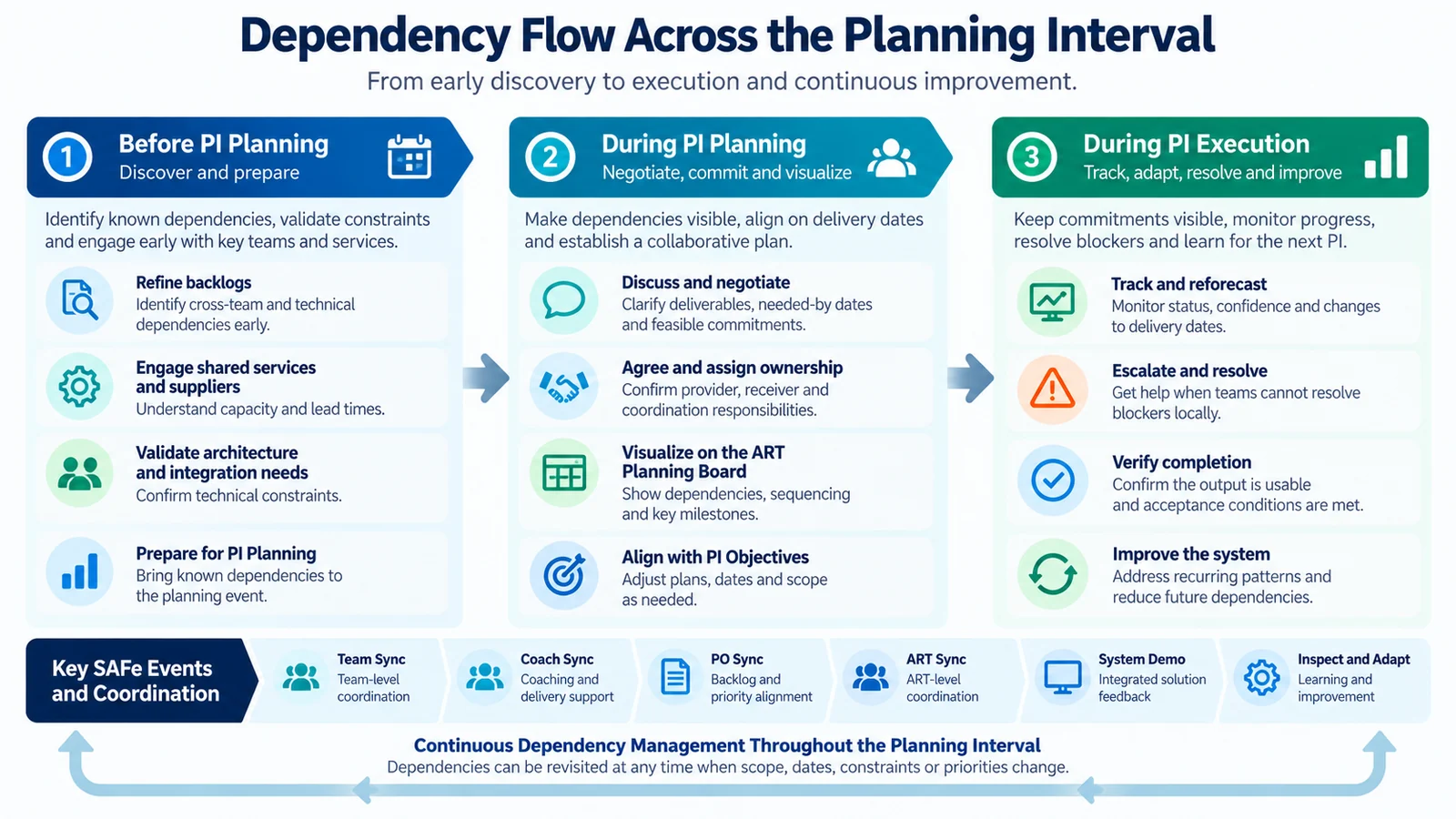
SAFe dependency management does not end when PI Planning ends.
A planning commitment is a baseline informed by what teams knew at that point. During execution, new information can change the provider’s forecast, the receiver’s priorities or the technical solution.
Effective execution management keeps material commitments visible, checks whether they remain feasible and ensures that affected teams respond before delays cascade across the ART.
Keep Important Commitments Visible
Choose an agreed source of truth for material dependencies.
Depending on the organization, this may be a delivery platform with linked work items, a digital dependency board or a practical dependency register.
The key requirement is not the tool. It is that the provider, receiver and relevant coordinators can identify the latest accepted information.
Avoid independently maintained spreadsheets and boards that contradict the delivery system.
When multiple artifacts are necessary, establish which record is authoritative and how changes propagate between them.
Monitor Dates, Confidence and Blocked Work
A useful operational distinction is whether a commitment is still feasible, becoming uncertain, actively blocked or verified as resolved.
An agreed dependency has a mutual understanding of what should be supplied. An at-risk dependency has deteriorating confidence or a forecast that threatens the receiving team’s need. A blocked dependency is already preventing required progress. A resolved dependency has satisfied the agreed conditions.
These are illustrative tracking concepts, not mandatory SAFe statuses.
Review material changes in needed-by dates, provider forecasts, capacity, technical scope and downstream consequences.
Pay particular attention to dependencies whose delays could affect several teams or important PI Objectives.
Use ART Sync and Direct Cross-Team Coordination
Official Scaled Agile guidance on Team and Technical Agility describes Core SAFe coordination mechanisms including Team Sync, Coach Sync, PO Sync and ART Sync.
Team Sync helps Agile Teams inspect near-term progress and raise impediments. Coach Sync and PO Sync support cross-team coordination, while ART Sync provides a broader venue for matters requiring ART-level attention.
Not every dependency deserves a meeting.
A brief provider-to-receiver conversation, linked work-item update or asynchronous confirmation may resolve a straightforward issue faster.
Use effective cross-team communication practices to support clarity, but judge coordination by decisions and outcomes rather than meeting frequency.
Renegotiate When Reality Changes
Suppose the platform team discovers that its API needs additional security work. The original delivery forecast shifts by one iteration.
The receiving team should not continue planning around the old date merely because it remains visible on the planning board.
Both teams should examine whether to change sequencing, reduce initial scope, use a temporary interface, shift testing or obtain additional support.
If the required decision exceeds their authority, they should escalate with the facts, impact and feasible alternatives.
Update affected work items, forecasts, commitments and risk or issue records as appropriate.
The purpose of renegotiation is to preserve delivery transparency—not conceal a missed expectation.
Confirm That Delivery Dependencies Are Actually Resolved
Close a dependency when the agreed input has been supplied and appropriately verified by its receiver.
For software integration, that may require more than deployment of a component. The receiving team may need evidence that the interface works under agreed conditions.
Core SAFe System Demos provide integrated feedback on delivered features and may expose unresolved integration problems. They are not a substitute for dependency-specific acceptance.
A verified result, recorded decision or completed approval provides more useful closure evidence than a status change alone.
Who Owns a Cross-Team Dependency in SAFe?
There is no universal rule that every cross-team dependency belongs to the RTE.
Ownership should reflect who must provide the result, who needs it, who coordinates the work and who can authorize necessary decisions.
| SAFe Role or Contributor | Typical Dependency Contribution |
|---|---|
| Agile Teams | Supply, consume and validate dependent work |
| Product Owner | Clarify team backlog implications and priorities |
| Product Management | Resolve feature-level priority trade-offs |
| Scrum Master/Team Coach | Facilitate coordination and address impediments |
| Release Train Engineer | Support ART-level flow and cross-team escalation |
| System Architect | Help resolve significant architecture and interface questions |
| Business Owners | Participate in major business and governance decisions |
| Shared Services | Provide agreed specialist capabilities |
| Suppliers | Deliver agreed external inputs or components |
Provider, Receiver, Coordinator and Decision Authority
For practical SAFe dependency management, identify these four responsibilities explicitly, even when one person fulfills more than one.
The provider remains responsible for supplying the agreed result. The receiver clarifies and validates the need. The coordinator maintains necessary follow-up. The decision authority becomes relevant when a conflict cannot be resolved locally.
This is TechTeamSynergy’s practical ownership model, not an additional set of official SAFe roles.
When the RTE, Product Management or System Architect Becomes Involved
The RTE may help when an impediment affects coordination or flow across the ART.
Product Management may become involved when priorities or feature commitments conflict. The System Architect may be needed for interface or technical-direction decisions. Business Owners may contribute when significant business trade-offs are involved.
For formal responsibility mapping beyond a specific dependency, consult our RACI responsibility matrix and practical RACI matrix examples.
What Information Should a Dependency Record Contain?
For SAFe dependency management, a simple, shared record helps teams distinguish a real agreement from a loosely documented assumption.
The following is a TechTeamSynergy Practical Dependency Register — Example, not an official SAFe template.
| Essential Field | Information Captured |
|---|---|
| ID and description | What input is required |
| Receiving team | Who needs it |
| Providing party | Who supplies it |
| Related work | Feature, story or capability affected |
| Needed-by date | When the receiver needs the result |
| Provider forecast | When the provider expects delivery |
| Coordination contacts | Who follows up on both sides |
| Status and confidence | Current condition and reliability |
| Impact and blocker | Consequence or active impediment |
| Next action and last update | What happens next and information freshness |
| Escalation / completion evidence | Decision route and proof of resolution |
Organizations can keep additional details, including acceptance criteria, architecture references or supplier milestones, where useful.
The register should complement existing work management rather than introduce unnecessary administration.
Why Needed-by and Agreed Delivery Dates Must Be Separate
If Team A requires an input on March 10 but Team B forecasts March 18, the dependency has an unresolved timing conflict.
Documenting both dates does not make the commitment healthy.
The teams must decide whether the provider can change its delivery plan, the receiver can adjust sequencing, or another intervention is needed.
This distinction is one of the most valuable checks in dependency management.
How to Use the ART Planning Board for Dependency Visibility
What the Planning Board Shows
Within Core SAFe, the ART Planning Board provides visibility into feature delivery timing and dependencies established during PI Planning. Important milestones form part of the broader planning context.
It helps teams recognize cross-team timing relationships before execution begins.
Why the Planning Board Does Not Replace Execution Tracking
A planning board can become stale when forecasts change.
The board does not automatically replace team work items, detailed dependency records, direct coordination or evidence of completed handoffs.
Use it for integrated planning visibility; maintain accurate execution information in the agreed operational system.
When to Escalate a Cross-Team Dependency
Resolve Locally Before Escalating
Start with direct discussion between the provider and receiver.
Can the teams revise sequencing, clarify scope, agree a different delivery approach or update a forecast without compromising broader objectives?
If the resolution remains within their authority, local coordination is usually preferable.
Escalate Decisions That Exceed Team Authority
| Trigger | Local Action | Possible Escalation | Evidence Needed |
|---|---|---|---|
| Needed-by date at risk | Reforecast and explore alternatives | SM/TC or RTE | Dates and impact |
| Provider cannot commit | Identify capacity constraints | RTE / Product Management | Demand and available capacity |
| Competing priorities | Compare scope and value | Product Management | Conflicting commitments |
| Architecture decision blocked | Present technical options | System Architect | Options and implications |
| Shared-service constraint | Negotiate available support | Service lead / RTE | Capacity gap |
| Supplier delay | Confirm new forecast | Supplier or program governance | Milestones and consequences |
| PI Objective threatened | Assess recovery options | RTE / Product Management; Business Owners where appropriate | Objective and delivery impact |
| Recurring unresolved issue | Identify structural cause | Relevant ART leadership | History and repeated impact |
Escalation should include a clear decision request, realistic alternatives and relevant evidence.
Escalate the decision that cannot be made locally, not merely the existence of a dependency.
Reducing Cross-Team Dependencies Over Time
Some dependencies are a natural consequence of integrating complex systems. Others result from avoidable handoffs, unclear interfaces or organizational bottlenecks.
Reducing dependency load may involve clearer API contracts, better backlog decomposition, architecture decoupling, improved sequencing, automation, platform self-service, earlier Shared Services involvement or more realistic supplier planning.
Better capability ownership can also reduce recurring coordination overhead.
For the wider team-design perspective, see building effective Agile teams.
Address Recurring Dependencies as System Problems
Repeated waiting on the same component, approval or specialist group may indicate structural coupling.
Not every recurring dependency is unhealthy. What matters is whether it repeatedly interrupts flow, causes rework or makes delivery unreliable.
Use evidence from completed PIs to decide which recurring patterns deserve improvement.
Metrics That Help Without Creating Vanity KPIs
Measure SAFe dependency management outcomes to improve delivery—not to reward teams for reporting fewer dependencies.
| Metric | What It Reveals | What It Does Not Prove |
|---|---|---|
| Open dependencies | Current coordination workload | Poor ART performance |
| Missed needed-by dates | Failed timing alignment | Which party caused the delay |
| Unclear coordination contacts | Ownership ambiguity | Overall accountability quality |
| Dependency age | How long items remain unresolved | Criticality |
| Blocked work / waiting time | Flow interruption | Root cause |
| Dependencies threatening PI Objectives | Potential outcome impact | Certain objective failure |
| Recurring dependency patterns | Possible structural bottlenecks | That every dependency is avoidable |
These are suggested practical indicators, not official SAFe dependency metrics or universal benchmarks.
Combine counts with impact, trends and delivery context. A low dependency count can conceal serious problems if teams stop reporting important handoffs.
Common SAFe Dependency-Management Mistakes
| Mistake | Why It Hurts | Better Approach |
|---|---|---|
| Discovering dependencies too late | Plans become unrealistic | Identify prerequisites during refinement |
| Unclear provider and receiver | Handoffs lack agreement | Identify both parties |
| Missing needed-by date | Urgency is ambiguous | Record the receiving team’s requirement |
| Unrealistic commitment | Creates false confidence | Negotiate against actual capacity |
| Static planning board | Hides changing conditions | Maintain current execution information |
| No post-planning tracking | Dependencies become forgotten | Review material commitments throughout the PI |
| Confusing dependencies with risks/issues | Produces the wrong response | Separate prerequisites, uncertainty and active problems |
| No escalation path | Important conflicts remain unresolved | Clarify decision authority |
| RTE treated as universal owner | Weakens team accountability | Keep responsibility context-specific |
| Replanning without updating commitments | Teams follow obsolete assumptions | Communicate and record revised agreements |
Example: Managing Dependencies Across an Agile Release Train
Illustrative scenario — not an official SAFe example.
The Situation: Multiple Teams and a Shared Release
An ART has six Agile Teams preparing a synchronized customer-service release.
An application team needs a new API from a shared platform team. Integration testing also depends on security approval, while an external supplier must provide an updated identity-verification component.
During PI Planning, the teams identify the dependencies and agree initial delivery dates.
The Dependency Conflict
During execution, the platform team discovers that the API requires additional authentication work. Its forecast shifts beyond the application team’s needed-by date.
The security specialists have limited availability, and the supplier has not confirmed when its updated component will be ready.
The original plan is no longer credible.
Negotiation, Reforecasting and Escalation
The application and platform teams clarify the minimum usable API contract and negotiate an earlier partial delivery.
They update the forecast and link the relevant work items. The receiving team adjusts integration testing to use the initial API capability first.
However, the delayed supplier component threatens a significant PI Objective. The issue is raised for ART-level coordination, with Product Management involved in the scope trade-off and the appropriate supplier contact asked for a credible recovery forecast.
The decision is to preserve the core release functionality while moving one supplier-dependent capability to a later delivery point.
Resolution and Lessons Learned
The application team tests the usable API and confirms the agreed acceptance conditions. The dependency is closed with integration evidence, not simply because the platform team reports completion.
At Inspect and Adapt, the ART examines repeated platform and supplier bottlenecks and identifies improvement work for future planning.
The scenario illustrates a realistic result: dependency management does not eliminate uncertainty, but it makes its consequences visible and actionable.
SAFe Cross-Team Dependency Checklist
Use these 14 SAFe dependency management checks to review actual commitments—not to replace the complete PI Planning readiness checklist.
Before PI Planning
- ☐ Identify important cross-team and external prerequisites.
- ☐ Name likely receiving and providing parties.
- ☐ Clarify required deliverables and needed-by dates.
- ☐ Surface specialist-capacity and supplier constraints.
During PI Planning
- ☐ Negotiate feasible provider delivery forecasts.
- ☐ Confirm coordination and delivery responsibilities.
- ☐ Visualize material dependencies and timing conflicts.
- ☐ Record unresolved trade-offs requiring decisions.
During Execution
- ☐ Maintain current dependency status and forecasts.
- ☐ Inform affected teams when commitments change.
- ☐ Assess downstream impact and renegotiate when needed.
- ☐ Escalate material blockers beyond local authority.
Verify and Improve
- ☐ Confirm completion with receiving-team evidence.
- ☐ Review recurring dependency patterns for improvement.
Frequently Asked Questions
What Is a Dependency in SAFe?
A dependency exists when an Agile Team needs work, information, a service, a decision or another input from a separate party. It may involve another team, platform, Shared Services or an external supplier. The important management task is to make that prerequisite explicit and coordinate its delivery.
How Are Dependencies Identified During PI Planning?
Teams identify dependencies while examining planned features, sequencing work and coordinating with other teams. Core SAFe PI Planning supports cross-team collaboration and uses the ART Planning Board to make significant dependencies and feature timing visible. Known dependencies should also be discovered before the event whenever possible.
Who Owns Cross-Team Dependencies in SAFe?
Ownership depends on the work and decision context. The providing party is responsible for its agreed deliverable, while the receiving party clarifies and validates the required input. Scrum Masters/Team Coaches and the RTE can facilitate coordination, but the RTE does not automatically own every dependency.
What Is the ART Planning Board Used For?
The ART Planning Board helps Agile Teams and stakeholders visualize feature delivery timing and significant cross-team dependencies during Core SAFe PI Planning. It supports integrated planning, but does not automatically replace detailed work records, operational status updates, direct communication or dependency acceptance evidence.
How Do You Track Dependencies After PI Planning?
For effective SAFe dependency management, maintain an agreed, current record of provider and receiver, needed-by date, provider forecast, status, impact and next action. Use delivery tools or linked records that the affected teams can access. Revisit commitments when conditions change, and verify that completed inputs meet the receiving team’s requirements.
When Should a Dependency Be Escalated to ART Leadership?
Escalate when the affected teams cannot resolve a material constraint with their available authority, capacity or information. Examples include conflicting feature priorities, major architecture decisions, unavailable shared services or threats to PI Objectives. Provide the impact, options and specific decision needed rather than raising an unexplained blocker.
What Is the Difference Between a Dependency and a Risk?
A dependency is a required input or prerequisite. A risk is an uncertain condition that may affect objectives. For example, needing another team’s API is a dependency; uncertainty about its timely delivery is a risk. If it is already late and blocking work, an issue exists.
How Can Agile Teams Reduce Recurring Dependencies?
Teams can reduce unnecessary handoffs through clearer interfaces, better work decomposition, more autonomous capabilities, architecture improvements, automation and earlier specialist coordination. Recurring dependencies should be examined in context: some are legitimate integration requirements, while others reveal structural bottlenecks that can be improved.
Conclusion
PI Planning helps make dependencies visible and establishes a collaborative delivery baseline. But execution reveals whether those initial commitments remain credible.
Effective SAFe dependency management requires teams to identify and clarify prerequisites, negotiate feasible commitments, assign responsibilities, visualize relationships, track changing conditions, escalate when necessary and verify results.
The goal is not to eliminate every dependency. It is to keep cross-team delivery predictable, transparent and responsive while reducing recurring sources of delay.
A dependency is truly managed when the affected teams understand it, act on it and know when it has been resolved.