
This PI Planning agenda template gives you a practical two-day structure in which every session has a clear purpose, a realistic timebox, the right people in the room, and a defined output that enables the next planning decision.
A typical SAFe PI Planning event is structured across two days. The exact clock times can vary by Agile Release Train (ART), location, time zone, and organizational context, but the overall flow usually moves from business and product context to team planning, cross-team alignment, risk resolution, and confidence in the resulting plan.
This PI Planning agenda template is designed as a practical working guide. It shows what should happen during each planning block, who should participate, how long to reserve, and what should exist before the session is considered complete.
If you are still checking whether your ART is ready for the event, use the PI Planning Checklist: Before, During & After first. The checklist answers “Are we ready?” This guide answers “What happens next, and in what order?”
PI Planning Agenda Template at a Glance
The following two-day agenda is a practical starting point rather than a mandatory timetable. However, you should adjust the exact times to your ART while preserving enough space for team planning, cross-team decisions, risks, and rework.
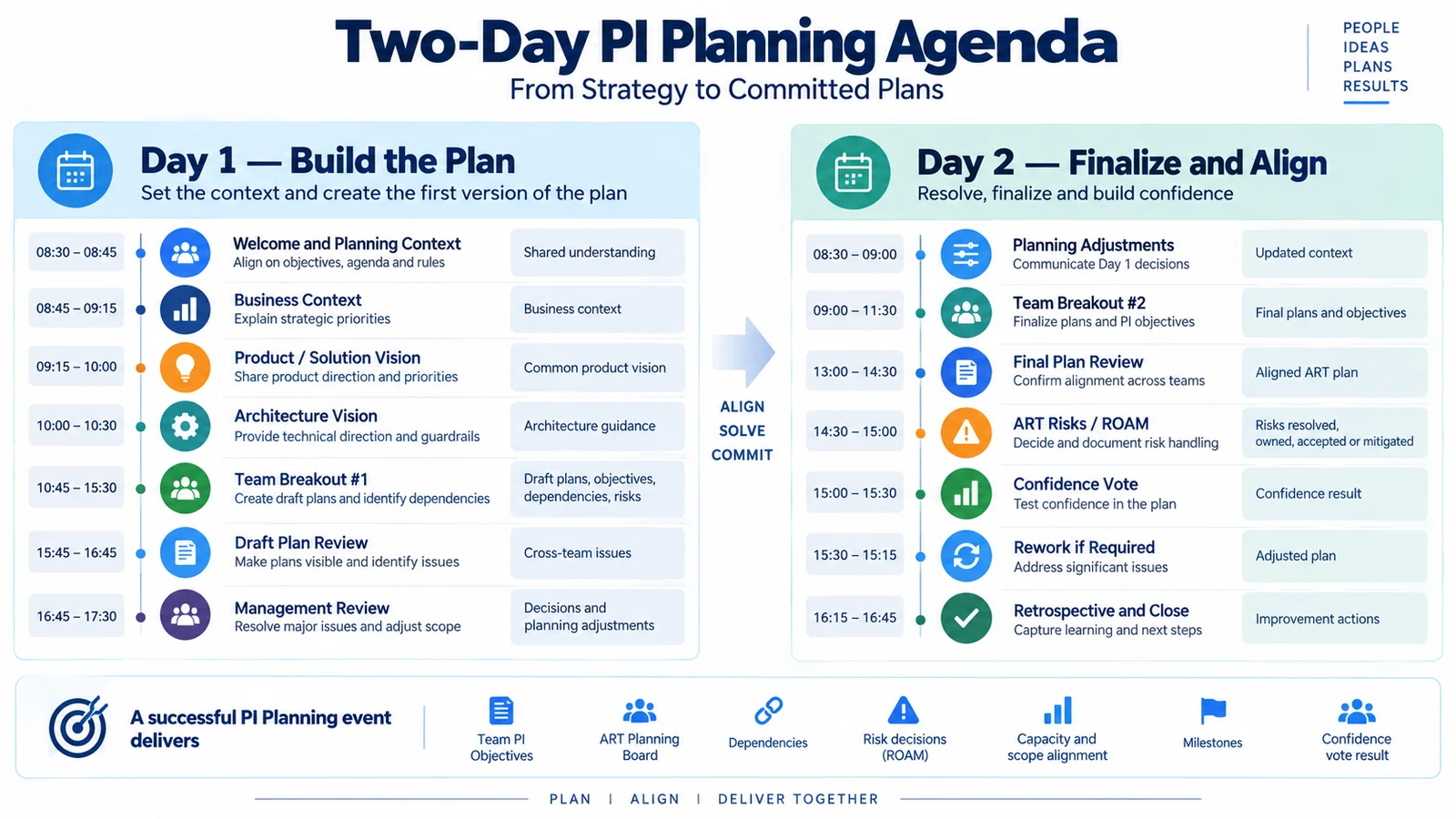
Two-Day PI Planning Agenda Template Schedule
| Day | Time | Session | Primary Owner | Main Objective | Expected Output |
|---|---|---|---|---|---|
| Day 1 | 08:30–08:45 | Welcome and Planning Context | RTE | Align participants on the event and process | Shared understanding of agenda, objectives and rules |
| Day 1 | 08:45–09:15 | Business Context | Business Owners | Explain strategic and business priorities | Shared business context |
| Day 1 | 09:15–10:00 | Product / Solution Vision | Product Management | Explain priorities and desired outcomes | Common view of product direction |
| Day 1 | 10:00–10:30 | Architecture Vision | System Architect / Engineering | Explain technical direction and constraints | Architecture guidance and constraints |
| Day 1 | 10:45–15:30 | Team Breakout #1 | Agile Teams | Build initial plans and objectives | Draft plans, objectives, dependencies and risks |
| Day 1 | 15:45–16:45 | Draft Plan Review | Teams / RTE | Test alignment across teams | Visible draft plans and cross-team issues |
| Day 1 | 16:45–17:30 | Management Review and Problem Solving | ART Leadership | Resolve issues teams cannot solve alone | Planning adjustments and decisions |
| Day 2 | 08:30–09:00 | Planning Adjustments | RTE / Leadership | Communicate Day 1 decisions | Updated assumptions and priorities |
| Day 2 | 09:00–11:30 | Team Breakout #2 | Agile Teams | Finalize realistic plans | Final objectives, dependencies and risks |
| Day 2 | 13:00–14:30 | Final Plan Review | Teams / Business Owners | Review plans and objectives | Agreed team plans and PI Objectives |
| Day 2 | 14:30–15:00 | ART Risks / ROAM | RTE / ART | Decide how exposed risks will be handled | Risks resolved, owned, accepted or mitigated |
| Day 2 | 15:00–15:30 | Confidence Vote | RTE | Test belief in the plan | Confidence result and feedback |
| Day 2 | 15:30–16:15 | Rework if Required | Relevant Teams | Address significant confidence issues | Adjusted plan |
| Day 2 | 16:15–16:45 | Retrospective and Close | RTE | Capture improvements and close planning | Improvement actions and aligned next steps |
How to Use This PI Planning Agenda Template
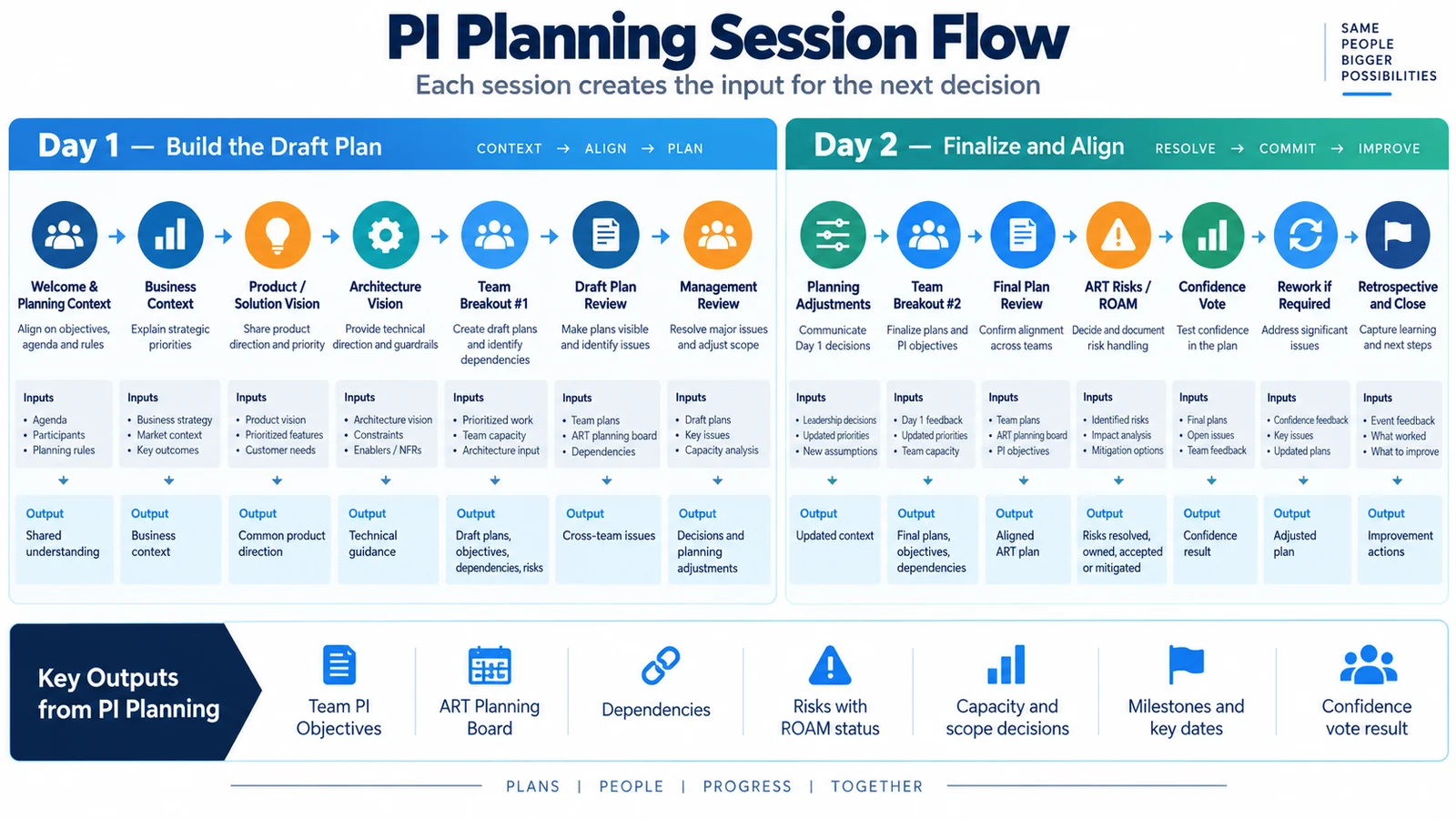
Practical rule: adapt the clock times, but protect the planning logic. Therefore, each session should produce information or decisions that the next session needs.
Free PI Planning Agenda Template
Run your next PI Planning event with a ready-to-use two-day agenda covering session timings, owners, objectives and expected outputs.
Before the PI Planning Agenda Starts: What Must Be Ready
In addition, a well-designed agenda cannot compensate for weak preparation. Before Day 1 starts, teams need enough business, product and technical context to make useful planning decisions. That normally means having the business context, product or solution vision, architecture guidance, prioritized work, team capacity, known risks and major dependencies available.
Moreover, the right participants also need to be present. Business Owners, Product Management, architecture roles and other decision-makers should not appear only for their presentation and disappear before teams begin uncovering questions.
Finally, logistics matter as well. Physical rooms, digital planning boards, conferencing tools, permissions and breakout spaces should be tested before the event.
Do not turn this section into another preparation exercise. For the complete readiness process, use the PI Planning readiness checklist, which covers organizational, content and logistics readiness in detail.
Day 1 PI Planning Agenda: Build the Draft Plan
First, Day 1 establishes context and converts high-level priorities into the first realistic version of the plan. The most common Day 1 failure is spending too much time presenting information and leaving too little time for the teams to plan. However, context matters, and the people responsible for delivery still need significant space to discuss capacity, sequencing, dependencies and risk.
Welcome and Planning Context
Recommended duration: 15–30 minutes
Owner: Release Train Engineer
Participants: Entire ART and relevant stakeholders
Purpose: Establish how the two days will work. The RTE explains the agenda, expected outputs, collaboration rules, key planning milestones and where teams should record plans, dependencies, PI Objectives and risks.
Inputs: confirmed participant list, planning environment, agenda, facilitation rules and planning assumptions.
Expected output: Everyone understands the event structure and what their team must produce.
Common mistake: Spending the opening session re-explaining SAFe theory. Participants need enough context to work, not a training course. Readers needing that foundation can use the complete guide to SAFe PI Planning.
Business Context
Recommended duration: 20–30 minutes
Owner: Business Owners or appropriate business leaders
Participants: Entire ART
Purpose: Explain why the upcoming Planning Interval matters. The business context should connect planning with customer needs, strategic priorities, business performance, market conditions and significant constraints.
Expected output: Teams understand the business priorities that should influence planning decisions.
Common mistake: Presenting broad corporate strategy without translating it into decisions relevant to the upcoming PI.
Product / Solution Vision
Recommended duration: 30–45 minutes
Owner: Product Management or Solution Management
Participants: Entire ART
Purpose: Establish product direction and priority. Product Management explains what customers and the business need from the upcoming PI, which features or outcomes carry the highest priority, and where uncertainty still exists.
Inputs: Product vision, roadmap, ART backlog, customer needs and relevant milestones.
Expected output: A common understanding of what the ART is trying to achieve.
Common mistake: Presenting a fixed scope that implicitly assumes every requested feature must fit regardless of actual team capacity.
Architecture Vision and Development Practices
Recommended duration: 20–30 minutes
Owner: System Architect / Engineering
Participants: Entire ART
Purpose: Provide enough technical direction for teams to build compatible plans. Architecture guidance may cover significant technical changes, enablers, nonfunctional requirements, platform constraints, integration points, security requirements or important architectural dependencies.
Expected output: Shared understanding of architecture constraints and technical direction.
Common mistake: Turning architecture vision into a long technical presentation that consumes team planning time.
Team Breakout Session 1
Recommended duration: Approximately 2.5–3.5 hours
Owners: Agile Teams
Facilitators: Scrum Masters / Team Coaches
Purpose: Convert priorities into the first realistic team plan. Teams compare requested work with usable capacity, examine features, identify dependencies, expose risks, draft PI Objectives and build a high-level iteration plan.
Meanwhile, cross-team conversations should happen during the breakout, not be postponed until the formal review. If Team A needs an API, environment, architecture decision or feature from Team B, both teams should clarify what is needed and when.
Expected outputs: draft team plan, draft PI Objectives, identified dependencies, initial risks, capacity and scope questions, and updates to the ART Planning Board.
Common mistake: Building the plan against theoretical capacity instead of realistic capacity after absences, operational commitments and other known constraints. Strong team collaboration practices also matter; see our guide to building effective Agile teams.
Draft Plan Review
Recommended duration: 45–60 minutes depending on ART size
Owner: RTE
Presenters: Agile Teams
Purpose: Make the draft plans visible and identify issues while there is still time to change them. A useful review focuses on objectives, major dependencies, risks, constraints and decisions that require another team or leadership.
Expected output: A visible set of cross-team issues, planning conflicts and decisions requiring action.
Common mistake: Treating the review as a status presentation rather than a planning checkpoint.
Management Review and Problem Solving
Recommended duration: Approximately 45–60 minutes
Owners: Business Owners, Product Management, RTE and relevant ART leadership
Purpose: Resolve issues that cannot reasonably be solved by individual teams. Draft plans may reveal too much demand for available capacity, impossible dependencies, conflicting priorities, insufficient resources or significant scope problems.
As a result, leadership should use this session to adjust the planning environment by reducing or reprioritizing scope, moving features, changing assumptions, resolving ownership questions or accepting explicit risk.
Expected output: A concise set of decisions and adjustments for teams to use when finalizing their plans.
Common mistake: Asking teams to simply “try harder” when draft plans reveal a genuine demand-versus-capacity problem.
Day 2 PI Planning Agenda: Resolve, Finalize and Build Confidence
Next, Day 2 turns draft plans into an aligned ART plan. The focus shifts from exploration toward decisions: final scope, PI Objectives, dependencies, risks and collective confidence.
Planning Adjustments
Recommended duration: 20–30 minutes
Owner: RTE with relevant Business Owners and Product Management
Purpose: Communicate the decisions made after the Day 1 draft review. Therefore, changes should be specific enough for teams to act on immediately.
Expected output: All teams begin Day 2 using the same updated planning context.
Common mistake: Announcing vague changes that teams then interpret differently.
Team Breakout Session 2
Recommended duration: Approximately 2–3 hours
Owners: Agile Teams
Facilitators: Scrum Masters / Team Coaches
Purpose: Finalize the plan based on Day 1 feedback and management decisions. Then, teams revise iteration-level planning, close dependency gaps, refine objectives, validate capacity and update risks.
Expected outputs: final team plan, final PI Objectives, updated dependencies, updated ART Planning Board, remaining ART-level risks, and clear scope and capacity decisions.
Common mistake: Hiding uncertainty so that every objective appears equally certain.
Final Plan Review
Recommended duration: 60–90 minutes depending on ART size
Owner: RTE
Presenters: Agile Teams
Purpose: Confirm that the plans now form one coherent ART plan. Teams present their objectives, major feature timing, dependencies, risks and relevant milestones.
Expected output: Aligned team plans and PI Objectives that can be evaluated as a complete ART plan.
Common mistake: Reviewing each team independently and missing contradictions between plans.
ART Risks and ROAM
Recommended duration: 20–30 minutes
Owner: RTE
Participants: ART and relevant decision-makers
Purpose: Ensure important ART-level risks leave PI Planning with an explicit decision. ROAM provides a simple structure: Resolved, Owned, Accepted or Mitigated.
The value is not the acronym; the value is removing ambiguity. Risk handling should happen progressively during the planning event, not only at the end. For a broader method, see project risk identification and analysis.
Expected output: Significant ART risks have a visible ROAM status and, where required, a clear owner or mitigation action.
Confidence Vote
Recommended duration: 15–30 minutes
Owner: RTE
Participants: Agile Teams and ART
Purpose: Test whether the people responsible for execution believe the plan is workable. However, the confidence vote should not be treated as a ceremony designed to produce a high score. Its value comes from making concerns visible.
When confidence is low, ask: “What would need to change for this plan to become credible?”
Expected output: A transparent view of confidence and actionable feedback where confidence is insufficient.
Common mistake: Applying social pressure that discourages honest voting.
Plan Rework if Needed
Recommended duration: Reserve 30–45 minutes as a buffer
Owner: Relevant teams with RTE coordination
Purpose: Change the plan when the confidence discussion exposes material problems. For example, rework may include reducing scope, adjusting sequencing, renegotiating dependencies or changing an objective.
Expected output: A plan that reflects the issues surfaced by the people expected to execute it.
Planning Retrospective and Close
Recommended duration: 20–30 minutes
Owner: RTE
Purpose: Capture immediate learning from the planning process and close with clear next steps. Ask what should be kept, what created unnecessary delay, which decisions came too late, which information was missing and what should change before the next event.
Expected output: A small number of improvement actions with clear ownership.
Sample Two-Day PI Planning Agenda Template
For example, the following schedule illustrates how the sessions can fit together. It is not an official mandatory SAFe timetable.
Example Day 1 Schedule
| Time | Session | Expected Result |
|---|---|---|
| 08:30–08:45 | Welcome and Planning Context | Participants aligned on process |
| 08:45–09:15 | Business Context | Strategic priorities understood |
| 09:15–10:00 | Product / Solution Vision | Product direction and priority understood |
| 10:00–10:30 | Architecture Vision | Technical direction understood |
| 10:30–10:45 | Break | — |
| 10:45–12:00 | Team Breakout #1 | Initial team planning |
| 12:00–13:00 | Lunch | — |
| 13:00–15:30 | Team Breakout #1 Continues | Draft plans, objectives, dependencies, risks |
| 15:30–15:45 | Break | — |
| 15:45–16:45 | Draft Plan Review | Cross-team issues exposed |
| 16:45–17:30 | Management Review / Problem Solving | Adjustments decided |
Example Day 2 Schedule
| Time | Session | Expected Result |
|---|---|---|
| 08:30–09:00 | Planning Adjustments | Day 1 decisions communicated |
| 09:00–11:30 | Team Breakout #2 | Finalized plans and objectives |
| 11:30–12:00 | Cross-Team Synchronization / Buffer | Remaining dependencies resolved |
| 12:00–13:00 | Lunch | — |
| 13:00–14:30 | Final Plan Review | ART-level plan visible |
| 14:30–15:00 | ART Risks / ROAM | Risk decisions captured |
| 15:00–15:30 | Confidence Vote | Confidence and concerns visible |
| 15:30–16:15 | Rework if Required | Material issues corrected |
| 16:15–16:45 | Retrospective and Close | Improvement actions captured |
The schedule is deliberately generous with team planning time. If presentations expand, do not automatically take the lost time from the breakouts. Compress presentation content first.
Virtual and Hybrid PI Planning Agenda Template
However, virtual PI Planning should not simply reproduce an eight-hour conference-room agenda on video. Distributed teams experience collaboration differently. Screen fatigue, time-zone constraints and switching between plenary and breakout environments all influence the agenda.
Design Around Time Zones
Identify the hours where the greatest number of participants can collaborate synchronously. Protect the sessions that genuinely require real-time interaction—especially team breakouts, dependency negotiation, plan reviews and important decisions.
Shorten Presentation Blocks
Remote participants lose attention faster during long one-way presentations. Business, product and architecture context should be concise and supported by material teams can review asynchronously.
Protect Breakout Time
Remote PI Planning still depends on teams planning together. Provide stable breakout spaces and make it simple for teams to invite Product Management, architects or other teams into their discussions.
Use One Shared Planning Environment
Therefore, teams need a common source of truth for objectives, dependencies, feature timing, milestones and risks. Avoid conflicting versions of the plan across separate files.
Add More Frequent Breaks
Moreover, short breaks improve concentration and give facilitators time to review boards, identify emerging cross-team issues and prepare the next synchronization point.
Prepare Asynchronously Where It Helps
Pre-reading, tool orientation, business data and some context can be shared before the event. Do not use asynchronous preparation to pre-build the entire plan; PI Planning creates value because the people doing the work plan collaboratively.
PI Planning Agenda Template Roles and Responsibilities
| Role | Main Agenda Responsibility | Key Sessions | Expected Contribution |
|---|---|---|---|
| Release Train Engineer | Facilitate the event and ART-level flow | Entire event | Effective facilitation, impediment escalation, alignment |
| Business Owners | Provide business context and decision support | Business Context, reviews, objectives | Strategic clarity and business decisions |
| Product Management | Communicate product direction and priorities | Product Vision, breakouts, reviews | Priorities, feature clarification and trade-offs |
| System Architect / Engineering | Provide technical direction | Architecture Vision, breakouts | Architecture guidance, constraints and technical decisions |
| Scrum Masters / Team Coaches | Facilitate team planning | Team breakouts | Productive planning, impediment visibility |
| Product Owners | Connect priorities with team backlog | Breakouts and plan reviews | Backlog clarification and objective refinement |
| Agile Teams | Build realistic plans | Breakouts and reviews | Plans, dependencies, objectives, risks and estimates |
In addition, when responsibilities extend beyond standard Agile roles—for example architecture approvals, security governance, regulatory reviews or external suppliers—a lightweight responsibility model can help. See RACI Matrix Examples: 10 Practical Scenarios for ways to clarify cross-functional ownership without redefining Agile accountabilities.
What Should a PI Planning Agenda Template Produce?
For example, according to the official SAFe PI Planning guidance, PI Planning is a cadence-based ART event, typically two days, and its central outputs include PI Objectives and the ART Planning Board. The SAFe glossary provides the corresponding definitions for the planning board, objectives and related terminology.
Team PI Objectives
PI Objectives summarize the important business and technical outcomes teams intend to achieve during the upcoming Planning Interval. Objectives make plans easier for stakeholders to understand than a long collection of backlog items.
ART Planning Board
The ART Planning Board provides a cross-team view of important feature delivery dates, dependencies and relevant milestones. It should help the ART understand coordination—not attempt to reproduce every task from every team board.
Explicit Dependencies
A dependency should communicate more than a line between two cards. The teams involved should understand what is required, when it is required and who will coordinate it.
ART Risks
Major risks should be visible and addressed through explicit decisions such as ROAM.
Capacity and Scope Decisions
PI Planning should expose the relationship between demand and actual capacity. When demand exceeds capacity, the outcome should be an explicit scope or priority decision—not hidden overload.
Milestones and Constraints
Important external dates, technical milestones, regulatory commitments or other constraints should be visible where they affect planning.
Confidence Result
The confidence vote gives the ART feedback on whether the combined plan appears credible to the people who will execute it.
Common PI Planning Agenda Template Mistakes
| Mistake | What Happens | Better Approach |
|---|---|---|
| Too much presentation | Teams lose planning time | Keep context focused and protect breakouts |
| Insufficient breakout time | Plans remain superficial | Reserve the largest blocks for teams |
| Missing decision-makers | Questions stay unresolved | Ensure Business Owners and leaders remain accessible |
| Dependencies discovered late | Cross-team conflicts appear during final review | Visualize dependencies continuously |
| No real management review | Capacity and scope conflicts survive Day 1 | Use the review to make explicit decisions |
| Overloaded agenda | Sessions regularly overrun | Use buffers and limit nonessential content |
| Weak facilitation | Issues remain hidden | Use active RTE and team-level facilitation |
| No breaks | Participation and decision quality fall | Schedule deliberate recovery time |
| Remote agenda copied from onsite | Distributed teams disengage | Redesign timing around remote constraints |
| Ceremonial confidence vote | Teams hide concerns | Treat low confidence as useful planning information |
How to Customize Your PI Planning Agenda Template
In practice, no two ARTs need an identical clock-based agenda. The goal is to preserve the sequence of information, collaboration and decisions while adapting the amount of time required.
Number of Teams and ART Size
A larger ART may require more time for plan reviews and cross-team synchronization. Avoid extending presentations simply because more people attend.
ART Maturity
A newly formed ART may need more facilitation, planning guidance and synchronization points. A mature ART with stable working practices may move through some coordination activities faster.
Product and Architecture Complexity
Complex products and major platform changes can justify additional cross-team or technical synchronization, but architecture discussion should remain focused on planning decisions.
Remote or Hybrid Setup
Distributed ARTs may spread sessions differently across time zones or use additional asynchronous preparation. Preserve collaborative planning where synchronous interaction provides real value.
Regulatory Environment
Regulated environments may need explicit security, compliance or approval dependencies represented during planning. Bring the relevant constraints and decision-makers into the planning flow rather than adding long governance presentations.
Cross-ART Dependencies
When several ARTs depend on one another, additional coordination may be required before and during the event.
Customize duration without removing the decision points required for the next planning step.
Free PI Planning Agenda Template
Therefore, a reusable template makes it easier to convert this framework into an agenda for your own ART.
Download the Free PI Planning Agenda Template
The package includes an editable Excel workbook and a printable PDF with Day 1 and Day 2 sessions, owners, participants, objectives, inputs, expected outputs and notes.
The editable workbook includes Instructions, Day 1 Agenda, Day 2 Agenda and Custom Agenda tabs. Use the default two-day structure as a baseline, then adapt timings to team count, maturity, location and product complexity.
Avoid deleting breakout, review, risk or confidence activities simply to make the schedule look shorter. The objective is not to fit PI Planning into the smallest possible calendar. It is to create enough structure for good decisions to happen.
Frequently Asked Questions About the PI Planning Agenda Template
What is a typical PI Planning agenda?
A typical PI Planning agenda progresses from business, product and architecture context into team breakouts, draft plan reviews, management problem solving, final planning, risk resolution and a confidence vote. Exact clock times vary by ART.
How long does PI Planning take?
Current official SAFe guidance describes PI Planning as typically a two-day event for the entire Agile Release Train.
Is PI Planning always two days?
Two days is the typical SAFe approach, not a requirement that every organization reproduce the same timetable regardless of context. The important question is whether teams have enough time and access to the right people to create an aligned and credible plan.
Who creates the PI Planning agenda?
The Release Train Engineer normally coordinates and facilitates the event, working with Product Management, Business Owners, architecture roles, Scrum Masters / Team Coaches and other stakeholders.
Who facilitates PI Planning?
The RTE facilitates the ART-level event. Scrum Masters or Team Coaches typically support facilitation within individual team breakouts. The official SAFe Release Train Engineer guidance describes the RTE’s role in facilitating ART events and flow.
What happens on Day 1 of PI Planning?
Day 1 establishes the business, product and architecture context before teams build draft plans. Those draft plans are reviewed to expose dependencies, risks and demand-versus-capacity problems while there is still time to respond.
What happens on Day 2 of PI Planning?
Teams receive planning adjustments, refine their plans, finalize PI Objectives, resolve dependencies, review ART risks and participate in the confidence vote.
Can PI Planning be done remotely?
Yes. Official SAFe guidance recognizes virtual planning when physical co-location is not practical, provided the ART participates and the collaborative intent of the event is preserved.
What outputs should PI Planning produce?
Central outputs include PI Objectives and the ART Planning Board. The planning process should also create visibility into dependencies, risks, feature timing, milestones, capacity decisions and confidence in the plan.
What is the difference between a PI Planning agenda and a PI Planning checklist?
A PI Planning checklist validates whether the ART is ready and whether preparation, execution and follow-up activities have been addressed. A PI Planning agenda defines the sequence of the event itself: what happens, when it happens, who participates and what each session must produce.
Conclusion
Ultimately, a useful PI Planning agenda is not simply a calendar filled with meetings. Each block should create the information, decisions or planning artifacts that the next block needs.
Business context explains why the PI matters. Product and architecture vision establish direction and constraints. Team breakouts convert those inputs into realistic plans. Reviews expose conflicts. Management problem solving removes barriers. ROAM turns risks into explicit decisions. The confidence vote tests whether the resulting plan is believable to the people responsible for delivery.
The precise timings can change. The decision flow should remain intentional. That is what turns a two-day agenda into an effective planning system rather than two days of presentations.
Ready to Build Your Agenda?
Download the printable PDF and editable Excel workbook, then customize the timing, owners and expected outputs for your ART.
Continue Learning
PI Planning Checklist: Before, During & After
Validate readiness before, during and after the event.
SAFe PI Planning: Complete Guide
Understand the broader PI Planning process, roles and outputs.
What Is SAFe? Scaled Agile Framework Explained
See how PI Planning fits into ARTs and the wider SAFe model.
RACI Matrix Examples: 10 Practical Scenarios
Clarify responsibilities across complex cross-functional work.