

Effective teamwork depends on more than talented people, powerful digital tools, and well-defined objectives. It also requires team communication strategies that help people share relevant information, clarify responsibilities, make decisions, and coordinate work without unnecessary delays.
Yet many teams struggle with communication even when they use sophisticated collaboration platforms.
Messages get lost across channels. Meetings produce discussions but no decisions. Important updates arrive too late. Remote employees miss essential context. Project teams discover that everyone understood the same requirement differently.
The problem is not always insufficient communication.
Sometimes, teams communicate constantly without communicating effectively.
Research supports this distinction. A 2018 meta-analysis by Marlow and colleagues found that communication quality was more strongly associated with team performance than communication frequency.
Source: Marlow et al. — A Meta-Analysis of Team Communication and Performance
For IT managers, project managers, Agile leaders, and cross-functional teams, the practical lesson is clear:
Better communication is not about sending more messages. It is about helping the right people exchange the right information at the right time.
This guide explores 12 practical team communication strategies, channel selection, real-world IT scenarios, performance indicators, and a 30-day improvement plan.
What Is Effective Team Communication?
Effective team communication is the exchange of information, ideas, feedback, decisions, and expectations in a way that helps people understand one another and coordinate their work.
It includes more than conversations.
Effective communication also involves:
- Knowing who needs particular information.
- Selecting the appropriate communication channel.
- Explaining expectations clearly.
- Checking whether messages have been understood.
- Recording important decisions and commitments.
- Ensuring relevant information remains accessible.
- Creating opportunities for questions and feedback.
The objective is not to maximize communication activity. It is to improve shared understanding and coordinated action.
Communication Quality vs Communication Quantity
Consider two project teams.
Team A exchanges hundreds of messages every day but rarely documents decisions. Engineers repeatedly ask for clarification, and project managers spend significant time reconstructing previous discussions.
Team B communicates less frequently but uses clear meeting agendas, structured project updates, a shared decision log, and explicit escalation procedures.
Team B may achieve better coordination despite generating fewer messages.
The distinction reflects a central finding of the Marlow et al. meta-analysis: communication quality and frequency relate differently to team performance, and the relationship varies across team characteristics and circumstances.
A practical communication model is:
Clear Message → Shared Understanding → Agreed Action → Visible Follow-Up
Each step matters.
A message that receives no response may still be understood. A meeting that generates enthusiastic discussion may still produce no decision.
The manager’s responsibility is to choose team communication strategies appropriate to the work, rather than simply increasing message volume.
Team Communication vs Team Collaboration
Communication and collaboration are connected, but they are not identical.
| Dimension | Communication | Collaboration |
|---|---|---|
| Primary purpose | Exchange information and meaning | Work together toward an outcome |
| Typical activities | Updates, questions, explanations, feedback | Planning, problem-solving, delivery, decisions |
| Key requirement | Shared understanding | Coordinated contribution |
| Common failure | Missing or misunderstood information | Misaligned actions and dependencies |
| Example | Explaining a deployment risk | Agreeing and implementing the mitigation plan |
Communication enables collaboration, but communication alone does not guarantee it.
For the broader relationship between digital tools, leadership, coordination, and performance, explore our Technology and Teamwork guide.
Why Team Communication Strategies Matter
Well-designed team communication strategies shape how teams coordinate everyday work and respond to unexpected changes.
The CIPD’s 2023 evidence review on high-performing teams identifies information sharing, shared thinking, team dynamics, and reflection as important considerations for team effectiveness.
Source: CIPD — High-Performing Teams: An Evidence Review
Better Alignment
People need a shared understanding of priorities, expected results, deadlines, and dependencies.
Without that alignment, departments may optimize their own tasks while unintentionally creating problems for other teams.
Better-Informed Decisions
Important decisions frequently depend on information distributed across different functions.
An architecture decision, for example, may require input from networking, cybersecurity, operations, finance, and service management.
Communication helps decision-makers understand the implications before committing.
Less Avoidable Rework
Incomplete requirements and undocumented assumptions can lead to unnecessary redesign, retesting, and repeated approvals.
Clear communication cannot eliminate all rework, but it can reduce problems caused by preventable misunderstandings.
Earlier Risk Detection
An engineer, tester, or supplier may notice an emerging issue before it appears in a project dashboard.
A clear escalation route allows the concern to reach the appropriate decision-maker.
Greater Trust and Engagement
Consistent, respectful communication makes expectations more understandable and enables people to contribute.
However, employees also need confidence that speaking up is welcome. This is where psychological safety complements communication practices.
Good communication requires both reliable processes and constructive human behavior.
12 Team Communication Strategies That Work
The following strategies can be adapted to technology departments, project delivery organizations, operational teams, and remote or hybrid workplaces.
These team communication strategies are intended to work together as a practical system, rather than as isolated tips.
1. Establish Clear Communication Norms
Team members often have different assumptions about how quickly messages should be answered, which channels should be used, and when interruptions are acceptable.
Those expectations should not remain invisible.
Establish working agreements covering response times, communication channels, availability, escalation, and meeting participation.
For example, a distributed IT team might agree that routine questions belong in a shared channel, project decisions require written records, and urgent production incidents follow a dedicated escalation procedure.
These agreements should be developed with team members, rather than imposed without discussion.
Atlassian’s Team Communication Norms Play provides a practical approach to identifying communication challenges, creating shared expectations, and reviewing those agreements.
Source: Atlassian — Team Communication Norms
Practical action: Organize a team workshop and document five communication rules that everyone can understand and apply.
2. Choose the Right Communication Channels
Not every message deserves a meeting, and not every issue should be resolved through email.
The appropriate channel depends on urgency, complexity, sensitivity, and the need for documentation.
For example:
- Chat works well for simple coordination.
- Shared documents support detailed asynchronous reviews.
- Live meetings support complex discussions.
- Incident channels support time-critical operational coordination.
- Project repositories preserve decisions and approvals.
Avoid defining one platform as the solution to every communication problem.
Practical action: Create a channel selection guide and make it accessible to the entire team.
3. Clarify Roles and Responsibilities
Communication breaks down when employees do not know who owns a decision, deliverable, or dependency.
A message addressed to ten people does not automatically create accountability.
For cross-functional projects, explicitly distinguish who performs the work, who owns the result, who contributes expertise, and who needs to remain informed.
Governance frameworks can help clarify these relationships.
Our guide to RACI vs RASCI vs DACI explains when to use responsibility frameworks and when a decision-oriented model is more appropriate.
Practical action: For each important workstream, identify the accountable owner, relevant contributors, required approvals, and communication recipients.
4. Practice Active Listening
Effective communication is not simply the ability to explain something clearly.
It also requires understanding what another person is trying to communicate.
Active listening involves giving attention, asking clarifying questions, and verifying understanding before responding.
For example, when a colleague raises a technical objection, avoid immediately defending the existing plan.
Ask:
“What assumption do you believe needs further validation?”
Then summarize the concern before discussing alternatives.
This can help separate substantive risks from misunderstandings or conflicting terminology.
Practical action: At the end of important discussions, have the meeting facilitator summarize the concern, agreed interpretation, and proposed next step.
5. Encourage Open and Respectful Feedback
Employees should be able to identify risks, question assumptions, and suggest improvements without being dismissed or ridiculed.
However, feedback must remain constructive.
Encourage people to focus on observable facts, impact, and possible solutions rather than personal judgments.
For example:
Instead of “The operations team never communicates properly,” use “The handover document was not available before testing began, so we need to agree on an earlier review checkpoint.”
Managers should respond respectfully and explain what happens to the feedback.
Practical action: Introduce a recurring opportunity to raise blockers, risks, and improvement suggestions during team reviews.
6. Make Meetings Purposeful
Too many meetings can reduce the time available for actual work.
Before scheduling a meeting, clarify its purpose:
- Is information being shared?
- Is the team solving a problem?
- Is a decision required?
- Is coordination needed?
- Could the objective be achieved asynchronously?
Every essential meeting should have a purpose, relevant participants, and a clear expected output.
A project decision meeting, for example, should conclude with an agreed decision or a documented reason the decision remains open.
Practical action: Review recurring meetings and redesign or remove those without a clear purpose.
7. Balance Synchronous and Asynchronous Work
Synchronous communication happens when participants interact in real time.
Asynchronous communication allows participants to contribute at different times.
Both have value.
Live discussions are useful when the issue is complex, urgent, or requires rapid clarification.
Asynchronous methods are valuable for routine updates, detailed document reviews, and collaboration across time zones.
For an international engineering team, requiring every participant to attend every discussion can create unnecessary scheduling pressure.
A better model uses written preparation before meetings and clear documentation afterward.
Practical action: Identify recurring meetings that can be replaced with concise updates and structured asynchronous feedback.
8. Document Decisions and Action Items
Teams often remember that a discussion occurred but disagree about what was decided.
Important decisions should not exist only in chat history or individual meeting notes.
Maintain a simple decision log containing:
| Field | Example |
|---|---|
| Decision | Adopt the revised deployment sequence |
| Context | Reduce dependency conflicts during migration |
| Decision owner | Program Manager |
| Date | October 2026 |
| Contributors | Network, Security, Operations |
| Action owner | Implementation Lead |
| Next review | Before production change approval |
Documentation should be concise and easy to find.
Practical action: Establish one shared location for decisions, action items, responsible owners, and review dates.
9. Improve Cross-Functional Handoffs
Many delivery problems occur between teams rather than within them.
One department completes its activity but assumes the next team has all the information needed to proceed.
A strong handoff explains:
- What has been completed.
- What remains open.
- Which dependencies or risks exist.
- Where the supporting evidence is stored.
- Who accepts the handoff.
- What happens next.
For example, a network implementation handover should make validation results, configuration references, unresolved issues, and operational contacts accessible to the receiving team.
Practical action: Create a standard handoff checklist for recurring cross-functional activities.
10. Build Inclusive Remote Communication
Hybrid and remote teams can experience information gaps when decisions happen informally among people working in the same office.
Employees in other locations may receive the outcome without understanding the discussion behind it.
Improve inclusion by sharing relevant materials beforehand, allowing asynchronous contributions, rotating inconvenient meeting times where appropriate, and documenting decisions afterward.
Managers should also be attentive to language differences and communication preferences.
Inclusive communication does not require everyone to speak for the same amount of time. It requires meaningful opportunities to contribute.
Practical action: Before an important decision, confirm that affected remote stakeholders had a reasonable opportunity to provide input.
11. Establish Clear Escalation Paths
Escalation should not depend on employees knowing the right person personally.
Define when and how concerns move beyond the immediate team.
Different issues may require different procedures:
- Production incidents may need immediate operational escalation.
- Delivery risks may need project governance escalation.
- Security events may require dedicated incident-response processes.
- Serious conduct concerns may require appropriate organizational reporting channels.
An escalation framework should identify responsibilities and expected responses without encouraging unnecessary escalation of ordinary questions.
Practical action: Publish a simple escalation guide covering issue type, urgency, accountable function, and the next review point.
12. Review and Improve Communication Practices
Communication practices should evolve as teams, technologies, and working arrangements change.
What works for a small co-located team may not work for a large international program.
Introduce regular communication reviews that ask:
- Are essential decisions easy to find?
- Are meetings producing useful outcomes?
- Are responsibilities understood?
- Are issues reaching the correct people?
- Are employees experiencing unnecessary interruptions?
- What recurring misunderstandings can we prevent?
Focus on observable improvements rather than simply introducing another communication tool.
Practical action: Review communication practices monthly and agree on one or two targeted improvements.
Synchronous vs Asynchronous Communication: Choosing the Right Channel
Effective team communication strategies do not favor synchronous or asynchronous channels in every situation.
It is to match the communication approach to the work.
A Practical Team Communication Channel Matrix
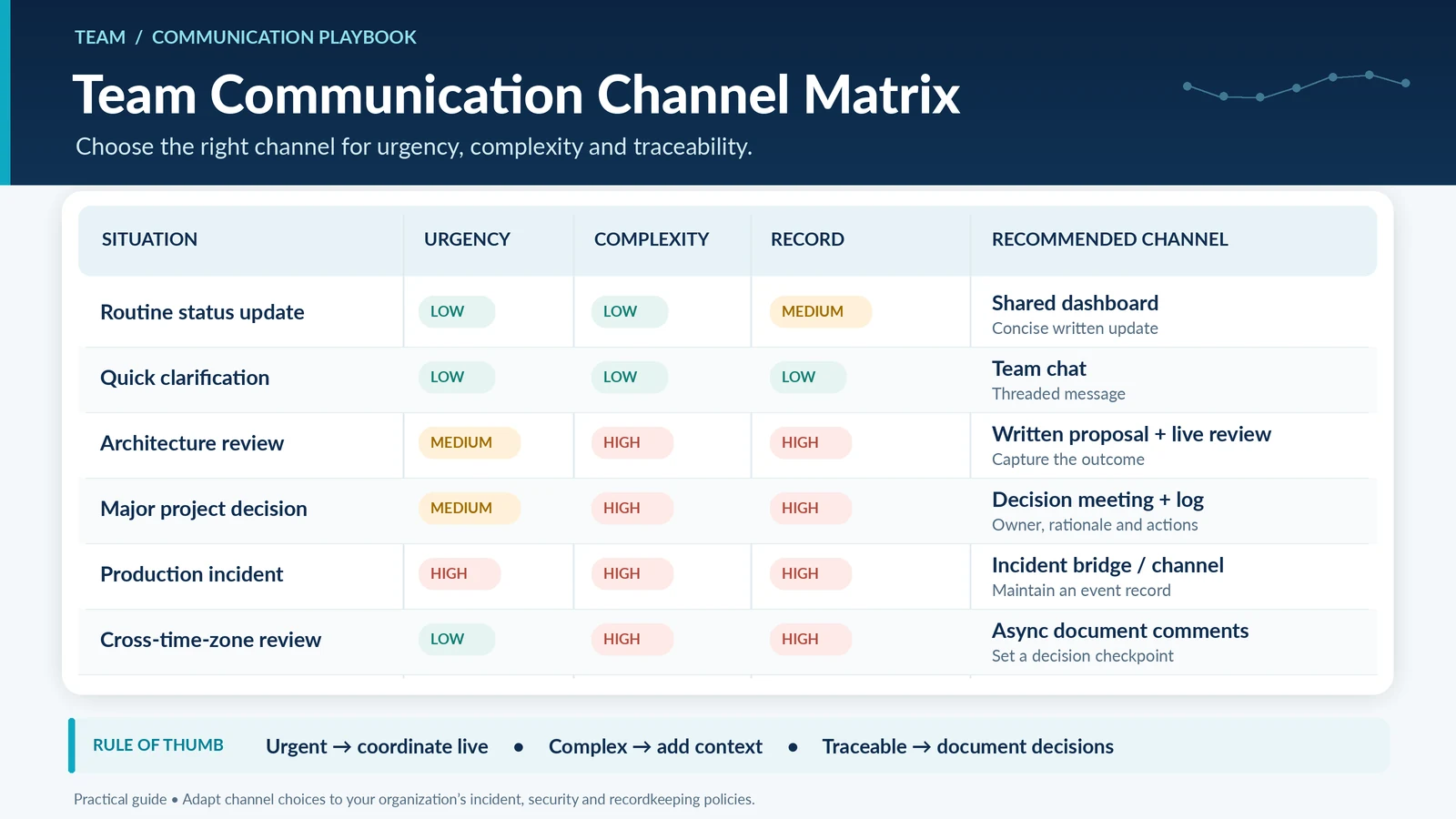
| Situation | Urgency | Complexity | Documentation Need | Recommended Approach |
|---|---|---|---|---|
| Routine project update | Low | Low | Medium | Shared dashboard or written update |
| Simple clarification | Low | Low | Low | Team chat or threaded comment |
| Architecture review | Medium | High | High | Written proposal + live review + decision record |
| Major project decision | Medium | High | High | Structured meeting + decision log |
| Production service incident | High | High | High | Incident bridge/channel + event record |
| Cross-time-zone document review | Low | High | High | Asynchronous comments + scheduled decision checkpoint |
| Sensitive interpersonal feedback | Variable | High | Appropriate confidential record | Private conversation through appropriate channels |
These are practical defaults, not universal rules. Organizations should apply their incident procedures, confidentiality policies, and operational requirements.
A Three-Question Selection Framework
Before choosing a channel, ask:
1. How urgent is the issue?
Does it require immediate action, or can it be handled during normal working hours?
2. How complex is the discussion?
Will the participants need interactive problem-solving, or can they understand the information independently?
3. What must be documented?
Does the conversation involve a formal decision, approval, operational change, or regulatory requirement?
A useful principle is:
Communicate asynchronously by default when practical; collaborate synchronously when interaction materially improves the outcome.
This principle should never override emergency response or other requirements for timely action.
Team Communication Examples in IT and Project Management
The following scenarios are illustrative examples showing how communication practices can improve coordination. They are not documented organizational case studies.
Example 1: Network Change Management
Situation: A global network team prepares a backbone configuration change involving engineering, implementation, operations, and service management.
Communication problem: Technical decisions are spread across email threads, and operational stakeholders receive incomplete information.
Improved approach: The project uses a shared change record, a defined approval process, one owner for each action, and a dedicated operational channel during implementation.
After completion, the team records validation results and communicates any outstanding risks.
Lesson: Structured communication supports traceability and coordinated execution during operational changes.
Example 2: Production Incident Management
Situation: A critical application becomes unavailable, affecting multiple services.
Communication problem: Engineers create parallel conversations, duplicate investigations, and provide inconsistent status updates.
Improved approach: An incident lead establishes one coordination channel, assigns investigation responsibilities, maintains a shared incident timeline, and separates internal technical updates from stakeholder communications.
The team follows established response and escalation procedures.
Lesson: During incidents, communication ownership and accurate information are more useful than uncontrolled message volume.
Example 3: Agile Software Delivery
Situation: A cross-functional Agile team repeatedly carries unfinished work into the next iteration.
Communication problem: Dependencies are discussed informally but not made visible during planning.
Improved approach: The team clarifies acceptance criteria, documents dependencies, visualizes blocked work, and uses short coordination discussions when a decision is needed.
Retrospectives identify which communication practices need adjustment.
These practices complement the broader principles in our guide to building Agile teams.
Lesson: Effective Agile communication makes dependencies and blockers visible without turning every interaction into a meeting.
Example 4: International Hybrid Teams
Situation: A technology program brings together engineering teams from Europe, Asia, and Africa.
Communication problem: Decisions are made during meetings that some participants cannot attend, leaving remote teams uncertain about requirements.
Improved approach: The program adopts shared documentation, asynchronous review windows, explicit decision ownership, and rotating meeting schedules where appropriate.
Each major decision receives a written summary containing the rationale, owner, implications, and next actions.
Lesson: Distributed collaboration improves when access to information does not depend on physical presence or local time zone.
How to Measure the Impact of Team Communication Strategies
Communication effectiveness cannot be measured reliably by counting messages or meetings alone.
Teams should evaluate whether their team communication strategies help people coordinate their work.
Practical Indicators for Managers
| Indicator | What to Examine | Possible Improvement Signal |
|---|---|---|
| Decision clarity | Are decisions recorded and understood? | Fewer repeated clarification requests |
| Decision delays | How long do important decisions remain unresolved? | Shorter avoidable delays |
| Handoff quality | Are deliverables accepted with necessary information? | Fewer preventable handoff problems |
| Meeting effectiveness | Do meetings achieve their stated purpose? | More useful outcomes with less unnecessary meeting time |
| Information accessibility | Can people find current decisions and procedures? | Less time spent searching |
| Escalation effectiveness | Do material issues reach the right owners? | Earlier, more reliable escalation |
| Team feedback | Do people understand expectations and communication norms? | Improved qualitative feedback |
These indicators should not become individual employee surveillance metrics.
For example, a high message count does not necessarily mean better communication, and a low meeting count does not necessarily mean better collaboration.
Combine Quantitative and Qualitative Evidence
A practical assessment may combine project performance data, documented decision delays, retrospective findings, and confidential employee feedback.
Ask employees which communication practices help them perform and which create unnecessary friction.
Interpret results carefully. A temporary increase in reported blockers may indicate that teams are communicating previously hidden problems more openly.
The objective is improvement, not producing an artificially positive communication score.
A 30-Day Team Communication Improvement Plan
Managers do not need a major transformation program to begin improving communication.
The following four-week roadmap provides a starting point for introducing clearer working practices.
It is a practical TechTeamSynergy management framework, not a scientifically validated intervention.
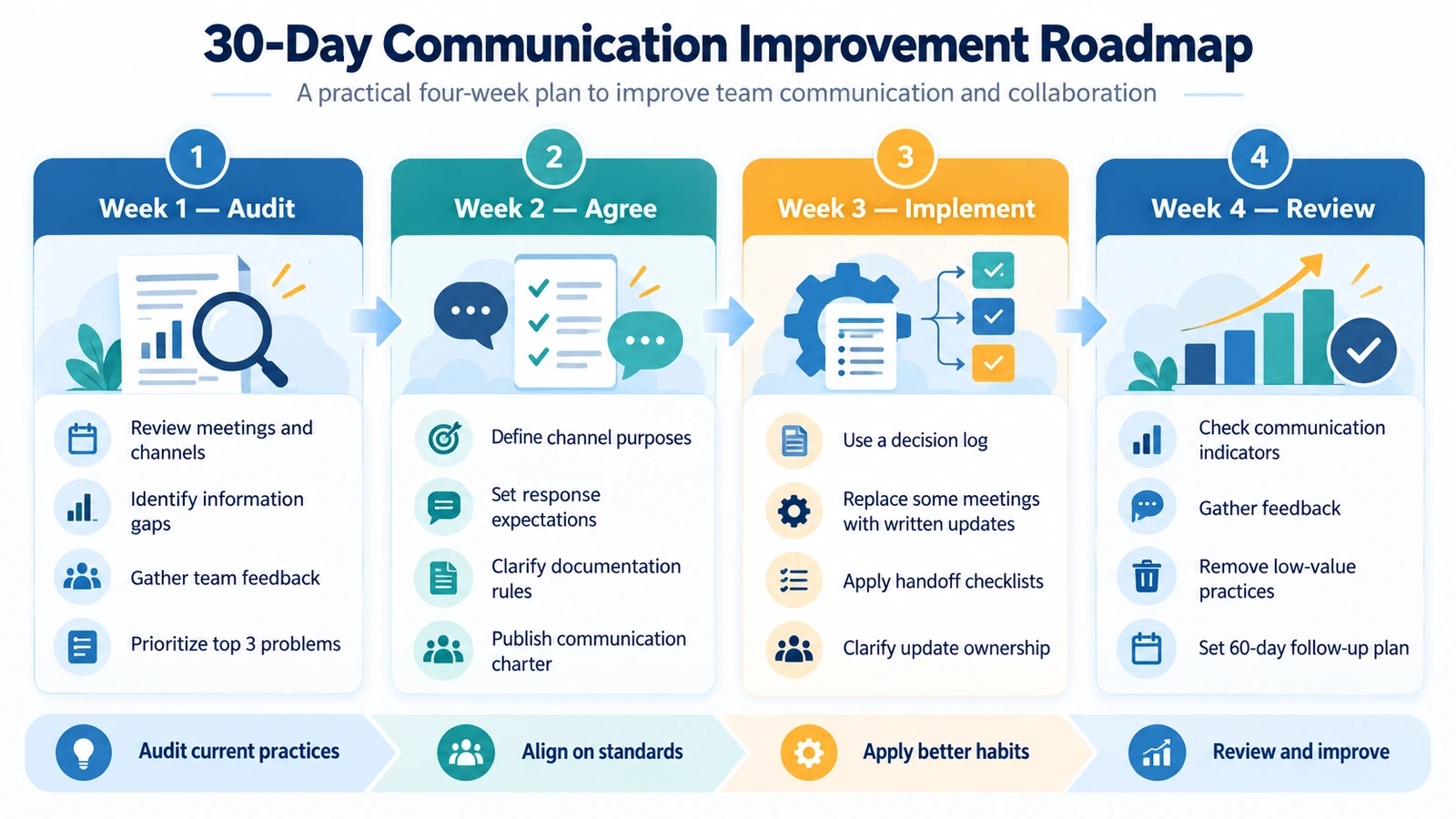
Week 1: Audit Existing Communication
Objective: Understand where communication is helping or slowing the team.
Actions:
- Review recurring meetings and communication channels.
- Identify common misunderstandings and information gaps.
- Examine recent delayed decisions and problematic handoffs.
- Gather team feedback on communication frustrations.
- Identify the three most important problems to address.
Deliverable: A short communication improvement backlog.
Week 2: Agree on Communication Standards
Objective: Create consistent expectations.
Actions:
- Define channel purposes and response expectations.
- Establish decision-documentation rules.
- Clarify important communication responsibilities.
- Agree on meeting preparation and follow-up practices.
- Publish escalation procedures or link to existing ones.
Deliverable: A concise Team Communication Charter.
Week 3: Implement Better Practices
Objective: Make the new agreements part of daily work.
Actions:
- Introduce or improve a shared decision log.
- Replace selected status meetings with written updates.
- Apply standard handoff checklists.
- Use meeting agendas with expected outcomes.
- Clarify ownership of cross-functional updates.
Deliverable: Observable adoption of selected communication improvements.
Week 4: Review Results and Adjust
Objective: Learn what is working and identify remaining gaps.
Actions:
- Review communication quality indicators.
- Gather feedback from team members.
- Check whether decisions and handoffs are clearer.
- Remove practices that add work without value.
- Agree on follow-up actions for the next 60 days.
Deliverable: A revised communication charter and follow-up plan.
| Week | Focus | Primary Output |
|---|---|---|
| 1 | Audit | Communication improvement backlog |
| 2 | Agree | Team Communication Charter |
| 3 | Implement | New working practices |
| 4 | Review | Follow-up improvement plan |
The first month establishes a baseline. Sustainable results depend on consistent adoption and continuous adjustment.
Common Team Communication Mistakes to Avoid
Mistake 1: Confusing More Communication With Better Communication
Sending more messages does not necessarily improve understanding.
Focus on relevance, clarity, ownership, and outcomes.
Mistake 2: Using Too Many Collaboration Tools
When the same information exists in several platforms, employees may not know which version is authoritative.
Define a shared source of truth for important information.
Mistake 3: Leaving Decisions Without Owners
A meeting may end with broad agreement but no responsibility for execution.
Record the decision, accountable owner, actions, and review date.
Mistake 4: Treating Every Issue as Urgent
If every message is labeled urgent, genuine operational priorities become harder to distinguish.
Agree on escalation thresholds and use them consistently.
Mistake 5: Avoiding Difficult Conversations
Communication tools cannot solve every interpersonal issue.
Some situations require direct, respectful conversations about behavior, expectations, and boundaries.
For further guidance, see How to Manage Difficult People at Work.
Mistake 6: Ignoring Communication Fatigue
Constant notifications, unnecessary meetings, and unclear availability expectations may interrupt focused work.
Support reasonable communication boundaries and appropriate asynchronous collaboration.
Team Communication Checklist for Managers
Use this checklist during a monthly team review.
- ☐ Our team has clear communication norms.
- ☐ Each communication channel has a defined purpose.
- ☐ Response-time expectations are understood.
- ☐ Important activities and decisions have clear owners.
- ☐ Meetings have explicit objectives and expected outcomes.
- ☐ Major decisions and actions are documented.
- ☐ Cross-functional handoffs include the necessary information.
- ☐ Remote team members can contribute meaningfully.
- ☐ Urgent issues have clear escalation routes.
- ☐ Team members can raise questions and concerns respectfully.
- ☐ Communication practices protect reasonable focus time.
- ☐ We review and improve our communication system regularly.
Free Resource — Team Communication Charter & Checklist
A useful companion resource would include a one-page communication charter, channel selection matrix, meeting standards, decision-log template, and monthly review checklist.
Editorial note: This downloadable resource is planned, not yet created. The download CTA should remain inactive until the files and landing page are available.
Frequently Asked Questions About Team Communication
What are team communication strategies?
Team communication strategies are agreed methods for sharing information, clarifying expectations, making decisions, coordinating activities, and exchanging feedback.
They may include communication norms, channel selection, meeting practices, decision documentation, and escalation procedures.
How can managers improve communication within a team?
Managers can begin by identifying recurring communication problems, agreeing on clear working norms, listening actively, clarifying responsibilities, documenting decisions, and reviewing communication practices regularly.
The most useful changes depend on the team’s work and context.
What are the most effective communication methods for remote teams?
Remote teams benefit from combining asynchronous documentation with purposeful synchronous collaboration.
Shared decision logs, accessible project updates, clear channel expectations, inclusive meetings, and explicit escalation paths are useful practices.
No single channel is ideal for every situation.
How can teams reduce communication misunderstandings?
Use clear language, explain context, confirm important assumptions, identify responsible owners, and document decisions that affect future work.
When misunderstandings recur, investigate whether the problem comes from unclear processes, roles, or missing information.
What is the difference between synchronous and asynchronous communication?
Synchronous communication occurs when participants interact in real time, such as during meetings or live calls.
Asynchronous communication allows people to contribute at different times, such as through shared documents, project comments, and written updates.
Both approaches can be effective when matched to the task.
How do you measure effective team communication?
Evaluate whether team members understand priorities, find information, make decisions, complete handoffs, and escalate risks appropriately.
Combine operational indicators with qualitative feedback rather than relying solely on message counts or meeting activity.
Conclusion: Build a Communication System, Not More Meetings
Effective team communication does not require endless meetings, constant availability, or more digital tools.
It requires a shared understanding of how information should flow, how decisions should be made, and how responsibilities should be coordinated.
The 12 team communication strategies in this guide provide practical ways to improve clarity, strengthen collaboration, reduce unnecessary friction, and support better-informed decisions.
For managers leading IT, Agile, project, or international teams, the most valuable starting point is often surprisingly simple.
Define your communication norms. Clarify ownership. Choose channels deliberately. Document important decisions. Review what works.
Clear Communication + Shared Understanding + Explicit Ownership + Continuous Improvement = Better Conditions for Team Collaboration
Start with one improvement this week, evaluate its usefulness, and build from there.
Continue Learning
Stay Connected With TechTeamSynergy
Better team communication starts with practical habits. Discover actionable insights on technology, teamwork, project management, and transformation.
Subscribe to the TechTeamSynergy Weekly Newsletter for practical guides, tools, and ideas to help modern teams perform better.