
The PMI AI Standard 2026 gives project professionals an official framework for using artificial intelligence more responsibly and consistently across project-based work. Published by the Project Management Institute in June 2026, its formal title is The Standard for Artificial Intelligence in Portfolio, Program and Project Management.
PMI classifies it as a PMI Standard and describes it as the first ANSI-approved AI standard for the project profession. It addresses two connected needs: using AI within project-based work and managing initiatives in which AI is itself part of what is being delivered. PMI’s official Standard page is the primary authority for this guide.
This guide explains the Standard’s eight guiding principles, five performance domains, human-in-the-loop approach and practical implications for project professionals. It does not replace our broader guide to AI in Project Management, nor does it recreate detailed AI governance, risk-management or agent workflows.
PMI AI Standard 2026 at a Glance
| Area | What the Standard Covers | Why It Matters for Project Professionals |
|---|---|---|
| Guiding principles | Eight principles shaping responsible AI behaviors and decisions | Provides durable decision guardrails as AI technologies evolve |
| Performance domains | Five areas of practice for AI-enabled work | Connects AI considerations to practical project execution |
| Human-in-the-loop practices | Reviewing AI outputs, determining escalation and deciding whether to accept or override recommendations | Keeps professional judgment and accountability visible |
| Ethical and legal guardrails | Ethics, regulations, accountability, intellectual property, audits and contractual obligations | Expands AI decisions beyond technical performance alone |
| Lifecycle and tailoring | Application according to organization, team, context and delivery environment | Avoids a one-size-fits-all approach |
| Applied project work | Portfolio, program and project use cases | Makes the Standard relevant beyond dedicated technical AI projects |
These components are identified by PMI on the official Standard page. PMI also states that the guidance is technology-agnostic and can be tailored across predictive, adaptive and hybrid environments.
What Is the PMI AI Standard 2026?
The official publication is titled The Standard for Artificial Intelligence in Portfolio, Program and Project Management. The Project Management Institute published the 275-page Standard in June 2026 and officially categorizes it as a PMI Standard.
PMI announced the Standard on June 9, 2026, positioning it as a principle-driven, technology-agnostic framework for project professionals working in an environment where AI is increasingly embedded in projects, programs and portfolios.
PMI identifies the intended audience as project professionals, PMO leaders, executives and organizations adopting AI. Importantly, the Standard addresses two related but different situations: using AI in project-based work and managing AI-driven initiatives.
That distinction matters. A project manager using generative AI to summarize meetings has different delivery concerns from a program manager overseeing the development and deployment of an enterprise AI platform, but both operate within the Standard’s broad scope.
PMI also describes the Standard as ANSI-approved. That establishes its formal standards status; it should not be interpreted as meaning that every statement in it automatically becomes a law, regulation or mandatory policy for every organization. Legal, contractual and internal-policy obligations still depend on the applicable environment.
Why PMI Introduced an AI Standard
PMI’s stated rationale is closely connected to a gap between AI adoption and organizational alignment. Project teams already use AI to generate reports, summarize meetings, analyze information, identify risks and support decisions. However, PMI notes that teams can differ in what they automate, what they review, what they escalate and how they assign accountability for AI-influenced decisions.
PMI’s June 2026 announcement also emphasizes that organizations frequently deliver AI transformation through projects and programs. Therefore, project and program teams must still scope, govern, deliver and evaluate new AI systems, AI-enabled workflows and AI-driven products as organized work.
The Standard therefore aims to create a more consistent professional foundation around value, risk, governance, people, ethics, stakeholders, data and responsible decision-making rather than tying good practice to any particular AI product or model.
Core Principles of the PMI AI Standard 2026
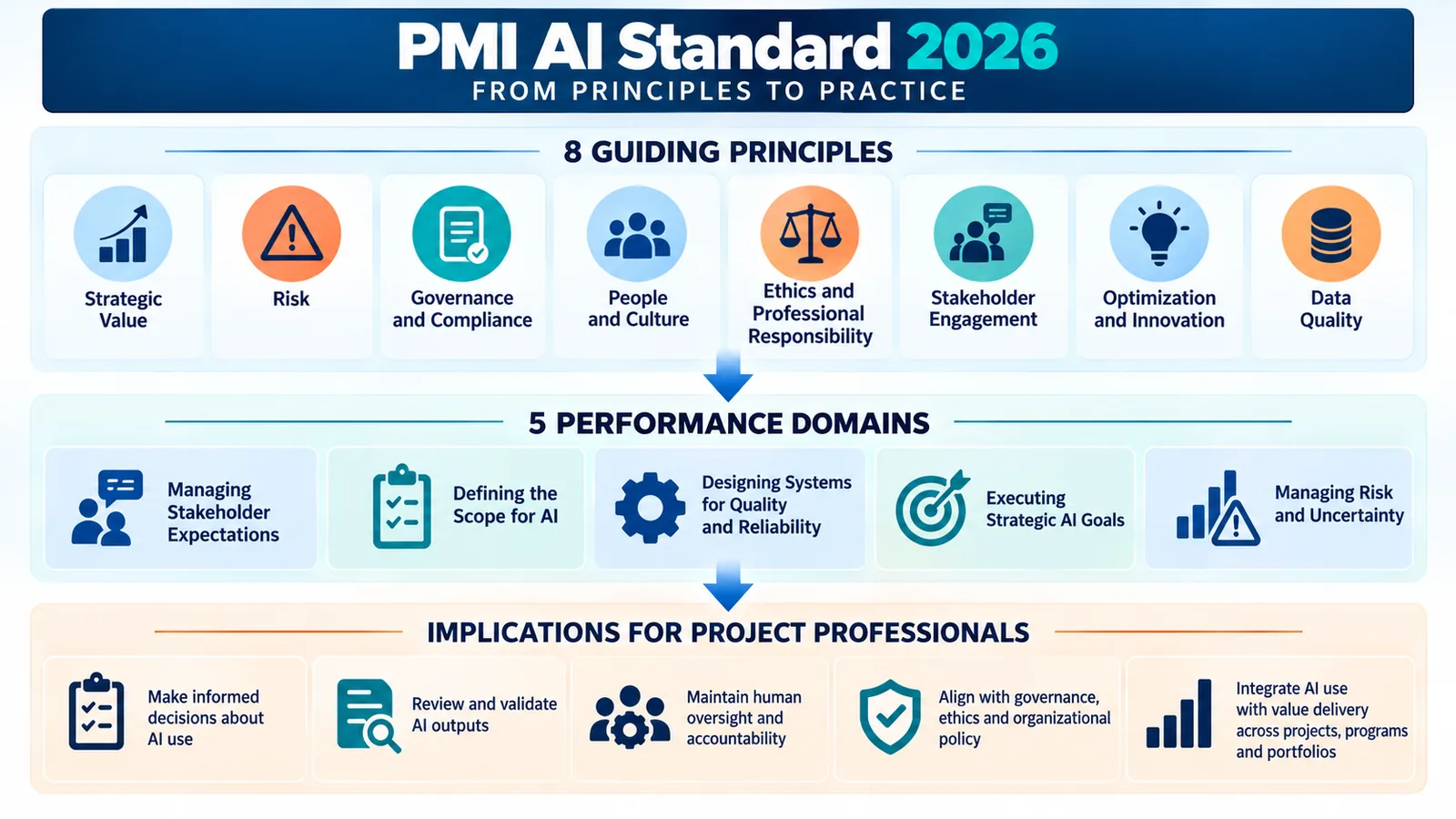
PMI organizes the Standard around eight guiding principles. PMI describes these as guardrails that shape responsible AI behaviors and decisions in its official explanation, The New AI Standard: A Shared Foundation for Responsible Adoption.
Strategic Value
What PMI says: Strategic Value is one of the eight guiding principles, and PMI connects AI initiatives with organizational objectives and value delivery.
What this means for project managers: AI should have a reason to be part of the work. The relevant question is not simply whether a tool can perform a task, but whether using it improves an outcome that matters. An AI forecasting capability, for example, should be evaluated against whether it improves decision quality or visibility—not merely whether it produces forecasts faster.
Risk
What PMI says: Risk is a guiding principle, while Managing Risk and Uncertainty also appears as one of the five performance domains.
What this means for project managers: AI introduces opportunities and uncertainties that need to be examined rather than hidden behind confident-looking outputs. A team using AI to flag emerging schedule risks still needs to evaluate the evidence, assumptions and consequences before treating an AI-generated signal as an established project risk. For the operational workflow, see our guide to AI for Project Risk Management.
Governance and Compliance
What PMI says: Governance and Compliance is one of the Standard’s guiding principles. PMI also identifies governance strengthening as one of the reasons the Standard matters to organizations adopting AI.
What this means for project managers: AI use sits within existing organizational authority, policies, legal considerations and project governance rather than outside them. The fact that an AI tool can analyze a confidential project document does not establish that the team is authorized to submit that document to the system.
Detailed implementation—approved tools, decision rights, data rules, review thresholds and auditability—belongs in an operational AI governance for project managers framework rather than in this Standard explainer.
People and Culture
What PMI says: People and Culture is one of the eight guiding principles.
What this means for project managers: Successful AI adoption is not purely a technology issue. New workflows can change responsibilities, expectations and ways of working. If AI begins drafting status reports, for example, the project manager may spend less time assembling information but more time validating conclusions, explaining assumptions and ensuring the team understands how the output was produced.
Ethics and Professional Responsibility
What PMI says: Ethics and Professional Responsibility is an explicit guiding principle. PMI’s Standard also includes ethical and legal guardrails covering areas such as accountability, regulations, intellectual property, audits and contractual obligations.
What this means for project managers: Technical capability does not remove professional responsibility. A project professional should therefore consider whether an AI-supported action is appropriate, defensible and consistent with relevant obligations—not merely whether the system can execute it.
Stakeholder Engagement
What PMI says: Stakeholder Engagement is a guiding principle, and Managing Stakeholder Expectations is also a performance domain.
What this means for project managers: AI-supported work can influence how stakeholders interpret forecasts, risks, recommendations and project status. An executive status summary drafted by AI may save time, but the project manager still needs to ensure that the communication reflects project reality, uncertainty and stakeholder context.
Optimization and Innovation
What PMI says: Optimization and Innovation is one of the Standard’s guiding principles.
What this means for project managers: AI creates opportunities to improve how project work is performed, but optimization should remain connected to value and responsible delivery. Automating meeting-summary preparation may remove repetitive work. Automating a significant project decision is a different proposition because its consequences, accountability and required oversight are substantially greater.
Data Quality
What PMI says: Data Quality is one of the eight guiding principles. PMI’s Standard also highlights data as a core consideration when applying AI.
What this means for project managers: AI output quality depends heavily on the information available to the system. If milestone data is outdated, risk records are incomplete or assumptions are treated as facts, an AI-generated analysis may appear sophisticated while still providing a weak basis for action.
Performance Domains of the PMI AI Standard 2026
The Standard also contains five performance domains. PMI describes these as areas of practice that translate the guiding principles into AI-enabled project work.
Managing Stakeholder Expectations
This domain connects AI-enabled work with stakeholder expectations. In practice, project professionals can clarify what an AI capability should achieve, how stakeholders should interpret its outputs and where its limitations matter.
Defining the Scope for AI
AI should not enter project work simply because a capability is available. This domain focuses attention on where AI belongs in the initiative and what problem it is expected to address. The project manager should be able to explain the intended use case, boundaries and connection to value before AI becomes embedded in the workflow.
Designing Systems for Quality and Reliability
This domain brings attention to the quality and reliability of AI-enabled systems and outputs. A fast output is not automatically a reliable one. As a result, project teams need to evaluate whether data quality, system design and validation make the solution fit for its intended use.
Executing Strategic AI Goals
This domain connects delivery with the strategic objectives behind AI adoption. In project practice, that means avoiding a situation where a team successfully deploys an AI capability without demonstrating that the capability contributes to the intended organizational outcome.
Managing Risk and Uncertainty
AI initiatives can contain uncertainty related to data, performance, changing conditions, stakeholder impact and the quality of AI-generated recommendations. This domain reinforces the need to recognize and manage such uncertainty throughout the work rather than treating AI risk as a one-time technical review.
What the PMI AI Standard 2026 Means for Project Managers
The Standard does not turn project managers into data scientists. It changes the questions project professionals need to ask as AI becomes embedded in ordinary delivery work.
First, AI use should remain connected to value and scope. A project manager should understand why AI is being introduced and what outcome it is intended to improve.
Second, AI-generated output needs professional interpretation. PMI explicitly discusses human-in-the-loop practices for reviewing outputs, deciding when escalation is necessary and determining whether recommendations should be accepted or overridden.
Third, accountability does not automatically transfer to the system. PMI’s explanatory guidance states that AI can support decisions, but people must interpret outputs and remain accountable for consequences.
Fourth, project professionals should consider AI throughout the work rather than only when selecting a tool. PMI includes lifecycle and tailoring considerations and states that teams can apply the practices across predictive, adaptive and hybrid environments.
For a broader view of AI-assisted planning, reporting, meetings, risk analysis and other use cases, see our complete guide to AI in Project Management.
What the Standard Means for PMOs
For a PMO, the PMI AI Standard 2026 provides a common professional reference point rather than a ready-made internal operating procedure.
PMI states that the Standard serves PMO leaders as well as project professionals and organizations adopting AI. It addresses governance, risk, value, human oversight and consistent practice.
For PMOs, this can translate into aligning project teams around common expectations, connecting enterprise AI policies with delivery practices, developing appropriate AI capability and maintaining visibility over how AI influences projects and portfolios.
The implementation mechanics are a separate question. Tool approval, data classification, decision rights, human-review thresholds, records, escalation and maturity models belong in an operational AI Governance for Project Managers framework.
Human Oversight and Accountability
Human oversight is one of the clearest themes in PMI’s AI Standard.
PMI identifies human-in-the-loop practices for reviewing and acting on AI outputs. Its Standard page specifically refers to determining what requires escalation and deciding whether to accept or override AI recommendations.
PMI’s supporting explanation makes the accountability boundary clearer: AI can process information, identify patterns and generate recommendations, but people must interpret outputs and remain accountable for the consequences.
AI produces a forecast recommendation → the project professional evaluates the assumptions and context → the authorized person accepts, modifies, rejects or escalates the recommendation → the resulting project decision remains a human or organizational responsibility.
This is an interpretation of how the principle can work in practice. It is not a new PMI process or approval model.
Risk in the PMI AI Standard
Risk appears in two important places in the Standard: Risk is one of the eight guiding principles, and Managing Risk and Uncertainty is one of the five performance domains.
PMI’s public material also directs attention to data quality, privacy, ethics, monitoring, reliability and uncertainty when teams use AI. Its launch announcement references AI-specific risk management among the decisions organizations are confronting.
For project professionals, the practical implication is that an AI output should not become a risk conclusion simply because the system presents it confidently. Evidence, context, assumptions and potential consequences still need evaluation.
This article stops at the Standard-level interpretation. For a detailed workflow covering risk discovery, analysis, responses, human validation and monitoring, use our AI for Project Risk Management guide.
Data, Privacy and Security
Data Quality is an explicit guiding principle in the PMI AI Standard, and PMI’s supporting material asks teams to consider data, quality, privacy and ethical risks when applying AI. The Standard also includes ethical and legal considerations involving regulations, accountability, intellectual property, audits and contractual obligations.
For project managers, this suggests a straightforward discipline: understand what information the AI system is using and whether its use is appropriate for the project environment.
That may include checking whether project data is current, whether the selected system may process sensitive information, and whether organizational security, privacy, contractual or regulatory requirements affect the use case.
Those requirements vary by organization and jurisdiction. The PMI Standard should therefore not be read as replacing specialist security, privacy, legal or compliance advice.
Skills Project Professionals Need
The PMI AI Standard itself should not be turned into an invented competency framework.
However, PMI publishes separate guidance on skills for AI project work. Its 2025 guidance identifies areas including data literacy and awareness, critical thinking and problem solving, trustworthy AI practices, communication across technical and business teams, Agile and iterative delivery, understanding AI technology and lifecycle, and tool proficiency. See PMI’s skills guidance for AI project managers.
These are associated PMI recommendations rather than eight principles or five performance domains of the Standard.
For project professionals, they reinforce a useful direction: learning how to operate AI tools is only one part of AI readiness. Project managers also need enough understanding to challenge outputs, communicate uncertainty, work across disciplines and apply professional judgment when AI influences delivery.
For everyday application, our 50 AI Prompts for Project Managers focuses specifically on structuring AI-assisted project tasks rather than on the Standard itself.
How the AI Standard Fits Existing Project Management Practice
PMI positions its AI Standard as applicable across predictive, adaptive and hybrid environments. That matters because responsible AI use does not sit outside normal project disciplines. AI-supported work still intersects with governance, stakeholder engagement, risk, quality, leadership, planning, decision-making and value delivery.
Therefore, project professionals should not interpret the Standard as replacing established project management practice. Instead, it provides an AI-specific professional foundation that teams can integrate into the way they govern and deliver projects, programs and portfolios.
PMI also maintains a separate Leading & Managing AI Projects Digital Guide, a Practice Guide based on the CPMAI methodology, for professionals who need a more implementation-oriented approach to AI initiatives.
PMI AI Standard vs an Operational AI Governance Framework
The distinction between a professional standard and an operational governance framework is essential.
| Area | PMI AI Standard | Operational PM/PMO AI Governance |
|---|---|---|
| Purpose | Establish a professional foundation for AI-enabled project work | Turn principles and organizational policy into operating controls |
| Source | Project Management Institute | Organization or PMO |
| Principles | Eight official guiding principles | Internal policies and governance rules |
| Performance areas | Five official performance domains | Project-specific processes and controls |
| Roles | Provides professional context | Assigns named owners and responsibilities |
| Decision rights | Human oversight and accountability are central | Specifies who may recommend, approve or decide |
| Tool/data controls | Addresses governance, data and responsible use | Defines approved systems, data categories and permissions |
| Implementation | Principle- and practice-oriented | Procedures, thresholds, RACI, records and escalation |
The first answers “What professional foundation should guide AI-enabled project work?” The second answers “How will our organization operationalize that foundation?”
For the second question, see the dedicated AI Governance for Project Managers article.
Practical Example: Applying the PMI AI Standard to a Project
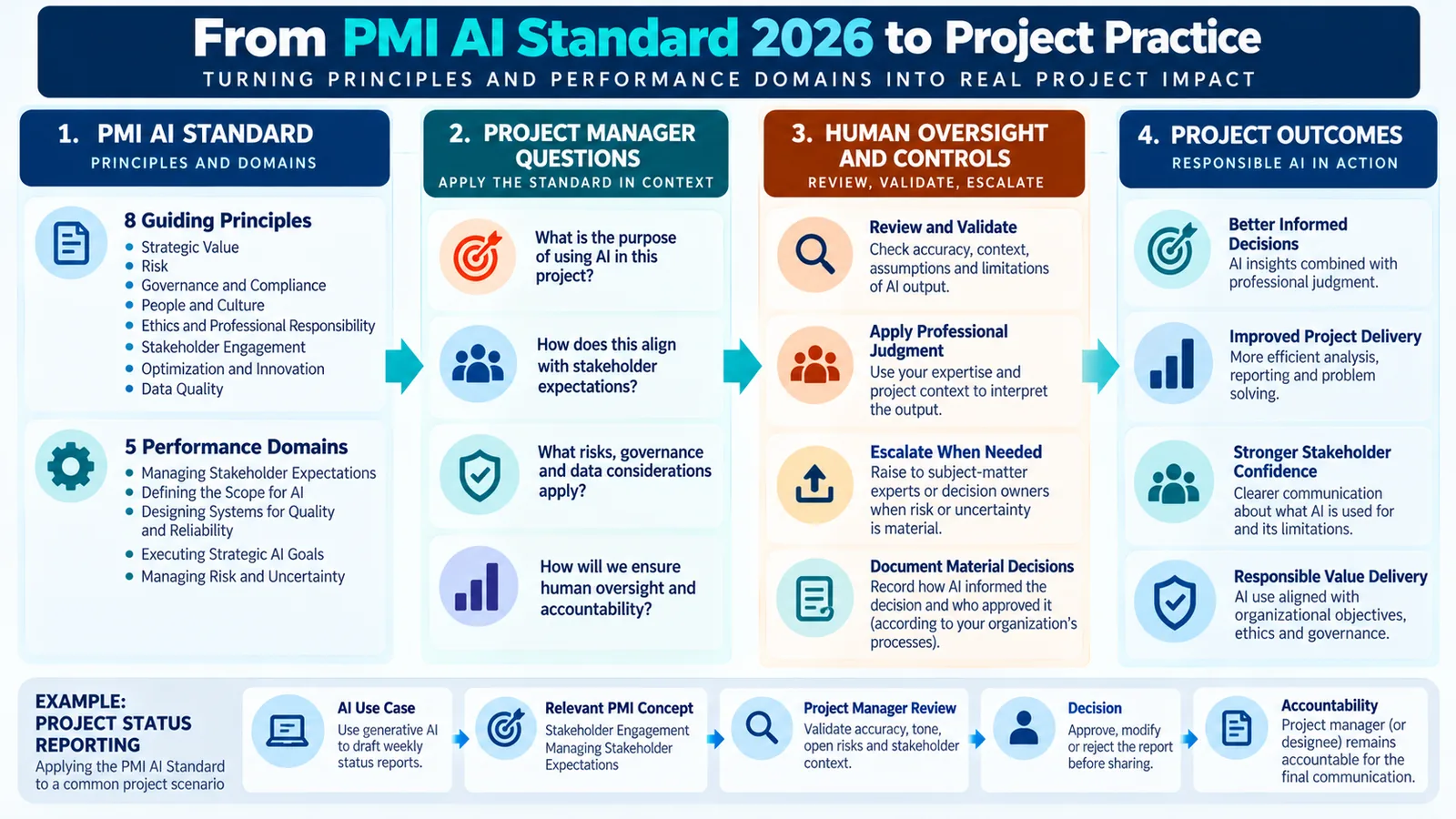
Consider an enterprise transformation program using approved AI capabilities for meeting summaries, risk identification, weekly status reporting and schedule forecasting.
| AI Use Case | Relevant PMI Concept | Professional Review | Accountable Action |
|---|---|---|---|
| Meeting summary | Data Quality / Stakeholder Engagement | Check facts, decisions and missing context | PM approves the final record |
| Risk identification | Risk / Managing Risk and Uncertainty | Review evidence and uncertainty | Project team decides whether a risk should enter the register |
| Status-report drafting | Managing Stakeholder Expectations | Validate accuracy, tone and material issues | PM approves stakeholder communication |
| Forecast recommendation | Strategic Value / Designing Systems for Quality and Reliability | Challenge assumptions and reliability | Authorized project role accepts, changes or rejects the recommendation |
This is TechTeamSynergy’s practical interpretation of PMI concepts, not a PMI-prescribed workflow. The important pattern is consistent: AI can accelerate analysis or drafting, while the project professional provides context, validation and accountable judgment.
Practical Checklist for Project Managers
The following is a practical checklist based on concepts in the PMI AI Standard 2026. It is not presented as a list of mandatory PMI requirements.
Before Using AI
- Is there a clear project or business value for the AI use case?
- Is the scope of AI involvement understood?
- Is the selected use consistent with organizational governance and applicable obligations?
- Is the data sufficiently reliable and appropriate for the intended use?
- Has the team identified relevant stakeholder, ethical and risk considerations?
During AI Use
- Are project professionals reviewing important outputs instead of accepting them automatically?
- Are assumptions, missing context and uncertainty visible?
- Does the use case require escalation or specialist input?
- Are stakeholders receiving an accurate picture of what the AI output represents?
Before Acting on an AI Output
- Is the output reliable enough for the consequence of the decision?
- Has the appropriate human reviewed the recommendation?
- Is the person accepting or rejecting the recommendation authorized to make that decision?
- Should the authorized person accept, modify, override or escalate the AI recommendation?
After Material AI-Assisted Decisions
- Do existing governance rules require documenting the decision?
- Has new evidence changed the risk, reliability or appropriateness of the AI use?
- Should the approach be tailored as the project, system or context changes?
Common Misinterpretations of the PMI AI Standard
“AI Replaces Professional Judgment”
It does not. PMI explicitly emphasizes human-in-the-loop oversight and states in its supporting explanation that people remain responsible for interpreting AI outputs and accountable for consequences.
“The Standard Requires Every Project to Use AI”
The Standard provides a framework for responsible AI-enabled project work. It does not mean every project needs an AI use case. Strategic Value and Defining the Scope for AI point in the opposite direction: AI should have a relevant purpose.
“An AI Recommendation Becomes an Accountable Decision”
A recommendation and a decision are not the same thing. PMI emphasizes review, escalation and the human choice to accept or override AI recommendations.
“The Standard Is Just an AI Governance Guide”
Governance is important, but the Standard is broader. It covers eight guiding principles and five performance domains spanning strategic value, risk, people, ethics, stakeholders, innovation, data, scope, quality/reliability and execution.
“The Standard Is an AI Tools Guide”
PMI explicitly describes the Standard as technology-agnostic. That approach helps the guidance remain relevant as AI tools, platforms and capabilities change.
“The AI Standard Replaces Existing Project Management Practice”
PMI says teams can tailor the Standard across predictive, adaptive and hybrid environments. Therefore, the stronger interpretation is integration with project practice—not replacement of established project management disciplines.
Frequently Asked Questions
What is the PMI AI Standard 2026?
It is PMI’s The Standard for Artificial Intelligence in Portfolio, Program and Project Management. PMI published it in June 2026 and describes it as a technology-agnostic professional Standard covering responsible AI-enabled project work and AI-driven initiatives.
Who is the PMI AI Standard for?
PMI identifies project professionals, PMO leaders, executives and organizations adopting AI as intended audiences. Its scope spans portfolio, program and project work.
Is the PMI AI Standard mandatory?
PMI formally classifies it as a PMI Standard and states that it is ANSI-approved. That does not by itself make every part of the Standard a universal legal requirement. Organizations still operate under their own applicable policies, contracts, regulations and governance structures.
What are the eight principles of the PMI AI Standard?
They are Strategic Value; Risk; Governance and Compliance; People and Culture; Ethics and Professional Responsibility; Stakeholder Engagement; Optimization and Innovation; and Data Quality.
What are the five performance domains?
They are Managing Stakeholder Expectations; Defining the Scope for AI; Designing Systems for Quality and Reliability; Executing Strategic AI Goals; and Managing Risk and Uncertainty.
How does the PMI AI Standard affect project managers?
It gives project professionals a structured foundation for evaluating value, risk, governance, stakeholders, data, quality and human oversight when AI contributes to project work or when AI is part of the initiative being delivered.
Does PMI allow AI to make project decisions?
PMI recognizes AI’s role in analysis and decision support, but its guidance emphasizes human-in-the-loop practices and human accountability. PMI specifically discusses reviewing outputs, escalating when necessary and deciding whether AI recommendations should be accepted or overridden.
How does the Standard address human oversight?
Human-in-the-loop practices are an explicit part of the Standard. PMI says they help teams review AI outputs, determine what requires escalation and decide whether to accept or override recommendations.
How is the PMI AI Standard different from AI governance?
The Standard establishes PMI’s broader professional foundation for AI-enabled project work. An operational AI governance framework translates applicable principles and organizational policies into specific roles, controls, permissions, decision rights and approval mechanisms.
Does the PMI AI Standard replace existing PMI standards?
PMI does not position the AI Standard as a wholesale replacement for established project, program or portfolio management standards. Its own product page presents it alongside the PMBOK® Guide, the Standard for Program Management and the Standard for Portfolio Management, while emphasizing its application across different delivery environments.
Conclusion
The PMI AI Standard 2026 marks an important step in bringing artificial intelligence into a more structured professional project-management context.
Its eight guiding principles address Strategic Value, Risk, Governance and Compliance, People and Culture, Ethics and Professional Responsibility, Stakeholder Engagement, Optimization and Innovation, and Data Quality. Its five performance domains connect those principles with stakeholder expectations, AI scope, quality and reliability, strategic execution, and risk and uncertainty.
But one of its most important messages is not about technology.
As AI becomes capable of producing more analysis, recommendations and project outputs, professional judgment and accountability remain essential. PMI’s human-in-the-loop approach makes that distinction explicit.
For project professionals, the practical value of the Standard is therefore not to treat AI as a separate project-management discipline. It is to provide a common foundation for integrating AI into project work with greater structure, responsible judgment and attention to value.
Continue Learning
AI in Project Management
Explore AI use across project planning, risk, meetings, reporting, forecasting and delivery.
AI for Project Risk Management
Use AI to identify risk signals, analyze uncertainty, develop responses and monitor change with human validation.
AI Governance for Project Managers
Turn responsible-AI principles into practical PMO roles, controls, human oversight and decision rights.
AI Agents for Project Management
Explore bounded agent workflows, approval points, permissions and human accountability in project work.