
Technology and teamwork are increasingly interconnected. Digital platforms, cloud services, automation and artificial intelligence can help teams communicate, coordinate work and access information, while immersive tools such as AR and VR are creating additional collaboration and training possibilities. For more on that technology layer, see our Extended Reality (XR) guide. Technology alone, however, does not create a high-performing team.
In practice, strong digital teams combine the right technology with trust, clear responsibilities, effective communication, useful processes and leadership. When those elements reinforce one another, technology becomes an enabler of teamwork rather than another source of complexity.
At the same time, the challenge is becoming even more important as artificial intelligence changes how work is organized. Teams are beginning to combine human expertise with AI assistants and agents, creating new questions around skills, accountability, decision-making and collaboration.
This guide explains how to combine technology and teamwork to build high-performing digital teams, improve collaboration, introduce AI responsibly and create a working environment where both people and technology contribute effectively.
What Is the Relationship Between Technology and Teamwork?
Technology and teamwork influence each other.
Technology can help a team:
- Communicate across locations
- Coordinate tasks
- Share information
- Automate repetitive activities
- Visualize progress
- Analyze information
- Support decisions
- Collaborate asynchronously
But the same technology can create problems when poorly implemented.
Teams can experience:
- Too many applications
- Constant notifications
- Duplicate information
- Unclear communication channels
- Excessive meetings
- Weak adoption
- Confusion about responsibilities
The objective is therefore not to maximize the amount of technology used by a team.
The objective is to use technology deliberately to improve how people work together.
The Four Foundations of High-Performing Digital Teams
A useful model for thinking about modern digital teamwork is:
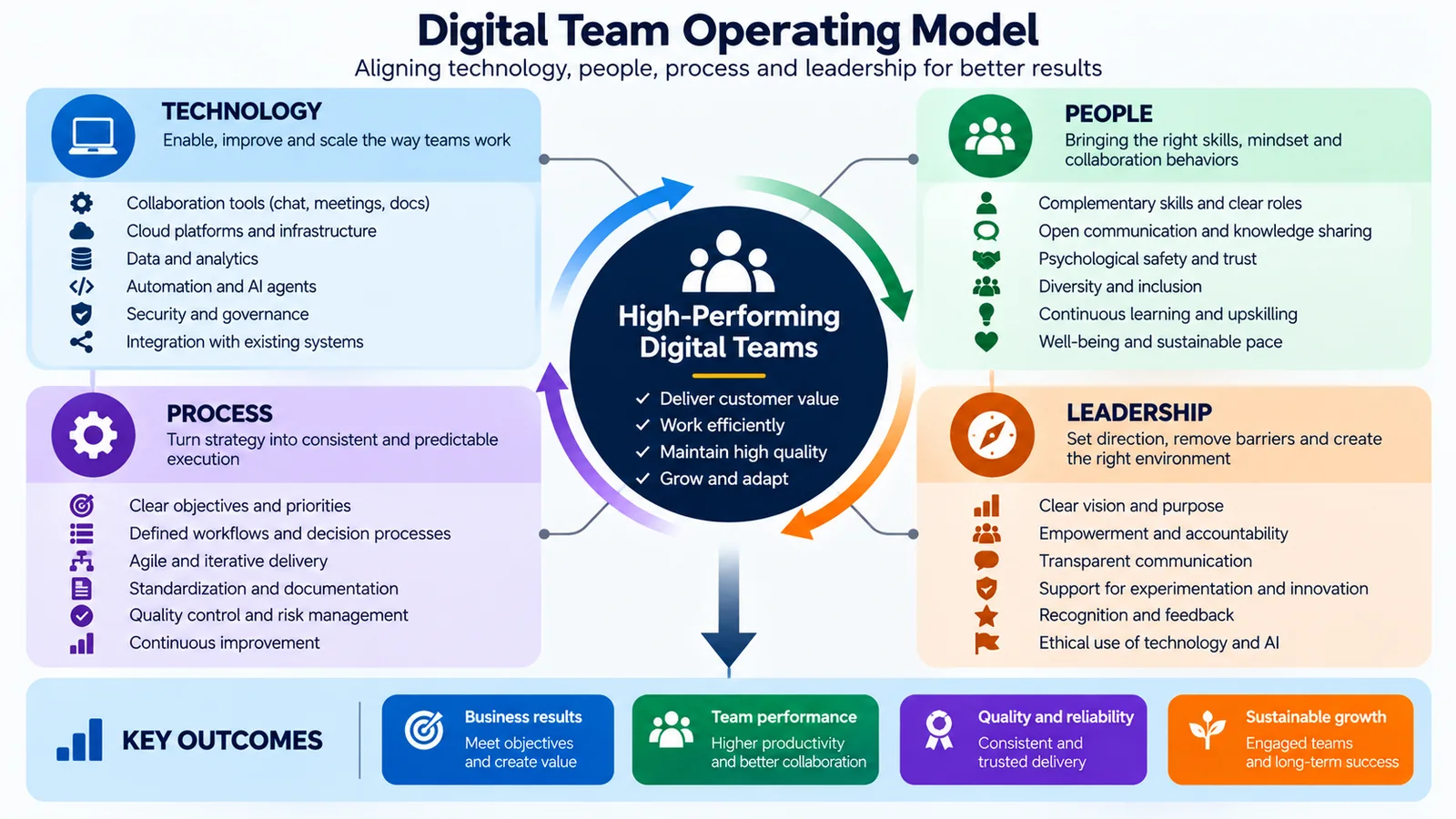
Treat the four foundations as an operating system rather than four separate initiatives. First define a shared outcome, then make roles and decision rights explicit, simplify the workflow, choose tools that support it, and use leadership to remove constraints. Review the whole system periodically instead of measuring software adoption in isolation.
Technology + People + Process + Leadership = Digital Team Performance
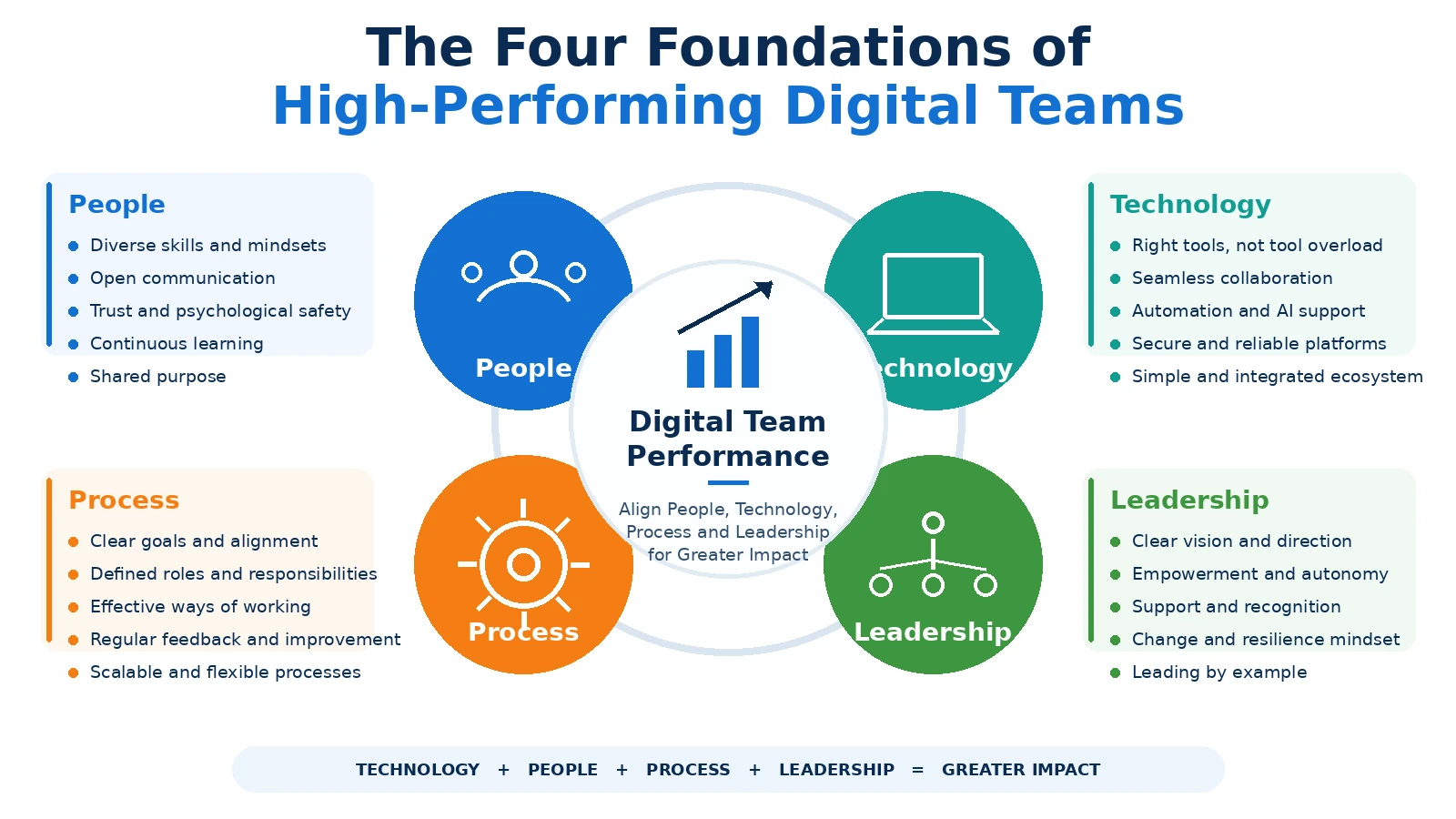
Together, these four components matter.
1. Technology
Technology provides the infrastructure and tools that enable communication, collaboration, automation, information sharing and digital work.
2. People
People contribute expertise, creativity, judgment, communication, relationships and contextual understanding.
3. Process
Processes define how work moves through the team, how decisions are made and how responsibilities are coordinated.
4. Leadership
Leadership creates direction, establishes priorities, removes obstacles and helps the team operate effectively through change.
Therefore, weakness in any one of these areas can reduce the value of the others.
Excellent collaboration software cannot compensate for unclear responsibilities. Strong technical skills cannot compensate for poor communication. A good process can still fail when nobody understands the objective.
IT Example: Coordinating a Multi-Team Network Change
Consider an illustrative network change involving network engineering, service provisioning, cybersecurity, automation and a customer operations team. The goal is not merely to complete a change ticket; it is to deliver a verified customer outcome without introducing avoidable service risk.
| Operating-model element | Practical agreement |
|---|---|
| Technology | One shared change record, an approved monitoring dashboard and a documented source of truth |
| People | Network owner, change coordinator, security reviewer and customer communication contact |
| Process | Entry criteria, risk assessment, peer review, approved execution window, validation and rollback decision |
| Leadership | Decision rights, escalation thresholds, capacity protection and a short post-change learning review |
For example, an automation tool can compile a pre-change checklist, but the designated engineer verifies the evidence and the authorized change owner approves execution. A shared status record helps each team distinguish an update from a decision. This example is illustrative; outcomes depend on the controls and constraints of each organization.
For the organizational design behind multidisciplinary delivery, see our guide to building Agile teams. Use the team operating model above to make the four foundations practical, not as a substitute for established operational governance.
Why Technology Alone Does Not Create Better Teamwork
Organizations sometimes treat collaboration problems as technology problems.
When communication is difficult, organizations may introduce another communication platform.
If work is difficult to track, they may add another project-management tool.
For overloaded employees, automation may appear to be the obvious solution.
However, these technologies can help without automatically solving the underlying problem.
Before introducing another tool, teams should ask:
- What problem are we trying to solve?
- Is the problem technological, organizational or behavioral?
- What process needs to change?
- Who owns the process?
- How will the technology improve the current workflow?
- How will we know whether it worked?
As a result, technology adoption becomes a team-design decision rather than a purchasing exercise.
Technology and Teamwork Start With Clear Goals
High-performing teams need a shared understanding of what they are trying to achieve.
Therefore, technology should support those objectives.
For example, if a team wants to reduce project delays, introducing another dashboard is useful only if it improves visibility into dependencies, decisions or risks.
If the objective is better collaboration between technical and business teams, the solution may require clearer terminology and responsibilities rather than additional software.
A practical sequence is:
Business Outcome → Team Goal → Process → Technology
Starting with the tool reverses this logic and can create technology without measurable value.
Trust and Psychological Safety in Digital Teams
Team performance depends on more than technical expertise.
People need to be able to:
- Ask questions
- Challenge assumptions
- Raise risks
- Share ideas
- Admit uncertainty
- Discuss mistakes
- Request help
This is closely related to psychological safety: an environment in which people can contribute and raise concerns without unnecessary interpersonal fear. For actionable techniques, see our psychological safety at work guide. Google’s research on team effectiveness identified psychological safety, dependability, structure and clarity, meaning, and impact as important team dynamics.
However, psychological safety does not mean avoiding disagreement.
High-performing teams can disagree strongly about technical architecture, priorities or execution while maintaining respect and focusing on the problem rather than attacking the person.
Technology Can Support Psychological Safety, but Cannot Create It
Digital channels can provide different ways for people to contribute.
For example, asynchronous documents can give team members more time to formulate their thoughts than a fast-moving meeting.
In addition, anonymous feedback mechanisms can sometimes help identify issues.
But psychological safety ultimately depends on behavior.
If leaders punish disagreement or teams blame individuals whenever something goes wrong, no collaboration platform will solve the problem.
Technology and Teamwork: Communication in High-Performing Digital Teams
However, more communication does not necessarily mean better communication. Our guide to 12 team communication strategies explains how to improve clarity without adding unnecessary meetings or messages.
Modern teams can communicate through:
- Chat
- Video meetings
- Project-management platforms
- Documents
- Dashboards
- Knowledge bases
- AI assistants
Otherwise, without clear communication practices, information becomes fragmented across channels.
Create Communication Rules
Teams should agree on basic principles such as:
- Where important decisions are documented
- Which channel is used for urgent issues
- Where project information is maintained
- When meetings are necessary
- When asynchronous communication is preferred
- How quickly different types of messages require a response
Therefore, the goal is not rigid bureaucracy.
It is to reduce uncertainty about where information belongs.
Synchronous vs Asynchronous Collaboration
In practice, digital teams need both synchronous and asynchronous collaboration.
Synchronous Collaboration
Synchronous collaboration happens when people work together at approximately the same time.
Examples include:
- Meetings
- Workshops
- Calls
- Live problem-solving sessions
It is particularly useful when a team needs rapid interaction, discussion or alignment.
Asynchronous Collaboration
Asynchronous collaboration allows people to contribute at different times.
Examples include:
- Shared documents
- Recorded updates
- Project boards
- Knowledge bases
- Written decision records
As a result, it can reduce unnecessary meetings and help geographically distributed teams collaborate across schedules and time zones.
Use the Right Mode for the Right Work
A practical approach is:
Discuss complex issues synchronously. Document important outcomes asynchronously.
This combines human interaction with durable organizational knowledge.
Quick Decision Matrix: Choose the Right Collaboration Mode
Communication practices are part of the operating model. Choose the channel based on urgency, complexity, required input and how durable the result needs to be.
| Situation | Preferred mode | Evidence to retain |
|---|---|---|
| Production incident or urgent dependency | Live incident bridge or real-time call | Incident log, actions, decision owner |
| Architecture trade-off or contentious decision | Time-boxed discussion with relevant experts | Decision record, options, risks and approver |
| Routine cross-time-zone project update | Asynchronous written update | Current status, blockers, next owner and date |
| Policy, runbook or recurring guidance | Shared, version-controlled documentation | Maintained source of truth and review owner |
A practical rule is to discuss complex or time-sensitive issues together, then document ownership and decisions in a durable place. Teams should also agree on expected response times so that asynchronous communication does not hide urgent work.
Technology and Teamwork in Hybrid and Remote Teams
Hybrid and distributed teams depend heavily on digital infrastructure.
However, effective remote teamwork involves more than video conferencing.
If you are preparing for your first remote role, our remote-work beginner guide explains how to build relevant skills, demonstrate your ability and prepare for distributed teamwork.
Distributed teams need:
- Clear goals
- Visible responsibilities
- Accessible documentation
- Reliable communication channels
- Transparent decisions
- Intentional relationship building
A useful principle is to make important information accessible independently of physical location. Gallup’s guidance on hybrid and remote teams also emphasizes clear goals, collaboration norms, workload discussions and healthy boundaries.
Otherwise, people working away from the office can become disconnected from informal decisions and conversations.
Clarifying Roles and Responsibilities
However, technology makes work visible only when responsibilities are clear enough for that visibility to be useful.
Therefore, every important activity should have an understandable owner.
Teams should know:
- Who makes the decision?
- Who performs the work?
- Who provides expertise?
- Who needs to be consulted?
- Who needs to be informed?
For example, responsibility frameworks can help when projects involve many stakeholders.
Our RACI Matrix guide explains one practical approach to clarifying who is Responsible, Accountable, Consulted and Informed.
Choosing Technology for Team Collaboration
There is no universal collaboration platform that is best for every team.
The right technology depends on the work.
Instead of beginning with product names, evaluate capabilities.
| Team Need | Useful Technology Capability |
|---|---|
| Communication | Messaging, calls and discussions |
| Coordination | Tasks, dependencies and workflow |
| Knowledge | Documentation and search |
| Planning | Backlogs, roadmaps and schedules |
| Collaboration | Shared documents and workspaces |
| Visibility | Dashboards and reporting |
| Automation | Workflow and repetitive-task automation |
| AI assistance | Analysis, drafting and information support |
Therefore, the technology portfolio should remain as simple as reasonably possible.
Avoiding Collaboration Tool Overload
However, adding tools continuously can fragment teamwork.
For example, imagine that one project uses:
- Email for approvals
- Chat for decisions
- A project platform for tasks
- A spreadsheet for risks
- A separate document platform for meeting notes
- Another application for reporting
The problem is not necessarily that any individual tool is bad.
The problem is that nobody knows which system represents the current state of the project.
Teams should define a source of truth for important information.
Technology and Teamwork in Agile Teams
Agile teams provide a useful example of how technology, process and teamwork interact.
Tools can make work visible through:
- Backlogs
- Boards
- Sprint information
- Dependencies
- Progress indicators
But a digital board does not make a team Agile.
Agility depends on behaviors such as collaboration, feedback, learning, prioritization and adaptation.
Our guide to building Agile teams explores these team practices in more detail.
Technology and Teamwork in Cross-Functional Digital Teams
Many technology initiatives require expertise from multiple disciplines.
A digital team might include:
- Engineering
- Operations
- Cybersecurity
- Data
- Product
- Project management
- Business stakeholders
- Customer-facing teams
Cross-functional teams can solve complex problems more effectively because they combine different perspectives.
To understand how representation, access and participation shape team effectiveness more broadly, see our guide to diversity, equity and inclusion in the workplace.
But diversity of expertise also creates communication challenges.
Terms that are obvious to one specialist may be unfamiliar to another.
High-performing cross-functional teams therefore develop a shared language around:
- Objectives
- Priorities
- Risks
- Architecture
- Customer impact
- Decisions
Technology and Teamwork: Technical Skills and Human Skills
Digital teams need both technical and human capabilities.
Technical skills might include:
- Software development
- Networking
- Cloud computing
- Data
- Cybersecurity
- Automation
- Artificial intelligence
Human skills include:
- Communication
- Listening
- Collaboration
- Problem solving
- Critical thinking
- Conflict management
- Adaptability
- Leadership
These capabilities reinforce each other.
A brilliant technical solution can fail if nobody can explain why it matters, coordinate its implementation or build stakeholder confidence.
Likewise, excellent communication cannot replace the expertise required to solve a complex technical problem.
Technology Leadership in High-Performing Teams
Leadership in a digital environment is not simply about selecting technology.
Leaders need to connect:
Strategy → People → Technology → Execution → Outcomes
This is where modern leadership in digital teams matters: leaders need to connect technology choices with people, priorities and measurable outcomes without becoming the bottleneck for every decision.
This requires leaders to:
- Provide direction
- Clarify priorities
- Delegate appropriately
- Build trust
- Encourage learning
- Remove organizational barriers
- Make difficult decisions
- Protect focus
Leaders Should Not Become Bottlenecks
Teams slow down when every small decision requires senior approval.
Effective leaders establish boundaries within which teams can make decisions independently.
This combines autonomy with accountability.
Artificial Intelligence and Teamwork
Artificial intelligence is changing the relationship between technology and teamwork.
AI systems can support activities such as:
- Summarizing information
- Drafting content
- Analyzing data
- Searching organizational knowledge
- Generating ideas
- Supporting repetitive workflows
- Assisting with software development
But adding AI does not automatically make a team more productive.
The team still needs to determine:
- Where AI adds value
- What information AI can access
- How outputs are validated
- Who remains accountable
- What tasks require human judgment
Our Artificial Intelligence guide explains how AI works, its major capabilities and the risks organizations need to consider.
From Human Teams to Human-AI Teams
In addition, AI assistants and agents introduce a new collaboration model.
Instead of technology functioning only as a passive tool, some AI systems can perform increasingly complex tasks under human direction.
This can create a model such as:
Human Direction → AI Assistance/Execution → Human Review → Business Outcome
Current workplace research increasingly focuses on this interaction between human agency and AI-assisted execution.
The Microsoft 2026 Work Trend Index, for example, discusses how organizations are redesigning work as AI agents take on more execution while people continue to direct work and own outcomes.
Technology and Teamwork With AI Agents
AI agents add another layer to digital teamwork because they can potentially work across multiple steps and tools.
Depending on their design and permissions, agents may help:
- Collect information
- Coordinate workflows
- Prepare analyses
- Perform defined digital tasks
- Interact with authorized systems
However, organizations should not treat AI agents exactly like human colleagues.
AI systems have different capabilities, limitations and failure modes.
Therefore, human-agent teamwork requires explicit design.
Our Agentic AI guide explains how AI agents plan, use tools and perform multi-step tasks.
Designing Human-AI Team Responsibilities
Human-AI teamwork works best when responsibilities are assigned by capability and risk rather than by trying to automate entire roles.
| Activity | Potential Lead |
|---|---|
| Repetitive structured processing | Automation |
| Information synthesis | Human + AI |
| Creative exploration | Human + AI |
| High-context judgment | Human |
| Stakeholder relationships | Human |
| Routine workflow execution | Automation or agent where appropriate |
| Accountability | Human/organization |
Teams should make ownership, human review, permitted AI actions and information access explicit. Delegating execution to AI does not automatically delegate organizational accountability. The exact allocation depends on risk, context and the importance of the decision.
Human-AI Workflow: Approval Boundaries and Accountability
In an illustrative IT status-reporting workflow, an AI assistant may summarize approved ticket data and suggest possible risks. A human team member checks source quality, corrects ambiguous statements and signs off on the stakeholder update. The AI assistant must not be assumed to have permission to change production systems, disclose sensitive information or make high-impact decisions.
Define the workflow explicitly: Input owner → automated preparation → human validation → authorized decision → documented outcome. Record permitted data sources, review points, escalation paths and a way to stop or override automated actions. For a deeper discussion of agent autonomy and limitations, consult our Agentic AI guide.
The Microsoft Work Trend Index offers context for human-agent collaboration; its observations should be understood as research context, not proof that a particular operating model guarantees higher performance.
Automation and Team Performance
For example, automation can improve teamwork by reducing repetitive administrative work.
Potential examples include:
- Routine data movement
- Status collection
- Standard notifications
- Recurring reports
- Structured workflow steps
However, automation should not be measured only by the number of automated tasks.
Instead, the more important question is whether it improves the overall workflow.
Our Robotic Process Automation guide explains how RPA, intelligent automation and AI agents can play different roles in modern automation.
Cybersecurity and Digital Teamwork
Collaboration technology expands the number of systems, identities and information flows involved in teamwork.
Teams therefore need good security practices around:
- Identity
- Access permissions
- Information sharing
- Devices
- Applications
- Cloud services
- AI tools
Therefore, security should support collaboration rather than simply block it.
When approved tools are too difficult to use, people may look for unofficial alternatives, creating additional risk.
Our cybersecurity guide provides a broader explanation of managing security risk across people, processes and technology.
Managing Digital Overload
Technology can improve productivity while simultaneously increasing interruption.
For example, notifications, meetings, messages and dashboards can fragment attention.
Teams should therefore actively protect focused work.
Practical approaches include:
- Reducing unnecessary notifications
- Limiting recurring meetings
- Using asynchronous updates
- Creating focus periods
- Consolidating tools
- Defining communication expectations
Ultimately, the goal is not to eliminate communication.
It is to make communication intentional.
Employee Wellbeing in Technology-Driven Teams
Above all, high performance should be sustainable.
Constant digital availability can create unhealthy expectations if teams assume that every message requires an immediate response.
Leaders should pay attention to:
- Workload
- Meeting load
- Digital interruption
- Recovery time
- Role clarity
- Work boundaries
This digital environment also shapes the broader employee experience, from communication and access to information to trust and day-to-day ways of working. Our Employee Wellbeing and Mental Health at Work guide explores the organizational practices that can help create healthier working environments.
Continuous Learning and Digital Skills
Technology changes quickly, which means team capabilities cannot remain static.
Therefore, learning should become part of normal work rather than an occasional training event.
Teams can encourage learning through:
- Peer knowledge sharing
- Communities of practice
- Mentoring
- Short learning sessions
- Documentation
- Experimentation
- Retrospectives
AI literacy is becoming particularly important because employees need to understand not only how to use AI, but also when not to rely on it. At an organizational level, this connects with talent management: identifying capability gaps, developing people and aligning skills with future business needs.
Technology and Teamwork During Workforce Transformation
Technology transformation changes more than systems.
It can change:
- Roles
- Skills
- Processes
- Responsibilities
- Decision-making
- Organizational structures
As a result, technology strategy and workforce strategy increasingly need to be considered together.
Our Workforce Transformation guide explores how AI, skills, operating models and the future of work affect workforce strategy.
How to Build a High-Performing Digital Team
Building strong technology-enabled teamwork can be approached systematically.
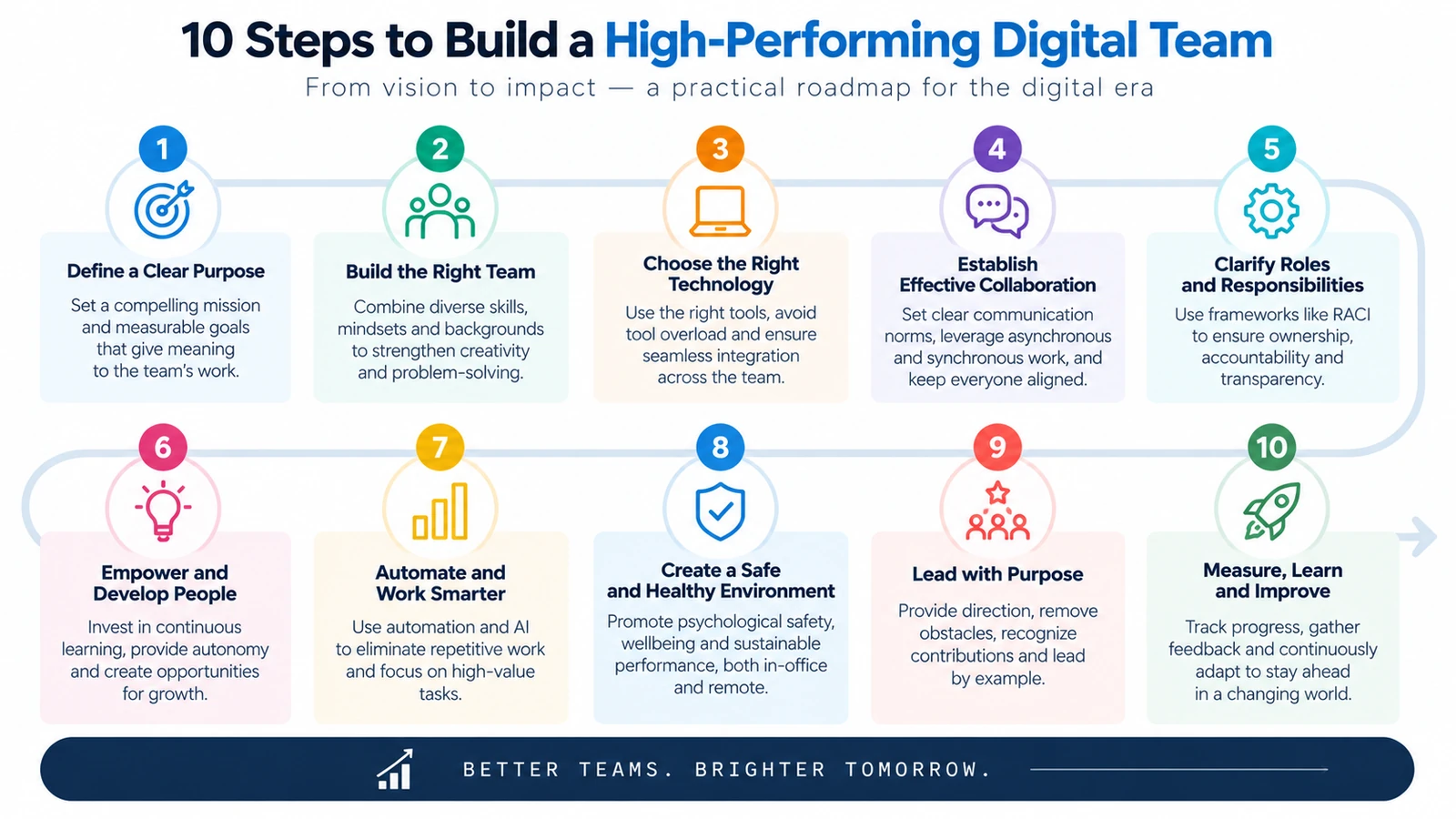
Step 1: Define the Outcome
Clarify what the team exists to achieve.
Step 2: Clarify Responsibilities
Make ownership and decision rights visible.
Step 3: Understand the Workflow
Map how work moves from request to outcome.
Step 4: Remove Unnecessary Complexity
Simplify approvals, handoffs and duplicated activities where possible.
Step 5: Select Technology
Choose technology that supports the improved workflow rather than forcing the workflow to fit the tool.
Step 6: Define Team Practices
Agree how the team communicates, documents decisions and collaborates.
Step 7: Build Skills
Develop both technical and human capabilities.
Step 8: Create Psychological Safety
Encourage questions, constructive disagreement, learning and early escalation of problems.
Step 9: Introduce Automation and AI Deliberately
Automate tasks where the value is clear and define appropriate human oversight.
Step 10: Measure and Improve
Use outcomes and team feedback to continuously refine the operating model.
15-Minute Digital Team Operating Review
Use this short review every few weeks—or after a meaningful delivery problem—to identify one change that can improve how the team works. The goal is not to redesign the entire operating model in one meeting. It is to remove one source of friction at a time.
- Minutes 0–3 — Reconfirm the outcome. State the customer or business outcome the team is currently trying to deliver. If team members describe different priorities, resolve that misalignment before changing tools or processes.
- Minutes 3–6 — Check ownership and decision rights. Identify one important decision or deliverable that is slowing down. Confirm who owns the outcome, who can decide, who contributes expertise and when escalation is required.
- Minutes 6–9 — Inspect the workflow and technology. Ask where work is waiting, duplicated or repeatedly re-entered. Confirm the source of truth for tasks, decisions and documentation. Flag any tool that adds coordination effort without enough value.
- Minutes 9–12 — Review collaboration friction. Look for unnecessary meetings, unclear communication channels, unresolved dependencies, excessive notifications or information that is difficult to find. Choose the issue that creates the greatest recurring delay.
- Minutes 12–15 — Commit to one experiment. Select one change to test for the next two to four weeks. Assign an owner, define the expected improvement and choose one simple measure such as fewer handoffs, shorter decision time, reduced meeting load or better delivery predictability.
Finish with one explicit decision: KEEP the current practice, SIMPLIFY it, AUTOMATE part of it, REMOVE it, or ESCALATE a structural blocker. Record the owner and review date so the improvement does not disappear into meeting notes.
How to Measure Digital Team Performance
High-performing teams should not be measured using activity alone.
Sending more messages, attending more meetings or closing more tasks does not necessarily mean that the team is producing more value.
A balanced measurement model can consider:
| Dimension | Possible Measure |
|---|---|
| Outcomes | Business or customer results |
| Flow | Lead time or cycle time |
| Quality | Defects, rework or reliability |
| Collaboration | Dependencies and handoff effectiveness |
| Learning | Improvement actions and capability development |
| People | Team experience and sustainable workload |
| Technology | Adoption and usefulness |
Metrics should support improvement rather than become targets that encourage unhelpful behavior.
Example: A Balanced Digital Team Scorecard
| Dimension | Example question | Example signal |
|---|---|---|
| Outcomes | Did the delivered change produce the agreed customer benefit? | Acceptance or customer outcome |
| Flow | How long did work wait between teams? | End-to-end lead time and blocked time |
| Quality | Was the change validated without avoidable rework? | Defects, rollback and repeat incidents |
| Collaboration | Were dependencies and decisions handled clearly? | Aged handoffs, unresolved decisions |
| Team health | Can the team sustain this pace? | Workload feedback and recovery capacity |
Review a small combination of these measures in context rather than chasing a single target. A faster delivery that increases rework or harms team sustainability is not necessarily an improvement. The Google re:Work team-effectiveness material is useful background on how team dynamics complement operational metrics.
To clarify who validates outcomes and who approves trade-offs, apply a RACI matrix to the delivery workflow. For leadership responsibilities and delegation boundaries, see the Modern Leadership guide.
Common Technology and Teamwork Mistakes
In practice, many digital teamwork problems come from applying technology without enough attention to the way work is designed. Therefore, these are some of the most common mistakes to avoid:
| Mistake | Better Approach |
|---|---|
| Buying technology before defining the problem | Start with the business outcome, team need and workflow. |
| Using too many collaboration tools | Reduce fragmentation and define clear sources of truth. |
| Automating a broken process | Simplify the process before automating it. |
| Measuring activity instead of outcomes | Track value, quality, flow and customer or business results. |
| Ignoring human skills | Combine technical expertise with communication, collaboration and leadership. |
| Treating AI as automatically correct | Validate important outputs and maintain appropriate human oversight. |
| Ignoring change management | Explain why the change matters and support people through adoption. |
| Confusing visibility with surveillance | Create enough transparency to coordinate work without undermining trust. |
The Future of Technology and Teamwork
Looking ahead, the future of teamwork will involve a deeper relationship between people and technology.
Several changes are already influencing how teams operate.
AI Will Become More Embedded in Workflows
AI is moving from separate chat interfaces toward integration with everyday work processes.
Human-Agent Collaboration Will Grow
As a result, some teams will increasingly coordinate work across people, AI assistants, automation and agents.
Human Judgment Will Remain Important
As technology performs more execution, human capabilities such as judgment, accountability, communication and context remain important.
Teams Will Need New Skills
Employees will increasingly need to understand how to delegate work to AI, evaluate results and determine where human intervention is required.
Leadership Will Focus More on Work Design
Leaders will need to think not only about organizational charts but about how work is divided across people, processes, automation and AI.
Frequently Asked Questions About Technology and Teamwork
How Does Technology Improve Teamwork?
Technology can improve teamwork by supporting communication, coordination, information sharing, visibility, automation and collaboration across locations. Its effectiveness depends on how well the technology fits the team’s workflow and needs.
Can Technology Replace Teamwork?
No. Technology can support collaboration and automate selected activities, but teamwork still involves communication, trust, judgment, accountability and shared goals.
What Technology Is Most Important for Teamwork?
There is no single best technology. Teams typically need capabilities for communication, task coordination, knowledge management, documentation and information sharing. The right combination depends on the team’s work.
How Does AI Affect Teamwork?
AI can support analysis, drafting, information retrieval, automation and other tasks. Teams need to define how AI is used, how outputs are validated and who remains accountable for outcomes.
What Is a Human-AI Team?
A human-AI team combines human direction, judgment and accountability with AI capabilities that assist or execute selected tasks.
What Makes a Digital Team High Performing?
High-performing digital teams typically combine clear objectives, complementary skills, trust, effective communication, well-designed processes, appropriate technology and strong leadership.
Why Is Psychological Safety Important in Technology Teams?
Technology teams frequently work with uncertainty and complex problems. People need to be able to raise risks, challenge assumptions, ask questions and discuss mistakes so that issues can be identified and addressed early.
How Can Teams Avoid Technology Overload?
Teams can reduce overload by consolidating tools, clarifying communication channels, reducing unnecessary notifications and meetings, using asynchronous collaboration and maintaining clear sources of truth.
Should Teams Automate as Much Work as Possible?
Not necessarily. Automation should be applied where it improves the workflow. Tasks involving complex judgment, relationships, accountability or unusual situations may still require substantial human involvement.
How Do You Measure Teamwork?
Rather than relying only on activity metrics, organizations can consider outcomes, quality, flow, collaboration, learning, employee experience and customer or business results.
Conclusion: Technology Should Strengthen the Team
Technology and teamwork work best when they are designed together.
In practice, the most effective digital teams do not simply accumulate collaboration platforms, automation and AI tools.
They build an operating model where:
Technology enables the work.
People provide expertise, judgment and relationships.
Processes coordinate execution.
Leadership creates direction and accountability.
As artificial intelligence and AI agents become more capable, this balance becomes even more important.
The question for organizations is no longer simply:
“Which technology should we adopt?”
Instead, a better question is:
“How should people, processes and technology work together to produce better outcomes?”
That shift—from adopting tools to designing effective teamwork—is the foundation of a high-performing digital organization.
Continue Learning
Continue exploring TechTeamSynergy with these related guides.
Comments are closed.