
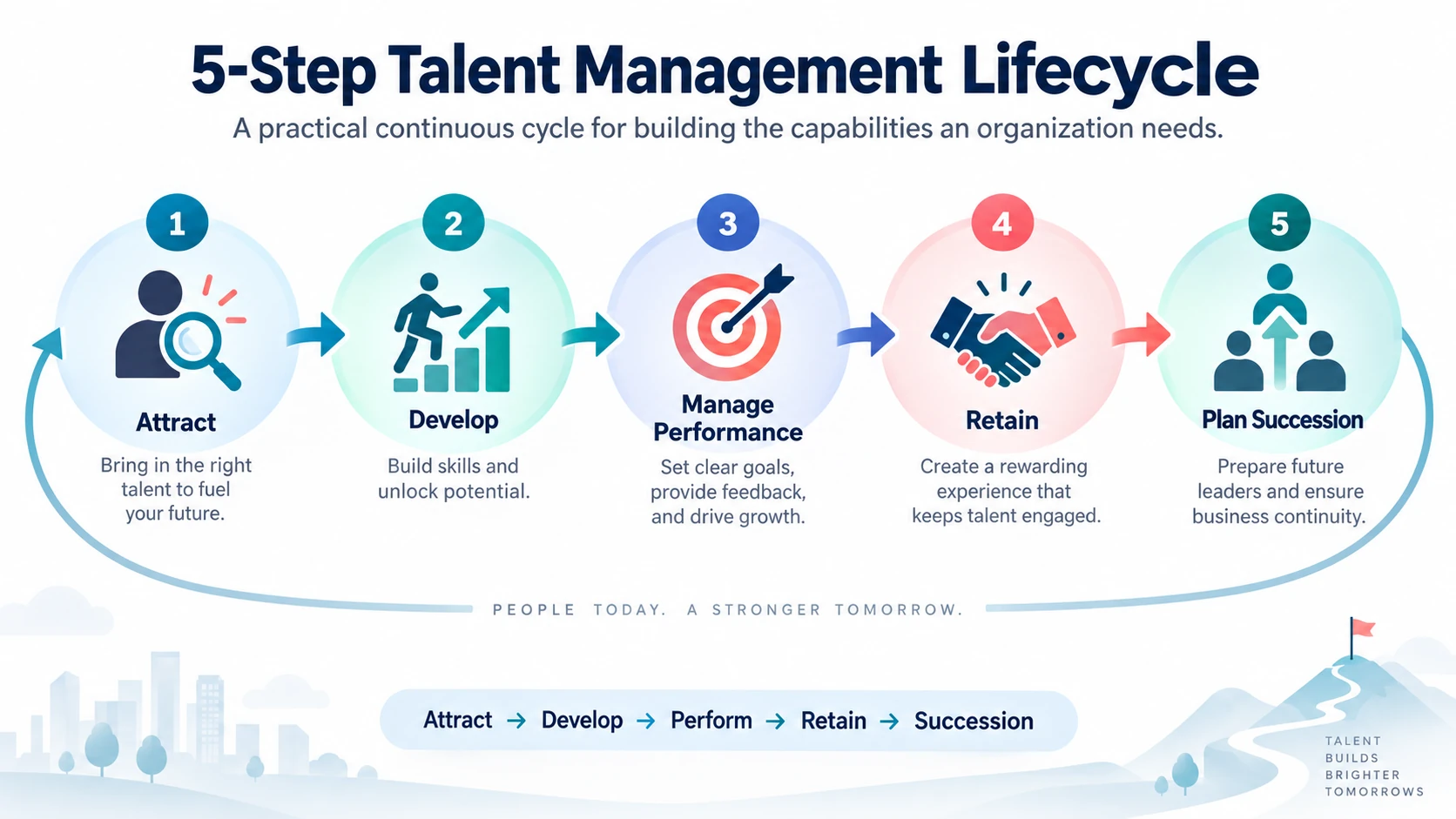
The 5 steps of talent management are attracting the right talent, developing skills and capabilities, managing performance, retaining valuable employees, and planning succession and future talent needs.
But effective talent management is more than a sequence of HR activities. It connects business strategy with the people, skills and capabilities an organization needs to succeed.
In addition, that connection is becoming increasingly important as artificial intelligence, automation, changing employee expectations and evolving business models reshape jobs and skills.
A practical talent management model can be summarized as:
Attract → Develop → Perform → Retain → Succession
This guide explains each of these five steps, how to build a talent management strategy, how skills-based workforce planning fits into the process, and how AI can support talent decisions without replacing human judgment and accountability.
What Is Talent Management?
Talent management is a systematic approach to attracting, developing, engaging, retaining and deploying the people and capabilities an organization needs.
However, the goal is not simply to recruit talented employees.
Therefore, it is to ensure that the organization has the right capabilities in the right places at the right time.
The CIPD talent management framework describes talent management as a systematic process involving attraction, identification, development, engagement, retention and deployment.
Organizations may approach talent differently. Some focus primarily on high-performing or high-potential employees. Others use a more inclusive model that aims to develop capabilities across the workforce.
Therefore, there is no single approach that fits every organization.
A useful talent strategy should reflect the organization’s:
- Business objectives
- Workforce requirements
- Critical roles
- Current and future skills
- Culture
- Operating model
- Growth plans
What Are the 5 Steps of Talent Management?
The 5 steps of talent management provide a practical lifecycle for managing talent:
- Attract — bring the right people and capabilities into the organization.
- Develop — build the skills people need now and in the future.
- Manage Performance — align individual and team contribution with meaningful outcomes.
- Retain — create conditions that encourage valuable employees to stay, contribute and grow.
- Plan Succession — prepare talent for critical roles and future organizational needs.
| Step | Objective | Key Actions | Example KPI |
|---|---|---|---|
| 1. Attract | Bring the right capabilities into the organization. | Define role needs, strengthen the employer value proposition, use skills-based hiring and structured selection. | Time to fill critical roles |
| 2. Develop | Build the skills and capabilities needed now and in the future. | Assess skills gaps, create development plans, use learning, coaching, mentoring and mobility. | Skills-gap closure |
| 3. Perform | Align contribution with meaningful business outcomes. | Set clear expectations, use relevant goals, provide continuous feedback and recognition. | Goal or outcome achievement |
| 4. Retain | Create conditions that encourage valuable employees to stay, contribute and grow. | Improve career visibility, leadership, recognition, development opportunities and employee experience. | Regrettable turnover |
| 5. Succession | Prepare talent for critical roles and future capability needs. | Identify critical roles, build talent pools, assess readiness and connect succession with development. | Critical-role succession coverage |
These steps are interconnected.
For example, recruitment without development can create recurring skills shortages.
Likewise, development without career opportunities can contribute to employee frustration.
Similarly, performance management without feedback can become a bureaucratic exercise.
Finally, retention without succession planning can leave the organization vulnerable when key employees move on.
Effective talent management therefore treats these activities as one connected system.
Why the 5 Steps of Talent Management Matter
Ultimately, organizations compete through capabilities, not simply headcount.
For example, they need people who can solve problems, serve customers, operate technology, lead teams, manage risk and adapt to change.
Talent management helps organizations answer important questions:
- What capabilities do we need to execute our strategy?
- Which skills do we already have?
- Where are the gaps?
- Which capabilities should we build internally?
- What capabilities should we recruit?
- Which roles are critical?
- Where do we have succession risks?
- How can employees continue developing?
As a result, this makes talent management a strategic capability rather than simply an HR process.
Talent Management vs Human Resources
However, talent management and human resources overlap, but they are not identical concepts.
Human Resources covers a broad range of activities that can include employment policies, compensation, benefits, compliance, employee relations, workforce administration and organizational practices.
Talent management focuses more specifically on how organizations attract, develop, deploy, engage and retain the capabilities needed to achieve business objectives.
| Human Resources | Talent Management |
|---|---|
| Broad people-management function | Focused talent and capability strategy |
| Policies and administration | Skills and capability development |
| Employee lifecycle | Talent lifecycle |
| Employment practices | Future talent needs |
| Organization-wide people processes | Talent pools and critical capabilities |
| Operational and strategic | Strong strategic emphasis |
In practice, talent management is often one important part of the broader people or HR strategy.
Talent Management Starts With Business Strategy
For example, a common mistake is to start talent management with recruitment.
Instead, the better starting point is strategy.
Ask:
What capabilities will the organization need to execute its strategy?
For example, an organization expanding its digital services may need stronger capabilities in:
- Artificial intelligence
- Cloud computing
- Cybersecurity
- Data
- Automation
- Product management
- Digital leadership
A company expanding internationally may instead need capabilities in new markets, languages, regulatory environments or global operations.
Talent management should therefore flow from business needs rather than operate as an isolated people process.
Workforce Planning Before Talent Management
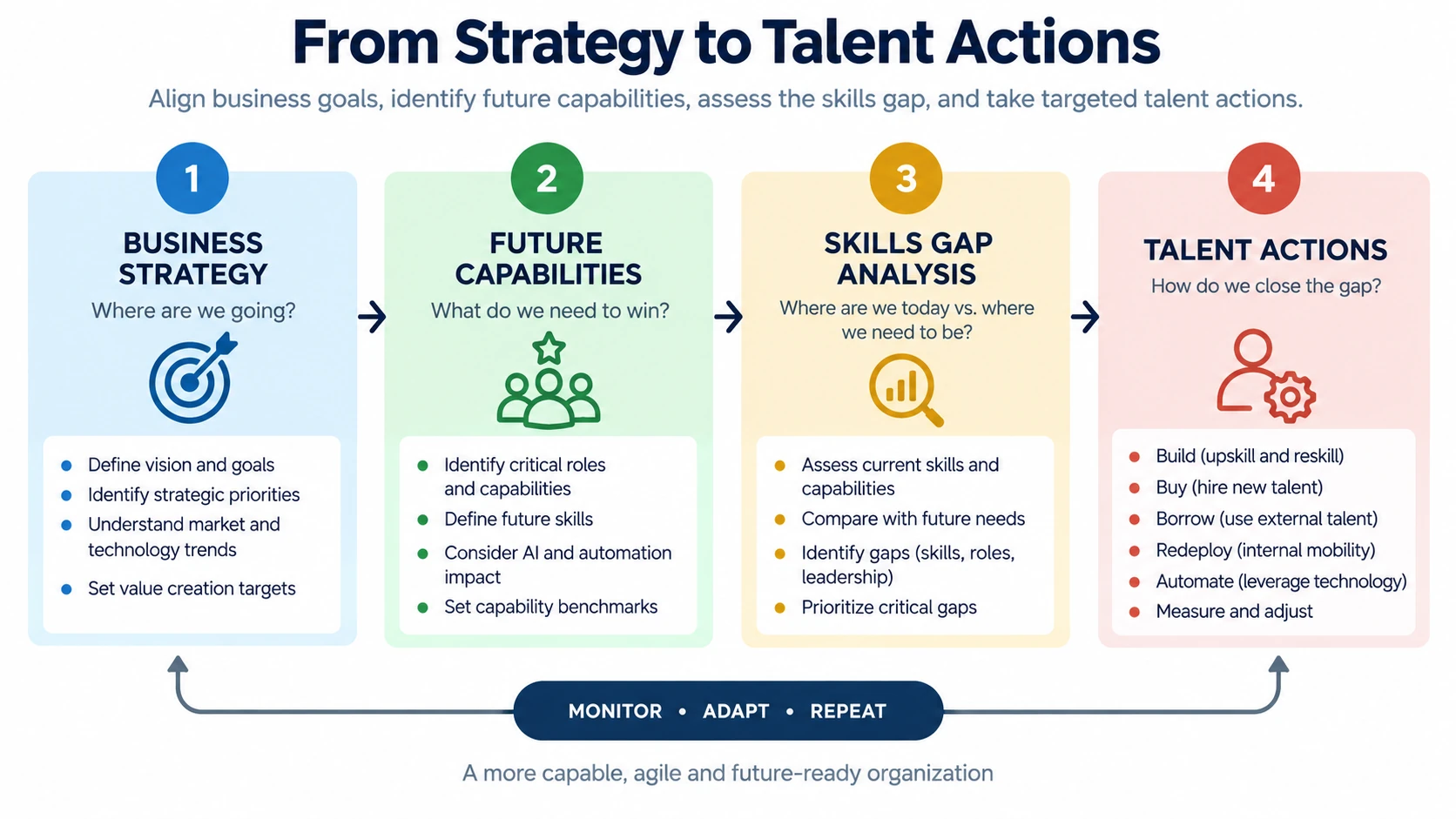
In addition, workforce planning connects business strategy with talent decisions.
A simple model is:
Business Strategy → Future Capabilities → Current Workforce → Gap → Talent Actions
Those actions can include:
- Recruitment
- Training
- Reskilling
- Internal mobility
- Automation
- Succession planning
- Role redesign
- External partnerships
As a result, recruitment does not become the default answer to every capability gap.
In this guide, workforce planning is used to identify the capabilities talent management must attract, develop, retain and prepare for succession. Broader questions such as role redesign, operating-model change, AI-enabled work redesign and organization-wide workforce shifts belong to workforce transformation.
Step 1: Attract the Right Talent
The first of the 5 steps of talent management is attraction.
In practice, attraction means creating access to the people and capabilities the organization needs.
In addition, this includes recruitment, but effective talent attraction starts before a candidate submits an application.
Define What Talent You Actually Need
Before opening a position, clarify:
- The outcome the role should deliver
- The essential capabilities
- Skills that can be developed after hiring
- Experience genuinely required
- Decision-making responsibilities
- Relationships with other roles
For example, long lists of unnecessary requirements can reduce the candidate pool without improving hiring quality.
Build an Employer Value Proposition
An employer value proposition, or EVP, describes what employees can reasonably expect in exchange for their contribution.
It can include:
- Meaningful work
- Compensation
- Career opportunities
- Learning
- Leadership
- Flexibility
- Culture
- Recognition
- Wellbeing
However, an EVP should reflect the real employee experience rather than exist only as recruitment marketing.
Use Skills-Based Hiring Where Appropriate
For example, organizations can sometimes improve talent access by focusing more directly on demonstrated skills rather than relying entirely on job titles, degrees or years of experience.
However, this does not mean qualifications are irrelevant.
Some roles genuinely require specific education, certification or regulated expertise.
Therefore, the objective is to distinguish between requirements that are essential and those that are simply traditional.
Create a Structured Selection Process
In addition, structured recruitment can help improve consistency.
Organizations can define:
- Evaluation criteria
- Interview questions
- Role-relevant assessments
- Decision responsibilities
- Documentation expectations
As a result, this can reduce the risk that hiring decisions depend excessively on intuition or unstructured impressions.
Questions of equity, inclusion, access and consistency across people processes are covered more fully in our DEI guide, while this article remains focused on the talent management lifecycle.
Onboarding: The Bridge Between Attraction and Development
Importantly, recruitment does not end when an employee accepts an offer.
For example, onboarding helps new employees understand:
- The organization
- Their role
- Expected outcomes
- Key relationships
- Processes
- Tools
- Culture
- Sources of support
A useful onboarding model is:
Context → Connections → Capabilities → Contribution
However, the goal is not to overload new employees with information during their first week.
Therefore, it is to progressively help them become confident and effective contributors.
Step 2: Develop Skills and Capabilities
The second step is talent development.
However, development should not be limited to sending employees to training courses.
People can develop through:
- Formal learning
- Coaching
- Mentoring
- Stretch assignments
- Project work
- Job rotations
- Peer learning
- Communities of practice
- Feedback
- Real-world experience
Therefore, the best development method depends on the capability being developed.
Start With a Skills Gap Analysis
A practical skills-development process is:
Current Skills → Future Skills → Gap → Development Action → Application → Review
As a result, this connects learning investments to real organizational needs.
Technical Skills and Human Skills
However, future capability does not consist only of technology skills.
Organizations increasingly need combinations of:
- Technical expertise
- Analytical thinking
- Communication
- Leadership
- Collaboration
- Adaptability
- Problem-solving
- Continuous learning
The World Economic Forum Future of Jobs skills outlook highlights the continuing rise of technology skills while also emphasizing capabilities such as resilience, leadership, social influence and lifelong learning.
Upskilling vs Reskilling
Upskilling develops additional or deeper capabilities for a person’s current or evolving area of work.
Reskilling prepares someone for a substantially different role or type of work.
In practice, both can help organizations respond to changing capability requirements.
Create Individual Development Plans
A useful development plan can include:
| Element | Question |
|---|---|
| Goal | What capability should be developed? |
| Reason | Why does it matter? |
| Action | How will the capability be developed? |
| Application | Where will it be practiced? |
| Support | Who can help? |
| Evidence | How will progress be demonstrated? |
Mentoring and Coaching
In addition, mentoring and coaching can complement formal learning.
Mentors often share experience, perspective and career guidance.
Coaching more often helps people think through goals, behaviors, decisions and development challenges.
Therefore, both can be useful components of a broader talent strategy.
Career Development and Internal Mobility
Importantly, career development should not always be interpreted as vertical promotion.
Employees may develop through:
- Promotion
- Lateral moves
- Project assignments
- New technical responsibilities
- Leadership opportunities
- International assignments
- Cross-functional roles
As a result, internal mobility can help organizations deploy existing capabilities where they create greater value while giving employees opportunities to grow.
Step 3: Manage Performance and Provide Feedback
The third of the 5 steps of talent management is performance management.
Therefore, performance management should connect individual and team contribution with organizational outcomes.
A practical cycle is:
Expectations → Action → Feedback → Learning → Adjustment
Set Clear Expectations
Employees should understand:
- What outcomes matter
- How success will be evaluated
- What decisions they can make
- What standards apply
- Where collaboration is required
As a result, ambiguous expectations make meaningful performance conversations difficult.
Use Goals Carefully
For example, organizations may use objectives, KPIs, OKRs or other goal-setting mechanisms.
However, the framework matters less than whether goals:
- Support meaningful outcomes
- Are understandable
- Can be influenced by the employee or team
- Avoid creating harmful incentives
- Are reviewed as circumstances change
Make Feedback Continuous
Similarly, feedback should not be limited to an annual performance review.
For example, regular conversations can help people:
- Understand what is working
- Identify problems early
- Adjust behavior
- Develop capabilities
- Clarify expectations
Recognition Matters Too
In addition, performance management should not focus exclusively on gaps.
For example, recognition can reinforce valuable behaviors and contributions.
Recognition can include:
- Direct appreciation
- Peer recognition
- Expanded responsibilities
- Development opportunities
- Formal rewards
Modern Leadership and Talent Development
In addition, managers and leaders play an important role in talent management.
However, HR can create frameworks and programs, but employees experience talent management largely through their day-to-day work and leadership.
Leaders influence:
- Feedback
- Development opportunities
- Delegation
- Recognition
- Career conversations
- Psychological safety
- Team culture
Talent management therefore defines the capability and development system, while leadership shapes how that system is experienced in day-to-day work. Our Modern Leadership guide explores leadership skills, styles, decision-making, adaptability and accountability in more depth.
Step 4: Retain and Engage Talent
The fourth step is retention.
However, retention does not mean trying to prevent every employee from leaving.
After all, employee movement is a normal part of organizational life.
Therefore, the objective is to understand why valuable people stay, why they leave and where unwanted turnover creates business risk.
What Influences Employee Retention?
Retention can be influenced by combinations of:
- Leadership
- Meaningful work
- Compensation
- Career development
- Recognition
- Workload
- Flexibility
- Team relationships
- Organizational culture
- Learning opportunities
- Employee wellbeing
However, there is rarely one universal reason why employees stay or leave.
Employee Experience and Retention
Employee experience includes the interactions employees have with the organization throughout their employment, from recruitment and onboarding to development, daily work and departure.
Within talent management, employee experience matters because it influences engagement, development and retention. It is not the same discipline: talent management focuses on building and deploying capability, while employee experience focuses on what people actually experience across the employee journey.
This can include:
- Recruitment
- Onboarding
- Technology
- Management
- Learning
- Career opportunities
- Recognition
- Work environment
However, a strong employer brand cannot compensate indefinitely for a poor internal employee experience.
Career Visibility
For example, employees may be more likely to explore opportunities elsewhere when they cannot see realistic opportunities to develop internally.
Organizations can improve career visibility through:
- Career frameworks
- Internal job opportunities
- Talent marketplaces
- Mentoring
- Development conversations
- Project opportunities
Wellbeing and Sustainable Performance
However, talent retention should not depend on permanently increasing workload.
Therefore, organizations need to consider sustainable performance.
Our Employee Wellbeing and Mental Health at Work guide explains how organizations can approach wellbeing through prevention, protection, support and measurement.
Step 5: Plan Succession and Future Talent Needs
The fifth of the 5 steps of talent management is succession planning.
Therefore, succession planning helps organizations prepare for changes in critical roles.
However, it should not be limited to identifying a replacement for the CEO.
Organizations can face succession risks in:
- Leadership roles
- Technical specialist positions
- Customer relationships
- Operational roles
- Cybersecurity
- Architecture
- Engineering
- Program management
- Other business-critical capabilities
Identify Critical Roles
For example, a critical role is not necessarily the most senior role.
Ask:
- Would losing this capability significantly affect operations?
- Is the skill difficult to replace?
- Does the role hold unique organizational knowledge?
- Would replacement take a long time?
- Does the role influence major customers, systems or decisions?
Build Talent Pools
However, succession planning should avoid assuming that one named person will definitely replace another.
Instead, talent pools can create greater flexibility.
A talent pool may contain people who could become ready for different critical roles through targeted development.
Assess Readiness Carefully
Possible categories include:
- Ready now
- Potentially ready in the near term
- Longer-term development candidate
These classifications should be treated as planning tools rather than permanent labels.
Connect Succession With Development
However, a succession plan without development actions is simply a list of names.
Potential successors may need:
- Broader experience
- Leadership development
- Technical depth
- Cross-functional exposure
- Customer experience
- Strategic responsibilities
- Mentoring
What Is Skills-Based Talent Management?
In addition, skills-based talent management focuses on capabilities as an important unit for workforce decisions.
Instead of looking only at jobs and titles, organizations ask:
What skills do we have, what skills do we need, and how can we close the gap?
A practical model is:
Current Skills → Future Skills → Skills Gap → Build / Buy / Borrow / Automate
Build
Develop capabilities internally through learning, experience and mobility.
Buy
Recruit capabilities from outside the organization.
Borrow
Access temporary expertise through partners, contractors or other external resources where appropriate.
Automate
Use technology to automate suitable activities so that human capability can be applied elsewhere.
Talent Management and Workforce Transformation
Although closely related, talent management and workforce transformation solve different problems.
Talent management focuses on how an organization attracts, develops, manages, retains and prepares the capabilities it needs.
Workforce transformation focuses more broadly on how work itself changes — including roles, workflows, operating models, organization design and the interaction between people, AI and automation.
A practical distinction is:
Talent Management → Build and deploy capability
Workforce Transformation → Redesign the system of work
The two disciplines should inform each other without becoming the same topic. Our Workforce Transformation guide covers role redesign, AI-enabled work, operating-model change and broader workforce shifts in more depth.
AI in Talent Management
In addition, artificial intelligence can support parts of the talent management lifecycle.
Potential applications include:
- Skills analysis
- Learning recommendations
- Workforce analytics
- Knowledge discovery
- Administrative automation
- Career recommendations
- Recruitment workflow support
- Workforce scenario analysis
However, AI should not automatically become the final decision-maker for consequential people decisions.
AI in Recruitment
For example, AI can assist recruiters by organizing information, supporting workflow activities or helping identify patterns across large volumes of data.
But recruitment systems can also introduce risks.
These can include:
- Bias
- Poor-quality training or input data
- Opaque recommendations
- Privacy concerns
- Overreliance on automated scoring
- False confidence in predictions
Therefore, organizations should understand what an AI system is doing before relying on its outputs.
Human Oversight in AI-Supported Talent Decisions
However, AI can provide useful inputs, but accountability for important talent decisions remains an organizational responsibility.
The NIST AI Risk Management Framework provides a useful general framework for managing AI risks and emphasizes governance, defined responsibilities and human oversight.
A practical principle is:
AI Insight → Human Review → Context → Decision → Accountability
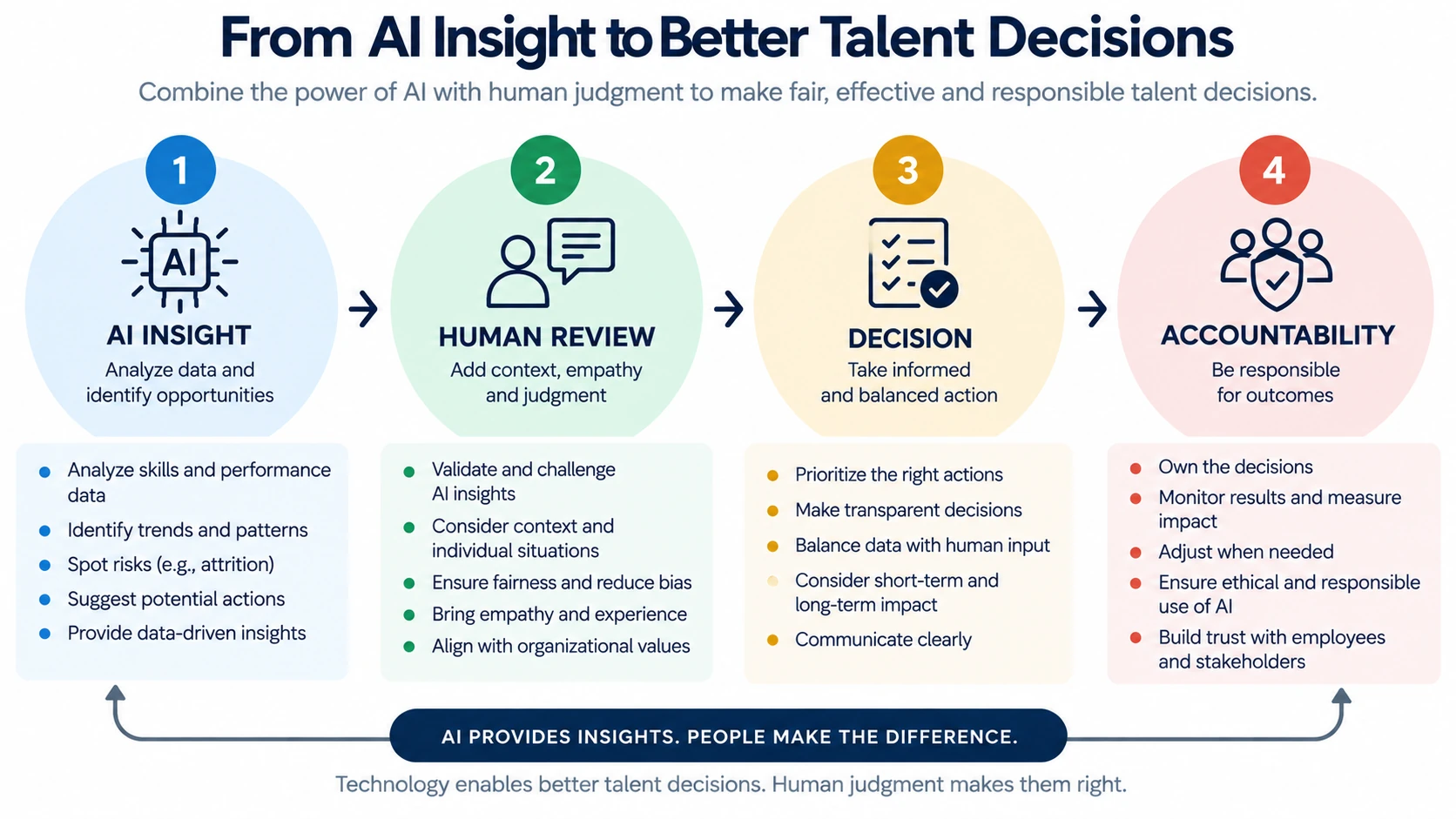
In particular, this is important for decisions affecting:
- Hiring
- Promotion
- Performance
- Compensation
- Succession
- Employment opportunities
Risks of AI in Talent Management
Organizations adopting AI for talent processes should consider several risks.
Bias
Historical data can contain patterns that organizations may not want automated systems to reproduce.
Privacy
Employee data can be sensitive. Access, purpose and retention should be appropriately controlled.
Explainability
Decision-makers should understand the limitations of AI-generated recommendations.
Over-Automation
Not every people decision should be optimized as if it were a purely technical problem.
Employee Monitoring
The technical ability to measure an activity does not automatically make that measurement useful or appropriate.
Accountability
Organizations should establish who is responsible when AI contributes to a talent decision.
Talent Analytics: Measure What Matters
Talent analytics can help organizations understand whether their strategy is working.
Useful indicators may include:
| Talent Area | Possible Metric |
|---|---|
| Attraction | Time to fill critical roles |
| Recruitment | Quality of hire indicators |
| Onboarding | Time to productive contribution |
| Development | Capability progression |
| Mobility | Internal move rate |
| Retention | Regrettable turnover |
| Succession | Coverage of critical roles |
| Skills | Priority skills gaps |
| Leadership | Leadership pipeline readiness |
Metrics should support decisions rather than become targets detached from context.
Talent Management KPIs
Organizations should choose KPIs based on their actual talent strategy.
Examples include:
- Critical-role vacancy rate
- Time to fill
- Internal promotion rate
- Internal mobility rate
- Retention of critical talent
- Skills-gap closure
- Development-plan completion
- Succession coverage
- Successor readiness
- New-hire retention
No single metric provides a complete picture of talent effectiveness.
How to Build a Talent Management Strategy
Step 1: Understand Business Priorities
Identify where the organization is going and what capabilities will be required.
Step 2: Assess the Current Workforce
Understand existing roles, capabilities, demographics, talent risks and critical dependencies.
Step 3: Identify Future Skills
Determine which capabilities are likely to become more important.
Step 4: Identify Gaps
Compare future needs with current workforce capability.
Step 5: Prioritize Critical Gaps
Not every gap deserves equal investment.
Step 6: Choose Talent Actions
Decide whether to:
- Recruit
- Develop
- Reskill
- Redeploy
- Partner
- Automate
Step 7: Engage Leaders
Talent management cannot be owned by HR alone.
Managers and leaders need to actively develop and deploy talent.
Step 8: Measure Outcomes
Track whether talent actions are improving the capabilities the business actually needs.
Step 9: Adjust
Talent strategy should evolve as business strategy and workforce conditions change.
A Practical Framework for the 5 Steps of Talent Management
The entire model can be summarized as:
Strategy → Workforce Needs → Attract → Develop → Perform → Retain → Succession → Measure → Improve
This expands the 5 steps of talent management into a continuous strategic cycle.
Who Is Responsible for Talent Management?
Talent management is a shared responsibility.
| Stakeholder | Typical Responsibility |
|---|---|
| Executive Leadership | Set strategic capability priorities |
| HR / People Team | Design frameworks, processes and support |
| Managers | Develop, coach and manage talent |
| Employees | Participate actively in their development |
| Learning Teams | Support capability development |
| Technology / Data Teams | Support responsible talent systems and analytics |
The strongest talent strategies connect these responsibilities rather than treating talent as the responsibility of one department.
Common Talent Management Mistakes
1. Starting With Recruitment Instead of Strategy
Hiring people without understanding future capability needs can create repeated talent gaps.
2. Focusing Only on High-Potential Employees
Critical expertise can exist throughout an organization.
Organizations should understand where value and risk actually sit.
3. Treating Training as Development
Training is only one development mechanism.
Experience, feedback, mentoring and challenging assignments also matter.
4. Ignoring Internal Talent
Recruiting externally while overlooking existing employees can waste capability and reduce career opportunities.
5. Conducting Performance Reviews Without Useful Feedback
A rating alone does little to improve future performance.
6. Creating Succession Lists Without Development Plans
Potential successors need experiences that prepare them for future responsibilities.
7. Using AI Without Governance
Automation should not remove accountability for consequential talent decisions.
8. Measuring Activity Instead of Outcomes
Training hours, applications or completed reviews do not automatically demonstrate improved organizational capability.
Talent Management in Small vs Large Organizations
Talent management does not require a large HR department.
Smaller organizations can use simpler processes:
- Identify critical roles
- Discuss future skills
- Create development plans
- Hold regular career conversations
- Track succession risks
- Review retention issues
Large organizations may require more formal talent systems, skills taxonomies, talent marketplaces, analytics and governance.
The principle remains the same: use the level of complexity appropriate to the organization.
The Future of Talent Management
Talent management is becoming increasingly connected to skills, technology and workforce transformation.
Several trends are likely to shape its future:
- Skills-based workforce planning
- Continuous reskilling
- AI-supported talent analytics
- Internal talent marketplaces
- Greater career mobility
- Human-AI collaboration
- More dynamic role design
- Greater emphasis on employee experience
The World Economic Forum’s Future of Jobs research indicates that employers expect substantial changes in workforce skills through 2030, reinforcing the importance of continuous learning and workforce adaptation.
The organizations best positioned for this environment will not simply recruit for today’s jobs.
They will continuously understand, develop and deploy capabilities for tomorrow’s work.
Frequently Asked Questions About Talent Management
What Are the 5 Steps of Talent Management?
The five practical steps are attracting talent, developing skills, managing performance, retaining employees and planning succession. Together, they create a continuous talent lifecycle.
What Is Talent Management?
Talent management is a systematic approach to attracting, developing, engaging, retaining and deploying the people and capabilities an organization needs to achieve its objectives.
Why Is Talent Management Important?
Talent management helps organizations build the capabilities required to execute strategy, close skills gaps, develop employees, manage succession risks and adapt to changing workforce requirements.
What Is the Difference Between HR and Talent Management?
HR covers a broad range of people-management responsibilities, while talent management focuses specifically on attracting, developing, deploying and retaining the capabilities needed by the organization.
What Is a Talent Management Strategy?
A talent management strategy defines how an organization will obtain and develop the capabilities required to achieve its business objectives.
What Is Skills-Based Talent Management?
Skills-based talent management uses capabilities as an important input for workforce decisions such as recruitment, learning, mobility and workforce planning.
What Is the Difference Between Upskilling and Reskilling?
Upskilling develops additional or deeper capabilities related to existing work, while reskilling prepares someone for a substantially different role or type of work.
What Is Succession Planning?
Succession planning identifies critical roles and develops potential talent so the organization is better prepared when important positions become vacant or new responsibilities emerge.
What Is a Talent Pool?
A talent pool is a group of people who may be developed for future roles or capabilities rather than being designated as the guaranteed successor to one specific position.
How Can AI Be Used in Talent Management?
AI can support skills analysis, learning recommendations, workforce analytics, recruitment workflows, administrative automation and career recommendations. Important talent decisions should still include appropriate human review and accountability.
Can AI Replace HR or Talent Managers?
AI can automate or assist with parts of talent management, but people professionals and leaders remain responsible for context, relationships, governance and consequential organizational decisions.
How Do You Measure Talent Management?
Organizations can combine indicators such as skills-gap closure, critical-role coverage, internal mobility, retention of important talent, successor readiness and hiring outcomes.
Who Is Responsible for Talent Management?
Talent management is a shared responsibility involving executive leaders, HR, managers, employees and other teams involved in workforce development and technology.
Conclusion: Talent Management Is a Continuous Strategy
The 5 steps of talent management provide a practical starting point:
- Attract the right talent.
- Develop the capabilities people need.
- Manage performance through clear expectations and feedback.
- Retain valuable people by creating conditions for contribution and growth.
- Plan succession so critical capabilities are available when needed.
But modern talent management goes further.
It connects those five steps with business strategy, workforce planning, skills, employee experience, leadership, technology and measurement.
A useful overall model is:
Strategy → Skills → Talent → Performance → Future Capability
Artificial intelligence will increasingly support parts of this process, from skills analysis to learning recommendations and workforce analytics.
But technology does not remove the need for human judgment.
Organizations remain responsible for how talent decisions are made, how employees are treated and how AI-supported recommendations are governed.
Ultimately, effective talent management is not about collecting talent.
It is about continuously developing and deploying the capabilities an organization and its people need to succeed.
Continue Learning
Continue exploring TechTeamSynergy with these related guides.
Comments are closed.