
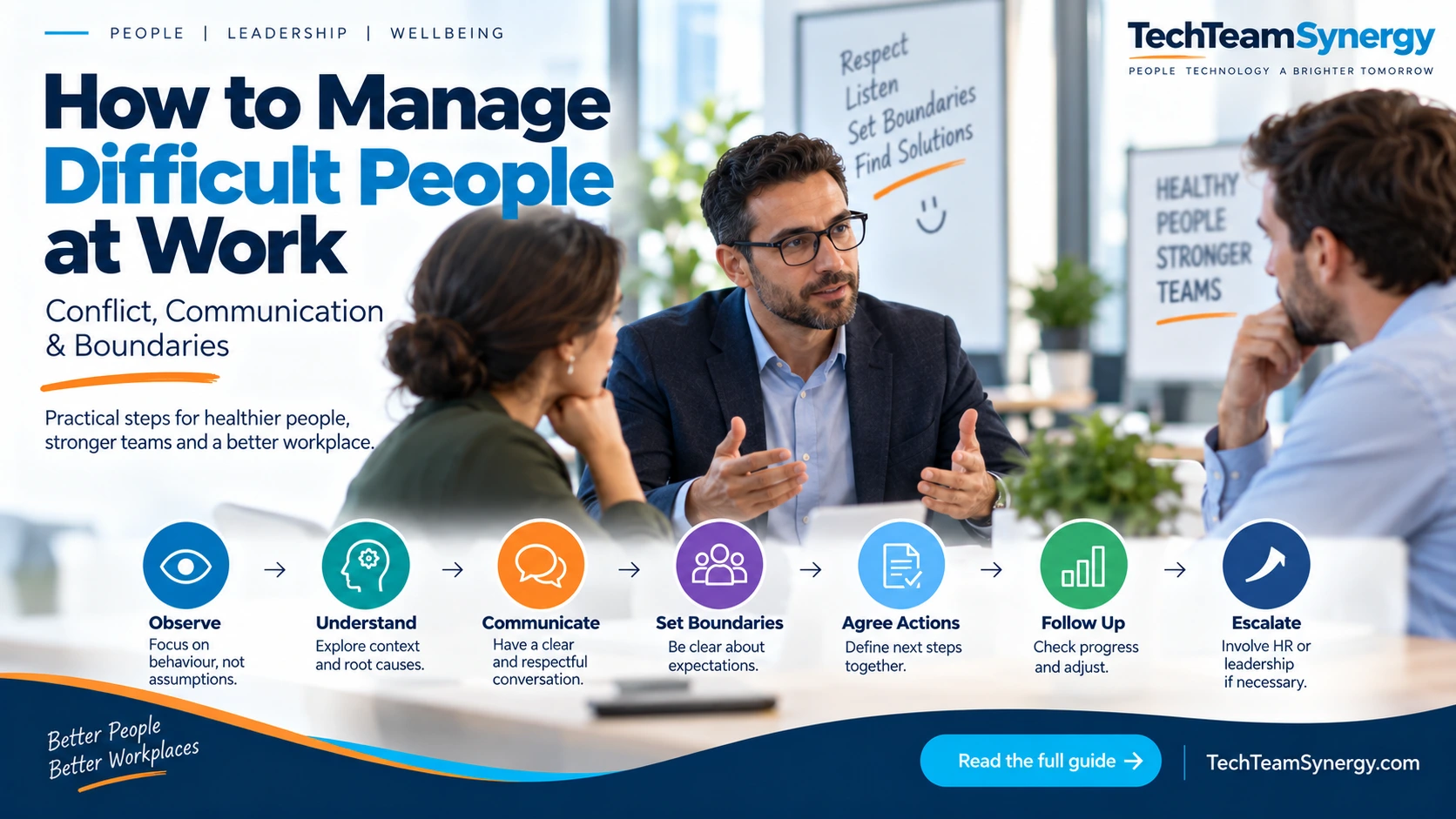
Learning how to manage difficult people at work is less about labeling someone as a “difficult person” and more about responding effectively to difficult behaviors, disagreements and recurring workplace problems.
People can disagree, communicate poorly, miss expectations or react badly under pressure without being inherently difficult. The most effective response is therefore to focus on observable behavior, its impact on the work or team, and what needs to change.
A practical framework is:
Observe → Understand → Communicate → Set Boundaries → Agree Actions → Follow Up → Escalate if Necessary
This guide explains how to manage difficult people using that framework while maintaining professionalism, accountability and respect.
What Does “Difficult People” Mean at Work?
The phrase “difficult people” is commonly used to describe people whose behavior makes collaboration, communication or management challenging.
But the label can be misleading.
Instead of asking:
“Why is this person so difficult?”
ask:
“What specific behavior is creating a problem, what might be contributing to it, and what needs to change?”
Examples of difficult workplace behavior can include:
- Repeatedly interrupting colleagues
- Ignoring agreed responsibilities
- Reacting defensively to feedback
- Dominating meetings
- Withholding information needed by others
- Repeatedly missing commitments
- Communicating disrespectfully
- Refusing reasonable collaboration
- Creating unnecessary conflict
- Undermining agreed team decisions
Focusing on behavior rather than personality makes the situation easier to discuss objectively.
Why Managing Difficult People at Work Can Be Challenging
Workplace conflict rarely has only one possible cause.
It can emerge from differences in:
- Goals
- Priorities
- Communication styles
- Responsibilities
- Working methods
- Expectations
- Access to resources
- Decision authority
- Professional opinions
Organizational conditions can also contribute.
For example, unclear responsibilities can create repeated disputes over ownership. Conflicting objectives can make two teams appear uncooperative even when both are trying to meet their own targets.
Pressure, workload and organizational change can also make existing disagreements harder to manage.
Understanding how to manage difficult people starts with separating observable workplace behavior from assumptions about personality or intent.
Early intervention can often prevent ordinary disagreements from becoming more serious workplace conflicts. For additional guidance, see Acas guidance on workplace conflict and resolution.
Conflict Is Not Always a Bad Thing
Not every disagreement is a problem.
Professional disagreement can expose risks, challenge assumptions and improve decisions.
Imagine two technical experts disagreeing about the architecture of a new system.
One prioritizes reliability.
The other prioritizes speed of deployment.
The disagreement itself is not necessarily unhealthy.
The problem begins when disagreement becomes personal, disrespectful or impossible to resolve constructively.
Healthy teams therefore do not eliminate disagreement.
They learn how to disagree productively.
Four Workplace Problems That Should Not Be Confused
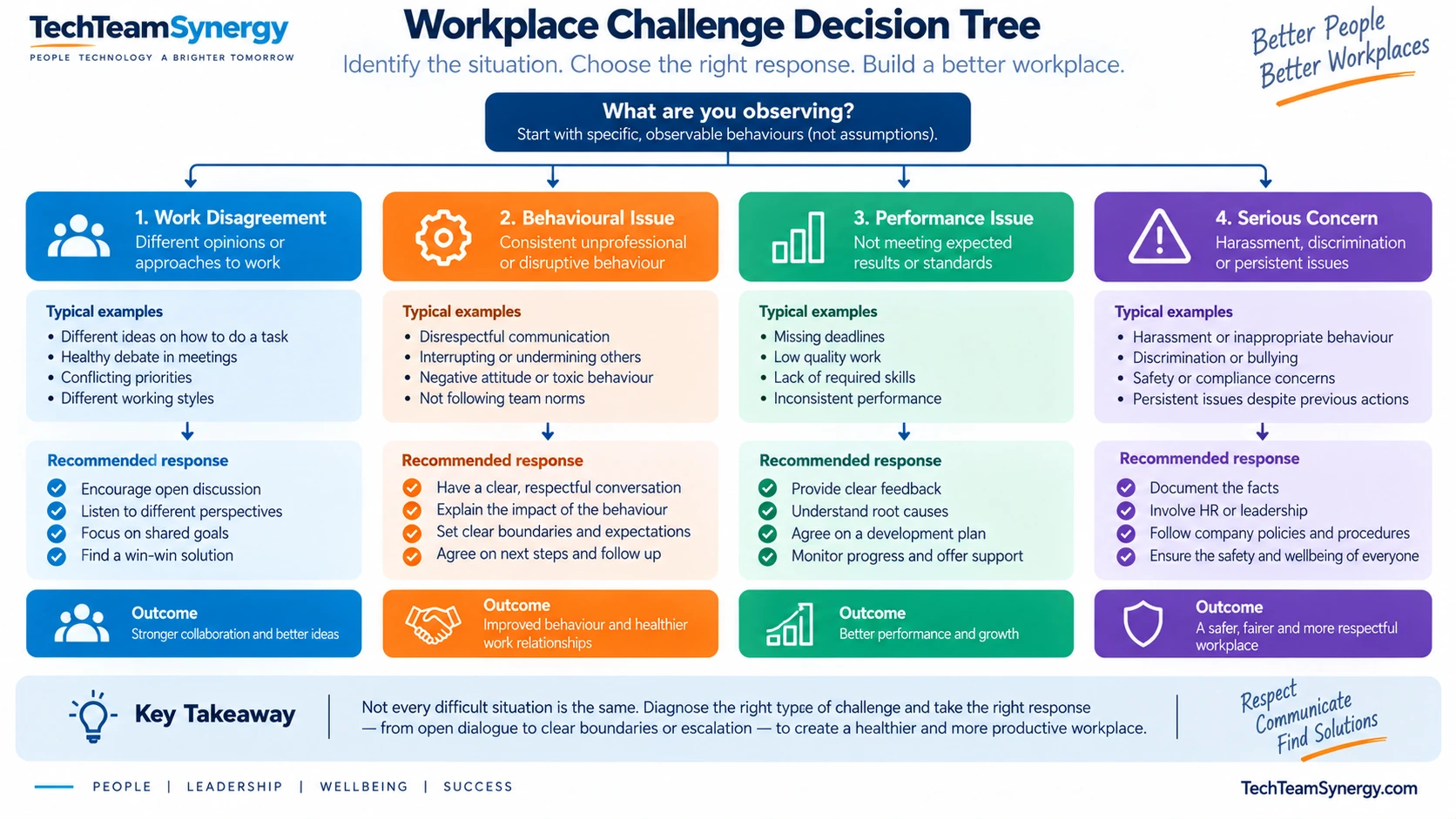
Before deciding how to manage a difficult situation, identify what kind of problem you are dealing with.
1. Normal Disagreement
Two people have different views about a decision, approach or priority.
This often requires discussion rather than intervention.
2. Relationship Conflict
Communication has deteriorated and interactions are becoming increasingly difficult.
This may require a structured conversation or facilitated discussion.
3. Performance or Capability Problem
The core problem is that expected work, behavior or responsibilities are repeatedly not being delivered.
This requires clarity about expectations, evidence and improvement.
4. Potential Misconduct or Serious Concern
Some situations go beyond ordinary interpersonal conflict.
Potential harassment, discrimination, threats, retaliation or other serious misconduct should not simply be treated as a personality disagreement.
Organizations should follow their applicable policies, HR processes and legal requirements for serious concerns.
How to Manage Difficult People: A 7-Step Framework
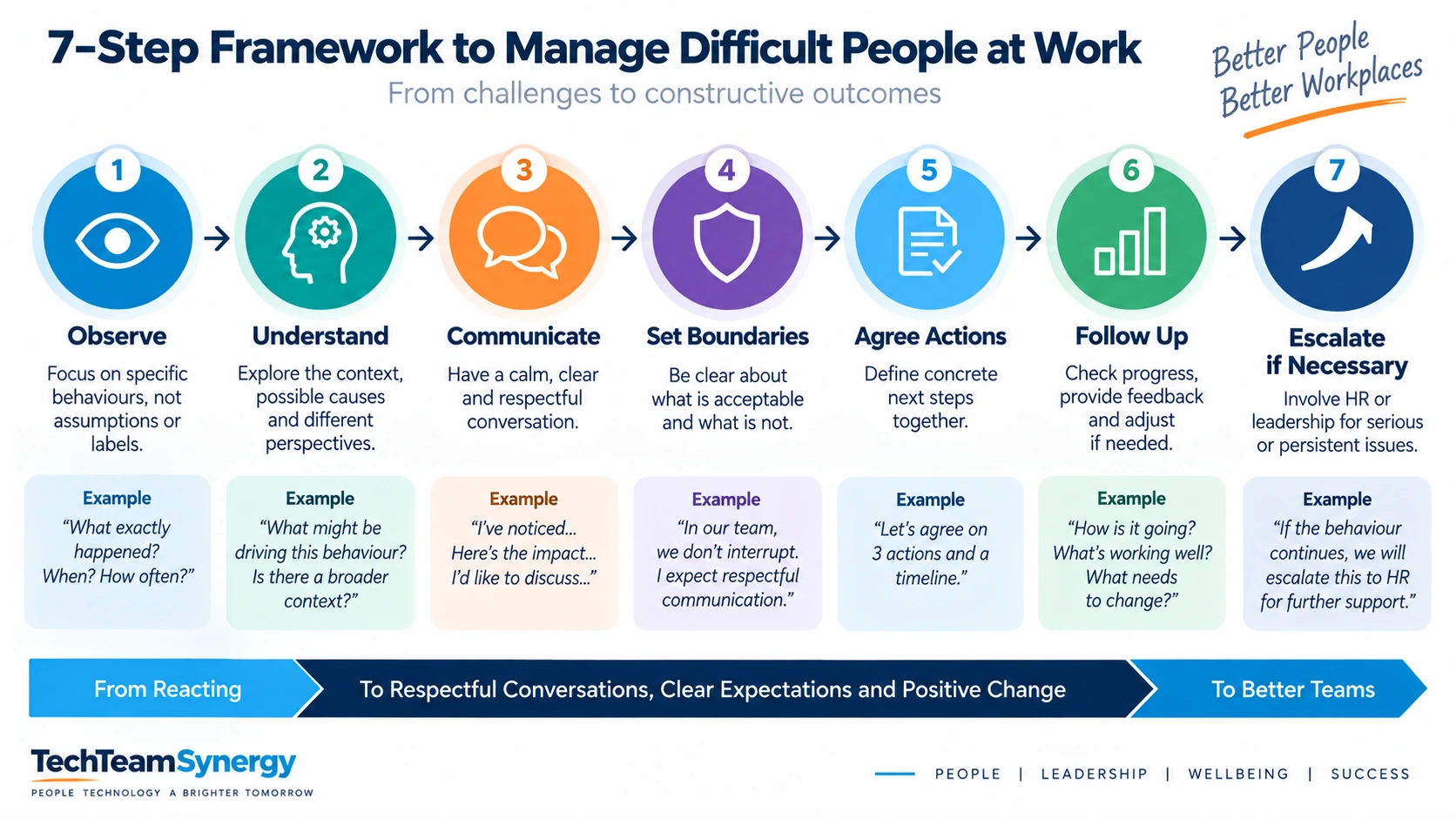
The following framework can be used for many everyday workplace conflicts:
Observe → Understand → Communicate → Set Boundaries → Agree Actions → Follow Up → Escalate if Necessary
Step 1: Observe the Behavior
Start with what you can actually observe.
Avoid conclusions such as:
- “She is impossible.”
- “He doesn’t respect anyone.”
- “They are lazy.”
- “She has a bad attitude.”
These are interpretations rather than precise descriptions.
Instead, identify specific behaviors.
For example:
- “The last three deliverables arrived after the agreed deadline.”
- “You interrupted two colleagues several times during today’s meeting.”
- “The information needed by the implementation team was not shared before the deadline.”
Specific observations create a stronger basis for discussion.
Step 2: Understand the Situation
Observation tells you what happened.
It does not necessarily tell you why.
Before reaching conclusions, gather context.
Useful questions can include:
- Is the expectation clear?
- Does the person have the information they need?
- Are responsibilities ambiguous?
- Are priorities conflicting?
- Is there a dependency causing delays?
- Has the issue happened repeatedly?
- Is there an unresolved disagreement?
The goal is not to excuse inappropriate behavior.
The goal is to understand the problem accurately enough to respond effectively.
Step 3: Have a Direct Conversation
Many workplace problems become harder because people avoid discussing them.
One of the most important skills when learning how to manage difficult people is addressing problems early instead of allowing frustration to accumulate.
Choose an appropriate time and setting.
Then structure the conversation around:
Observation → Impact → Perspective → Expectation → Next Step
Observation
Describe what happened without exaggeration.
Impact
Explain how the behavior affected the work, customer, project or team.
Perspective
Ask for the other person’s view.
Expectation
Clarify what needs to happen differently.
Next Step
Agree on what happens after the conversation.
Practical Difficult Conversation Template
Use this structure when you need to address a difficult behavior without making the conversation personal:
- Observation: Describe what happened using specific, neutral facts.
- Impact: Explain the effect on the team, project, customer or working relationship.
- Perspective: Ask for the other person’s view and listen before judging intent.
- Expectation: State clearly what needs to change or what good behavior looks like.
- Next Step: Agree on a concrete action, owner and follow-up point.
Example: “In the last two project meetings, several people were interrupted before they finished speaking. That made it harder to hear different viewpoints. How did you see those discussions? Going forward, I need everyone to have space to finish their point. In the next meeting, let’s use a round-robin for key decisions and review how it worked afterward.”
Example of a Difficult Workplace Conversation
Instead of saying:
“You are always difficult in meetings and nobody can work with you.”
try something more specific:
“During today’s meeting, several people were interrupted before they finished explaining their points. It made it difficult to complete the discussion. I want us to make sure everyone can finish before we respond. How did you see the meeting?”
The second approach addresses the behavior without attacking the person’s identity.
Use Questions Before Assumptions
Questions can uncover information that changes your understanding of a situation.
Examples include:
- “Can you help me understand what happened?”
- “What is making this difficult?”
- “What do you see differently?”
- “Is there something blocking you?”
- “What would help us move forward?”
Asking questions does not mean avoiding accountability.
It means gathering information before deciding how to respond.
Listen Actively
Difficult conversations often fail because each person is preparing the next argument instead of listening.
Active listening can involve:
- Allowing the person to explain their perspective
- Checking your understanding
- Asking clarifying questions
- Avoiding unnecessary interruption
- Separating facts from assumptions
You can understand someone’s perspective without necessarily agreeing with their conclusion.
Step 4: Set Clear Boundaries
Understanding someone’s perspective does not require accepting behavior that disrupts the workplace.
Knowing how to manage difficult people also means knowing when understanding should be followed by a clear professional boundary.
Boundaries define what is and is not acceptable.
A useful boundary is:
- Specific
- Relevant
- Reasonable
- Consistent
- Connected to work
For example:
“We can disagree strongly about the technical approach, but personal comments are not acceptable. Let’s keep the discussion focused on the architecture and evidence.”
This allows disagreement while setting a clear behavioral expectation.
Be Assertive Without Becoming Aggressive
Assertiveness means communicating clearly while respecting the other person.
Aggressive communication often focuses on blame or dominance.
Passive communication can leave important issues unresolved.
Assertive communication aims for:
Clarity + Respect + Boundaries
For example:
“I understand that you disagree with the decision. We can discuss the concerns, but we still need to complete the agreed action by Friday unless the decision is formally changed.”
Step 5: Agree on Actions
A difficult conversation should ideally end with greater clarity.
Agree on:
- What needs to change
- Who is responsible
- What support is needed
- When the action should happen
- How progress will be reviewed
Without clear actions, the same conflict may simply reappear later.
Clarify Roles and Responsibilities
Some interpersonal conflicts are actually role-clarity problems.
For example:
- Two people believe they own the same decision.
- Nobody believes they own a task.
- One team expects another team to approve something it does not own.
- Stakeholders have different assumptions about who must be consulted.
Before treating these situations as personality conflicts, clarify the operating model.
A responsibility framework can sometimes help. Our RACI Matrix guide explains how Responsible, Accountable, Consulted and Informed roles can clarify ownership.
Step 6: Follow Up
A key part of learning how to manage difficult people is recognizing that one conversation may not be enough to change a recurring pattern.
Follow-up helps determine whether the agreed changes are happening.
Ask:
- Has the behavior changed?
- Has the original problem been resolved?
- Are expectations now clear?
- Is additional support needed?
- Has another underlying issue appeared?
If progress is happening, acknowledge it.
If not, decide what the next appropriate step should be.
Step 7: Escalate When Necessary
Informal resolution is useful for many workplace disagreements, but it is not appropriate for every situation.
Escalation may be necessary when:
- Problematic behavior continues despite clear feedback
- The situation is affecting other employees significantly
- There may be serious misconduct
- There are potential harassment or discrimination concerns
- There are safety or legal concerns
- Informal attempts have repeatedly failed
Depending on the organization, appropriate escalation may involve a manager, HR, employee representative, mediator or formal organizational procedure.
The appropriate route depends on the seriousness and nature of the issue.
When Is Workplace Mediation Useful?
Mediation can help when people want to resolve a workplace relationship problem but are struggling to do so themselves.
It can be particularly useful for:
- Relationship breakdowns
- Communication problems
- Strong differences of opinion
- Recurring interpersonal conflict
Mediation generally involves an impartial person helping participants understand different perspectives and work toward an agreed solution.
It is not the right mechanism for every issue. Serious allegations or concerns may need to be addressed through appropriate formal procedures instead.
For additional guidance on when mediation may be appropriate, see the CIPD guide to workplace mediation.
How Managers Can Manage Difficult People at Work
Managers have additional responsibilities because they need to balance the needs of the individual, team and organization.
Managers who understand how to manage difficult people focus on expectations, evidence and behavior rather than personal labels.
Effective managers should:
- Address issues early
- Clarify expectations
- Listen before reaching conclusions
- Apply standards consistently
- Document important agreements where appropriate
- Provide reasonable support
- Follow organizational policy
- Escalate serious concerns appropriately
Avoiding difficult conversations can allow small problems to become larger ones.
Our Modern Leadership guide explores communication, decision-making, emotional intelligence, accountability and leadership in greater depth.
How to Give Feedback to a Difficult Employee
Feedback should focus on observable behavior and its impact.
A useful structure is:
Situation → Behavior → Impact → Expectation
For example:
“During yesterday’s project review, the discussion moved away from the agreed agenda several times. We did not complete the risk review. In the next meeting, I need us to keep unrelated issues for the end or schedule them separately.”
This is clearer than saying:
“You always derail meetings.”
Avoid “Always” and “Never”
Statements such as:
- “You always do this.”
- “You never listen.”
- “Everyone thinks you’re difficult.”
often make conversations more defensive.
Use specific examples instead.
Separate Intent From Impact
Someone may not intend to create a problem, but their behavior can still have an unwanted impact.
For example, a person may interrupt because they are enthusiastic rather than because they intend to disrespect colleagues.
The impact can still be that other people cannot contribute effectively.
Focusing on impact allows the behavior to be addressed without pretending to know the person’s motives.
How to Handle Defensive Reactions
People do not always respond calmly to difficult feedback.
If someone becomes defensive:
- Stay focused on the specific issue
- Avoid matching their emotional intensity
- Listen to their perspective
- Clarify misunderstandings
- Return to observable facts
- Restate the required expectation
You do not need to win an argument.
You need to make the issue and next steps clear.
How to Handle Someone Who Dominates Meetings
Meeting dominance can reduce participation from other team members.
Possible responses include:
- Setting meeting participation expectations
- Using structured turn-taking where useful
- Asking others directly for input
- Speaking privately with the person afterward
- Separating discussion from decision-making
A manager might say:
“Your input is valuable, but I also need to make space for everyone else to contribute before we decide.”
How to Handle Chronic Negativity
Not every critical comment is negativity.
People who identify risks can make valuable contributions.
The distinction is whether criticism helps the team understand and solve problems.
When repeated criticism becomes unproductive, ask:
- What specifically is the problem?
- What evidence supports the concern?
- What alternative do you recommend?
- What action would improve the situation?
This moves the discussion from complaint toward problem-solving.
How to Handle Passive Resistance
Sometimes people appear to agree during a discussion but repeatedly fail to follow through afterward.
Rather than assuming bad intent, clarify:
- Was the decision understood?
- Did the person actually agree?
- Is there a dependency?
- Is there an unresolved objection?
- Are responsibilities clear?
If the expectation is clear and the behavior continues, address the pattern directly.
How to Handle Repeated Missed Commitments
When someone repeatedly misses agreed commitments, move away from vague reminders.
Clarify:
Commitment → Owner → Deadline → Dependency → Follow-Up
If the problem continues, determine whether it is primarily a capability, workload, priority or accountability issue.
How to Handle Conflict Between Two Team Members
Managers should avoid automatically deciding who is right before understanding both perspectives.
A useful approach is:
- Understand each person’s view.
- Identify the specific disagreement.
- Separate facts from interpretations.
- Clarify shared goals.
- Identify possible solutions.
- Agree on future behavior.
- Follow up.
When appropriate, a facilitated conversation can help both people hear perspectives they have stopped listening to directly.
Psychological Safety Does Not Mean Avoiding Difficult Conversations
Psychological safety is sometimes misunderstood as making sure nobody feels uncomfortable.
Healthy teams still need:
- Honest feedback
- Accountability
- Professional disagreement
- Clear standards
- Difficult conversations
The objective is to create an environment where concerns and mistakes can be discussed without unnecessary humiliation or retaliation.
These conditions also support inclusive participation and respectful workplace relationships, topics explored further in our DEI guide.
Technology and Workplace Conflict
Digital communication can create its own conflict challenges.
Email, messaging platforms and remote work remove some of the contextual information available in face-to-face conversations.
A short message can therefore be interpreted differently than intended.
When a sensitive disagreement is becoming more complicated through text messages, consider whether a direct conversation would be more effective.
Our Technology and Teamwork guide explores how communication, collaboration, technology and leadership interact in digital teams.
AI and Workplace Conflict
AI tools can help with some parts of workplace communication.
For example, AI may help someone:
- Organize points before a meeting
- Summarize a long discussion
- Draft neutral wording
- Identify questions to ask
- Structure meeting notes
But AI should not automatically determine who is “difficult,” who is at fault or what disciplinary action should be taken.
Workplace conflicts often require context, human judgment and appropriate organizational processes.
Emotional Intelligence in Difficult Conversations
Emotional intelligence can help people recognize both their own reactions and the reactions of others.
Useful capabilities include:
- Self-awareness
- Emotional self-regulation
- Empathy
- Listening
- Perspective-taking
- Clear communication
These skills do not remove conflict.
They can help people manage it more constructively.
Managing Your Own Emotional Response
Before a difficult conversation, ask yourself:
- What specifically happened?
- What am I assuming?
- What outcome do I want?
- What behavior needs to change?
- Am I reacting to the current issue or previous frustration?
This preparation can prevent the conversation from becoming a release of accumulated frustration.
Difficult People and Employee Experience
Unresolved workplace conflict can affect more than the people directly involved.
It can influence:
- Team communication
- Trust
- Meetings
- Collaboration
- Decision-making
- Employee experience
Our Employee Experience guide explains how leadership, work, culture, technology and relationships shape the wider experience of work.
Workplace Conflict and Employee Wellbeing
Persistent unresolved conflict can create significant pressure for the people involved.
Organizations should therefore treat conflict management as both a performance and people issue.
However, managers should avoid trying to diagnose someone’s health based on workplace behavior.
Where wellbeing concerns arise, appropriate organizational support should be considered separately from resolving the work issue itself.
Continue Learning
Continue exploring the TechTeamSynergy people and leadership cluster with these related guides.
When You Are Not the Manager
You may need to deal with difficult workplace behavior even when you have no formal authority over the other person.
Focus on:
- Your own boundaries
- The specific behavior
- The impact on your work
- Direct communication where appropriate
- Documenting important work decisions
- Seeking appropriate support when needed
A useful statement might be:
“When the requirements change after we have started implementation, it creates rework. Can we agree that changes after approval go through the change process?”
This focuses on the work rather than attacking the person.
When You Are Contributing to the Conflict
Everyone can contribute to workplace conflict.
If several people give you similar feedback, consider it carefully rather than dismissing it automatically.
Ask:
- What behavior are they describing?
- When does it happen?
- What impact does it have?
- What could I do differently?
- What feedback can I request afterward?
Being willing to adjust your own behavior is an important professional skill.
Common Mistakes When Managing Difficult People
1. Labeling the Person
Labels encourage assumptions. Focus on behavior instead.
2. Avoiding the Problem
Small issues can become established patterns when nobody addresses them.
3. Waiting Until You Are Angry
Address concerns before frustration accumulates.
4. Making the Issue Personal
Discuss what happened and what needs to change.
5. Assuming Intent
You can often observe impact more reliably than motive.
6. Giving Vague Feedback
“Improve your attitude” gives little guidance about what to do differently.
7. Trying to Win
The objective is usually resolution or clarity, not victory.
8. Being Inconsistent
Standards lose credibility when similar behavior is handled very differently without a good reason.
9. Escalating Everything Immediately
Many ordinary disagreements can be addressed through direct conversation.
10. Treating Serious Problems as Ordinary Conflict
Some issues require formal organizational procedures and should not be minimized as personality clashes.
Checklist for Managing Difficult People at Work
Before the Conversation
- Identify the specific behavior
- Check the relevant facts
- Understand the impact
- Consider possible context
- Choose an appropriate setting
- Know the outcome you need
During the Conversation
- Describe the behavior
- Explain the impact
- Ask for their perspective
- Listen
- Clarify expectations
- Agree on actions
After the Conversation
- Record important agreements where appropriate
- Provide agreed support
- Follow up
- Recognize improvement
- Escalate appropriately if the problem continues
A Simple Conflict Resolution Model
The complete approach can be summarized as:
Facts → Conversation → Understanding → Boundaries → Agreement → Follow-Up
If that works, the situation may be resolved informally.
If it does not:
Review → Support → Mediation or Appropriate Escalation
The exact route depends on the issue and organizational context.
Frequently Asked Questions About Managing Difficult People
How Do You Manage Difficult People at Work?
Focus on observable behavior rather than personality labels. Understand the situation, discuss the issue directly, clarify expectations, set appropriate boundaries, agree on actions and follow up.
How Do You Deal With a Difficult Coworker?
Identify the specific behavior affecting your work, communicate directly when appropriate, establish reasonable boundaries and seek support if the issue cannot be resolved or becomes serious.
How Should a Manager Handle a Difficult Employee?
A manager should clarify expectations, gather relevant information, provide specific feedback, listen to the employee’s perspective, agree on required changes and follow up consistently.
What Should You Say to a Difficult Employee?
Use specific examples and explain their impact. Avoid personality labels. A useful structure is situation, behavior, impact and expectation.
How Do You Set Boundaries With Difficult Coworkers?
State clearly what behavior or working arrangement is needed, connect it to the work, remain respectful and apply the boundary consistently.
How Do You Deal With Someone Who Is Always Negative?
Distinguish legitimate concerns from repetitive unproductive criticism. Ask for specific evidence, alternatives and proposed solutions to move the discussion toward problem-solving.
How Do You Deal With Someone Who Becomes Defensive?
Stay focused on observable facts, listen to their perspective, clarify misunderstandings and restate the required expectation without escalating the emotional tone.
When Should Workplace Conflict Be Escalated?
Escalation may be appropriate when informal resolution repeatedly fails, problematic behavior continues, the issue significantly affects others, or there are potentially serious misconduct, harassment, discrimination, safety or legal concerns.
Is Mediation Useful for Workplace Conflict?
Mediation can be useful for some relationship disputes, communication breakdowns and strong differences of opinion when participants want to find a solution. It is not appropriate for every type of workplace concern.
Is Conflict Always Bad for a Team?
No. Constructive disagreement can improve decisions by challenging assumptions and identifying risks. Conflict becomes problematic when it becomes personal, disrespectful, persistent or prevents effective work.
Can AI Help With Difficult Workplace Conversations?
AI can help organize thoughts, summarize information or draft neutral wording, but it should not automatically decide who is at fault or replace appropriate human judgment and organizational processes.
Conclusion: How to Manage Difficult People Without Labeling Them
The most useful principle for managing difficult people at work is simple: manage the behavior, not the label.
Calling someone “difficult” rarely explains what needs to change.
A stronger approach is:
Observe → Understand → Communicate → Set Boundaries → Agree Actions → Follow Up → Escalate if Necessary
Start with specific facts. Understand the context. Have the conversation early. Listen to the other person’s perspective. Set clear expectations and boundaries. Then follow up.
Many ordinary workplace disagreements can be addressed through clear communication and early intervention.
But not every problem should remain informal. Repeated problematic behavior and serious workplace concerns may require additional support or formal organizational procedures.
Ultimately, learning how to manage difficult people means developing the ability to address difficult behavior while maintaining clarity, respect and accountability.
Strong teams are not teams where everyone always agrees.
They are teams where people can disagree, address problems and remain accountable without turning every difficult situation into a personal battle.
Comments are closed.