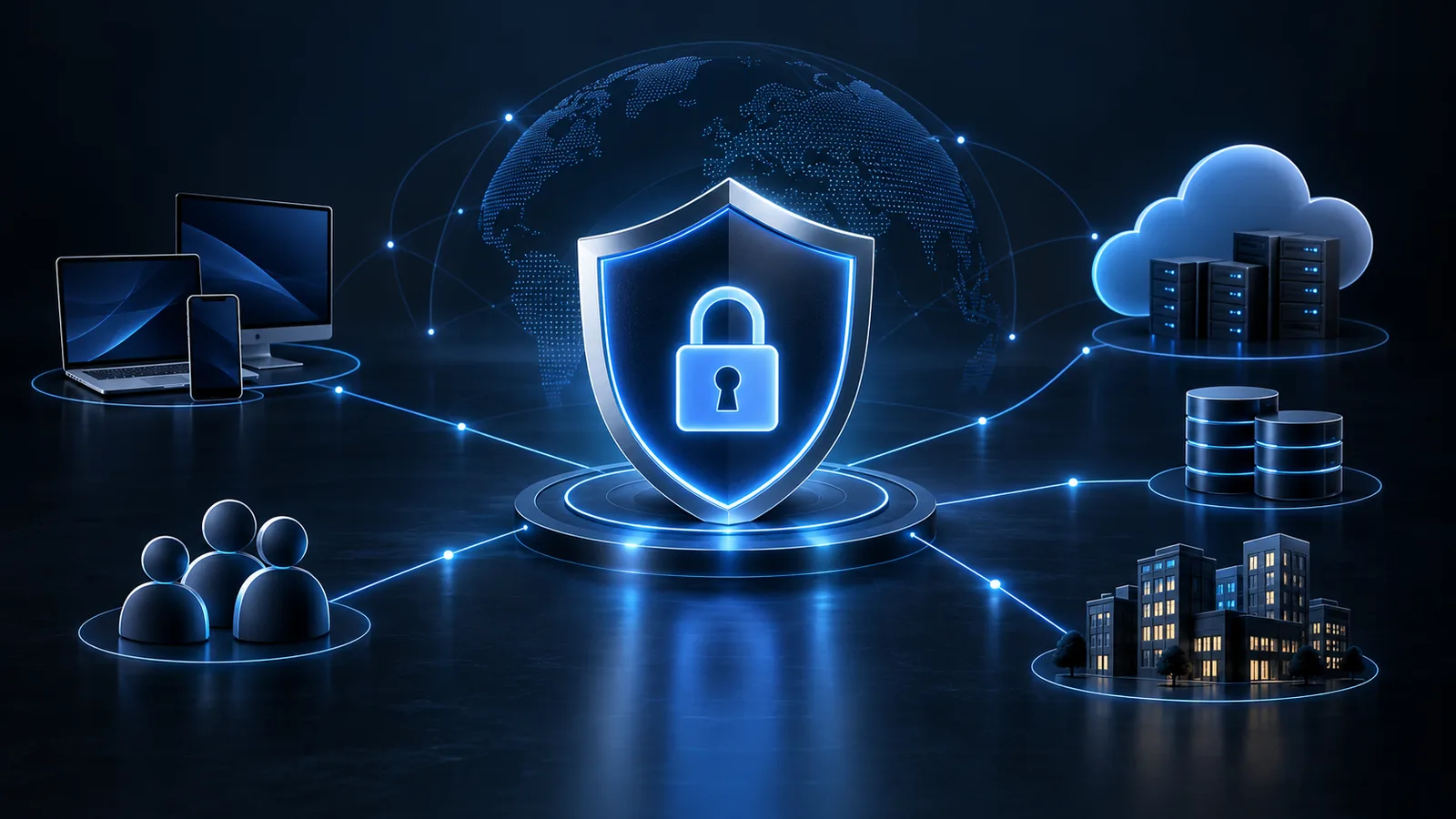
Cybersecurity is the practice of managing risks to digital systems, networks, applications, devices and data. It combines technology, processes, governance and people to help organizations prevent security incidents, detect suspicious activity, respond effectively and recover when incidents occur.
Cybersecurity is therefore much broader than stopping hackers or installing antivirus software. For a practical view of the functions, responsibilities and careers behind this discipline, see our roles and responsibilities guide.
A modern cybersecurity program addresses questions such as:
- What digital assets and data do we depend on?
- What threats and vulnerabilities could affect them?
- Who should have access?
- Which safeguards should be implemented?
- How will suspicious activity be detected?
- What happens when the organization needs to respond to an incident?
- How will critical services recover?
- Who is accountable for cyber risk?
Modern frameworks such as the NIST CSF 2.0 treat cybersecurity as an enterprise risk-management discipline rather than a purely technical responsibility. For organizations prioritizing a practical baseline, CISA Cross-Sector Performance Goals provide a complementary set of high-impact actions aligned with the NIST CSF functions.
This guide explains what cybersecurity is, how it works, the major types of cybersecurity, common threats, the role of Zero Trust and AI, and how organizations can build a practical cybersecurity strategy.
What Is Cybersecurity?
Cybersecurity refers to the practices, technologies and processes used to manage risks affecting digital information and technology.
The assets being protected can include:
- Networks
- Servers
- Cloud platforms
- Applications
- Endpoints
- Mobile devices
- Identities
- Data
- Operational technology
- Internet of Things devices
The objective is not to make cyber risk disappear completely.
However, no organization can eliminate every threat, vulnerability or failure.
Therefore, a more realistic objective is to understand risk, prioritize it appropriately, implement safeguards, detect problems, limit impact and recover effectively.
What Is Cybersecurity and Why Is It Important?
Modern organizations depend on digital technology for almost every major business process.
Technology supports:
- Customer interactions
- Payments
- Communications
- Supply chains
- Product development
- Employee collaboration
- Cloud services
- Business operations
- Critical infrastructure
At the same time, this dependence creates value, but it also creates exposure.
A cybersecurity incident can potentially affect:
- Data confidentiality
- System integrity
- Service availability
- Business operations
- Customer trust
- Financial performance
- Regulatory obligations
- Reputation
Cybersecurity is therefore both a technology concern and a business-risk concern.
The Three Fundamental Security Objectives: CIA Triad
A classic cybersecurity model is the CIA triad.
CIA represents:
Confidentiality → Integrity → Availability
Confidentiality
This security objective means information should be accessible only to authorized people, systems or processes.
Controls that can support confidentiality include:
- Access control
- Encryption
- Authentication
- Data classification
- Least privilege
Integrity
Integrity means information and systems should not be changed improperly or without authorization.
Therefore, organizations need confidence that data remains accurate and trustworthy.
Availability
Availability means authorized users should be able to access systems and information when required.
This requires attention to:
- Resilience
- Redundancy
- Backup
- Recovery
- Capacity
- Incident response
In addition, cybersecurity decisions frequently involve balancing all three objectives.
What Is Cybersecurity and How Does It Work?
Cybersecurity works through multiple layers of controls rather than one defensive technology.
A simplified model is:
Govern → Understand Risk → Protect → Monitor → Respond → Recover → Improve
For example, protecting a business application might involve:
- Understanding its business importance
- Identifying sensitive data
- Controlling user access
- Securing the application
- Protecting the network
- Monitoring suspicious activity
- Managing vulnerabilities
- Maintaining backups
- Preparing an incident-response plan
- Testing recovery
However, no single control provides complete protection.
Therefore, cybersecurity relies on layers of complementary safeguards.
The NIST Cybersecurity Framework 2.0
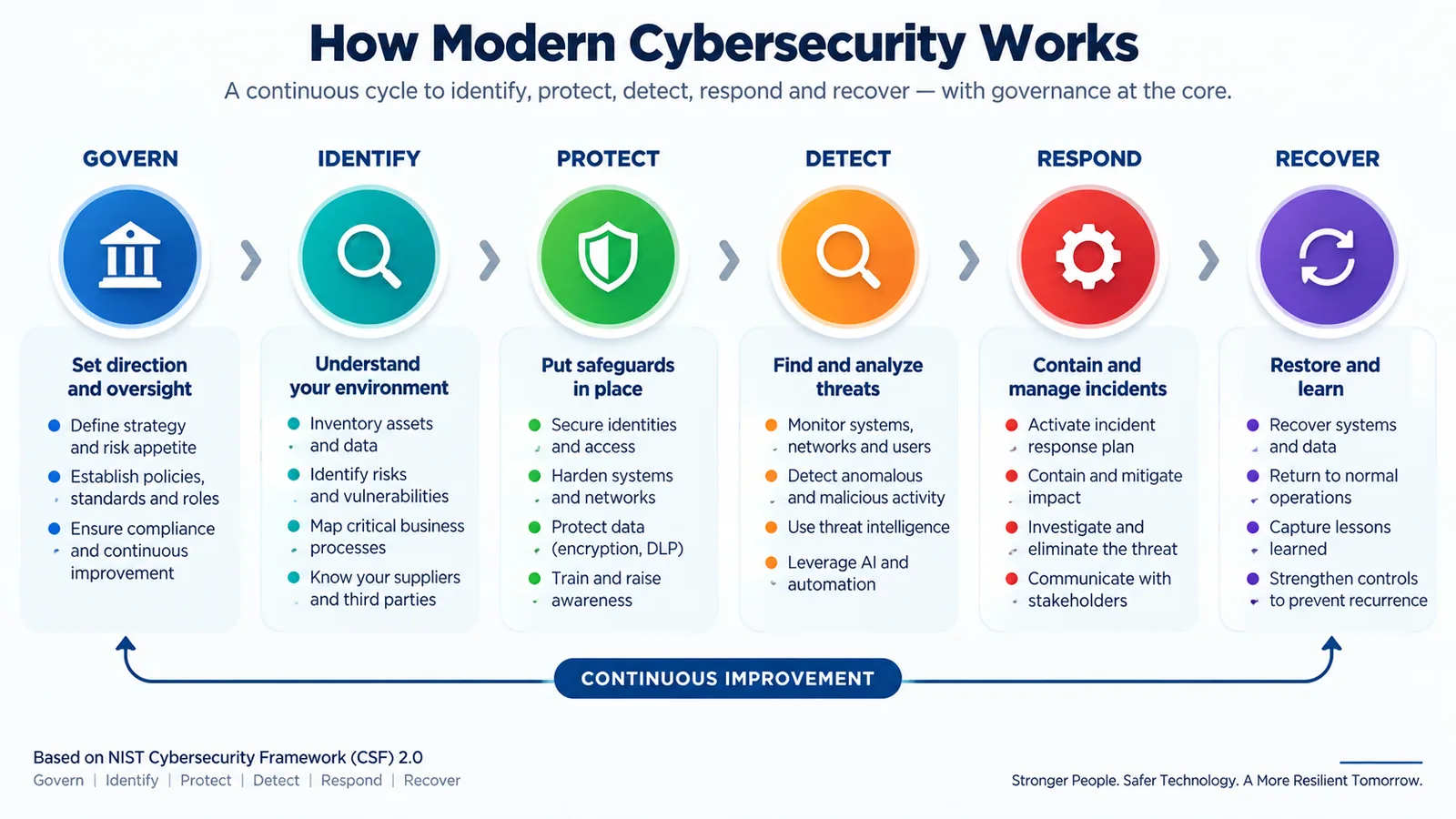
One useful way to understand a modern cybersecurity program is through the NIST Cybersecurity Framework (CSF) 2.0.
CSF 2.0 organizes cybersecurity outcomes around six Functions:
Govern → Identify → Protect → Detect → Respond → Recover
Overall, these Functions provide a high-level view of cybersecurity risk management.
1. Govern
Govern addresses how cybersecurity risk is directed and managed across the organization.
This can include:
- Cybersecurity strategy
- Roles and responsibilities
- Policies
- Risk-management expectations
- Oversight
- Supply-chain risk
- Legal and regulatory considerations
More importantly, the Govern function aligns cybersecurity with broader enterprise risk management rather than isolating it inside the IT department.
2. Identify
Identify focuses on understanding the organization’s current cybersecurity risks.
This can include understanding:
- Hardware
- Software
- Data
- Services
- People
- Suppliers
- Vulnerabilities
- Threats
- Dependencies
Therefore, an organization cannot effectively protect assets it does not know exist.
3. Protect
Protect covers safeguards used to manage cybersecurity risk.
Examples can include:
- Identity management
- Authentication
- Access control
- Data protection
- Platform security
- Security awareness
- Technology resilience
4. Detect
Detect focuses on finding and analyzing possible cybersecurity events.
Controls can include:
- Security monitoring
- Log analysis
- Endpoint detection
- Network monitoring
- Alerting
- Anomaly detection
However, protection is never perfect, which makes detection essential.
5. Respond
Respond covers actions taken after a cybersecurity incident is detected.
Activities may include:
- Incident management
- Investigation
- Containment
- Communication
- Mitigation
- Coordination
6. Recover
Recover addresses restoration of systems, services and operations affected by cybersecurity incidents.
Recovery can involve:
- Restoring systems
- Recovering data
- Rebuilding services
- Communicating with stakeholders
- Applying lessons learned
Overall, the six Functions should not be interpreted as a simple one-time sequence. Cybersecurity risk management is continuous.
The Main Types of Cybersecurity
Cybersecurity includes several overlapping disciplines.
1. Network Security
Network security protects communications, network infrastructure and connected resources.
Technologies and practices can include:
- Firewalls
- Network segmentation
- Secure routing
- VPNs
- Intrusion detection and prevention
- Network access control
- Secure DNS
- Traffic monitoring
Modern network security increasingly overlaps with Zero Trust and SASE architectures. For a practical access-security comparison, see our VPN vs SASE guide.
2. Application Security
Application security focuses on reducing security risks in software.
It can include:
- Secure development practices
- Code review
- Dependency management
- Security testing
- Authentication and authorization
- API security
- Vulnerability management
Security should ideally be considered throughout the software lifecycle rather than added only before release. The OWASP Top 10:2025 provides a current awareness reference for major web-application security risks and secure-development priorities.
3. Cloud Security
In addition, cloud security protects data, workloads, identities, applications and infrastructure hosted in cloud environments.
Cloud environments introduce considerations such as:
- Identity configuration
- Permissions
- Cloud misconfiguration
- Data exposure
- Workload protection
- API security
- Logging
- Shared responsibility
4. Endpoint Security
Endpoints include devices such as:
- Laptops
- Desktops
- Mobile devices
- Servers
- Workstations
Endpoint security may include:
- Endpoint protection
- Detection and response
- Patch management
- Device encryption
- Configuration management
- Application controls
5. Identity and Access Management
As a result, identity has become one of the most important security control points in distributed environments.
Identity and Access Management (IAM) addresses:
- Authentication
- Authorization
- Account lifecycle
- Privileged access
- Multi-factor authentication
- Federation
- Single sign-on
A central principle is least privilege: users and systems should receive only the access necessary for their legitimate functions.
6. Data Security
Data security focuses on protecting information throughout its lifecycle.
Controls can include:
- Classification
- Encryption
- Access control
- Backup
- Retention policies
- Data Loss Prevention
- Secure deletion
7. Operational Technology Security
Operational Technology, or OT, includes systems that monitor or control physical processes.
Examples can exist in:
- Manufacturing
- Energy
- Transportation
- Utilities
- Industrial environments
In addition, OT cybersecurity must consider not only information security but also operational reliability and safety.
8. IoT Security
Internet of Things devices can introduce security risks because they may be widely distributed, difficult to patch or deployed for long periods. For the broader technology model, see our Internet of Things guide.
Security considerations include:
- Device identity
- Authentication
- Secure configuration
- Firmware updates
- Network segmentation
- Lifecycle management
9. Security Operations
Security operations focuses on monitoring, detecting, investigating and responding to cybersecurity events.
A Security Operations Center, or SOC, may use technologies such as:
- SIEM
- Endpoint detection and response
- Network telemetry
- Threat intelligence
- Security automation
However, tools alone are not sufficient. Effective security operations also require processes, skills and clear escalation paths.
Common Cybersecurity Threats
A threat is something capable of causing harm to systems, information or operations.
Threats change over time; however, several categories remain particularly important.
Phishing and Social Engineering
Social engineering attempts to manipulate people into taking actions that create security risk.
For example, this might involve deceptive messages, fake login pages or impersonation.
At the same time, technical controls can help, but user awareness, authentication and verification processes also matter.
Credential Compromise
Attackers may attempt to obtain or misuse usernames, passwords, authentication tokens or other credentials.
Organizations can reduce risk through:
- Multi-factor authentication
- Strong identity controls
- Privileged-access management
- Credential monitoring
- Least privilege
Malware
For example, malware is malicious software designed to perform unauthorized or harmful actions.
Therefore, organizations use layered controls such as endpoint protection, application controls, patching, segmentation and monitoring to reduce malware risk.
Ransomware
Ransomware incidents can disrupt access to systems or data and may be accompanied by data theft or extortion.
However, resilience against ransomware involves more than malware detection.
Organizations should consider:
- Identity security
- Network segmentation
- Vulnerability management
- Monitoring
- Incident response
- Protected backups
- Recovery testing
Software Vulnerabilities
Vulnerabilities are weaknesses that may create security exposure.
Vulnerability management typically involves:
- Asset discovery
- Scanning
- Risk assessment
- Prioritization
- Patching or mitigation
- Verification
However, not every vulnerability represents the same level of risk.
Cloud Misconfiguration
Incidents can result from poorly configured:
- Storage
- Permissions
- Network controls
- Identity policies
- APIs
- Logging
Cloud security therefore requires strong configuration and identity governance.
Supply-Chain Risk
Organizations depend on:
- Software suppliers
- Cloud providers
- Managed services
- Hardware vendors
- Open-source components
- Business partners
As a result, a weakness in one supplier can potentially create risk for many customers.
Therefore, this is one reason CSF 2.0 gives cybersecurity supply-chain risk greater visibility within governance.
Insider Risk
In addition, cybersecurity incidents can also involve people who already have legitimate access.
For example, insider risk can be intentional or accidental.
Therefore, controls such as least privilege, segregation of duties, monitoring and good access lifecycle management can help reduce exposure.
Internet-Facing Systems
Systems directly reachable from the internet require particular attention to:
- Secure configuration
- Authentication
- Patch management
- Monitoring
- Exposure management
Threat, Vulnerability and Risk: What Is the Difference?
However, these terms are related but should not be used interchangeably.
Threat
A threat is something that can potentially cause harm.
Vulnerability
A vulnerability is a weakness that can potentially be exploited or otherwise contribute to harm.
Risk
Risk considers the potential impact and likelihood or conditions associated with an unwanted event.
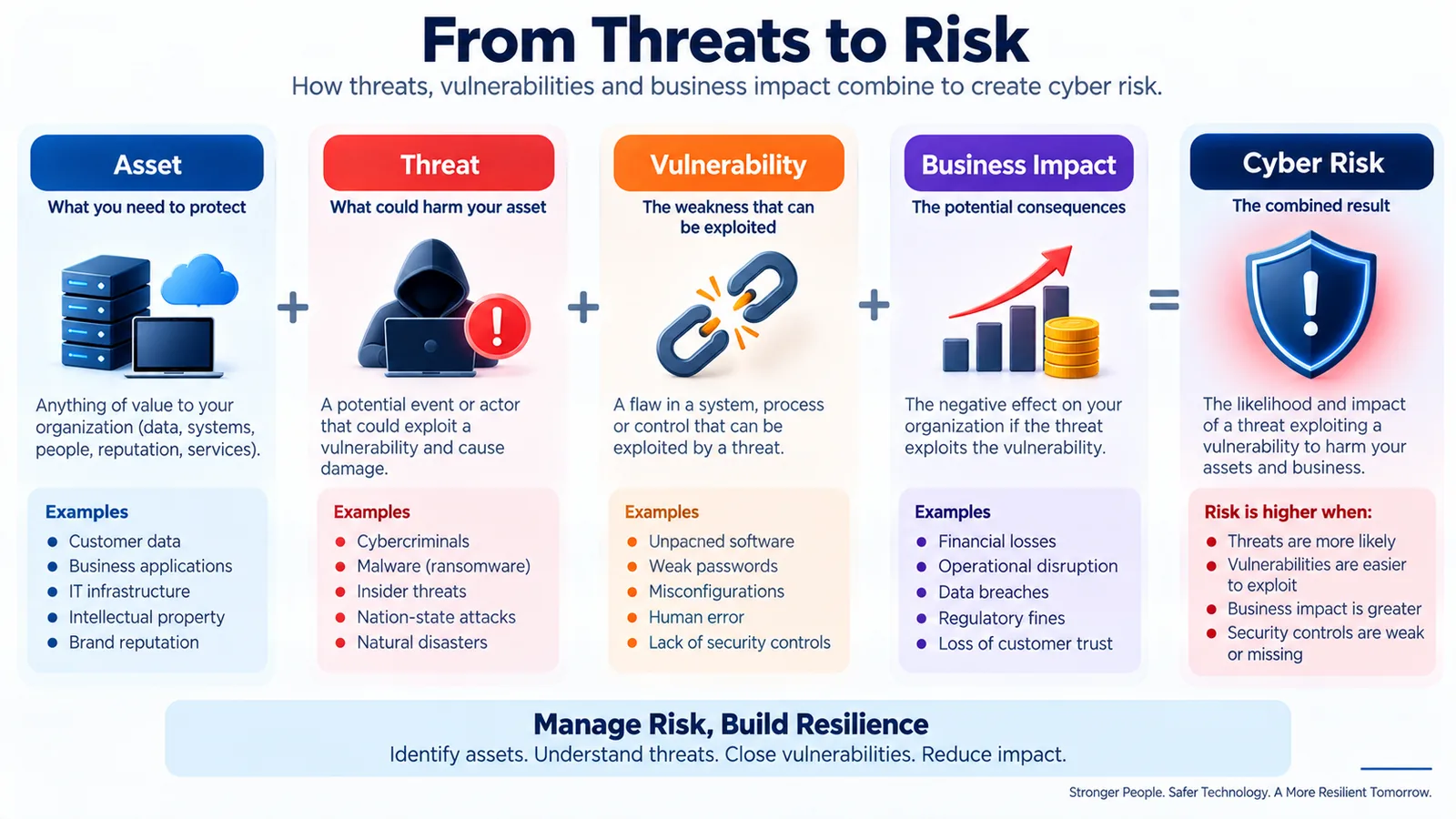
A simplified model is:
Assets + Threats + Vulnerabilities + Business Impact → Cyber Risk
Real risk analysis is more nuanced; however, this model helps explain why finding vulnerabilities is not the same thing as managing cybersecurity risk.
What Is a Cybersecurity Control?
A cybersecurity control is a safeguard or measure used to manage risk.
Controls can be:
Preventive
Designed to reduce the chance of an unwanted event.
Examples include access controls and secure configuration.
Detective
Designed to identify suspicious activity or security events.
Examples include monitoring and alerting.
Responsive
Designed to contain or manage incidents.
Recovery-Oriented
Designed to restore services or data following disruption.
Therefore, a mature security architecture uses multiple control types rather than relying entirely on prevention.
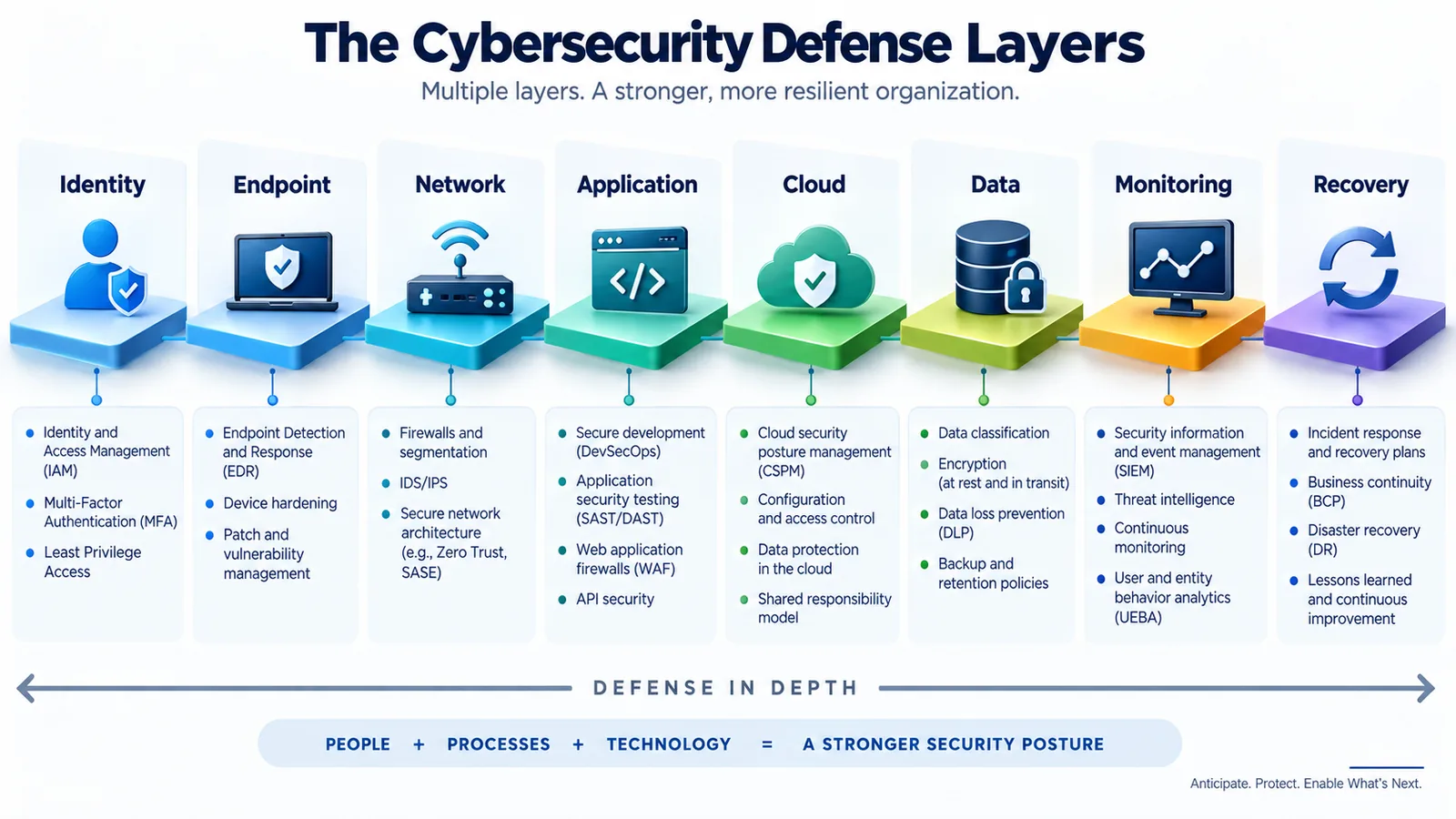
What Is Defense in Depth?
Defense in depth means using multiple complementary security controls so the failure of one safeguard does not automatically result in complete compromise.
For example:
Identity → Endpoint → Network → Application → Data → Monitoring → Recovery
As a result, if one layer fails, other controls can still reduce risk or help detect and contain the problem.
Cybersecurity and Zero Trust
Traditional security models often placed significant emphasis on the boundary between an internal network and the internet.
Modern environments are more distributed.
Users work remotely.
Applications run in multiple clouds.
In addition, devices connect through networks the organization may not control.
Therefore, Zero Trust addresses this reality by avoiding implicit trust based solely on network location.
Access decisions can instead consider:
- Identity
- Device
- Resource
- Authorization
- Context
- Risk
Zero Trust does not mean trusting nobody.
In other words, trust should not be assumed simply because something is connected to an internal network.
Cybersecurity and SASE
Secure Access Service Edge, or SASE, addresses the convergence of networking and security for distributed users, sites and applications.
SASE can combine capabilities associated with:
- SD-WAN
- Zero Trust Network Access
- Secure Web Gateway
- Cloud Access Security Broker
- Firewall services
However, SASE is not identical to Zero Trust, and it is not the entirety of cybersecurity.
Specifically, it addresses the architectural problem of securely connecting distributed users and locations to distributed applications.
Read our complete guide to Secure Access Service Edge for the detailed architecture, or compare the networking and security roles directly in our SD-WAN vs SASE comparison.
Cybersecurity and DevSecOps
Meanwhile, modern software teams increasingly integrate security into development and operations rather than treating security as a final approval step.
This approach is commonly associated with DevSecOps.
Practices can include:
- Security requirements
- Automated security testing
- Dependency scanning
- Infrastructure-as-code checks
- Secrets management
- Container security
- Continuous monitoring
However, DevSecOps does not replace cybersecurity. Our DevSecOps and security guide explains how the practices fit together.
It applies security practices more directly within software delivery and operations. For a practical comparison of the two approaches, see our DevOps vs DevSecOps guide.
Cybersecurity and AI
At the same time, artificial intelligence is affecting cybersecurity from both defensive and risk-management perspectives.
Security teams can use AI-assisted capabilities for areas such as:
- Alert analysis
- Anomaly detection
- Threat investigation
- Event correlation
- Security operations
- Knowledge retrieval
At the same time, organizations adopting AI systems must consider new security and governance questions around:
- Data
- Access
- Models
- Applications
- Third-party AI services
- Human oversight
AI should therefore be treated as both a cybersecurity capability and an area requiring cybersecurity controls. Our guide to AI security use cases explores those use cases, risks and governance considerations in more depth.
Cybersecurity vs Information Security
Although cybersecurity and information security overlap significantly, they are not always identical.
Information security focuses broadly on protecting information regardless of format.
Cybersecurity focuses particularly on risks involving digital systems, networks, technologies and information.
In practice, many organizations use the terms in overlapping ways.
Cybersecurity vs Network Security
In particular, network security is one part of cybersecurity.
Cybersecurity also includes:
- Applications
- Endpoints
- Identity
- Cloud
- Data
- Incident response
- Governance
- Recovery
Therefore:
Network Security ⊂ Cybersecurity
Cybersecurity vs IT Security
Similarly, IT security generally focuses on protecting information-technology environments.
Cybersecurity can extend into areas such as:
- Cloud
- IoT
- OT
- Digital supply chains
- Connected products
Therefore, the boundaries between the terms depend on organizational context.
What Is Cybersecurity? Best Practices for Managing Risk
No universal checklist can eliminate cyber risk; however, several practices form a strong foundation.
1. Know Your Assets
Maintain visibility into hardware, software, cloud services, applications, data and identities.
2. Prioritize Risk
Do not treat every asset or vulnerability as equally important.
Therefore, prioritize according to business impact and actual exposure.
3. Strengthen Identity
Use strong authentication and appropriate access controls.
In addition, apply least privilege and carefully manage privileged accounts.
4. Keep Systems Securely Configured
Reduce unnecessary services, permissions and exposure.
5. Manage Vulnerabilities
Identify, prioritize and remediate or mitigate vulnerabilities according to risk.
6. Protect Data
Understand where sensitive data exists and apply appropriate controls throughout its lifecycle.
7. Monitor the Environment
Collect useful security telemetry and establish processes for identifying suspicious activity.
8. Prepare for Incidents
Define responsibilities, communication paths and response procedures before an incident occurs.
9. Maintain Resilient Backups
Moreover, backups should be appropriately protected and recovery should be tested.
10. Train People
Security awareness should help employees recognize relevant risks and understand expected behaviors.
11. Manage Third-Party Risk
Understand important suppliers, services and dependencies.
12. Test and Improve
Cybersecurity is not a one-time implementation.
Therefore, organizations should continuously evaluate controls, incidents, technology changes and evolving risks.
Why Multi-Factor Authentication Matters in Cybersecurity
Passwords alone can create significant exposure if they are stolen or reused.
Multi-factor authentication adds another authentication factor.
However, MFA is not perfect and does not replace broader identity security, but it can significantly strengthen account protection when appropriately implemented.
Why Patch Management Matters in Cybersecurity
Security updates address known weaknesses in software and systems.
However, effective patch management requires more than automatically installing every update immediately.
Organizations should understand:
- Which assets are affected
- How exposed they are
- The severity of the vulnerability
- Whether exploitation is occurring
- Operational impact of the update
- Available mitigations
Risk-based prioritization is important.
Why Backups Are a Cybersecurity Control
In addition, backups are often considered an IT operations responsibility, but they are also important to cyber resilience.
A useful backup strategy considers:
- What must be backed up
- How frequently
- Where backups are stored
- Who can access them
- How they are protected
- How quickly they can be restored
- Whether restoration has been tested
A backup that cannot be successfully restored provides limited resilience.
Cybersecurity Incident Response
However, organizations should assume that prevention will sometimes fail.
Therefore, incident response prepares the organization to manage that reality.
A response capability typically needs to address:
- Detection
- Analysis
- Prioritization
- Containment
- Communication
- Mitigation
- Recovery coordination
- Lessons learned
Responsibilities should be established before an incident occurs.
Cyber Resilience and Recovery
Cyber resilience focuses on an organization’s ability to continue or restore important operations despite cybersecurity disruption.
This can require:
- Redundant systems
- Protected backups
- Recovery plans
- Business continuity
- Disaster recovery
- Alternative communications
- Exercises
Recovery is therefore part of cybersecurity—not something that begins only after the security team’s work is finished.
How to Build a Cybersecurity Strategy
Step 1: Understand Business Priorities
Identify critical business processes, services and outcomes.
Step 2: Identify Critical Assets
Determine which systems, data, applications, identities and suppliers support those outcomes.
Step 3: Assess Cyber Risk
Understand threats, vulnerabilities, dependencies and potential business impact.
Step 4: Define Risk Priorities
Determine which risks require immediate treatment and which can be managed differently.
Step 5: Establish Governance
Define:
- Responsibilities
- Decision rights
- Policies
- Risk ownership
- Oversight
Step 6: Implement Appropriate Controls
Select controls based on risk rather than simply buying more security tools.
Step 7: Build Detection and Response
Prepare for controls to fail.
Step 8: Strengthen Recovery
Ensure critical operations can be restored.
Step 9: Measure
Use meaningful metrics to understand whether cyber risk is being managed effectively.
Step 10: Continuously Improve
Update the strategy as:
- Technology changes
- Threats change
- Business priorities change
- New suppliers are introduced
- Incidents reveal weaknesses
15-Minute Cybersecurity Risk Triage
Use this short review to turn a broad cybersecurity discussion into one prioritized action. Choose one important business service, application or data set and work through the following questions with the relevant business and technology owners.
- Define what matters. What business outcome, service or information are you protecting, and what would meaningful disruption look like?
- Identify the most important current risk. Consider exposure, vulnerabilities, identity, configuration, dependencies and potential business impact rather than listing every possible threat.
- Check the control coverage. What preventive, detective, response and recovery controls already exist, and where is the most important gap?
- Confirm ownership. Name the person or team responsible for the risk, the control improvement and any decision that requires escalation.
- Require evidence. Define one observable signal that will show whether the action improved risk management, such as control coverage, remediation time, detection capability or recovery readiness.
Finish with one decision: ACT NOW / PLAN IMPROVEMENT / INVESTIGATE FURTHER / ACCEPT OR ESCALATE RISK. Record the owner, next action and review date so the discussion produces a measurable follow-up rather than another general security checklist.
Cybersecurity Metrics That Matter
In particular, security programs should avoid relying only on activity metrics such as the number of alerts generated.
Useful measurements can include:
- Critical asset coverage
- Identity-control coverage
- Vulnerability remediation performance
- Detection capability
- Incident-response performance
- Recovery readiness
- Security-control effectiveness
- Third-party risk coverage
Ultimately, metrics should help decision-makers understand risk, not simply demonstrate that the security team is busy.
Common Cybersecurity Mistakes
Buying Tools Without a Risk Strategy
However, more security products do not automatically create better security.
Focusing Only on Prevention
In addition, organizations also need detection, response and recovery.
Assuming the Internal Network Is Trusted
Therefore, network location alone is an insufficient basis for modern access decisions.
Ignoring Identity
However, strong network security cannot compensate for uncontrolled privileged access.
Ignoring People and Processes
Likewise, technology cannot compensate for unclear responsibilities or ineffective processes.
Treating Compliance as Security
Compliance requirements can support cybersecurity, but passing an audit does not prove that all meaningful risks are controlled.
Ignoring Recovery
However, security incidents can still occur despite strong preventive controls.
Trying to Eliminate All Risk
Ultimately, the objective is risk management, not an unrealistic promise of zero risk.
Cybersecurity for Small Businesses
For example, small organizations may not need the same security architecture as a global enterprise.
But they still benefit from fundamentals such as:
- Asset awareness
- Strong authentication
- Secure configuration
- Software updates
- Backups
- Access control
- Security awareness
- Incident planning
NIST CSF 2.0 is intentionally designed to be applicable to organizations regardless of size or sector.
Cybersecurity for Enterprises
By contrast, large organizations face additional complexity from:
- Thousands of identities
- Multiple clouds
- Large application portfolios
- Global networks
- Third parties
- Legacy technology
- Regulatory requirements
- Mergers and acquisitions
Enterprise cybersecurity therefore requires strong governance, architecture, automation and coordination across technology and business teams.
Cybersecurity Careers
Cybersecurity includes many different roles rather than one universal “cybersecurity job.”
Examples include:
- Security analyst
- Cybersecurity engineer
- Security architect
- Cloud security engineer
- Application security specialist
- Identity specialist
- Security operations analyst
- Incident responder
- Governance, risk and compliance specialist
- Security leader
In addition, some roles are highly technical, while others focus more on governance, risk, architecture or business coordination.
The Future of Cybersecurity
Overall, cybersecurity will continue to evolve alongside technology.
Several areas are particularly important.
Identity-Centric Security
As users and applications become more distributed, identity and authorization will remain central security controls.
Zero Trust
Organizations will continue moving away from assumptions based purely on network location.
Cloud and SaaS Security
Security architectures must increasingly protect resources outside traditional data centers.
AI
AI will increasingly influence both security operations and the systems security teams need to protect.
Automation
Automation can help organizations handle growing scale, but automated security actions still require appropriate governance.
Software Supply Chains
Organizations will continue paying greater attention to dependencies, suppliers and software provenance.
Cyber Resilience
The emphasis will increasingly extend beyond preventing incidents toward maintaining and restoring important business capabilities.
Frequently Asked Questions About Cybersecurity
What is cybersecurity in simple terms?
Cybersecurity is the practice of managing risks to digital systems, networks, devices, applications and data. It combines prevention, detection, response, recovery and governance.
What are the main types of cybersecurity?
Major areas include network security, application security, cloud security, endpoint security, identity and access management, data security, IoT security, OT security and security operations.
What are the six NIST Cybersecurity Framework functions?
NIST CSF 2.0 uses six Functions: Govern, Identify, Protect, Detect, Respond and Recover.
What is the difference between cybersecurity and network security?
Network security protects networks and communications. Cybersecurity is broader and also covers applications, identities, endpoints, cloud environments, data, governance, incident response and recovery.
What is Zero Trust?
Zero Trust is a cybersecurity architecture that avoids granting implicit trust based solely on network location. Access decisions consider resources, identities and relevant context.
Is cybersecurity only about hackers?
No. Cybersecurity also addresses accidental errors, misconfiguration, software vulnerabilities, insider risk, supply-chain risk, operational failures and recovery from incidents.
Can cybersecurity prevent every attack?
No security program can guarantee prevention of every incident. Effective cybersecurity combines prevention with detection, response, resilience and recovery.
Is cloud computing less secure than on-premises IT?
Neither model is automatically more secure. Security depends on architecture, configuration, identity controls, responsibilities, monitoring and operations.
Is AI replacing cybersecurity professionals?
AI can automate or assist selected security activities, but cybersecurity still requires human judgment, architecture, governance, risk decisions and accountability.
Why is cybersecurity a business issue?
Cyber incidents can affect operations, customers, revenue, data, legal obligations and reputation. Cyber risk therefore needs to be considered alongside other enterprise risks.
What is the first step in cybersecurity?
A strong starting point is understanding the organization’s important business processes, assets, data, identities and dependencies so risks can be prioritized appropriately.
Conclusion
Cybersecurity is ultimately the discipline of managing digital risk.
It is not one technology, one department or one security product.
Effective cybersecurity combines:
Governance → Risk Understanding → Protection → Detection → Response → Recovery → Continuous Improvement
Organizations need to understand what matters, determine what could affect it, implement appropriate safeguards, monitor for problems and prepare to recover when prevention fails.
The NIST Cybersecurity Framework 2.0 provides a useful way to organize that thinking through six Functions:
Govern → Identify → Protect → Detect → Respond → Recover.
Modern cybersecurity must also adapt to a world of cloud computing, remote work, SaaS, AI, IoT, distributed applications and complex supply chains.
That means the traditional idea of protecting only a corporate network perimeter is no longer enough.
Identity, data, applications, cloud platforms, endpoints, networks and third parties all form part of the security architecture.
The goal should not be to promise perfect security.
The goal is to understand and manage risk well enough that the organization can continue achieving its objectives—even as technology and threats evolve.
Continue Learning
Continue exploring the TechTeamSynergy cybersecurity cluster with these related guides:
Comments are closed.