

AI in cybersecurity uses artificial intelligence and machine learning to help security teams analyze data, identify suspicious activity, prioritize risks, investigate incidents and automate selected security operations.
Its greatest advantage is not replacing cybersecurity professionals. AI helps people work with the enormous volume of security information generated by modern networks, endpoints, identities, applications, cloud platforms and connected services.
However, the relationship works in both directions. Organizations can use AI to strengthen cyber defense, but they must also protect AI models, applications, data, APIs, infrastructure and autonomous agents. This guide explains both sides, including practical use cases, benefits, limitations, emerging generative and agentic AI risks, governance and responsible adoption.
For the broader foundation, read our complete guide to cybersecurity. Organizations can also use the NIST Cybersecurity Framework, the OWASP GenAI Security Project and MITRE ATLAS as authoritative starting points.
What Is AI in Cybersecurity?
AI in cybersecurity refers to the application of artificial intelligence techniques to security activities. Depending on the solution, these techniques may include machine learning, statistical modeling, anomaly detection, classification, clustering, natural language processing, generative AI and recommendation systems.
These capabilities can process information that would otherwise require substantial manual effort. Examples include analyzing security alerts, identifying unusual behavior, summarizing incident evidence, correlating events and prioritizing vulnerabilities according to business context.
AI should not be confused with complete security automation. A model produces predictions, classifications, rankings, recommendations or generated content based on its design and available data. Its output must still operate within access controls, policies, validation processes and human accountability.
AI for Cybersecurity vs Security for AI
A complete enterprise strategy must answer two complementary questions:
- AI for cybersecurity: How can AI improve detection, prioritization, investigation and response?
- Security for AI: How should organizations protect AI applications, models, data, infrastructure, interfaces and agents?
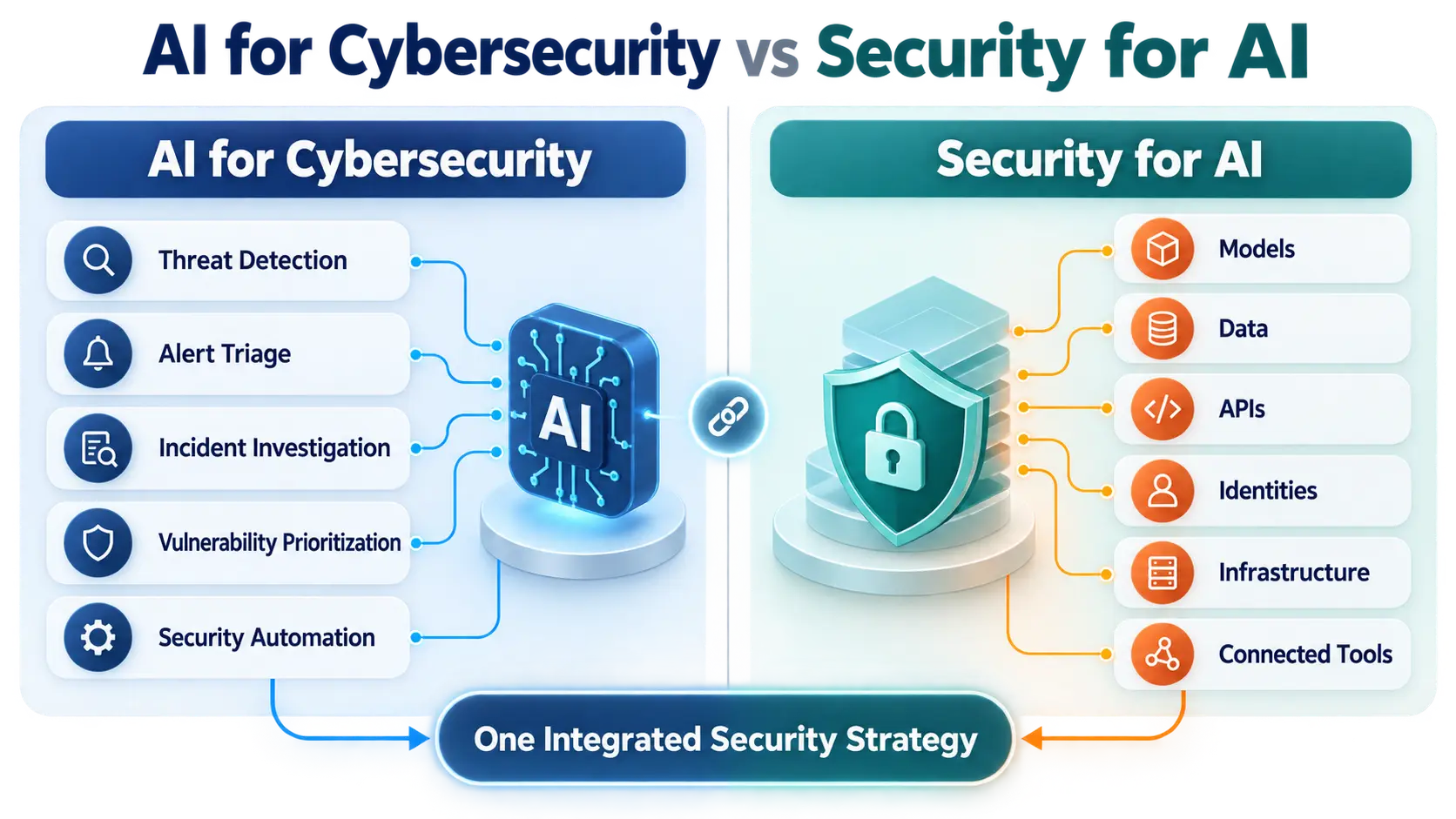
Treating only one side leaves a significant gap. An organization may deploy excellent AI-assisted detection while exposing sensitive data through an inadequately secured model. Conversely, it may protect its AI platform while failing to use analytical capabilities that could improve security operations. The strongest approach integrates both dimensions.
Why Is AI Becoming Important in Cybersecurity?
Modern organizations operate across hybrid networks, cloud platforms, SaaS services, endpoints, identities, APIs and third-party ecosystems. These environments generate more telemetry than analysts can review manually. The challenge is not simply collecting data; it is determining what matters, what looks suspicious and what requires immediate investigation.
AI can help identify patterns, rank signals and organize evidence at scale. It is particularly useful when it reduces repetitive analysis and gives specialists more time for investigation, architecture, threat hunting and business-risk decisions.
How Is AI Used in Cybersecurity?
AI supports multiple security functions rather than one isolated product category. The following table summarizes the most common applications and the controls they still require.
| Use case | AI contribution | Human responsibility | Primary risk |
|---|---|---|---|
| Threat detection | Identify unusual patterns | Validate context | False positives or negatives |
| Alert triage | Rank and group alerts | Confirm priority | Incorrect scoring |
| Incident investigation | Summarize evidence and timelines | Verify conclusions | Unsupported output |
| Vulnerability management | Prioritize remediation | Accept business risk | Missing context |
| Identity security | Estimate contextual risk | Define access policy | Improper access decisions |
| Security automation | Recommend or trigger workflows | Authorize critical actions | Excessive autonomy |
1. Threat and Anomaly Detection
Traditional detection uses rules, signatures and known indicators. These techniques remain essential. Machine learning complements them by identifying patterns or deviations that may deserve investigation across authentication activity, network traffic, endpoint behavior, application events and cloud activity.
An anomaly is not automatically an attack. Legitimate business behavior can also appear unusual, which is why contextual analysis, appropriate thresholds and analyst review remain necessary.
2. Security Operations and Alert Triage
A Security Operations Center may receive thousands of events and alerts. AI-assisted capabilities can group related events, enrich signals, prioritize investigations, search security data, summarize incident timelines and retrieve relevant procedures.
For example, instead of presenting hundreds of isolated alerts, a platform may correlate identity, endpoint and network events into a smaller number of potential incidents. Analysts can then validate the evidence and determine the appropriate response.
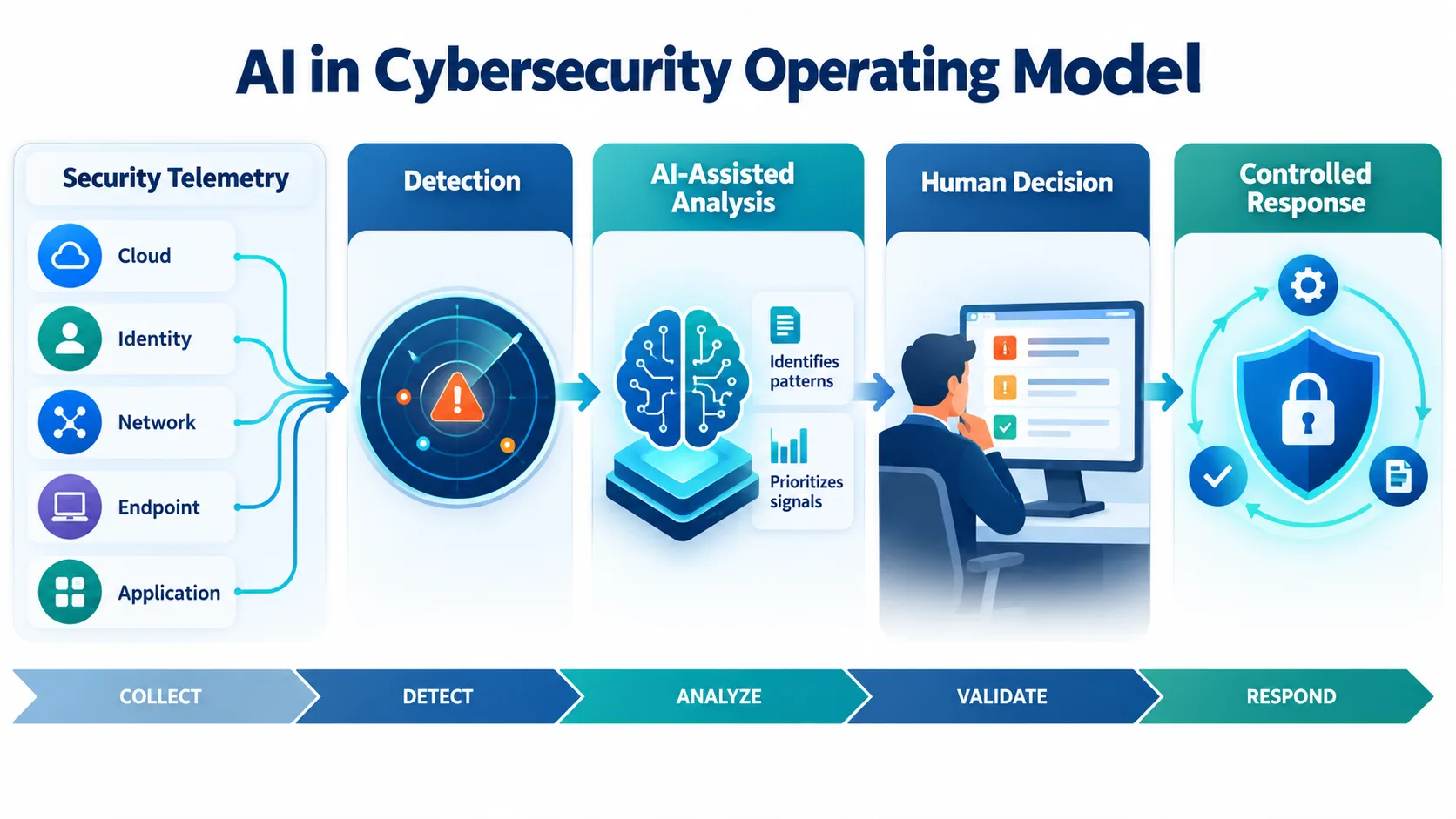
The operating principle is simple: collect → detect → analyze → validate → respond. AI improves speed and scale, but high-impact actions should remain governed by defined authorization and escalation rules. Our guide to cybersecurity roles and responsibilities explains how analysts and other specialists fit into the broader organization.
3. Incident Investigation
Security investigations require analysts to collect evidence from multiple systems. AI assistants can help search large datasets, organize observations, explain unfamiliar alerts, build timelines and draft incident summaries. Generative AI makes this information accessible through natural-language interaction.
Generated explanations must be verified against trusted evidence. A confident answer is not automatically correct, and summaries should never replace the original logs, forensic evidence or analyst judgment.
4. Vulnerability Prioritization
Organizations often discover more vulnerabilities than teams can remediate immediately. Analytical models can combine severity, exploitability, asset importance, exposure, compensating controls, threat intelligence and business context to support risk-based prioritization.
The purpose is not to ignore every low-scoring weakness. It is to help limited remediation resources focus on the exposures most likely to create meaningful business impact.
5. Identity and Access Security
AI-assisted identity systems can analyze authentication patterns, device posture, resource sensitivity, user behavior and previous access activity. These signals may support adaptive authentication or risk-based access decisions.
AI does not replace strong authentication, least privilege, privileged-access management, authorization or access lifecycle governance. It contributes another source of context to these established controls.
6. Network, Endpoint and Cloud Security
Machine learning can identify suspicious patterns across network communications, device processes, cloud activity and configuration data. Potential applications include traffic analytics, behavioral detection, workload monitoring, configuration prioritization and event correlation.
These capabilities complement rather than replace secure architecture, segmentation, endpoint protection, identity governance, logging and vulnerability management. AI can also support analytics within Secure Access Service Edge environments, although AI is not what defines SASE. Read our complete SASE guide for the architectural foundation.
7. AI and SOAR
Security Orchestration, Automation and Response platforms use governed workflows to coordinate response activities. AI can enrich alerts, classify events, recommend next steps and summarize investigations. Deterministic automation can then perform authorized actions according to predefined policies.
This distinction matters: traditional automation follows explicit logic, while AI outputs are probabilistic. A safer workflow is:
Detection → AI-assisted assessment → Policy check → Authorized action → Human review when required
Generative AI in Cybersecurity
Generative AI can create and summarize text, explain technical concepts, translate natural-language questions into searches and help professionals interact with security information. Common applications include alert summaries, investigation notes, threat-intelligence synthesis, procedure retrieval and security knowledge management.
Generative AI is not a guaranteed source of truth. It can produce incomplete, outdated or unsupported content. Security teams should use trusted data sources, retrieval controls, access restrictions, logging, output validation and escalation procedures. The higher the potential impact of a recommendation, the stronger its validation should be.
Benefits of AI in Cybersecurity
- Analysis at scale: Process large security datasets and identify patterns that would be difficult to evaluate manually.
- Better prioritization: Rank alerts, vulnerabilities and events so analysts can focus attention more effectively.
- Faster investigation: Retrieve relevant information and summarize repetitive evidence.
- Pattern recognition: Identify statistical relationships that static rules may not capture.
- Controlled automation: Provide classifications or risk signals to governed response workflows.
- Analyst productivity: Free specialists to concentrate on complex investigations, architecture and risk decisions.
Limitations of AI and the Importance of Human Oversight
AI introduces valuable capabilities, but it also creates operational limitations:
- False positives: Legitimate activity may be classified as suspicious.
- False negatives: Harmful activity may remain undetected.
- Data quality: Incomplete, outdated or unrepresentative data reduces usefulness.
- Model drift: Performance can degrade as users, systems and threat patterns change.
- Limited context: A model may identify a statistical anomaly without understanding its business reason.
- Explainability: Some outputs can be difficult to justify or audit.
- Generated errors: Plausible language may conceal incorrect conclusions.
Core operating principle: Human expertise + AI assistance + controlled automation + security governance.
People provide business context, judgment, accountability, architecture expertise, exception handling and risk acceptance. AI provides speed, scale and analytical assistance. The balance should reflect the consequences of the decision being made.
GenAI and Agentic AI Security Risks
Generative and agentic systems create risks beyond those found in conventional applications. For the underlying architecture, autonomy model, tool use and human-oversight principles, see our complete Agentic AI guide. The OWASP Top 10 for LLM and GenAI applications and the OWASP Top 10 for Agentic Applications provide practical reference points.
Prompt Injection
Untrusted instructions can attempt to alter a model’s intended behavior. Controls may include separating trusted instructions from untrusted content, restricting available tools, validating inputs and outputs, and requiring approval for sensitive operations.
Sensitive Information Disclosure
An AI system may reveal information through its responses, retrieval sources, logs or integrations. Apply data classification, least privilege, access control, redaction, retention limits and testing appropriate to the information involved.
Data and Model Poisoning
Manipulated training, reference or feedback data can affect model behavior. Organizations should establish data provenance, integrity checks, controlled update processes and monitoring for unexpected changes.
Improper Output Handling
Generated output should be treated as untrusted until validated. Applications must not pass model output directly into sensitive commands, code execution, databases or downstream systems without appropriate controls.
Excessive Agency
Agentic AI can plan tasks, call tools and take actions. Risk grows when an agent has more functionality, permissions or autonomy than necessary. Limit tool access, use least privilege, constrain objectives, isolate execution environments and require human approval for high-impact actions.
Insecure Tools, Plugins and APIs
Agents may inherit risks from connected services. Each integration needs strong authentication, authorization, input validation, secrets protection, rate limits, logging and revocation mechanisms.
Supply-Chain and Model Risks
Models, datasets, libraries, vector stores, plugins and hosted services create dependencies. Organizations should maintain an inventory, assess suppliers, verify artifacts where possible, monitor changes and prepare alternatives for critical services.
Memory and Identity Risks
Persistent agent memory may store inaccurate, manipulated or sensitive information. Memory should have defined sources, access rules, retention periods, correction mechanisms and auditability. Agent identities and credentials should be separated from human identities and scoped to specific tasks.
MITRE ATLAS complements these controls with a living knowledge base of tactics and techniques affecting AI-enabled systems. The CISA Secure by Design guidance also reinforces the principle that security should be built into systems rather than transferred entirely to users.
Securing the AI Lifecycle
AI security should begin before production and continue until retirement:
Design → Data → Development → Evaluation → Deployment → Operation and Monitoring → Retirement
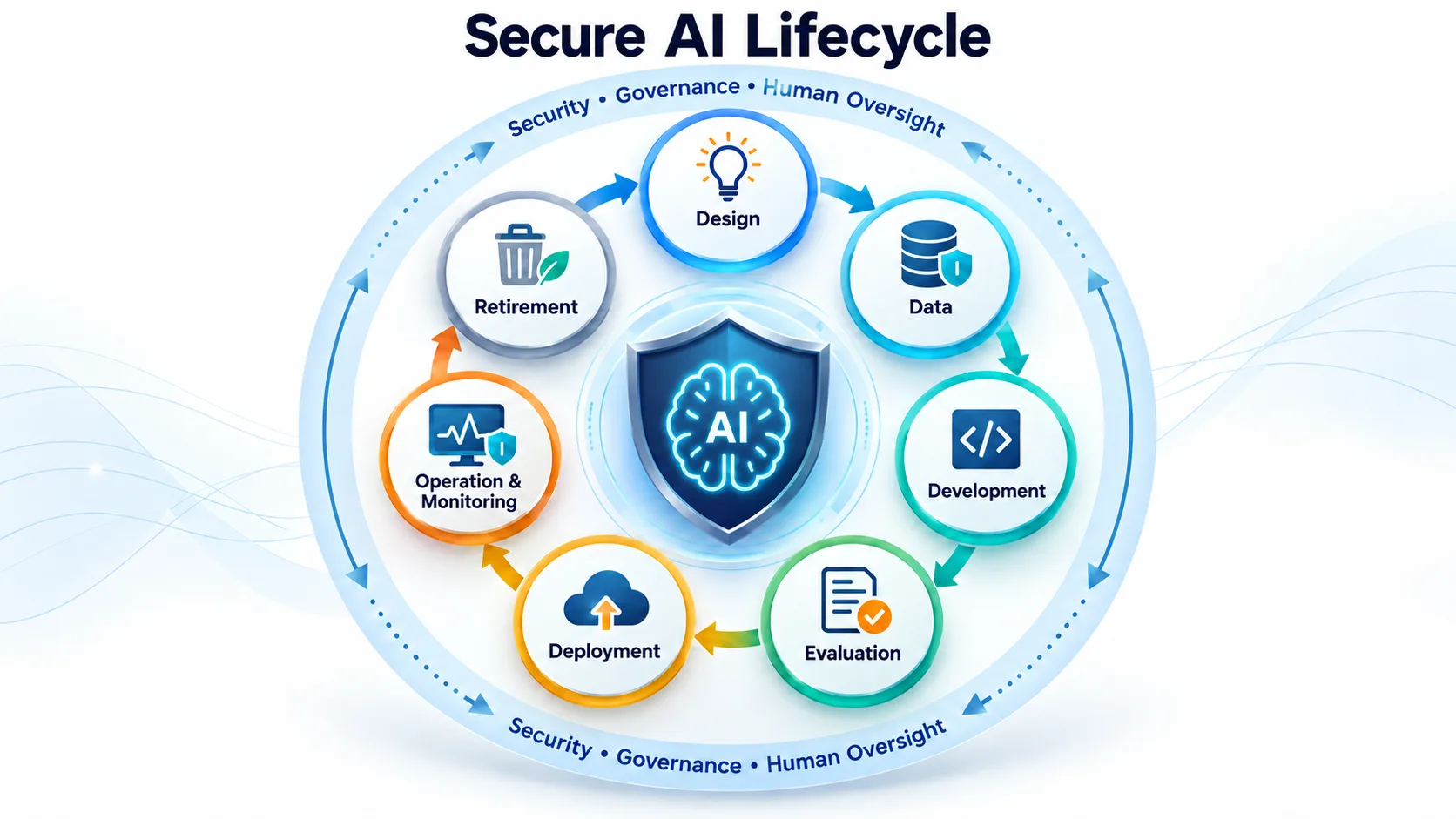
- Design: Define purpose, users, data requirements, impact, permitted actions and accountability.
- Data: Protect confidentiality and integrity, establish provenance and minimize unnecessary collection.
- Development: Apply secure software practices and protect code, dependencies, secrets and environments.
- Evaluation: Test behavior, limitations, misuse scenarios and security assumptions before release.
- Deployment: Use appropriate identity, network, application, data and infrastructure controls.
- Operation and monitoring: Observe performance, access, tool use, drift and security-relevant changes.
- Retirement: Revoke credentials and manage models, data, logs and dependent resources appropriately.
AI applications also benefit from secure development practices. Security, development and platform teams should address code, dependencies, APIs, containers, infrastructure as code, CI/CD pipelines and monitoring. See our DevOps vs DevSecOps guide for the delivery-model comparison, and our guide to how DevSecOps fits into cybersecurity for the broader security context.
AI Risk Management and Governance
Technical controls are only part of the solution. Organizations need governance that identifies which AI systems are in use, what information they access, who owns them, which decisions may be automated, where human review is mandatory and how incidents are handled.
The NIST AI Risk Management Framework and its Generative AI Profile provide voluntary guidance for managing trustworthiness throughout design, development, use and evaluation. NIST’s Adversarial Machine Learning taxonomy provides additional terminology for attacks and mitigations.
Governance should define:
- An inventory of models, applications, agents and third-party AI services
- Named business and technical owners
- Approved purposes and prohibited uses
- Data-access and retention rules
- Automation and human-approval thresholds
- Evaluation and red-team requirements
- Supplier and supply-chain assessments
- Monitoring, incident response and retirement procedures
How to Adopt AI in Cybersecurity Responsibly
Step 1: Start With a Security Problem
Do not begin with the vague objective of “using AI.” Select a specific problem such as excessive low-value alerts, slow investigation or weak vulnerability prioritization.
Step 2: Define the Desired Outcome
Specify how success will be measured, including quality, time, risk reduction and analyst experience.
Step 3: Understand the Data
Identify the information required, its sensitivity, provenance, quality, location and permitted uses.
Step 4: Assess Risk
Consider the consequences of incorrect output, unauthorized access, manipulation, service failure and excessive autonomy.
Step 5: Define Human Oversight
Determine which recommendations require validation and which actions require explicit approval.
Step 6: Integrate Existing Controls
Connect the solution to identity, logging, network, application, data, vulnerability and incident-response controls.
Step 7: Run a Controlled Pilot
Test the capability with limited scope, permissions and data before wider deployment.
Step 8: Measure and Monitor Continuously
Review performance, errors, adoption, drift, access and security assumptions throughout operation.
How to Evaluate an AI Cybersecurity Solution
Before adopting an AI-enabled security capability, ask:
- What specific security problem does it solve?
- Which data does it require, and where is that data processed?
- How are outputs validated and explained?
- What happens when the model is wrong or unavailable?
- Which actions can it perform automatically?
- Can automation and tool access be restricted?
- How are identities, credentials and secrets protected?
- How are the model, application and integrations monitored?
- How are updates and third-party dependencies assessed?
- Can logs and decisions support investigation and audit?
Useful AI Cybersecurity Metrics
- Alert-quality improvement
- False-positive and false-negative rates
- Investigation and triage time
- Reduction in repetitive analyst work
- Vulnerability-prioritization effectiveness
- Analyst adoption and override rates
- Automation errors and prevented unsafe actions
- Model drift and performance degradation
The number of AI features in a product is not a meaningful security metric. Organizations should measure whether the system improves security outcomes without introducing unacceptable risk.
The Future of AI in Cybersecurity
AI capabilities will increasingly appear throughout security operations, identity protection, endpoint security, network monitoring, cloud security, application security and vulnerability management. Natural-language interfaces may also change how professionals search telemetry, retrieve knowledge and investigate incidents.
Agentic systems will expand from providing recommendations to coordinating multistep workflows. This makes identity, permission boundaries, tool governance, monitoring and approval checkpoints even more important. The realistic future is not AI replacing cybersecurity teams. It is cybersecurity professionals working with AI assistance, controlled automation and stronger governance.
Frequently Asked Questions About AI in Cybersecurity
What is AI in cybersecurity?
AI in cybersecurity is the use of artificial intelligence and machine-learning techniques to support activities such as threat detection, alert triage, vulnerability prioritization, investigation and security operations.
How is AI used in cybersecurity?
AI can assist with anomaly detection, security monitoring, incident analysis, identity analytics, endpoint protection, network security, cloud security and controlled response automation.
Can AI detect every cyber threat?
No. AI can identify patterns and suspicious activity, but it can produce false positives and false negatives. It should operate alongside complementary detection methods and analyst review.
Will AI replace cybersecurity analysts?
AI can accelerate repetitive analytical work, but cybersecurity still requires human judgment, investigation, business context, architecture, accountability and risk management.
What is the difference between AI for cybersecurity and AI security?
AI for cybersecurity uses AI to improve security activities. AI security protects models, applications, data, APIs, infrastructure and autonomous agents. Modern organizations need both.
What are the main risks of generative AI?
Important risks include prompt injection, sensitive-information disclosure, poisoned data, improper output handling, insecure integrations, supply-chain weaknesses and excessive agency.
What is agentic AI security?
Agentic AI security focuses on systems that can plan, use tools and perform actions. Controls should limit permissions and functionality, validate tool interactions, isolate sensitive operations and require approval for high-impact actions.
How should a company start using AI for cybersecurity?
Begin with a clearly defined security problem, establish measurable outcomes, assess data and risk, define human oversight, run a controlled pilot and monitor whether the capability improves security performance.
Conclusion
AI is becoming an important capability within modern cybersecurity, but it is not a replacement for cybersecurity fundamentals. It can help teams analyze information, identify patterns, prioritize risk, accelerate investigation and automate selected activities within governed workflows.
At the same time, adopting AI creates additional responsibilities. Models, applications, agents, APIs, data, identities and infrastructure need protection throughout their lifecycle.
The strongest strategy addresses both sides: use AI to strengthen cybersecurity, and use cybersecurity to secure AI. Organizations that combine people, AI assistance, controlled automation and governance will be better positioned to gain value without treating AI as a shortcut around sound security architecture and risk management.
Continue Learning
Continue exploring TechTeamSynergy with these related guides.
Comments are closed.