

What does cybersecurity do? At its core, it helps an organization understand digital risk, protect important systems and information, detect suspicious activity, respond to security incidents and restore operations when disruption occurs.
That makes cybersecurity much broader than antivirus software, firewalls or stopping hackers. It combines technology, people, processes, governance and risk management.
It is also not one job. A security analyst investigating alerts performs very different work from a cloud security engineer, security architect, incident responder or cybersecurity leader.
This guide focuses on that practical question: what does cybersecurity actually do inside an organization? We will examine its major functions, responsibilities, teams, roles and everyday activities.
If you first want to understand the discipline itself, start with our security fundamentals guide.
In this guide: organization overview · six core functions · security domains · operations and risk · roles and workforce · FAQ
What Does Cybersecurity Do in an Organization?
Cybersecurity helps organizations manage risks associated with digital technology.
In practical terms, security teams may be responsible for activities such as:
- Understanding critical systems, applications and data
- Assessing cyber risk
- Managing identities and access
- Protecting networks and endpoints
- Securing cloud environments
- Reducing software vulnerabilities
- Monitoring suspicious activity
- Investigating security events
- Responding to incidents
- Supporting recovery
- Managing security policies
- Evaluating third-party risk
- Reporting cyber risk to leadership
A useful simplified model is:
Understand → Protect → Monitor → Respond → Recover → Improve
Governance surrounds the entire lifecycle.
The Six Core Functions of Cybersecurity
The NIST CSF 2.0 provides a useful model for understanding the work performed across a cybersecurity program.
It organizes cybersecurity outcomes into six Functions:
Govern → Identify → Protect → Detect → Respond → Recover
These are not six separate departments or a rigid sequence. They represent interconnected areas of cyber risk management.
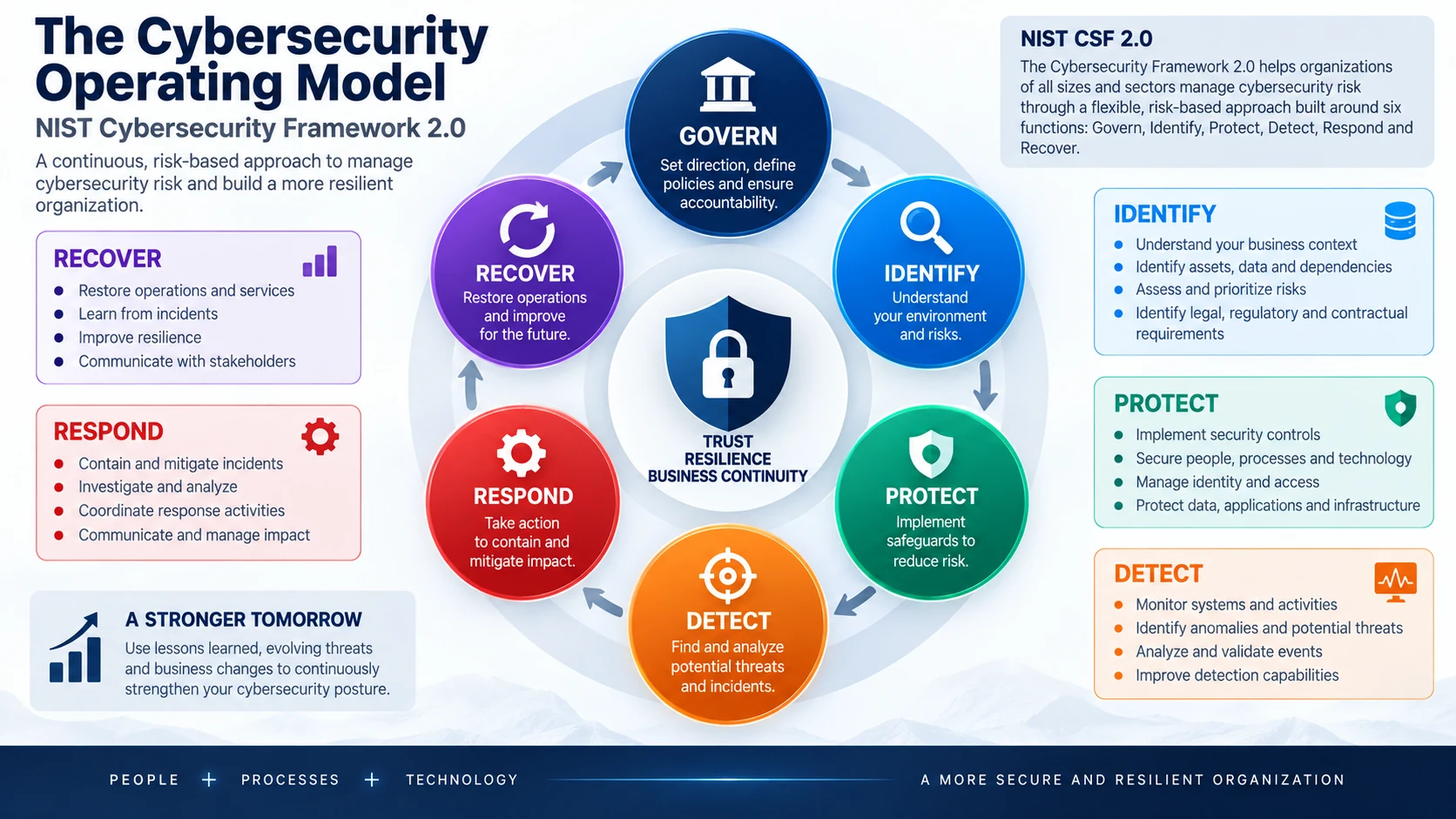
For organizations looking for a prioritized baseline of practical safeguards, the CISA Cross-Sector Performance Goals complement the framework with high-impact security practices designed to reduce common cyber risks.
1. Govern: Direct Cybersecurity Risk Management
Governance determines how an organization makes cybersecurity decisions.
This area can include:
- Cybersecurity strategy
- Policies
- Roles and responsibilities
- Risk-management expectations
- Leadership oversight
- Supply-chain risk
- Legal and regulatory considerations
- Performance measurement
Governance helps answer important questions:
- Who owns a particular cyber risk?
- Who can accept that risk?
- Which systems are most important?
- Which investments should receive priority?
- How should cybersecurity support business objectives?
This is why cybersecurity cannot be treated solely as an IT department responsibility.
2. Identify: Understand the Environment and Its Risks
Before an organization can protect something, it needs to understand what exists and why it matters.
Identification activities can include:
- Asset inventory
- Application inventory
- Data identification
- Business-impact analysis
- Risk assessment
- Dependency mapping
- Supplier identification
- Vulnerability awareness
For example, a team may need to determine:
- Which applications support critical services?
- Where sensitive information is stored?
- Which cloud environments exist?
- Who has privileged access?
- Which suppliers support critical systems?
Poor visibility makes effective risk management much harder.
3. Protect: Implement Appropriate Safeguards
Protection covers safeguards designed to reduce cyber risk.
Depending on the environment, this can involve:
- Authentication
- Access control
- Multi-factor authentication
- Network segmentation
- Endpoint protection
- Encryption
- Secure configuration
- Platform security
- Data protection
- Security awareness
- Infrastructure resilience
No single safeguard is sufficient.
Organizations generally need multiple complementary controls so that the failure of one layer does not automatically result in complete compromise.
4. Detect: Find and Analyze Suspicious Activity
Security teams cannot assume that every unwanted event will be prevented.
Detection capabilities help identify possible attacks, compromises and abnormal behavior.
Activities can include:
- Collecting security logs
- Monitoring endpoints
- Monitoring networks
- Reviewing cloud activity
- Detecting suspicious authentication
- Analyzing anomalies
- Correlating security events
- Investigating alerts
Effective detection aims to distinguish meaningful security events from the large amount of normal activity generated by modern technology environments.
5. Respond: Manage Security Incidents
When a security incident occurs, teams need to understand what happened and limit the impact.
Response activities can involve:
- Incident triage
- Analysis
- Investigation
- Containment
- Mitigation
- Internal communication
- Escalation
- Coordination with technical teams
Serious incidents can require cooperation across:
- Cybersecurity
- IT operations
- Network engineering
- Cloud teams
- Application teams
- Legal
- Communications
- Business leadership
6. Recover: Restore Operations
Recovery focuses on restoring assets and operations affected by an incident.
Activities can include:
- Restoring systems
- Recovering data
- Validating restored services
- Coordinating business priorities
- Communicating recovery status
- Reviewing lessons learned
This connects security with business continuity, backup strategy, disaster recovery and operational resilience.
Cybersecurity Is More Than Preventing Attacks
One of the biggest misconceptions about cybersecurity is that success means preventing every attack.
Prevention matters, but no organization can realistically guarantee that every safeguard will work perfectly all the time.
A mature security program therefore prepares to:
Prevent where possible → Detect what gets through → Limit impact → Recover → Learn
This is why monitoring, incident response and recovery are as important as preventive controls.
What Does a Cybersecurity Team Do Every Day?
There is no universal daily routine because responsibilities vary significantly by organization and role.
On a typical day, security professionals might:
- Review security alerts
- Investigate unusual account activity
- Assess vulnerabilities
- Review access requests
- Analyze security logs
- Meet developers about application security
- Review a new cloud architecture
- Test security controls
- Update policies
- Evaluate supplier risk
- Support an incident investigation
- Report important risks to management
Some work is proactive. Other work is reactive.
The balance depends on the organization’s technology, risk profile and security maturity.
Core Cybersecurity Domains
Cybersecurity is delivered through several overlapping domains. The exact boundaries vary by organization, but the following areas cover much of the practical work.
What Does Network Security Do?
Network security focuses on protecting network infrastructure, communications and connected resources.
Responsibilities can include:
- Firewall policies
- Network segmentation
- Secure routing
- Network access control
- Remote connectivity
- Network monitoring
- Secure DNS
- Intrusion detection and prevention
Modern network security increasingly overlaps with cloud security, identity and architectures such as Secure Access Service Edge.
See our SASE architecture guide for a deeper explanation of networking and security convergence.
What Does Identity Security Do?
Identity security determines who or what should be able to access resources and under which conditions.
Responsibilities can include:
- User authentication
- Authorization
- Multi-factor authentication
- Single sign-on
- Identity federation
- Account provisioning
- Account removal
- Privileged-access management
- Service-account management
A major objective is least privilege: users and systems should receive only the access required for legitimate activities.
What Does Endpoint Security Do?
Endpoint security protects devices such as laptops, desktops, servers and mobile devices.
Responsibilities can involve:
- Endpoint protection
- Endpoint detection and response
- Device encryption
- Patch management
- Security configuration
- Application controls
- Device compliance
Endpoints are particularly important because they connect users directly with applications, networks and data.
What Does Cloud Security Do?
Cloud security helps manage risk across cloud infrastructure, platforms, applications and services.
Activities can include:
- Cloud identity management
- Permission reviews
- Security architecture
- Configuration management
- Workload protection
- Network controls
- Data protection
- Logging and monitoring
- Vulnerability management
- Security automation
Cloud security also requires a clear understanding of which security responsibilities belong to the provider and which remain with the customer.
What Does Application Security Do?
Application security aims to reduce security weaknesses throughout the software lifecycle.
Work can include:
- Security requirements
- Threat modeling
- Architecture reviews
- Secure development practices
- Application security testing
- Dependency analysis
- API security
- Vulnerability remediation
Security is most effective when it is considered throughout software delivery rather than added only immediately before release.
What Does DevSecOps Do?
DevSecOps integrates security practices into development and operations workflows.
It can involve:
- Automated security testing
- Dependency scanning
- Secrets detection
- Infrastructure-as-code checks
- Container security
- CI/CD security controls
- Continuous monitoring
DevSecOps is one part of a broader cybersecurity program. It does not replace areas such as identity security, network security, governance or incident response. See our guide to how DevSecOps fits into cybersecurity for the broader relationship.
For a deeper comparison, see our DevSecOps vs DevOps guide.
What Does a Security Operations Center Do?
A Security Operations Center, commonly called a SOC, focuses on monitoring, detection, investigation and response.
SOC teams can use technologies such as:
- Security Information and Event Management (SIEM)
- Endpoint Detection and Response (EDR)
- Network telemetry
- Cloud logs
- Threat intelligence
- Security automation
A simplified operational workflow is:
Telemetry → Alert → Triage → Investigation → Response → Improvement
Technology helps process large volumes of information, but analysts still need context to determine which events require action.
Cybersecurity Roles and Responsibilities
Cybersecurity is not one job. Different specialists contribute different capabilities across analysis, engineering, architecture and incident response.
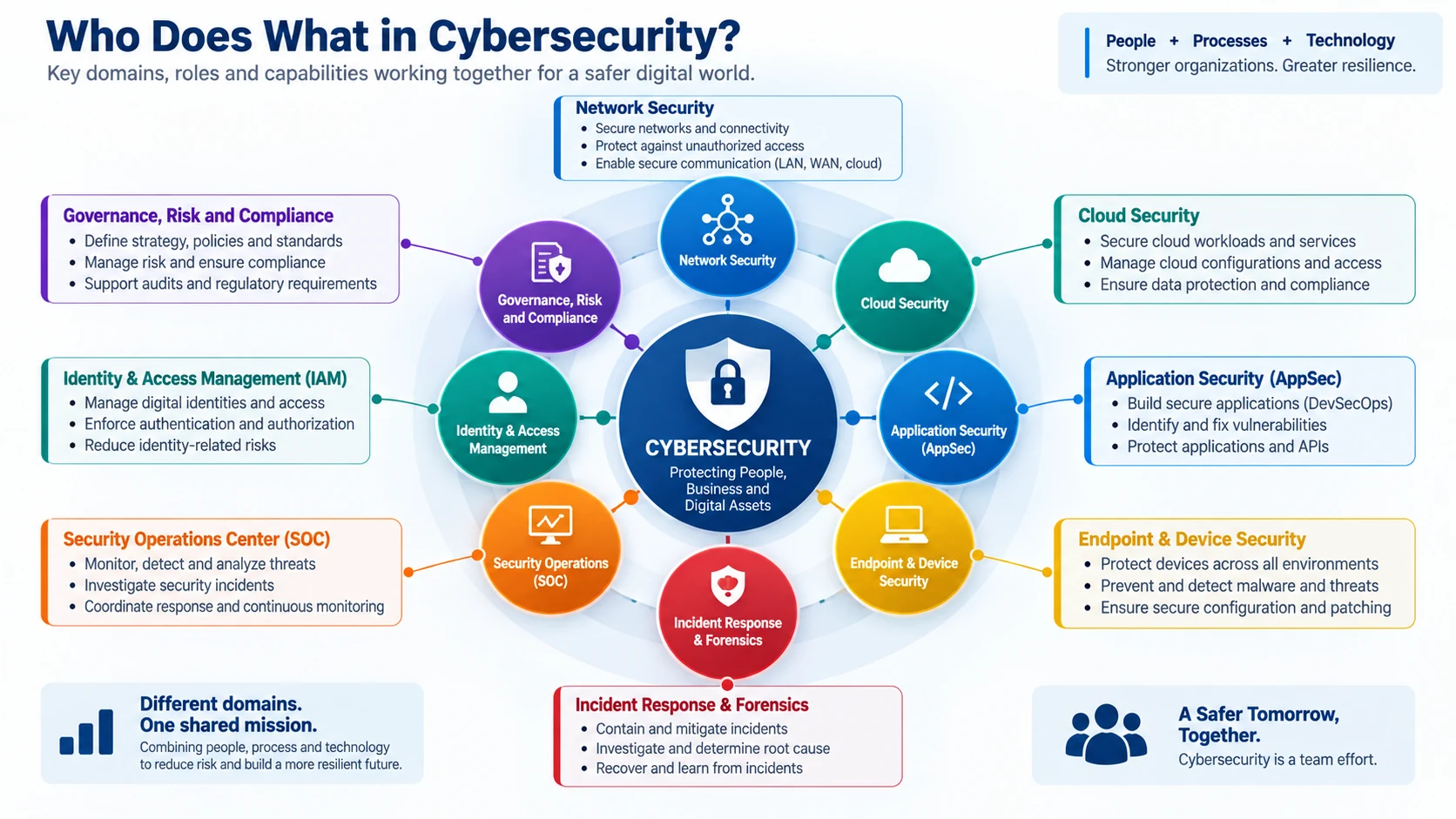
What Does a Cybersecurity Analyst Do?
A cybersecurity analyst may monitor security activity, investigate alerts, analyze vulnerabilities or support incident response.
Depending on the organization, responsibilities can include:
- Reviewing alerts
- Analyzing logs
- Investigating unusual behavior
- Documenting security events
- Escalating important findings
- Reviewing vulnerabilities
- Supporting remediation
The title is broad, so two cybersecurity analysts at different organizations may perform quite different work.
What Does a Cybersecurity Engineer Do?
Security engineers generally focus on designing, implementing, integrating or operating technical security capabilities.
Their work might involve:
- Identity systems
- Endpoint security
- Network security
- Cloud controls
- Security monitoring
- Automation
- Security integrations
Engineering roles usually work closely with other technology teams because security controls need to operate within the broader IT environment.
What Does a Security Architect Do?
A security architect considers how security requirements fit into the organization’s broader technology architecture.
Responsibilities can include:
- Defining security architecture
- Reviewing technical designs
- Developing security patterns
- Assessing architectural risk
- Defining security requirements
- Reviewing technology choices
- Working with cloud, application and network architects
A security architect’s job is therefore much broader than selecting security products.
What Does an Incident Responder Do?
Incident responders investigate and help coordinate the management of security incidents.
Their responsibilities can include:
- Analyzing security events
- Understanding incident scope
- Supporting containment
- Coordinating remediation
- Preserving useful information for investigation
- Supporting service restoration
- Documenting lessons learned
Incident response requires both technical knowledge and strong coordination skills.
Cybersecurity Operations, Governance and Risk
Beyond specialist roles, cybersecurity also depends on repeatable operational and governance processes that prioritize risk, maintain controls and coordinate response.
What Does Vulnerability Management Do?
Vulnerability management helps organizations identify weaknesses and prioritize their treatment.
A simplified lifecycle is:
Discover → Assess → Prioritize → Remediate or Mitigate → Verify
The objective should not simply be to generate the largest possible list of vulnerabilities.
Prioritization should consider context such as:
- Asset importance
- Exposure
- Severity
- Available mitigations
- Business impact
- Evidence of exploitation
This helps teams focus limited resources on the risks that matter most.
What Does Cybersecurity Governance Do?
Cybersecurity governance connects security decisions with business objectives, responsibilities and risk expectations.
Activities can include:
- Developing strategy
- Defining policies
- Assigning accountability
- Monitoring risk
- Reviewing performance
- Addressing regulatory obligations
- Managing third-party risk
- Reporting to executives
Governance becomes particularly important when security decisions require trade-offs involving cost, usability, business speed, performance and risk.
What Does Cyber Risk Management Do?
Cyber risk management helps organizations decide which security issues require the most attention.
A large environment may contain thousands of applications, devices, vulnerabilities, accounts and alerts.
Not everything can receive the same priority.
Risk management can consider:
- Business importance
- Threat exposure
- Known weaknesses
- Potential impact
- Existing safeguards
- Dependencies
The purpose is to support better decisions rather than simply create more security activity.
What Does Cybersecurity Do for Data?
Security teams help protect information throughout its lifecycle.
Relevant controls can include:
- Data classification
- Access management
- Encryption
- Monitoring
- Data Loss Prevention
- Backup
- Retention policies
- Secure deletion
The level of protection should reflect the sensitivity and business importance of the information.
What Does Cybersecurity Do for Remote Workers?
Remote and hybrid work requires security controls to operate beyond a traditional office perimeter.
Organizations may use:
- Strong authentication
- Endpoint protection
- Device-policy enforcement
- Secure remote access
- Web security
- Application-specific access
- Monitoring
Depending on the requirement, architectures may involve VPN, ZTNA, SSE or SASE.
Our VPN vs SASE comparison explains when these approaches may fit different access requirements.
What Happens During a Cybersecurity Incident?
When an incident occurs, security teams move from routine monitoring into coordinated investigation and response.
A simplified lifecycle can look like:
Detect → Analyze → Contain → Mitigate → Recover → Learn
Teams need to answer questions such as:
- What happened?
- Which systems are affected?
- Is suspicious activity continuing?
- Which business services could be affected?
- What should be contained?
- Who needs to be informed?
- How should services be restored?
The answers determine the appropriate response.
Does Cybersecurity Only Work Inside IT?
No.
Cybersecurity depends heavily on collaboration.
Security professionals may work with:
- IT operations
- Network teams
- Cloud teams
- Software developers
- Enterprise architects
- Risk teams
- Legal teams
- Procurement
- Human resources
- Business continuity teams
- Executives
This cross-functional nature is one reason governance and clearly defined responsibilities are important.
Cybersecurity Work Roles Are Not the Same as Job Titles
The NIST NICE Workforce Framework provides a useful distinction between cybersecurity work and job titles.
A Work Role represents a grouping of work for which an individual or team is responsible or accountable.
A Work Role is not necessarily the same thing as a job or occupation.
One employee may perform work associated with several roles, while a large organization may distribute one area of work across multiple specialists.
That is why titles such as:
- Cybersecurity Specialist
- Security Engineer
- Cyber Analyst
- Security Consultant
can represent different responsibilities at different organizations.
The Main Categories of Cybersecurity Work
The NICE Framework provides a structured way of describing different areas of cybersecurity work.
Its broad Work Role Categories include:
- Oversight and Governance
- Design and Development
- Implementation and Operation
- Protection and Defense
- Investigation
Oversight and Governance
This area includes leadership, management, direction and risk-related cybersecurity responsibilities.
Design and Development
This work focuses on researching, designing, developing and testing secure technology systems.
Implementation and Operation
This area involves implementing, administering, configuring, operating and maintaining technology securely.
Protection and Defense
This work focuses on protecting systems and networks and identifying or analyzing cybersecurity risks and events.
Investigation
This category covers work associated with cybersecurity investigations and digital evidence.
What Skills Do Cybersecurity Professionals Need?
There is no universal cybersecurity skill set because roles differ considerably.
Technical roles may benefit from knowledge of:
- Networking
- Operating systems
- Cloud platforms
- Identity
- Applications
- Security controls
- Automation
Other roles may emphasize:
- Risk analysis
- Architecture
- Governance
- Communication
- Policy
- Project management
- Leadership
Successful cybersecurity teams therefore combine different capabilities rather than relying on one type of specialist.
Does Cybersecurity Require Coding?
Not every cybersecurity role requires programming expertise.
Coding and scripting can be particularly useful in:
- Security automation
- Application security
- DevSecOps
- Cloud security
- Security engineering
- Data analysis
Other positions may focus more heavily on risk, governance, identity, architecture or security operations.
How Is AI Changing Cybersecurity Work?
Artificial intelligence is increasingly being used to assist selected security activities.
Potential applications include:
- Alert analysis
- Event correlation
- Anomaly detection
- Investigation support
- Knowledge retrieval
- Security operations automation
AI does not remove the need for professional judgment.
People remain responsible for important areas such as:
- Risk decisions
- Architecture
- Incident management
- Governance
- Business context
- Accountability
To explore this topic in more depth, see our guide to AI security use cases, including its use cases in threat detection, security operations and automation, as well as its risks and limitations.
What Cybersecurity Cannot Do
Security programs have limitations.
They cannot realistically guarantee:
- Zero incidents
- Zero vulnerabilities
- Perfect detection
- Zero disruption
- Perfect user behavior
Security tools also cannot indefinitely compensate for:
- Poor architecture
- Unsupported technology
- Unclear responsibilities
- Unmanaged identities
- Weak operational processes
The realistic objective is effective risk management and resilience—not a promise of perfect security.
Common Misconceptions About Cybersecurity Work
Cybersecurity Is Just Antivirus and Firewalls
Those technologies represent only a small part of a much broader discipline.
The Cybersecurity Team Owns All Security
Security specialists provide expertise, but developers, administrators, technology teams, leaders and users all influence cybersecurity outcomes.
Success Means Stopping Every Attack
No security program can guarantee this. Detection, response and recovery are therefore essential.
Cybersecurity Is Entirely Technical
Risk, governance, communication, architecture, policy and leadership are also major parts of cybersecurity.
Compliance Means the Organization Is Secure
Compliance requirements can support security objectives, but passing an audit does not automatically demonstrate that every meaningful cyber risk is effectively controlled.
How Do Cybersecurity Teams Measure Success?
Effective security measurement should help leaders understand risk and outcomes rather than simply count activity.
Useful metrics can include:
- Critical-asset security coverage
- Identity-control coverage
- Vulnerability-remediation performance
- Detection coverage
- Incident-response performance
- Recovery readiness
- Security-control effectiveness
- Third-party risk coverage
For example, the number of alerts generated by a monitoring platform says little by itself about whether the organization is more secure.
A Practical Example: Securing a New Cloud Application
Consider an organization preparing to launch a new cloud-based business application.
Security work can occur throughout the lifecycle.
Before Development
- Assess business and security risk
- Define security requirements
- Review the proposed architecture
- Identify important data
During Development
- Review application security
- Configure identity controls
- Assess cloud configuration
- Manage dependencies
- Integrate appropriate security testing
Before Launch
- Validate security controls
- Review access
- Configure logging
- Confirm monitoring
- Prepare response procedures
During Operation
- Monitor security activity
- Manage vulnerabilities
- Review access
- Maintain security configurations
If an Incident Occurs
- Investigate
- Contain the issue
- Coordinate remediation
- Restore affected services
- Capture lessons learned
This example shows why cybersecurity is a lifecycle rather than a security check performed only before production.
15-Minute Cybersecurity Responsibility Review
Use this quick review to turn the cybersecurity lifecycle into one concrete improvement for a real business service, application or platform.
- Minutes 0–3 — Pick one critical service. Define the business outcome, the systems or data involved and why disruption or compromise would matter.
- Minutes 3–6 — Identify the main risk. Choose the most important current concern: unauthorized access, vulnerable software, weak monitoring, dependency risk, data exposure, resilience or another specific issue.
- Minutes 6–9 — Map the lifecycle. Ask which of Govern, Identify, Protect, Detect, Respond or Recover is weakest for this risk. Do not assume every gap requires a new security product.
- Minutes 9–12 — Clarify ownership. Name the accountable owner and the teams that must contribute, such as security, application, cloud, network, identity, operations or business leadership.
- Minutes 12–15 — Choose one next action. Define a specific improvement, the evidence that will show it is complete and a date to review the result.
Decision output: ACT NOW / ASSIGN OWNER / INVESTIGATE FURTHER / ACCEPT OR ESCALATE RISK.
The purpose is not to perform a full risk assessment in 15 minutes. It is to convert a broad cybersecurity concern into a clearly owned, evidence-based next step.
Frequently Asked Questions
What does cybersecurity do in simple terms?
It helps organizations manage digital risk by protecting systems and data, detecting suspicious activity, responding to incidents and supporting recovery after disruption.
What are the main functions of cybersecurity?
NIST CSF 2.0 organizes cybersecurity outcomes into six Functions: Govern, Identify, Protect, Detect, Respond and Recover.
What does a cybersecurity professional do every day?
Activities depend on the role and may include monitoring security events, investigating alerts, managing access, reviewing vulnerabilities, assessing architecture, supporting incidents or communicating cyber risk.
Does cybersecurity prevent every attack?
No. Security controls aim to reduce risk, but no program can guarantee prevention of every incident. Organizations also need detection, response, recovery and resilience.
Does cybersecurity protect data?
Yes. Data protection can include access controls, encryption, monitoring, classification, backup and other safeguards appropriate to the information.
What does a cybersecurity analyst do?
An analyst may monitor security activity, investigate alerts, analyze vulnerabilities, support incident response and recommend improvements.
What does a cybersecurity engineer do?
A security engineer typically designs, implements, integrates or operates technical security capabilities across areas such as identity, cloud, networks and endpoints.
Is cybersecurity the same as IT?
No. IT focuses broadly on delivering and operating technology. Cybersecurity focuses on managing risks affecting technology, information and digital operations. The two work closely together.
Does cybersecurity require coding?
Some roles benefit significantly from programming and scripting, while others focus more on architecture, governance, risk, identity or operations.
Is cybersecurity one job?
No. Cybersecurity includes many different roles across governance, engineering, architecture, operations, defense, investigation, application security, cloud security and incident response.
Is cybersecurity only for large companies?
No. Organizations of all sizes depend on digital technology. The appropriate security program should reflect the organization’s size, technology environment, business requirements and actual risks.
Conclusion
Cybersecurity is much more than blocking attacks.
Its work spans the complete cyber-risk lifecycle:
Govern → Identify → Protect → Detect → Respond → Recover.
Different professionals contribute to that lifecycle in different ways.
Security analysts investigate events. Engineers implement controls. Architects design secure environments. Identity teams manage access. Cloud and application specialists protect modern platforms. Incident responders manage security events. Governance teams help leadership understand and manage risk.
These activities work together toward one larger objective:
help the organization use digital technology while keeping cyber risk at an acceptable and manageable level.
That is the practical answer to what cybersecurity does—and why cybersecurity should be understood as an organizational capability rather than a collection of security products.
Continue Learning
Continue exploring TechTeamSynergy with these related guides.
Comments are closed.