
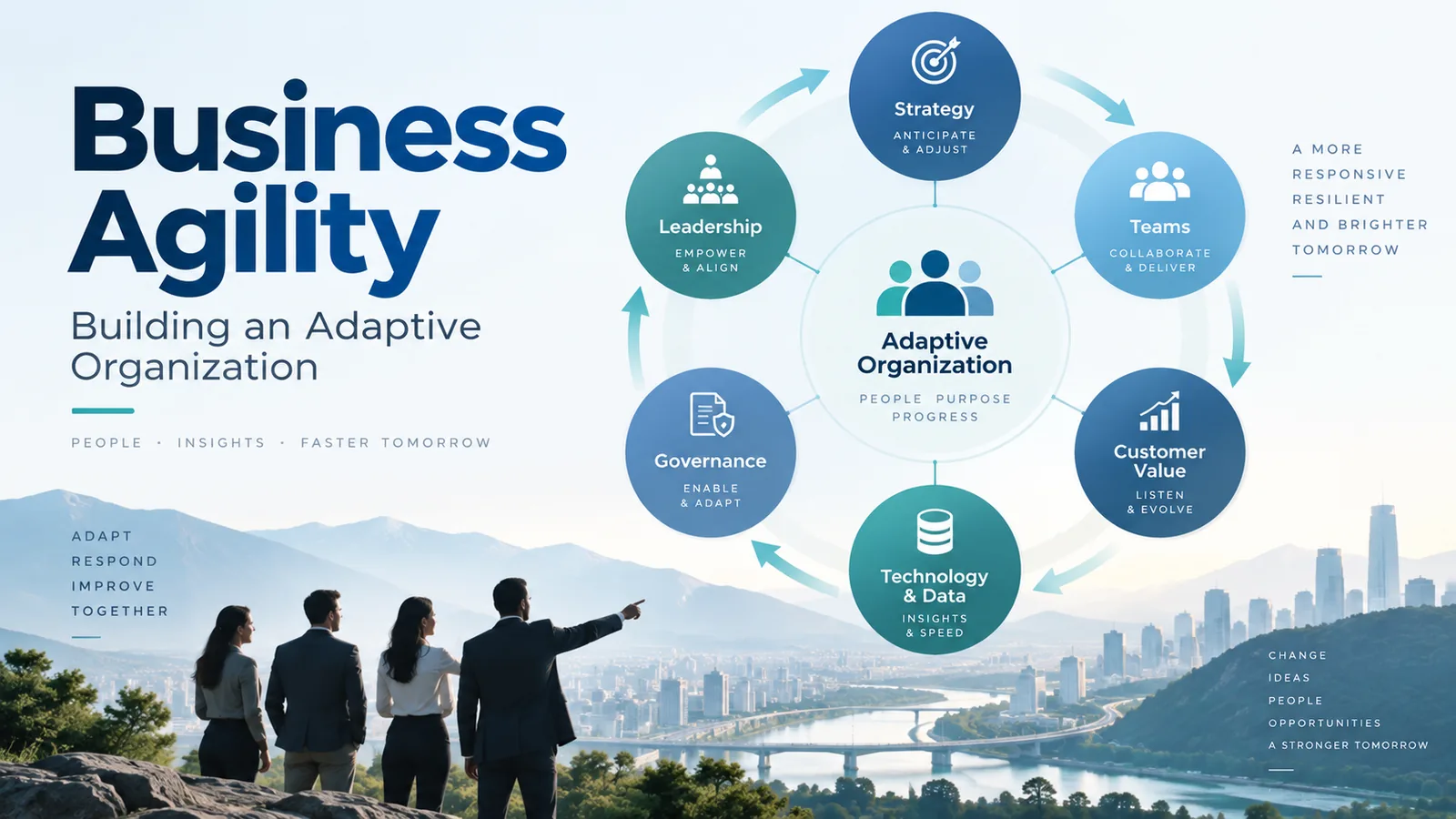
Business agility matters because markets change. Customer expectations evolve. New competitors emerge. Artificial intelligence changes how work gets done. Supply chains are disrupted, technologies mature, and strategies that looked right twelve months ago can quickly become outdated.
In this environment, organizations need more than efficiency. They need business agility: the ability to recognize change, make good decisions, adapt priorities and deliver value without losing strategic direction.
Business agility is not simply about moving faster. And it does not mean applying Scrum to every department. It is an organizational capability that connects strategy, leadership, people, technology, governance and execution.
This guide explains what business agility means, how it differs from Agile, what makes an organization genuinely adaptive, how technology enables agility, and how leaders can build greater agility across an enterprise.
What Is Business Agility?
Business agility is an organization’s ability to sense change, adapt effectively and continue delivering value in a changing environment.
The concept goes beyond reacting quickly to a crisis. A truly agile organization can continuously observe its environment, learn from customers and employees, make decisions, redirect resources and adjust its operating model when necessary.
Business agility therefore combines several capabilities:
- Understanding changes in markets and customer expectations.
- Making decisions at the appropriate level without unnecessary delay.
- Adjusting strategy when evidence changes.
- Organizing people around outcomes and value.
- Using technology and data to improve visibility and execution.
- Experimenting and learning continuously.
- Changing priorities without creating organizational chaos.
The Project Management Institute’s guidance on enterprise agility emphasizes both adaptability and the predictable, sustainable realization of business value.
Similarly, IBM’s explanation of business agility describes the ability to sense internal and external changes and adapt quickly through innovative solutions.
The Agile Business Consortium takes an important additional step: business agility is not simply another framework to implement. It is an organizational capability involving leadership, culture, governance, empowered teams and continuous learning.
Business Agility, Organizational Agility and Enterprise Agility
You will often encounter three related terms:
- Business agility focuses on an organization’s overall ability to respond, adapt and continue creating value.
- Organizational agility emphasizes how structures, teams, leadership and operating practices enable adaptation.
- Enterprise agility often describes the same capability at scale across an entire enterprise rather than within individual teams.
There are differences in how frameworks and organizations use these terms, but they share a common objective: creating an organization capable of adapting without losing alignment.
For TechTeamSynergy, the most useful way to think about business agility is as the connection between Technology, Team and Transformation.
Technology provides information, automation and digital capabilities. Teams provide knowledge, creativity and execution. Transformation connects those capabilities to strategy, governance and organizational change.
Why Business Agility Matters
Traditional organizations were often designed primarily for stability and efficiency. Responsibilities were clearly separated, annual plans established priorities, budgets followed predictable cycles and major decisions moved upward through management hierarchies.
That model can work well when the environment is relatively predictable.
The problem appears when the environment changes faster than the organization’s decision and execution cycles.
Imagine that customer demand changes in January. The organization recognizes the change in February. Management studies it in March. A business case is approved in May. Funding becomes available in July. Development begins in September.
By the time the organization responds, the opportunity may have moved elsewhere.
Business agility attempts to shorten this distance between signal, decision and action.
Customer expectations change quickly
Digital experiences have changed what customers expect from almost every industry. Customers increasingly expect convenient services, faster responses, personalization and continuous improvement.
An agile organization creates mechanisms for capturing those signals and turning them into decisions rather than waiting for the next annual planning cycle.
Technology changes competitive boundaries
Cloud platforms, APIs, automation, artificial intelligence and data analytics can dramatically change how products and services are created.
Technology therefore affects more than IT departments. It can change business models, cost structures, customer experiences and competitive positions.
AI is accelerating the cycle again
Artificial intelligence adds another dimension. Organizations can now automate activities, accelerate analysis, improve knowledge access and create new digital services faster than before.
But adopting AI tools does not automatically make a company agile. Organizations still need governance, skills, reliable data, appropriate technology architecture and teams capable of turning new capabilities into business outcomes.
Uncertainty makes rigid planning less effective
Planning remains important. Business agility does not mean abandoning plans.
It means recognizing that plans are based on assumptions and that assumptions sometimes change.
An adaptive organization can preserve its strategic purpose while adjusting the path used to reach it.
Business Agility vs Agile: What Is the Difference?
This distinction is essential.
Agile and business agility are related, but they are not the same thing.
Agile originated largely from approaches to software development that emphasized collaboration, incremental delivery, feedback and adaptation. Those principles subsequently influenced product management, project delivery and broader organizational practices.
Business agility expands the idea to the organization as a whole.
A development team can work in two-week iterations and still operate inside a company that takes six months to approve funding.
A product team can use Scrum while procurement requires months to onboard a supplier.
Employees can attend daily stand-ups while senior leaders still make every meaningful decision.
None of these organizations is necessarily business-agile.
If you want to understand the foundations first, see our complete guide to Agile.
Doing Agile vs being agile
This provides a useful distinction.
Doing Agile can include practices such as:
- Sprints
- Backlogs
- Daily meetings
- Kanban boards
- Retrospectives
- Incremental delivery
Being agile is broader. It includes:
- Learning quickly
- Responding to evidence
- Empowering teams
- Making decisions closer to the work
- Collaborating across organizational boundaries
- Continuously improving
- Adapting strategy when circumstances change
The objective is not to choose between the two. Effective organizations need appropriate delivery practices supported by an operating environment that enables adaptation.
The Core Dimensions of Business Agility
Business agility does not come from one methodology. It emerges when several organizational capabilities reinforce one another.
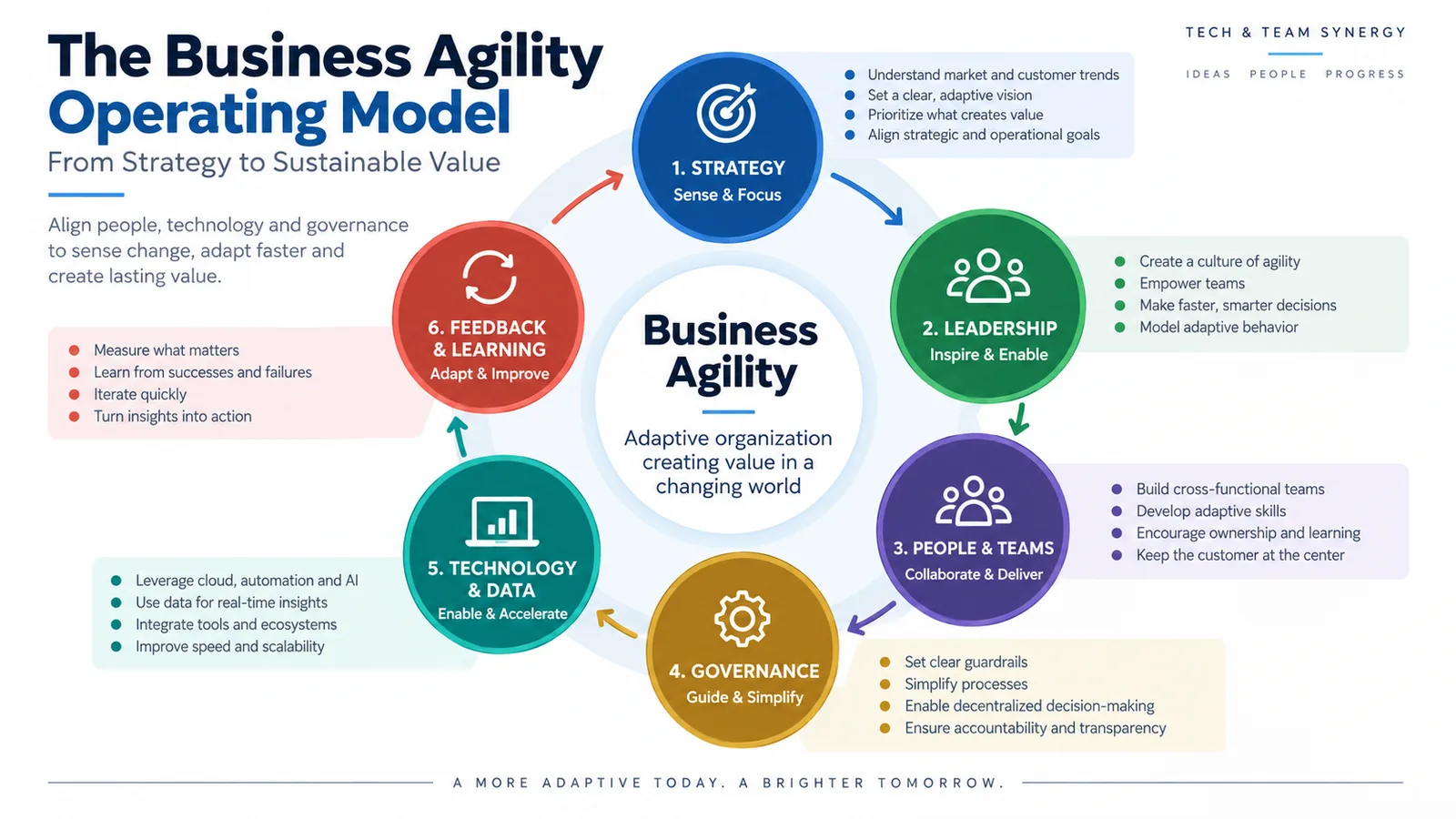
1. Adaptive Strategy for Business Agility
Strategy gives an organization direction. Agility determines how effectively it can navigate toward that direction as conditions change.
An adaptive strategy establishes clear outcomes while allowing assumptions, initiatives and priorities to evolve.
This requires leaders to distinguish between purpose and plan. Purpose can remain stable even when the plan changes.
2. Leadership for Business Agility
Leadership is one of the strongest enablers—or blockers—of business agility.
If every important decision must travel through several layers of approval, teams cannot respond quickly regardless of which Agile framework they use.
Agile leadership creates clarity about objectives and boundaries, then gives people appropriate autonomy within those boundaries.
This means moving from:
- Control toward empowerment.
- Activity tracking toward outcome management.
- Information ownership toward transparency.
- Fear of failure toward responsible experimentation.
- Detailed instructions toward clear intent.
Explore these ideas further in our guide to modern leadership.
3. Empowered teams
Organizations ultimately adapt through people.
Teams need enough information, skills and authority to solve problems without waiting unnecessarily for decisions elsewhere.
This does not eliminate management. Instead, management creates context, priorities, boundaries and support so teams can operate effectively.
Cross-functional teams can be particularly valuable because they reduce dependencies between organizational silos.
Our guide to building Agile teams explores the team dimension in greater detail.
4. Customer centricity
Agility without customer value simply means changing quickly.
Business agility should therefore be connected to customer or stakeholder outcomes.
Organizations need mechanisms that continuously answer questions such as:
- What problem are we solving?
- Who benefits?
- What evidence shows that the problem matters?
- Did our solution create the expected outcome?
- What did we learn?
These questions help prevent teams from becoming highly efficient at producing outputs that customers do not need.
5. Feedback Loops for Business Agility
Feedback is one of the engines of agility.
A long feedback cycle allows incorrect assumptions to survive for longer. A shorter cycle exposes problems earlier.
Feedback can come from customers, operational systems, employees, financial results, experiments, analytics or product usage.
The goal is not simply collecting more data. The organization must connect information to decisions.
6. Adaptive governance
Governance and agility are sometimes incorrectly presented as opposites.
Organizations still need financial discipline, cybersecurity, architecture, risk management, regulatory compliance and accountability.
The challenge is creating governance that protects the organization without turning every decision into a queue.
Adaptive governance uses clear principles, decision rights and guardrails. Teams understand what they can decide independently and which decisions require broader review.
7. Technology and data
Modern business agility is increasingly dependent on digital capabilities.
Teams cannot make rapid evidence-based decisions if information is fragmented across disconnected systems or if obtaining basic data takes weeks.
Likewise, organizations struggle to change rapidly when every application modification requires a large, risky deployment.
Technology architecture therefore affects organizational agility.
8. Continuous learning
Adaptation requires learning.
Organizations need mechanisms for testing assumptions, reviewing outcomes, sharing knowledge and improving capabilities.
This includes individual skills, team learning and organizational learning.
A learning organization does not treat every unsuccessful experiment as failure. It distinguishes between careless execution and a well-designed experiment that generated useful information.
What Does an Agile Organization Look Like?
There is no single organizational chart that creates business agility.
However, adaptive organizations often share several characteristics.
Clear direction
People understand the organization’s priorities and the outcomes they are trying to achieve.
This matters because decentralization without strategic clarity can produce conflicting local decisions.
Decision-making close to the information
Not every decision belongs at the top of the organization.
Teams closest to customers, products and operations often possess information that senior management does not have.
Effective organizations define which decisions can be decentralized and which genuinely require enterprise-level oversight.
Cross-functional collaboration
Customer value rarely follows organizational departments.
A single customer journey may involve sales, IT, operations, security, finance and support.
Business agility therefore requires mechanisms that allow people to collaborate across these boundaries.
Shorter planning and learning cycles
Long-term direction remains important, but assumptions are reviewed more frequently.
Teams compare expected outcomes with actual results and adjust priorities accordingly.
Transparency
People need visibility into priorities, dependencies, progress and constraints.
Without transparency, organizations spend enormous energy coordinating information rather than solving problems.
The Role of Leadership in Business Agility
Business agility cannot be delegated to an Agile transformation office.
Leadership behavior shapes the environment in which agility either develops or disappears.
Set direction without prescribing every action
Teams need to know what matters and why.
Instead of specifying every activity, leaders can define outcomes, constraints and decision boundaries.
This creates alignment while preserving room for teams to determine how best to achieve the objective.
Create psychological safety
Organizations cannot learn effectively when employees are afraid to raise problems.
Leaders should create an environment where people can challenge assumptions, surface risks and discuss mistakes constructively.
Reward learning, not just certainty
Innovation involves uncertainty.
If leaders expect every experiment to succeed, employees quickly learn to avoid experiments.
A better approach is to ask whether an experiment had a reasonable hypothesis, controlled risk, useful measurement and meaningful learning.
Remove organizational friction
Leadership also means removing systemic blockers.
If teams repeatedly encounter the same approval bottleneck, technology dependency or governance problem, simply asking them to “be more agile” will not solve it.
The system itself needs to change.
Technology as an Enabler of Business Agility
Technology is not business agility, but modern organizations increasingly depend on technology to achieve it.
Cloud computing
Cloud platforms can give organizations flexible access to computing resources and digital services. When implemented appropriately, this can shorten infrastructure provisioning cycles and support experimentation.
Artificial intelligence
AI can accelerate information discovery, analysis, content creation, automation and decision support.
Its greatest organizational value comes when it is connected to redesigned processes rather than simply added on top of inefficient ones.
Automation
Automation can reduce repetitive manual work and shorten process cycle times.
It can also improve consistency and free employees to focus on higher-value activities.
Data and analytics
Agile decision-making requires visibility.
Reliable analytics help teams understand customer behavior, operational performance and the results of experiments more quickly.
Enterprise networking
Distributed applications, cloud services and hybrid work depend on reliable connectivity.
Modern networking technologies can help organizations support changing application and workforce requirements more dynamically.
DevOps and continuous delivery
Digital businesses need the ability to change software safely and frequently.
DevOps practices can shorten the path between an idea and production by improving collaboration, automation, testing and deployment.
Cybersecurity
Security should enable responsible change rather than become an afterthought.
Embedding security into architecture and delivery processes can help organizations innovate while maintaining appropriate controls.
The broader lesson is important: technology creates agility only when architecture, processes and people are designed to use it effectively.
Business Agility and Digital Transformation
Business agility and digital transformation are closely connected, but they are not interchangeable.
Digital transformation uses digital capabilities to change how an organization operates, delivers value or competes.
Business agility is the organizational capability to continue adapting as those technologies, markets and customer needs evolve.
This explains why buying new technology rarely creates transformation on its own.
A company can migrate applications to the cloud while preserving the same slow decision processes.
It can deploy AI while maintaining fragmented data.
It can introduce collaboration platforms while teams remain organizationally isolated.
Technology changes capability. Transformation changes how the organization works.
This is why TechTeamSynergy approaches transformation through three connected dimensions:
Technology + Team + Transformation → Sustainable Results
For a deeper view of organizational change, see our Workforce Transformation Guide.
Business Agility at Scale
Agility becomes more difficult as organizations grow.
A small team can communicate informally. A multinational enterprise may have thousands of employees, multiple products, regulatory obligations, legacy systems, complex budgets and dependencies between hundreds of teams.
Scaling therefore requires coordination without recreating excessive bureaucracy.
Organize around value
Traditional organizational structures often optimize individual functions.
Business agility encourages leaders to also examine how value moves across those functions from an idea to a customer or business outcome.
Identifying value streams can expose delays that remain invisible when each department measures only its own performance.
Connect strategy and execution
Teams need to understand how their work contributes to enterprise priorities.
Portfolio management can help translate strategy into investments, initiatives and measurable outcomes.
Manage dependencies deliberately
Dependencies cannot always be eliminated.
The objective is to make important dependencies visible and reduce unnecessary ones through architecture, team design and clearer ownership.
Use frameworks as tools, not objectives
Frameworks such as SAFe can provide structures for coordinating Agile delivery across large organizations.
But implementing a framework should never become the business objective itself.
The objective remains better value delivery and greater adaptability.
For organizations exploring this approach, see our complete SAFe guide and our PI Planning guide.
Business Agility vs Organizational Resilience
Business agility and resilience are related but distinct.
Agility emphasizes sensing and adapting to change.
Resilience emphasizes the ability to withstand disruption, recover and continue functioning.
Consider a major market disruption.
A resilient organization may maintain critical operations despite the disruption.
An agile organization may recognize that customer behavior has permanently changed and redesign its products, channels or operating model.
Organizations increasingly need both.
Resilience without agility can preserve an outdated model. Agility without resilience can produce rapid change without sufficient stability.
Common Barriers to Business Agility
Organizational silos
When departments optimize independently, work slows at the boundaries between them.
Teams may achieve their local targets while the overall customer journey remains slow.
Slow decision-making
Multiple approval layers increase decision lead time.
Leaders should identify which approvals genuinely manage significant risk and which exist primarily because “we have always done it this way.”
Legacy technology
Tightly coupled systems, manual processes and fragmented data can make even small changes expensive and risky.
Technology modernization therefore often becomes part of the agility journey.
Rigid funding models
Organizations may discover a new priority but remain unable to redirect resources because budgets are locked into annual project structures.
Misaligned KPIs
Metrics can unintentionally work against agility.
For example, one department may be rewarded for minimizing costs while another is rewarded for accelerating innovation.
Our KPI vs OKR guide explains how different measurement approaches can support clearer outcome management.
Resistance to change
Transformation affects roles, routines and sometimes professional identities.
Leaders should not assume resistance is simply negativity. People may have legitimate concerns about skills, workload, accountability or previous unsuccessful transformation programs.
Lack of skills
Organizations cannot become more adaptive if employees do not have the capabilities required by new technologies and operating models.
Continuous learning and workforce transformation therefore become strategic capabilities.
Agile theater
One of the most common traps is adopting Agile terminology without changing organizational behavior.
Meetings are renamed. Teams use new boards. Employees attend Agile training.
But funding, decision-making, incentives and governance remain unchanged.
The organization appears Agile while the underlying operating system remains rigid.
How to Build Business Agility
Business agility is a journey rather than a one-time transformation project.
Step 1: Assess the current system
Start by understanding where adaptation is currently slow.
Examine:
- Decision lead times.
- Customer feedback loops.
- Technology constraints.
- Organizational dependencies.
- Governance processes.
- Funding cycles.
- Skills gaps.
- Information flows.
The goal is not to produce an abstract maturity score. It is to identify the constraints that materially reduce the organization’s ability to respond.
Step 2: Define strategic outcomes
Agility needs direction.
Clarify what outcomes matter and how teams will know whether progress is being made.
Step 3: Organize around value
Study how customer and business value actually moves through the organization.
Where possible, reduce unnecessary handoffs and give teams greater end-to-end responsibility.
Step 4: Empower teams with guardrails
Define decision rights explicitly.
Teams should understand what they can decide, which constraints apply and when escalation is necessary.
Step 5: Shorten feedback loops
Move from large batches of work and infrequent reviews toward smaller experiments and more frequent evidence.
Step 6: Modernize enabling technology
Identify technology bottlenecks that repeatedly delay business change.
Prioritize architecture, automation, data and platforms that reduce those constraints.
Step 7: Adapt governance
Review approval mechanisms, portfolio governance and funding.
Ask whether each control protects a meaningful risk or simply adds delay.
Step 8: Measure outcomes
Avoid measuring transformation success solely through training completed, teams converted or Agile ceremonies implemented.
Measure whether the organization is actually becoming more responsive and effective.
Step 9: Learn continuously
Business agility is never finished.
As the environment changes, the organization needs to keep reviewing its own assumptions, structures and capabilities.
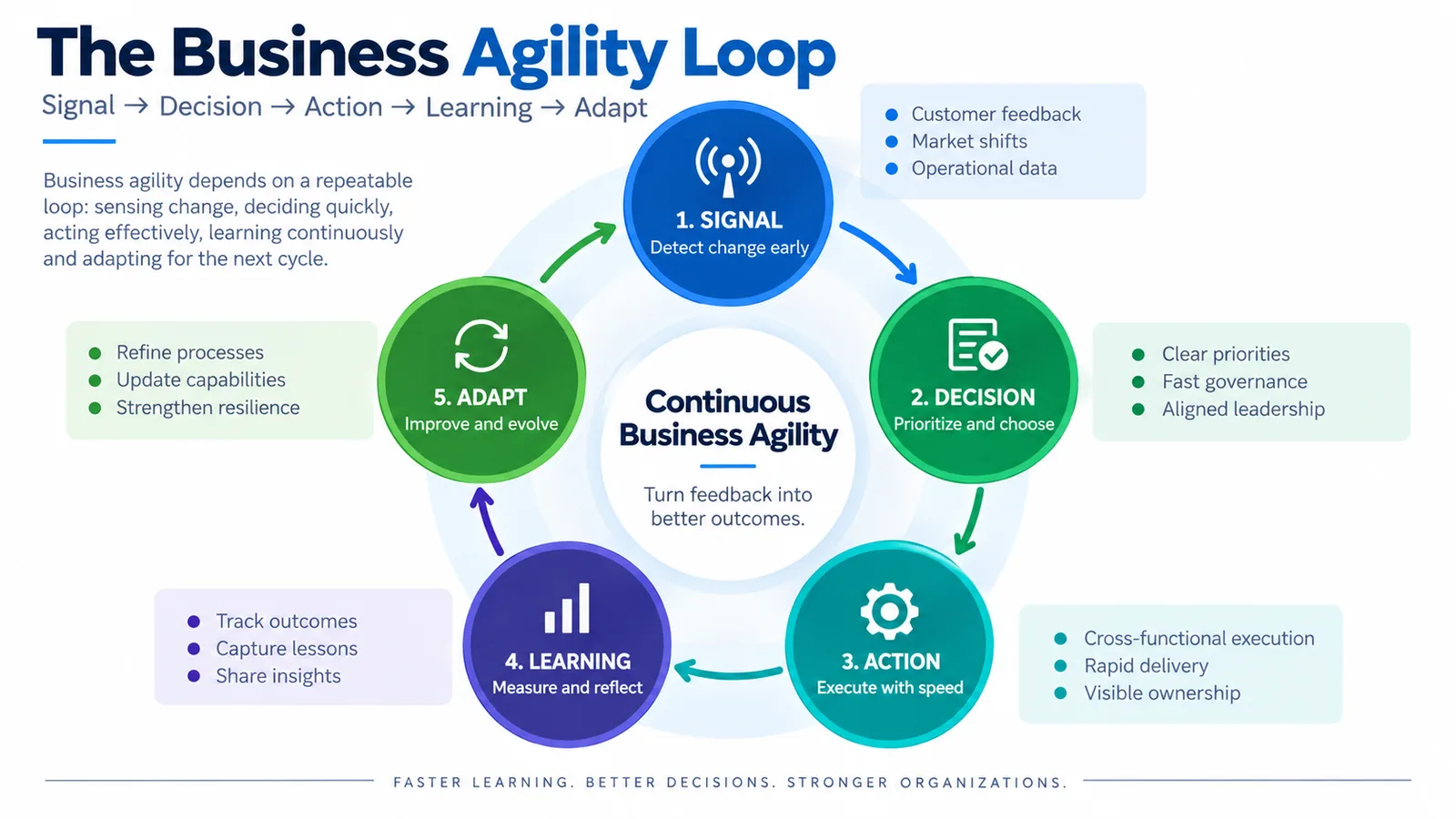
15-Minute Business Agility Readiness Review
Use this short review to identify where adaptation is currently slowing down. The objective is not to produce a maturity score. It is to identify the single constraint that most limits the organization’s ability to respond.
- Signal — 3 minutes: Name one important market, customer, operational or technology change the organization needs to respond to now. Identify what evidence shows the change matters.
- Decision — 3 minutes: Identify who can make the required decision today. If the decision must cross several approval layers, record the delay and decide which decision rights could safely move closer to the work.
- Team — 3 minutes: Check whether the people needed to act are available across business, technology, operations, finance, security or other relevant functions. Make the most important dependency explicit.
- Technology and data — 3 minutes: Ask whether teams have the information, platforms and automation required to test or implement a response quickly. Identify one technical bottleneck that repeatedly slows change.
- Governance — 3 minutes: Separate controls that protect meaningful risk from controls that mainly create waiting time. Assign an owner and deadline to the most important friction point.
Finish with one decision: choose one constraint to remove or reduce during the next 30 days. Define the owner, the evidence of improvement and the next review date. Business agility improves when the organization shortens the distance between signal → decision → action → learning.
How to Measure Business Agility
There is no universal business-agility metric. A useful measurement system combines operational indicators with business outcomes.
Time to decision
How long does it take to make an important decision once the necessary information is available?
Time to market
How quickly can an idea become a product, service or meaningful customer improvement?
Lead time and cycle time
How long does work spend moving through the delivery system?
Customer outcomes
Are faster delivery cycles actually improving customer satisfaction, retention, adoption or other relevant outcomes?
Employee experience
Do employees have the clarity, tools and autonomy needed to perform effectively?
Our Employee Experience Guide explores this dimension further.
Innovation effectiveness
How effectively can the organization test new ideas, learn and scale successful experiments?
Response to change
When priorities change, how long does it take for resources, plans and execution to follow?
Business outcomes
Ultimately, agility should improve outcomes that matter to the organization.
Faster activity without better outcomes is not success.
A Practical Example of Business Agility
Consider a traditional enterprise launching a new digital service.
Customer research identifies an emerging requirement, but the initiative must pass through multiple departments before work can begin.
Business creates a detailed specification. Finance approves the budget. Architecture reviews the solution. IT begins development. Security reviews the product near the end. Operations prepares for deployment.
Months later, the service launches.
The problem is that customer expectations have changed during development.
An organization with greater business agility could approach the same challenge differently.
A cross-functional team involving business, technology, security, operations and customer expertise is created around the desired outcome.
The team develops a smaller initial solution and tests its assumptions earlier.
Customer feedback reveals which features matter.
Architecture and security requirements are incorporated from the beginning rather than appearing as late-stage gates.
Leadership establishes budget and risk guardrails so the team can make many day-to-day decisions independently.
Data from the initial release guides the next investment decision.
The difference is not simply that the second organization uses Agile ceremonies.
The difference is that strategy, funding, teams, technology, governance and feedback have been designed to support adaptation.
Business Agility and the Future of Work
The importance of business agility is likely to increase as AI, automation and digital platforms continue changing work.
AI-assisted work
AI is becoming part of knowledge work, software development, analysis, customer service and operational processes.
Organizations will need to learn where AI creates value, where human judgment remains essential and how risks should be governed.
Skills will evolve faster
Job descriptions alone will become less useful if required capabilities change continuously.
Organizations will increasingly need visibility into skills and mechanisms for continuous reskilling.
Teams will become more dynamic
Cross-functional teams may form around products, customer journeys, transformation objectives or emerging opportunities rather than remaining permanently constrained by functional structures.
Human and AI collaboration will matter
The future is unlikely to be defined simply by humans versus AI.
Many organizations will instead need to determine how people and intelligent systems can work together effectively.
This reinforces a central TechTeamSynergy principle: technology delivers its greatest value when combined with capable people and effective transformation.
Frequently Asked Questions About Business Agility
What is business agility?
Business agility is an organization’s ability to recognize change, adapt effectively and continue delivering value. It involves strategy, leadership, teams, technology, governance, culture and continuous learning rather than one specific methodology.
What is an example of business agility?
An example is an organization that detects a significant change in customer behavior, rapidly tests a new service, reallocates resources based on evidence and scales the successful solution without waiting for the next annual planning cycle.
What is the difference between Agile and business agility?
Agile generally describes principles and ways of working associated with iterative delivery, collaboration and adaptation. Business agility applies adaptability across the wider organization, including strategy, leadership, funding, governance, technology and organizational design.
What are the key elements of business agility?
Important elements include adaptive strategy, empowered teams, agile leadership, customer centricity, short feedback loops, technology enablement, adaptive governance, transparency and continuous learning.
How do you measure business agility?
Organizations can examine decision lead time, time to market, cycle time, customer outcomes, employee experience, innovation effectiveness and the speed with which resources and priorities can respond to change.
Is business agility only for technology companies?
No. Business agility is relevant wherever organizations operate in changing environments. The specific practices will vary by industry, regulation, organizational size and risk profile.
What is enterprise agility?
Enterprise agility generally describes the ability to adapt across an entire enterprise while maintaining strategic alignment and sustainable value delivery. The term is often used alongside business agility and organizational agility.
Does business agility mean eliminating governance?
No. Agile organizations still need governance, accountability, cybersecurity, financial management and risk controls. The objective is to design governance around clear guardrails and meaningful risks rather than unnecessary approval layers.
How does business agility support digital transformation?
Digital transformation introduces new technologies, capabilities and operating models. Business agility helps an organization continuously adapt those capabilities as customer needs, technologies and market conditions change.
Does SAFe create business agility?
SAFe can provide useful structures for coordinating Agile delivery at scale, but adopting a framework alone does not guarantee business agility. Leadership, culture, governance, technology, funding and organizational design also influence how effectively an enterprise can adapt.
Conclusion: From Doing Agile to Becoming Adaptive
Business agility is not about making every process faster. It is about building an organization capable of learning and adapting without losing strategic coherence.
That requires more than Agile ceremonies.
It requires leaders who provide clarity and empowerment. Teams that collaborate across boundaries. Technology that enables rather than constrains change. Governance that protects the organization without unnecessarily slowing it. And a culture capable of learning from evidence.
The organizations best prepared for uncertainty will not necessarily be those with the most technology or the largest transformation programs.
They will be those capable of connecting Technology, Team and Transformation and continuously turning change into sustainable business value.
Continue Learning
Continue exploring the TechTeamSynergy business agility and transformation cluster with these related guides.