
What is Agile? Agile is a way of working that helps teams deliver value in small increments, learn from feedback and adapt as needs change. Rather than trying to define every requirement and solution upfront, Agile encourages teams to work in shorter feedback loops, collaborate closely with customers and stakeholders, and continuously improve both the product and the way they work.
It is not one methodology, process or project-management framework. It is a broader mindset rooted in the Manifesto for Agile Software Development, which introduced four values and twelve principles in 2001.
Frameworks and methods such as Scrum, Kanban and Extreme Programming provide different ways to put those ideas into practice. These ideas have also expanded beyond software development into product management, projects, business transformation and other forms of knowledge work.
In this guide, you will learn what Agile means, how it works, the four manifesto values and twelve principles, the difference between iterative and incremental delivery, Scrum and Kanban, Agile vs Waterfall, when Agile makes sense, common mistakes and how organizations can adopt Agile without turning it into another rigid process.
What Is Agile?
Agile is an adaptive approach to delivering value under conditions where requirements, priorities or solutions may evolve.
Instead of relying entirely on a detailed long-term plan, teams work in smaller increments, inspect results frequently and adjust future work based on what they learn.
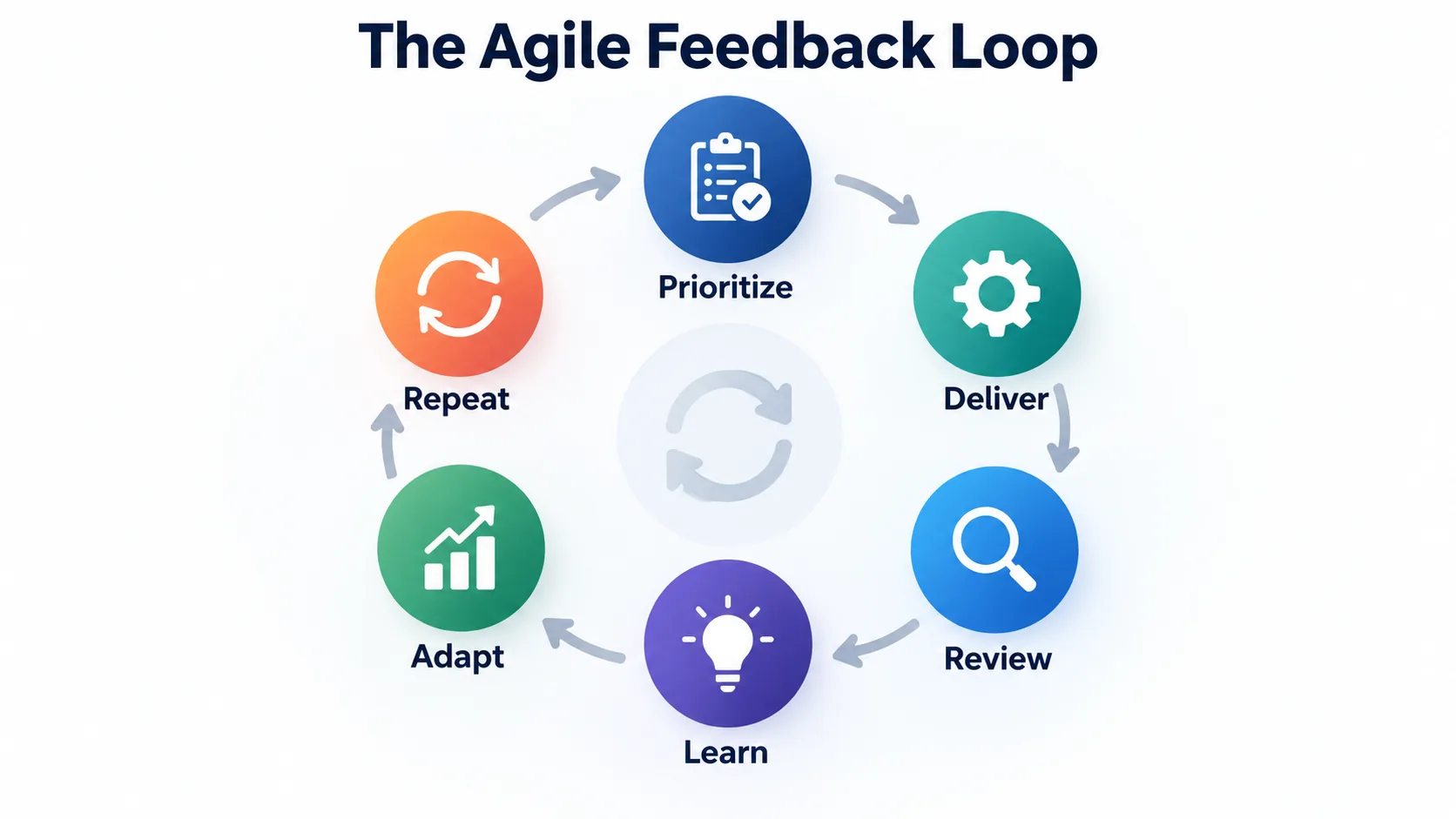
A simple feedback loop looks like this:
Prioritize → Deliver → Review → Learn → Adapt → Repeat
The objective is not simply to work faster.
The objective is to improve the team’s ability to deliver the right value while responding intelligently to new information.
Agile Is a Mindset, Not a Single Methodology
One of the most important things to understand is that there is no single universal process.
The movement provides values and principles.
Different frameworks and methods provide specific practices for applying those ideas.
For example:
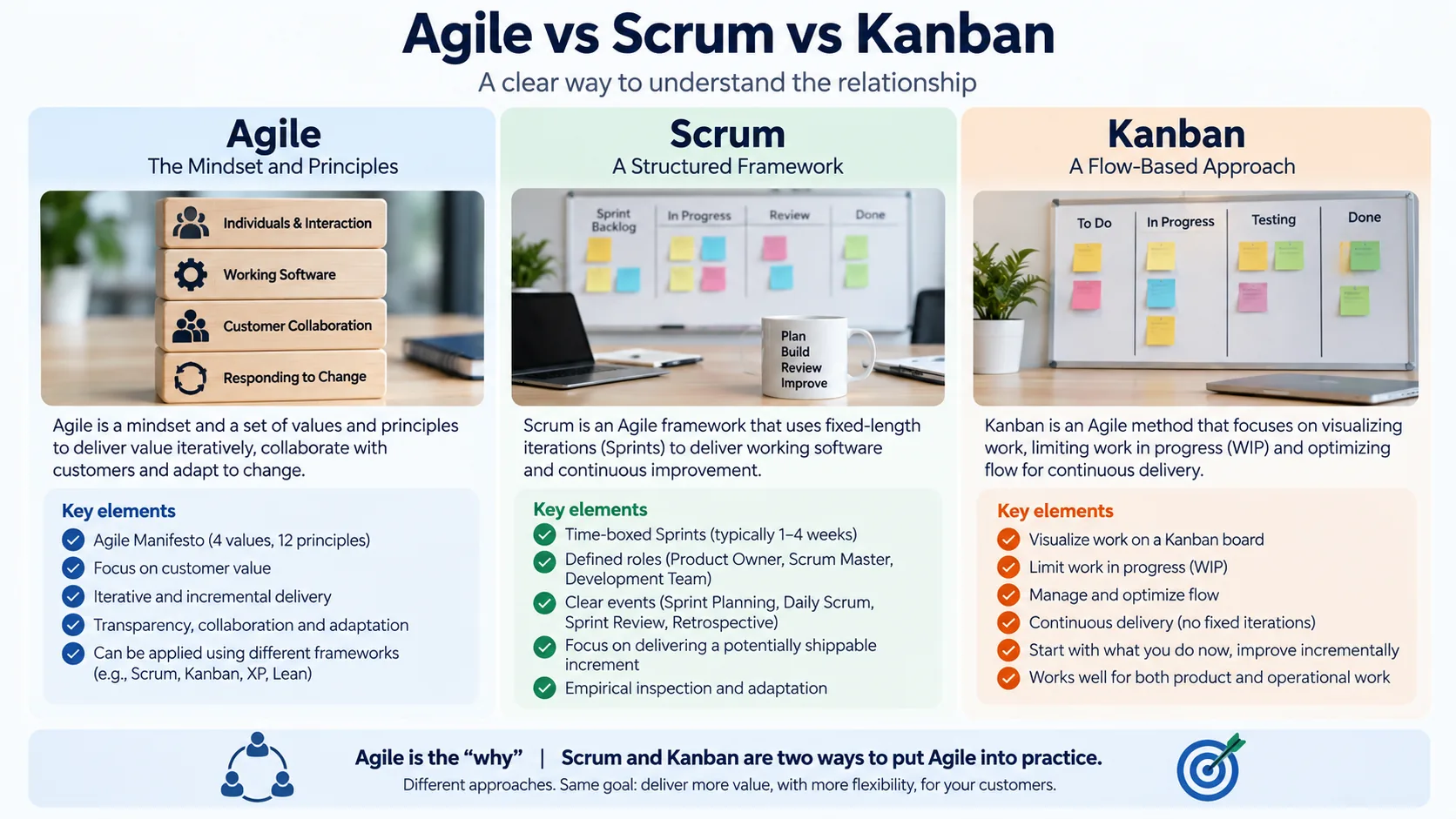
- Scrum uses Sprints, defined accountabilities, events and artifacts.
- Kanban emphasizes workflow visualization, managing flow and limiting work in progress.
- Extreme Programming (XP) emphasizes engineering practices and rapid feedback in software development.
- SAFe addresses coordination and alignment across multiple teams and larger organizations.
This distinction matters because a team can follow Scrum events mechanically without becoming truly adaptive.
Likewise, another team might use Kanban or a tailored approach while demonstrating those principles strongly.
Where Did Agile Come From?
The modern movement is closely associated with the Manifesto for Agile Software Development.
In February 2001, seventeen software practitioners met in Snowbird, Utah. They represented different lightweight approaches to software development but shared concerns about heavyweight development processes that could make adapting to change difficult.
The result was a short manifesto expressing four values supported by twelve principles.
The manifesto did not prescribe Scrum, Sprints, story points, stand-ups or a particular software tool.
Instead, it established priorities for how software teams should think about people, working results, customers and change.
The 4 Values of the Agile Manifesto
The Agile Manifesto establishes four value statements.
Importantly, the manifesto does not say that the items on the right have no value. It says the items on the left should receive greater emphasis.
1. Individuals and Interactions Over Processes and Tools
Processes and tools are useful, but they cannot replace effective communication and collaboration.
An organization can buy sophisticated project-management software and design detailed workflows, but those investments will not compensate for teams that cannot communicate, make decisions or solve problems together.
2. Working Software Over Comprehensive Documentation
The original manifesto is explicitly about software development, so it uses the term working software.
The principle does not mean documentation should disappear.
It means documentation should support delivery rather than becoming a substitute for delivering something that works.
In broader product and business contexts, organizations often interpret this idea as emphasizing usable outcomes and demonstrated value over excessive documentation.
3. Customer Collaboration Over Contract Negotiation
Contracts and agreements remain important.
Agile emphasizes maintaining collaboration with customers and stakeholders throughout delivery rather than assuming everything can be perfectly specified at the beginning.
Frequent interaction helps teams discover misunderstandings and changing needs earlier.
4. Responding to Change Over Following a Plan
Agile does not reject planning.
It rejects the assumption that following the original plan is automatically more important than responding to valuable new information.
Teams still plan, but planning happens repeatedly as understanding improves.
The 12 Principles Behind Agile
The Agile Manifesto is supported by twelve principles originally written for software development.
They can be understood through several broader themes.
Deliver Value Early and Frequently
The first principles emphasize satisfying customers through early and continuous delivery and delivering working results frequently.
Smaller deliveries create opportunities to learn before too much time or investment has been committed.
Welcome Useful Change
This approach recognizes that requirements can change as customers, technology and markets evolve.
Rather than treating every change as a failure of planning, teams evaluate whether responding to that change creates greater value.
Collaborate Closely
The original principles emphasize close collaboration between business people and developers.
Modern teams may include product managers, engineers, designers, operations specialists, security experts, data professionals and other stakeholders.
The underlying idea remains the same: reduce organizational handoffs and improve communication between the people defining value and those delivering it.
Build Around Motivated People
The principles emphasize creating an environment where capable people have the support and trust needed to do their work.
This does not mean eliminating accountability.
It means avoiding unnecessary micromanagement and enabling teams to make appropriate decisions close to the work.
Measure Progress Through Real Results
Completing documents, attending meetings or reporting that a project is “80% complete” does not necessarily prove that value has been delivered.
The principles emphasize working results as a key measure of progress.
Maintain a Sustainable Pace
Agility should not depend on permanent urgency or repeated periods of unsustainable workload.
A team needs a pace it can maintain while continuing to deliver quality work.
Invest in Technical Excellence
Moving quickly today while accumulating uncontrolled technical problems can make tomorrow’s changes slower and more expensive.
Technical excellence and good design therefore support long-term adaptability.
Keep Things Simple
One of the original principles describes simplicity as maximizing the amount of work not done.
Teams should challenge unnecessary features, handoffs, reports, approvals and complexity.
Enable Teams to Organize Their Work
The approach places significant emphasis on teams being able to determine how best to accomplish their objectives within appropriate organizational boundaries.
Reflect and Improve Regularly
Teams should periodically examine how they work and make practical adjustments.
Continuous improvement is therefore built into the approach itself rather than treated as a separate improvement project.
How Does Agile Work?
These approaches vary, but many share a common pattern.
- Identify the outcome or problem.
- Prioritize the most valuable work.
- Break large work into smaller pieces.
- Deliver or demonstrate something useful.
- Gather feedback and evidence.
- Inspect both the result and the process.
- Adjust priorities and plans.
- Repeat.
This creates a feedback system rather than a one-direction delivery process.
Iterative vs Incremental: What Is the Difference?
The terms iterative and incremental are frequently used together, but they describe different ideas.
Iterative Development
Iterative development means revisiting and improving work as new information becomes available.
A team may create something, evaluate it, learn from it and improve it in another iteration.
Incremental Development
Incremental development means building a product through a sequence of usable additions.
Each increment adds capability to what already exists.
Agile Often Combines Both
Many adaptive approaches are both iterative and incremental.
The team delivers smaller pieces while also refining its understanding and solution over time.
However, this does not necessarily mean every team works in fixed-length iterations. Kanban, for example, can operate through continuous flow.
What Is Scrum?
Scrum is a lightweight framework that helps people, teams and organizations generate value through adaptive solutions for complex problems.
Scrum is one way to work in an Agile manner, but Scrum and Agile are not synonyms.
According to the official Scrum Guide, Scrum is based on empiricism and Lean thinking and uses an iterative, incremental approach.
The Scrum Team
A Scrum Team consists of:
- Product Owner
- Scrum Master
- Developers
These are Scrum accountabilities, not universal Agile roles.
A RACI matrix should not be used to redefine Scrum accountabilities. However, it can help clarify responsibilities that sit outside the Scrum Team, such as architecture approval, security governance, funding decisions, production approval and cross-team dependencies. See our RACI example for Agile and Scrum governance for a practical illustration.
Scrum Events
Scrum uses the Sprint as a container for its other events:
- Sprint Planning
- Daily Scrum
- Sprint Review
- Sprint Retrospective
Sprints are fixed-length events of one month or less.
Scrum Artifacts
Scrum defines three artifacts:
- Product Backlog
- Sprint Backlog
- Increment
Each artifact also has an associated commitment: Product Goal, Sprint Goal and Definition of Done.
The important conceptual distinction is simple:
Agile = broader values and principles.
Scrum = a specific framework that can help teams apply Agile thinking.
What Is Kanban?
Kanban focuses heavily on understanding and improving the flow of work. The official Kanban Guide provides the current reference for Kanban practices and flow-based value delivery.
A team commonly visualizes its workflow on a board representing stages such as:
To Do → In Progress → Review → Done
However, Kanban is more than simply putting tasks on a board.
Important ideas include:
- Visualizing workflow
- Limiting work in progress (WIP)
- Managing flow
- Identifying bottlenecks
- Finishing work instead of continually starting more work
- Improving the system over time
Unlike Scrum, Kanban does not require Sprints.
Work can move through the system continuously.
Scrum vs Kanban
| Area | Scrum | Kanban |
|---|---|---|
| Delivery model | Fixed-length Sprints | Continuous flow |
| Defined accountabilities | Yes | Not prescribed in the same way |
| Work visualization | Commonly used | Core practice |
| WIP management | Managed through Sprint planning and team practices | Explicit WIP limits are central |
| Change | Sprint Goal should not be endangered during a Sprint | New work can enter according to workflow policies and capacity |
| Best fit | Teams benefiting from a regular inspection and planning cadence | Teams benefiting from continuous flow and explicit flow management |
Neither approach is automatically better.
The appropriate choice depends on the nature of the work.
Other Agile Approaches
Extreme Programming (XP)
Extreme Programming is strongly associated with software engineering practices designed to improve quality and responsiveness.
Practices associated with XP include pair programming, continuous integration, refactoring and test-driven development.
Lean Thinking
Lean and Agile have distinct histories, but modern Agile practices draw heavily on Lean concepts such as flow, limiting waste, delivering value and continuous improvement.
SAFe
When many teams need to coordinate around shared products, platforms or value streams, organizations may adopt approaches designed for larger-scale coordination.
The Scaled Agile Framework (SAFe) is one such framework.
Rather than duplicating SAFe here, see our complete SAFe guide and our SAFe PI Planning guide for the enterprise-scaling perspective. When you need the event structure itself, use the two-day PI Planning schedule and session template.
Agile vs Waterfall
Agile and Waterfall are often presented as opposites, but real delivery environments can be more nuanced.
Waterfall generally describes a more sequential approach in which major phases are planned and completed in sequence.
Agile approaches use shorter feedback loops and adapt planning as learning occurs.
| Dimension | Predictive / Waterfall | Agile |
|---|---|---|
| Planning | Greater planning upfront | Planning progressively refined |
| Requirements | Prefer stability | Can accommodate evolution |
| Delivery | Often larger phase-based releases | Smaller, more frequent increments |
| Feedback | Often tied to phases and milestones | Frequent feedback loops |
| Change | Usually controlled against an established baseline | Expected and evaluated throughout delivery |
| Best suited to | Work with greater predictability | Work involving uncertainty and learning |
For a deeper comparison, see our guide to Waterfall and the V-Model.
Agile Does Not Mean No Planning
This misconception deserves special attention.
Agile teams plan frequently.
What changes is when planning happens and how much detail is considered useful at each point.
A team may have:
- A long-term product direction
- A roadmap
- Release planning
- Iteration or Sprint planning
- Daily coordination
The difference is that plans can be refined as evidence changes.
Agility means adapting plans intelligently, not working without a plan.
Agile Does Not Mean No Documentation
Another common misconception is that Agile discourages documentation.
It does not.
The manifesto says working software is valued more than comprehensive documentation. It does not say documentation has no value.
Useful documentation may include:
- Architecture decisions
- Acceptance criteria
- Security requirements
- Regulatory evidence
- Operating procedures
- API documentation
- User guidance
The Agile question is:
Does this documentation help us deliver, operate, understand or govern the product?
If yes, it may be valuable.
Agile Does Not Mean Changing Everything Constantly
Welcoming change does not mean accepting every request immediately.
Teams still prioritize.
A new request should be evaluated against customer value, strategic objectives, capacity, risk and existing commitments.
Agility is disciplined adaptability, not permanent instability.
Benefits of Agile
When Agile is appropriate for the work and implemented effectively, it can create several advantages.
Earlier Feedback
Delivering or demonstrating work earlier lets customers and stakeholders react before the team has invested heavily in the wrong solution.
Better Adaptability
Plans and priorities can change as the team learns more about customers, technology or the business environment.
Earlier Value Delivery
Incremental delivery can make useful capabilities available before the entire product or project is complete.
Greater Transparency
Backlogs, workflow visualization, reviews and frequent delivery can make progress and problems more visible.
Continuous Improvement
Regular reflection gives teams an explicit mechanism for improving how they work.
Reduced Risk Through Smaller Decisions
Smaller increments can reduce the amount of investment committed before assumptions are tested.
However, these are potential benefits rather than guarantees. Simply renaming meetings or adopting an Agile tool does not automatically create them.
What Are the Limitations of Agile?
Agile is not automatically the best approach for every type of work.
Potential challenges include:
- Stakeholders may struggle with evolving scope.
- Teams need regular access to useful feedback.
- Dependencies can make incremental delivery difficult.
- Weak product ownership can create constantly changing priorities.
- Large organizations may impose governance processes that slow decisions.
- Teams can confuse flexibility with lack of discipline.
- Scaling coordination across many teams can become complex.
This approach also cannot remove fundamental constraints such as poor technical architecture, insufficient skills, unclear strategy or chronic organizational bottlenecks.
When Should You Use Agile?
This way of working tends to be particularly useful when:
- Requirements are expected to evolve.
- Customers can provide meaningful feedback.
- The solution involves uncertainty.
- Work can be divided into smaller valuable increments.
- Priorities may change as the organization learns.
- Cross-functional collaboration is possible.
When Might a Predictive Approach Be Better?
A more predictive approach may be appropriate when:
- The required outcome and solution are highly stable.
- Changes are extremely expensive once execution begins.
- The work must follow a strongly sequential physical process.
- Contracts or governance require tightly controlled baselines.
- Incremental delivery provides little practical value.
The decision should therefore be based on the characteristics of the work rather than an assumption that Agile is always more modern or superior.
What Is Hybrid Project Management?
Organizations do not always need to choose between a completely predictive model and a completely adaptive one.
A hybrid approach combines elements of different delivery models.
For example, an organization might maintain fixed regulatory milestones while using iterative development inside those boundaries.
Another program might use predictive planning for physical infrastructure while software components are developed iteratively.
The objective should not be to label the model “hybrid.”
The objective is to select practices that fit the work, risks, dependencies and governance environment.
Agile Projects vs Agile Products
The movement originated in software development, but many modern organizations increasingly organize digital work around long-lived products rather than temporary projects.
A project typically has a defined beginning and end.
A product may continue evolving for years.
Product-oriented teams therefore focus not only on completing a scope but on continuously improving outcomes for customers and the business.
This reinforces an important shift:
Output asks: What did we deliver?
Outcome asks: What changed because we delivered it?
How to Start Using Agile
1. Start With the Problem, Not the Framework
Do not begin by asking:
“How can we implement Scrum?”
Start by asking:
“What prevents us from delivering value effectively today?”
The problem might be slow feedback, excessive work in progress, unclear priorities, long approval chains or weak collaboration.
2. Understand Agile Values and Principles
Teams should understand why these practices exist before adopting ceremonies and tools.
Otherwise, the approach can become another compliance process.
3. Understand the Nature of Your Work
Ask:
- How uncertain are the requirements?
- How quickly can we get feedback?
- Can we deliver incrementally?
- How frequently do priorities change?
- What dependencies exist?
- What governance constraints apply?
4. Choose an Appropriate Approach
Scrum may fit teams that benefit from a regular inspection and planning cadence.
Kanban may fit continuous-flow environments.
Some teams may need a hybrid model.
Large organizations may require additional coordination mechanisms.
5. Make Work Visible
Teams should understand:
- What is waiting?
- What is being worked on?
- What is blocked?
- What is finished?
Visibility makes bottlenecks and competing priorities easier to identify.
6. Limit Work in Progress
Starting more work does not necessarily mean completing more work.
Too much work in progress increases context switching, queues and delays.
Encourage teams to finish valuable work before continually starting new work.
7. Create Short Feedback Loops
Show work to customers and stakeholders regularly.
Ask what has been learned and what should change.
8. Measure Flow and Outcomes
Useful measurements may include:
- Cycle time
- Lead time
- Throughput
- Work in progress
- Quality indicators
- Customer outcomes
- Business outcomes
Avoid turning a single metric into a target that teams optimize at the expense of real value.
9. Improve Continuously
Adoption should itself be adaptive.
Inspect whether your practices are solving real problems and modify them when necessary.
Try a 2-Week Agile Experiment
If your team is unsure whether these practices will help, test a small change before launching a large transformation program.
- Choose one delivery problem. Examples include slow feedback, too much work in progress, unclear priorities or long approval delays.
- Set one measurable outcome. For example, reduce cycle time, finish more work before starting new work, or obtain stakeholder feedback within two weeks.
- Limit work in progress. Make current work visible and agree what the team will not start until priority items are finished.
- Deliver one small useful increment. Demonstrate it to a real stakeholder or customer rather than waiting for a larger release.
- Review the evidence. Compare the result with the starting problem and capture what helped, what blocked flow and what should change next.
Decision after two weeks: KEEP the practice if it improved delivery, ADAPT it if the principle helped but the implementation needs adjustment, or STOP it if it adds process without improving outcomes.
The goal is not to prove that one framework is correct. The goal is to create a short feedback loop about how your team works.
What Makes an Effective Agile Team?
Tools and frameworks matter less than the environment in which the team operates.
Effective teams commonly need:
- Clear goals
- Customer access
- Cross-functional capability
- Decision-making authority
- Open communication
- Technical quality
- Manageable work in progress
- Psychological safety
- Continuous learning
For a deeper discussion of team design and collaboration, see our guide to building effective Agile teams.
Agile at Scale
Practices that work for one team do not automatically solve coordination across dozens or hundreds of teams.
Large-scale environments introduce questions involving:
- Strategy alignment
- Dependencies
- Architecture
- Portfolio prioritization
- Funding
- Governance
- Cross-team planning
Scaling approaches attempt to address these challenges.
SAFe is one example, but this broad guide should not duplicate the subject.
Continue with our SAFe guide if your focus is enterprise agility, our PI Planning guide if you want to understand multi-team planning in SAFe, or use the practical PI Planning checklist to prepare, run and follow up on the event.
Agile and DevOps Are Related but Different
Agile focuses broadly on adaptive value delivery, feedback and collaboration.
DevOps focuses heavily on improving the flow between software development and operations through culture, engineering practices and automation.
They often complement each other.
A team may become good at planning software iteratively but still have a slow manual release process. DevOps practices can help address that delivery constraint.
See our DevOps guide for a deeper explanation.
Agile in the Age of AI
Artificial intelligence is changing some of the tools teams use for planning, analysis, software development, testing and knowledge work.
It does not remove the fundamental need for Agile principles.
In fact, faster production can make prioritization and feedback even more important.
If teams can create outputs faster but cannot determine whether those outputs create value, productivity alone does not solve the problem.
AI can assist teams, but product judgment, customer understanding, governance and accountability remain important.
To explore this further, see our guide to AI in Project Management
Common Agile Mistakes
Calling Every Meeting a Ceremony
The broader approach does not prescribe a universal set of ceremonies.
Scrum defines specific events. Other approaches use different practices.
Measuring Productivity by Story Points
Story points are sometimes used by teams for relative estimation.
They should not automatically become a productivity score for comparing teams or individuals.
Changing Priorities Every Day
Responding to change does not mean creating constant disruption.
Teams need enough stability to finish valuable work.
Ignoring Technical Quality
Delivering quickly while allowing quality problems to accumulate eventually reduces adaptability.
Copying Another Organization’s Framework
Practices should fit the context, not simply imitate a successful company.
Doing Agile Instead of Becoming More Agile
A company can run Sprints, use Jira, hold stand-ups and still have slow decisions, overloaded teams and weak customer feedback.
The purpose is not to perform rituals.
The purpose is to improve the organization’s ability to learn and deliver value.
Agile in 2026 and Beyond
Modern practice increasingly extends beyond the original team-level software-development context.
Current areas of emphasis include:
- Product-oriented delivery
- Distributed and hybrid teams
- Psychological safety and team empowerment
- Flow and outcome-based measurement
- DevOps and continuous delivery
- Enterprise agility
- AI-assisted delivery
- Fit-for-purpose and hybrid delivery models
These developments do not replace the Agile Manifesto.
They show how organizations are adapting its underlying ideas to new technology, organizational structures and delivery environments.
Frequently Asked Questions About Agile
What is Agile in simple terms?
Agile is a way of working that delivers value in smaller pieces, gathers feedback frequently and adjusts plans as teams learn more.
What are the four values of Agile?
The four Agile Manifesto values prioritize individuals and interactions, working software, customer collaboration and responding to change while recognizing that processes, documentation, contracts and plans still have value.
Is Agile a methodology?
Agile is better understood as a mindset based on values and principles rather than one specific methodology. Scrum, Kanban and XP are different approaches that can support Agile ways of working.
Is Scrum the same as Agile?
No. Agile is the broader philosophy. Scrum is a specific framework with defined accountabilities, events and artifacts.
Does Agile mean no planning?
No. Agile teams plan repeatedly and adjust plans as information changes. The difference is not the absence of planning but the willingness to refine plans based on learning.
Does Agile mean no documentation?
No. Agile emphasizes useful working results over excessive documentation. Documentation that supports delivery, operation, governance, security or knowledge transfer can still be valuable.
What is the difference between Agile and Waterfall?
Waterfall generally emphasizes sequential phases and greater upfront definition. Agile uses shorter feedback loops, incremental delivery and adaptive planning. Hybrid approaches can combine elements of both.
What is the difference between Scrum and Kanban?
Scrum organizes work around fixed-length Sprints and defines specific accountabilities, events and artifacts. Kanban emphasizes visualizing workflow, limiting work in progress and improving continuous flow without requiring Sprints.
Can Agile be used outside software development?
The Agile Manifesto was written specifically for software development. However, many of its ideas—short feedback loops, collaboration, incremental delivery, prioritization and continuous improvement—are now applied to other forms of product and knowledge work.
When should Agile not be used?
Agile may provide less advantage when requirements and solutions are highly predictable, incremental delivery is impractical, feedback provides little additional value or the work must follow a strongly sequential process. The delivery model should fit the work rather than being selected because of a label.
What is the main goal of Agile?
The goal is not simply speed. Agile aims to improve the ability to deliver valuable outcomes while learning and adapting as circumstances change.
Conclusion
Agile is fundamentally about learning, value and adaptability.
Its roots are the four values and twelve principles of the Agile Manifesto, not a particular project-management tool, meeting structure or certification. Professionals developing broader project-leadership credentials can also explore our PMP certification guide for 2026.
Scrum, Kanban, XP and scaling frameworks provide different ways to put Agile thinking into practice, but the framework itself is not the objective.
A useful way to remember Agile is:
Prioritize → Deliver → Review → Learn → Adapt → Repeat.
Organizations become more Agile when they shorten feedback loops, make work visible, empower capable teams, maintain quality, reduce unnecessary work and change direction when evidence shows there is a better path.
The question is therefore not simply:
“Are we doing Agile?”
A better question is:
“Are we getting better at delivering value and adapting to what we learn?”
Agile methods become more valuable when the wider organization can adapt its strategy, funding, leadership and operating model. Explore our complete guide to business agility to connect team-level Agile practices with enterprise adaptability.
Continue Learning
Continue exploring TechTeamSynergy with these related guides.
Comments are closed.