
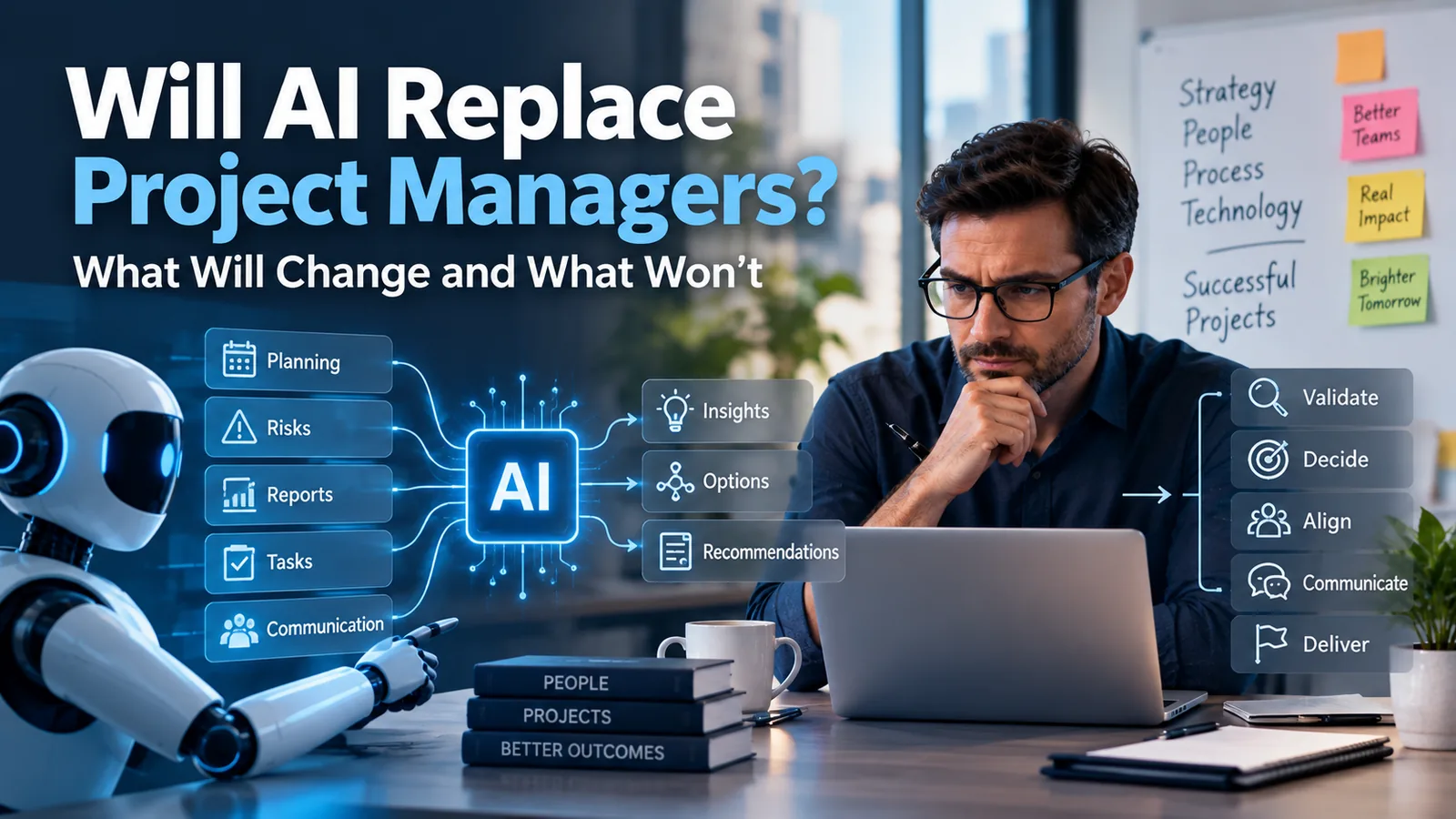
Will AI replace project managers? Based on what AI can do today, the more useful answer is that AI is likely to reshape project management before it replaces the project manager role itself. Administrative work, reporting, data consolidation and some analysis can increasingly be automated or accelerated. But project leadership also depends on accountability, negotiation, organizational context, stakeholder alignment and decisions under uncertainty.
The distinction that matters is simple: task automation is not the same as role replacement. The future PM is likely to spend less time collecting information and more time validating it, challenging assumptions and turning analysis into accountable decisions.
Will AI Replace Project Managers? The Short Answer
AI can already perform parts of project work that are structured, repetitive and data-heavy. It can summarize meetings, draft reports, consolidate updates, identify patterns and suggest next steps. Those capabilities can reduce the administrative load carried by project teams.
Replacing an entire project manager is a different problem. Projects are temporary organizations full of incomplete information, competing priorities, changing constraints and people with different incentives. A model can generate recommendations; an organization still needs someone with authority to validate assumptions, negotiate trade-offs and own the consequences.
For the broader foundation behind these capabilities, see our guide to artificial intelligence. For project-specific use cases, see AI in Project Management. This article focuses specifically on the future of the role.
Why This Question Matters Now
Generative AI, copilots and increasingly agentic systems are moving from isolated experiments into everyday workflows. Project teams can use AI for reporting, planning assistance, risk analysis, communication preparation and knowledge retrieval. The Project Management Institute is actively addressing AI in the profession, while the World Economic Forum continues to track how AI changes tasks and skills across knowledge work. The important question is therefore not whether project management will use AI, but which parts of the job will change most.
What Does a Project Manager Actually Do?
A project manager is not simply a scheduler or report writer. The role combines planning, coordination, analysis, communication, governance, leadership, decision-making and stakeholder management. Some of those activities are highly structured; others depend on authority, trust and organizational context.
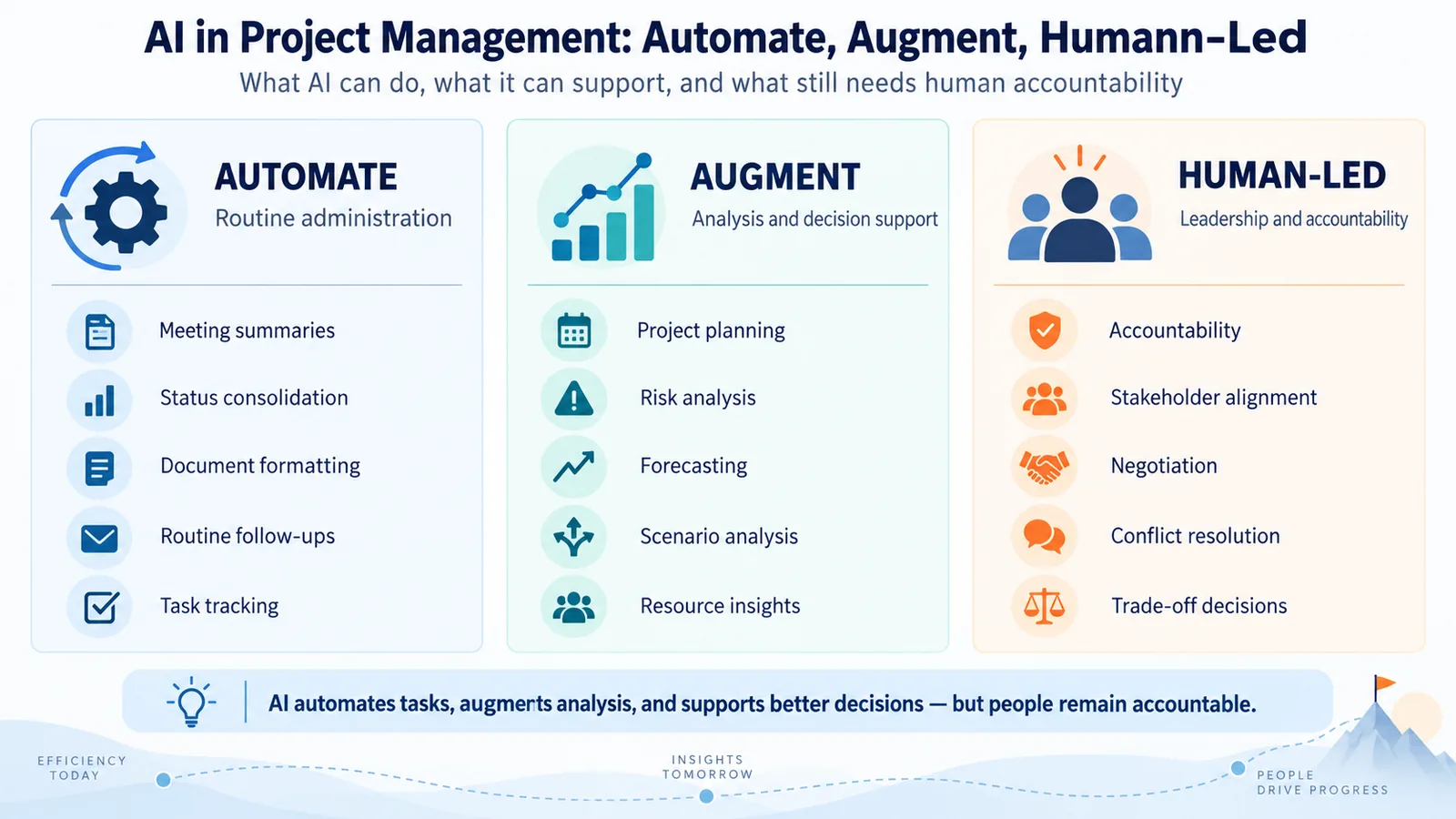
Project Management Tasks AI Can Automate
Meeting Notes and Summaries
AI can transcribe discussions, summarize decisions and extract actions. The limitation is context: a transcript may capture what was said without understanding what was politically sensitive, tentative or intentionally left unresolved.
Routine Status Reporting
When source data is reliable, AI can draft recurring status updates and highlight changes. Human review remains necessary because a polished report can still contain misleading conclusions.
Data Collection and Consolidation
AI can combine updates from multiple sources, normalize text and surface inconsistencies. This is especially valuable where PMs currently spend hours assembling information rather than interpreting it.
Schedule and Task Administration
AI can suggest dates, identify overdue actions and prepare follow-ups. It cannot independently resolve every dependency because priority often depends on business context that is not fully represented in project systems.
Basic Documentation and Follow-Ups
Templates, minutes, action reminders and first drafts are strong automation candidates. The more consequential the message, however, the more important human review becomes.
Project Management Tasks AI Will Augment
Project Planning
AI can propose work breakdowns, dependencies, assumptions and alternative plans. The PM still needs to validate whether those plans fit the organization, constraints and delivery model.
Risk Identification and Analysis
AI can scan project information for patterns, suggest risks and help structure scenarios. Our practical guide on AI for Project Risk Management goes deeper into this workflow.
Forecasting and Scenario Analysis
Models can compare scenarios quickly and expose assumptions. Forecast quality still depends on the data, the model and the framing of the question.
Resource Analysis and Reporting
AI can help detect capacity pressure, summarize progress and draft management reporting. These outputs should support decisions rather than become automatic decisions.
Stakeholder Communication
AI can draft an executive update or adapt a message for different audiences. The project manager remains responsible for timing, tone, context and the consequences of the communication.
What AI Still Struggles to Replace
Accountability: AI can recommend an action, but organizations still assign responsibility to people and governance bodies. Stakeholder negotiation: trade-offs often depend on incentives, trust and informal influence. Organizational context: not every constraint exists in a database. Leadership and conflict resolution: project outcomes depend on relationships as well as analysis. Decisions under ambiguity: leaders frequently act before complete information exists. Ethical and governance decisions: computational capability is not the same as organizational authority.
AI vs Project Manager — Task Comparison
| Responsibility | AI capability | Human role | Likely future |
|---|---|---|---|
| Scheduling | High | Validate constraints | More automated |
| Reporting | High | Interpret and approve | AI-drafted |
| Risk analysis | Strong augmentation | Challenge and decide | AI-assisted |
| Cost forecasting | Strong augmentation | Validate assumptions | AI-assisted |
| Stakeholder communication | Drafting support | Own context and consequences | Augmented |
| Conflict management | Limited support | Negotiate and resolve | Human-led |
| Strategic alignment | Decision support | Set priorities | Human-led |
| Governance | Monitoring support | Exercise authority | Human-led |
| Leadership | Supportive | Build trust and direction | Human-led |
| Decision accountability | Recommend | Own decision | Human-led |
Which Project Management Roles Are Most Exposed to AI?
Exposure is likely to be higher where a role is concentrated on manual reporting, status collection, repetitive scheduling, document production and data consolidation. That does not make a person “replaceable”; it means the task mix is changing. Roles with broader responsibility for stakeholder alignment, business outcomes, governance, transformation, technical-business integration and leadership are likely to evolve differently because more of their value sits in judgment and accountability.
The Project Manager Role Is Likely to Change
A useful way to think about the evolution is: task coordinator → information integrator → AI-assisted decision maker → outcome-oriented project leader. Less manual administration can create more capacity for analysis and leadership, but it can also raise expectations. Faster reporting may mean leaders expect faster decisions. Better forecasting may increase the PM’s responsibility to explain assumptions and challenge weak data.
What Will the AI-Augmented Project Manager Look Like?
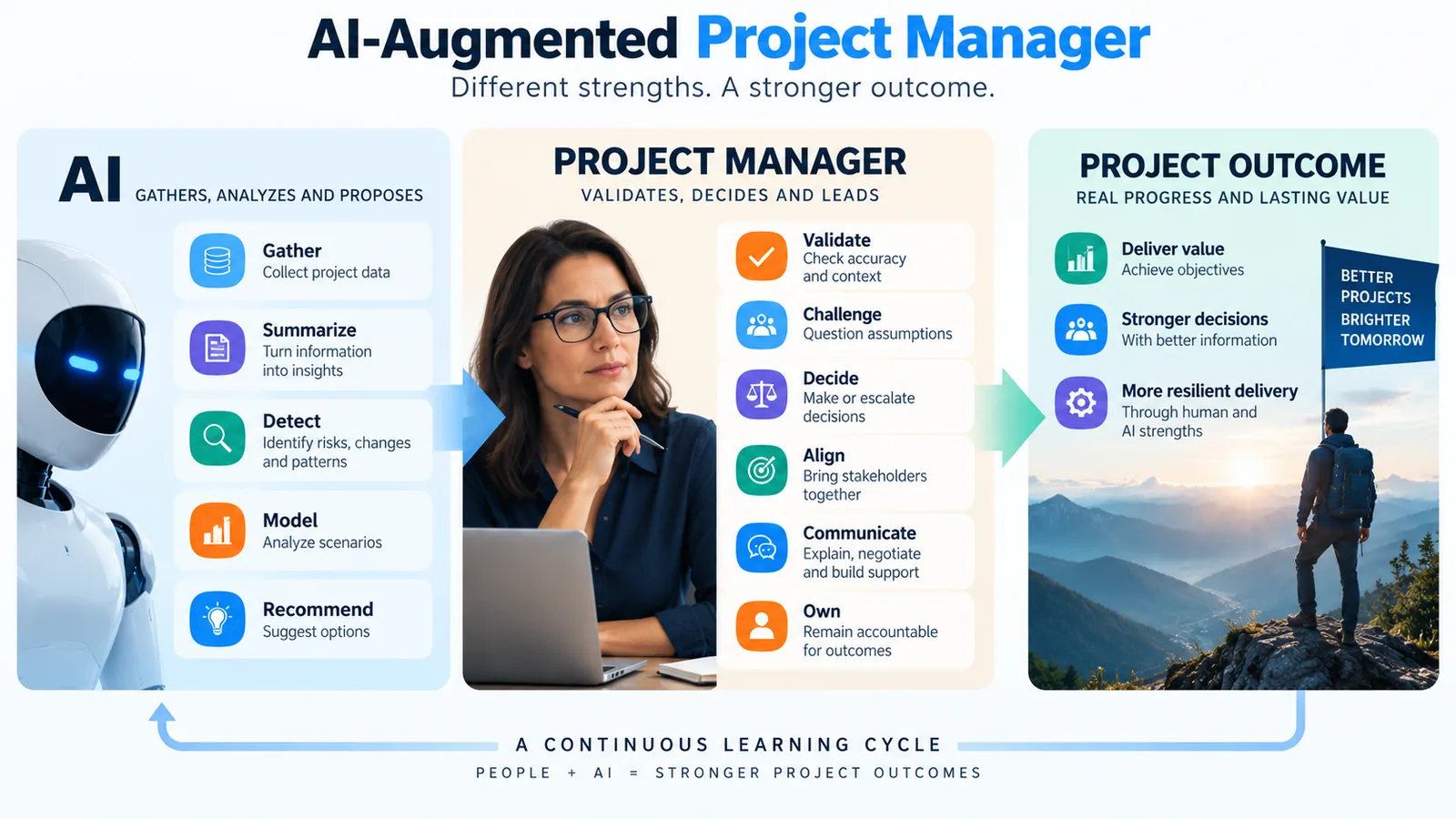
The operating model is straightforward. AI gathers, summarizes, detects patterns, models scenarios and proposes options. The project manager validates, challenges, decides, communicates, negotiates and owns outcomes. In other words: AI as copilot; human as accountable decision owner.
Will AI Replace Project Managers—or Reduce Their Number?
The question “will AI replace project managers” is also a question about productivity: if AI allows each project manager to coordinate more work, some organizations may need fewer purely administrative PM roles even while demand for project leadership continues.
It is reasonable to expect productivity gains, broader spans of coordination and redesign of some PMO processes. It is not reasonable to turn those possibilities into a precise employment forecast without strong evidence. Role disappearance and role redesign are not the same thing. AI may reduce the amount of administrative coordination required while increasing demand for governance, validation and cross-functional leadership.
What Should Project Managers Do Now?
- Use AI as a project copilot, not an unquestioned authority.
- Strengthen business judgment and stakeholder management.
- Develop enough data literacy to challenge AI-generated analysis.
- Understand AI limitations, privacy and governance requirements.
- Shift personal value from administration toward outcomes and decisions.
For hands-on practice, use these 50 AI prompts for project managers.
Practical Example — Traditional PM vs AI-Augmented PM
Consider an enterprise cloud migration. In a traditional workflow, the PM gathers updates from workstreams, consolidates risks, builds the weekly report and prepares steering material. In an AI-augmented workflow, AI consolidates updates, flags inconsistent statements, summarizes emerging risks and drafts the steering pack. The PM then validates the information, challenges assumptions, resolves dependencies, communicates trade-offs and makes or escalates decisions. Administrative effort falls; responsibility does not.
Will Agentic AI Change the Answer?
Agentic AI could automate multi-step workflows, coordinate routine actions, follow up across systems and monitor conditions continuously. That may push automation further into project operations. It still does not automatically transfer organizational authority or accountability to the system. For the broader concept, see our guide to Agentic AI.
Risks of Over-Automating Project Management
| Risk | Why it matters | Human control |
|---|---|---|
| Poor data quality | Bad inputs can create confident but weak outputs | Validate sources |
| Hallucinated conclusions | Generated claims may be unsupported | Verify material facts |
| Automation bias | Teams may over-trust recommendations | Require challenge and review |
| Loss of context | Systems may miss informal constraints | Add organizational context |
| Privacy | Projects contain sensitive information | Use approved tools and data rules |
| Unclear accountability | Automated actions can blur ownership | Define decision rights |
Enterprise adoption should follow approved security and governance practices. NIST’s AI Risk Management Framework provides a useful reference for managing AI-related risk.
Frequently Asked Questions
Will AI replace project managers?
AI is more likely to automate parts of project management and reshape the role than replace every responsibility of a project manager.
Can AI do project management?
AI can perform many project-management tasks, especially summarization, reporting, analysis and administrative support. Full project leadership also requires accountability, authority and stakeholder management.
Which project management tasks can AI automate?
Common candidates include meeting summaries, routine reporting, data consolidation, scheduling suggestions, document formatting and standard follow-ups.
Is project management a good career in the age of AI?
The role is changing. Professionals who combine AI fluency with business judgment, leadership, governance and stakeholder skills can adapt as administrative work becomes more automated.
Will AI replace PMOs?
AI may automate significant PMO reporting and coordination work, while increasing the importance of portfolio governance, standards, assurance and decision support.
Can AI manage projects autonomously?
AI can automate increasingly complex workflows, but autonomous execution does not remove the need for human governance, escalation paths and accountability.
What project management tasks still need humans?
Stakeholder negotiation, conflict resolution, leadership, governance, ethical judgment and accountable trade-off decisions remain strongly human-led.
How should project managers prepare for AI?
Learn to use AI productively, validate its outputs, strengthen business judgment and stakeholder skills, and understand data, privacy and governance constraints.
Will agentic AI replace project managers?
Agentic AI may automate more multi-step coordination, but organizational authority, negotiation and outcome accountability remain separate from automation capability.
Can AI make project decisions?
AI can recommend and sometimes execute predefined decisions. Material project decisions should have clear human decision rights and accountability.
Conclusion — AI Will Change Project Management More Than It Eliminates It
The most practical framework is: automate the administration → augment the analysis → keep humans accountable. Project managers should expect AI to remove some repetitive work and accelerate many analytical tasks. The durable part of the role is not manual coordination; it is turning information into aligned, responsible action.
Continue Learning
Continue exploring TechTeamSynergy with these related guides.