
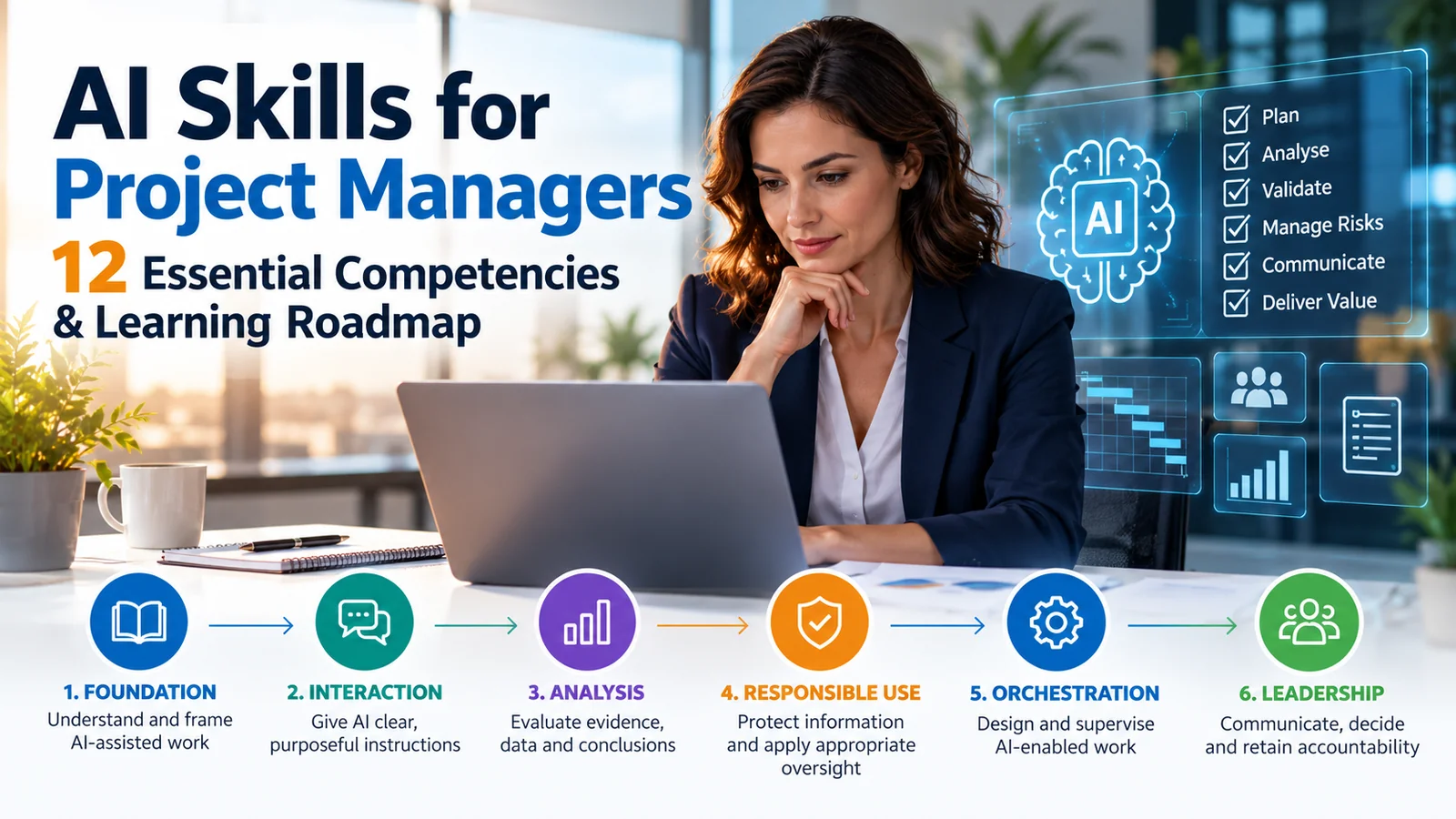
AI skills for project managers go beyond writing prompts or learning the latest software. The capabilities that matter are knowing when AI is appropriate, preparing reliable information, validating results, protecting sensitive data, designing effective workflows and making accountable decisions.
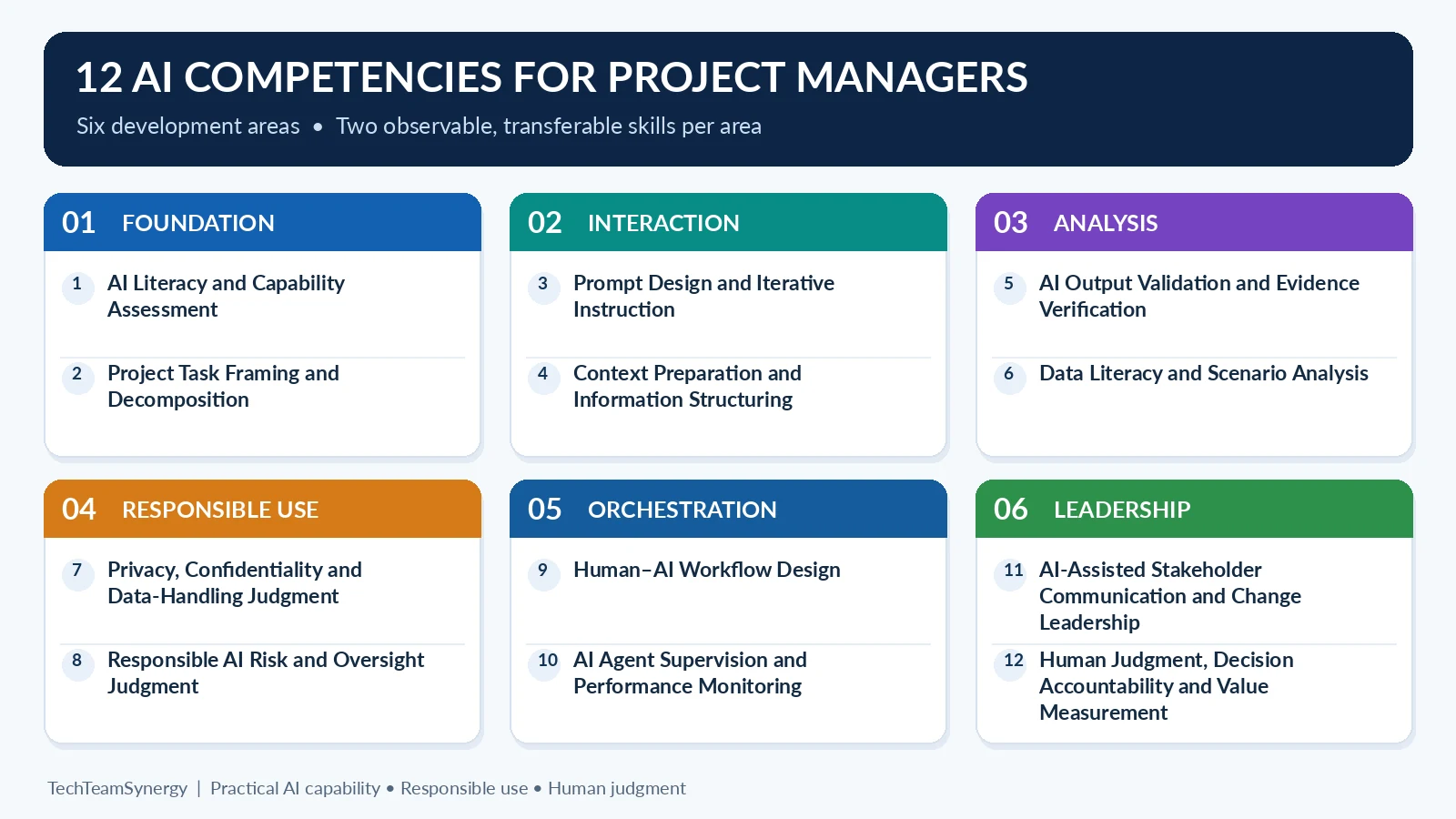
This guide defines 12 observable competencies across Foundation, Interaction, Analysis, Responsible Use, Orchestration and Leadership, then provides a proficiency self-assessment and evidence-based learning roadmap.
AI Skills for Project Managers at a Glance
| Skill | Area | Example PM Task |
|---|---|---|
| 1. AI Literacy and Capability Assessment | Foundation | Assess whether AI can group lessons learned from approved project records without replacing expert review. |
| 2. Project Task Framing and Decomposition | Foundation | Prepare a steering committee in stages: collect data, validate, analyze, draft and secure approval. |
| 3. Prompt Design and Iterative Instruction | Interaction | Draft a risk-review instruction using approved risk statements, explicit assumptions and a structured output format. |
| 4. Context Preparation and Information Structuring | Interaction | Prepare a milestone-review package with a schedule baseline, confirmed progress, dependencies and unresolved decisions. |
| 5. AI Output Validation and Evidence Verification | Analysis | Verify a generated statement that integration testing is complete against actual test records and the approved baseline. |
| 6. Data Literacy and Scenario Analysis | Analysis | Compare staffing scenarios with different cost, availability and schedule implications. |
| 7. Privacy, Confidentiality and Data-Handling Judgment | Responsible Use | Check whether supplier pricing may be included in an AI-assisted proposal comparison. |
| 8. Responsible AI Risk and Oversight Judgment | Responsible Use | Review an AI-generated staffing recommendation with material people and delivery implications. |
| 9. Human–AI Workflow Design | Orchestration | Meeting follow-up: AI drafts minutes; an owner reviews; participants confirm assignments; an authorized person updates the system. |
| 10. AI Agent Supervision and Performance Monitoring | Orchestration | A reporting agent may read approved records and draft summaries but must not publish or alter a baseline independently. |
| 11. AI-Assisted Stakeholder Communication and Change Leadership | Leadership | Explain a possible AI-assisted delay forecast to sponsors while distinguishing observations from projections. |
| 12. Human Judgment, Decision Accountability and Value Measurement | Leadership | Compare two delivery scenarios with differing risk, dependencies, resources and strategic impacts. |
Developing AI skills for project managers starts with an appropriate use case, verifiable project evidence and clear human accountability. The competencies below show how to move from basic understanding to demonstrable project work.
AI Skill vs AI Tool: Know the Difference
What Makes Something an AI Skill?
A skill is something you can practise and transfer between platforms: prompt design, evidence verification, workflow design or professional judgment. AI literacy includes knowledge of generative AI limitations, while ChatGPT, Copilot and Gemini are tools rather than competencies.
Skills, Knowledge and Tools: Three Examples
Skill: prompt design. Knowledge: limitations of generative AI. Tool: an approved AI assistant. Tools evolve faster than the professional capability to frame and validate work.
AI Skills for Project Managers: The Competency Framework
The following six-area, 12-skill model is a TechTeamSynergy editorial framework, not an official PMI, NIST or ISO certification. It reflects transferable skills for practical project work, informed by professional guidance on responsible AI use.
Foundation: Understand and Frame AI-Assisted Work
Skill 1 — AI Literacy and Capability Assessment
What it means. Understand AI capabilities and limitations and judge whether AI fits a project task.
Why it matters. Introducing AI without suitability checks can increase verification effort or create misleading outputs.
Project example. Assess whether AI can group lessons learned from approved project records without replacing expert review.
What good looks like. Produce a brief assessment of expected value, limitations, data concerns, required verification and accountable reviewer.
How to practise it. Select three familiar project activities. For each, record where AI can help, how it could fail and what human review remains necessary.
For related project-management applications, see this practical TechTeamSynergy guide.
Skill 2 — Project Task Framing and Decomposition
What it means. Translate an ambiguous objective into discrete activities with inputs, dependencies, outputs, decisions and responsibilities.
Why it matters. Clear task decomposition prevents important dependencies from being lost inside polished AI-generated drafts.
Project example. Prepare a steering committee in stages: collect data, validate, analyze, draft and secure approval.
What good looks like. Create a task map identifying AI-assisted steps, human-owned decisions, prerequisites and deliverables.
How to practise it. Break down an upcoming project meeting into steps; mark each as human-owned, AI-assisted or unsuitable for AI.
For related project-management applications, see this practical TechTeamSynergy guide.
Interaction: Instruct AI and Structure Context
Skill 3 — Prompt Design and Iterative Instruction
What it means. Define clear goals, relevant context, constraints, expected output, assumptions and feedback.
Why it matters. Vague prompts force systems to infer requirements and may produce confident but unusable results.
Project example. Draft a risk-review instruction using approved risk statements, explicit assumptions and a structured output format.
What good looks like. Turn a vague request into a reproducible, appropriately constrained instruction, then refine it using acceptance criteria.
How to practise it. Try two versions of a prompt for a fictional risk review; compare outputs against the same requirements.
For related project-management applications, see this practical TechTeamSynergy guide.
Skill 4 — Context Preparation and Information Structuring
What it means. Select and organize relevant project facts while documenting source dates, assumptions, exclusions and data boundaries.
Why it matters. Even a clear prompt fails when its context is incomplete, outdated or contradictory.
Project example. Prepare a milestone-review package with a schedule baseline, confirmed progress, dependencies and unresolved decisions.
What good looks like. Deliver a traceable context brief that another reviewer can understand and validate.
How to practise it. Create a fictional context package with verified facts, assumptions, constraints, missing information and exclusions.
For related project-management applications, see this practical TechTeamSynergy guide.
Analysis: Validate Evidence and Interpret Project Data
Skill 5 — AI Output Validation and Evidence Verification
What it means. Check generated statements, calculations, references and recommendations against independent, reliable evidence.
Why it matters. Polished AI writing can include obsolete figures, unsupported claims or invented sources.
Project example. Verify a generated statement that integration testing is complete against actual test records and the approved baseline.
What good looks like. Maintain a verification record separating confirmed facts, assumptions, interpretations and unsupported claims.
How to practise it. Generate a fictional status summary, then check every material claim against underlying project data.
For related project-management applications, see this practical TechTeamSynergy guide.
Skill 6 — Data Literacy and Scenario Analysis
What it means. Interpret data quality, completeness, uncertainty and sensitivity while comparing alternative project scenarios.
Why it matters. Forecast quality depends on the validity of the underlying assumptions and information.
Project example. Compare staffing scenarios with different cost, availability and schedule implications.
What good looks like. Explain input reliability, material assumptions, trade-offs, uncertainty and what the analysis cannot establish.
How to practise it. Use a small fictional capacity dataset; change a key assumption and explain the impact on the recommendation.
For related project-management applications, see this practical TechTeamSynergy guide.
For external, authoritative guidance, consult the PMI Standard for Artificial Intelligence in Portfolio, Program and Project Management, the NIST AI Risk Management Framework, and ISO/IEC 42001 on organizational AI management systems. These resources inform responsible project practice; none defines TechTeamSynergy’s 12-skill framework.
Responsible Use: Protect Data and Apply Oversight
Skill 7 — Privacy, Confidentiality and Data-Handling Judgment
What it means. Recognize sensitive information and decide whether and how it may be processed using approved AI services.
Why it matters. Projects contain supplier, employee, customer, financial and proprietary information subject to organizational restrictions.
Project example. Check whether supplier pricing may be included in an AI-assisted proposal comparison.
What good looks like. Identify permitted and restricted data, required approvals and the appropriate escalation point.
How to practise it. Classify fictional records under an example approved-use policy and document when permission is required.
For related project-management applications, see this practical TechTeamSynergy guide.
Skill 8 — Responsible AI Risk and Oversight Judgment
What it means. Identify potential AI-related impacts and establish when human review, approval, documentation or escalation is required.
Why it matters. A low-impact meeting draft and a staffing recommendation should not carry identical oversight requirements.
Project example. Review an AI-generated staffing recommendation with material people and delivery implications.
What good looks like. Determine whether AI may assist, whether human review is mandatory, when to escalate and when not to use AI.
How to practise it. Classify three hypothetical AI uses by potential impact and document proportionate approval gates.
For related project-management applications, see this practical TechTeamSynergy guide.
Orchestration: Design and Supervise AI-Enabled Work
Skill 9 — Human–AI Workflow Design
What it means. Design processes that assign appropriate work to AI, conventional automation and accountable people.
Why it matters. Automating an unclear process can multiply errors while obscuring ownership.
Project example. Meeting follow-up: AI drafts minutes; an owner reviews; participants confirm assignments; an authorized person updates the system.
What good looks like. Produce a workflow map with inputs, outputs, roles, human checkpoints, exceptions and measures.
How to practise it. Map a fictional recurring process and add one suitable AI-assisted stage with clear review and approval.
For related project-management applications, see this practical TechTeamSynergy guide.
Skill 10 — AI Agent Supervision and Performance Monitoring
What it means. Define boundaries, permissions, review gates, monitoring and exception handling for approved multistep AI agents.
Why it matters. Agent actions may extend beyond a single answer and need observable operating limits.
Project example. A reporting agent may read approved records and draft summaries but must not publish or alter a baseline independently.
What good looks like. Document authorized and prohibited actions, required approvals, performance checks and escalation routes.
How to practise it. Write an agent-supervision specification for a hypothetical draft-reporting workflow; do not deploy an agent.
For related project-management applications, see this practical TechTeamSynergy guide.
Leadership: Communicate, Decide and Remain Accountable
Skill 11 — AI-Assisted Stakeholder Communication and Change Leadership
What it means. Translate validated AI-assisted findings into accurate, audience-appropriate communication and support responsible adoption.
Why it matters. Stakeholders need clear uncertainties, decision requests and reassurance that accountability remains visible.
Project example. Explain a possible AI-assisted delay forecast to sponsors while distinguishing observations from projections.
What good looks like. Present factually validated, actionable information transparently, adapting communication without changing the underlying evidence.
How to practise it. Prepare two briefing versions for a fictional forecast, one for delivery teams and one for sponsors.
For related project-management applications, see this practical TechTeamSynergy guide.
Skill 12 — Human Judgment, Decision Accountability and Value Measurement
What it means. Challenge AI recommendations, decide with organizational context and evaluate whether AI assistance generates real project value.
Why it matters. Faster reporting is not valuable if accuracy falls, and AI cannot replace authorized business decision-making.
Project example. Compare two delivery scenarios with differing risk, dependencies, resources and strategic impacts.
What good looks like. Produce a reasoned decision record with sources, alternatives, assumptions, trade-offs, accountable owner and outcome review.
How to practise it. Prepare a one-page decision brief with a proposed measure for assessing the result.
For related project-management applications, see this practical TechTeamSynergy guide.
How to Assess Your AI Skills for Project Managers
This TechTeamSynergy developmental rubric is not a formal certification. Assess each skill independently using actual work evidence rather than an invented overall score.
| Level | Definition | Observable evidence |
|---|---|---|
| 1 — Foundational | Applies the skill with guidance | Completes supervised work and recognizes when support is needed |
| 2 — Practical | Applies it independently to routine work | Produces a usable, verified deliverable within approved boundaries |
| 3 — Advanced | Designs, reviews or improves its application | Reviews quality, coaches others and improves safeguards |
Self-Assessment Based on Evidence
For every competency, note your current level, a supporting example and one improvement opportunity. You can reasonably be advanced at output validation but foundational at agent supervision. Use the 12-skill table above as your checklist, and record proof rather than scoring yourself against other professionals.
Build Your AI Skills for Project Managers Learning Roadmap
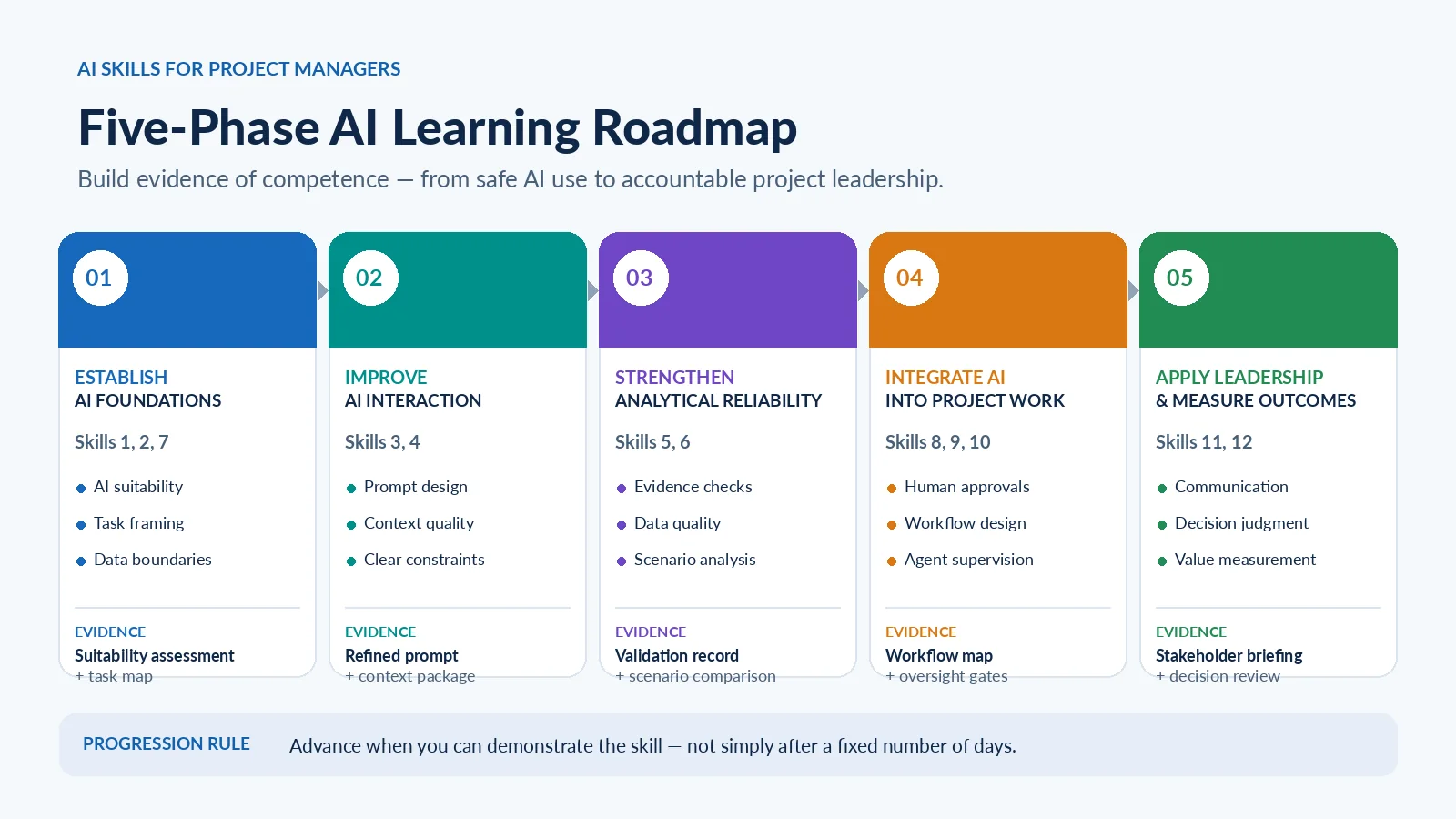
Phase 1: Establish AI Foundations
Skills: 1, 2 and 7. Goal and practice: Assess suitable uses, frame work and understand data boundaries. Evidence: Approved-use assessment and task map. Progress when you can demonstrate the result, not after an arbitrary number of days.
Phase 2: Improve AI Interaction
Skills: 3 and 4. Goal and practice: Write clearer instructions and prepare traceable context. Evidence: Improved prompt and reviewed context package. Progress when you can demonstrate the result, not after an arbitrary number of days.
Phase 3: Strengthen Analytical Reliability
Skills: 5 and 6. Goal and practice: Verify factual claims and compare data-driven alternatives. Evidence: Verification record and scenario-comparison brief. Progress when you can demonstrate the result, not after an arbitrary number of days.
Phase 4: Integrate AI into Project Work
Skills: 8, 9 and 10. Goal and practice: Design controlled workflows, approvals and agent oversight. Evidence: Human–AI workflow with monitoring criteria. Progress when you can demonstrate the result, not after an arbitrary number of days.
Phase 5: Apply Leadership and Measure Outcomes
Skills: 11 and 12. Goal and practice: Communicate validated recommendations, document decisions and review project value. Evidence: Stakeholder briefing, decision record and outcome review. Progress when you can demonstrate the result, not after an arbitrary number of days.
How to Demonstrate AI Skills Professionally
Build a Small Evidence Portfolio
Save fictional or authorized, anonymized examples: a verification record, context package, workflow map, responsible-use checklist, decision log, or before-and-after quality comparison. Never reveal customer, personal or proprietary information externally.
Describe Your Contribution Without Exaggerating
A credible description is “Designed and validated an AI-assisted project reporting workflow with human approval checkpoints.” Distinguish your contribution from work generated by a tool, and include metrics only if verified.
Common AI Skill-Building Mistakes
- Collecting tools instead of developing skills.
- Saving prompts without understanding goals or constraints.
- Trusting polished answers without evidence checks.
- Ignoring confidentiality and organizational policy.
- Automating processes before understanding their weaknesses.
- Giving agents unclear boundaries or permissions.
- Measuring generated output instead of project outcomes.
- Neglecting stakeholder communication and human judgment.
Frequently Asked Questions
What AI skills should project managers learn first?
Start with AI literacy, task framing, prompt design, output verification and safe data handling. These enable reliable use before expanding to workflows or agents.
Do project managers need coding skills to work with AI?
Not necessarily. Many useful planning, analysis and communication tasks require no code. Coding can help with specialized integrations but is not a prerequisite for this model.
Is prompt engineering still an important project-management skill?
Yes, when combined with context preparation, verification and iteration. Prompting alone does not establish reliable performance.
Which AI skills matter most for PMP professionals?
Validation, responsible judgment, stakeholder communication, workflow awareness and accountability complement established project-management capabilities. This list is not a PMI certification requirement.
How can project managers improve their AI skills?
Practise on one approved low-risk task, inspect the evidence and document what worked. Expand incrementally to analysis, controlled workflows and decisions.
Do project managers need data-analysis skills?
Basic data literacy is valuable for interpreting costs, schedules, capacity, risks and forecasts, even when specialized analysts perform advanced modeling.
Should project managers learn how to supervise AI agents?
Where approved agents are in use, understand permissions, review points, monitoring, exceptions and the human decision owner before attempting complex implementations.
How can project managers demonstrate AI skills on a resume?
Describe concrete, verified contributions such as validating AI-assisted analyses or implementing reviewed workflows. Avoid unsupported impact metrics or exaggerated autonomy claims.
Conclusion: Become an AI-Capable Project Leader
The aim is not to become an AI engineer. Develop the ability to Understand → Frame → Instruct → Validate → Orchestrate → Lead. AI supports information processing and recommendations; project professionals remain responsible for judgment, communication, accountable decisions and real delivery value.
Continue Learning
Explore related project-management AI guides to build practical capability, strengthen oversight and apply your learning.
Explore AI applications across the project lifecycle.
Compare platforms and appropriate use cases.
Practise structured prompts with real PM tasks.
Connect responsible-use skills with PMO controls.
Understand professional AI principles, oversight and accountability in project work.
Explore governed agent workflows and practical supervision controls.