
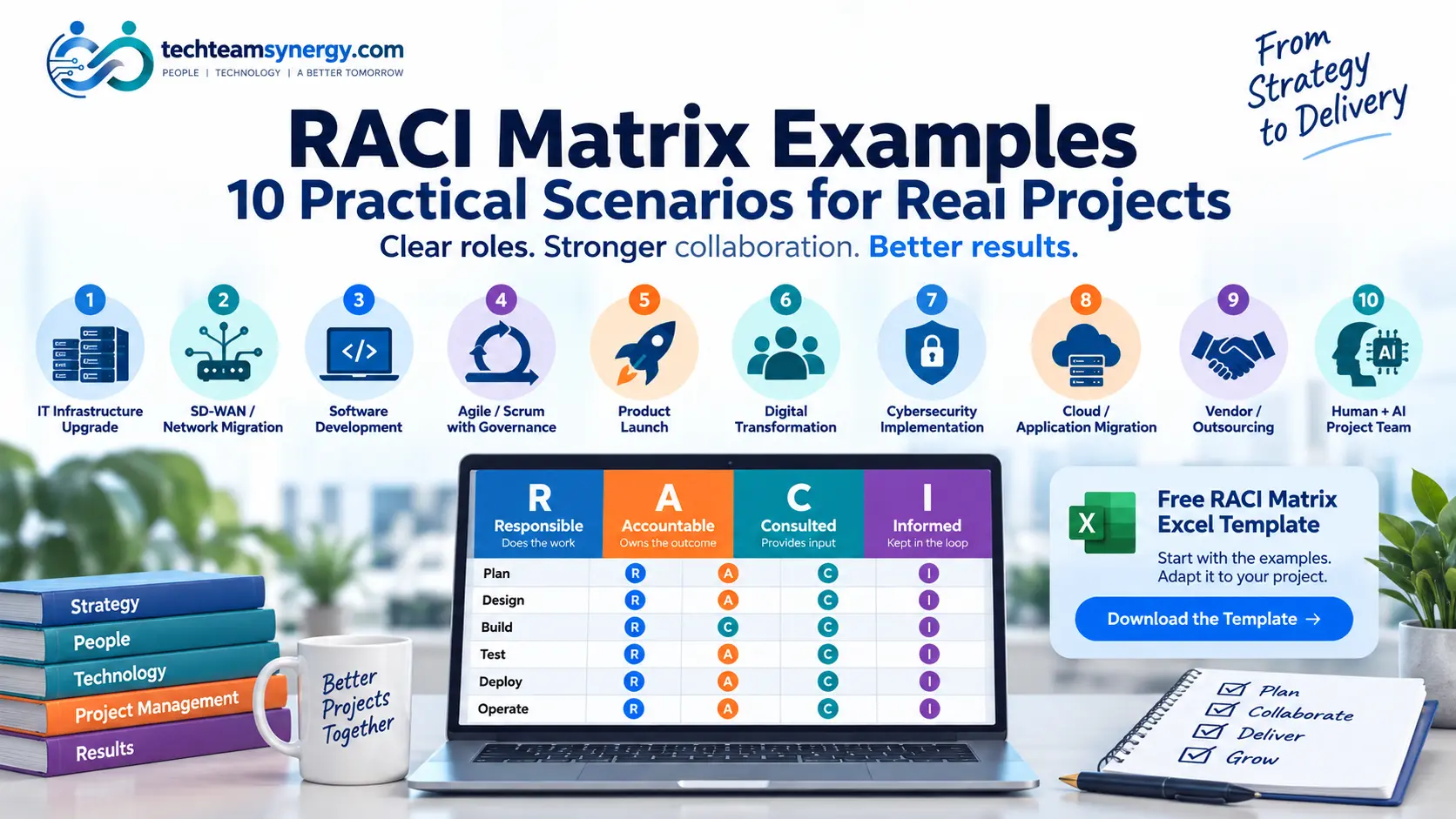
RACI matrix examples are most useful when they show how responsibility and accountability change from one real project situation to another. A matrix that works for an IT infrastructure upgrade will not necessarily fit an Agile team, a cloud migration, a vendor-led project or an AI-enabled delivery model.
RACI stands for Responsible, Accountable, Consulted and Informed. The model helps teams make ownership visible across major activities, deliverables and decisions. If you need the fundamentals first, start with our complete RACI Matrix guide. Before adapting these examples, teams with more complex support or decision needs may first need to choose between RACI, RASCI and DACI. This article focuses on worked examples you can adapt to real projects.
The examples below are intentionally practical rather than universal. Candidates strengthening their governance knowledge can connect these examples with the principles covered in our PMP certification requirements and exam guide. Your actual assignments should reflect your organization’s governance, authority, contracts, regulatory requirements and operating model. The goal is not to fill every cell. The goal is to make ownership clear enough that teams know who performs the work, who answers for the outcome, whose input matters and who simply needs visibility.
Free RACI Matrix Template
Turn the examples in this guide into your own project responsibility matrix.
Download the editable workbook with a blank RACI matrix, IT project example,
network migration example and validation checklist.
The Project Management Institute’s current RACI guidance reinforces an important principle: there may be multiple Responsible contributors, but accountability should remain clear, with one owner answering for an outcome.
Table of Contents
Jump directly to the section you need.
RACI Matrix Quick Reference
| Letter | Role | Practical Question |
|---|---|---|
| R | Responsible | Who performs the work? |
| A | Accountable | Who owns the outcome and answers for it? |
| C | Consulted | Whose input is required before action or decision? |
| I | Informed | Who needs visibility but not active participation? |
Rule of thumb: aim for one clear Accountable owner for each major activity or outcome. Multiple Responsible roles can make sense when several teams perform work. Multiple Accountable roles often indicate that authority has not been clarified.
PMI’s current Lexicon defines a responsibility assignment matrix as a grid that shows project resources assigned to work packages. RACI is a practical way to express that assignment across responsibilities and decision rights.
How to Read These RACI Matrix Examples
Each example below uses roles rather than individual names so the matrix remains easier to adapt and maintain. A blank cell means the role has no formal RACI assignment for that activity. In smaller teams, the same role can sometimes be both Responsible and Accountable, shown as R/A.
Use these examples as starting points rather than fixed rules. Real authority matters more than the template. If your security organization has formal approval rights, your RACI should reflect that. If a managed service provider owns operational acceptance under contract, its accountability may be different from an internally operated environment.
Keep the matrix at the level of meaningful deliverables, approvals, decisions and handoffs. If every minor task becomes a row, the matrix becomes difficult to maintain and stops helping the team see the decisions that matter.
1. RACI Matrix Example for an IT Infrastructure Upgrade
Consider an organization upgrading server, network and security infrastructure across several locations. The project needs technical design, implementation, security review and operational acceptance.
| Activity | Executive Sponsor | Project Manager | Infrastructure Lead | Security Lead | Operations Lead | Vendor |
|---|---|---|---|---|---|---|
| Approve project scope | A | R | C | C | C | I |
| Develop technical design | I | A | R | C | C | C |
| Procure infrastructure | I | A | R | C | C | C |
| Complete security review | I | C | C | R/A | C | I |
| Perform implementation | I | A | R | C | C | R |
| Validate solution | I | A | R | C | R | C |
| Approve operational handover | I | R | C | C | A | I |
Why This Assignment Works
The sponsor owns the scope decision but does not become Responsible for technical delivery. The Project Manager coordinates delivery, while the Infrastructure Lead performs much of the technical work. Security owns its formal review, and Operations owns the decision to accept the solution into steady-state operations.
What Could Go Wrong
- Making the Project Manager Accountable for security acceptance even though the PM cannot approve security risk.
- Making the vendor Accountable for internal operational readiness.
- Consulting Operations only at the end, when design choices can no longer be changed easily.
Adapt it: ask who has the actual authority to accept the infrastructure into production. That role is a strong candidate for Accountable on operational handover.
If you are moving from technical delivery toward project leadership, our IT Project Manager career guide explains how technical experience translates into project responsibilities, stakeholder coordination and delivery ownership.
2. RACI Matrix Example for an SD-WAN or Network Migration
A network migration is a useful RACI example because internal teams, business sites and external providers may all perform important parts of the work. For technical background, see our complete SD-WAN guide.
| Activity | Project Manager | Network Architect | Network Operations | Security | Site / Business | Service Provider |
|---|---|---|---|---|---|---|
| Network discovery | A | R | R | C | C | C |
| Target architecture | C | R/A | C | C | I | C |
| Security design review | C | R | C | A | I | C |
| Pilot preparation | A | R | R | C | C | R |
| Site readiness | A | C | C | I | R | C |
| Execute migration | A | C | R | I | I | R |
| Validate service | A | C | R | C | R | C |
| Operational handover | R | C | A | C | I | C |
Why This Assignment Works
The Network Architect owns the target architecture, while the provider can perform significant migration work without automatically owning internal business accountability. Network Operations owns steady-state operational acceptance, and local business or site teams play an active role in site readiness and service validation.
What Could Go Wrong
- Assigning the provider as Accountable for every migration outcome simply because it performs the implementation.
- Bringing Security into the design after key architecture choices are already fixed.
- Leaving the business or site representative only Informed until the cutover window.
Adapt it: in a managed SD-WAN environment, provider responsibility may increase, but internal accountability should still reflect who owns business continuity, architecture decisions and service acceptance.
3. RACI Matrix Example for a Software Development Project
Software projects often blur product ownership, technical ownership, quality assurance and release authority. RACI is most useful when it clarifies those cross-functional decision points instead of documenting every development task.
| Activity | Product Owner | Project Manager | Technical Lead | Developers | QA Lead | Security |
|---|---|---|---|---|---|---|
| Define business requirements | R/A | C | C | I | I | I |
| Define solution architecture | C | I | R/A | C | C | C |
| Develop features | I | C | A | R | C | I |
| Create test strategy | C | I | C | C | R/A | C |
| Execute testing | I | C | C | R | R/A | I |
| Security validation | I | C | C | C | C | R/A |
| Release decision | A | R | C | I | C | C |
Why This Assignment Works
The Product Owner owns business requirements and the final product decision, while the Technical Lead owns architecture. QA and Security own their specialized validation activities. The Project Manager coordinates the release process without becoming Accountable for every specialist outcome.
What Could Go Wrong
- Making the Project Manager Accountable for product requirements, architecture, quality and security because the PM coordinates the overall plan.
- Using RACI to assign every development ticket instead of clarifying decisions and cross-team ownership.
- Confusing technical implementation responsibility with release authority.
4. RACI Matrix Example for Agile / Scrum with External Governance
RACI should complement Agile governance rather than redefine Scrum roles. Scrum already defines accountabilities within the team. RACI becomes useful when work crosses organizational boundaries—for example architecture approvals, security decisions, funding or cross-team escalation.
For the broader context, see our Agile guide.
| Activity | Product Owner | Scrum Master | Development Team | Architecture | Security | Business Sponsor |
|---|---|---|---|---|---|---|
| Product priority | R/A | C | C | I | I | C |
| External architecture approval | C | I | R | A | C | I |
| Security approval | C | I | R | C | A | I |
| Funding decision | C | I | I | I | I | R/A |
| Production readiness | A | C | R | C | C | I |
| Cross-team dependency escalation | R | A | C | C | C | I |
Why This Assignment Works
The matrix is limited to responsibilities that extend beyond normal Scrum team accountabilities. The Product Owner still owns product priority. Architecture, Security and the Sponsor retain their real decision rights for approvals and funding.
What Could Go Wrong
- Using RACI to create a second, conflicting set of Scrum accountabilities.
- Making the Scrum Master Accountable for product delivery outcomes.
- Assigning all technical approval responsibility to the Product Owner.
5. RACI Matrix Example for a Cross-Functional Product Launch
A product launch crosses product, engineering, marketing, legal and operations. RACI is helpful because each function can own a different outcome while still contributing to the same launch.
| Activity | Executive Sponsor | Product Lead | Project Manager | Engineering | Marketing | Legal / Compliance | Operations |
|---|---|---|---|---|---|---|---|
| Approve launch objective | A | R | C | I | C | I | I |
| Define product scope | C | R/A | C | C | C | I | C |
| Build product | I | A | C | R | I | I | C |
| Legal / compliance review | I | C | C | I | I | R/A | I |
| Launch campaign | I | C | C | I | R/A | C | I |
| Operational readiness | I | C | R | C | I | C | A |
| Go-live decision | A | R | R | C | C | C | C |
Why This Assignment Works
Each specialist function owns the outcome it has authority to approve: Product owns scope, Legal owns compliance review, Marketing owns the campaign, Operations owns readiness and the Sponsor owns the final launch decision.
What Could Go Wrong
- Creating one global Accountable role for every launch activity.
- Consulting Legal only after campaign and product claims are finalized.
- Confusing project coordination with ownership of operational readiness.
Want to Build Your Own RACI Matrix?
Download the free TechTeamSynergy RACI Matrix Excel Template with a blank editable matrix, IT project example, network migration example and validation checklist.
6. RACI Matrix Example for a Digital Transformation Program
Digital transformation demonstrates why technical deployment and organizational adoption should not be treated as the same responsibility.
| Activity | Executive Sponsor | Transformation Lead | Project Manager | Change / HR Lead | IT Lead | Business Managers |
|---|---|---|---|---|---|---|
| Define transformation vision | A | R | C | C | C | C |
| Build transformation roadmap | C | A | R | C | R | C |
| Business impact assessment | I | A | C | R | C | R |
| Communication plan | I | C | C | R/A | I | C |
| Technology rollout | I | C | A | I | R | C |
| Training execution | I | C | C | R/A | C | R |
| Adoption measurement | I | A | C | R | C | R |
Why This Assignment Works
The Executive Sponsor owns the transformation vision, while the Transformation Lead owns the roadmap and adoption outcome. IT owns technical execution but does not automatically own user adoption. Change and business leaders carry active responsibility for communication, training and adoption.
What Could Go Wrong
- Making IT Accountable for adoption simply because IT owns the technology rollout.
- Treating training as the only change-management activity.
- Giving the Sponsor operational responsibility for day-to-day transformation tasks.
7. RACI Matrix Example for a Cybersecurity Implementation Project
Cybersecurity projects need clear separation between security ownership, technical implementation, compliance validation and operational transition.
| Activity | Sponsor | Project Manager | Security Lead | Infrastructure | Application Owner | Compliance | Operations |
|---|---|---|---|---|---|---|---|
| Define security requirements | I | C | R/A | C | C | C | C |
| Perform risk assessment | I | C | R/A | C | C | C | I |
| Technical design | I | C | A | R | R | C | C |
| Implement controls | I | A | C | R | R | I | C |
| Compliance validation | I | C | C | I | I | R/A | I |
| Security acceptance | I | C | A | C | C | C | I |
| Production transition | I | R | C | C | C | I | A |
Why This Assignment Works
The Security Lead owns the risk and security acceptance decisions, while Infrastructure and Application teams perform implementation work. Compliance owns its formal validation and Operations owns steady-state transition.
What Could Go Wrong
- Assuming technical implementation automatically means security acceptance.
- Making Compliance Responsible for implementing security controls.
- Keeping Operations outside the project until production transition.
8. RACI Matrix Example for a Cloud or Application Migration
Cloud migrations combine architecture, application ownership, security, cutover and operational readiness. The role owning cloud architecture should not automatically own application acceptance.
| Activity | Sponsor | Project Manager | Cloud Architect | Application Owner | Security | Operations | Vendor |
|---|---|---|---|---|---|---|---|
| Application assessment | I | A | R | R | C | C | C |
| Target cloud architecture | I | C | R/A | C | C | C | C |
| Migration plan | I | A | R | R | C | C | C |
| Security review | I | C | C | C | R/A | C | I |
| Migration execution | I | A | R | C | I | C | R |
| Application validation | I | C | C | R/A | C | C | C |
| Operational handover | I | R | C | C | C | A | I |
Why This Assignment Works
The Cloud Architect owns the technical target architecture, but the Application Owner owns application validation because that role is best positioned to confirm that the migrated application still meets business and functional expectations.
What Could Go Wrong
- Making the Cloud Architect Accountable for business application acceptance.
- Treating migration completion as operational handover.
- Leaving security review until after the target architecture has been finalized.
9. RACI Matrix Example for a Vendor or Outsourcing Project
Vendor projects are where responsibility and accountability are most commonly confused. A supplier can perform substantial delivery work without automatically owning the customer organization’s business outcome.
| Activity | Executive Sponsor | Project Manager | Business Owner | Procurement | Technical Lead | Vendor PM |
|---|---|---|---|---|---|---|
| Define business requirements | I | C | R/A | I | C | I |
| Vendor selection | I | C | C | R/A | C | I |
| Contract approval | A | C | C | R | C | I |
| Technical delivery | I | A | C | I | R | R |
| Delivery governance | I | R/A | C | I | C | R |
| Business acceptance | I | C | R/A | I | C | I |
| Service transition | I | R | C | I | C | A |
Why This Assignment Works
Procurement owns the vendor-selection process, the Project Manager owns delivery governance, and the Business Owner retains business acceptance. The Vendor PM can be Accountable for service transition when the provider will own the managed service after handover.
What Could Go Wrong
- Assuming outsourcing execution means outsourcing business accountability.
- Giving the vendor Accountable status where the supplier has no authority to accept the customer’s business outcome.
- Keeping Procurement Accountable throughout technical delivery after the commercial decision has been completed.
Adapt it: if service operations remain internal after handover, replace the Vendor PM’s Accountable assignment for service transition with the appropriate internal Operations or Service Owner role.
10. RACI Matrix Example for a Human + AI Project Team
AI-enabled project teams create a newer responsibility question: how should automated systems appear in a RACI matrix when they perform real work?
The PMI discussion of RACI for hybrid human and AI teams emphasizes that accountability should remain human even when AI agents perform bounded tasks.
In the example below, the AI Agent column represents automated execution. It does not receive the Accountable role. This is also where AI governance for project managers helps define human oversight, decision rights and accountability around automated work.
| Activity | Business Owner | Project Manager | AI / Product Lead | Data / Technical Team | Risk / Governance | AI Agent / Automation |
|---|---|---|---|---|---|---|
| Define business objective | R/A | C | C | I | C | — |
| Define AI use case | C | A | R | C | C | — |
| Prepare project data | I | C | A | R | C | R |
| Generate draft analysis | I | A | C | C | C | R |
| Validate AI output | C | A | R | R | C | — |
| Review AI risk / governance | I | C | C | C | R/A | — |
| Make project decision | C | R/A | C | C | C | — |
| Generate routine status draft | I | A | C | C | I | R |
Why This Assignment Works
AI can perform bounded execution such as drafting, summarizing or analyzing information. Humans still own the outcome, validation, governance and decision-making. This keeps automation useful without obscuring accountability.
For examples of bounded AI-assisted project work, see our 50 AI prompts for project managers.
What Could Go Wrong
- Assigning Accountable to an AI agent because it performs a task automatically.
- Failing to define who validates AI-generated output.
- Using automation without clear escalation or governance ownership.
What These 10 RACI Matrix Examples Teach Us
Accountability Should Follow Authority
If someone cannot approve, accept or answer for an outcome, assigning that role as Accountable may create a matrix that looks clear on paper but fails in practice. RACI should reflect real decision rights.
Responsible Is Not the Same as Accountable
The role performing the work does not always own the outcome. A vendor may implement a solution, a developer may build a feature and a network engineer may execute a migration, while another role remains Accountable for the result.
Consulted Should Be Selective
Consultation has a cost. If every stakeholder becomes Consulted on every activity, teams can create delays and decision congestion. Use C where input is genuinely needed before the work or decision is completed.
Informed Does Not Mean Invited to Every Meeting
Informed is a visibility role. It does not mean someone needs to participate continuously. Status reports, dashboards, decision logs or targeted updates may be more appropriate than another recurring meeting.
Vendors Can Execute Without Owning Internal Accountability
Contracts can transfer responsibility for delivery or operations, but they do not automatically transfer every business decision. Distinguish clearly between supplier execution, customer acceptance and internal governance.
RACI Should Complement Agile Governance
Agile teams already have defined accountabilities. Use RACI where work crosses boundaries—architecture, security, funding, compliance, dependencies or other external governance—not to replace the team’s established operating model. For organizations using the Scaled Agile Framework (SAFe), RACI can help clarify responsibilities outside team-level accountabilities. For SAFe events, the PI Planning checklist complements RACI by making readiness, dependencies, risks and follow-up actions visible.
AI Can Execute Work Without Holding Accountability
AI systems can increasingly generate drafts, analyze data and perform bounded workflows. Human roles should remain explicit for validation, risk acceptance and final decisions.
Common Problems Revealed by RACI Examples
| Problem | Why It Matters | Recommended Fix |
|---|---|---|
| No Accountable role | No clear owner for the outcome | Assign one A |
| Multiple Accountable roles | Authority becomes ambiguous | Clarify the decision owner |
| No Responsible role | Nobody clearly performs the work | Assign at least one R |
| Everyone is Consulted | Decisions slow down | Reduce C roles to essential contributors |
| PM Accountable for everything | Matrix does not reflect specialist authority | Assign A to the real owner |
| Sponsor Responsible for operational tasks | Leadership becomes an execution bottleneck | Keep sponsor ownership at decision level |
| Vendor Accountable for internal outcomes | Authority may not match accountability | Keep internal ownership where appropriate |
| Matrix is too detailed | It becomes difficult to maintain | Focus on deliverables, approvals and decisions |
| Accountable role lacks authority | RACI becomes theoretical | Align ownership with actual decision rights |
How to Adapt These RACI Matrix Examples to Your Project
1. Replace the Roles
Use the actual roles in your organization. Prefer role names over individual names when the matrix needs to remain useful as people change.
2. Replace the Activities
Focus on major deliverables, approvals, decisions, cross-team handoffs and governance checkpoints rather than documenting every individual task.
3. Identify Actual Authority
Ask a simple question for each important row:
Who can actually approve or accept this outcome?
The answer is usually a stronger candidate for Accountable than the person who simply coordinates the work.
4. Validate R and A First
Every important activity should normally have at least one Responsible role and one clear Accountable owner.
5. Review C and I
Remove unnecessary consultation and communication. A good RACI matrix reduces confusion; it should not create additional process overhead.
6. Validate the Matrix with Stakeholders
RACI should be agreed with the people expected to operate under it. Discuss disagreements early, especially where accountability, approval rights or supplier responsibilities are unclear.
How to Validate a RACI Matrix
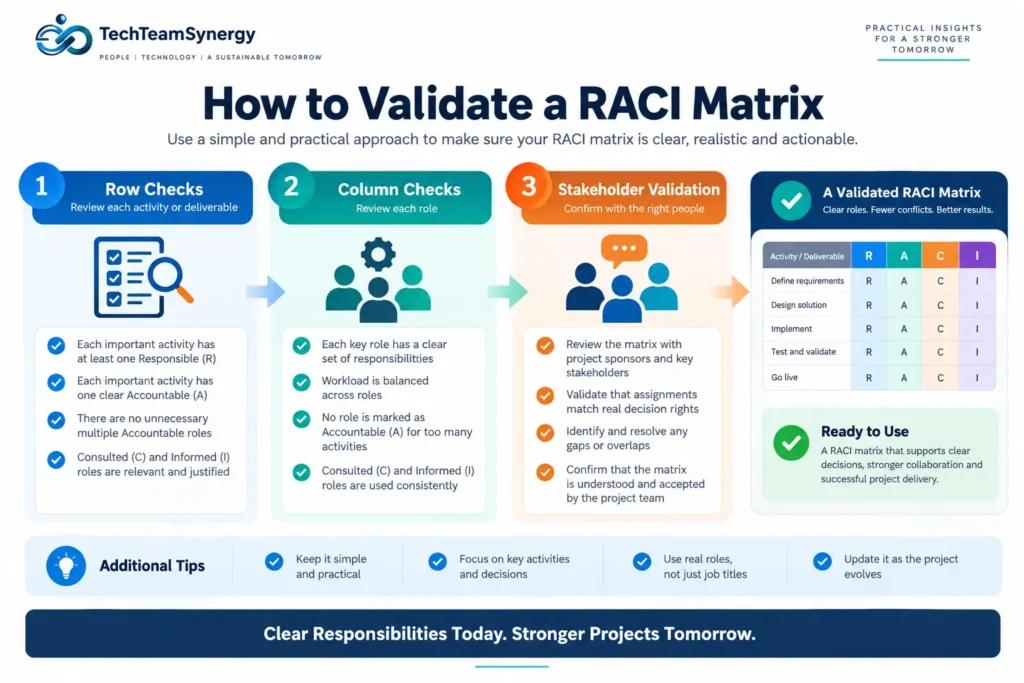
A useful validation method is to review the matrix in three passes.
Row Check
- Does every important activity have one clear Accountable owner?
- Is at least one role Responsible for doing the work?
- Are there too many Consulted roles?
- Are Informed roles genuinely necessary?
Column Check
- Is one person Accountable for almost everything?
- Is one role Responsible for nearly all execution?
- Does the workload distribution reflect the actual organization?
Authority and Stakeholder Check
- Does accountability match real decision rights?
- Does the matrix reflect contractual and regulatory governance?
- Have the assignments been reviewed with the stakeholders themselves?
10-Minute RACI Validation Review
Before publishing or approving a RACI matrix, run a short validation review with the people who will actually use it. The objective is not to debate every cell. It is to expose unclear ownership before the project depends on it.
Minute 0–2 — Check Every Row
- Confirm each important activity has at least one Responsible role.
- Confirm each important activity has one clear Accountable owner.
- Flag rows with multiple Accountable roles for clarification.
Output: a short list of rows with missing or ambiguous execution and ownership.
Minute 2–4 — Test Real Authority
- Ask whether each Accountable role can genuinely approve, accept or answer for the outcome.
- If not, move accountability to the role with real decision rights or split the activity into separate decisions.
Output: accountability that matches actual governance rather than job-title assumptions.
Minute 4–6 — Reduce Decision Friction
- Review every Consulted assignment and keep only roles whose input is genuinely needed before action or decision.
- Review every Informed assignment and decide whether a dashboard, status update or decision log is enough.
Output: fewer unnecessary consultations and clearer communication expectations.
Minute 6–8 — Check Role Overload
- Scan columns for one role that appears Responsible or Accountable for almost everything.
- Challenge whether that reflects the real operating model or whether ownership has simply defaulted to the Project Manager, Sponsor or technical lead.
Output: a matrix that distributes responsibility according to real capabilities and authority.
Minute 8–10 — Confirm With Stakeholders
- Ask the key stakeholders whether they understand and accept the assignments that affect them.
- Record unresolved disagreements as explicit governance actions with an owner and due date.
Final decision: the RACI is ready when every critical row has clear execution, one accountable owner, realistic authority and stakeholder agreement. If any of those conditions are missing, treat the matrix as a draft rather than approved governance.
Frequently Asked Questions About RACI Matrix Examples
What is a simple RACI matrix example?
A simple RACI matrix lists several major project activities in rows and key project roles in columns. Each activity then receives one or more R, A, C or I assignments so the team can see who performs the work, who owns the outcome, whose input is needed and who needs to stay informed.
What is a RACI matrix example for an IT project?
For an IT infrastructure project, a RACI matrix might assign the Executive Sponsor as Accountable for project scope, the Project Manager as Accountable for delivery coordination, technical leads as Responsible for design and implementation, Security as Accountable for security acceptance and Operations as Accountable for operational handover.
Can one person be both Responsible and Accountable?
Yes. In smaller teams or for activities where one role both performs and owns the outcome, an R/A assignment can be reasonable. The important question is whether the role has both the capacity to perform the work and the authority to answer for the result.
Can a RACI matrix have more than one Responsible person?
Yes. Some activities genuinely require work from multiple roles. For example, both Network Operations and a service provider may be Responsible for executing a migration. Keep the Accountable owner clear even when several roles perform the work.
Should a RACI matrix have more than one Accountable person?
Usually no. Multiple Accountable roles can create uncertainty about who owns the final outcome. If two roles appear to need A, clarify whether the activity should be split into separate decisions or deliverables.
How do you use RACI in Agile projects?
Use RACI mainly for responsibilities that extend beyond normal Agile team accountabilities, such as external architecture approvals, security governance, funding, compliance, cross-team dependencies and production approval.
Can a vendor be Accountable in a RACI matrix?
Yes, when the vendor genuinely owns an outcome under the operating model or contract and has the authority to answer for it. However, internal business acceptance and governance accountability often remain with the customer organization.
How detailed should a RACI matrix be?
Keep the matrix focused on meaningful deliverables, decisions, approvals and handoffs. A matrix that contains every minor project task becomes difficult to maintain and can hide the ownership questions that matter most.
Should a RACI matrix use names or roles?
Roles are usually more maintainable, especially for long-running or repeatable projects. Names can be useful for a short-lived initiative when the specific individuals and decision rights are stable.
Can AI be Responsible or Accountable in a RACI matrix?
An AI system can represent bounded execution similar to Responsible work, such as generating a draft or analyzing data. Final accountability should remain with an appropriate human role that can validate the output, manage risk and make or approve the decision.
Get the Free RACI Matrix Excel Template
Turn these examples into your own responsibility matrix with the free TechTeamSynergy RACI Matrix Excel Template.
The workbook includes:
- Blank editable RACI matrix
- IT Infrastructure Upgrade example
- SD-WAN / Network Migration example
- RACI validation checklist
- Automatic checks for missing or duplicate accountability
Download the Free RACI Matrix Template →
Conclusion: Clear Accountability Creates Better Execution
A good RACI matrix is not about filling every cell. It is about making ownership visible where ambiguity could slow the project or create conflict.
The 10 RACI matrix examples in this guide show that accountability changes with context. A Security Lead can own security acceptance. Operations can own production handover. A Product Owner can own product decisions. A vendor can perform delivery work without automatically owning the customer’s business outcome. AI can execute bounded tasks while accountability remains human.
Use the examples as starting points, then adapt the roles, activities and decision rights to your own governance model.
Clear accountability. Clear execution. Better project decisions.
Continue Learning
Continue exploring the TechTeamSynergy project management and accountability cluster with these related guides.