
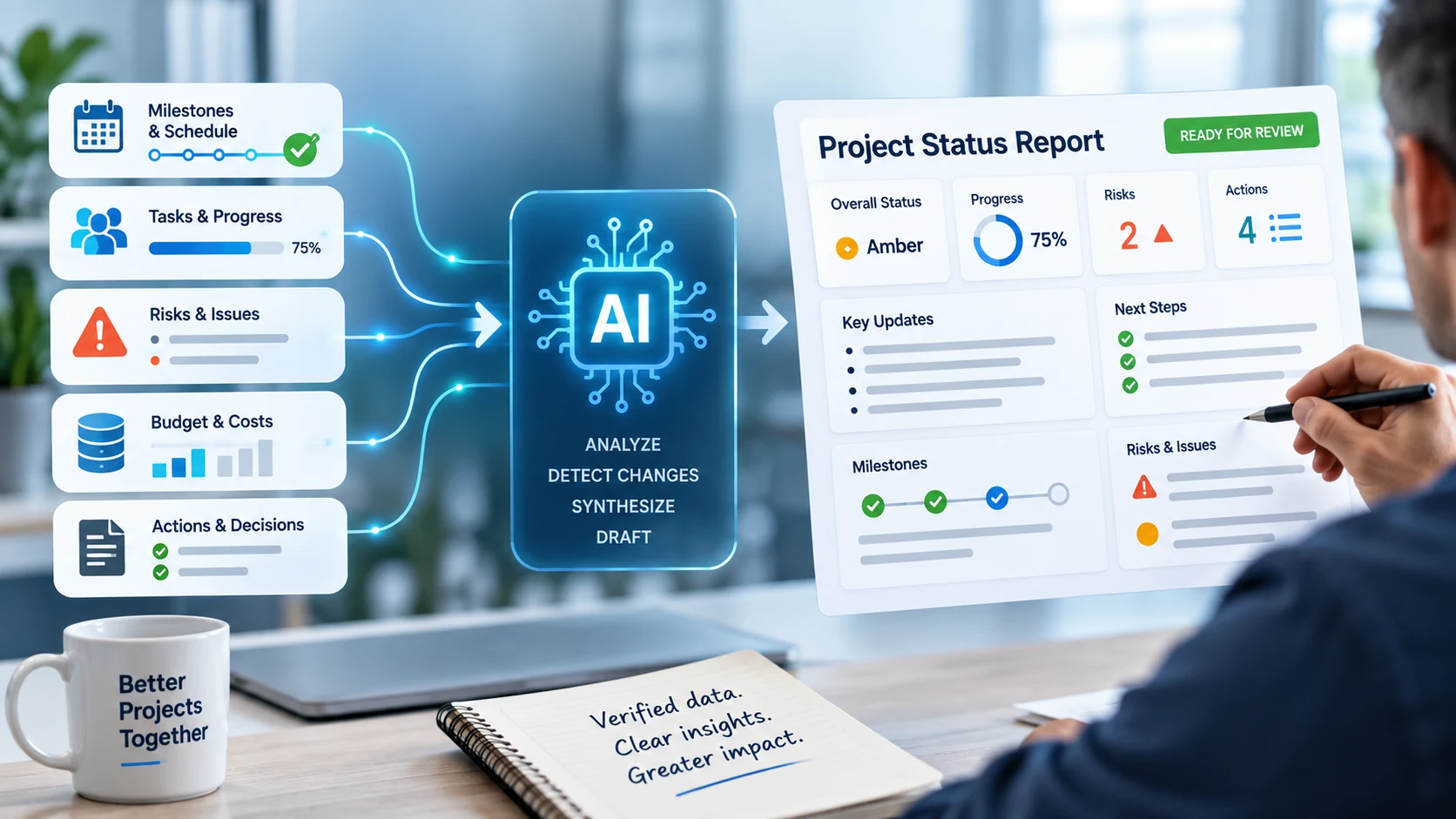
AI project status reporting can reduce the time spent collecting updates, comparing reporting periods and drafting recurring project communications. Reliable reporting, however, starts from verified project data—not from a blank prompt or an old status report copied forward.
Moreover, AI can consolidate signals from schedules, work-management tools, RAID logs, spreadsheets and financial data; detect what changed; synthesize exceptions; and prepare audience-specific drafts. But fluent output is not automatically accurate output. Material facts, interpretations, forecasts, decisions and escalations still require human validation before publication.
The principle is simple: automate the reporting workflow, not accountability. In other words, AI should transform verified project evidence into reporting. It should not invent the project evidence. For hands-on development of context preparation, output validation and accountable communication, see our AI skills for project managers framework.
AI Project Status Reporting at a Glance
| Reporting Stage | AI Can Help With | Human Control | Output |
|---|---|---|---|
| Collection | Consolidate approved inputs | Confirm sources and cutoff | Reporting dataset |
| Validation | Flag gaps, stale values and conflicts | Resolve discrepancies | Verified dataset |
| Change detection | Compare current and previous periods | Confirm materiality | Change list |
| Analysis | Surface exceptions and dependencies | Add project context | Findings |
| Narrative | Draft concise commentary | Validate claims | Master draft |
| Audience tailoring | Adjust detail and emphasis | Keep facts unchanged | Audience version |
| Approval | Prepare final package | Approve material statements | Approved report |
| Publication | Format and route | Control release | Published report |
| Traceability | Preserve sources and versions | Confirm retention | Reporting record |
What Is AI Project Status Reporting?
In simple terms, AI project status reporting is the use of AI to transform verified project signals into structured, reviewed and audience-appropriate status communication.
For example, a practical operating model is:
System of record → AI processing layer → human-approved report
In practice, AI can consolidate, compare, classify, summarize and draft. However, it should not become the source of truth for milestone dates, financial figures, risk status or project commitments.
AI Is a Reporting Layer, Not the System of Record
Above all, authoritative systems remain authoritative. Depending on the project, for example, those sources may include an approved schedule, project-management platform, Jira, Excel tracker, RAID log, decision log or financial system.
For example, if a milestone date in the approved schedule conflicts with a date in meeting notes, AI should flag the conflict rather than decide which date is probably correct.
For the broader lifecycle view, see TechTeamSynergy’s AI in Project Management guide.
Seven Quality Tests for AI-Assisted Project Reports
| Quality Criterion | Editorial Test |
|---|---|
| Accurate | Are material statements supported by verified evidence? |
| Current | Does the report reflect the defined reporting cutoff? |
| Traceable | Can important claims be connected to a source? |
| Concise | Does it remove detail that does not affect understanding or action? |
| Audience-relevant | Does it emphasize what this stakeholder needs to know or decide? |
| Actionable | Are decisions, escalations and next steps clear? |
| Consistent | Are status definitions, RAG logic and periods applied consistently? |
Together, these tests become a practical human-review quality gate later in the workflow.
Why Traditional Project Status Reporting Is Difficult
Project information is often fragmented across tools, documents, spreadsheets, meetings and workstream owners. As a result, manual consolidation can create stale data, inconsistent formats, subjective RAG ratings, repetitive copy/paste and reports that contain plenty of activity but little explanation of what changed.
Consequently, the reporting cycle can remain slow while stakeholders still ask for interpretation. AI therefore adds more value by detecting and synthesizing material change than by merely rewriting project text faster.
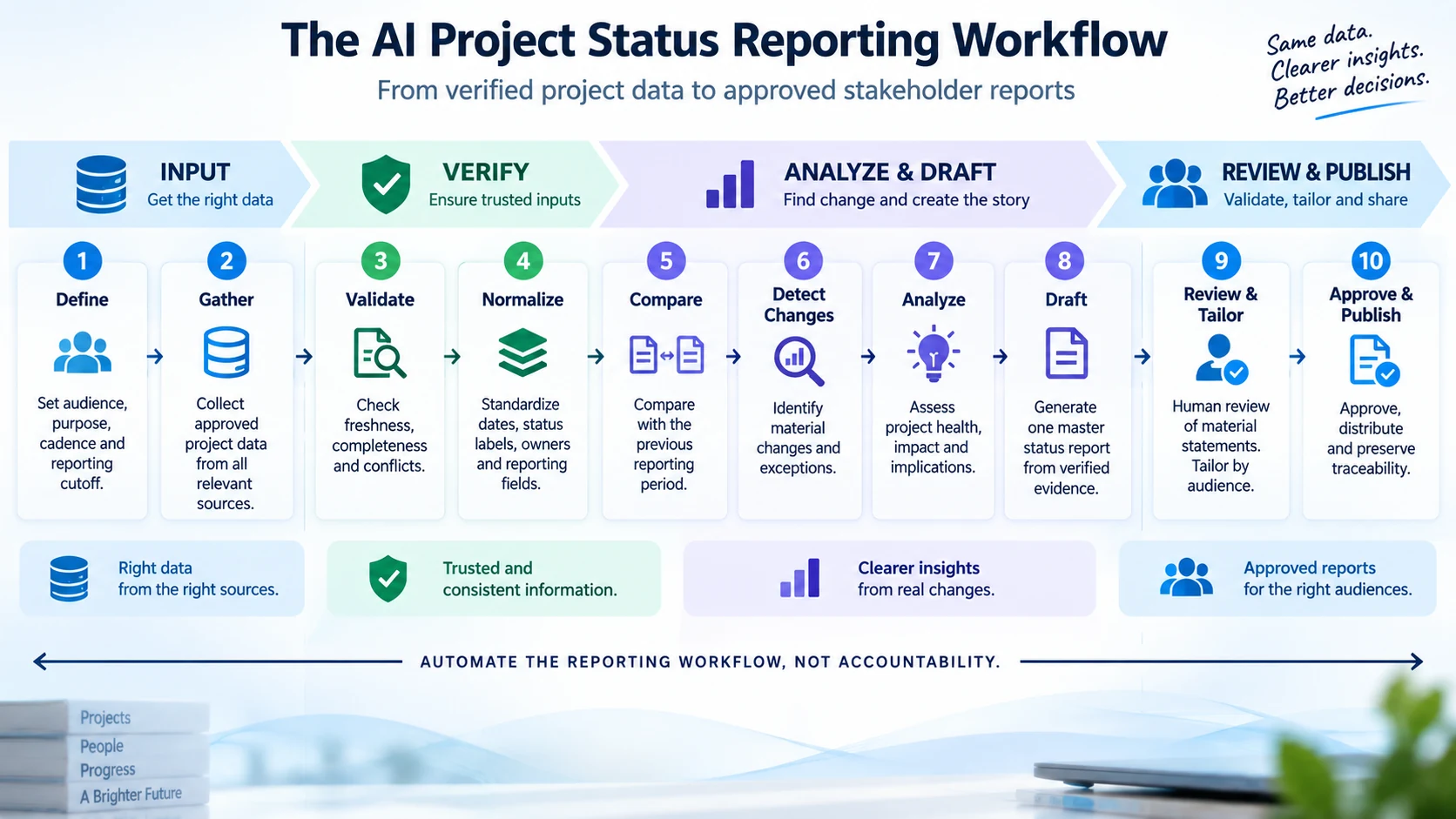
The AI Project Status Reporting Workflow
In practice, a reliable AI-assisted workflow can be organized into ten steps.
1. Define the Audience, Purpose, Cadence and Cutoff
First, decide who will use the report, what decisions it supports, how often it is produced and the exact point in time represented.
2. Gather Approved Project Data
Next, collect the authoritative inputs required for the report.
3. Validate Source Data
Then, check freshness, completeness and conflicts before analysis.
4. Normalize Reporting Fields
After that, align dates, status labels, owners, RAG definitions and field names.
5. Compare Against the Previous Reporting Period
Next, create a structured current-versus-previous view.
6. Detect Material Changes and Exceptions
Then, identify milestone movement, risk or issue changes, overdue actions, dependency shifts and forecast movement.
7. Analyze Project Health
Afterward, assess what those changes mean for scope, schedule, cost, risk, outcomes and decisions.
8. Generate the Master Status Draft
Next, create one evidence-based reporting narrative.
9. Human-Validate and Tailor by Audience
Before publication, review material statements first, then adjust detail and emphasis.
10. Approve, Publish and Preserve Traceability
Finally, release the report after sign-off and retain enough context to explain material conclusions.
1. Start with Verified Project Data
For example, a practical reporting dataset may draw from the schedule, milestone tracker, Jira or another backlog, project-management platform, Excel, risk register, issue log, action log, decision log, budget or cost data, resource indicators and approved meeting decisions. When resource shortages affect status, the AI-assisted capacity planning workflow helps establish verified demand, availability and gaps before reporting them.
Not every source deserves equal authority. For example, meeting notes may provide context, but they should not silently override an approved milestone baseline or financial record. If the main question is which AI-enabled platform or assistant to use, that belongs in TechTeamSynergy’s AI Tools for Project Managers comparison rather than in the reporting workflow itself.
AI Is Not the System of Record
Although AI can process information stored in project systems, it should not become an alternative project database. Instead, the authoritative source for a committed date, cost value or approved decision should remain the system designated by project governance.
What Happens When Data Sources Conflict?
Use:
Flag → Investigate → Resolve → Report
For instance, if Jira shows a release as delayed while the milestone tracker still shows it on schedule, AI should surface the inconsistency. Then, a human owner should resolve the authoritative status before publication.
Establish a Reporting Cutoff
Every report should represent a defined point in time, such as Friday at 16:00. Otherwise, late updates can mix different reporting moments and create an internally inconsistent report.
2. Define a Consistent Project Reporting Data Model
Core Status Fields
Typically, core fields include overall status or RAG, milestones, schedule position, completed work, upcoming work, risks, issues, dependencies, decisions, actions, forecast and asks or escalations.
Conditional Fields
For example, budget and cost, scope change, resources, benefits or value, and quality measures may be essential for some projects but unnecessary for others. Therefore, include them when they influence project health or decisions.
The objective is not to capture every available metric. Instead, the goal is to create a reporting model that supports the decisions the audience needs to make. In that context, PMI’s PMBOK Guide—Eighth Edition organizes modern project practice across areas including governance, scope, schedule, finance, stakeholders, resources and risk; those areas can inform what evidence a project may need without prescribing one universal status-report template.
Separate Evidence from Commentary
Use:
Fact → Interpretation → Recommendation / Ask
For example, Fact: testing moved from 15 October to 24 October.
Interpretation: contingency before deployment has reduced.
Recommendation: approve weekend test support to protect the deployment date.
As a result, this structure helps reviewers see whether the evidence is sound and whether the interpretation is justified.
3. Use AI to Detect Changes in Project Status
In particular, change detection is one of the strongest uses of AI in recurring reporting because stakeholders rarely need the entire project rewritten every week.
Compare Current Period vs Previous Period
First, give AI structured snapshots from the current and previous periods and ask it to identify differences in key fields. Then, prefer underlying project records over two old status reports; reports are outputs, not the primary evidence.
Detect Material Changes
- slipped or completed milestones;
- new or closed risks;
- worsening issues;
- overdue actions;
- dependency changes;
- budget or resource movement;
- forecast changes;
- new decisions or escalations.
Separate Change from Noise
Materiality depends on impact on scope, schedule, cost, risk, outcomes or a required decision. For example, a small task movement may be irrelevant, while the same movement on a regulatory approval milestone could be critical.
4. Turn Project Data into an Accurate Status Narrative
Use the sequence:
Change detected → Significance → Impact → Required action → Next step
Summarize Evidence, Do Not Invent Explanations
If a milestone slipped but the confirmed reason is absent, the draft should say that the cause requires confirmation instead of inventing a plausible explanation. In this way, uncertainty remains visible rather than being replaced by a plausible guess.
Preserve Uncertainty
When information is incomplete, missing data, disputed forecasts and unresolved dependencies should remain visible when material. For example, “Cost forecast pending finance validation” is more useful than a fabricated number.
5. Generate the Executive Summary
For executive readers, an executive summary should prioritize overall status, material change, forecast, the most significant risk or issue, decisions required and any escalation or support needed.
Separate Facts, Interpretation and Recommendations
Because concise wording can make an interpretation sound like fact, evidence still matters. For example, “Deployment readiness is at risk” should be supported by delayed testing, an unresolved dependency or a missed approval. Finally, recommendations should be clearly presented as proposed actions.
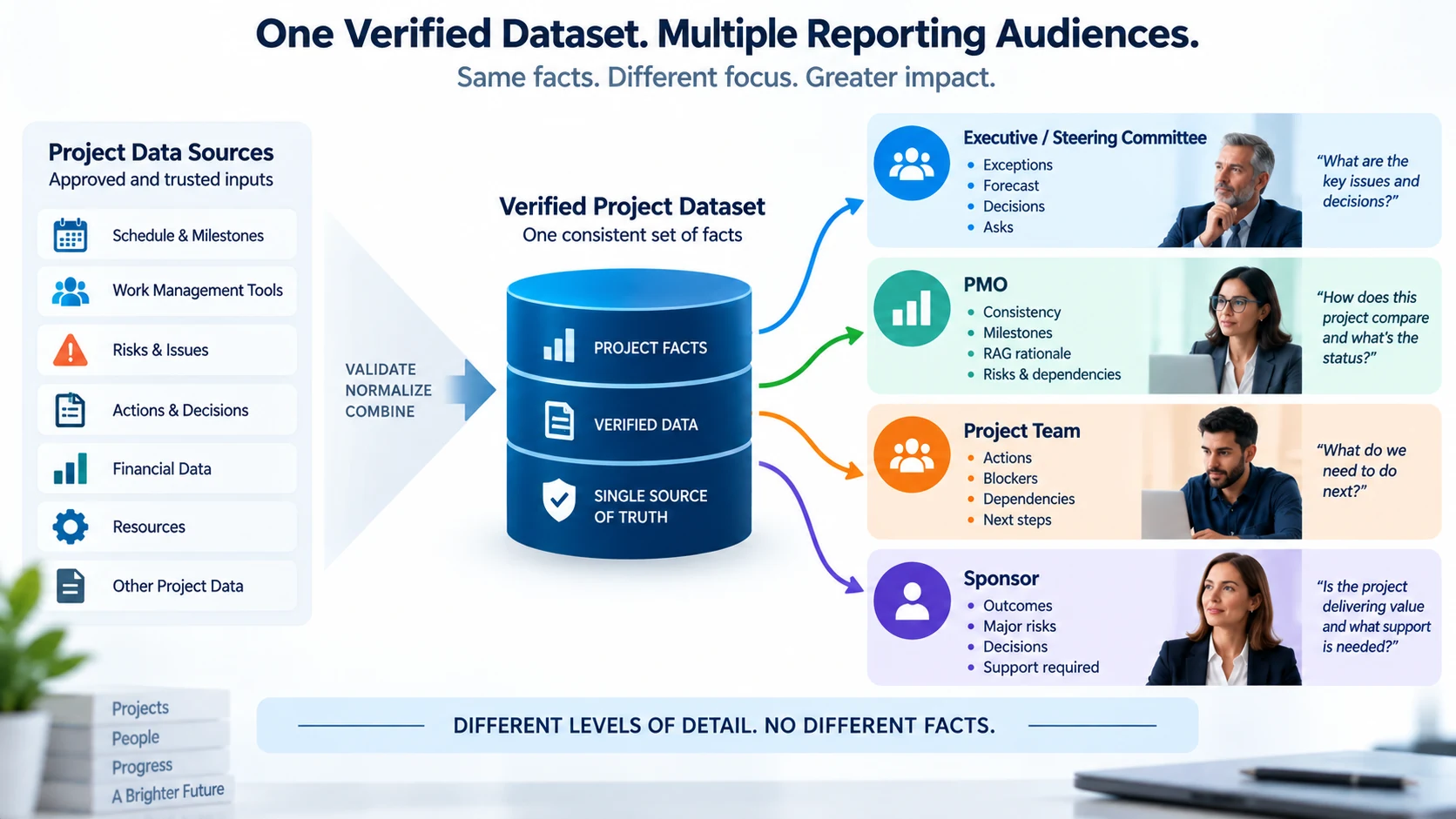
6. Tailor One Verified Dataset for Different Audiences
| Audience | Primary Emphasis |
|---|---|
| Executive / Steering Committee | Exceptions, forecast, decisions, asks |
| PMO | Consistency, milestones, RAG rationale, risks, dependencies |
| Project Team | Actions, blockers, dependencies, next steps |
| Sponsor | Outcomes, major risks, decisions, support required |
In short, one verified dataset. Different levels of detail. No different facts.
For PMO reporting, consistency matters because multiple projects need to be comparable without erasing project context. In addition, PMI’s Project Management Offices: A Practice Guide emphasizes PMO effectiveness, organizational alignment and measurable value, which supports consistent reporting structures without implying a single mandatory format.
What Can Change by Audience?
For instance, length, terminology, ordering, level of detail and emphasis can change.
What Must Not Change?
However, dates, financial data, milestone status, risk facts, commitments and other verified project facts must remain consistent. In other words, audience tailoring changes communication, not reality.
7. Validate AI Project Status Reports
Before publication, human validation should be required, especially for material statements.
- overall RAG or health rating;
- dates and milestones;
- financial figures;
- risks and issues;
- dependencies;
- assumptions and forecast;
- decisions and recommendations;
- escalations;
- stakeholder-sensitive language.
PMI’s Standard for Artificial Intelligence in Portfolio, Program, and Project Management addresses structured and accountable AI use in project work, including human-in-the-loop practices. In addition, NIST’s AI Risk Management Framework and its Generative AI Profile provide broader voluntary guidance for trustworthy AI, including reliability, transparency and risk management. However, these sources support the control principles; they do not prescribe this exact reporting workflow.
Use Source Traceability
Where practical, material statements should be traceable to underlying project evidence. As a result, reviewers should be able to answer: “Where did this date, figure, status or conclusion come from?”
What AI Should Do When Information Is Missing
Use:
Flag → identify the missing input → request clarification or mark confirmation required
Therefore, never create a plausible substitute merely to complete the report.
Treat Contradictions as Exceptions
Conflicting project data may indicate a process problem, ownership gap or delayed update. Therefore, resolve the conflict before publishing a definitive status where possible.
8. Automate Recurring Project Status Reporting
At a high level, a controlled recurring process can be:
Scheduled extraction → validation → comparison → change detection → draft → review → approval → distribution → archive
What Can Be Automated Safely?
In practice, good candidates include collection from approved sources, normalization, period comparison, candidate exception detection, first-draft generation, formatting and workflow routing.
Where Approval Gates Should Remain
However, keep human approval for material RAG ratings, financial statements, milestone commitments, forecasts, escalations, major decisions and external or sensitive communications.
For a broader discussion of what automation may change in the role—and what remains accountable human work—see Will AI Replace Project Managers?
Advanced Option: Agentic Reporting
For example, an agentic workflow can monitor approved sources, detect defined changes, prepare a draft and route it for review. Nevertheless, publication should still depend on an approval gate for material project statements.
For the broader concept, see TechTeamSynergy’s Agentic AI guide.
Example: Weekly AI-Assisted Project Status Report
For example, consider a fictional enterprise cloud migration project.
The Verified Source Dataset
| Field | Verified Status |
|---|---|
| Overall status | Amber |
| Milestone 1 | Network design approved — complete |
| Milestone 2 | Pilot migration moved from 21 Sep to 28 Sep |
| Milestone 3 | Production wave remains planned for 20 Oct |
| Risk 1 | Legacy application latency risk — exposure increased after pilot testing |
| Risk 2 | Vendor resource availability — unchanged |
| Issue | Firewall-rule approval is four business days late |
| Dependency | Security approval required before pilot migration |
| Action 1 | Security team to close firewall review by 22 Sep |
| Action 2 | Application team to complete latency retest by 23 Sep |
| Decision required | Approve weekend migration support for the pilot |
Project-Team Version
Status: Amber. First, the network design is complete, but the pilot migration has moved from 21 September to 28 September because security approval remains outstanding. Firewall-rule approval is four business days late and must close before the pilot. The legacy-application latency risk increased after testing.
Next, the security team must complete the firewall review by 22 September and the application team must finish the latency retest by 23 September. Meanwhile, production remains planned for 20 October. Finally, a decision is required on weekend migration support.
Executive Version
Status: Amber. The pilot migration has moved one week to 28 September due to delayed security approval. However, the 20 October production target remains unchanged, although contingency has reduced. In addition, legacy-application latency risk increased after testing.
Decision required: approve weekend migration support. Specifically, security approval and the latency retest are the immediate controls required to protect the revised pilot date.
What Changed Between the Two Reports?
Presentation, detail and emphasis changed. However, the facts did not. As a result, the team version can emphasize actions and dependencies while the executive version emphasizes schedule movement, risk and the decision required.
AI Prompts for Project Status Reporting
Above all, use prompts inside a controlled workflow and only on validated inputs.
1. Detect Period-over-Period Changes
Compare the current verified dataset with the previous reporting-period dataset. List only material changes in milestones, schedule, risks, issues, dependencies, actions, cost, resources, forecast and decisions. Do not infer missing causes. Flag conflicting or incomplete data.
2. Draft the Master Status Report
Using only the verified dataset below, draft a status report covering overall health, material changes, milestones, top risks and issues, dependencies, decisions required and next steps. Separate facts from interpretation. Do not invent missing information.
3. Create an Executive Summary
Convert the validated master report into a concise executive summary. Prioritize exceptions, forecast, material risks or issues, decisions and support required. Keep all dates, figures and status facts unchanged.
4. Check Contradictions and Unsupported Claims
Review this draft against the source dataset. Identify statements that are unsupported, inconsistent, outdated or more certain than the evidence allows. List the exceptions before rewriting anything.
5. Tailor a Validated Report by Audience
Adapt this validated report for [audience]. Change only detail, terminology, ordering and emphasis. Do not change project facts, dates, financial values, risks, milestone status or commitments.
For additional examples, see TechTeamSynergy’s 50 AI Prompts for Project Managers.
AI Project Status Reporting and Project Risks
For risk communication, project reports should communicate new top risks, significant changes in exposure, overdue mitigation and risks that require escalation or a decision.
However, project status reports should not recreate the risk-management process. Instead, risk identification, assessment, response planning and monitoring remain separate management activities. Status reporting then consumes those validated outputs and communicates the current position.
For a deeper workflow, see TechTeamSynergy’s AI for Project Risk Management.
Governance Controls for AI-Generated Reports
Approved Data Sources
First, define which systems and records AI may use. Then, do not mix authoritative project information with uncontrolled notes or outdated reports without clear labeling.
Sensitive and Confidential Project Information
Likewise, use approved tools and data-handling rules when reports contain financial, customer, employee, security or commercially sensitive information.
Human Approval and Accountability
In addition, a named accountable role should review material statements before publication. Although AI can prepare the draft, it does not own the project commitment.
Traceability, Auditability and Report Retention
Finally, retain the approved report and enough supporting context to explain significant figures, status changes and decisions. In parallel, NIST offers voluntary risk-management guidance for trustworthy AI, while ISO/IEC 42001:2023 provides a formal AI management-system standard for organizations that choose to adopt it.
Can AI Agents Automate Project Reporting?
AI agents can automate parts of reporting. For example, an agent could monitor approved sources, detect defined changes, prepare a draft and route it to the project manager or PMO for review.
However, the boundary is the approval gate. Therefore, automation should not turn ambiguity into a definitive project statement or publish material changes without the required review.
For the broader architecture and use cases, see TechTeamSynergy’s Agentic AI guide.
Common AI Project Reporting Mistakes
- using unverified or stale inputs;
- vague “write a status report” instructions;
- invented information;
- mixing reporting periods;
- inconsistent RAG logic;
- different facts for different audiences;
- excessive detail;
- hidden uncertainty;
- old reports reused as the source of truth;
- no traceability;
- reporting activity instead of change and outcomes;
- over-automating approval.
Ultimately, the most dangerous failure is a report that looks professional enough to avoid challenge.
AI Project Status Reporting Checklist
Source Data
- Confirm the reporting cutoff.
- Use approved source systems.
- Check required fields are current.
- Flag missing or conflicting values.
Change Detection
- Compare with the previous reporting period.
- Identify milestone, risk, issue, dependency, cost and forecast changes.
- Separate material changes from routine activity.
Analysis and Drafting
- Distinguish facts from interpretation.
- Make assumptions and uncertainty visible.
- Focus on impact, action and next steps.
Human Validation
- Validate RAG, dates, milestones and financials.
- Validate material risks, issues and dependencies.
- Review forecast, recommendations, decisions and escalations.
Audience and Approval
- Tailor detail without changing facts.
- Check stakeholder-sensitive language.
- Obtain approval before distribution.
Publication and Traceability
- Publish the approved version only.
- Retain source references where practical.
- Archive the version for future comparison.
Frequently Asked Questions
What is AI project status reporting?
In practice, AI project status reporting uses AI to transform verified project information into recurring status communication. It can help consolidate inputs, compare periods, detect changes, draft narratives and tailor reports, while humans validate material facts and decisions.
How can AI automate project status reports?
For example, AI can automate collection, normalization, comparison, exception detection, first-draft generation, formatting and workflow routing. However, approval of consequential project statements should remain a human control.
Can ChatGPT create project status reports?
Yes. For example, ChatGPT can draft project status reports from reliable inputs and clear instructions. It should not be treated as the source of truth; dates, financials, RAG, milestones, risks and commitments should be checked before publication.
What data should AI use for a project status report?
In practice, use validated data relevant to the reporting purpose: schedule, milestones, completed and upcoming work, risks, issues, dependencies, actions, decisions, forecast and, where needed, budget, scope, resources, benefits or quality.
How do you prevent AI from inventing project information?
To reduce hallucinations, provide authoritative inputs, prohibit unsupported assumptions, require missing data to be flagged and validate the draft against source records. In addition, missing or contradictory information should be resolved or clearly marked—not filled with a plausible substitute.
Should AI decide project RAG status?
Although AI can summarize evidence and highlight indicators, final RAG status should follow defined project criteria and accountable governance. A human reviewer should confirm that the rating reflects context and materiality.
Can AI create executive project summaries?
Yes. For example, AI can convert a validated master report into an executive version focused on exceptions, forecast, significant risks or issues, decisions and support required. The facts must remain unchanged.
Can AI generate weekly project reports automatically?
For weekly reporting, a workflow can automate extraction, comparison, change detection and draft preparation. Nevertheless, a controlled process should normally route the draft to an accountable reviewer before release.
How should AI-generated status reports be validated?
First, check material dates, milestones, RAG, financial figures, risks, issues, dependencies, forecast, decisions and recommendations against project evidence. In addition, check cutoff, assumptions, conflicting inputs and overstated certainty.
Can AI agents automate project reporting?
Yes. Similarly, agents can monitor approved systems, trigger comparisons, prepare drafts and route them through a workflow. Agentic automation does not remove the need for source controls, approval gates, traceability and accountable human decisions.
Conclusion: Automate Reporting, Not Accountability
Ultimately, the strongest model is not “give AI some notes and ask for a polished update.” It is:
Verified data → Detect change → Analyze → Synthesize → Validate → Tailor → Approve → Publish → Trace
As a result, AI can reduce consolidation, comparison, exception-detection and drafting effort. This gives project managers and PMOs more capacity for interpretation, decisions and stakeholder alignment.
However, speed is not the same as trust. Ultimately, the project manager or accountable project role remains responsible for the accuracy, meaning and consequences of the report.
Automate the reporting workflow, not accountability.
Continue Learning
Continue exploring the TechTeamSynergy AI project management and governance cluster with these related guides.
AI in Project Management: Complete Guide for Project Managers
Explore practical AI use cases across planning, reporting, risk analysis, decision support and other project activities.
50 AI Prompts for Project Managers
Use practical prompts across planning, reporting, risk management, meetings, stakeholders and governance.
AI for Project Risk Management
Go deeper into AI-assisted risk identification, analysis, response preparation and monitoring while preserving human judgment.
What Is Agentic AI? How AI Agents Work, Use Cases, Benefits & Risks
Understand how agentic systems use goals, tools, context and actions to execute multi-step workflows, including project-management use cases.