Employee experience is the complete experience people have with an organization throughout their relationship with it — from their first interaction as a potential candidate to onboarding, daily work, development and eventually leaving the organization.
It is shaped by much more than benefits, office design or employee surveys. Leadership, culture, technology, processes, relationships, career opportunities and the way work is designed all influence how employees experience an organization. Gallup’s research on employee engagement similarly emphasizes the role of workplace conditions and leadership in shaping whether people feel involved and enthusiastic about their work.
A useful way to think about employee experience is:
Employee Experience = People + Leadership + Work + Culture + Technology + Environment
These dimensions interact across the employee journey. Improving employee experience therefore requires organizations to understand both the individual moments employees encounter and the wider system in which those moments occur.
This guide explains what employee experience means, how it differs from employee engagement, the stages of the employee journey, the role of leadership and technology, how AI is changing EX, and how organizations can measure and improve the experience of work.
What Is Employee Experience?
Employee experience, often abbreviated as EX, describes what employees encounter, perceive and experience through their interactions with an organization.
These interactions can include:
- Applying for a job
- Recruitment interviews
- Onboarding
- Working with a manager
- Collaborating with colleagues
- Using workplace technology
- Learning new skills
- Receiving feedback
- Seeking career opportunities
- Navigating organizational change
- Leaving the organization
Employee experience is therefore not one HR program.
It is the cumulative result of many interactions over time.
Why Does Employee Experience Matter?
Organizations depend on people being able to perform their work effectively.
When the employee experience contains unnecessary friction, employees may spend time navigating unclear processes, searching for information, switching between systems or trying to understand conflicting priorities.
A better-designed experience can make it easier for people to:
- Understand expectations
- Access information
- Collaborate
- Make decisions
- Develop capabilities
- Use technology effectively
- Raise problems
- Focus on meaningful work
Employee experience should therefore be treated as an organizational design question, not simply as an HR initiative.
Employee Experience vs Employee Engagement
The Employee experience and employee engagement are related, but they are not the same thing.
Employee experience describes what people encounter throughout their relationship with the organization.
Employee engagement describes aspects of the psychological connection employees have with their work and organization.
A simple distinction is:
Experience = What employees encounter
Engagement = How employees respond to aspects of their work experience
Organizations can influence employee experience by changing work design, leadership practices, technology, processes and other workplace conditions.
Employee Experience vs Employee Lifecycle
The employee lifecycle provides a structure for understanding the stages through which employees move.
The employee experience is what people experience during those stages.
For example:
| Lifecycle Stage | Possible Employee Experience |
|---|---|
| Hire | Clear and respectful recruitment process |
| Onboard | Easy access to people, systems and information |
| Perform | Clear objectives and useful feedback |
| Develop | Meaningful learning and career opportunities |
| Depart | Professional transition and knowledge transfer |
The lifecycle helps organizations organize the journey. Employee experience describes the quality and meaning of that journey.
Employee Experience vs Employer Brand
Employer brand is how an organization is perceived as a place to work.
Employee experience is what people actually encounter once they interact with or join the organization.
The two should be aligned.
An employer brand promising flexibility, development and empowerment can lose credibility if employees encounter rigid processes, limited career opportunities or micromanagement after joining.
In other words:
Employee Experience = Reality
Employer Brand = Promise
Employee Experience vs Employee Wellbeing
Wellbeing is an important component of employee experience, but the two concepts are not interchangeable.
Employee experience also includes:
- Leadership
- Technology
- Career development
- Processes
- Communication
- Recognition
- Work design
- Collaboration
Our Employee Wellbeing and Mental Health at Work guide explores wellbeing in more depth, including prevention, protection, support and measurement. The World Health Organization’s mental health at work guidance also highlights organizational interventions, manager training and healthier working conditions as important levers for protecting and promoting mental health.
The Six Dimensions of Employee Experience
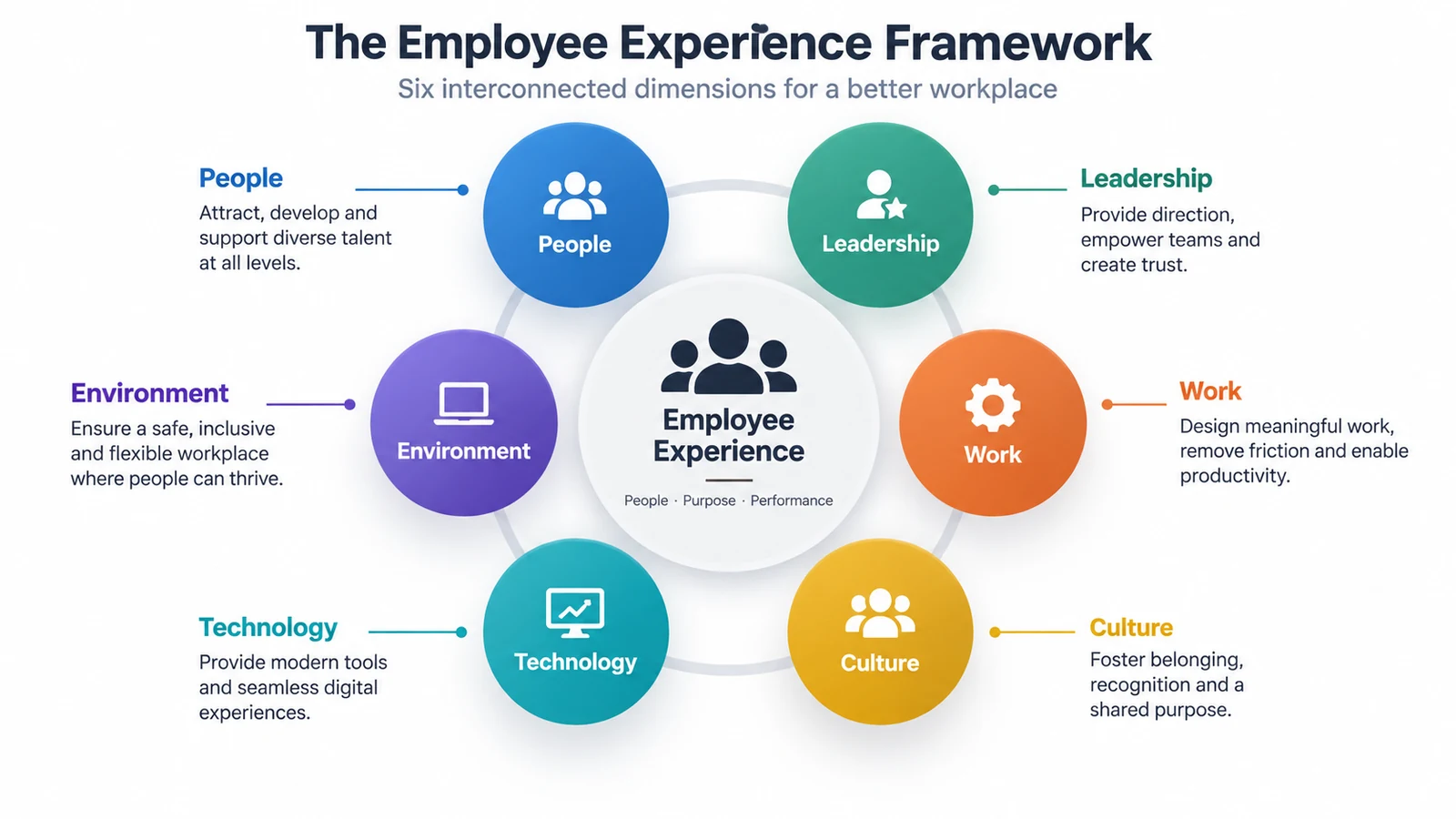
A practical employee experience framework can be organized around six interconnected dimensions:
People + Leadership + Work + Culture + Technology + Environment
1. People
Relationships strongly influence everyday work.
This includes relationships with:
- Colleagues
- Managers
- Customers
- Partners
- Cross-functional teams
Employees need opportunities to communicate, collaborate, ask for help and contribute their expertise. When working relationships become difficult, clear communication, boundaries and appropriate escalation also matter; see our guide to managing difficult people at work.
2. Leadership
Leaders influence employee experience through the decisions they make and the conditions they create.
Leadership affects:
- Direction
- Priorities
- Trust
- Communication
- Feedback
- Recognition
- Decision-making
- Development opportunities
Our Modern Leadership guide explores how leaders can combine direction, people, decisions, adaptability, technology and accountability.
3. Work
The design of work itself matters.
Questions include:
- Are responsibilities clear?
- Are priorities understandable?
- Can employees make appropriate decisions?
- Are workloads sustainable?
- Are processes unnecessarily complex?
- Does the work provide opportunities to use and develop skills?
4. Culture
Culture influences how work is actually performed.
It appears through everyday behaviors such as:
- How decisions are made
- How mistakes are handled
- Whether people can disagree
- How leaders respond to bad news
- What behaviors receive recognition
- How collaboration works
Culture is therefore experienced through behavior, not simply through published organizational values.
5. Technology
Employees increasingly experience their organization through technology.
They may use:
- Communication platforms
- Collaboration tools
- Business applications
- HR systems
- Knowledge platforms
- AI assistants
- Workflow automation
When these tools work together effectively, they can reduce friction.
When they do not, employees can spend significant effort navigating the technology rather than performing the work.
6. Environment
The work environment includes both physical and digital conditions.
Depending on the organization, this may include:
- Office design
- Remote-work arrangements
- Hybrid collaboration
- Accessibility
- Work equipment
- Digital workspace
The appropriate environment depends on the type of work being performed.
For people preparing for their first distributed role, our beginner guide to remote work covers transferable skills, portfolio evidence, job-search preparation and remote-work expectations.
The Seven Stages of the Employee Journey
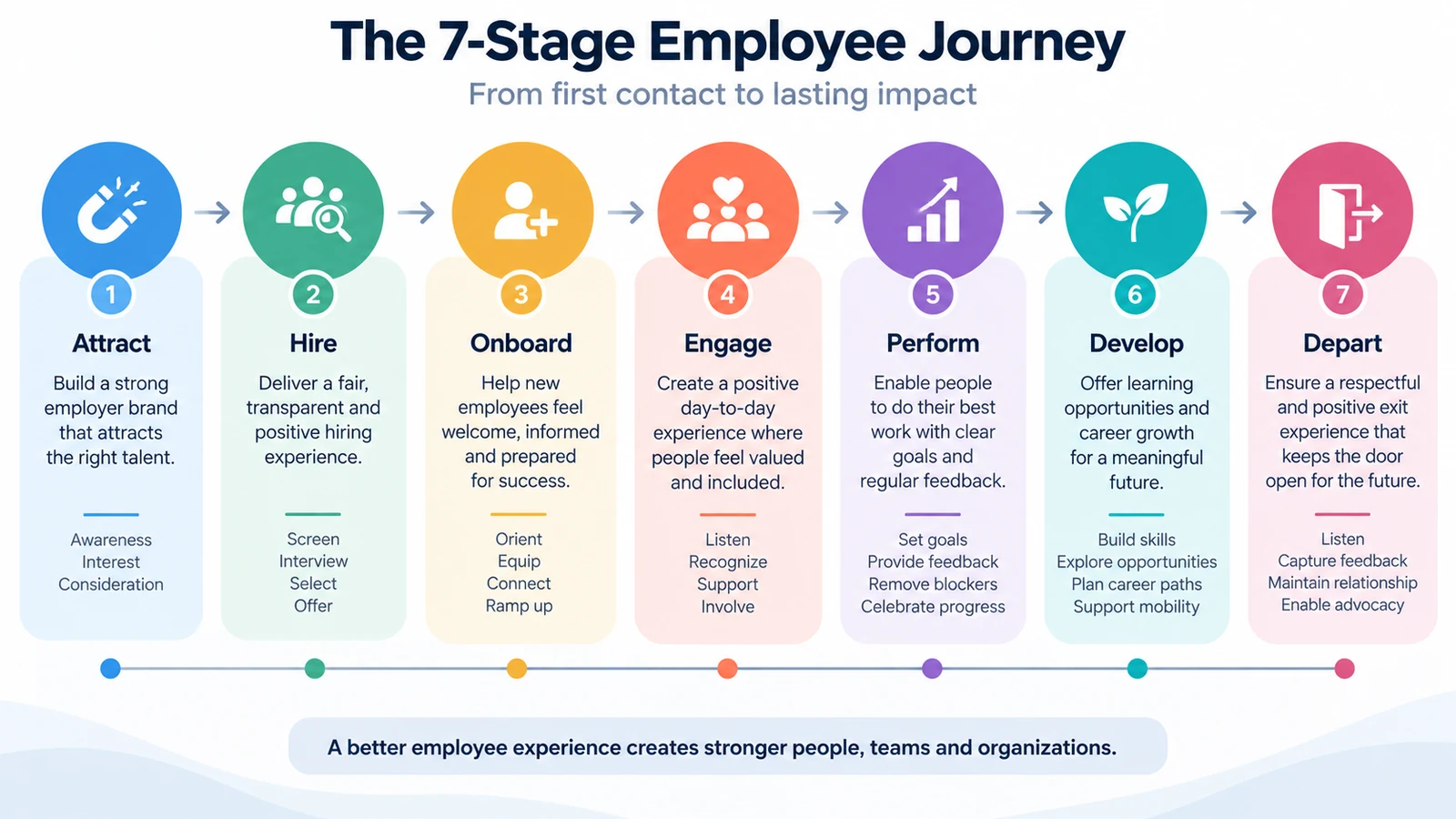
A useful employee journey model contains seven stages:
Attract → Hire → Onboard → Engage → Perform → Develop → Depart
Organizations can examine each stage to understand where employees encounter value, confusion or friction.
Stage 1: Attract
Employee experience begins before employment.
Potential employees may encounter an organization through:
- Its website
- Job advertisements
- Employees
- Professional networks
- Social media
- Recruitment events
The experience should provide a realistic understanding of the organization rather than an idealized employer-brand promise.
Stage 2: Hire
The recruitment process creates important early impressions.
A candidate experience can be influenced by:
- Clarity of job information
- Ease of application
- Interview quality
- Communication
- Respect for candidates’ time
- Transparency about the process
Recruitment should also connect with the organization’s wider talent strategy.
Our 5 Steps of Talent Management guide explains attraction, skills-based hiring and talent planning in more detail.
Stage 3: Onboard
Onboarding helps new employees move from being outsiders to effective contributors.
Good onboarding should help people understand:
- The organization
- Their role
- Expected outcomes
- Important relationships
- Processes
- Technology
- Sources of support
A useful model is:
Context → Connections → Capabilities → Contribution
Effective onboarding is more than completing administrative tasks on the first day.
Stage 4: Engage
The engage stage concerns the ongoing relationship employees have with their work, team and organization.
Organizations can support this stage through:
- Clear purpose
- Useful communication
- Recognition
- Employee voice
- Trust
- Team relationships
- Meaningful work
Engagement should not be reduced to an annual survey score.
Stage 5: Perform
Employees need to understand what effective performance looks like.
This requires:
- Clear objectives
- Appropriate autonomy
- Resources
- Useful technology
- Feedback
- Decision clarity
- Support when obstacles arise
Performance management works best when it supports ongoing alignment and improvement rather than existing only as an annual administrative process.
Stage 6: Develop
Employees need opportunities to maintain and develop capabilities as work changes.
Development can include:
- Training
- Coaching
- Mentoring
- Stretch assignments
- Projects
- Internal mobility
- Peer learning
- New responsibilities
Development does not always mean promotion.
Our Talent Management guide explores skills development, internal mobility and succession planning in greater detail.
Stage 7: Depart
Employee experience does not end the moment someone resigns.
A professional departure process can include:
- Knowledge transfer
- Clear administrative processes
- Exit feedback
- Respectful communication
- Appropriate transition planning
Former employees can remain customers, partners, advocates or even future employees.
What Are “Moments That Matter”?
Not every employee interaction has the same impact.
Moments that matter are significant experiences that can strongly influence how employees perceive their relationship with the organization.
Examples can include:
- First day
- First meeting with a manager
- Receiving important feedback
- Promotion
- Changing teams
- Returning from extended leave
- Organizational restructuring
- Handling a serious mistake
- Career-development conversations
- Departure
Organizations should identify the moments that matter most to their own workforce rather than assuming the same moments are equally important everywhere. During major organizational change, these moments also connect directly to broader workforce transformation.
Employee Journey Mapping
Employee journey mapping helps organizations visualize the employee experience across different stages and touchpoints.
A simple process is:
Stage → Touchpoint → Employee Need → Friction → Opportunity → Improvement
Step 1: Define the Employee Group
Different employees may experience the organization differently.
Examples include:
- New employees
- Frontline workers
- Remote employees
- Managers
- Technical specialists
Step 2: Identify Key Touchpoints
Map the important interactions employees have with people, systems and processes.
Step 3: Gather Evidence
Use surveys, interviews, operational data and direct observation where appropriate.
Step 4: Identify Friction
Look for repeated problems rather than isolated complaints.
Step 5: Prioritize Improvements
Focus on improvements that are meaningful and feasible rather than trying to redesign every interaction simultaneously.
Step 6: Measure the Effect
Determine whether the change actually improved the employee experience or merely changed the process.
Employee Experience Examples
Leaders influence many of the conditions employees experience.
For example, leaders determine or influence:
- Priorities
- Decision boundaries
- Communication patterns
- Feedback
- Recognition
- Workload
- Access to opportunities
This does not mean every employee experience problem is caused by a manager.
Some problems come from organizational structures, policies, technology or poorly designed processes.
The goal should be to identify the actual source of friction rather than automatically assigning blame.
Psychological Safety and Employee Experience
Employees need appropriate opportunities to raise concerns, ask questions and share ideas.
Psychological safety can help employees say:
- “I need help.”
- “I think this process has a problem.”
- “I disagree with this assumption.”
- “I made a mistake.”
- “I have another idea.”
Psychological safety does not mean removing standards or accountability. Our psychological safety at work guide explains how leaders can support both.
Teams can maintain high expectations while making it possible to discuss problems openly.
Recognition and Employee Experience
Recognition helps people understand which contributions are valued.
It can take many forms:
- Direct appreciation
- Peer recognition
- Public acknowledgment
- Development opportunities
- Expanded responsibility
- Formal rewards
The appropriate form depends on the person, contribution and organizational context.
Employee Experience and Career Development
Career experience is broader than promotion.
Employees can grow through:
- New projects
- Lateral moves
- Technical specialization
- Mentoring
- Leadership opportunities
- Cross-functional experience
- New skills
Organizations can improve employee experience by making development opportunities easier to understand and access.
Employee Experience and Talent Management
Talent management and employee experience overlap but serve different purposes.
Talent management asks:
How do we attract, develop, retain and deploy the capabilities the organization needs?
Employee experience asks:
What do people experience as they interact with the organization?
The two systems influence each other.
For example, career development is part of talent management strategy and also an important part of an employee’s experience.
Employee Experience and Wellbeing
Employee wellbeing is influenced by many factors, including workload, working conditions, leadership and organizational practices. When these pressures persist, they can increase workplace stress and workplace burnout risk.
A strong employee experience strategy should therefore consider whether work can be sustained over time.
Warning signs of excessive friction may include:
- Constant urgency
- Conflicting priorities
- Excessive meetings
- Repeated manual work
- Unclear responsibilities
- Persistent after-hours expectations
Wellbeing requires deeper treatment than an EX survey alone can provide, which is why it should remain a dedicated organizational topic rather than simply an employee-experience metric.
Hybrid and Remote Employee Experience
Hybrid and remote work change how employees interact with colleagues, leaders and technology.
Organizations should consider:
- Access to information
- Meeting inclusion
- Decision documentation
- Communication practices
- Collaboration tools
- Relationship building
- Career visibility
A remote employee should not need to be physically present in an office to access essential information or understand important decisions. Inclusive employee experience also requires attention to accessibility, equity and belonging; our DEI guide explores those principles in more detail.
What Is Digital Employee Experience?
Digital Employee Experience (DEX) describes how employees experience the digital tools, systems and services required to perform their work.
DEX can include:
- Device performance
- Applications
- Authentication
- Collaboration platforms
- Knowledge systems
- Employee portals
- Support services
- AI tools
Digital employee experience matters because technology increasingly mediates everyday work.
Digital Friction: A Hidden Employee Experience Problem
Technology does not automatically improve employee experience.
A poorly designed digital environment can create friction.
For example:
Poor Digital Experience:
Employee → Multiple Systems → Duplicate Data → Repeated Authentication → Manual Approval → More Tools → Outcome
A better experience might look like:
Employee → Clear Workflow → Integrated Technology → Appropriate Automation → Outcome
The objective is not necessarily to minimize the number of tools.
It is to reduce unnecessary complexity between the employee and the work they need to complete.
Technology and Teamwork
Technology should support collaboration rather than define it.
Teams still need:
- Shared goals
- Clear responsibilities
- Trust
- Communication
- Decision clarity
Our Technology and Teamwork guide explains how people, technology, process and leadership combine to create effective digital teams.
AI and Employee Experience
Artificial intelligence is becoming another layer of the digital employee experience.
AI can potentially support employees through:
- Knowledge discovery
- Document summarization
- Employee self-service
- Workflow assistance
- Learning recommendations
- Administrative automation
- Drafting and analysis
- Feedback analysis
The objective should not be to introduce AI simply because the technology is available.
Organizations should identify where AI can remove meaningful friction or improve access to useful information.
How AI Can Improve Employee Experience
Faster Access to Knowledge
AI-powered search and assistants can help employees navigate large knowledge bases when appropriately designed and governed.
Administrative Assistance
Routine tasks such as summarizing information, preparing drafts or navigating standard workflows may be partially automated.
Learning Support
AI can help recommend learning resources or explain concepts based on an employee’s needs.
Employee Self-Service
AI assistants can potentially help employees navigate common HR, IT or operational questions.
Workflow Support
AI can support parts of multi-step workflows, particularly when systems are appropriately integrated.
Risks of AI in Employee Experience
AI can also create new employee experience problems.
Employee Surveillance
The ability to collect employee data does not automatically mean that every form of monitoring is necessary or appropriate.
Privacy
Employee information can be sensitive. Organizations should understand what data AI systems access and why.
Bias
AI-generated recommendations may reflect problems in data, models, assumptions or implementation.
Opaque Decisions
Employees may lose trust if important decisions affecting them appear to come from systems they cannot understand or challenge.
Loss of Human Interaction
Automating every employee interaction can create an efficient process but a poor human experience.
Over-Automation
Some situations require empathy, context, negotiation or judgment rather than an automated response.
Responsible AI and Employee Experience
Organizations should govern AI used in employee-facing systems according to the significance and risk of the use case. The NIST AI Risk Management Framework provides a useful reference for incorporating trustworthiness and risk management into the design, deployment and evaluation of AI systems.
A practical model is:
Employee Need → Appropriate AI Assistance → Human Oversight → Feedback → Improvement
Important questions include:
- What employee data can the AI access?
- Why is that data necessary?
- What decisions can the system influence?
- Can employees challenge an outcome?
- Where is human review required?
- Who is accountable?
For higher-impact uses, governance should be stronger than for low-risk productivity assistance.
Employee Listening
Organizations cannot improve employee experience effectively without understanding what employees encounter.
Employee listening can include:
- Surveys
- Pulse surveys
- Interviews
- Focus groups
- Manager conversations
- Journey feedback
- Operational data
- Exit feedback
No single method provides the complete picture.
Employee Experience Surveys
Surveys can help identify patterns, but survey design matters.
Useful questions can explore:
- Role clarity
- Leadership communication
- Collaboration
- Access to resources
- Development
- Recognition
- Technology friction
- Employee voice
Organizations should avoid asking for feedback repeatedly if they have no process for reviewing or acting on the results.
What Is eNPS?
Employee Net Promoter Score, or eNPS, is a commonly used metric based on whether employees would recommend their organization as a place to work.
It can provide a simple indicator, but it should not be treated as a complete measure of employee experience.
A single number cannot explain:
- Why employees responded as they did
- Which parts of the journey are problematic
- Whether technology is creating friction
- How experiences differ across employee groups
eNPS is therefore more useful when combined with other evidence.
How to Measure Employee Experience
A stronger measurement model combines four types of information:
Perception + Behavior + Operations + Outcomes
| Dimension | Examples |
|---|---|
| Perception | Surveys, interviews, qualitative feedback |
| Behavior | Internal mobility, adoption, participation |
| Operations | Onboarding completion, service resolution, workflow friction |
| Outcomes | Retention patterns, capability development, performance indicators |
The goal is not to prove that every business outcome was caused by employee experience.
It is to combine evidence so organizations can identify patterns and make better decisions.
Useful Employee Experience Metrics
Depending on the organization’s objectives, useful metrics can include:
- Onboarding feedback
- Time to productive contribution
- Employee survey results
- Internal mobility
- Learning participation
- Digital service performance
- Support resolution times
- Regrettable turnover
- Exit feedback
- Employee journey satisfaction
Metrics should be interpreted in context.
How to Build an Employee Experience Strategy
Step 1: Define the Business Context
Understand the organization’s strategy, workforce and operating model.
Step 2: Understand Employees
Identify meaningful employee groups and their different needs.
Step 3: Map the Employee Journey
Document major lifecycle stages and touchpoints.
Step 4: Gather Evidence
Combine employee feedback with operational evidence.
Step 5: Identify Moments That Matter
Determine which experiences deserve the greatest attention.
Step 6: Identify Friction
Look for problems involving people, leadership, work, culture, technology or environment.
Step 7: Prioritize
Choose a manageable number of improvements based on employee impact, business relevance and feasibility.
Step 8: Redesign the Experience
Improve the process, interaction or environment rather than simply communicating differently about it.
Step 9: Measure
Determine whether the change improved the relevant experience.
Step 10: Continue Improving
Employee experience changes as organizations, technology and workforce expectations evolve.
A Practical Employee Experience Framework
The overall model can be summarized as:
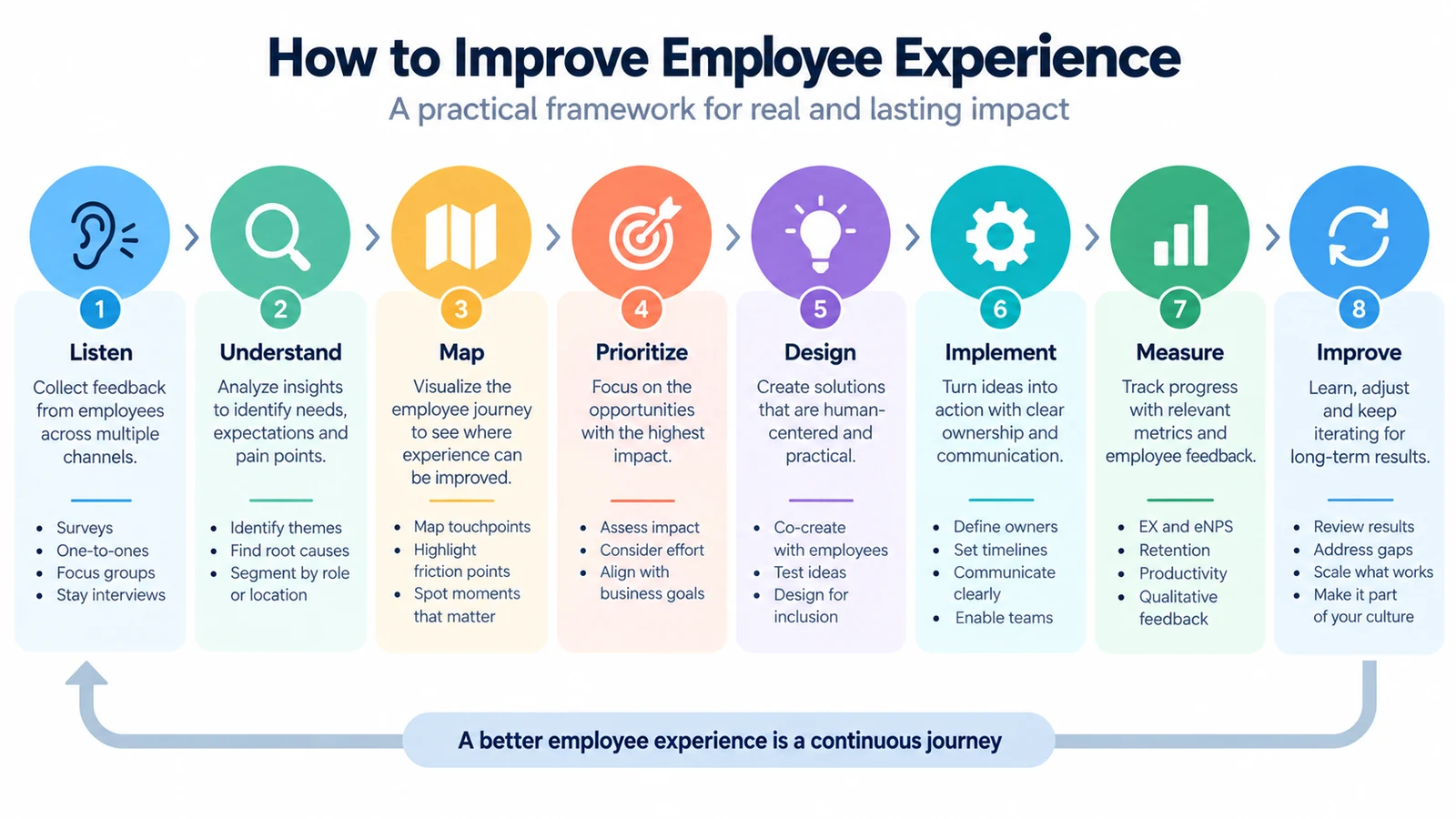
Listen → Understand → Map → Prioritize → Design → Implement → Measure → Improve
This creates a continuous improvement cycle rather than a one-time employee experience project.
15-Minute Employee Experience Improvement Review
Use this short review to turn employee feedback into one concrete improvement rather than another discussion or survey result.
- 0–3 minutes — Choose one moment that matters. Select a specific stage or touchpoint such as onboarding, manager feedback, access to tools, internal mobility or a repeated digital workflow.
- 3–6 minutes — Review the evidence. Combine employee feedback with operational signals such as delays, support tickets, repeated manual steps, drop-off, usage data or recurring complaints.
- 6–9 minutes — Identify the source of friction. Decide whether the main constraint comes from people, leadership, work design, culture, technology, policy or the physical/digital environment.
- 9–12 minutes — Assign one owner and one improvement. Define the smallest meaningful change that can be tested within the next 30 days and name the person accountable for moving it forward.
- 12–15 minutes — Define the evidence of improvement. Choose one practical indicator such as reduced cycle time, fewer support requests, improved onboarding completion, better employee feedback or lower process failure.
Review outcome: record KEEP if the experience works as intended, IMPROVE when a clear friction point can be addressed, or ESCALATE when the issue requires broader policy, technology or organizational change. Revisit the result after the test period and compare the evidence with the original baseline.
Who Owns Employee Experience?
Employee experience should not belong to one department alone.
| Stakeholder | Typical Contribution |
|---|---|
| Executive Leadership | Direction, priorities and organizational conditions |
| Managers | Daily leadership and team experience |
| HR / People Teams | Employee lifecycle and people processes |
| IT | Digital workplace and technology experience |
| Facilities | Physical workplace where relevant |
| Communications | Organizational communication |
| Employees | Feedback and participation in improvement |
Clear ownership is still important for individual initiatives.
Shared responsibility should not mean nobody is accountable.
Employee Experience and Workforce Transformation
Employee experience becomes especially important during transformation.
New technology, automation, AI and organizational redesign can change:
- Roles
- Responsibilities
- Skills
- Processes
- Career paths
- Team structures
Employees experience transformation through these changes, not through the transformation strategy document itself.
Our Workforce Transformation guide explains how organizations can connect future skills, AI and workforce strategy.
Common Employee Experience Mistakes
1. Treating EX as an HR Project
Many employee experience problems involve technology, processes, leadership or work design.
2. Measuring Without Improving
Repeated surveys without visible follow-up can reduce confidence in the listening process.
3. Focusing Only on Perks
Perks cannot compensate indefinitely for unclear roles, poor systems or dysfunctional processes.
4. Copying Another Company’s Employee Experience
Practices need to fit the organization’s workforce, culture and operating environment.
5. Optimizing Every Touchpoint Equally
Some employee moments matter more than others.
6. Ignoring Digital Friction
Slow systems and fragmented workflows can directly affect everyday work.
7. Automating Human Moments
Not every interaction should become a chatbot or automated workflow.
8. Using AI Without Appropriate Governance
Employee-facing AI can create privacy, transparency and accountability risks if poorly governed.
9. Assuming Everyone Has the Same Experience
Different roles, locations and employee groups may encounter very different conditions.
10. Confusing Engagement With Experience
An engagement survey is one source of information, not the complete employee experience.
The Future of Employee Experience
The future of employee experience will increasingly combine human and digital dimensions.
Several developments are likely to shape EX:
- Artificial intelligence
- Automation
- Skills-based organizations
- Hybrid work
- Digital workplace integration
- Personalized learning
- Employee self-service
- Internal talent mobility
AI may make workplace systems more conversational and capable of completing increasingly complex tasks.
But organizations will still need to make deliberate choices about which interactions should be automated and which require human involvement.
The future of EX should therefore not be:
Human Experience vs Technology
It should be:
Human Experience + Well-Designed Technology
Frequently Asked Questions About Employee Experience
What Is Employee Experience?
Employee experience is the cumulative experience employees have through their interactions with an organization throughout the employee journey.
What Is EX in HR?
EX stands for employee experience. In an HR context, it describes how employees experience workplace interactions, processes, leadership, technology and other aspects of their relationship with the organization.
What Are the Stages of the Employee Experience?
A useful employee lifecycle model contains seven stages: attract, hire, onboard, engage, perform, develop and depart.
What Is the Difference Between Employee Experience and Employee Engagement?
Employee experience describes what employees encounter throughout their relationship with the organization. Employee engagement describes aspects of how employees psychologically connect with their work and organization.
What Is Digital Employee Experience?
Digital Employee Experience, or DEX, describes how employees experience the devices, applications, digital services and technologies required to perform their work.
Why Is Employee Experience Important?
Employee experience influences how easily people can access information, collaborate, use technology, develop capabilities and perform their work.
How Do You Improve Employee Experience?
Start by understanding employees, mapping their journey, identifying important moments and sources of friction, prioritizing improvements and measuring whether those changes work.
How Do You Measure Employee Experience?
A balanced approach combines perception data such as surveys with behavioral, operational and outcome indicators.
What Is an Employee Journey Map?
An employee journey map visualizes major employee stages, touchpoints, needs, friction and opportunities for improvement.
What Are Moments That Matter?
Moments that matter are significant interactions or events that can strongly influence how employees perceive their relationship with the organization.
Who Is Responsible for Employee Experience?
Employee experience is a shared responsibility involving leaders, managers, HR, IT and other functions, with clear accountability needed for individual improvements.
How Can AI Improve Employee Experience?
AI can potentially improve knowledge discovery, self-service, workflow support, learning and administrative activities when deployed for appropriate use cases.
What Are the Risks of AI for Employee Experience?
Potential risks include privacy concerns, excessive monitoring, biased recommendations, opaque decisions, over-automation and loss of useful human interaction.
Is Employee Wellbeing Part of Employee Experience?
Yes. Wellbeing is an important dimension of employee experience, but employee experience is broader and also includes leadership, work, technology, culture, development and workplace interactions.
Conclusion: Employee Experience Is the Experience of Work
Employee experience is not a single program, platform or survey.
It is the cumulative experience people have as they interact with the organization throughout their journey.
A useful model is:
Employee Experience = People + Leadership + Work + Culture + Technology + Environment
Organizations can apply those dimensions across the employee lifecycle:
Attract → Hire → Onboard → Engage → Perform → Develop → Depart
Improving employee experience begins by understanding what employees actually encounter.
That means listening, mapping important interactions, identifying friction and redesigning the underlying experience rather than simply adding another employee initiative.
Technology and AI will become increasingly important parts of this environment.
They can reduce administrative work, improve knowledge access and support employees through complex digital workflows.
But poorly designed technology can create new friction, while poorly governed AI can introduce privacy, transparency and accountability problems.
The objective should therefore not be to create the most digital employee experience.
The objective is to create an employee experience that helps people understand their work, access what they need, develop their capabilities and contribute effectively.
A strong employee experience must work for different people and work settings. Our guides to diversity, equity and inclusion in the workplace and starting to work from home with no experience explore two practical dimensions of that challenge.
Continue Learning
Continue exploring the TechTeamSynergy employee experience and workplace cluster with these related guides:
Get Practical Insights from TechTeamSynergy
Join TechTeamSynergy Weekly for practical insights, frameworks, templates and resources covering Technology, Team and Transformation.