

What is artificial intelligence? Artificial intelligence (AI) refers broadly to machine-based systems and techniques designed to perform tasks such as prediction, recommendation, decision-making, perception, language processing, reasoning and content generation.
For example, AI already supports many technologies people and organizations use every day—from search and recommendation systems to fraud detection, predictive maintenance, virtual assistants, cybersecurity tools and generative applications.
However, artificial intelligence is much broader than ChatGPT or generative AI. If you are comparing the major conversational assistants, see our practical ChatGPT vs Gemini vs Claude comparison.
A useful way to understand the field is:
Artificial Intelligence → Machine Learning → Deep Learning → Generative AI → AI Agents and Applications
Although these concepts overlap, they are not interchangeable.
This guide explains how AI works, its major types, machine learning, neural networks, generative systems, large language models, AI agents, applications, business benefits, limitations, governance and future developments. If you are building the technical skills behind AI, data and automation work, our guide on why learning Python is useful provides a practical starting point.
Table of Contents
Jump directly to the section you need.
Authoritative reference points: This guide aligns its terminology and governance guidance with the OECD definition of an AI system, the NIST AI Risk Management Framework, ISO/IEC 42001 for AI management systems and the European Commission’s current AI Act overview.
Key Takeaways
- Artificial intelligence is the broad field. It includes systems designed to perform tasks such as prediction, classification, recommendation, perception, language processing, reasoning and content generation.
- AI, machine learning and deep learning are related but not interchangeable. Machine learning is a major branch of AI, while deep learning uses multilayer neural networks to learn complex patterns from data.
- Modern AI supports different capabilities. Predictive AI estimates outcomes or classifies information, generative AI creates new content, and agentic AI can pursue goals through multiple steps and authorized tools.
- Successful AI depends on more than the model itself. Data quality, evaluation, security, privacy, governance, human oversight and continuous monitoring all influence whether an AI system is reliable and useful.
- Organizations should start with the problem, not the technology. The strongest AI use cases connect a clearly defined business or operational need with suitable data, measurable outcomes and appropriate risk controls.
Understanding Artificial Intelligence
Artificial intelligence is a broad field concerned with building systems capable of performing tasks that normally require forms of intelligence, such as learning, recognizing patterns, interpreting information, making predictions or supporting decisions.
An intelligent system might:
- Classify an image
- Predict equipment failure
- Recommend a product
- Detect unusual network behavior
- Recognize speech
- Translate languages
- Generate text or images
- Analyze large datasets
- Support business decisions
Importantly, AI does not necessarily mean that a machine thinks like a human.
In practice, Modern systems typically use mathematical models, algorithms, data and computing resources to perform defined tasks.
What Are the Main Types of Artificial Intelligence?
In practice, artificial intelligence can be grouped in several ways. For business and technology use, one useful approach is to distinguish AI by the capability it provides rather than by hypothetical levels of human-like intelligence.
| Type of AI | Primary capability | Example |
|---|---|---|
| Predictive AI | Estimates outcomes, detects patterns or classifies information | Fraud detection, demand forecasting or predictive maintenance |
| Generative AI | Creates new content from learned patterns | Text, images, code, audio or summaries |
| Conversational AI | Interacts with users through natural language | Virtual assistants, chatbots and support agents |
| Computer Vision | Analyzes and interprets images or video | Quality inspection, object detection or medical imaging support |
| Agentic AI | Pursues goals through multiple steps and authorized tools | Workflow agents that research, plan, call tools and complete tasks |
However, these categories can overlap. For example, an AI agent may use a large language model for reasoning, computer vision to interpret images and predictive models to support decisions. Therefore, the classification describes the system’s primary capability rather than a rigid boundary between technologies.
How Does AI Work?
Importantly, there is no single process used by every intelligent system.
However, many machine-learning applications can be represented by a simplified lifecycle:
Problem → Data → Model → Training → Evaluation → Deployment → Inference → Monitoring

1. Define the problem
First, The process should begin with a clearly defined objective.
For example:
- Predict customer demand
- Classify documents
- Identify unusual equipment behavior
- Generate a summary
- Recognize objects in an image
Therefore, starting with the business or operational problem helps prevent organizations from adopting AI simply because the technology is available.
2. Collect and prepare data
In practice, many AI techniques depend heavily on data.
Depending on the application, data might include:
- Text
- Images
- Audio
- Video
- Sensor information
- Business transactions
- Network telemetry
- Historical operational data
As a result, Data quality, relevance, representativeness and governance can strongly influence system performance.
3. Select a model or approach
Next, Teams select an algorithm, model architecture or existing model suited to the task.
For example, not every problem requires deep learning or a large language model. Simpler approaches can sometimes be more efficient and easier to operate.
4. Train or configure the model
Then, During training, a machine-learning model adjusts internal parameters based on examples or other training signals.
Alternatively, organizations can use an existing pretrained model rather than training one from scratch.
5. Evaluate performance
Before deployment, the system should be tested against appropriate criteria.
Evaluation might consider:
- Accuracy
- Precision and recall
- Reliability
- Robustness
- Latency
- Fairness
- Security
- Business usefulness
Ultimately, The correct measures depend on the application.
6. Deploy the system
Once validated for its intended use, the model can be integrated into an application, workflow or business process.
7. Perform inference
In other words, Inference is the process of using a trained model to produce an output from new input.
For example, a trained model might receive a new image and classify what it contains.
8. Monitor and improve
However, deployment is not necessarily the end of the lifecycle.
Organizations may need to monitor:
- Model performance
- Changes in data
- Unexpected outputs
- Security events
- Operational cost
- User feedback
AI vs Machine Learning vs Deep Learning
Although these terms are often used as if they mean the same thing, they describe different concepts.
| Concept | Meaning |
|---|---|
| Artificial Intelligence | The broad field of creating systems that perform tasks associated with intelligent behavior |
| Machine Learning | A set of methods that enables systems to learn patterns from data |
| Deep Learning | A machine-learning approach based on multilayer neural networks |
| Generative AI | AI designed to generate new content such as text, images, audio or video |
A simple relationship is:
AI ⊃ Machine Learning ⊃ Deep Learning

Generative models often use deep-learning architectures, although the broader field of AI contains many other approaches.
What Is Machine Learning?
More specifically, Machine learning enables computing systems to learn useful patterns from data rather than relying exclusively on manually programmed rules for every situation.
For example, instead of writing thousands of explicit rules describing unwanted email, a machine-learning system can learn patterns from previously classified messages.
Machine learning supports applications such as:
- Recommendations
- Forecasting
- Classification
- Anomaly detection
- Computer vision
- Fraud detection
- Predictive maintenance
Main Machine-Learning Approaches
Supervised learning
For example, Supervised learning uses examples where the desired output or label is available during training.
In practice, Common applications include classification and prediction.
Unsupervised learning
By contrast, Unsupervised methods look for structures or patterns in data without relying on the same type of labeled target used in supervised learning.
For instance, Examples include clustering and some forms of anomaly analysis.
Reinforcement learning
Meanwhile, Reinforcement learning involves an agent interacting with an environment and learning from signals associated with its actions.
Therefore, It is useful for certain sequential decision-making problems.
What Is Deep Learning?
More specifically, Deep learning is a branch of machine learning based on neural networks containing multiple computational layers.
In particular, It has become important for tasks involving complex and high-dimensional data such as:
- Images
- Speech
- Language
- Video
As a result, Deep learning has contributed significantly to advances in computer vision, speech recognition and modern generative systems.
What Are Neural Networks?
At a basic level, Artificial neural networks are computational models made of interconnected units organized into layers.
A simplified structure contains:
Input Layer → Hidden Layers → Output Layer
Then, During training, the network adjusts numerical parameters so that its outputs better match the objective defined for the task.
However, The term “neural network” is inspired by biological neurons, but artificial neural networks should not be understood as digital replicas of the human brain.
Predictive AI vs Generative AI
For example, One useful way to understand modern systems is to distinguish between predictive and generative capabilities.
Predictive systems
In practice, Predictive models use patterns in data to estimate outcomes, classify information or support forecasts.
Examples include:
- Demand forecasting
- Equipment-failure prediction
- Fraud detection
- Customer churn prediction
- Risk scoring
Generative systems
By contrast, Generative models create new outputs based on patterns learned during training.
Outputs can include:
- Text
- Images
- Software code
- Audio
- Video
- Structured information
The distinction is useful, although real applications can combine predictive and generative capabilities.
What Is Generative AI?
For practical guidance on interacting with generative systems, see our guide to writing better AI prompts.
More specifically, Generative AI refers to models capable of generating new content based on patterns represented in their training and inputs.
For example, a generative application might:
- Draft an email
- Summarize a document
- Create an image
- Generate software code
- Answer questions
- Transform existing content
Generative systems have made AI much more accessible because people can interact with many applications through natural language.
However, generated content should not automatically be treated as accurate. Outputs may contain errors, unsupported statements or misleading information.
What Are Foundation Models?
In addition, A foundation model is generally trained on broad data and designed so that it can be adapted or applied across multiple tasks.
Instead of building a completely separate model for every application, organizations can build applications around an existing foundation model.
As a result, This approach has helped accelerate the development of generative applications.
What Is a Large Language Model?
For example, A large language model (LLM) is a model designed to process and generate language.
LLMs can support tasks such as:
- Question answering
- Summarization
- Translation
- Content generation
- Information extraction
- Classification
- Programming assistance
However, An LLM does not function like a traditional database that simply retrieves a stored answer. It generates outputs using learned patterns and the context supplied to it.
What Is Natural Language Processing?
Similarly, Natural language processing (NLP) focuses on enabling computers to work with human language.
Applications include:
- Translation
- Speech and text analysis
- Sentiment analysis
- Document classification
- Search
- Conversational systems
As a result, modern language models have significantly expanded the range of NLP applications.
What Is Computer Vision?
Similarly, computer vision enables systems to analyze images and video.
Applications can include:
- Object detection
- Image classification
- Quality inspection
- Document processing
- Medical imaging support
- Infrastructure monitoring
Therefore, The appropriate level of human oversight depends on the impact and risk of the application.
What Is Agentic AI?
Meanwhile, some modern systems are designed not only to generate an answer but also to pursue goals through multiple steps.
A simplified agent workflow is:
Goal → Plan → Select Action or Tool → Act → Observe → Adjust
For example, An AI agent may interact with applications, retrieve information, call authorized tools or coordinate multiple steps within defined boundaries.
At the same time, greater autonomy creates additional requirements around permissions, monitoring, reliability and human oversight.

This topic deserves deeper treatment, so our dedicated Agentic AI guide covers agents, workflows, autonomy and enterprise use cases separately.
AI vs Automation
For a deeper comparison with rule-based workflows, read our guide to robotic process automation in the AI era.
However, automation and artificial intelligence are related but different.
Typically, Traditional automation generally follows predefined rules and workflows.
For example:
If condition A occurs → perform action B
By contrast, AI can introduce capabilities such as prediction, classification, language understanding or generation.
The two can also work together:
Input → AI Analysis → Decision Logic → Automated Workflow
As a result, this combination can make automation more adaptable, but it also requires appropriate controls.
Common Applications
Today, Intelligent systems now support a wide range of business and technology applications.
Customer service
For example, Organizations can use language technologies to:
- Answer common questions
- Classify requests
- Summarize conversations
- Assist customer-service teams
Marketing and content
Similarly, Generative applications can assist with:
- Drafting content
- Brainstorming
- Summarization
- Content adaptation
- Research support
Therefore, human review remains important, particularly for factual or externally published content.
Software development
In addition, AI-assisted development tools can support:
- Code suggestions
- Documentation
- Testing
- Code explanation
- Debugging support
For this reason, generated code should still be reviewed, tested and handled according to appropriate software-development and security practices.
Data analysis
Likewise, Intelligent tools can help users explore datasets, identify patterns and generate summaries.
However, organizations still need appropriate data-quality and validation processes.
Operations
Predictive models can support:
- Demand forecasting
- Capacity planning
- Anomaly detection
- Predictive maintenance
- Resource optimization
AI in Enterprise Networking and Telecom
In parallel, Telecommunications and enterprise networking generate large quantities of operational data.
Potential applications include:
- Traffic analysis
- Capacity forecasting
- Anomaly detection
- Network optimization
- Incident analysis
- Customer-support assistance
- Operational automation
However, AI can support network teams, but operational changes should still be governed according to their potential impact and the reliability of the underlying system.
AI and Cybersecurity
Explore the defensive applications and associated risks in our dedicated guide to AI in cybersecurity.
For example, Security teams can use intelligent systems to help analyze telemetry, identify anomalies, correlate events, prioritize alerts and support investigations.
At the same time, AI systems introduce their own security and governance considerations.
This relationship is explored in greater depth in our AI in Cybersecurity guide.
AI and the Internet of Things
See how intelligent analysis works with sensors, devices and edge systems in our Internet of Things guide.
For example, connected devices generate information about physical environments, while intelligent models can analyze that information.
A simplified relationship is:
Device Senses → Data Collected → AI Analyzes → Application Decides → System Responds
As a result, applications can include predictive maintenance, anomaly detection, energy optimization and operational analytics.
See our Internet of Things guide for a deeper explanation of connected-device architecture, sensors, edge computing and security.
AI in Project Management
For applied workflows, continue with AI in project management, AI for project risk management, our collection of AI prompts for project managers and our comparison of AI tools for project managers.
Likewise, Project and program teams can use intelligent tools to assist with activities such as:
- Meeting summaries
- Document analysis
- Draft communications
- Risk identification
- Knowledge retrieval
- Schedule analysis
- Reporting
However, the project manager remains responsible for judgment, stakeholder management and decisions that require organizational context.
Benefits for Organizations
Scale
For example, Models can process quantities of information that would be difficult to analyze manually.
Productivity
In addition, AI can assist employees with repetitive knowledge-work activities such as drafting, summarizing and classifying information.
Faster analysis
As a result, Models can help organizations identify patterns in large datasets more quickly.
Personalization
Similarly, Applications can adapt recommendations or experiences using relevant contextual information.
Automation
Moreover, AI capabilities can be combined with workflows to automate selected processes.
Innovation
Ultimately, Organizations can use intelligent capabilities to create new products, services and operating models.
Limitations
However, AI is powerful, but it is not automatically accurate, objective or appropriate for every problem.
Dependence on data
For example, Model performance can be affected by incomplete, inaccurate, unrepresentative or outdated data.
Errors
In addition, Systems can produce incorrect outputs even when those outputs appear convincing.
Limited context
Similarly, A model may lack organizational, cultural or situational context that a human decision-maker understands.
Bias
Moreover, Data, system design and deployment choices can contribute to undesirable differences in system behavior or outcomes.
Explainability
Furthermore, Some complex models can be difficult to interpret.
Cost
Finally, Training, operating and integrating advanced models can require substantial computing, engineering and operational resources.
What Are AI Hallucinations?
Generative systems can sometimes produce information that is incorrect, fabricated or unsupported while presenting it confidently.
This behavior is often called a hallucination.
For important tasks, organizations should use appropriate validation techniques such as:
- Human review
- Trusted data sources
- Retrieval from approved information
- Automated evaluation
- Application-specific controls
Generative output should not be considered correct merely because it sounds plausible.
AI Risk Management
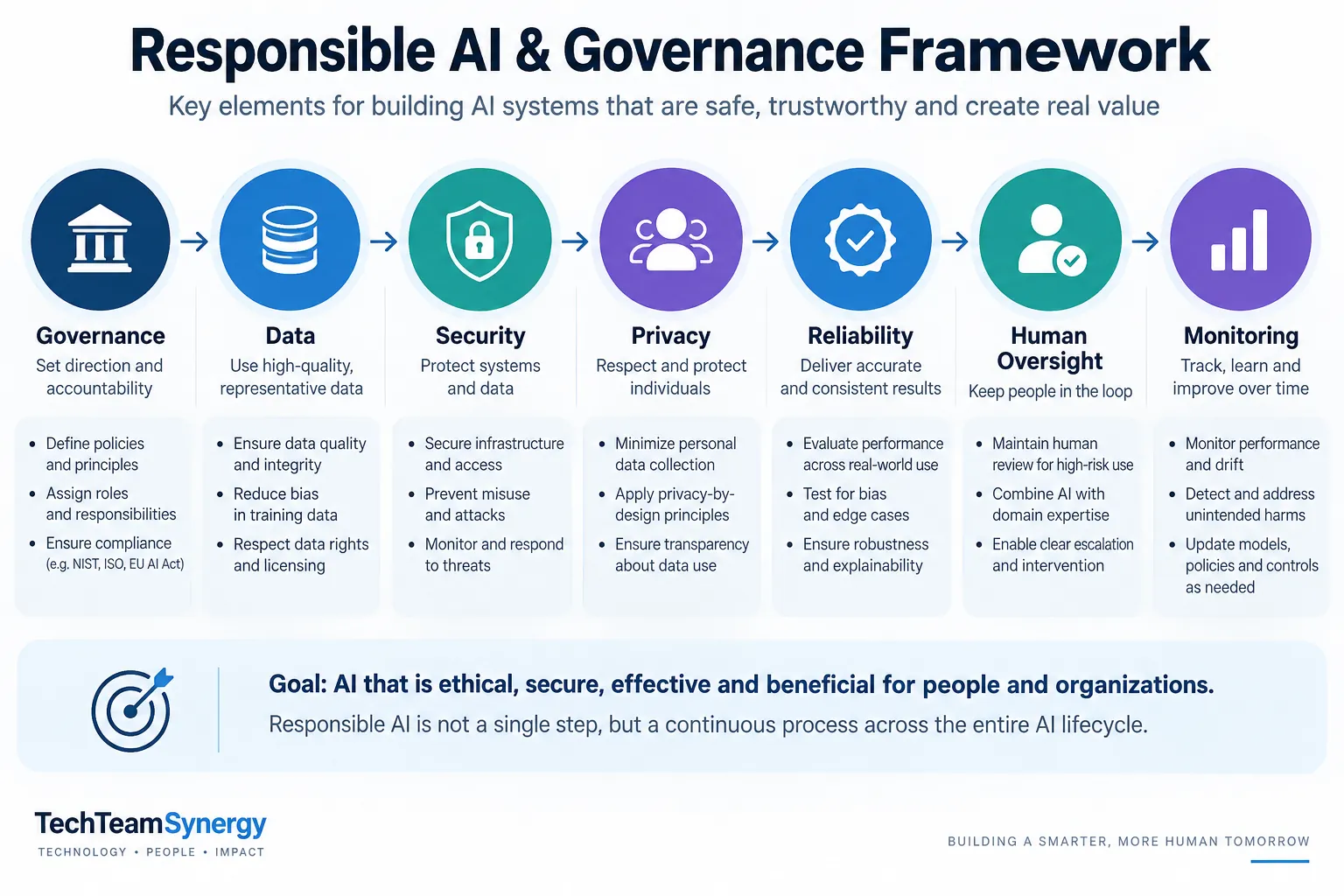
Therefore, Organizations should treat AI risk as an ongoing management responsibility rather than a one-time technical review.
The NIST AI Risk Management Framework provides a useful structure built around four functions:
Govern → Map → Measure → Manage
Govern
Establish policies, responsibilities, accountability and organizational processes for managing risk.
Map
Understand the system’s context, purpose, users, dependencies and potential impacts.
Measure
Assess relevant performance, risk and trustworthiness characteristics.
Manage
Prioritize and address identified risks based on organizational objectives and risk tolerance.
Responsible and Trustworthy AI
Importantly, Trustworthy deployment involves more than model accuracy.
Depending on the application, organizations may need to consider:
- Validity and reliability
- Safety
- Security and resilience
- Accountability
- Transparency
- Explainability
- Privacy
- Fairness
For this reason, The appropriate controls should depend on the context and potential impact of the system.
Generative AI Risk
Generative systems introduce or amplify several challenges because they can produce content at scale and may be integrated with sensitive information or business processes.
Risk considerations can include:
- Incorrect generated information
- Data privacy
- Information security
- Intellectual-property considerations
- Bias
- Misuse
- Overreliance
- Third-party dependencies
Organizations should therefore evaluate generative applications in the context in which they will actually be used.
Human Oversight
In particular, Human oversight is particularly important when systems influence decisions with significant consequences.
The appropriate level of oversight depends on factors such as:
- Potential impact
- Model reliability
- Ability to reverse a decision
- Sensitivity of the data
- Level of automation
- Regulatory requirements
However, Human oversight should be meaningful rather than simply adding an approval step that users routinely accept without review.
Security
AI systems also need cybersecurity.
Organizations should consider the security of:
- Training data
- Models
- Applications
- APIs
- Credentials
- Infrastructure
- Third-party components
- Model outputs
Security should be considered throughout the lifecycle rather than added only after deployment.
Privacy
In addition, AI applications may process personal, confidential or proprietary information.
Organizations should understand:
- Which information enters the system
- Why it is required
- Where it is processed
- How it is retained
- Who can access it
- Which third parties receive it
Employees should also understand what types of organizational information are permitted in external AI services.
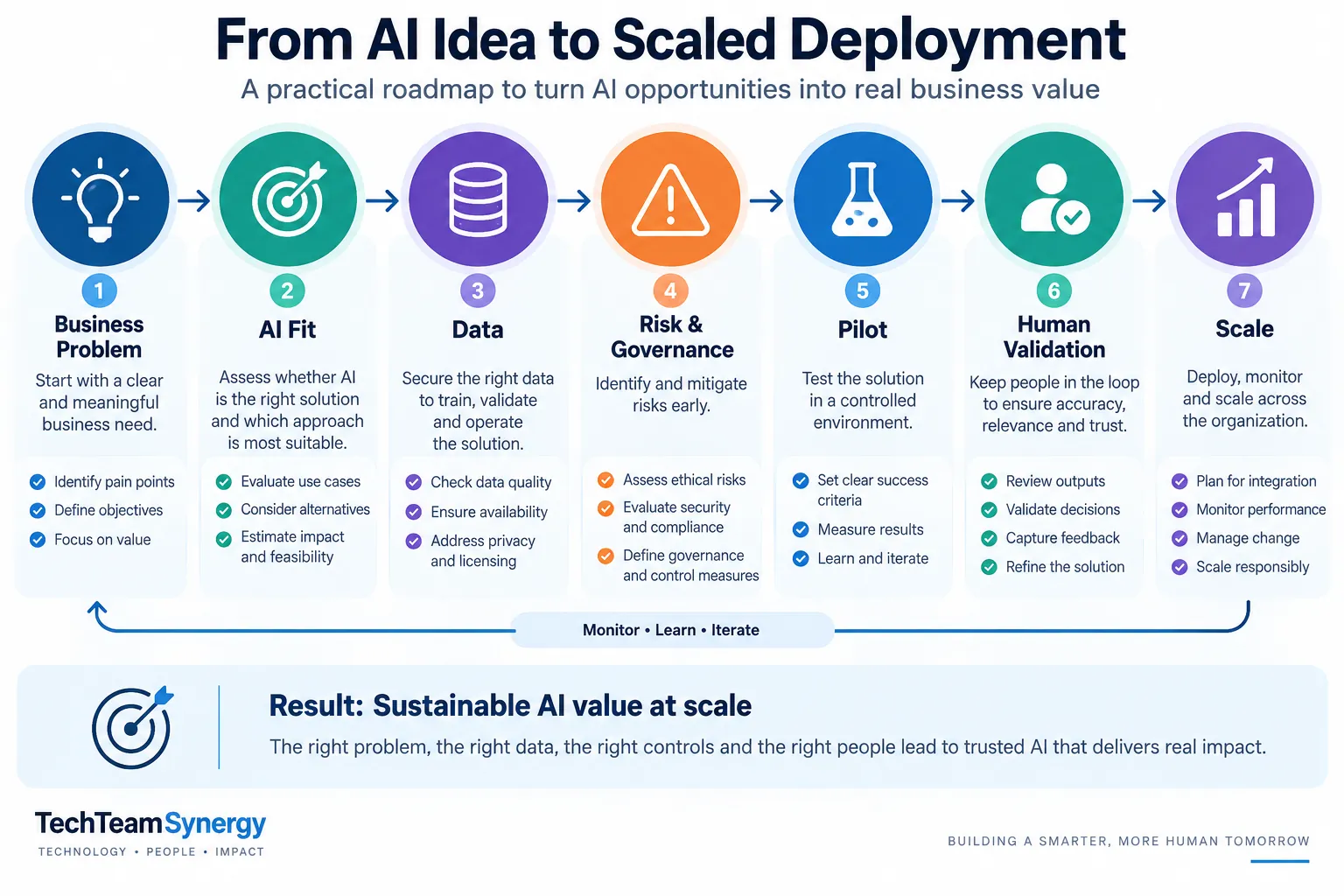
How to Adopt AI in an Organization
1. Start with a business problem
Identify the outcome the organization wants to improve.
2. Determine whether AI is necessary
A conventional application, analytics solution or rule-based automation may sometimes solve the problem more simply.
3. Assess data readiness
Understand which data is required, its quality and whether its use is appropriate.
4. Define success measures
Establish technical and business metrics before deploying the system.
5. Assess risk
Evaluate security, privacy, reliability, operational and organizational risks.
6. Select the appropriate approach
Decide whether to build, buy, configure or integrate an existing model or service.
7. Pilot
Begin with a controlled use case that can be evaluated.
8. Keep humans appropriately involved
Define where human review, approval or intervention is required.
9. Monitor
Measure performance and identify unexpected behavior after deployment.
10. Scale based on evidence
Expand when the pilot demonstrates measurable value and acceptable risk.
15-Minute AI Use-Case Triage
Before committing budget, data or engineering effort, teams can run a short use-case review to decide whether AI is actually the right approach.
- Start (minutes 0–3) — Define the outcome: state the business or operational problem in measurable terms. Avoid starting with a model or vendor.
- Next (minutes 3–6) — Test simpler alternatives: ask whether a rule, workflow change, analytics solution or conventional automation could solve the problem more simply.
- Then (minutes 6–9) — Check evidence and data: confirm that suitable data, examples or knowledge sources exist and that their use is appropriate.
- After that (minutes 9–12) — Check risk and oversight: identify what could go wrong, who is affected, what must remain human-reviewed and whether the output can be validated.
- Finally (minutes 12–15) — Make the decision: choose PILOT AI, USE A SIMPLER SOLUTION, REDESIGN THE PROCESS FIRST or INVESTIGATE FURTHER. Record an owner, success measure and next validation date.
As a result, this review helps prevent teams from treating AI as the default answer when the real requirement may be better data, a simpler workflow or clearer business logic.
How to Measure AI Success
In practice, organizations should avoid measuring success simply by counting the number of models, tools or users.
Instead, metrics should connect technology performance with business outcomes.
Depending on the application, measures might include:
- Accuracy or task performance
- Time saved
- Quality improvement
- Cost per task
- User adoption
- Customer satisfaction
- Operational reliability
- Error rate
- Risk indicators
- Return on investment
Common AI Adoption Mistakes
Starting with technology instead of the problem
For example, using AI without a clear objective can create expensive experiments with little measurable value.
Assuming every problem requires generative AI
By contrast, predictive analytics, conventional software or simple automation may be more appropriate.
Ignoring data quality
Advanced models cannot automatically compensate for every data problem.
Trusting outputs without verification
Generated or predicted results should be validated according to their intended use and potential impact.
Ignoring security and privacy
AI applications can create new information flows and dependencies that require governance.
Automating too quickly
Connecting models directly to business actions without appropriate controls can increase operational risk.
Ignoring people and skills
Successful adoption also requires training, process redesign, leadership and change management.
AI and the Future of Work
Our workforce transformation guide examines the related implications for skills, roles and organizational change. For a project-management-specific view, see Will AI Replace Project Managers?
Artificial intelligence is changing how many knowledge-based tasks are performed.
In many roles, the more immediate change is not complete replacement of a profession but redistribution of tasks between people and software.
Employees may spend less time on activities such as:
- Basic drafting
- Routine summarization
- Information classification
- Initial research
- Repetitive analysis
This can increase the importance of complementary human capabilities such as:
- Critical thinking
- Domain expertise
- Judgment
- Communication
- Leadership
- Creativity
- Verification
The Future of Artificial Intelligence
The field is developing rapidly, but several directions are already important for organizations.
Multimodal systems
Models are increasingly able to work across combinations of text, images, audio, video and other data.
AI agents
Systems are increasingly being designed to perform multi-step workflows using tools and applications within defined permissions.
Smaller and specialized models
Not every application requires the largest available model. Smaller or domain-specific systems can offer advantages in cost, latency, control or deployment flexibility.
More AI at the edge
Some inference can move closer to devices, users and operational environments.
AI integrated into everyday software
Intelligent capabilities are increasingly becoming features within existing applications rather than separate destinations.
Greater emphasis on governance
As adoption expands, organizations will need stronger processes for evaluating performance, security, privacy, accountability and risk.
Human-AI collaboration
One of the most important developments may be better integration between human expertise and machine capabilities rather than treating the future simply as humans versus machines.
Frequently Asked Questions
What is artificial intelligence in simple terms?
Artificial intelligence is the broad field of creating machine-based systems that can perform tasks such as learning patterns, making predictions, interpreting information, generating content or supporting decisions.
What is an example of AI?
Examples include recommendation systems, image recognition, language translation, fraud detection, predictive maintenance and generative assistants.
Is AI the same as machine learning?
No. Artificial intelligence is the broader field. Machine learning is one approach used to build intelligent systems by learning patterns from data.
Is AI the same as ChatGPT?
No. ChatGPT is an application built using generative artificial intelligence. AI is a much broader field that includes predictive models, computer vision, machine learning, robotics and many other technologies.
What is generative AI?
Generative AI refers to models designed to generate content such as text, images, audio, video or software code.
What is the difference between predictive and generative AI?
Predictive systems primarily estimate, classify or forecast outcomes, while generative systems produce new content. Some applications combine both capabilities.
What is an LLM?
A large language model is a model designed to process and generate language. LLMs can support tasks such as summarization, question answering, translation and content generation.
What is an AI agent?
An AI agent is a system designed to pursue goals through actions or multiple steps, potentially using software tools and responding to information it receives during the process.
Can AI make mistakes?
Yes. Models can produce incorrect predictions or generated content. The level of validation and human oversight should reflect the importance and potential impact of the application.
Will AI replace jobs?
AI can automate some tasks and change how jobs are performed. Its impact varies by occupation, industry and use case, and many roles are likely to combine human expertise with intelligent tools.
What are the main risks?
Risks can include unreliable outputs, security problems, privacy concerns, bias, inappropriate automation, overreliance and poor governance. The importance of each risk depends on the system and how it is used.
What is responsible AI?
Responsible AI involves developing and using intelligent systems with appropriate attention to reliability, safety, security, privacy, accountability, transparency, fairness and human oversight.
How should a company start using AI?
Start with a specific business problem, determine whether AI is actually appropriate, assess the available data and risks, define measurable outcomes, run a controlled pilot and scale based on evidence.
Conclusion
Artificial intelligence is much broader than generative AI, chatbots or any individual product.
It encompasses technologies that can analyze information, learn patterns, make predictions, generate content and support decisions.
A useful conceptual hierarchy is:
Artificial Intelligence → Machine Learning → Deep Learning → Generative AI → AI Agents and Applications
Organizations can use these capabilities for analytics, automation, cybersecurity, networking, connected devices, software development, customer service and many other applications. If software development is your starting point, our Python beginner guide provides a practical path from fundamentals to real projects.
But successful adoption requires more than selecting a powerful model.
Organizations need clear objectives, appropriate data, reliable evaluation, cybersecurity, privacy protection, governance, human oversight and measurable business outcomes.
The organizations that create sustainable value from AI are therefore likely to be those that combine technology with people, processes and responsible decision-making.
For readers who want to move from broad AI concepts into practical ChatGPT workflows, ChatGPT Unlocked provides a structured path from fundamentals to advanced applications.
Continue Learning
Continue exploring the TechTeamSynergy AI cluster with these related guides.
Comments are closed.