

Telco Cloud is a cloud-based architecture designed to run, manage and automate telecommunications network functions and services across distributed infrastructure.
It brings together technologies such as Network Functions Virtualization (NFV), virtual machines, containers, Kubernetes, cloud-native network functions, automation, orchestration and increasingly AI-assisted operations.
For engineers building the scripting fundamentals behind automation and orchestration, our learn Python from scratch guide provides a practical foundation.
But a telecommunications cloud is not simply “public cloud for telecom.” Carrier networks have demanding requirements for availability, performance, networking, lifecycle management, geographical distribution and operational automation.
As networks evolve toward 5G, edge computing and future network generations, this architecture is becoming an important foundation for moving from appliance-centric infrastructure toward programmable, software-driven networks.
This guide explains how telecom cloud architecture works, where NFV, VNFs, CNFs and Kubernetes fit, how it supports 5G and edge computing, and why cloud-native and AI-native principles are increasingly important to the future of telecommunications.
What Is Telco Cloud?
Telco Cloud is a telecommunications cloud environment that provides infrastructure, platform capabilities, management and orchestration for deploying and operating network functions and telecom applications.
The goal is to separate network software from dedicated hardware and provide programmable infrastructure on which telecom workloads can be deployed, scaled, updated and managed.
A modern environment can support different workload models, including:
- Physical Network Functions (PNFs) where required
- Virtualized Network Functions (VNFs)
- Cloud-native Network Functions (CNFs)
- Virtual machines
- Containers
- Kubernetes-based applications
- 5G network functions
- Edge applications
This heterogeneous nature is important.
Modernization does not mean that every network function must immediately become containerized. Real telecommunications networks evolve progressively and often contain several generations of technology at the same time.
Why Do Telecom Operators Need Cloud Infrastructure?
Traditional telecommunications networks were largely built around specialized network appliances.
A firewall, packet gateway, router, session border controller or mobile-core function could be closely associated with dedicated hardware.
This model delivered predictable behavior, but it also created limitations:
- Hardware and software lifecycles could be tightly coupled.
- Introducing services could require additional appliances.
- Infrastructure utilization could be inefficient.
- Scaling could require new dedicated hardware.
- Automation across different vendors could be difficult.
- Service deployment cycles could be relatively long.
Operators therefore began separating network-function software from dedicated hardware.
NFV was a major step in this transformation. Cloud-native architecture takes that journey further by combining virtualization with distributed infrastructure, APIs, automation and modern software lifecycle practices.
From Physical Appliances to Cloud-Native Telecom
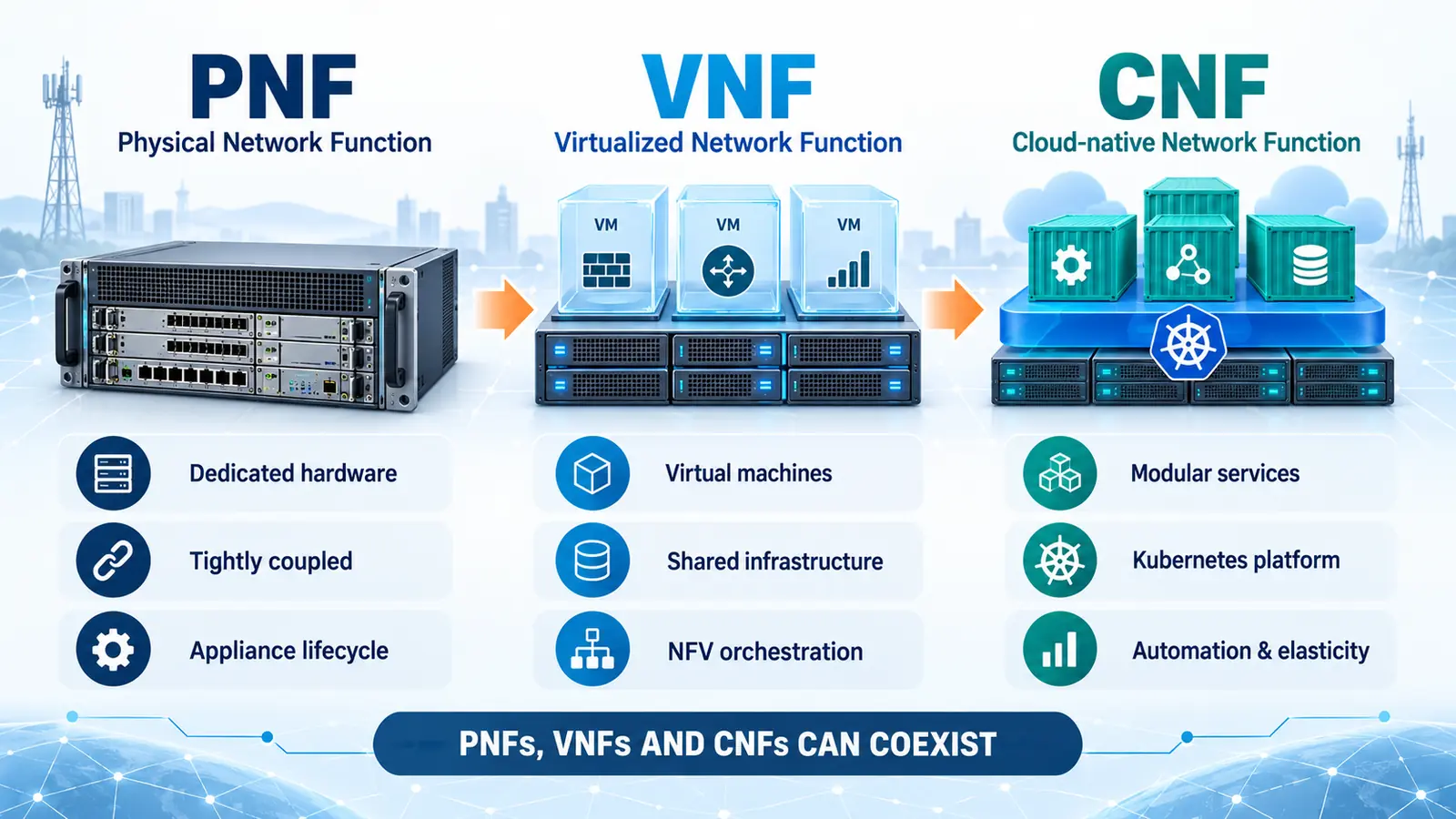
The transformation is easier to understand as a series of overlapping architectural stages rather than a simple replacement of one technology by another.
Stage 1: Physical Network Functions
Network functions traditionally ran on purpose-built or dedicated physical systems.
These are commonly described as Physical Network Functions (PNFs).
The hardware and network-function software were closely associated, creating highly specialized network appliances.
Stage 2: Network Functions Virtualization
NFV introduced greater separation between network-function software and the physical infrastructure.
Network functions could increasingly operate as software on shared virtualized resources rather than requiring a dedicated appliance.
This introduced the Virtualized Network Function (VNF).
For a deeper explanation of the architecture and management model, read our complete guide to Network Functions Virtualization (NFV).
Stage 3: Cloud-Native Network Functions
Virtualizing an application does not automatically make it cloud-native.
Cloud-native architecture introduces characteristics such as modularity, loose coupling, resilience, elasticity, declarative management and automation.
This evolution has driven increasing interest in Cloud-native Network Functions (CNFs).
Our VNF vs CNF comparison explains these architectural differences and why “VNF equals VM, CNF equals container” is an oversimplification.
Stage 4: Telco Cloud
The next step brings these technologies together into a broader infrastructure and operational architecture.
The objective is no longer simply to virtualize individual appliances. It is to create a programmable environment capable of supporting telecom applications across central data centers, regional locations, network sites and the edge.
Telco Cloud Architecture
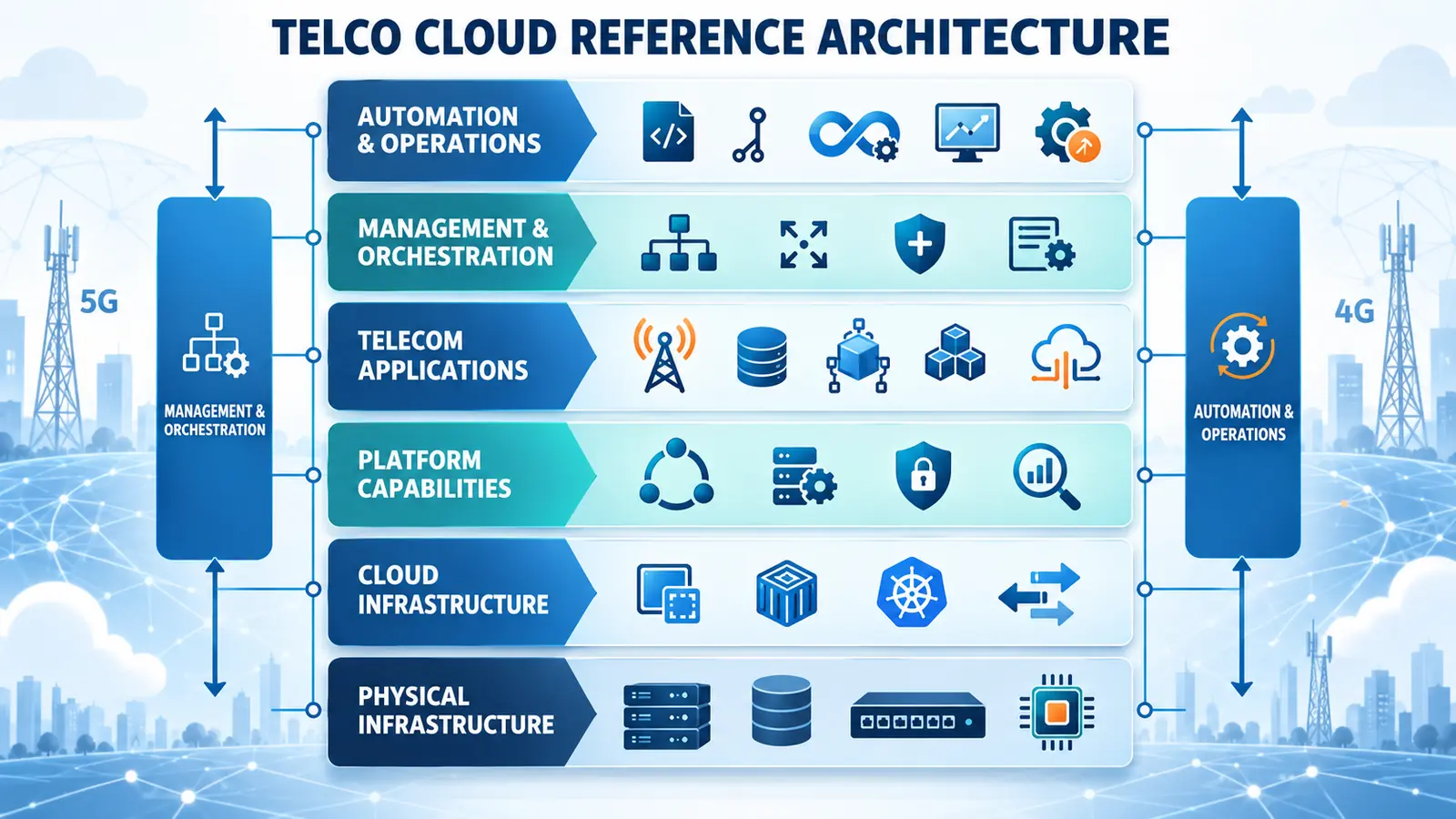
A useful way to understand the architecture is through several interacting layers.
Implementations differ among operators and vendors, but the conceptual model typically includes:
- Physical infrastructure
- Cloud infrastructure
- Platform capabilities
- Telecom applications and network functions
- Management and orchestration
- Automation and operations
1. Physical Infrastructure
The physical layer provides the underlying compute, storage and networking resources.
It can include:
- Servers
- CPU resources
- Memory
- Storage
- Network interfaces
- Switching infrastructure
- Hardware acceleration
- Data-center facilities
Telecommunications workloads can impose demanding requirements on this layer, particularly for packet processing, latency-sensitive applications and high-throughput network functions.
2. Cloud Infrastructure
Above the hardware sits the infrastructure used to host telecom applications.
This can combine virtualization and container technologies, including:
- Hypervisors
- Virtual machines
- Container runtimes
- Kubernetes clusters
- Virtual networking
- Software-defined storage
- Hardware acceleration
A modern telecom environment therefore does not necessarily require choosing between virtual machines and containers. Both can form part of the infrastructure strategy.
3. Platform Capabilities
Platform services provide reusable capabilities so that every network application does not need to implement the same functionality independently.
Depending on the architecture, these services can support:
- Application deployment
- Service discovery
- Configuration
- Observability
- Security
- Data management
- Lifecycle operations
- Automation
This platform-oriented approach becomes increasingly important as telecommunications software becomes more modular and cloud-native.
4. Telecom Applications and Network Functions
The application layer contains the workloads that deliver actual network and telecommunications services.
Examples include:
- Mobile-core functions
- IMS functions
- Firewalls
- Session border controllers
- Network gateways
- Security functions
- Virtualized or cloudified RAN components
- Edge applications
Different applications can use different implementation models. Some may remain VM-based VNFs while others adopt cloud-native architectures.
5. Management and Orchestration
Running network applications across distributed infrastructure requires much more than scheduling workloads.
Management and orchestration can coordinate:
- Infrastructure resources
- Application lifecycle
- Network services
- Configuration
- Scaling
- Healing
- Updates
- Policies
- Multi-domain resources
This broader operational scope is one reason telecom cloud architecture cannot be reduced to Kubernetes alone.
6. Automation and Operations
Automation connects infrastructure, applications and operational systems.
A mature operating model should progressively reduce repetitive manual activities and move toward policy-driven and intent-driven operations.
Automation can cover:
- Provisioning
- Configuration
- Testing
- Deployment
- Scaling
- Healing
- Monitoring
- Optimization
- Security controls
Telco Cloud Infrastructure and Telco Cloud Applications
Current ETSI NFV evolution introduces an important distinction between Telco Cloud Infrastructure (TCI) and Telco Cloud Applications (TCA).
At a high level, TCI represents infrastructure and associated capabilities used to host telecom workloads, while TCA represents applications operating within this architectural environment.
The ETSI GS NFV 008-1 architectural framework specifies architectural blocks, functions and service interfaces intended to enable management and orchestration of TCA and TCI.
This is an important development because it reflects the industry’s progression beyond the original model of simply running virtualized functions on shared infrastructure.
The architecture increasingly needs to accommodate cloud-native applications, platform capabilities, automation and future AI-native workloads.
What Is the Difference Between NFV and Telco Cloud?
NFV and modern telecommunications cloud architecture are closely related, but they are not identical.
NFV established an important architectural foundation for separating network functions from dedicated hardware and managing virtualized network services.
The broader cloud model extends this transformation through cloud-native infrastructure, applications, platform services, distributed computing, automation and modern operational practices.
The ETSI NFV program continues to evolve in this direction, with Release 6 work addressing cloud-native technologies and the architecture required for future telecommunications environments.
NFV therefore remains part of the story rather than becoming irrelevant.
Telco Cloud vs Public Cloud
Telecommunications clouds and general public-cloud platforms share many technologies and principles, but their requirements are not identical.
| Area | General Public Cloud | Telecom Cloud |
|---|---|---|
| Primary workloads | General IT and digital applications | Telecom applications and network functions |
| Distribution | Regions and availability zones | Core data centers plus distributed network and edge locations |
| Networking | Application connectivity | Application plus carrier-network connectivity |
| Performance | Application dependent | Can include demanding packet-processing and latency requirements |
| Workloads | Primarily cloud applications | PNFs, VNFs, CNFs and telecom applications |
| Operations | Cloud operations | Cloud plus network and service operations |
The boundary is becoming less rigid. Operators can use private, public, hybrid and distributed cloud approaches according to workload requirements and business strategy.
Private, Public, Hybrid and Distributed Models
There is no single mandatory deployment model.
Private Telecom Cloud
The operator controls dedicated infrastructure in its own facilities or dedicated environments.
This approach can provide significant control over infrastructure, network integration, data and operational requirements.
Public Cloud
Some telecommunications workloads can use hyperscale public-cloud infrastructure and services.
Suitability depends on requirements such as performance, latency, resilience, data governance, cost, regulation and operational strategy.
Hybrid Architecture
A hybrid model combines operator-controlled infrastructure with external cloud resources.
Applications can then be placed according to technical and business requirements rather than forcing every workload onto one platform.
Distributed Architecture
Telecommunications infrastructure is naturally distributed.
A network cloud may extend across:
- Central data centers
- Regional data centers
- Network points of presence
- Edge locations
- Access-network locations
- Public-cloud regions
Managing this distributed environment consistently is one of the industry’s major architectural and operational challenges.
What Role Does Kubernetes Play?
Kubernetes has become an important technology for running cloud-native telecom workloads.
It provides capabilities such as:
- Container scheduling
- Desired-state management
- Service discovery
- Automated workload restart and rescheduling
- Configuration management
- Resource management
- Declarative application deployment
However, Kubernetes is not the entire Telco Cloud.
An operator may need to manage large numbers of distributed resources across several infrastructure domains. The architecture can also contain virtual machines, physical functions, transport networks, edge infrastructure and OSS/BSS platforms.
Kubernetes should therefore be viewed as an important component of modern cloud-native telecom infrastructure rather than a replacement for end-to-end service and network orchestration.
How Do CNFs Fit into the Architecture?
Cloud-native network functions are one of the major drivers behind modern telecom cloud design.
CNFs are designed around cloud-native principles documented by the CNCF telecom community that make network software better suited to dynamic and automated environments.
Characteristics can include:
- Modular architecture
- Loose coupling
- Elasticity
- Resilience
- Declarative management
- Automation
- Modern software lifecycle practices
Containers and Kubernetes are frequently used to implement CNFs, but cloud-native architecture should not be reduced to container packaging.
For a deeper comparison, see our VNF vs CNF: Key Differences Explained guide.
Telco Cloud and 5G
5G has accelerated demand for flexible and programmable telecom infrastructure.
The 5G Core introduced a service-based architecture defined by 3GPP that aligns well with modular software and cloud-native deployment models.
Cloud infrastructure can provide an operational foundation for deploying these functions across centralized and distributed environments.
Potential workloads include:
- 5G Core functions
- IMS services
- Policy functions
- Subscriber-related services
- Network exposure functions
- Edge applications
- Virtualized or cloudified RAN components
However, 5G and Telco Cloud are not synonyms.
The underlying cloud environment can support multiple network generations and many workloads beyond 5G.
Edge Computing and Distributed Cloud
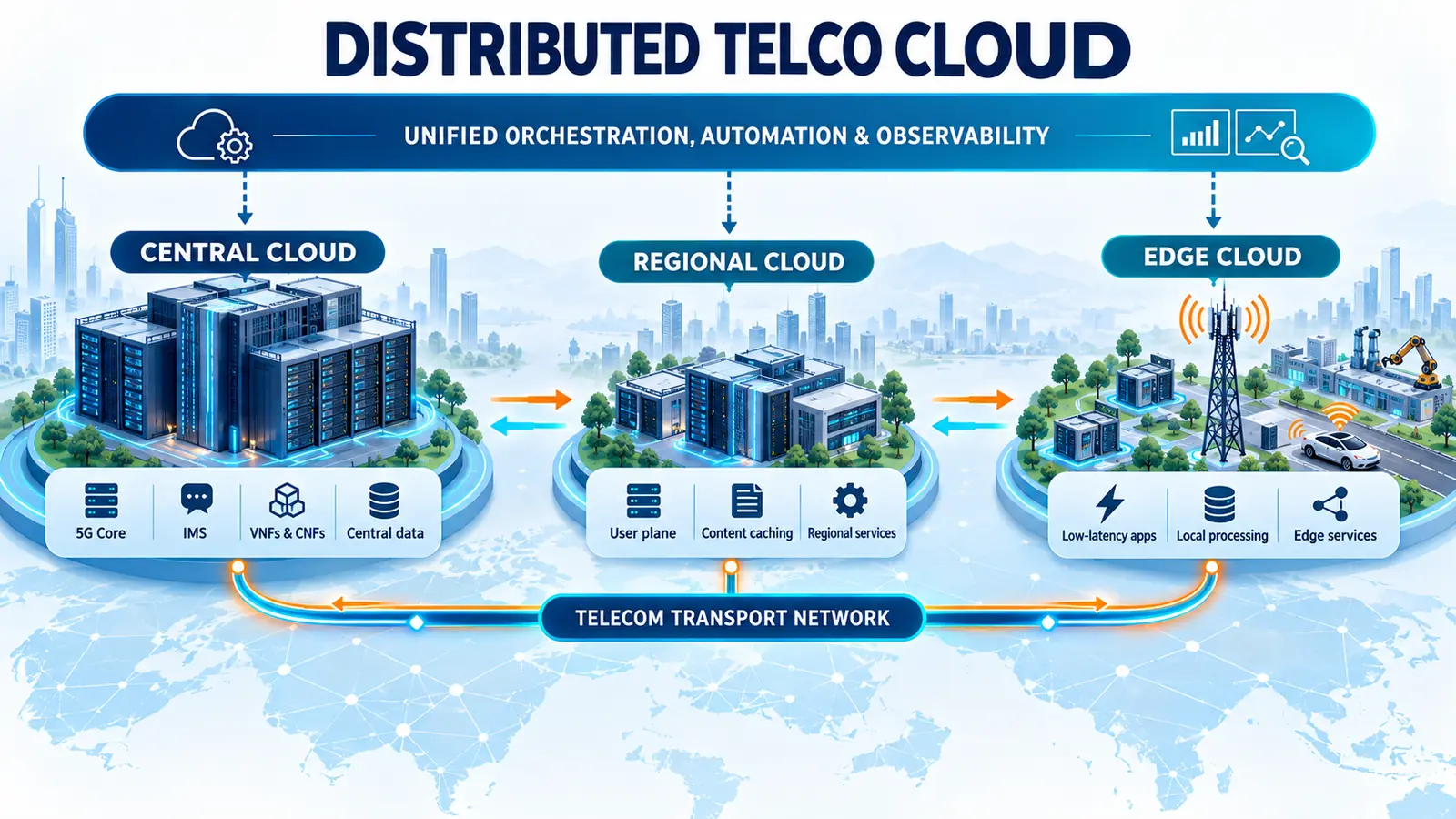
Edge computing moves compute and application capabilities closer to users, IoT devices or network traffic.
This can benefit workloads requiring:
- Low latency
- Local processing
- Traffic localization
- Distributed services
- Industrial applications
Telecom operators are naturally positioned for distributed architectures because they already operate geographically dispersed network infrastructure.
But the edge creates an operational challenge: hundreds or thousands of smaller sites cannot realistically be managed with the same manual processes used for a few centralized data centers.
This makes automation essential.
Automation in Telecom Cloud Operations
Automation is one of the defining capabilities of a mature cloud operating model.
Without it, moving from a limited number of physical appliances to thousands of software components can actually increase operational complexity.
Automation should cover as much of the lifecycle as practical:
- Infrastructure provisioning
- Network configuration
- Application onboarding
- Testing
- Deployment
- Configuration
- Scaling
- Healing
- Upgrades
- Observability
- Security
The long-term direction is a move away from manual device-level operations toward service-oriented, policy-driven and eventually more intent-driven operations.
Infrastructure as Code and GitOps
Cloud-native operational practices also change how infrastructure and applications can be managed.
Infrastructure as Code (IaC) allows infrastructure configuration to be defined in machine-readable files and managed using software engineering practices.
GitOps extends declarative operations by using version-controlled desired state as a basis for automated reconciliation.
Potential benefits include:
- Repeatability
- Version control
- Auditability
- Automation
- Faster recovery
- Reduced configuration drift
These approaches must still be adapted carefully to telecommunications change-management, availability, resilience and regulatory requirements.
Observability in Telco Cloud
Traditional monitoring alone becomes insufficient as networks move toward highly distributed cloud-native architectures.
Operators need visibility across applications, infrastructure and networking.
Important telemetry can include:
- Metrics
- Logs
- Events
- Traces
- Network telemetry
- Application health
- Infrastructure health
- Service-level indicators
The objective is not simply to collect more information.
Operations teams need to correlate data across layers so that they can understand how infrastructure conditions affect network services and ultimately customer experience.
Security in Cloud-Native Telecom Infrastructure
Moving network functions into dynamic software environments changes the security model.
The attack surface can span:
- Physical infrastructure
- Hypervisors
- Virtual machines
- Containers
- Kubernetes
- APIs
- Container registries
- CI/CD pipelines
- Management platforms
- Orchestration systems
- Software supply chains
Security should therefore be integrated throughout the lifecycle using principles aligned with DevSecOps and continuous security. For the broader operating model across network, cloud, identity, monitoring, incident response and governance, see our guide to enterprise security functions and responsibilities.
Important principles include:
- Strong identity
- Least privilege
- Segmentation
- Secure APIs
- Encryption
- Image and artifact security
- Vulnerability management
- Secrets management
- Runtime monitoring
- Software supply-chain security
High Availability and Resilience
Telecommunications networks often have demanding availability requirements.
Cloud-native infrastructure provides mechanisms for workload recovery and redistribution, but infrastructure automation alone does not guarantee service continuity.
Resilience must be designed across:
- Hardware
- Cloud infrastructure
- Applications
- Data
- Networking
- Availability zones
- Geographical locations
- Management systems
Stateful network functions require particular attention because restarting a workload is not necessarily equivalent to restoring the sessions or service state it was handling.
Performance and Hardware Acceleration
Some telecommunications workloads process large volumes of network traffic and require predictable performance.
General-purpose cloud infrastructure may therefore need additional optimization.
Depending on the workload, technologies can include:
- NUMA-aware placement
- CPU pinning
- Huge pages
- SR-IOV
- DPDK
- SmartNICs
- Hardware accelerators
Not every application requires these technologies.
Infrastructure design should reflect the actual performance characteristics of each network function rather than applying the same optimization model everywhere.
Key Benefits of Telco Cloud
A well-designed telecommunications cloud can provide several strategic and operational advantages.
Infrastructure Flexibility
Network functions can increasingly be separated from dedicated appliances and deployed across shared infrastructure.
Faster Service Evolution
Software-driven infrastructure can reduce some dependencies associated with traditional hardware deployment cycles.
Greater Automation
APIs, declarative platforms and orchestration make large-scale automation more achievable.
Resource Efficiency
Shared infrastructure can improve resource utilization when capacity is designed and managed effectively.
Elasticity
Cloud-native applications can be designed to adapt resources according to workload requirements.
Ecosystem Flexibility
Standard interfaces and abstraction can help reduce tight coupling between infrastructure and application lifecycles.
Foundation for Innovation
The architecture creates a foundation for edge computing, advanced automation, cloud-native 5G and increasingly intelligent network operations.
Major Challenges
The transformation also introduces significant challenges.
Architectural Complexity
Operators may need to integrate physical infrastructure, virtual machines, containers, Kubernetes, networking and multiple orchestration systems.
Skills Transformation
Operations teams increasingly need capabilities spanning:
- Networking
- Linux
- Virtualization
- Kubernetes
- Automation
- APIs
- DevSecOps
- Observability
- Cloud architecture
These capabilities increasingly overlap with modern DevOps practices, where automation, CI/CD, observability and shared operational responsibility help teams manage software-driven infrastructure more consistently.
Multi-Vendor Integration
A real telecommunications environment frequently combines infrastructure and software from multiple vendors.
Interoperability therefore remains critical.
Operational Transformation
Installing Kubernetes does not create a cloud operating model.
Processes, organizations, tools, skills and governance must evolve alongside the technology.
Security
Dynamic software supply chains and API-driven infrastructure create new security requirements that must be managed throughout the lifecycle.
Legacy Integration
Existing network functions cannot simply disappear.
Modern infrastructure must coexist with established technologies during what can be a long transformation period.
Telco Cloud vs Traditional Telecom Infrastructure
| Traditional Telecom | Modern Telecom Cloud |
|---|---|
| Dedicated appliances | Software-driven workloads on shared cloud infrastructure |
| Hardware-centric lifecycle | Greater software/hardware lifecycle separation |
| Device-oriented operations | Increasingly service and platform-oriented operations |
| Manual provisioning common | Automation-first direction |
| Relatively static infrastructure | More dynamic infrastructure |
| Vendor-specific systems | Greater emphasis on APIs and interoperable interfaces |
| Primarily centralized infrastructure | Centralized plus distributed and edge infrastructure |
How to Build a Telco Cloud Strategy
A successful transformation should begin with business and network requirements rather than with a particular technology.
1. Define the Business Objectives
Identify why the transformation is needed.
Objectives may include faster service introduction, 5G deployment, infrastructure modernization, greater automation, consolidation or new edge services.
2. Assess Existing Network Functions
Classify existing PNFs and VNFs and understand their lifecycle, performance requirements, dependencies and vendor roadmaps.
3. Define the Target Architecture
Determine how physical infrastructure, virtual machines, Kubernetes, networking, storage, security and orchestration should work together.
4. Define Workload Placement
Decide which workloads belong in central data centers, regional facilities, edge locations or external cloud environments.
5. Design Automation Early
Automation should be an architectural requirement rather than an enhancement added after deployment.
6. Build Observability and Security into the Platform
Both should be designed across the infrastructure and application lifecycle from the beginning.
7. Develop Skills and Operating Models
Technology transformation without organizational transformation can create operational bottlenecks.
8. Migrate Incrementally
A phased approach allows teams to learn, validate assumptions and improve the platform while controlling service risk.
15-Minute Telco Cloud Workload Readiness Review
Before moving a network function into a new cloud model, run a short workload review with architecture, operations, security and the application owner.
- Confirm the business reason. Identify the outcome expected from the change: lifecycle simplification, automation, faster releases, capacity flexibility, 5G support, edge placement or infrastructure consolidation.
- Classify the current workload. Record whether it is a PNF, VNF or CNF, its lifecycle status, vendor roadmap, statefulness, dependencies and operational criticality.
- Check platform fit. Validate compute, storage, networking, acceleration, latency, resilience, observability and security requirements against the target platform.
- Check operational readiness. Confirm deployment automation, upgrade method, rollback, monitoring, incident ownership, backup/recovery and the skills needed to support the workload.
- Make the migration decision. Select one explicit outcome and document the evidence behind it.
- RETAIN AS-IS: the current implementation still meets technical and business requirements.
- VIRTUALIZE: move from dedicated hardware toward a VNF when virtualization provides value but a cloud-native redesign is not yet justified.
- CLOUD-NATIVE MIGRATE: adopt a CNF or cloud-native implementation when the application and operating model are ready for it.
- INVESTIGATE FURTHER: pause the migration when performance, resilience, vendor support, data, security or operational dependencies remain unclear.
Next action: capture the chosen outcome, owner, target platform, unresolved dependencies and the next validation date. Cloudification should be driven by evidence and service requirements rather than by an assumption that every workload must become a CNF immediately.
AI and the Future of Telco Cloud
Artificial intelligence is becoming increasingly relevant to telecom infrastructure and operations.
Large distributed networks generate enormous quantities of operational data and telemetry.
AI-assisted systems can potentially support areas such as:
- AI-assisted anomaly detection
- Capacity forecasting
- Fault correlation
- Resource optimization
- Operational recommendations
- Energy optimization and sustainable IT
- Predictive maintenance
The next stage extends beyond applying AI tools to traditional operations. The industry is also exploring AI-native infrastructure in which cloud platforms, orchestration and operations are designed to support increasingly intelligent applications and agentic AI capabilities.
ETSI’s current work is examining AI-native infrastructure and next-generation telecom cloud architecture as part of the industry’s longer-term evolution toward 6G.
Telco Cloud and the Road Toward 6G
The architecture will continue to evolve as the telecommunications industry prepares for future network generations.
Important areas include:
- Deeper cloud-native adoption
- AI-native infrastructure
- Distributed computing
- Edge integration
- Compute and network convergence
- Advanced automation
- Intent-driven operations
- New infrastructure resources
ETSI’s Release 6 work provides an important foundation, while further specifications and studies continue to evolve. The transition should therefore be viewed as an ongoing architectural journey rather than a finished endpoint.
Frequently Asked Questions About Telco Cloud
What is Telco Cloud in simple terms?
Telco Cloud is cloud infrastructure plus platform, management and orchestration capabilities designed to host and operate telecommunications applications and network functions.
Is Telco Cloud the same as NFV?
No. NFV is a foundational part of the evolution. The broader telecom cloud model also incorporates cloud-native infrastructure, containers, Kubernetes, platform services, distributed computing, automation and modern operational practices.
What is the difference between cloud computing and Telco Cloud?
General cloud computing supports many types of IT workloads. A telecommunications cloud applies cloud technologies to network functions and services and therefore must address requirements such as distributed deployment, packet processing, network integration, availability and telecom lifecycle management.
Does Telco Cloud require Kubernetes?
Kubernetes is important for many modern cloud-native network functions, but the complete architecture is broader. It can also contain VM-based VNFs, physical functions, specialized networking and other infrastructure.
What is the difference between VNF and CNF?
VNFs are virtualized network functions traditionally associated with virtual-machine-based NFV environments. CNFs apply cloud-native architectural principles and are commonly associated with containers and Kubernetes. Both can coexist in the same telecom environment.
Is Telco Cloud only for 5G?
No. 5G is an important driver, but the infrastructure can support applications and network functions across multiple technologies and network generations.
What is Telco Cloud Infrastructure?
Telco Cloud Infrastructure, or TCI, provides infrastructure resources and associated capabilities required to host telecommunications applications and network functions.
What is a Telco Cloud Application?
A Telco Cloud Application, or TCA, is an application operating within the architectural environment defined for modern telecom cloud infrastructure. The TCA concept is part of current ETSI NFV Release 6 architecture.
Can Telco Cloud run in a public cloud?
Yes. Some telecommunications workloads can use public-cloud infrastructure. Operators can also use private, hybrid and distributed models depending on technical, operational, regulatory and business requirements.
Will cloud infrastructure replace traditional telecom infrastructure?
The transition is gradual. Physical, virtualized and cloud-native functions are likely to coexist for significant periods while operators modernize different parts of their networks according to technical and business priorities.
Conclusion: Telco Cloud Is the Next Stage of Network Virtualization
Telco Cloud represents the evolution of telecommunications from hardware-centric networks toward programmable, software-driven and increasingly cloud-native infrastructure.
NFV provided an essential foundation by separating network functions from dedicated hardware. VNFs brought many network functions into virtualized environments. CNFs extend this transformation through cloud-native architecture and modern software practices.
The broader cloud architecture brings these technologies together across centralized data centers, distributed infrastructure and edge locations.
Its real value does not come simply from virtual machines, containers or Kubernetes.
The transformation comes from combining programmable infrastructure with orchestration, automation, observability, security and new operational models.
As 5G evolves and the industry prepares for future network generations, the architecture is also progressing toward deeper cloud-native and AI-native capabilities.
For telecom organizations, the strategic question is therefore no longer simply whether network functions should be virtualized.
The question is how to build a flexible infrastructure capable of supporting multiple generations of network functions while progressively increasing automation, agility and operational intelligence.
Continue Learning
Continue exploring the TechTeamSynergy telco cloud and network transformation cluster with these related guides.