

Telecom project management goes beyond installation tracking because a schedule alone cannot establish service readiness. For example, a network deployment may depend on approved designs, site access, carrier circuits, staged equipment, vendor resources, security reviews, technical testing, production change windows and a receiving operations team. As a result, a delay in any critical prerequisite can stop activation even when most planned activities are complete.
Successful delivery therefore requires three kinds of evidence: completed work, readiness for the next milestone, and proof that the service meets agreed requirements. In particular, installation is not the same as activation; activation is not the same as acceptance; acceptance is not automatically operational handover.
This guide covers network deployment from design and readiness to cutover, acceptance and NOC handover, while respecting technical approval boundaries.
Telecom Project Management at a Glance
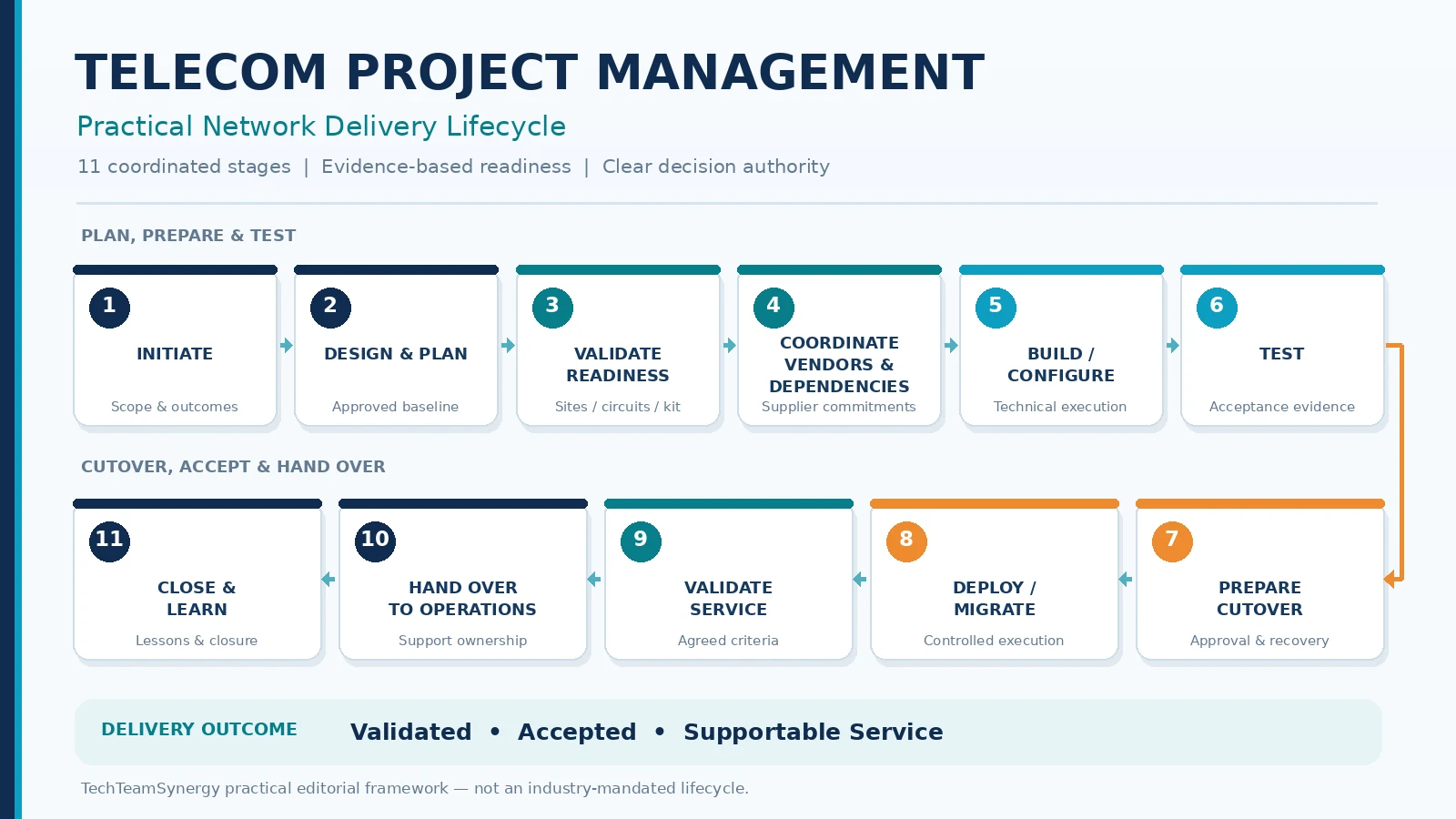
The TechTeamSynergy Practical Telecom Delivery Lifecycle defines eleven governance stages.
| Stage | Primary PM Question | Required Evidence |
|---|---|---|
| 1. Initiate | What customer outcome must be delivered? | Authorized scope, stakeholders and success conditions |
| 2. Design & Plan | Is the solution sufficiently defined to deliver? | Approved design baseline and integrated plan |
| 3. Validate Readiness | Can field and technical work proceed? | Site, circuit, equipment and approval evidence |
| 4. Coordinate Vendors | Are external commitments credible and aligned? | Deliverables, dates, dependencies and confirmations |
| 5. Build / Configure | Is the approved solution being implemented? | Installation records and technical checks |
| 6. Test | Does the solution meet agreed test criteria? | Test results, defects and retest evidence |
| 7. Prepare Cutover | Is production transition authorized and recoverable? | Change approval, readiness and recovery evidence |
| 8. Deploy / Migrate | Is the production change controlled? | Execution log, checkpoints and decisions |
| 9. Validate Service | Does the service meet acceptance conditions? | Technical and customer validation evidence |
| 10. Hand Over | Can the receiving team support it? | Monitoring, records, support ownership and acceptance |
| 11. Close & Learn | Are obligations closed and improvements captured? | Closure record, exceptions and lessons |
PMI’s PMBOK Guide, Eighth Edition emphasizes tailoring and value delivery; however, it does not prescribe this telecom-specific sequence.
This lifecycle is TechTeamSynergy practical editorial guidance, not a mandated PMI, TM Forum, ITU, MEF or ETSI process. For example, real programs may use pilots, parallel workstreams, several rollout waves, iterative testing or staged acceptance. Meanwhile, coordination and readiness reviews continue across delivery stages.
Why Telecom Project Management Is Different
Managing Telecom Project Dependencies
Because services depend on several workstreams, telecom project management links physical access and connectivity to network, service, security and operations work. For example, equipment can be installed while a circuit remains unactivated; a configured platform may still have untested interfaces. A Telco Cloud deployment or project involving Network Functions Virtualization introduces additional platform and integration considerations, but those technical topics retain their own dedicated guides.
Therefore, the PM needs to know which specialist decision or dependency blocks delivery, not design the underlying architecture.
Vendor, Carrier and Field Coordination
For example, a carrier delivery date, local-access appointment or hardware shipment may control the critical path. Because parties use different tools, contracts and reporting calendars, apparent agreement at a status meeting is weaker than matching evidence for the same milestone.
Managing Telecom Project Production Change Constraints
Change windows, operational freezes, customer business hours and support-roster availability influence when a completed deployment can enter production. Consequently, a lost window disrupts dependent teams.
Technical Delivery vs Service Acceptance
Installed, activated, validated, accepted and handed over are useful distinctions, although contracts may use different milestone labels. Nevertheless, a technically functioning connection can remain commercially unaccepted or operationally unsupported until the appropriate evidence and approvals exist.
Telecom Project Management: Progress vs Readiness vs Acceptance
| Concept | Question | Typical Evidence |
|---|---|---|
| Project Progress | What planned work is complete? | Closed work packages, installation records, schedule updates |
| Deployment Readiness | Can the next authorized milestone proceed? | Prerequisite checks, approvals, technical readiness and available teams |
| Service Acceptance | Does the delivered service meet the agreed requirements? | Test evidence, agreed KPI results, customer or service sign-off |
For example: A 24-site connectivity rollout reports 95% completion against planned activities. Yet one critical circuit is unavailable, a required security approval is outstanding and the technical owner has not verified rollback feasibility. Even so, that activity percentage may be accurate, but cutover readiness is not established for the affected scope. Therefore, service acceptance cannot be asserted for an unvalidated service.
Therefore, a useful report names ready sites, missing evidence, blocker owners and required decisions, including whether unaffected sites can proceed.
For reporting methods and human verification of project data, see AI project status reporting.
Project progress ≠ deployment readiness ≠ service acceptance.
Stage 1: Initiate the Telecom Project
First, define the service outcome instead of starting with a hardware inventory. For instance, an enterprise may need resilient connectivity for its regional offices; the technical deliverables could include circuits, network devices, approved configurations and management integration. Consequently, neither the equipment list nor the implementation date alone defines success.
Separate three elements at initiation:
- Business outcome: the capability or service the customer expects.
- Technical deliverables: the infrastructure and configured components the teams will provide.
- Acceptance evidence: the tests, documentation and decisions demonstrating that requirements have been met.
Then confirm scope boundaries, locations, customer constraints and deployment waves. Next, identify technical, security, supplier, change, customer and operations authorities.
Finally, name service and operations acceptance owners early, or completed technical work may lack a receiving authority.
Stage 2: Design and Plan the Network Deployment
Confirm Telecom Project Design Maturity
Before procurement and execution, ask whether the architecture and interfaces have sufficient approval. For example, unresolved transport choices, address plans, platform integrations or security interfaces may affect equipment, circuit orders, installation sequences and cost.
While the design authority approves technical choices, the PM tracks unresolved decisions and deadlines. Consequently, late design changes require impact assessment and appropriate change control.
The SD-WAN architecture guide explains technology decisions that may shape a WAN deployment. By contrast, this article addresses the coordination consequences of those decisions, not technical design instruction.
Build a Dependency-Based Telecom Project Plan
Plan from prerequisites toward the service milestone: access before field work, staged hardware before build, delivered circuits before end-to-end testing and required technical evidence before cutover authorization. In addition, explicitly capture external lead times and shared resources, including scarce engineering teams or customer representatives.
Then sequence waves by readiness, geographical access, business importance and implementation windows. However, re-sequence blocked sites only with applicable technical and customer approvals. Furthermore, pilots do not automatically qualify later sites.
Define Telecom Service Acceptance Evidence Early
In addition, agree technical test scope, acceptance owners, service-quality criteria, monitoring expectations, as-built documentation and any operational observation period during planning. Consequently, the team avoids a late disagreement about whether installed means ready for service.
To this end, name each milestone’s deliverable, evidence and accepting authority.
Stage 3: Validate Telecom Deployment Readiness
Site Readiness for a Telecom Project
Before scheduling field work, obtain site-level evidence for access permissions, rack space, power, cabling, relevant environmental conditions and permits where applicable. However, a scheduled field visit is not proof that the premises are ready. Instead, technical and field specialists confirm adequacy; the PM tracks evidence, exceptions and appointment coordination.
Carrier Circuit and Connectivity Readiness
First, distinguish order acceptance, committed delivery, physical handoff, service activation and required connectivity tests. For example, a carrier may confirm a date while local demarcation arrangements or customer premises access remain incomplete.
Then track each critical circuit against the site and deployment wave it supports. Instead, ask for handoff or test evidence rather than relying on a generic delivered label. An accepted order is not a ready circuit.
Network Hardware, Licensing and Logistics
Track procurement, transport, customs when relevant, receiving, inventory, staging, authorized firmware/software versions and licensing. For instance, a device may be present in a warehouse but unusable for the planned change because its license or configuration baseline is missing.
Hardware received is not necessarily hardware deployable.
Telecom Security and Approval Readiness
Similarly, coordinate the timing and evidence of applicable security reviews. However, the security authority approves controls; a pending review is not approval. For an SD-WAN example, specialized controls are covered in SD-WAN Security.
Stage 4: Coordinate Telecom Vendors, Carriers and Dependencies
Track Telecom Vendor Commitments, Not Just Status
Vendor says on track is insufficient when the project depends on a precise handoff. Therefore, a useful commitment names the deliverable, the date needed by the integrated plan, the supplier forecast or contractual commitment, prerequisites, current evidence, escalation owner and acceptance condition.
TechTeamSynergy Practical Supplier Commitment Example — fictional illustration
| Deliverable | Needed By | Supplier Forecast | Dependency | Evidence | Escalation Owner | Acceptance |
|---|---|---|---|---|---|---|
| Site A circuit | Week 4 | Week 5 | Carrier handoff and site access | Updated provider confirmation | Carrier manager | Link handoff and test record |
| Site B equipment | Week 3 | Week 3 | Staging and licenses | Receiving/staging confirmation | Hardware supplier lead | Equipment cleared for build |
In other words, this editorial example distinguishes supplier forecasts from readiness evidence.
Separate Needed-by Dates From Supplier Forecasts
If a circuit is needed in Week 4 but the latest provider forecast is Week 5, the dependency is at risk regardless of a supplier’s reassuring status color. Consequently, the PM should show consequences and decision options: resequence sites, revise the window, escalate the commitment or obtain an authorized rebaseline.
For a bounded SD-WAN example, MEF 70.2 describes service attributes agreed by a provider and subscriber; it is not a general telecom delivery method.
For example, when procuring a managed network service, contract-level questions about the provider’s delivery and operating model belong in the Managed SD-WAN RFP guide; this article governs the resulting delivery commitments rather than comparing suppliers.
Escalate Evidence-Based Delivery Risks
When a commitment is threatened, an escalation should state the affected milestone, evidence, accountable owner, available choices and the decision deadline. However, it should not merely label the issue high risk. For more general risk-analysis methods, see AI for Project Risk Management.
Stage 5: Build, Configure and Integrate
During implementation, the PM coordinates site access, resource availability, sequencing, deviations, issue resolution and evidence of work completed against the approved design. Meanwhile, the technical teams perform installation, configuration, peer review and technical validation.
Use implementation records to distinguish physical installation from verified configuration. For example, an unresolved interface between a carrier circuit, network edge and security platform can make an apparently completed site unusable. In response, the PM facilitates the cross-team decision and updates the integrated plan; engineering authorities own the technical solution.
Consequently, technical-baseline changes require the applicable approvals; unresolved integration cannot be hidden in an installation percentage.
Stage 6: Test the Network or Service
Confirm Test Entry Criteria
Confirm components, environment, owners and approved test scope before testing. However, a booked window does not prove test readiness; record missing prerequisites and downstream impacts.
Track Defects and Retesting
Then track defects, technical owners, agreed severity, resolution and retests. Meanwhile, qualified owners assess residual defects; the PM coordinates schedule implications.
Capture Acceptance Evidence
In addition, preserve traceable technical and integration results, including applicable security and service tests. Therefore, avoid replacing agreed acceptance criteria with universal latency, packet-loss or uptime numbers.
TM Forum’s Service Test Management API (TMF653) defines a standardized interface for managing service tests in supported implementations. It is evidence that service testing is a distinct operational capability—not a claim that the API prescribes how all telecom projects must test or accept a service.
Stage 7: Prepare the Telecom Project for Production Cutover
In telecom project management, production transition deserves a dedicated readiness decision. Nevertheless, the project may have finished building and testing while still lacking authorization, recovery capability, required teams or operational visibility.
Confirm Change Authorization
Confirm the production scope, maintenance window, relevant freeze restrictions and formal approval under the applicable change process. The designated change authority makes the authorization decision; the PM coordinates the evidence and participant availability. In particular, a technical lead’s confidence does not replace change approval.
Validate Telecom Project Cutover and Rollback Feasibility
In addition to change authorization, the implementation team needs a reviewed procedure, checkpoints, validation and recovery criteria. However, a written rollback plan is not proof that rollback is technically feasible.
For example, recovery feasibility can depend on changed service state, compatibility of saved configurations, restoration of live sessions, data or schema changes, and the time remaining in the window. Importantly, these are illustrative constraints. Qualified technical owners must validate recovery against the real environment.
NIST SP 800-128 provides principles for security-focused configuration management and risk control. However, it is not a mandatory telecom cutover lifecycle or a source of universal rollback thresholds.
Confirm Teams, Communications and Monitoring
Next, confirm implementers, vendor/carrier support, customer representatives where needed, operations and monitoring. For example, use a command bridge where appropriate.
Also name milestone communicators, technical validators and escalation contacts. General collaboration methods are addressed in Team Communication Strategies; the deployment need is a specific operational communication plan.
Coordinate the Go / No-Go Decision
| Gate | Evidence to Confirm |
|---|---|
| Critical prerequisites | Mandatory site, carrier, platform and approval evidence available |
| Unresolved risks | Disposition or authorized acceptance recorded |
| Implementation | Approved technical procedure and responsible team |
| Recovery | Rollback feasibility validated by technical owner |
| Resources and monitoring | Required responders and visibility available |
| Customer and operations | Applicable business and support readiness confirmed |
| Decision authority | Authorized go/no-go participant identified |
Finally, a practical governance record may use GO, CONDITIONAL GO or NO-GO. However, conditional GO is possible only where organizational policy permits explicitly authorized exceptions; it cannot bypass mandatory security, safety, legal or contractual controls. In all cases, the PM coordinates and records the decision. The designated authority makes it.
Stage 8: Deploy or Migrate
During the approved window, track execution checkpoints, current status, deviations, stakeholder updates and decision points. Meanwhile, the technical implementation team carries out the change. The relevant authorized roles decide whether to continue, pause or initiate recovery when outcomes differ from the approved plan.
Therefore, record both step completion and technical validation; completed commands do not prove service success.
Technology-specific procedures, such as overlay verification, route changes and SD-WAN restoration checks, belong in the SD-WAN Migration Checklist. By contrast, telecom project management provides the cross-technology governance and evidence trail, not the engineering runbook.
Stage 9: Validate Telecom Service Performance and Acceptance
Following the transition, obtain technical confirmation against the agreed acceptance criteria. For example, applicable service evidence may include connectivity, functionality, resilience, security, customer application checks, service-quality measures and an agreed period of stability observation.
Distinguish a service activation signal from test results and customer acceptance. For instance, TM Forum’s Service Activation Management API (TMF640) addresses standardized activation/configuration interactions, while TMF653 concerns service testing. However, neither API automatically confers contractual customer acceptance.
Finally, record defect resolution, retesting or authorized exceptions, plus separate technical validation and customer acceptance. Silence is not acceptance.
Stage 10: Hand Over the Telecom Service to Operations
Deployment complete ≠ operationally accepted. For example, a live network service without appropriate monitoring, access, procedures and support ownership still presents operational risk.
Confirm Telecom Operational Readiness
First, the NOC or designated operations team should demonstrate the agreed ability to monitor the service, receive alerts, access approved tools, identify incidents and escalate problems. In addition, verify support contacts, incident procedures, service dependencies and known issues. However, a document transfer alone does not establish supportability.
Transfer Telecom Service Support Ownership
Then define the point at which incident and performance responsibilities move from project/hypercare teams to steady-state service support. Next, confirm applicable vendor support entitlements, maintenance contacts, escalation paths and the treatment of open defects. Where hypercare or warranty coverage applies, agree its scope, owner and exit conditions.
Update Documentation and Asset Records
Finally, transfer as-built diagrams, relevant configuration records, equipment inventory, service identifiers and CMDB entries where used. For example, TM Forum’s Service Inventory Management API (TMF638) offers a standardized interface for querying and managing service inventory in supported environments, but it does not require every organization to adopt a particular CMDB.
Receiving operations records acceptance; the PM coordinates but cannot accept on its behalf.
Stage 11: Close the Telecom Project and Learn
Before formal closure, reconcile contractual deliverables, defects, handover exceptions and records. Then assign residual actions and review carrier commitments, installation blockers and change-window performance.
Then translate lessons into reusable site-readiness criteria, vendor evidence expectations and deployment sequencing improvements. Finally, closure requires the applicable approval.
Telecom Project Management Health: Five Readiness Dimensions
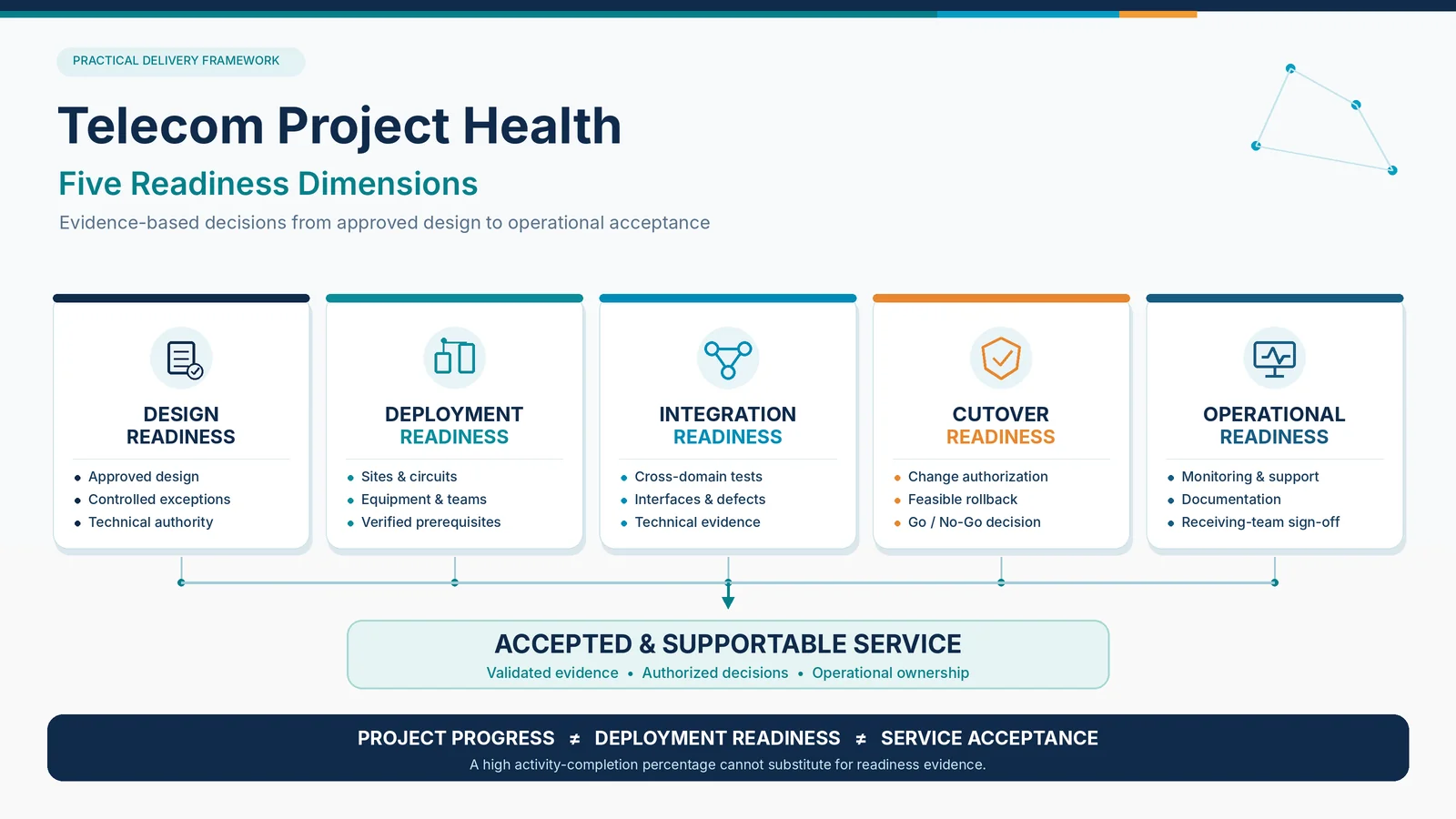
The TechTeamSynergy Five-Dimension Readiness Model strengthens telecom project management beyond traditional schedule tracking by showing what evidence supports the next delivery decision.
| Dimension | Core Question | Evidence | Typical Blocker |
|---|---|---|---|
| Design Readiness | Is the technical baseline approved and stable? | Approved design, controlled exceptions | Open interface or design decision |
| Deployment Readiness | Are sites, circuits, equipment and teams ready? | Readiness records, handoff, staging | Missing circuit or license |
| Integration Readiness | Do technical domains work together as required? | Integration tests and defect disposition | Unresolved cross-vendor defect |
| Cutover Readiness | Is the change authorized, staffed and recoverable? | Change approval, recovery validation, monitoring | Unapproved window or infeasible rollback |
| Operational Readiness | Can the service be monitored, supported and accepted? | Procedures, inventory, support and acceptance evidence | NOC not prepared to receive service |
However, this editorial model is not a maturity standard. Track evidence, exceptions, owners and decisions—not arbitrary scores. For example, a healthy schedule can coexist with a blocked readiness gate.
Telecom Project Management Roles: Who Approves What?
| Role | Typical Contribution | Authority / Boundary |
|---|---|---|
| Project Manager | Plans, coordinates, records evidence and escalates | No automatic technical or acceptance approval |
| Technical Lead / Engineer | Implements, tests and validates configurations | Authorized technical execution and validation |
| Architect | Establishes design and interface decisions | Design/architecture approval where delegated |
| Security Function | Reviews security requirements and controls | Authorized security approval |
| Vendor | Delivers contracted work and support | Responsibilities defined by contract/delegation |
| Carrier | Provides circuits and handoff evidence | Carrier-network obligations |
| Field Team | Installs equipment and checks local work | Assigned physical execution |
| Customer / Business Owner | Defines requirements and reviews outcomes | Business/service acceptance where designated |
| Change Authority | Evaluates production change | Formal production authorization |
| Operations / NOC | Monitors and supports live service | Receiving operational acceptance |
| Service Manager | Coordinates service accountability and transition | Service-management authority as delegated |
Because decision rights vary by organization and contract, this responsibility model remains illustrative. Use RACI Matrix Examples to adapt responsibility assignments; this article does not impose one universal RACI. The PM coordinates delivery and evidence, while technical, security, change, business and operations authorities retain their assigned approvals.
Common Telecom Project Management Mistakes
| Mistake | Delivery Impact | Better Approach |
|---|---|---|
| Field team reaches an unready site | Lost visit and schedule delay | Verify access, power and site evidence first |
| Circuit lead time is underestimated | Critical-path slippage | Track carrier handoff and customer prerequisites separately |
| Delivered hardware is assumed deployable | Installation blocked by staging/licensing | Verify staging and license evidence |
| Supplier status hides date mismatch | False delivery confidence | Compare needed-by and supplier forecast dates |
| Security review arrives too late | Cutover blocked | Include security approval in early readiness planning |
| Integration testing is incomplete | Faults surface in production | Apply agreed test exit criteria and defect review |
| Rollback plan exists but cannot work | Recovery risk during change | Obtain scenario-specific feasibility validation |
| Project closes before NOC acceptance | Unsupported production service | Record formal support ownership and handover |
Telecom Project Management Example: Multi-Site Network Rollout
The following scenario is fictional and illustrative.
A company upgrades connectivity across 24 sites, working with two carriers, a hardware supplier, local field teams, security reviewers and a centralized NOC. Sites differ in access constraints, available circuits and customer operating hours.
Plan and Validate the Deployment Waves
The PM proposes several waves based on verified readiness rather than geography alone. For example, an early group has approved designs, site access and staged equipment. By contrast, another group still awaits carrier handoff and therefore cannot be treated as cutover-ready. In addition, each wave has agreed technical test owners, customer acceptance contacts and operational handover conditions.
Resolve a Carrier Dependency
During preparation, one carrier revises its forecast for four sites. Rather than delaying all 24, the PM checks whether other sites can be advanced safely. Meanwhile, engineers validate technical independence, the customer confirms business suitability and the change authority reviews revised windows. Then the supplier commitment, impact and authorized resequencing decision are documented.
Govern Cutover and Service Acceptance
Before each production window, the PM assembles readiness evidence, including tested circuits, security approval, technical procedures, monitoring and rollback feasibility. Then the authorized team executes; technical owners validate results; the designated customer representative accepts the service when criteria are met. Nevertheless, a completed installation at one site remains open if service validation fails.
Complete NOC Handover
Finally, the NOC verifies monitoring, incident routing, support contacts, as-built information and remaining exceptions. Therefore, only sites meeting the agreed support and acceptance conditions pass into steady-state operations. Consequently, project closure follows the applicable obligations and acceptance records—not a headline installation percentage.
Telecom Project Management Checklist for Network Deployment
In summary, these sixteen governance checks capture the delivery lifecycle. In addition, use separate engineering-specific checklists for configuration or technology migration.
Planning
- ☐ 1. Scope and business outcome confirmed.
- ☐ 2. Technical design approved by the authorized authority.
- ☐ 3. Delivery dependencies mapped.
- ☐ 4. Acceptance criteria and owners defined.
Readiness
- ☐ 5. Applicable sites ready.
- ☐ 6. Required circuits and connectivity ready.
- ☐ 7. Equipment, licenses and resources available.
- ☐ 8. Security and integration gates satisfied.
Cutover
- ☐ 9. Production change authorized.
- ☐ 10. Rollback feasibility confirmed by technical owners.
- ☐ 11. Required teams and monitoring available.
- ☐ 12. Go/no-go decision recorded by the designated authority.
Acceptance & Handover
- ☐ 13. Agreed technical tests passed.
- ☐ 14. Customer/service acceptance recorded.
- ☐ 15. NOC support readiness confirmed.
- ☐ 16. Documentation and support ownership transferred.
Telecom Project Management: Frequently Asked Questions
What Is Telecom Project Management?
Telecom project management coordinates network delivery scope, schedules, dependencies, implementation governance and acceptance evidence. It connects engineers, carriers, vendors, customer authorities and operations so technical deliverables become an agreed, supportable service.
What Does a Telecom Project Manager Manage?
The PM coordinates planning, site and circuit readiness, equipment, vendors, technical milestones, project reporting, cutover preparation and handover evidence. However, authorized specialists retain technical design, security, implementation, production change and acceptance decisions.
How Is Telecom Project Management Different From IT Project Management?
Although they share project-governance practices, telecom projects face additional delivery constraints. For example, telecom delivery may require carrier provisioning, physical site access, field teams, contractual service requirements, constrained change windows and multi-organization NOC handover.
What Should Be Checked Before a Network Deployment?
Check the approved design, applicable site and carrier prerequisites, equipment and license availability, resource assignments, security approvals, integration test readiness, required customer participation and the production change process. However, the exact checks depend on the project.
What Is Deployment Readiness?
Deployment readiness is verified evidence that the prerequisites for a specific technical milestone are satisfied. However, it is not a general percentage of completed work: one critical missing circuit, approval or recovery capability can prevent progression.
Who Approves a Telecom Network Cutover?
The designated change authority authorizes the production change under the relevant governance process. Meanwhile, technical, security, customer and operations functions provide their assigned approvals or readiness confirmations. For this reason, the PM coordinates the process and records decisions.
What Is the Difference Between Cutover and Service Acceptance?
Cutover is the authorized transition or activation of a service. By contrast, service acceptance confirms that the delivered outcome meets agreed technical, operational and customer criteria. A cutover may finish successfully while acceptance evidence is still incomplete.
What Should Operational Handover Include?
It should include agreed monitoring, alerting, procedures, access, incident and vendor escalation, support ownership, known issues, documentation, relevant asset or service inventory records, and acceptance by the receiving operations authority.
What Are the Biggest Risks in Telecom Network Projects?
Typical risks include delayed carrier circuits, unready sites, unavailable equipment, late design or security decisions, unresolved multi-vendor integration defects, inadequate production recovery arrangements and unsupported services transferred to operations.
How Do You Coordinate Multiple Telecom Vendors?
Use an integrated dependency plan showing contractual deliverables, needed-by dates, supplier forecasts, prerequisites, current evidence, escalation owners and acceptance conditions. Escalate schedule consequences with decision options rather than relying on unverified status statements.
Conclusion: Deliver an Accepted and Supportable Network Service
Effective telecom project management connects planning → verified readiness → vendor coordination → testing → authorized cutover → service validation → operational handover. Above all, its purpose is not to replace technical authorities, but to ensure the right evidence and decisions are available at the right time.
A network project is not complete simply because equipment was installed or a change window ended. Instead, delivery reaches its intended outcome when the service satisfies agreed acceptance requirements and the receiving organization can actually support it. For this reason, treating progress, readiness and acceptance as separate questions is one of the simplest ways to make telecom project delivery more reliable.
Continue Learning
Continue exploring telecom technology, network deployment, supplier delivery, project governance, risk and reporting.