
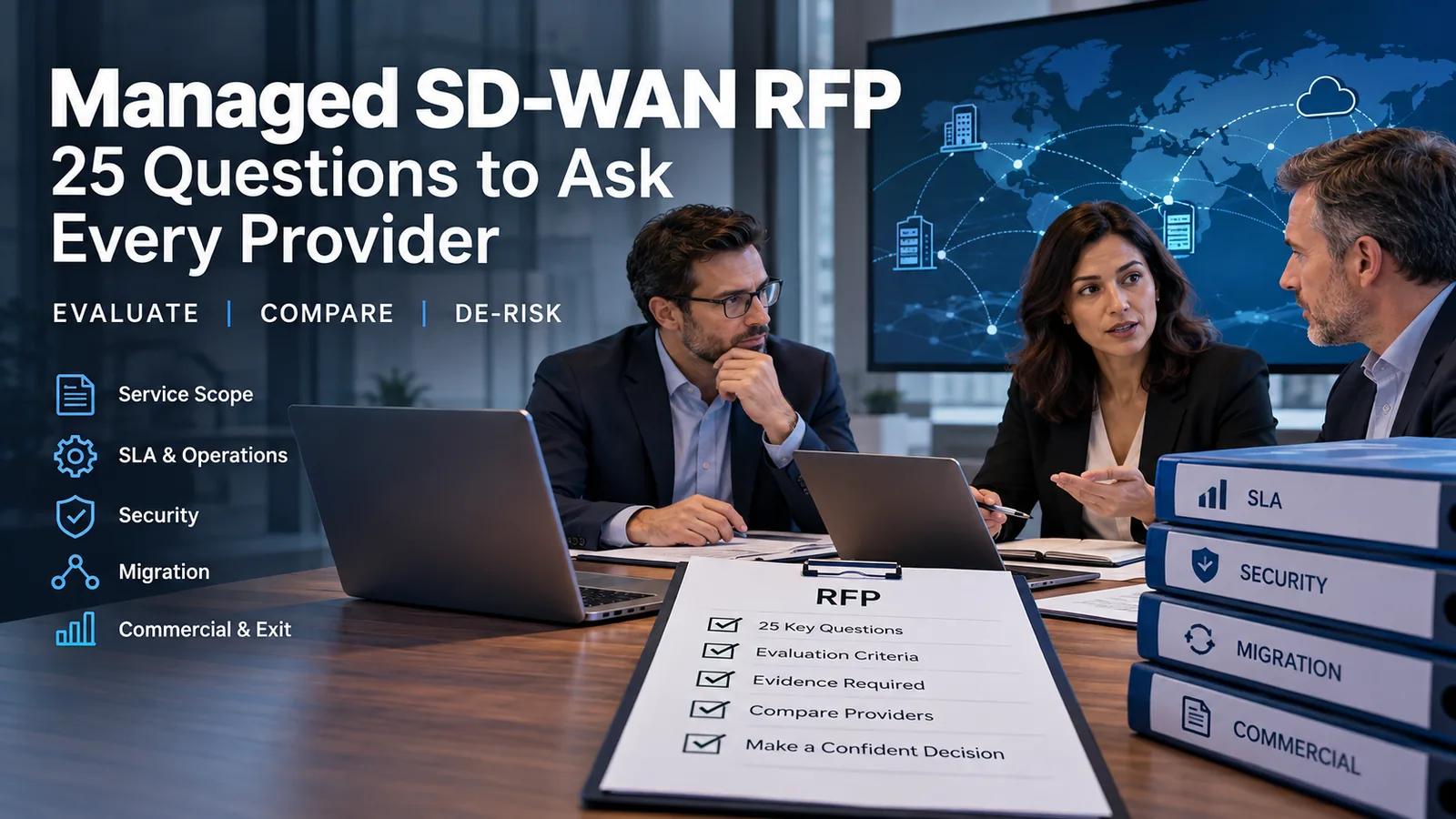
A managed SD-WAN RFP helps enterprises select a service provider based on operational capability, evidence and accountability—not just platform features. A multinational enterprise is selecting network coverage, carrier coordination, security responsibilities, service-level commitments, migration delivery and long-term commercial support. Two providers supporting similar SD-WAN technology can deliver materially different managed services.
A structured managed SD-WAN RFP makes these differences visible before contract award. The MEF 70.2 SD-WAN service framework provides a standards-based vocabulary for agreed service attributes; it does not replace contractual diligence. This guide asks 25 evidence-driven questions, offers a practical scoring framework and identifies red flags that matter to enterprise buyers.
Managed SD-WAN RFP at a Glance
| RFP area | Evaluation | Main risk | Questions |
|---|---|---|---|
| Service Scope & Operating Model | Scope, roles, platform and support | Unclear ownership | 1–4 |
| Architecture, Underlay & Global Coverage | Carriers, geographic delivery and resilience | Delivery gaps | 5–8 |
| Cloud, SaaS & Application Experience | Cloud integration and app visibility | Unsupported assurances | 9–10 |
| Security & Shared Responsibility | Security inclusions, privileges and integrations | Control gaps | 11–13 |
| SLA, Monitoring & Operations | Availability, performance, incidents and change | Weak commitments | 14–19 |
| Migration & Lifecycle Management | Delivery, acceptance and maintenance | Transition risk | 20–22 |
| Commercial Model, Governance & Exit | TCO, governance and contract exit | Lock-in | 23–25 |
Before the RFP: Confirm Your SD-WAN Operating Model
This guide assumes the organization is already considering managed or co-managed SD-WAN. Self-managed, co-managed and fully managed models differ in retained responsibilities; the choice belongs in our SD-WAN vs Managed SD-WAN operating-model guide. Avoid re-opening that decision here. Instead specify the service activities, administrative controls and approval rights you expect the supplier to own.
How to Use These 25 Managed SD-WAN RFP Questions
In your managed SD-WAN RFP, give every bidder the same response form: requirement ID, precise answer, included/optional/excluded status, owner, supporting evidence, commercial impact, contractual reference and exceptions. For each question below, compare the rationale, what good looks like, warning signs and documentary proof. Identify non-negotiable conditions before weighted scoring. Suppliers should disclose deviations rather than hide them behind a generic yes.
Supplier diligence should extend to third parties and subcontractors, consistent with the risk-based approach in NIST SP 800-161 Rev. 1. A responsibility matrix should explicitly allocate WAN edge, controllers, circuits, policy changes, segmentation, patching, logs, incident coordination and replacement obligations to the provider, customer or third parties.
Specify What Counts as Evidence
For each requirement, distinguish the technical capability from the managed-service commitment. A diagram may show that traffic can fail over between two links, but it does not establish who diagnoses the outage, who coordinates with the access carrier, what the customer will see in the ticketing portal, or how service credits are calculated. The RFP should require an artifact that answers the precise buyer question: a sample contractual SLA, regional coverage schedule, interface responsibility matrix, incident-report example, or live demonstration supported by a written service description.
Use the same evidence threshold for every bidder. Mark documents that are generic, expired, or not applicable to the proposed geography or subscription tier. If the provider references a partner or subcontractor, establish who remains accountable to the customer and which obligations are backed by enforceable arrangements. Do not treat a product brochure as proof that a managed service is included.
Buyer preparation: Prepare a common inventory of sites, countries, estimated bandwidth, relevant application classes, cloud destinations, current carriers and critical business windows. Include mandatory compliance conditions and an explicit list of known dependencies. Without that baseline, suppliers may price materially different scopes, making even detailed RFP answers difficult to compare.
Managed SD-WAN RFP Questions 1–4: Service Scope & Responsibilities
Q1. Which services are included, optional, or excluded from your managed SD-WAN offering?
Why it matters: In practice, the label fully managed can conceal important differences in circuit support, licenses, equipment, security and change services.
What a strong answer looks like: A credible response clearly distinguishes committed, optional and excluded deliverables in an itemized service description.
Red flags: Claims of complete ownership that cannot be traced to the contract.
Evidence to request: Service catalogue, scope matrix and exclusions.
Q2. How are responsibilities, administrative access, and change authority divided between provider and customer?
Why it matters: Without explicit decision rights, teams risk delays, accidental changes and disputes over incident ownership.
What a strong answer looks like: A service-specific RACI defines approval, execution, accountability and administration rights.
Red flags: Shared responsibility without named accountable roles.
Evidence to request: RACI, access-role matrix and approval workflow.
Q3. Which SD-WAN platforms and deployment models do you support, and what limitations apply?
Why it matters: Moreover, technology dependencies influence interoperability, future flexibility and licensing.
What a strong answer looks like: Supported versions, management-plane ownership, integration and license restrictions are explicit.
Red flags: Forced replacement without documented technical rationale.
Evidence to request: Support matrix, reference design and license terms.
Q4. What support organization and accountable service-management structure will operate our WAN?
Why it matters: However, a 24/7 helpdesk alone does not establish accountable network operations.
What a strong answer looks like: NOC location/coverage, skills, ownership, escalation and regional limitations are documented.
Red flags: No named owner for major incidents or unclear regional coverage.
Evidence to request: NOC operating model and escalation matrix.
Managed SD-WAN RFP Questions 5–8: Architecture & Global Coverage
Q5. Which underlay networks and carriers can you support, and who manages provisioning and faults?
Why it matters: Because an overlay relies on access networks, separate carriers may control critical parts of the service.
What a strong answer looks like: Provider-supplied and customer-provided circuits have clear ordering, monitoring and escalation obligations.
Red flags: End-to-end support claims exclude third-party access.
Evidence to request: Carrier support matrix and demarcation schedule.
Q6. Which countries, sites and access arrangements can you support contractually?
Why it matters: For multinational buyers, marketing claims of global coverage may not reflect local field or regulatory capability.
What a strong answer looks like: Site-specific commitments list lead times, field resources, language, logistics and partner dependencies.
Red flags: One global map substituted for a site-level commitment.
Evidence to request: Coverage matrix and country-specific exceptions.
Q7. How will the service support our approved WAN architecture and future design requirements?
Why it matters: Even with a compatible platform, the managed service may impose topology or integration limits.
What a strong answer looks like: The proposal maps approved requirements to supportable implementations and identifies exceptions.
Red flags: Unsupported customization or unacknowledged interoperability gaps.
Evidence to request: Reference design and interoperability matrix.
Q8. What resilience can you deliver, and who owns recovery for each failure scenario?
Why it matters: Consequently, credible failover requires independent failure domains and coordination across parties.
What a strong answer looks like: Provider models failure cases, tests failover and identifies restore ownership.
Red flags: Unqualified zero-downtime language.
Evidence to request: Failure map, test evidence and restoration RACI.
For technical design mechanics, consult SD-WAN Architecture Explained and MPLS vs Internet vs SD-WAN.
Questions 9–10: Cloud, SaaS & Application Experience
Q9. What cloud and SaaS connectivity capabilities are included in the managed service?
Why it matters: For example, the base offering may exclude cloud gateways, interconnects or security dependencies.
What a strong answer looks like: Supported destinations, demarcation, interfaces, third-party dependencies and fees are identified.
Red flags: Cloud access presented as universally included.
Evidence to request: Cloud service matrix and connectivity scope.
Q10. How will you measure application experience, and what performance can you reasonably commit to?
Why it matters: Importantly, application visibility is not an end-to-end performance guarantee.
What a strong answer looks like: Measurement points, metrics, retention, troubleshooting duties and contractual limits are clear.
Red flags: Guarantees ignoring SaaS and internet dependencies.
Evidence to request: Sample application report and methodology.
Managed SD-WAN RFP Questions 11–13: Security & Shared Responsibility
Q11. Which security functions are included, optional, or excluded, and who owns policies?
Why it matters: Although overlay encryption protects traffic, it does not replace a complete enterprise security architecture.
What a strong answer looks like: Segmentation, encryption, inspection and policy ownership are separately described.
Red flags: Generic secure-by-design assertions without service inclusions.
Evidence to request: Security scope and responsibility matrices.
Q12. How will you secure management access, logs, vulnerability handling and incident response?
Why it matters: Because providers may hold privileged credentials, enterprises must assess access security and supplier-related risks.
What a strong answer looks like: Access controls, logging, patch ownership and security notification obligations are documented.
Red flags: Shared admin accounts or undefined breach escalation.
Evidence to request: Access policy, log retention, vulnerability and incident procedures.
Q13. How will the service integrate with existing firewalls, monitoring and SSE/SASE services?
Why it matters: As a result, incidents spanning several security vendors need explicit interfaces and accountable coordination.
What a strong answer looks like: Tested integrations, support boundaries, policy responsibilities and cross-team escalation are defined.
Red flags: Technically possible integrations without support commitments.
Evidence to request: Integration matrix and joint escalation process.
For detailed controls, see SD-WAN Security and SD-WAN vs SASE.
Questions 14–19: Managed SD-WAN RFP — SLA, Monitoring & Operations
Q14. What availability SLAs apply to platform, WAN edge, circuits and overall service?
Why it matters: In particular, each component has a distinct failure domain and contractual boundary.
What a strong answer looks like: Named elements, measurement periods, maintenance/exclusions, credits and formulas are clear.
Red flags: A headline availability percentage with undefined scope.
Evidence to request: SLA schedule and calculation examples.
Buyer interpretation example: A proposal might advertise 99.95% platform availability, yet measure it only at the hosted management service. That figure would not automatically describe the availability of each WAN edge, local access circuit or application path. Ask suppliers to show exactly where measurements occur, whether planned maintenance is excluded, how outages are attributed, and what remedies apply. A provider can coordinate a third-party carrier incident without necessarily guaranteeing the carrier’s restoration time.
For multi-carrier sites, request a component-by-component SLA schedule rather than accepting one undifferentiated percentage. It should separate detection, acknowledgment, incident response, target restoration and actual service credits. If performance objectives require specified access circuits or geography, the provider should state those conditions before award.
Q15. Which latency, loss, jitter and restoration commitments can you actually support?
Why it matters: Therefore, SD-WAN path selection cannot deliver guarantees that the underlying connectivity contracts do not support.
What a strong answer looks like: Paths, measurements, relevant carriers and dependencies are contractually qualified.
Red flags: Unconditional internet performance or restoration guarantees.
Evidence to request: Performance schedule and underlying carrier commitments.
Q16. What proactive 24/7 monitoring and incident-detection capabilities are included?
Why it matters: Above all, monitoring should trigger operational action rather than simply populate dashboards.
What a strong answer looks like: Covered elements, thresholds, correlation, ticket creation and customer notification are defined.
Red flags: Customer has to detect failures first.
Evidence to request: NOC workflow and sample alert-to-ticket records.
Q17. How are incidents prioritized, escalated and restored across multiple providers?
Why it matters: Without clear escalation, cross-domain faults can prolong disputes about responsibility.
What a strong answer looks like: Severity, response, updates, restoration and coordination ownership are defined.
Red flags: Response targets mislabeled as restoration guarantees.
Evidence to request: Incident SLA, escalation matrix and anonymized incident example.
Q18. How are changes requested, approved, delivered, validated and charged?
Why it matters: For operational agility, buyers need clear routine and emergency change workflows with predictable costs.
What a strong answer looks like: Standard/emergency catalogs, approval, lead times, rollback, maintenance windows and pricing exist.
Red flags: ‘Unlimited changes’ inconsistent with actual contract exclusions.
Evidence to request: Change catalogue, sample change record and fee schedule.
Q19. What portal visibility, performance reports, logs, telemetry and API rights will customers receive?
Why it matters: Nevertheless, enterprises must retain enough visibility to verify service health and provider performance.
What a strong answer looks like: Access roles, retention, export, report granularity, API limits and charges are specified.
Red flags: Read-only high-level dashboard with no usable evidence.
Evidence to request: Portal demo, reporting samples and API documentation.
Managed SD-WAN RFP Questions 20–22: Migration & Lifecycle
Q20. How will you deliver discovery, design, pilot and phased rollout while coordinating incumbent carriers?
Why it matters: WAN transformations have dependencies across sites, businesses and existing providers.
What a strong answer looks like: Staffing, responsibilities, pilot exit criteria, prerequisites and schedule dependencies are credible.
Red flags: One generic deployment timeline for all sites.
Evidence to request: Representative implementation plan and relevant references.
Q21. What cutover, rollback, acceptance and operational-handover controls will apply?
Why it matters: For this reason, hardware installation alone cannot establish service readiness.
What a strong answer looks like: Cutover controls, rollback triggers, acceptance thresholds and defect remedies are agreed.
Red flags: No rollback owner or written acceptance standard.
Evidence to request: Sample cutover, rollback and acceptance checklist.
Q22. How will you manage configuration baselines, patches, upgrades, end-of-support and hardware replacement?
Why it matters: Over time, poorly defined lifecycle responsibilities can increase operational risk and cost.
What a strong answer looks like: Maintenance, patch policy, hardware logistics, upgrade testing and fees are explicit.
Red flags: ‘Lifecycle included’ despite broad exclusions.
Evidence to request: Lifecycle policy, replacement SLA and maintenance schedule.
For implementation tasks rather than supplier qualification, use our SD-WAN Migration Checklist.
Questions 23–25: Managed SD-WAN RFP — Commercial Model, Governance & Exit
Q23. What is the complete pricing structure and comparable total cost of ownership?
Why it matters: For instance, a low monthly fee may exclude connectivity, deployment, licensing, changes or termination charges.
What a strong answer looks like: Itemized recurring/nonrecurring rates, renewal and volume terms, exclusions and optional charges are explicit.
Red flags: Opaque bundled price preventing like-for-like comparison.
Evidence to request: Pricing schedule and commercial assumptions.
Q24. What service governance, KPIs, reviews, problem management and continuous improvement will you commit to?
Why it matters: Beyond resolving tickets, providers should commit to measurable service improvement.
What a strong answer looks like: Review cadence, KPIs, problem ownership, corrective action and governance escalation are defined.
Red flags: Informal service reviews without accountability.
Evidence to request: Governance charter and anonymized review pack.
Q25. What contract exit, configuration/data export and transition assistance are guaranteed?
Why it matters: Finally, proprietary configurations, licensing, carrier contracts and exit fees can create lock-in.
What a strong answer looks like: Export formats, ownership rights, transition periods, assistance obligations and prices are contractual.
Red flags: Unclear data ownership or uncapped exit support charges.
Evidence to request: Exit schedule, portability clauses and fee structure.
How to Score Managed SD-WAN RFP Responses
For managed SD-WAN RFP scoring, TechTeamSynergy proposes an illustrative five-point scale—not an industry-standard weighting. Rate each answer from 1 (weak) to 5 (excellent), based on both capability and evidence. However, mark missing responses as unverified until the supplier clarifies them. Before comparing weighted totals, check mandatory requirements for country coverage, security, legal obligations and essential integrations.
| Category | Weight |
|---|---|
| Service Scope & Operating Model | 15% |
| Architecture, Underlay & Global Coverage | 15% |
| Cloud, SaaS & Application Experience | 10% |
| Security & Shared Responsibility | 15% |
| SLA, Monitoring & Operations | 20% |
| Migration & Lifecycle Management | 10% |
| Commercial Model, Governance & Exit | 15% |
| Total | 100% |
Calculate and Interpret the Weighted Score
First, average individual question scores within their group. Next, calculate each weighted contribution as (category average ÷ 5) × category weight. For example, a rating of 4/5 in a category weighted at 20% contributes 16 points out of 100. Alongside that total, keep a separate register of contractual exceptions, unverified evidence and residual risks. Crucially, a high score never overrides a failed mandatory requirement.
Compare the Evidence Behind Provider Scores
Practical scoring example: Suppose Provider A offers excellent platform capabilities but excludes third-party carrier incident coordination, while Provider B includes cross-carrier fault ownership and supplies an escalation matrix. If carrier coordination is a mandatory requirement, Provider A must resolve the exception before weighted scoring can determine a winner. If it is a preference rather than a mandatory gate, record the exclusion and score the relevant operations question using the same evidence threshold as every other bidder.
Evidence quality matters: A provider presentation describing 24/7 support is not equivalent to a contractually applicable NOC schedule with incident categories, communication intervals, named escalation points and a sample reporting pack. Give a high rating only when both capability and service-accountability evidence are sufficient. Do not award extra points simply because a proposal is polished or uses more technical terminology.
For each supplier, retain a one-page decision summary: mandatory compliance status, weighted category result, unresolved assumptions, contractual deviations, total-cost estimate and final decision rationale. This supports a defensible award recommendation and makes negotiations more focused.
Managed SD-WAN Provider Red Flags
Challenge vague SLA measurement boundaries, unassigned carrier faults, absent RACI, 24/7 monitoring without active response, unverified international coverage, security exclusions, limited evidence access, no rollback plan, hidden service fees and undefined configuration-export or exit rights. A red flag should trigger documented clarification, mitigation or a contract change; not necessarily automatic rejection.
From RFP Responses to Final Provider Selection
Start by checking response completeness and mandatory requirements. Next, validate the evidence, score bids consistently and record exceptions. Then invite shortlisted suppliers to technical and operational workshops covering a multi-carrier outage, an emergency change and a cross-platform security escalation. Where appropriate, check customer references and run a targeted pilot to validate critical assumptions. Finally, reconcile every decisive promise with the binding service description, SLA, RACI, pricing schedule and exit provisions.
Test the Provider’s Operational Response
Workshop scenario 1 — cross-carrier failure: Ask the bidder to explain what happens when a branch loses primary internet access while the SD-WAN edge remains reachable on a backup link. Who opens the carrier ticket, distinguishes a circuit fault from an edge issue, updates the customer and validates restoration? Compare the process with the SLA and the responsibility matrix. This exposes gaps that a generic “single point of contact” promise may conceal.
Workshop scenario 2 — urgent policy change: Request a realistic example involving a priority application that requires a routing or security-policy update. Ask who can authorize the change, whether the customer has self-service access, how the implementation is validated, and how the provider handles an unsuccessful change. The answer tests operational agility and contractual change commitments.
Confirm the Commitments Before Contract Award
Contract review checkpoint: Build a final traceability table connecting each decisive RFP answer to a named appendix, service schedule, SLA or agreed statement of work. Mark any commitment that appears only in the supplier presentation. Commercial negotiations should resolve the gap before award, not leave it to post-contract onboarding.
Frequently Asked Questions
What should be included in a managed SD-WAN RFP?
Document the scope, operational ownership, architecture fit, geographic and carrier coverage, security, SLAs, support, observability, migration, pricing, governance and exit commitments. Require documentary evidence for significant claims.
How many providers should be shortlisted?
There is no universal requirement. Three qualified contenders can be a practical starting point, but the appropriate number depends on market availability, procurement rules and evaluation resources.
How do I compare providers fairly?
Set mandatory gates and weights before seeing responses, use the same evidence standards for every bidder, document exceptions and verify claims in workshops and references.
What is the difference between managed and co-managed SD-WAN?
The distinction concerns which party owns operational work and decision rights, not a different networking technology. The full comparison is in SD-WAN vs Managed SD-WAN.
Should the provider manage internet circuits?
It depends on the agreed delivery model. Some providers supply circuits; others monitor or coordinate customer-provided connectivity. Specify responsibilities and restoration dependencies by carrier.
What SLAs should be included?
Define platform, edge and circuit availability separately where appropriate, alongside performance measurement, incident response, restoration processes, exclusions, reporting and service credits. Underlay commitments require supporting contractual scope.
How do we avoid lock-in?
Set ownership, configuration/data export rights, API access, license and circuit transfer conditions, transition assistance and exit pricing before contract award.
Conclusion: Choose Accountability, Not Just Features
Select the managed SD-WAN provider that can substantiate its service boundaries, delivery capabilities, security ownership, measurable operational commitments, migration readiness, commercial transparency and exit obligations. A credible RFP turns product features into accountable service outcomes.
Continue Learning
Explore the SD-WAN operating-model guide, review enterprise SD-WAN architecture, and deepen your knowledge of security controls and provider accountability.