

SD-WAN security is not simply about encrypting traffic between branches. A secure deployment must protect the WAN edge, management and control systems, device identities, overlay traffic, segmentation policies, APIs, internet breakout and the operational processes surrounding the platform.
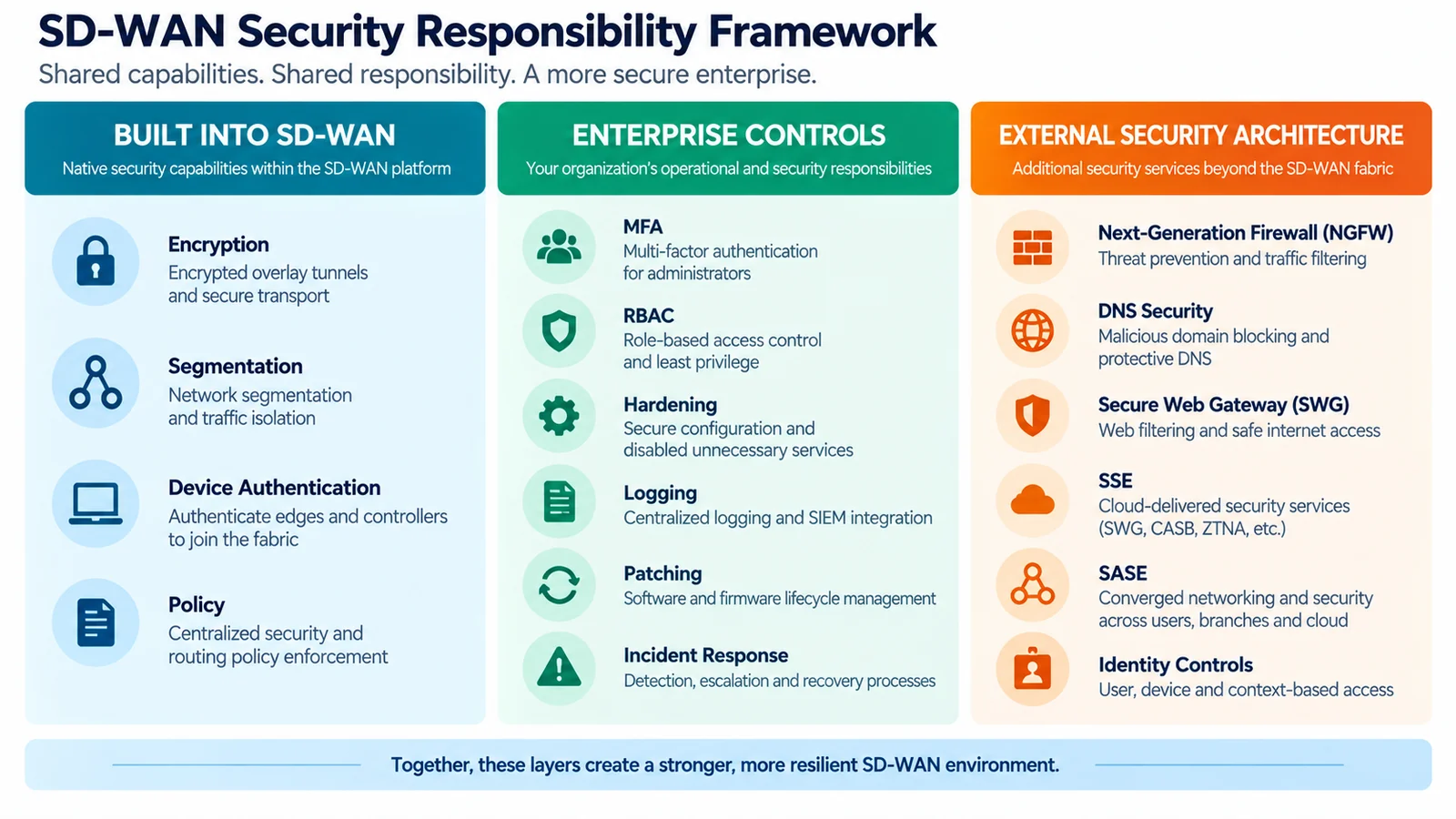
Modern SD-WAN solutions can provide valuable security capabilities such as encrypted connectivity, segmentation, centralized policy and device authentication. However, those capabilities do not automatically create a complete enterprise security architecture. Firewalls, DNS protection, threat prevention, identity controls, secure web access, monitoring and incident response may still need to be provided by the SD-WAN platform, separate security products, or an SSE/SASE architecture.
If you need the networking fundamentals first, start with TechTeamSynergy’s What Is SD-WAN? The Complete Guide.
SD-WAN Security at a Glance
A useful way to approach SD-WAN security is to ask what could be compromised at each part of the environment and which controls reduce that risk.
| Security Area | Main Risk | Typical Controls |
|---|---|---|
| WAN edge | Device compromise, vulnerable software, unauthorized services | Hardening, patching, restricted management, integrity controls |
| Management plane | Stolen administrator credentials or unauthorized configuration | MFA, RBAC, least privilege, trusted management access, audit logging |
| Control plane | Unauthorized devices or manipulation of control relationships | Device authentication, certificates, secure control sessions |
| Data plane | Traffic interception or tampering | Encrypted tunnels, integrity protection, key management |
| Segmentation | Unintended lateral access between business environments | Explicit segments, restrictive inter-segment policy, validation |
| Internet breakout | Branch traffic bypasses centralized security controls | Firewall, DNS security, web/threat inspection, SSE/SASE where required |
| APIs and automation | Exposed credentials or automated deployment of incorrect policy | API access control, secret protection, validation and approval guardrails |
| Operations | Drift, unpatched devices, weak logging or delayed detection | Monitoring, SIEM, configuration control, vulnerability and incident processes |
MEF 70.2 is useful for the vendor-neutral service context because it distinguishes the SD-WAN service from the underlying connectivity over which it operates. MEF 138 goes further on security functions applicable to IP services, including functions such as filtering, protective DNS, malware handling and data-loss controls.
The practical lesson is straightforward: secure the SD-WAN fabric, then secure the traffic and services around it.
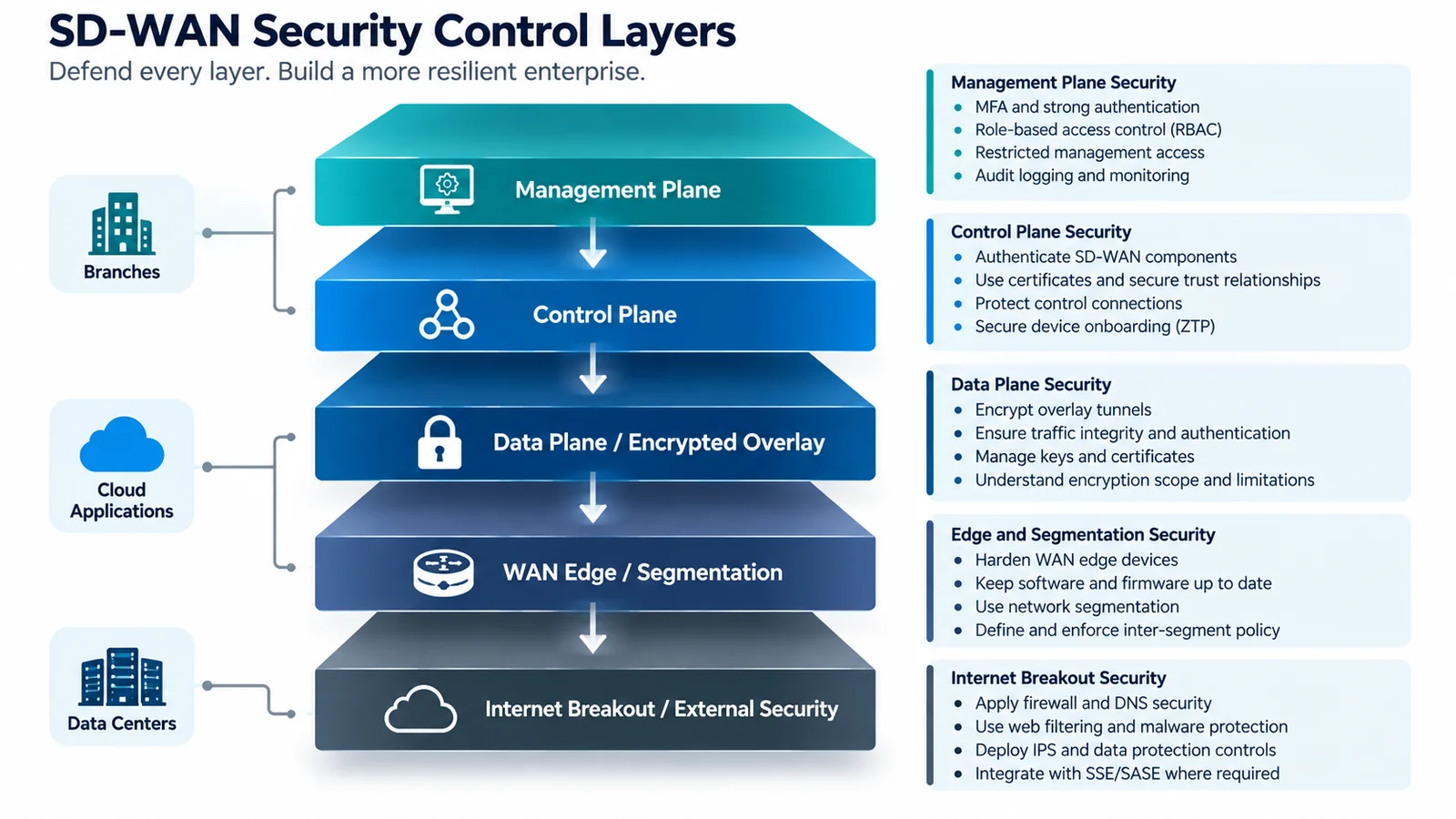
What Does SD-WAN Security Actually Cover?
SD-WAN security spans several areas, but the exact capabilities differ by platform.
At the WAN edge, the distributed enforcement point sits at a branch, data center or cloud location. It can participate in tunnel establishment, traffic classification, segmentation, routing and security policy.
Meanwhile, the management plane is where administrators define configuration and policy. Because centralized management can influence many sites, compromise here can have a much larger impact than compromise of one isolated branch device.
In turn, the control plane establishes trusted relationships and distributes information needed for the fabric to operate. Device identity, authentication and certificate trust are therefore important controls.
By contrast, the data plane carries production traffic. Depending on the implementation, overlay traffic may be encrypted and integrity-protected while crossing one or more underlay networks.
The underlay still matters. In addition, internet, MPLS, broadband, dedicated internet and cellular connectivity have their own risks and operational characteristics. SD-WAN does not make the physical transport irrelevant.
Finally, security services such as firewalls, DNS protection, IPS, Secure Web Gateway or other cloud-delivered controls may be native to the platform, integrated with it, or delivered separately.
That last distinction is critical. SD-WAN can contribute to security without being the entire security architecture. For the component and traffic-flow view, see SD-WAN Architecture Explained.
The Main SD-WAN Security Risks
Centralization and automation make SD-WAN easier to operate at scale, but they also concentrate responsibility around controllers, management systems, credentials, certificates and policy.
Important risks include:
- compromise of a WAN-edge device;
- exposed or poorly restricted administrative interfaces;
- administrator accounts with excessive privileges;
- stolen credentials or weak authentication;
- incorrect routing, segmentation or security policy;
- expired, misissued or improperly protected certificates;
- insecure API credentials;
- vulnerable or unsupported software;
- segmentation failures that create unintended reachability;
- local internet breakout without equivalent security controls;
- incomplete logs or logs that remain only on the network device;
- configuration drift between the intended and deployed state;
- excessive provider or third-party administrative access.
The objective is not to eliminate every possible failure. It is to build layers of control so that one compromised credential, device or configuration error does not automatically compromise the wider WAN.
1. Protect the SD-WAN Management Plane
Centralized management is one of SD-WAN’s major operational advantages. It is also one of its most sensitive security domains.
An administrator who can change global templates, routing policy, segmentation or software versions may be able to affect dozens or hundreds of sites. Management access should therefore be treated as privileged infrastructure access.
CISA’s network infrastructure hardening guidance recommends isolating device management from production traffic, using secure management mechanisms, centrally collecting authentication and configuration activity, and monitoring administrative behavior.
Use Strong Administrator Authentication
Require multi-factor authentication where the management platform supports it.
Avoid shared administrator accounts. Each privileged user should have an individual identity so that authentication, configuration changes and approvals can be attributed to a specific person.
In addition, service accounts and automation identities should be separated from human administrator accounts.
Apply Role-Based Access Control
Not everyone who needs visibility into SD-WAN needs permission to change routing, certificates or global policy.
Use role-based access control and least privilege to separate functions such as monitoring, troubleshooting, branch operations, network policy, security policy, software administration and platform administration.
Therefore, permissions should reflect operational responsibility rather than convenience.
Restrict Management Access
Management interfaces should not be unnecessarily exposed to user or public networks.
Where practical, use a dedicated or trusted management path, management VRF, out-of-band network, restricted source addresses or equivalent controls supported by the environment.
CISA specifically recommends physically or logically isolating management infrastructure from production data flows where possible.
Log Administrative Actions
Record successful and failed authentication, privilege changes, configuration changes, API activity and important platform administration events.
For better visibility, send relevant logs to centralized storage or a SIEM rather than depending only on the local storage of the SD-WAN platform.
Administrative visibility should answer basic questions quickly: Who logged in? What did they change? When did they change it? Was the change approved? Which sites were affected?
2. Secure the Control Plane and Device Identity
An SD-WAN fabric should be able to distinguish authorized components from unauthorized ones.
Authenticate SD-WAN Components
WAN edges, controllers and management systems should establish trusted relationships before participating in the environment.
Depending on the vendor, this may involve certificates, hardware-backed identity, cryptographic keys or other mechanisms.
However, do not assume every platform implements device trust in the same way. During design and procurement, document how the selected platform authenticates new devices and how trust is established between components.
Protect Certificate Lifecycles
Certificates are operational assets, not one-time installation tasks.
Define ownership for issuance, renewal, expiry monitoring, revocation, replacement, private-key protection and recovery following device replacement or compromise.
CISA’s current network hardening guidance recommends PKI-based certificates where supported and an explicit process for renewing certificates before expiry.
As a result, a secure architecture can still suffer an outage if its certificate lifecycle is poorly operated.
Secure Zero-Touch Provisioning
Zero-touch provisioning can greatly simplify branch deployment, but onboarding must not become an uncontrolled path into the fabric.
Verify that a new device is expected, associated with the correct site and authorized before it receives production policy.
The exact controls vary by product, but the principle is consistent: automation should reduce manual work without removing device trust.
3. Protect the SD-WAN Data Plane
Encrypt Overlay Traffic
Many SD-WAN implementations can establish encrypted overlay tunnels across public or private underlays.
Encryption protects confidentiality while integrity mechanisms help detect unauthorized modification of traffic. Authentication helps ensure that tunnel peers are legitimate.
Enterprises should understand which traffic is encrypted, which cryptographic mechanisms are used, how keys are generated and rotated, what happens during certificate or key failure, and whether traffic ever exits the encrypted overlay before reaching its final destination.
Therefore, do not assume that every vendor, deployment mode or traffic path behaves identically.
Do Not Treat Encryption as the Entire Security Model
However, encrypted traffic can still carry malware.
An encrypted tunnel does not determine whether a user should access a sensitive application. It does not automatically block malicious DNS requests, inspect risky web activity or prevent an administrator from deploying an incorrect routing policy.
Encryption protects traffic in transit. It is one control inside a broader security model.
4. Use Segmentation to Limit Lateral Movement
Segmentation is one of the most useful security capabilities available in many SD-WAN environments.
An enterprise may separate traffic for corporate users, guest Wi-Fi, voice, IoT devices, production or operational systems, payment or other sensitive workloads, and network administration.
The objective is not to create as many segments as possible. Excessive segmentation can become difficult to operate.
Instead, create boundaries where business risk, trust level or access requirements genuinely differ.
Define Explicit Inter-Segment Policy
Therefore, creating two logical segments is not sufficient if broad routing or firewall rules still permit traffic between them.
Next, define which communication is required between segments and deny unnecessary paths.
For example, guest Wi-Fi may need internet access but no access to corporate applications. IoT devices may require communication with a small number of management services but not general access to user networks.
Segmentation becomes a security control only when the reachability policy behind it is explicit and tested.
5. Secure Local Internet Breakout
Local internet breakout changes the security architecture.
In a traditional centralized design, branch internet traffic may travel through a data center where central firewalls, DNS controls and web-security systems inspect it.
With SD-WAN, SaaS and internet traffic can leave directly from the branch. As a result, application paths can improve, but the traffic may no longer pass through the previous centralized security stack.
The SD-WAN Migration Checklist therefore treats security and internet breakout as part of migration design rather than as an afterthought.
Determine Which Controls Are Required at the Breakout Point
Depending on risk and traffic, the organization may require firewall policy, protective or controlled DNS, web filtering, malware protection, intrusion prevention, data protection and cloud-delivered security inspection.
MEF 138 provides a standards-based framework for several security functions that can be applied to IP services, including IP/port/protocol filtering, DNS and domain filtering, URL filtering, malware controls, data-loss prevention and protective DNS.
Do Not Create Uncontrolled Direct Internet Access
“Direct internet access” should never mean “uncontrolled internet access.”
The security architecture should define which traffic can exit locally, where security enforcement occurs, which logs are retained and how incidents are investigated.
For organizations that need cloud-delivered enforcement across branches, remote users and cloud applications, SSE or SASE may become part of the design. That is an integration decision, not a reason to turn every SD-WAN deployment into SASE.
For the broader architectural comparison, see SD-WAN vs SASE: Differences, Architecture & When You Need Both and TechTeamSynergy’s What Is SASE? guide.
6. Secure SD-WAN APIs, Automation and Orchestration
SD-WAN platforms increasingly expose APIs for provisioning, policy, monitoring and integration.
However, that programmability comes with risk because an API capable of changing network policy is itself a privileged administrative interface.
Protect API Credentials
First, keep API secrets out of scripts, repositories and documentation where unauthorized users may obtain them.
Then, use separate identities for automation where possible, grant only the permissions required, rotate credentials and monitor their use.
If the platform supports stronger alternatives to long-lived static credentials, evaluate them.
Add Guardrails to Automation
Automating a bad configuration only distributes the mistake faster.
Generate → Validate → Approve → Deploy → Verify
Validation can include syntax, policy logic, affected sites, expected routing, security impact and rollback readiness.
Critical production changes should not move directly from generated configuration to deployment without appropriate controls.
Monitor Configuration Drift
Compare intended policy with deployed state.
Unexpected changes may result from troubleshooting, provider intervention, manual exceptions, failed automation or malicious activity.
Drift monitoring should help identify unauthorized policy changes, unexpected local configuration, inconsistent templates, changed routing behavior and disabled security controls.
7. Patch, Harden and Protect the WAN Edge
WAN edges are infrastructure systems and need a defined vulnerability and software lifecycle.
Maintain Software and Firmware
Maintain an accurate inventory of hardware, software and firmware versions.
In addition, track vendor security advisories, supported releases and end-of-support dates. Test important upgrades before broad rollout and maintain rollback procedures appropriate to the platform.
CISA recommends keeping network-device operating systems at vendor-supported versions, applying security updates and replacing unsupported devices that no longer receive security fixes. See the joint network device security advisory for related hardening guidance.
Disable Unnecessary Services
Reduce exposed services and management protocols.
If a protocol or service is not required for the architecture, disable it where the platform allows.
Where management protocols are required, use secure authenticated variants and restrict which systems can reach them.
Protect Device Integrity
Where supported, evaluate platform capabilities such as signed software, trusted boot mechanisms, secure boot or hardware-backed identity.
These features are vendor-dependent and should not be assumed to exist on every SD-WAN appliance.
Security architecture should therefore distinguish between required controls and optional platform capabilities.
8. Monitor SD-WAN Security Continuously
Security controls become much less useful if nobody can see when they fail.
CISA recommends centralized network-device logging, monitoring of account activity, off-device log collection and SIEM correlation, as well as maintaining visibility into devices and firmware.
Monitor Authentication and Administration
Watch for repeated failed logins, new administrator accounts, privilege changes, unusual login locations or times, unexpected API use and changes outside approved windows.
Monitor Routing and Connectivity
Network-security monitoring should also understand network behavior.
Useful events can include unexpected route changes, unusual next hops, tunnel failures, repeated control-session instability, new or unexpected connectivity, and changes to segmentation or routing policy.
CISA has specifically highlighted the importance of monitoring network-device configurations, routes and management services because adversaries can use infrastructure changes to redirect or persist traffic.
Monitor Security and Traffic Events
Where available, also integrate SD-WAN telemetry with security monitoring.
This can include firewall or IPS events, DNS security events, flow telemetry, application anomalies, unusual destinations and unexpected traffic between segments.
The goal is not to collect every possible event forever. It is to retain enough high-value telemetry to detect, investigate and respond to meaningful security activity.
SD-WAN Security vs SASE: Where Is the Boundary?
SD-WAN security and SASE overlap, but they should not be treated as synonyms.
| Concept | Primary Role |
|---|---|
| SD-WAN Security | Protect SD-WAN edges, fabric, tunnels, management, segmentation and WAN traffic |
| SSE | Deliver cloud-based security enforcement such as secure web, SaaS and private-application access controls |
| SASE | Converge networking with distributed cloud-delivered security |
| Zero Trust | Apply identity-, resource- and context-driven access principles without assuming trust from network location |
NIST SP 800-207 is clear that Zero Trust focuses on protecting resources and does not grant implicit trust merely because a user or asset is on a particular network. That makes Zero Trust a security principle rather than another name for SD-WAN segmentation.
For a detailed architecture comparison rather than repeating it here, see SD-WAN vs SASE.
SD-WAN Security Best-Practice Checklist
Identity and Administration
- Require MFA for privileged administration where supported.
- Use individual administrator identities rather than shared accounts.
- Apply RBAC and least privilege.
- Separate human, service and automation identities.
- Restrict management interfaces to trusted management paths.
Device and Fabric Security
- Authenticate SD-WAN components before they join the fabric.
- Maintain certificate issuance, renewal and revocation processes.
- Protect device onboarding and zero-touch provisioning.
- Verify overlay encryption and key-management behavior.
Network Policy
- Segment environments according to real trust and business requirements.
- Define restrictive inter-segment communication policies.
- Validate routing, firewall and breakout policy after major changes.
Platform Hardening
- Maintain supported firmware and software versions.
- Disable unnecessary services and insecure management protocols.
- Use device-integrity capabilities where supported.
Security Services
- Define controls for every local internet breakout path.
- Determine where firewall, DNS, web, IPS and data-security functions are enforced.
- Integrate SSE/SASE only where broader cloud-delivered security is required.
Operations
- Centralize administrative, configuration and security logs.
- Monitor configuration drift and unexpected routing changes.
- Maintain incident-response and recovery procedures for compromised WAN edges or credentials.
Example: Securing a Branch SD-WAN Deployment
Consider a fictional branch with two internet connections, corporate users, guest Wi-Fi, IoT devices, SaaS applications and private applications hosted in a data center or cloud environment.
The branch SD-WAN edge connects both internet circuits and establishes encrypted overlay connectivity toward enterprise resources.
Corporate users are placed in a corporate segment. Guest Wi-Fi is isolated in a guest segment with internet-only access. IoT devices use a separate segment whose access is limited to the services they genuinely require.
Administrator access to the SD-WAN platform uses individual identities, MFA and role-based permissions. Branch users cannot reach management interfaces.
Corporate traffic for private applications uses the encrypted overlay according to defined routing and security policy.
SaaS traffic may use local internet breakout, but only through the organization’s approved internet-security controls. Depending on the enterprise architecture, those controls may be provided locally, centrally or through cloud-delivered security services.
The branch sends authentication, configuration, connectivity and relevant security events to centralized monitoring.
If an administrator changes segmentation policy, the change is logged. Likewise, operations can see when a tunnel unexpectedly fails. When a new WAN-edge version contains a security fix, the organization follows a defined patch process instead of relying on ad hoc upgrades.
No single control secures the branch.
Security comes from the combination of trusted device identity + secure management + encrypted connectivity + segmentation + internet controls + monitoring + disciplined operations.
Managed SD-WAN: Who Owns Security?
Managed SD-WAN changes who performs operational tasks. It does not remove enterprise risk ownership.
A provider may operate WAN edges, apply software updates, monitor incidents or manage certificates. The enterprise may retain responsibility for application policy, identity, segmentation or security architecture.
For each managed deployment, define ownership explicitly.
| Security Activity | Responsibility Must Be Defined For |
|---|---|
| WAN-edge patching | Monitoring advisories, testing and deployment |
| Software upgrades | Version selection, approval and rollback |
| Administrator accounts | Creation, removal, MFA and privilege review |
| Certificates | Issuance, renewal, revocation and expiry |
| Firewall/security policy | Design, approval and implementation |
| Segmentation | Architecture, rule ownership and validation |
| Logging | Collection, retention, access and SIEM integration |
| Incident response | Detection, escalation, containment and recovery |
| Vulnerability management | Identification, prioritization and remediation |
| Change approval | Who authorizes production changes |
| Escalation | Provider and enterprise contacts and response paths |
A managed provider can operate the service, but enterprise risk ownership does not disappear.
The operating-model questions are explored further in SD-WAN vs Managed SD-WAN.
Frequently Asked Questions
Is SD-WAN secure?
SD-WAN can provide important security capabilities such as encrypted overlay connectivity, device authentication, segmentation and centralized policy. Exact capabilities vary by platform, and additional controls are usually required around identity, internet access, threat protection, logging and operations.
Does SD-WAN encrypt traffic?
Many SD-WAN platforms support encrypted overlay traffic, but encryption technologies, traffic coverage and key-management mechanisms vary. Verify the behavior of the selected platform rather than assuming all traffic is automatically encrypted.
Does SD-WAN need a firewall?
In many enterprise designs, yes. SD-WAN connectivity and traffic steering do not eliminate the need for firewall policy. The firewall capability may be integrated into the WAN edge, delivered through another appliance, or provided as part of a cloud security architecture.
Can SD-WAN replace a firewall?
Not as a general rule. Some platforms include firewall capabilities, but SD-WAN and firewalling solve different primary problems. Enterprises should evaluate the required security controls independently of the WAN-routing functions.
What are the main SD-WAN security risks?
Important risks include compromised WAN edges, weak administrator access, certificate problems, vulnerable software, insecure APIs, policy errors, segmentation failures, uncontrolled local internet breakout, configuration drift and insufficient monitoring.
Does SD-WAN require SASE?
No. SD-WAN can operate independently. SASE becomes relevant when an organization also wants broader distributed networking and cloud-delivered security for branches, users, applications and resources.
How do you secure SD-WAN management?
Use strong administrator authentication, MFA where supported, RBAC, least privilege, restricted management access, individual identities, centralized audit logging and continuous monitoring of administrative activity.
Is MPLS more secure than SD-WAN?
The comparison should not be reduced to “MPLS is secure” or “SD-WAN is secure.” MPLS provides private traffic separation within a provider network, but separation is not the same as end-to-end encryption. SD-WAN can add encrypted overlays and segmentation across different underlays, while the overall security outcome depends on architecture, configuration and operations. For the broader WAN context, see Is MPLS Dead?.
Conclusion: Secure the Fabric, Then Secure Everything Around It
SD-WAN can strengthen enterprise WAN security, but only when its networking capabilities are combined with deliberate security controls and disciplined operations.
Protect the WAN edge → Authenticate the fabric → Secure management → Encrypt traffic → Segment the network → Protect internet breakout → Monitor continuously
The most important design principle is therefore not that SD-WAN is inherently secure or insecure.
It is that SD-WAN can provide important security capabilities, but securing an enterprise SD-WAN requires controls beyond the SD-WAN fabric itself.
Continue Learning
What Is SD-WAN? The Complete Guide
Learn the fundamentals, benefits, architecture and enterprise use cases behind software-defined WAN.
Architecture: SD-WAN Architecture Explained
Understand edges, management and control functions, overlay, underlay and production traffic flow.
Comparison: SD-WAN vs SASE
See where WAN connectivity ends and broader networking and security convergence begins.
Migration: SD-WAN Migration Checklist
Move from architecture to execution with assessment, security, pilot, cutover and validation guidance.