
AI leadership is changing the way teams work. It can help employees analyze information, prepare reports, solve problems, and complete repetitive tasks faster. But introducing AI into a workplace does not automatically make a team more productive.
A team may have access to powerful AI tools and still struggle with unclear responsibilities, inconsistent results, security concerns, or employee resistance. This is where leadership makes the difference.
AI leadership is not about replacing people with technology. It is about helping people use AI effectively, responsibly, and confidently while keeping human judgment at the center of important decisions.
For managers, project leaders, and business executives, this requires more than technical knowledge. It calls for trust, communication, experimentation, coaching, and a clear understanding of where AI can—and cannot—add value.
In this guide, you will learn 12 practical AI leadership strategies, six essential competencies, a five-stage implementation framework, and a 30-day action plan you can adapt to your own team.
AI Leadership: Key Takeaways
- AI leadership combines human-centered management with practical AI literacy, responsible decision-making, and continuous improvement.
- Successful leaders focus on measurable business outcomes rather than the number of AI tools deployed.
- Employees need clear rules about AI use, data protection, accountability, and human review.
- AI can support analysis and execution, but leaders remain responsible for consequential decisions.
- Small, carefully measured pilots are usually a better starting point than organization-wide rollouts.
- The strongest AI-enabled teams invest in both technology and human skills.
1. What Is AI Leadership?
AI leadership is the ability to guide people, decisions, and organizational change in environments where artificial intelligence plays a meaningful role in daily work.
It involves identifying useful AI applications, developing employee capabilities, establishing responsible practices, and measuring whether AI improves results.
In fact, traditional leadership and AI leadership share many foundations: setting direction, building trust, managing performance, and developing people. The difference is that AI introduces new questions about how work is performed and who remains accountable.
Consider a project manager preparing a weekly status report. Without AI, the manager may collect updates manually, consolidate spreadsheets, review risks, and draft a summary. With AI, the manager might use an approved assistant to organize project notes, identify inconsistencies, and prepare a first draft.
Nevertheless, the manager’s responsibility does not disappear. They must still verify the information, evaluate risks, understand the project context, and approve the final communication. AI changes the workflow. Leadership determines whether that change is useful and safe.
AI Leadership vs. Traditional Leadership
| Leadership dimension | Traditional approach | AI-enabled approach |
|---|---|---|
| Decision support | Experience, reports, team input | Human expertise combined with AI-assisted analysis |
| Work allocation | Tasks assigned primarily to people | Work divided between people, automation, and AI assistance |
| Skills development | Role-specific professional training | Professional skills plus AI literacy and verification skills |
| Performance management | Output, quality, cost, and delivery | Existing measures plus AI reliability, adoption, and net value |
| Risk management | Operational and business risks | Operational risks plus privacy, bias, inaccuracies, and AI misuse |
| Accountability | Assigned human owners | Human owners remain accountable for AI-assisted outcomes |
Therefore, the goal is not to create an entirely new management philosophy. It is to adapt sound leadership principles to a changing working environment.
2. Why AI Leadership Matters in 2026
AI tools are becoming increasingly accessible across business functions, from customer support and software development to project management, marketing, and operations. However, access does not guarantee value.
For example, a company may purchase AI subscriptions without defining which problems the tools should solve. Employees may experiment independently, producing inconsistent practices. Managers may encourage automation without explaining what must remain under human control. Ultimately, these problems are fundamentally leadership challenges.
Research and guidance from organizations such as Microsoft, Deloitte, Boston Consulting Group, and the U.S. National Institute of Standards and Technology highlight different aspects of the same transition: organizations must connect AI capabilities to work design, people, governance, and measurable outcomes.
Productivity must be measured, not assumed
Although AI can reduce the time needed for some tasks, a faster first draft is not necessarily a better final result. Time spent checking outputs, correcting errors, or addressing security issues must also be considered.
Employees need clarity and confidence
People may worry about job security, changing expectations, or being evaluated against unrealistic productivity targets. Therefore, leaders should explain how AI will be used, what employees are expected to learn, and how responsibilities may evolve.
Human judgment remains essential
AI-generated recommendations can appear convincing even when they are incomplete or wrong. As a result, leaders need review mechanisms, escalation paths, and clear decision ownership.
Governance must be practical
Policies that are too vague leave employees uncertain. Policies that are too restrictive may encourage unauthorized workarounds. For this reason, effective governance explains which tools are approved, what information may be entered, and when human review is mandatory.
Continuous learning becomes part of daily work
AI capabilities and limitations change rapidly. Consequently, a one-time training session is not enough. Teams need opportunities to practice, share lessons, and update their working methods.
3. Six Essential AI Leadership Skills
AI leadership is not reserved for data scientists or technology executives. Most managers can develop the skills needed to guide AI-enabled teams, provided they approach the subject systematically.
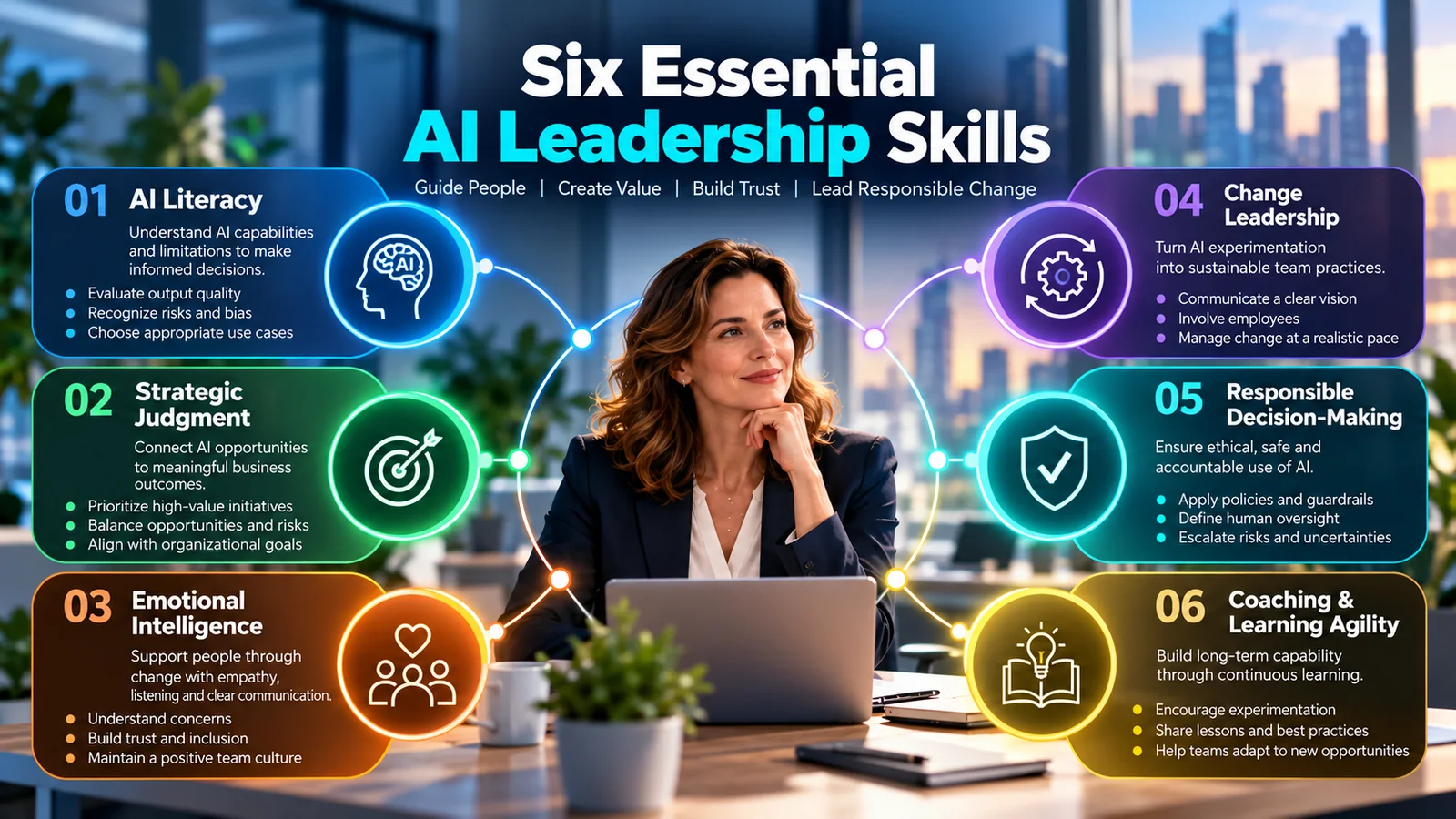
Skill 1: AI Literacy
Leaders should understand what common AI systems can do, where they struggle, and how to recognize unreliable outputs. Importantly, this does not require building machine-learning models. It means understanding concepts such as generative AI, automation, hallucinations, data sensitivity, and human oversight.
Practical example: Before using AI-generated meeting summaries, a manager tests whether the tool accurately identifies decisions, owners, and deadlines.
Skill 2: Strategic Judgment
A useful AI application should support a clear business objective. Therefore, leaders must distinguish meaningful opportunities from technology-driven experimentation.
Practical example: A department chooses to improve customer response consistency rather than deploy an AI chatbot simply because competitors have one.
Skill 3: Emotional Intelligence
AI adoption affects people differently. For example, some employees are enthusiastic. Others may feel uncertain about their roles or uncomfortable admitting that they lack technical confidence. Emotionally intelligent leaders listen, explain changes clearly, and provide support without dismissing concerns.
Practical example: During a team meeting, a manager invites employees to identify tasks where AI could reduce frustration, rather than presenting automation as a predetermined solution.
Skill 4: Change Leadership
In practice, introducing AI often changes workflows, approval processes, and responsibilities. Leaders must communicate the purpose of change, involve employees in implementation, and respond to feedback.
Practical example: A project leader introduces an AI-assisted reporting process to one team before considering a wider rollout.
Skill 5: Responsible Decision-Making
Leaders need to recognize risks involving confidential information, biased outputs, intellectual property, and inaccurate recommendations. They must establish appropriate controls and know when specialist advice is required.
Practical example: A manager prohibits uploading identifiable customer records into an unapproved public AI tool.
Skill 6: Coaching and Learning Agility
As a result, AI adoption creates new learning needs. Strong leaders encourage experimentation, help employees improve their methods, and create opportunities to share useful practices.
Practical example: A team dedicates 20 minutes every two weeks to discussing successful AI use cases, mistakes, and lessons learned.
AI Leadership Skills Self-Assessment
Rate each capability from 1 (beginner) to 5 (confident practitioner).
| Competency | Self-rating | Improvement question |
|---|---|---|
| AI literacy | 1–5 | Can I explain the limitations of the AI tools my team uses? |
| Strategic judgment | 1–5 | Can I connect AI initiatives to measurable business goals? |
| Emotional intelligence | 1–5 | Do employees feel comfortable discussing concerns about AI? |
| Change leadership | 1–5 | Do I involve the team before changing workflows? |
| Responsible decision-making | 1–5 | Do we know which AI uses require additional review? |
| Coaching and learning agility | 1–5 | Does the team have regular opportunities to learn and improve? |
Use the results to identify development priorities, not to label employees or managers as ready or unready.
4. Twelve Practical AI Leadership Strategies
The following strategies translate AI leadership principles into actions managers can use in real teams.
Strategy 1: Start With a Business Problem
First, before selecting an AI tool, identify a problem worth solving. Ask what is taking too long, creating unnecessary effort, reducing quality, or preventing employees from focusing on valuable work. Examples include repetitive status reporting, inconsistent documentation, slow knowledge retrieval, and time-consuming meeting follow-ups. Therefore, define the desired outcome first. Then evaluate whether AI is an appropriate solution.
Leadership action: Write a one-sentence problem statement and choose one measurable success criterion.
Strategy 2: Build Trust Through Transparent Communication
Above all, employees should understand why AI is being introduced and how it may affect their work. Explain what the organization hopes to improve, which decisions remain human, and what employees should do when AI results are unreliable. Avoid promises that AI will eliminate every repetitive task or guarantee productivity gains. Trust grows when leaders communicate both opportunities and limitations. For additional guidance, see Psychological Safety at Work.
Leadership action: Hold an open discussion about AI opportunities, concerns, and boundaries before launching a pilot.
Strategy 3: Establish Clear AI Usage Rules
Employees need practical guidance on approved tools, acceptable data, output verification, and escalation. A useful policy should explain which AI applications are approved, whether confidential business information may be entered, what must be checked before sharing AI-generated content, who approves high-impact decisions, and how to report concerning outputs. Work with relevant IT, security, privacy, legal, and compliance stakeholders.
Leadership action: Create a one-page team AI usage guide aligned with organizational policy.
Strategy 4: Keep Humans Accountable for Decisions
AI can generate recommendations, identify patterns, and summarize options. It should not become an excuse for unclear ownership. A named person should remain responsible for reviewing important outputs and making consequential decisions. An AI assistant may help identify project risks, but the project manager and appropriate risk owners must validate the risks and agree on responses.
Leadership action: Identify a human decision owner for every AI-assisted workflow.
Strategy 5: Develop AI Literacy Across the Team
Employees do not need identical technical skills, but they should understand the AI tools relevant to their responsibilities. Training should cover effective instructions, critical evaluation, confidentiality, and common failure modes. Use real work examples rather than relying entirely on generic demonstrations.
Leadership action: Organize a short, role-based workshop using one approved tool and one realistic task.
Strategy 6: Redesign Workflows, Not Just Individual Tasks
AI value often depends on how an entire process changes. Automating one activity may create extra work elsewhere if responsibilities and handoffs remain unclear. Map the current workflow, identify where AI can help, and define the new review and approval steps.
Leadership action: Compare the existing and proposed workflows before introducing automation.
Strategy 7: Encourage Small, Controlled Experiments
A limited pilot provides evidence before larger commitments are made. Choose a manageable use case with clear boundaries, a defined owner, and measurable results. Avoid testing several unrelated AI applications simultaneously.
Leadership action: Run a two- to four-week pilot with a small group and documented evaluation criteria.
Strategy 8: Protect Psychological Safety
Employees should feel comfortable reporting errors, asking questions, and challenging AI-generated recommendations. A culture that rewards only visible productivity gains may discourage people from discussing failures. Leaders should treat early experimentation as a learning process while maintaining accountability for safety and quality.
Leadership action: Include “What did not work?” in every pilot review.
Strategy 9: Strengthen Collaboration and Knowledge Sharing
AI adoption can become fragmented when individuals develop useful practices but never share them. Create simple mechanisms for exchanging approved prompts, lessons, templates, and verification methods. This helps teams avoid repeating the same mistakes. Explore Team Communication Strategies.
Leadership action: Maintain a shared library of reviewed AI workflows and lessons learned.
Strategy 10: Measure Quality Alongside Speed
Time savings matter, but they are only part of the picture. Track accuracy, rework, employee experience, customer impact, and compliance alongside productivity. A process that saves ten minutes but introduces frequent errors may deliver little or no net value.
Leadership action: Define a balanced scorecard before the pilot begins.
Strategy 11: Adapt Leadership to Human–AI Teams
Managers increasingly coordinate work involving employees, software automation, and AI assistants. That requires clear handoffs. Define what AI prepares, what people verify, who approves outputs, and when the workflow should stop or escalate.
Leadership action: Document responsibilities for each step in an AI-assisted process.
Strategy 12: Build a Continuous Improvement Culture
AI implementation is not a one-time project. Tools change, employees gain experience, and business needs evolve. Review results regularly, retire ineffective use cases, and update guidance when new risks or opportunities appear.
Leadership action: Schedule a monthly AI workflow review focused on value, quality, risk, and learning.
5. AI Leadership and Human–AI Responsibilities
One of the most practical ways to lead AI-enabled work is to clarify the division of responsibilities. The following matrix illustrates how AI can assist without replacing human accountability.
| Activity | AI contribution | Human responsibility | Recommended control |
|---|---|---|---|
| Meeting summary | Draft notes and action items | Confirm decisions and owners | Review against original meeting records |
| Project status report | Consolidate updates and prepare a draft | Validate progress, risks, and commitments | Approval before distribution |
| Risk identification | Suggest potential risks | Assess relevance, probability, and impact | Risk-owner validation |
| Customer communication | Propose response wording | Check accuracy, tone, and policy alignment | Human review based on risk |
| Knowledge retrieval | Retrieve and summarize relevant material | Verify sources and applicability | Source traceability |
| Workforce decisions | Support permitted analysis | Make fair, lawful, accountable decisions | Appropriate human and specialist oversight |
This is an illustrative operating model. Actual controls should reflect the sensitivity of the task, organizational policies, applicable laws, and the capabilities of the tools involved. For formal role clarity, the principles behind a RACI Matrix can help teams assign ownership.
6. The TechTeamSynergy Five-Stage AI Leadership Framework
A practical AI initiative needs a repeatable method. The TechTeamSynergy framework organizes implementation into five stages: Assess → Align → Pilot → Evaluate → Improve.
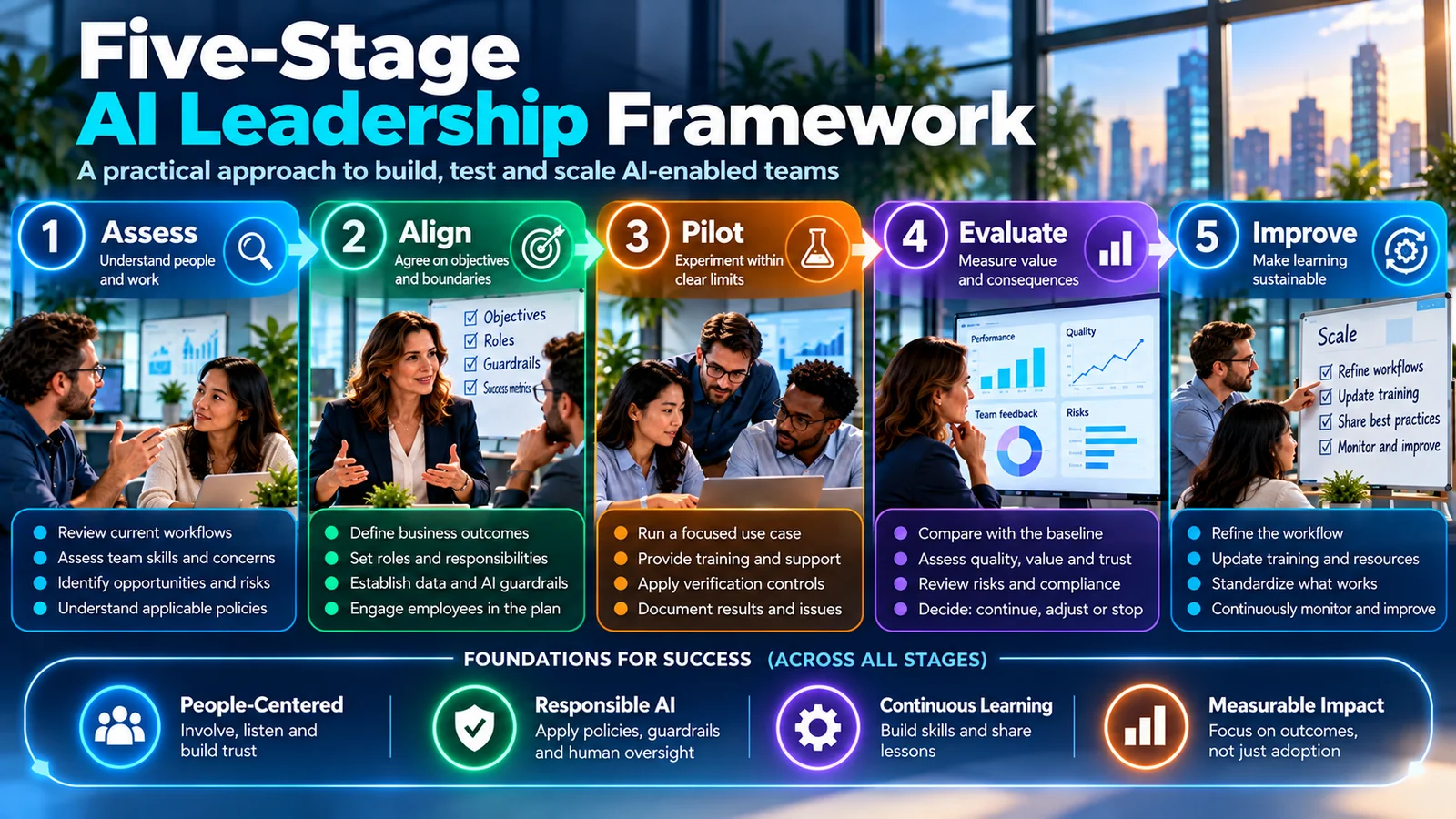
Stage 1: Assess
Understand the team’s current situation. Identify repetitive work, capability gaps, data constraints, employee concerns, and existing technology. Do not assume that every inefficient process requires AI.
Key output: A prioritized list of candidate use cases.
Stage 2: Align
Connect the proposed use case to a business objective. Agree on success criteria, roles, safeguards, and employee involvement. Make sure the team understands the purpose of the change.
Key output: A pilot charter with objectives, responsibilities, measures, and boundaries.
Stage 3: Pilot
Test the workflow with a limited group. Provide training, document the process, and collect feedback. Keep the experiment manageable and ensure that required controls are in place.
Key output: A tested workflow and a record of observed results.
Stage 4: Evaluate
Compare pilot performance against the baseline. Assess productivity, accuracy, rework, employee feedback, and risks. Determine whether benefits are consistent enough to justify broader use.
Key output: An evidence-based decision to expand, revise, or stop.
Stage 5: Improve
Refine instructions, responsibilities, training, and controls. Share lessons across the team and establish a review cycle. Scale only where the results justify it.
Key output: An improved, documented operating process.
Four Principles Supporting Every Stage
- People-Centered: AI should support meaningful work and respect employee needs.
- Responsible AI: Risks, privacy, security, fairness, and accountability must be considered throughout.
- Continuous Learning: Employees and leaders should improve their capabilities through practice and feedback.
- Measurable Impact: Decisions about expansion should be based on evidence rather than enthusiasm alone.
7. Three Realistic AI Leadership Scenarios
The following scenarios are fictional illustrations designed to show how managers can apply the framework.
Scenario 1: A Telecom Project Manager Coordinating 40 Sites
A telecom project manager oversees a deployment across 40 locations. Every week, site teams submit progress updates, delivery risks, and installation issues. Consolidating this information takes considerable time. The manager proposes using an approved AI assistant to prepare a draft weekly report.
- Assess: Identify the most time-consuming reporting steps and review data sensitivity.
- Align: Define the goal as reducing report preparation time without lowering accuracy.
- Pilot: Test the process with five sites for three reporting cycles.
- Evaluate: Compare preparation time, corrections, missing issues, and stakeholder feedback.
- Improve: Refine the reporting template and verification checklist before expanding.
AI prepares the first draft. Site leads validate their updates, and the project manager approves the final report. The main leadership achievement is not automated writing. It is a clearer, more reliable reporting workflow.
Scenario 2: A Customer Operations Knowledge Assistant
A customer operations team receives frequent questions about procedures and service policies. Employees spend time searching multiple knowledge sources. The team leader proposes an AI-supported internal knowledge assistant that retrieves information from approved documentation.
The leader first establishes which documents are authoritative, who maintains them, and how employees should respond when the assistant cannot provide a reliable answer. During the pilot, employees verify cited sources before communicating with customers. The team measures response preparation time, answer accuracy, escalation rates, and employee satisfaction.
If the assistant produces outdated or unsupported guidance, the workflow directs employees back to verified sources and appropriate specialists. The leader’s priority is consistent service quality—not simply faster responses.
Scenario 3: A Hybrid Team Improving Meeting Follow-Ups
A hybrid team struggles to keep track of decisions and action items across virtual meetings. The manager tests an approved AI meeting assistant to draft summaries. Before the pilot, the team discusses meeting consent, recording rules, confidentiality, and who may access the summaries.
After each meeting, the organizer checks the draft against the actual discussion. Action owners confirm their responsibilities, and the final summary is shared through the normal collaboration channel. The team evaluates whether fewer decisions are missed and whether follow-up work becomes clearer.
This example demonstrates how AI can support collaboration while keeping communication and accountability human-led.
8. How to Measure AI Leadership Success
A strong AI leadership initiative should answer a simple question: Is the team producing better outcomes with acceptable effort and risk? That requires a balanced set of indicators.
AI Leadership KPI Scorecard
| KPI | What it measures | Example measurement |
|---|---|---|
| Net time saved | Productivity after review and correction | Minutes saved per completed task |
| Output accuracy | Reliability of AI-assisted work | Percentage of outputs passing review |
| Rework rate | Additional corrections required | Percentage of outputs needing substantial changes |
| Adoption rate | Use of approved workflows | Active users among eligible team members |
| Employee confidence | Readiness and comfort | Short pulse survey |
| Training completion | Capability development | Percentage completing role-based training |
| Policy exceptions | Responsible use | Number and severity of reported exceptions |
| Stakeholder satisfaction | Perceived value | Survey or structured feedback |
| Process cycle time | End-to-end efficiency | Average time from request to approved result |
Avoid treating every KPI as a target to maximize. For example, high adoption is not a success if quality declines or employees use AI for tasks where it adds no value.
Worked Example: Calculating Net Time Saved
Suppose a project manager prepares a recurring report. Before AI, the report takes 90 minutes. After introducing AI assistance: AI-assisted preparation takes 35 minutes; human verification takes 20 minutes; corrections take another 10 minutes.
The new total is 35 + 20 + 10 = 65 minutes. Net time saved: 90 − 65 = 25 minutes per report. Percentage reduction in effort: 25 ÷ 90 × 100 = 27.8%. At four reports per month, the illustrative saving is 100 minutes per month.
This calculation captures direct task effort. It does not automatically account for training, licensing, implementation, security review, or other overheads. Leaders should include those costs when evaluating overall business value.
9. Your 30-Day AI Leadership Action Plan
You do not need to transform your entire organization in one month. A more useful objective is to establish a responsible, measurable starting point.
Week 1 — Understand and Assess
Days 1–7
- Discuss AI opportunities and concerns with the team.
- Identify three repetitive or information-heavy workflows.
- Check which AI tools are approved.
- Assess data sensitivity and relevant policies.
- Select one low-risk use case.
Deliverable: A short AI opportunity assessment.
Week 2 — Align and Prepare
Days 8–14
- Define the pilot objective.
- Document the current baseline.
- Assign a pilot owner and human reviewers.
- Establish permitted inputs and verification steps.
- Provide focused training to participants.
Deliverable: A one-page pilot charter and review checklist.
Week 3 — Pilot and Learn
Days 15–21
- Run the workflow on a limited set of tasks.
- Record preparation and verification time.
- Track inaccuracies and rework.
- Ask participants what is helping or creating friction.
- Adjust the process where necessary.
Deliverable: A pilot log containing performance measures and feedback.
Week 4 — Evaluate and Improve
Days 22–30
- Compare results with the baseline.
- Review quality and compliance observations.
- Discuss employee experience.
- Decide whether to continue, revise, expand, or stop.
- Share lessons and establish the next review date.
Deliverable: A pilot evaluation and a practical next-step decision.
30-Day Action Plan Checklist
| Action | Owner | Target |
|---|---|---|
| Identify the business problem | Team leader | Week 1 |
| Confirm approved tools and data rules | Leader with relevant specialists | Week 1 |
| Define success measures | Pilot owner | Week 2 |
| Train participants | Team leader or trainer | Week 2 |
| Run controlled pilot | Pilot team | Week 3 |
| Measure outcomes and risks | Pilot owner | Week 3–4 |
| Review employee feedback | Team leader | Week 4 |
| Decide next steps | Accountable manager | Day 30 |
The purpose of the first 30 days is to build confidence and evidence—not to claim that the entire organization has become AI-ready.
10. Common AI Leadership Mistakes to Avoid
Even well-intentioned AI initiatives can struggle when leaders overlook basic management principles.
Mistake 1: Starting With the Tool Instead of the Problem
A new application can generate excitement, but enthusiasm is not a business case.
Better approach: Identify the desired outcome before selecting technology.
Mistake 2: Assuming AI Outputs Are Correct
AI-generated content can contain inaccuracies, omissions, or fabricated references.
Better approach: Match verification requirements to the risk and impact of the task.
Mistake 3: Ignoring Employee Concerns
Employees may interpret AI adoption as a threat if leaders communicate only efficiency targets.
Better approach: Explain the purpose, invite questions, and provide opportunities to develop skills.
Mistake 4: Measuring Only Time Savings
A faster process may produce more errors or require additional downstream corrections.
Better approach: Measure net effort, quality, rework, and stakeholder impact.
Mistake 5: Scaling Before the Pilot Is Ready
An inconsistent workflow becomes a larger problem when rolled out across many teams.
Better approach: Demonstrate reliable results and clear ownership before expanding.
Mistake 6: Treating Governance as a One-Time Document
Rules can become outdated as tools, risks, and work practices change.
Better approach: Review approved workflows, policies, and lessons learned regularly.
11. Frequently Asked Questions About AI Leadership
What is AI leadership in simple terms?
AI leadership means helping a team use artificial intelligence to improve work while maintaining human responsibility, trust, and sound decision-making. It combines familiar leadership skills with AI literacy, practical governance, and continuous learning.
Does an AI leader need technical expertise?
Not necessarily. Managers should understand the capabilities, limitations, and risks of the AI tools their teams use, but they do not need to become AI engineers. They can work with technical, security, and legal specialists when deeper expertise is required.
How can managers lead teams that are worried about AI?
Start with transparent communication. Explain why AI is being introduced, listen to concerns, involve employees in pilot design, and provide relevant training. Avoid making unsupported promises about job security or productivity.
What are the most important AI leadership skills?
Six particularly useful skills are AI literacy, strategic judgment, emotional intelligence, change leadership, responsible decision-making, and coaching. The right emphasis depends on the team’s responsibilities and maturity.
How do you measure the success of AI leadership?
Measure business outcomes rather than tool usage alone. Useful indicators include net time saved, accuracy, rework, employee confidence, customer impact, and policy compliance. Compare results with a baseline and include the cost of reviewing and correcting AI outputs.
What is the best way to start an AI leadership initiative?
Choose one low-risk business problem, confirm that the tools and data are approved, define a measurable goal, and run a controlled pilot. Evaluate the results before expanding to other workflows.
12. Conclusion: Lead People First, Technology Second
AI is creating new possibilities for how teams plan, communicate, analyze information, and deliver results. But technology alone cannot establish trust, resolve uncertainty, define accountability, or decide what matters most. Those remain leadership responsibilities.
Effective AI leaders do not need to have every technical answer. They need to ask better questions, create clear boundaries, develop their people, and make evidence-based decisions.
Start with one meaningful problem. Give employees the support they need. Keep human judgment visible. Measure results carefully. Improve what works.
The future of AI leadership will depend not only on what technology can do, but on how thoughtfully leaders help people work with it.
Sources and Further Reading
The following resources provide research, management context, and responsible AI guidance. Specific findings should be checked against the cited editions before publication.
- Microsoft — Work Trend Index. Research on AI, work patterns, employees, and organizational transformation.
- Deloitte — State of AI in the Enterprise. Research on enterprise AI adoption, organizational capabilities, governance, and value creation.
- Boston Consulting Group — Artificial Intelligence. Research on AI transformation, leadership, people, and organizational change.
- NIST — AI Risk Management Framework (AI RMF 1.0). A framework for managing risks associated with AI systems.
- NIST — Generative Artificial Intelligence Profile (AI 600-1). Guidance addressing risks specific to generative AI.
Continue Learning
Explore these related TechTeamSynergy guides to strengthen your leadership, collaboration, and AI management skills.