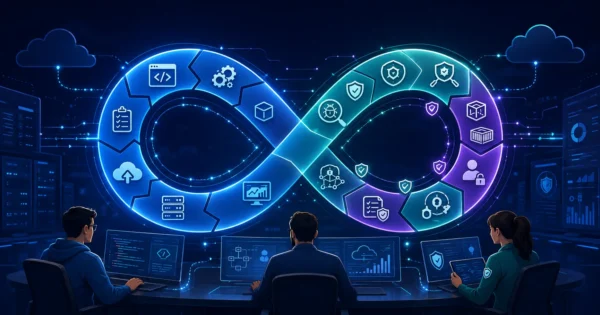
DevOps and DevSecOps are closely related approaches to modern software delivery, but they are not identical. DevOps brings development and operations closer together through collaboration, automation, continuous delivery and fast feedback. DevSecOps builds on those practices by integrating security more explicitly throughout the software-development lifecycle. For the broader security foundations behind these practices, see our complete cybersecurity guide.
For readers building the scripting foundation behind automated delivery and security workflows, our learn Python from scratch guide is a practical starting point.
The simplest way to understand the relationship is:
DevOps = Development + Operations
DevSecOps = Development + Security + Operations
However, that formula can be misleading if it suggests that DevOps ignores security completely.
Security can and should exist in DevOps. DevSecOps makes security a more systematic, continuous and shared part of development and operations workflows. For the broader relationship between the two disciplines, see how DevSecOps fits into cybersecurity.
This guide compares DevOps vs DevSecOps across culture, security, CI/CD, testing, automation, responsibilities, tools, software supply chains and implementation.
If you first need the broader concept, read our complete guide to DevOps.
DevOps vs DevSecOps: Quick Answer
The main difference between DevOps and DevSecOps is the degree to which security is explicitly integrated into software-development and delivery practices.
| Area | DevOps | DevSecOps |
|---|---|---|
| Primary emphasis | Development and operations collaboration | Development, security and operations collaboration |
| Security | Can be included in DevOps workflows | Explicitly integrated throughout the lifecycle |
| Automation | Build, test, deployment and operations automation | DevOps automation plus security automation |
| CI/CD | Automates software integration and delivery | Adds risk-appropriate security controls to pipelines |
| Responsibility | Shared development and operations ownership | Security also becomes shared responsibility |
| Testing | Functional, integration, performance and other testing | Adds integrated software-security testing |
| Feedback | Development and operational feedback | Adds continuous security feedback |
| Goal | Fast and reliable software delivery | Fast, reliable and appropriately secure software delivery |
DevSecOps is therefore better understood as an evolution or extension of DevOps practices rather than a competing replacement.
What Is DevOps?
DevOps is an approach that helps software-development and IT-operations teams work together throughout the software lifecycle.
Common DevOps principles include:
- Collaboration
- Shared ownership
- Automation
- Continuous Integration
- Continuous Delivery
- Fast feedback
- Infrastructure as Code
- Observability
- Continuous improvement
A simplified DevOps lifecycle might look like:
Plan → Code → Build → Test → Release → Deploy → Operate → Observe → Improve
DevOps reduces barriers between teams that traditionally built software and those responsible for running it.
For a deeper explanation of CI/CD, Infrastructure as Code, observability, platform engineering and DevOps metrics, see our What Is DevOps guide.
What Is DevSecOps?
DevSecOps stands for Development, Security and Operations.
It integrates security practices throughout modern software-development and delivery workflows.
Instead of waiting until the end of development to perform a large security review, DevSecOps tries to create security feedback throughout the lifecycle.
A simplified model is:
Plan → Secure Design → Code → Build → Test → Security Validation → Deploy → Monitor → Improve
Security activities can include:
- Security requirements
- Threat modeling
- Code analysis
- Dependency analysis
- Secrets management
- Infrastructure-as-Code security
- Container security
- Software supply-chain controls
- Security testing
- Continuous monitoring
Not every security activity needs to occur at every pipeline stage.
Controls should be selected according to the application’s architecture, risks and organizational requirements.
How DevSecOps Builds on DevOps
DevSecOps does not discard DevOps principles.
It relies on many of the same ideas:
- Small changes
- Automation
- Fast feedback
- Collaboration
- Shared ownership
- Continuous improvement
The major change is that security becomes more deeply integrated into those processes.
For example:
DevOps pipeline:
Code → Build → Test → Deploy → Monitor
DevSecOps-oriented pipeline:
Code → Build → Test + Security Checks → Validate → Deploy → Security Monitoring
The specific pipeline will differ between organizations.
DevOps vs DevSecOps: The Core Difference
The difference is not simply:
DevOps = speed
and
DevSecOps = security.
That is too simplistic.
DevOps already aims to balance software-delivery speed with quality and operational reliability.
DevSecOps adds more explicit integration of software security into that delivery model.
A better comparison is:
DevOps: How can we build, deliver and operate software effectively?
DevSecOps: How can we build, deliver, operate and secure software through integrated workflows?
DevOps vs DevSecOps Responsibilities
Traditional organizations often separated responsibilities:
Developers → Build software
Operations → Run software
Security → Review security
This created handoffs between teams.
DevOps reduces development-versus-operations separation.
DevSecOps extends shared responsibility further.
That does not mean every developer becomes a cybersecurity specialist.
Instead:
- Developers consider secure coding and dependencies.
- Security specialists provide expertise and guardrails.
- Platform teams integrate reusable security capabilities.
- Operations teams maintain secure configurations.
- Product teams consider security requirements.
Security specialists remain important.
The objective is to avoid making security exclusively somebody else’s responsibility.
Shift Left in DevSecOps
Shift left means introducing appropriate security activities earlier in the software-development lifecycle.
For example, instead of discovering a design problem shortly before production, teams may identify the issue during:
- Planning
- Architecture
- Design
- Development
This can provide faster feedback to the people who can correct the problem.
However, shift left does not mean moving every security activity to developers.
Security is also necessary after deployment.
Shift Right and Continuous Security
Modern DevSecOps also includes security during production operation.
This is sometimes described as shift right.
Activities can include:
- Runtime monitoring
- Vulnerability management
- Security telemetry
- Incident detection
- Configuration monitoring
- Operational feedback
A mature model therefore looks more like:
Secure Earlier + Monitor Continuously + Learn Continuously
rather than security happening only on the left side of the lifecycle.
DevOps vs DevSecOps in CI/CD
CI/CD pipelines automate important parts of software integration and delivery.
In DevOps, a typical pipeline may automate:
- Code integration
- Builds
- Unit tests
- Integration tests
- Packaging
- Deployment
DevSecOps can add security-related controls such as:
- Code-security analysis
- Dependency analysis
- Secrets detection
- Infrastructure-as-Code checks
- Container-image analysis
- Policy checks
The objective is not to add every possible security tool to every pipeline.
The objective is to integrate appropriate security controls without destroying the fast-feedback characteristics that make CI/CD valuable.
DevSecOps Security Testing
DevSecOps may use several forms of application-security testing.
Static Application Security Testing
SAST analyzes application source code or related artifacts for potential weaknesses.
It can provide developers with security feedback before software is running in production.
Dynamic Application Security Testing
DAST evaluates a running application from an external perspective.
It can identify certain issues that may not be visible through source-code analysis alone.
Software Composition Analysis
Modern applications frequently use third-party and open-source components.
Software Composition Analysis can help teams understand:
- Dependencies
- Known component vulnerabilities
- Licensing information
- Software-component inventory
Secrets Detection
Automated checks can help identify credentials or sensitive secrets accidentally introduced into:
- Source code
- Repositories
- Configuration
- Build processes
Infrastructure-as-Code Security
Infrastructure configuration can also be reviewed automatically.
This can help identify insecure settings before infrastructure is deployed.
DevSecOps and Threat Modeling
Not all security problems can be found by automated testing.
Threat modeling helps teams think about security during design.
It may consider questions such as:
- What are we building?
- What assets need protection?
- How will components communicate?
- Where are trust boundaries?
- What could go wrong?
- Which controls are appropriate?
This is one reason DevSecOps cannot be reduced to adding scanners to CI/CD.
DevSecOps and Secure Software Development
DevSecOps works best when connected to secure software-development practices.
Security should be considered across:
- Design
- Development
- Build
- Testing
- Release
- Deployment
- Operation
- Maintenance
The NIST Secure Software Development Framework, or SSDF, provides a useful framework for organizing secure software-development practices.
What Is the NIST SSDF?
The Secure Software Development Framework (SSDF) provides recommended secure software-development practices that organizations can integrate into their existing software-development lifecycle.
Its purpose is not to prescribe one particular development methodology or toolchain.
This makes it relevant to DevSecOps because organizations can integrate SSDF practices into their existing DevOps pipelines and processes.
DevSecOps and Software Supply-Chain Security
Modern applications are rarely created entirely from software written inside one organization.
They may rely on:
- Open-source libraries
- Commercial components
- Container images
- Package repositories
- Build systems
- External services
- Development tools
This creates a software supply chain.
DevSecOps therefore needs to consider the security and integrity of both internally developed software and external components.
DevSecOps and SBOM
A Software Bill of Materials, or SBOM, provides structured information about software components.
An SBOM can improve visibility into software composition.
However, having an SBOM does not automatically make software secure.
Organizations still need processes for:
- Analyzing component risk
- Managing vulnerabilities
- Updating dependencies
- Responding to newly discovered issues
DevSecOps and Containers
Containerized applications introduce additional security considerations.
DevSecOps practices can include:
- Container-image analysis
- Trusted base images
- Registry controls
- Dependency management
- Runtime monitoring
- Configuration policies
Container security should span build and runtime environments.
DevSecOps and Kubernetes
Kubernetes is commonly used to operate containerized applications and can therefore appear frequently in DevSecOps environments.
Security considerations include:
- Identity and access
- Secrets
- Workload configuration
- Network policies
- Container images
- Cluster configuration
- Runtime monitoring
Kubernetes itself does not make an application DevSecOps.
DevSecOps and Cloud Security
Cloud environments support rapid infrastructure provisioning, which can make security automation especially important.
DevSecOps can integrate controls for:
- Cloud configuration
- Identity permissions
- Infrastructure as Code
- Workload security
- Secrets management
- Security logging
This can help teams detect security issues before or shortly after cloud infrastructure is deployed.
DevOps vs DevSecOps Tools
There is no single DevOps or DevSecOps tool.
The distinction is better understood by capabilities.
| Capability | DevOps | DevSecOps Extension |
|---|---|---|
| Version control | Manage source code and changes | Add branch controls and security checks |
| CI/CD | Automate build, test and delivery | Integrate security validation |
| Infrastructure as Code | Automate infrastructure | Validate configuration and policy |
| Dependencies | Manage application packages | Analyze component risks |
| Containers | Package applications | Analyze images and configurations |
| Observability | Monitor application behavior | Add security telemetry and detection |
| Secrets | Support application configuration | Protect credentials and secrets |
Tool selection should follow the security and delivery requirements.
It should not define the methodology.
DevOps vs DevSecOps Culture
DevSecOps requires cultural change as much as technical change.
A poor implementation can create a new problem:
Development → DevOps → Security Approval
This recreates the same silo DevOps was intended to reduce.
A healthier model encourages:
- Shared responsibility
- Security expertise embedded into workflows
- Reusable security guardrails
- Fast security feedback
- Collaboration rather than gatekeeping
DevOps vs DevSecOps Benefits
DevSecOps can provide several potential benefits when implemented effectively.
Earlier Security Feedback
Developers can receive security information while the relevant change is still fresh and easier to modify.
More Consistent Security Controls
Automated pipeline controls can apply repeatable checks across software changes.
Reduced Manual Security Handoffs
Security capabilities can become part of established development workflows instead of requiring separate processes for every release.
Better Software Visibility
Dependency analysis, SBOMs and other controls can improve understanding of software composition.
Security at Delivery Speed
Automation can help security controls operate at the pace of frequent software changes.
DevSecOps Does Not Guarantee Secure Software
One important misconception is that implementing DevSecOps automatically produces secure applications.
It does not.
Security outcomes still depend on:
- Architecture
- Threat modeling
- Secure development
- Testing quality
- Configuration
- Identity controls
- Vulnerability management
- Operations
- Human judgment
A pipeline containing security scanners can still deliver insecure software.
Does DevSecOps Reduce Costs?
Finding some problems earlier can avoid expensive rework later.
However, organizations should avoid claiming that DevSecOps automatically lowers total costs.
DevSecOps may also require investment in:
- Tools
- Automation
- Platform engineering
- Training
- Security expertise
- Process redesign
The business case should therefore consider overall risk and delivery performance rather than assuming guaranteed savings.
Does DevSecOps Guarantee Compliance?
No.
DevSecOps can help automate and document certain controls, but regulatory and compliance obligations are broader than CI/CD pipelines.
Compliance can involve:
- Governance
- Policies
- Evidence
- Risk management
- Access control
- Data protection
- Operational procedures
DevSecOps can support compliance efforts, but it does not guarantee compliance.
Challenges of DevSecOps
Security Noise
Too many low-quality alerts can overwhelm developers.
Slow Pipelines
Poorly designed security checks can significantly increase delivery time.
Skill Gaps
Developers may need more secure-development knowledge while security teams may need stronger software-engineering and automation skills.
Tool Fragmentation
Too many independent tools can create complexity and duplicate findings.
Legacy Applications
Older software may not fit easily into modern automated pipelines.
Organizational Silos
Security teams working separately from development can remain a major bottleneck.
False Positives
Security automation can generate findings that require human validation.
Common DevSecOps Mistakes
Adding Security Only at the End
This preserves the old security-gate model instead of integrating security throughout the lifecycle.
Adding Every Security Tool to CI/CD
More tools do not automatically produce stronger security.
Making Developers Responsible for Everything
Shared responsibility does not mean eliminating security specialists.
Focusing Only on Shift Left
Production security and monitoring remain necessary.
Ignoring Software Dependencies
Third-party components are a significant part of modern software.
Ignoring Developer Experience
Security controls that create excessive friction may encourage workarounds rather than improve security.
Treating Compliance as Security
Passing compliance checks does not prove that all meaningful software risks have been addressed.
How to Move from DevOps Toward DevSecOps
Step 1: Understand the Existing DevOps Pipeline
Map:
- Code repositories
- Build systems
- Testing
- Artifacts
- Deployment
- Infrastructure
- Production monitoring
Step 2: Identify Software Risks
Determine which applications, data and systems have the highest security requirements.
Step 3: Introduce Security During Planning and Design
Use security requirements and threat modeling where appropriate.
Step 4: Add Developer Feedback
Integrate useful security information into the tools and workflows developers already use.
Step 5: Secure the Build Process
Protect:
- Repositories
- Build infrastructure
- Dependencies
- Artifacts
- Credentials
Step 6: Integrate Appropriate Pipeline Controls
Add security tests according to risk rather than adding every available scanner.
Step 7: Secure Infrastructure
Integrate configuration and Infrastructure-as-Code validation.
Step 8: Protect Production
Continue monitoring security after deployment.
Step 9: Measure Results
Measure whether security feedback is becoming faster and more useful.
Step 10: Continuously Improve
Adapt controls as applications, risks and delivery practices evolve.
15-Minute DevSecOps Control Review
Use this short review on one real application or delivery pipeline. The goal is not to add more scanners. It is to identify one security control that improves feedback without creating unnecessary delivery friction.
- 0–3 min — Identify the meaningful risk. Choose one issue that matters for this application, such as exposed secrets, vulnerable dependencies, insecure configuration, excessive permissions or weak artifact integrity.
- 3–6 min — Check where feedback arrives today. Determine whether the issue is discovered during design, coding, CI/CD, deployment or only after production.
- 6–9 min — Assess signal quality. Ask whether the current control produces clear, actionable findings or mostly noise, duplicate alerts and false positives.
- 9–12 min — Choose one improvement. Move feedback earlier, tune a rule, automate a repeatable check, improve a secure default or clarify when human review is required.
- 12–15 min — Assign ownership and evidence. Name one owner, define the expected improvement and select one measure such as feedback time, remediation time, false-positive rate or coverage of critical changes.
Decision: KEEP a control that is useful and proportionate; TUNE a noisy control; AUTOMATE a repeatable manual check; or ESCALATE when the risk requires specialist security review or a broader architecture decision.
DevSecOps Metrics
Useful metrics can include:
- Time to remediate important vulnerabilities
- Security findings discovered before production
- Security test reliability
- False-positive rates
- Coverage of critical applications
- Dependency visibility
- Time required for security feedback
- Security incidents related to software changes
Teams should avoid optimizing purely for the number of security scans or findings.
The objective is risk reduction and effective software delivery.
DevOps vs DevSecOps: Which Should You Choose?
For most organizations, this is not really an either-or decision.
If an organization already practices DevOps, the question is usually:
How should security be integrated into our DevOps practices?
rather than:
Should we abandon DevOps and replace it with DevSecOps?
DevSecOps builds on the collaboration, automation and feedback mechanisms already used by DevOps.
Does Every Organization Need DevSecOps?
Organizations that develop or operate software should consider appropriate secure-development practices.
However, the implementation should match:
- Application risk
- Architecture
- Organization size
- Regulatory environment
- Delivery model
- Team maturity
A small internal application may not need the same controls as a critical financial platform.
DevSecOps vs Cybersecurity
DevSecOps is related to cybersecurity, but the terms are not synonymous.
Cybersecurity is much broader and can include:
For a practical map of those wider functions, domains and specialist responsibilities, see our guide to enterprise security roles and responsibilities.
- Network security
- Identity security
- Cloud security
- Endpoint security
- Security operations
- Incident response
- Governance
- Risk management
DevSecOps focuses specifically on integrating security into software development, delivery and operations.
Our dedicated Is DevSecOps Cybersecurity? article explores that relationship in detail.
DevSecOps and AI
AI-assisted tools are increasingly appearing across development and security workflows.
Possible applications include:
- Code assistance
- Security analysis
- Test generation
- Dependency analysis
- Alert summarization
- Security documentation
AI does not remove the need for secure-development practices or human review.
AI-generated software must go through appropriate testing and security processes just like other software.
The Future of DevOps and DevSecOps
The distinction between DevOps and DevSecOps may become less visible as security becomes a more normal part of modern software engineering.
Several trends are reinforcing this direction.
Platform Engineering
Platform teams can provide reusable security capabilities inside developer platforms.
Policy as Code
Some security and governance requirements can increasingly be expressed and validated automatically.
Software Supply-Chain Security
Organizations are paying greater attention to components, build systems, repositories and artifacts.
AI-Assisted Engineering
AI is changing software development and will create both productivity opportunities and new security considerations.
Continuous Security
Security is increasingly becoming an ongoing lifecycle activity rather than a single pre-release event.
Frequently Asked Questions About DevOps vs DevSecOps
What is the main difference between DevOps and DevSecOps?
DevOps focuses on collaboration between development and operations throughout software delivery. DevSecOps builds on DevOps by integrating security more explicitly throughout the software-development lifecycle.
Does DevSecOps replace DevOps?
No. DevSecOps generally extends DevOps principles and practices rather than replacing them.
Does DevOps include security?
DevOps can include security. DevSecOps makes security integration more explicit, continuous and shared across development and operations workflows.
What does DevSecOps stand for?
DevSecOps stands for Development, Security and Operations.
What does shift left mean?
Shift left means introducing appropriate security activities earlier in software development so teams receive security feedback sooner.
Does DevSecOps only mean shift left?
No. DevSecOps also includes security during deployment and production operation, including monitoring, vulnerability management and continuous improvement.
What security tools are used in DevSecOps?
DevSecOps environments may use code-analysis, dependency-analysis, secrets-detection, infrastructure-security, container-security and monitoring capabilities. The appropriate tools depend on the application and risk.
What is the role of CI/CD in DevSecOps?
CI/CD pipelines provide opportunities to automate security checks and deliver fast security feedback during software integration and delivery.
Is DevSecOps cybersecurity?
DevSecOps is part of a broader cybersecurity strategy, particularly around software security, but cybersecurity includes many other disciplines such as network, identity, cloud and endpoint security.
Can DevSecOps prevent every vulnerability?
No. DevSecOps can improve security practices and feedback, but no methodology can guarantee vulnerability-free software.
Does DevSecOps slow down development?
Poorly designed security processes can slow delivery. Well-integrated automation and early feedback can reduce disruptive security handoffs while still managing risk.
Is DevSecOps only for cloud-native applications?
No. DevSecOps can be applied to different software architectures, although cloud-native Telco Cloud environments commonly use its automation and pipeline practices extensively.
Conclusion
DevOps and DevSecOps should not be viewed as competing methodologies.
DevOps established important principles around:
- Development and operations collaboration
- Automation
- Continuous delivery
- Fast feedback
- Shared ownership
- Continuous improvement
DevSecOps builds on those principles by integrating security more explicitly across software development and operations.
The relationship can therefore be summarized as:
DevOps + Integrated Security Practices = DevSecOps
But successful DevSecOps requires more than adding security scanners to CI/CD.
It requires:
- Secure design
- Appropriate automation
- Shared responsibility
- Software supply-chain awareness
- Continuous monitoring
- Human security expertise
The strongest approach is not to choose between speed and security.
It is to design software-delivery processes where security becomes part of the same fast-feedback system used to improve quality and reliability.
Continue Learning
Continue exploring the TechTeamSynergy DevOps, DevSecOps and cybersecurity cluster with these related guides.
Comments are closed.