

KPI vs OKR is a common comparison because both approaches are used to measure progress, improve performance and support better decisions. However, they solve different management problems, and organizations do not necessarily need to choose one instead of the other.
A KPI (Key Performance Indicator) is an important measure used to monitor performance. An OKR (Objectives and Key Results) combines a meaningful objective with measurable results that describe the progress an organization or team wants to achieve.
The simplest distinction is:
KPI = How are we performing?
OKR = What meaningful outcome do we want to achieve, and how will we know we are making progress?
In practice, the two approaches can also work together:
KPI Detects → Analyze → OKR Prioritizes → Initiatives Execute → Results Change → KPI Validates
Performance management works best when measurement is connected to decisions rather than treated as reporting for its own sake. This is especially important when measuring business agility, where speed should be evaluated alongside customer, employee and business outcomes. The CIPD’s performance management guidance similarly emphasizes that performance measures should be relevant and aligned with organizational goals. Google also describes using Objectives and Key Results to help communicate goals, while the Project Management Institute highlights the connection between measurement, analysis and corrective action in project environments.
Therefore, this guide goes beyond a simple KPI vs OKR definition. It explains their differences, provides practical examples, shows how to create better KPIs and OKRs, and explores how both approaches can support strategy, project management, Agile delivery and digital transformation.
KPI vs OKR Guide: Table of Contents
- KPI vs OKR: Quick Comparison
- What Is a KPI?
- What Is an OKR?
- KPI vs OKR: 7 Key Differences
- KPI vs OKR Examples
- How KPIs and OKRs Work Together
- How to Write a Good KPI
- How to Write a Good OKR
- KPI vs OKR in Project Management
- Common KPI and OKR Mistakes
- How AI Can Support KPI and OKR Management
- KPI + OKR Implementation Framework
- Frequently Asked Questions
KPI vs OKR: Quick Comparison
| Dimension | KPI | OKR |
|---|---|---|
| Meaning | Key Performance Indicator | Objectives and Key Results |
| Primary role | Monitor important performance | Define and measure desired progress |
| Structure | Indicator, often with a target or threshold | Objective + measurable Key Results |
| Duration | Can remain relevant for long periods | Usually associated with a defined planning cycle |
| Focus | Performance visibility | Priorities and outcomes |
| Typical question | How are we performing? | What do we want to achieve? |
| Can they work together? | Yes | Yes |
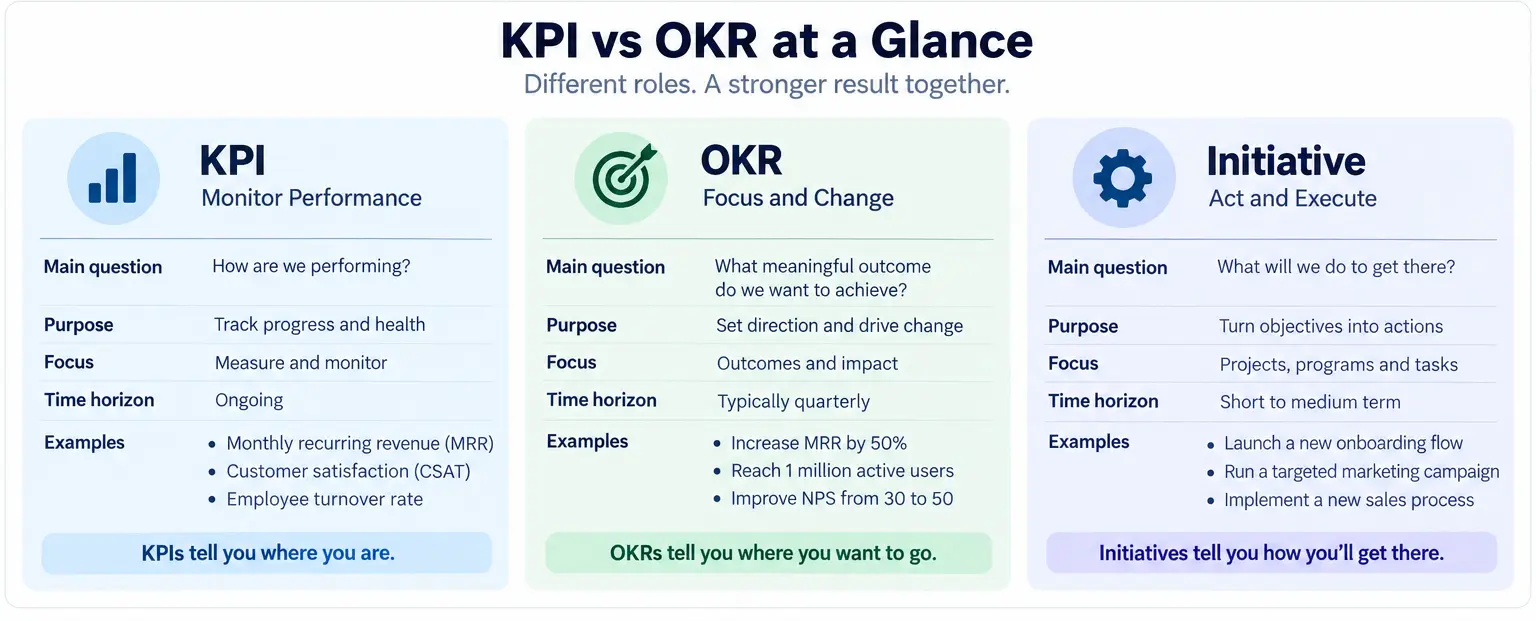
However, the distinction is useful only if it does not become rigid.
In practice, a KPI can measure strategic performance as well as operational performance. Similarly, a metric used as a KPI can sometimes appear within a Key Result when improving that metric becomes strategically important.
KPI vs OKR: What Is a KPI?
In this context, a Key Performance Indicator is a measure considered important enough to help an organization, team or function understand performance against an objective or expected outcome.
For example, KPIs might include:
- Customer churn rate
- Service availability
- Customer satisfaction
- Employee turnover
- On-time delivery rate
- Sales conversion rate
- Project milestone performance
- First-contact resolution
Therefore, the word key matters.
For example, organizations can collect hundreds or thousands of metrics. That does not mean every metric deserves to become a KPI.
Instead, a KPI should help answer a meaningful performance question and ideally influence a decision.
KPI vs Metric: What Is the Difference?
Every KPI is a metric, but not every metric needs to be a KPI.
For example, consider a customer-support operation. It might collect:
- Number of emails received
- Number of user logins
- Tickets created
- Average response time
- First-contact resolution
- Customer satisfaction
All of these can be metrics. Nevertheless, leadership may decide that only a small subset provides enough strategic or operational value to be treated as KPIs.
Therefore, the objective of measurement is not to create bigger dashboards. Instead, it is to improve understanding and decision-making.
What Makes a Good KPI?
1. It Is Relevant
First, the indicator should connect to something that genuinely matters to the organization, customer, project or team.
2. It Is Measurable
Next, the underlying data should be sufficiently reliable and consistently defined to support the intended decision.
3. It Has Context
However, a number without context can easily be misleading.
For example:
Customer churn = 4%
becomes much more useful when it is considered alongside:
- Previous performance
- Target or threshold
- Trend
- Market conditions
- Customer segments
- Business context
4. It Supports Action
Moreover, a good KPI should help someone recognize when further investigation, a decision or corrective action may be necessary.
5. It Has Clear Ownership
Finally, someone should understand and monitor the KPI. Improving it, however, may require several teams working together.
Leading vs Lagging KPIs
Performance indicators can also differ according to when they provide useful information.
Lagging Indicators
In other words, lagging indicators describe outcomes that have already occurred.
Examples can include:
- Revenue
- Customer churn
- Employee turnover
- Project completion rate
- Annual customer retention
Leading Indicators
By contrast, leading indicators attempt to provide earlier information about factors that may influence future outcomes.
The appropriate leading indicator depends strongly on the business context. A useful performance system may therefore combine both leading and lagging measures rather than relying entirely on one category.
KPI vs OKR: What Is an OKR?
OKR stands for Objectives and Key Results.
More specifically, the framework contains two core components:
- Objective: What meaningful outcome or direction do we want to pursue?
- Key Results: What measurable results would demonstrate meaningful progress toward that objective?
In other words, an OKR combines direction with measurable evidence.
Example of an OKR
Objective: Create a faster and more reliable customer-support experience.
Key Result 1: Reduce median first-response time from 6 hours to 2 hours.
Key Result 2: Increase first-contact resolution from 62% to 75%.
And Key Result 3: Reduce the unresolved ticket backlog from 800 to 300.
These values are illustrative examples rather than universal targets. Therefore, real OKRs should use genuine baselines, realistic context and consciously selected levels of ambition.
Objective vs Key Result vs Initiative
This is one of the most important distinctions when designing OKRs.
| Element | Main Question | Example |
|---|---|---|
| Objective | Where do we want to go? | Create a faster customer-support experience |
| Key Result | What measurable result shows progress? | Reduce median response time from 6 hours to 2 hours |
| Initiative | What will we do to influence the result? | Implement automated ticket classification |
In other words, tasks, projects and initiatives should not automatically be treated as Key Results.
A Common OKR Mistake
Weak Key Result:
Launch a new customer dashboard.
The problem is that this primarily describes an output.
A stronger question is:
What measurable customer outcome should the dashboard influence?
The dashboard can then become an initiative supporting a measurable Key Result rather than being treated as the result itself.
KPI vs OKR: 7 Key Differences
1. Purpose
KPIs provide visibility into important dimensions of performance. In contrast, OKRs define a desired direction and measurable results for a priority.
KPI → Monitor
OKR → Focus + Progress
2. Structure
A KPI is an indicator. Meanwhile, an OKR is a goal-management framework containing an Objective and one or more Key Results.
3. Time Horizon
A KPI can remain useful for many years when the underlying performance dimension remains important.
For example, service availability may continue to be monitored for as long as a digital service exists.
OKRs, however, are usually established for defined planning periods and are later reviewed, completed, revised or replaced.
4. Stability
Organizations often benefit from keeping important KPIs sufficiently stable to understand long-term trends.
By comparison, OKRs can change more frequently as priorities and strategic challenges evolve.
5. Relationship to Strategy
Importantly, both KPIs and OKRs can be strategic.
A common oversimplification is:
KPI = Operations
OKR = Strategy
However, this is not necessarily correct.
Customer retention, for example, could be a highly strategic KPI. An OKR could then focus organizational attention on materially improving retention during a particular period.
6. Relationship to Action
A KPI can reveal that performance requires attention. An OKR, meanwhile, can define the improvement the organization wants to achieve. Initiatives then describe the work undertaken to influence those results.
7. Lifecycle
A KPI may continue being monitored after an OKR finishes.
As a result, the two approaches can work particularly well together: an OKR creates temporary focus on improving an outcome while the KPI provides longer-term visibility into whether that improvement is sustained.
KPI vs OKR Examples
| Function | Example KPI | Example Objective | Example Key Result |
|---|---|---|---|
| Customer | Churn rate | Strengthen customer retention | Reduce churn from X% to Y% |
| IT Operations | Service availability | Improve service reliability | Reduce critical incidents from X to Y |
| Projects | On-time milestone rate | Improve delivery predictability | Increase on-time milestones from X% to Y% |
| People | Voluntary turnover | Strengthen employee retention | Reduce regretted attrition from X% to Y% |
| Sales | Conversion rate | Improve sales effectiveness | Increase conversion from X% to Y% |
The X and Y values should be replaced with genuine baselines and targets derived from the organization’s context.
Can a KPI Become a Key Result?
Yes. A metric monitored as a KPI can sometimes also appear within a Key Result.
Imagine that customer churn is continuously monitored as a KPI:
KPI: Customer churn rate
Leadership determines that retention now requires focused strategic attention.
An OKR could become:
Objective: Build a customer experience that strengthens long-term retention.
Key Result: Reduce customer churn from X% to Y% by the end of the cycle.
As a result, the metric did not stop being useful as a KPI. It also became part of a Key Result because changing its performance became an explicit priority.
KPI vs OKR: How They Work Together
In practice, organizations do not necessarily need to choose between KPI and OKR.
A practical relationship is:
KPI Detects → Analyze → OKR Prioritizes → Initiatives Execute → Key Results Measure Progress → KPI Validates
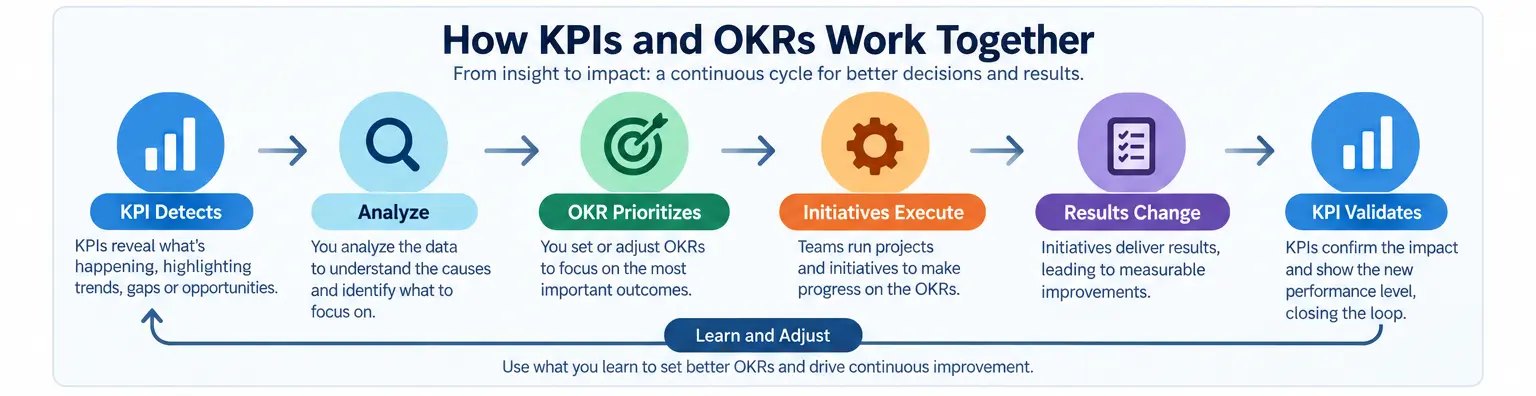
1. Detect the Signal With a KPI
A KPI reveals a meaningful performance pattern.
Example:
Customer response time has been deteriorating.
2. Analyze What Is Driving the Result
Do not automatically create an OKR as soon as a KPI turns red. Investigate first.
Potential causes might include:
- Increasing workload
- Poor ticket routing
- Insufficient knowledge resources
- Complex approval processes
- Resource constraints
Step 3: Define the OKR
If the issue deserves focused attention, define the desired improvement.
Objective: Create a faster and more predictable support experience.
KR1: Reduce median first-response time from X to Y.
KR2: Increase first-contact resolution from X% to Y%.
Step 4: Choose Initiatives
The team determines which actions could influence those results.
- Redesign ticket routing
- Improve knowledge management
- Automate selected triage activities
- Clarify escalation paths
Step 5: Measure Results
Key Results provide evidence about whether the intended progress is occurring. Teams should review progress while there is still enough time to learn, adapt or remove blockers.
Step 6: Continue Monitoring the KPI
After the OKR cycle finishes, the KPI can remain important. Continued monitoring shows whether the improvement was sustained or whether performance begins to deteriorate again.
KPI vs OKR vs Initiative
KPI = Signal
OKR = Direction + Measurable Outcomes
Initiative = Action
Confusing these layers is one of the fastest ways to create a performance system that measures activity rather than meaningful outcomes.
KPI vs OKR: How to Write a Good KPI
Start with the business question rather than starting with the metric.
A useful sequence is:
Objective → Success Factor → Indicator → Definition → Baseline → Target/Threshold → Owner → Review
Step 1: Define the Objective
What business, customer, operational or project outcome actually matters?
Step 2: Identify the Critical Performance Dimension
What aspect of performance would provide meaningful evidence about that outcome?
Step 3: Select the Indicator
Choose a measure that represents that performance dimension reasonably well and can be supported by trustworthy data.
Step 4: Define the KPI Precisely
Document at least:
- KPI name
- Definition
- Formula
- Data source
- Measurement frequency
- Owner
- Baseline
- Target or threshold where appropriate
Step 5: Review Its Usefulness
Ask:
- Does the KPI influence decisions?
- Do stakeholders understand it?
- Is the data sufficiently reliable?
- Does it still connect to something important?
- Could the measure create unintended behavior?
If nobody uses the KPI to understand performance or make decisions, reconsider why it is being measured.
KPI vs OKR: How to Write a Good OKR
A useful OKR connects meaningful direction with measurable evidence.
A simple lifecycle is:
Objective → Key Results → Initiatives → Check-ins → Review → Learning
Step 1: Write the Objective
The Objective should communicate the desired direction clearly enough that people understand why it matters.
Weak: Customer support project.
Better: Create a customer-support experience that is fast, predictable and easy to use.
Step 2: Define Measurable Key Results
Ask:
What evidence would convince us that meaningful progress occurred?
For example:
- Reduce median first-response time from X to Y
- Increase first-contact resolution from X% to Y%
- Reduce unresolved backlog from X to Y
Step 3: Separate Initiatives
Do not transform Key Results into a project task list. Activities, deliverables and projects belong under initiatives.
Step 4: Review Progress
Review progress often enough to identify:
- Progress
- Blockers
- Changed assumptions
- Dependencies
- Risks
- Required decisions
The appropriate cadence depends on the length and nature of the OKR cycle.
Bad OKR vs Better OKR
Example 1: Training
Weak Objective: Improve skills.
Weak Key Result: Deliver 10 training sessions.
The Key Result measures activity rather than the impact of learning.
Better Objective: Strengthen the team’s ability to manage cloud operations independently.
Key Results could then measure demonstrated capability, resolution effectiveness, reduced escalation or another outcome relevant to the organization.
Example 2: Digital Transformation
Weak Key Result: Implement a new workflow platform.
That primarily describes a deliverable.
A stronger Key Result could measure:
- Cycle-time reduction
- Error reduction
- Adoption
- Customer outcomes
- Employee experience
The workflow platform then becomes an initiative supporting those results.
How Many KPIs Should You Have?
There is no universal number of KPIs that works for every organization.
Instead, the appropriate number depends on factors such as:
- Organizational level
- Complexity
- Strategy
- Decision-making needs
- Team responsibilities
The principle is more useful than an arbitrary number:
If a dashboard contains dozens of indicators, separate them into:
- KPIs
- Supporting metrics
- Diagnostic metrics
How Many OKRs Should You Have?
Likewise, there is no universal answer for OKRs.
Focus is one of the main reasons organizations adopt the framework. Therefore, creating too many simultaneous objectives can weaken its value.
Ask:
Can the team genuinely explain, remember and prioritize all of these objectives?
If everything becomes an OKR, the framework may no longer be helping the organization make meaningful choices.
Should Every KPI Have an OKR?
No.
A KPI can simply indicate that an important process or outcome is healthy and does not currently require focused intervention.
For example:
KPI → Service availability is healthy.
No related OKR may be necessary.
Another KPI could reveal an important issue:
KPI → Customer retention is deteriorating.
That may justify focused analysis and potentially an OKR.
Use OKRs for priorities, not for every measurement on the dashboard.
Should Every OKR Have a KPI?
Not necessarily as a separate, permanent KPI.
Every Key Result should be measurable. However, that does not mean every measure used inside an OKR should become an ongoing organizational KPI.
Some measurements are useful only during a particular strategic cycle.
Can OKRs Replace KPIs?
In most cases, this is the wrong question.
Because KPIs and OKRs perform different functions, organizations can benefit from using both.
- KPIs provide ongoing performance visibility.
- OKRs create structured focus around desired progress.
Therefore, they overlap in measurement but differ in purpose and structure.
Can KPIs Replace OKRs?
An organization can certainly manage performance without formally adopting the OKR framework.
After all, OKRs are one approach to goal setting and strategy execution, not a mandatory management system.
The more important question is whether the organization’s chosen approach creates:
- Clarity
- Focus
- Alignment
- Measurability
- Accountability
- Learning
Should OKRs Always Be Stretch Goals?
Not necessarily.
Organizations may distinguish between highly ambitious or aspirational OKRs and committed goals that are expected to be achieved.
For this reason, rules such as “70% achievement always means success” should not be treated as universal.
Instead, interpretation depends on:
- The type of OKR
- The organization’s operating model
- The level of ambition
- How the target was established
- The context in which results were achieved
Therefore, define the scoring philosophy before evaluating performance.
Should OKRs Be Connected to Compensation?
This requires careful design rather than a universal yes-or-no answer.
Connecting highly ambitious goals too directly to individual compensation can potentially create incentives to select easier targets, avoid experimentation or manipulate measurements.
Ask:
- Will people choose easier targets?
- Could collaboration suffer?
- Could metrics be manipulated?
- Will employees avoid appropriate experimentation?
Performance systems should encourage the behaviors the organization actually wants.
KPI vs OKR in Project Management
Similarly, projects can use both performance indicators and outcome-oriented goals.
Project KPIs might monitor:
- Milestone performance
- Budget variance
- Defect trends
- Risk exposure
- Delivery predictability
- Quality or service outcomes
An OKR could instead focus on an important improvement in how projects are delivered.
Objective: Make project delivery more predictable and transparent.
KR1: Increase on-time milestone completion from X% to Y%.
KR2: Reduce unresolved critical dependencies from X to Y.
Performance management is only part of the project-governance picture. Responsibilities must also be explicit. Our RACI Matrix guide explains how Responsible, Accountable, Consulted and Informed roles clarify project ownership.
KPI vs OKR in Agile and SAFe Environments
Agile delivery does not eliminate the need for strategic objectives or performance measurement.
Teams still need to understand:
- Desired outcomes
- Value
- Quality
- Flow
- Customer impact
However, teams should avoid turning every Agile metric into a KPI or using measures in ways that encourage counterproductive behavior.
For broader context, see our What Is Agile? guide.
For enterprise-level alignment, our SAFe PI Planning guide explains Planning Intervals, PI Objectives, dependencies, risks, alignment and the ART Planning Board.
KPI vs OKR in Workforce Transformation
Transformation programs often need both stable indicators and time-bound improvement goals.
Workforce KPIs could monitor:
- Turnover
- Internal mobility
- Critical skill coverage
- Time to fill roles
- Capability gaps
An OKR could then focus on building an important future capability.
Objective: Build stronger internal capability for AI-enabled operations.
Key Results should describe measurable changes in capability or outcomes rather than simply counting training sessions.
See our Workforce Transformation guide for a broader approach to skills, AI and the future of work.
KPI vs OKR in Leadership
Leadership matters because performance frameworks influence behavior.
Leaders should avoid using dashboards simply to demand explanations whenever a number turns red.
A healthier performance cycle is:
Our Modern Leadership guide explores leadership, communication, accountability and decision-making in changing organizations.
KPI vs OKR Dashboard: How to Build One
A useful dashboard should preserve the distinction between performance monitoring and strategic priorities. If you want to turn those measures into a practical reporting view, our Excel dashboard guide shows how to combine KPIs, charts, PivotTables, slicers and filters in one interactive workbook.
KPI Section
For each important KPI, consider displaying:
- Name
- Current value
- Baseline
- Target or threshold
- Trend
- Owner
- Last update
OKR Section
For each OKR, consider displaying:
- Objective
- Key Results
- Baseline
- Target
- Current progress
- Owner
- Confidence or status where useful
- Major blockers
Connect Them Where Useful
If an OKR exists partly because an important KPI needs improvement, make that relationship visible.
However, do not duplicate every measurement across both sections simply for consistency.
KPI vs OKR Review Cadence: How Often?
There is no universal review frequency.
The appropriate cadence depends on how quickly underlying performance can change and how often decisions need to be made.
A digital-service operational KPI may require frequent monitoring. A strategic workforce indicator may move much more slowly.
OKR progress should be reviewed often enough for teams to identify blockers and make useful decisions before the cycle finishes.
Do not automatically review every metric at exactly the same cadence.
Common KPI Mistakes
Tracking Too Many KPIs
If everything is key, nothing is key.
Measuring What Is Easy Instead of What Matters
Available data is not automatically useful data.
No Clear Definition
Different teams may calculate the same KPI differently unless its definition and formula are documented.
No Owner
Someone needs to understand and monitor important performance indicators.
No Action
A KPI that never influences understanding or decisions may simply create reporting overhead.
Common OKR Mistakes
Turning Tasks Into Key Results
“Launch the new portal” describes an output more than an outcome.
Creating Too Many Objectives
OKRs should support focus rather than recreate the organization’s complete task list.
No Baseline
Improvement is difficult to evaluate without understanding the starting point.
Using Vague Key Results
“Improve customer satisfaction significantly” does not define measurable success.
Changing the Goal Whenever Progress Becomes Difficult
Adaptation can be appropriate, but repeatedly moving targets can destroy accountability and make learning difficult.
Ignoring Learning
A missed Key Result can still reveal valuable information about assumptions, dependencies, constraints and execution.
Common KPI and OKR System Mistakes
- Confusing KPIs with OKRs
- Confusing Key Results with initiatives
- Using arbitrary targets
- Creating metrics without reliable data
- Ignoring unintended behavior
- Using the same cadence for every metric
- Focusing on reporting instead of decisions
- Creating goals without ownership
- Measuring activity instead of outcomes
How AI Can Support KPI and OKR Management
Artificial intelligence can assist with selected parts of performance management when organizations have appropriate data, governance and human oversight.
Potential applications include:
- Summarizing performance reports
- Identifying patterns in metrics
- Drafting management commentary
- Highlighting anomalies for investigation
- Organizing information from multiple sources
- Supporting scenario analysis
- Comparing trends across reporting periods
- Preparing first drafts of executive summaries
However, AI should not determine strategy simply because it can process large amounts of information.
Instead, human judgment remains essential for:
- Choosing what matters
- Understanding context
- Setting priorities
- Evaluating trade-offs
- Managing accountability
- Making decisions
For a broader view of how artificial intelligence can support planning, risk analysis, reporting and project decision-making, see our AI in Project Management guide.
A Practical KPI + OKR Implementation Framework
Organizations introducing or redesigning their performance-management system can use this sequence:
1. Start With Strategy
What actually matters to the organization?
2. Define Important Outcomes
What does success look like for customers, employees, operations or the business?
3. Select KPIs
Which small set of indicators provides meaningful visibility into those outcomes?
4. Establish Baselines
What is current performance?
5. Identify Priorities
Which performance gaps or strategic opportunities deserve focused attention now?
6. Define OKRs
What outcome do we want, and which measurable results would demonstrate meaningful progress?
7. Choose Initiatives
What work could influence those Key Results?
8. Review
Are results moving? What is blocking progress? Have assumptions changed?
9. Learn
What should be sustained, changed, scaled or stopped?
KPI vs OKR Decision Guide
Use a KPI when you need to:
- Monitor important performance
- Understand trends
- Detect deviation
- Maintain ongoing visibility
Use an OKR when you need to:
- Clarify an important objective
- Create strategic focus
- Define measurable desired progress
- Align people around an outcome
You can Use both when KPIs reveal meaningful opportunities or problems that deserve focused improvement while ongoing performance visibility remains important.
10-Minute KPI vs OKR Fit Check
Use this quick review on one real performance issue before creating another dashboard metric or another objective.
- Minutes 0–2 — Define the question. Are you trying to monitor ongoing performance, improve a priority outcome, or both?
- Minutes 2–4 — Check the evidence. Identify the baseline, trend and data source. If the measure is not reliable enough to support a decision, fix the measurement first.
- Minutes 4–6 — Test strategic importance. Ask whether the issue deserves focused attention now or simply continued monitoring.
- Minutes 6–8 — Separate result from action. Define the outcome you want to change, then keep projects and tasks as initiatives rather than turning them into Key Results.
- Minutes 8–10 — Assign ownership and cadence. Name the owner, define when progress will be reviewed and choose the evidence that will trigger a decision.
Decision outputs: KPI ONLY when ongoing visibility is the main need; OKR when a priority outcome needs focused improvement; KPI + OKR when continuous monitoring and time-bound improvement should work together; or FIX MEASUREMENT FIRST when the data, definition or baseline is not reliable enough.
Frequently Asked Questions About KPI vs OKR
What Is the Main Difference Between KPI and OKR?
A KPI is an important performance indicator. An OKR combines an Objective with measurable Key Results describing desired progress. KPIs primarily provide performance visibility, while OKRs provide structured direction and measurable outcomes.
Can KPIs and OKRs Be Used Together?
Yes. A KPI can reveal an important performance trend, an OKR can focus attention on improving an outcome, initiatives can influence the Key Results, and the KPI can continue monitoring performance afterward.
Can a KPI Be a Key Result?
A metric monitored as a KPI can also be included within a Key Result when changing that metric becomes an explicit priority. The KPI and Key Result still serve different management purposes.
Can OKRs Replace KPIs?
They do not need to. KPIs and OKRs perform different but potentially complementary functions. KPIs can provide ongoing visibility while OKRs focus teams on specific desired progress.
What Is an Example of KPI vs OKR?
A customer-support KPI might be first-response time. An OKR could have the Objective “Create a faster support experience” with a Key Result that reduces median first-response time from a genuine baseline to a defined target.
What Is the Difference Between a Key Result and an Initiative?
A Key Result measures an outcome or evidence of progress. An initiative describes work undertaken to influence that result. Reducing response time is a result; implementing automated ticket routing is an initiative.
Are OKRs Always Quarterly?
No. Quarterly cycles are common, but organizations can choose planning periods appropriate to their operating environment and strategy.
Should Every KPI Have a Target?
Targets or thresholds can make KPIs easier to interpret, but the appropriate design depends on the indicator. Some measures may primarily be used for trend monitoring or diagnostic purposes.
How Many KPIs Should a Company Have?
There is no universal number. Organizations should distinguish truly key indicators from supporting metrics and avoid labeling every available measurement as a KPI.
How Many OKRs Should a Team Have?
There is no number that works for every team. The important principle is focus. Too many simultaneous objectives can weaken prioritization and make the framework less useful.
Should OKRs Be Linked to Employee Compensation?
Organizations should evaluate this carefully. Strong direct links between ambitious goals and compensation can influence target-setting and behavior. The appropriate model depends on the organization’s wider performance-management approach.
Is KPI or OKR Better?
Neither is universally better. Use KPIs when you need ongoing performance visibility, OKRs when you need structured focus around desired outcomes, and both when their functions complement each other.
Conclusion: KPI vs OKR Is Not an Either-Or Choice
The most important lesson from the KPI vs OKR comparison is that the two approaches solve different management problems.
A KPI tells you something important about performance.
An OKR tells you what meaningful outcome you want to achieve and which measurable results would demonstrate progress.
An initiative describes what you plan to do about it.
Put together:
That relationship is more useful than asking whether KPIs or OKRs are “better.”
- Start with strategy.
- Choose only indicators that genuinely matter.
- Use OKRs to create focus where meaningful progress is required.
- Separate outcomes from activities.
- Review performance at a cadence that supports decisions.
- Use measurement to learn, not simply to report.
The purpose of performance measurement is not to build bigger dashboards. It is to understand performance, make better decisions and create better outcomes.
Choosing and interpreting performance measures is also easier with a clear understanding of revenue, cost, margin, cash flow and investment. Our Finance for Non-Finance Professionals guide explains these foundations for managers.
Continue Learning
Explore related TechTeamSynergy guides to strengthen project governance, strategic alignment and performance management.
Comments are closed.