
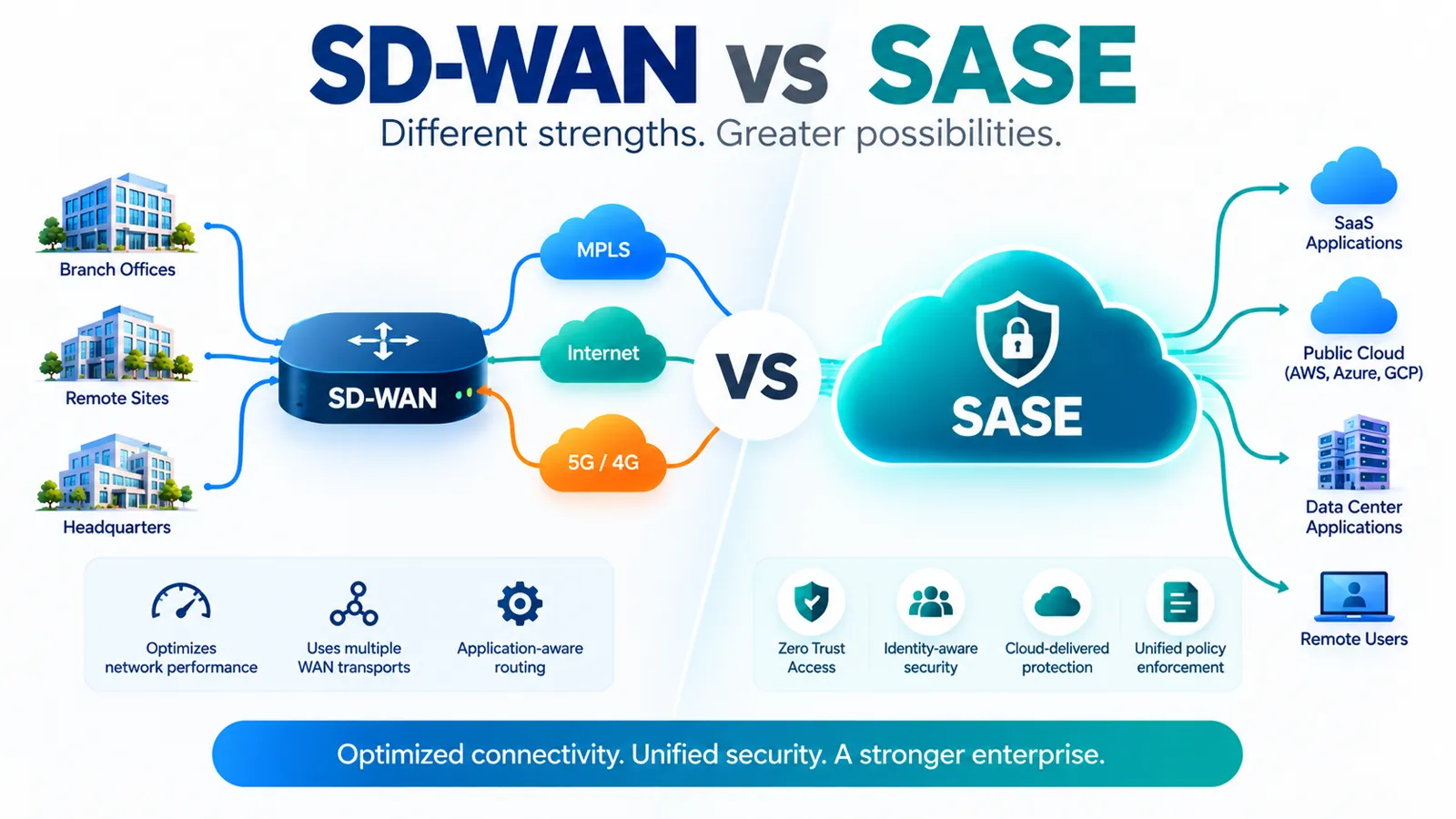
SD-WAN vs SASE is often framed as a technology comparison, but the two are not direct substitutes. SD-WAN primarily improves how enterprise sites connect to applications across multiple WAN transports. SASE is a broader architecture that combines networking with cloud-delivered security, identity-aware access and policy enforcement.
For many enterprises, the practical question is therefore not simply “SD-WAN or SASE?” It is where each capability fits, what problem it solves, and whether the organization needs one, the other, or both.
If you are new to the technologies, start with our complete guide to SD-WAN and our explanation of what SASE is and how it works. From a standards perspective, MEF 70.2 defines SD-WAN service concepts and attributes, while MEF 117 defines a SASE service framework that brings together security functions, policies and connectivity services.
Short answer: SD-WAN optimizes WAN connectivity. SASE converges connectivity and security for users, devices, branches and applications. A distributed enterprise with both branch connectivity and cloud-access requirements may need SD-WAN + SASE.
SD-WAN vs SASE at a Glance
The easiest way to understand the difference is to compare the problem each architecture is designed to solve.
| Dimension | SD-WAN | SASE |
|---|---|---|
| Primary purpose | WAN connectivity, path selection and application performance | Secure access plus networking |
| Main focus | Sites, branches and WAN paths | Users, devices, branches, applications and resources |
| Routing | Core capability | Part of the broader connectivity layer |
| Security | May include integrated security features | Security is fundamental to the architecture |
| Identity | Usually secondary to routing and network policy | Central to access decisions |
| Cloud delivery | Vendor and design dependent | Core architectural characteristic |
| Remote users | Not the primary design center | Major use case |
| Zero Trust alignment | Not inherent | Strongly aligned |
| SSE functions | Not core | Common security component |
| Best fit | Branch and WAN transformation | Distributed users, cloud and SaaS access |
| Relationship | Can operate independently | May incorporate or work alongside SD-WAN |
What Is SD-WAN?
Software-defined wide area networking creates a policy-driven overlay across one or more underlay networks such as MPLS, broadband Internet, dedicated Internet access and cellular connectivity. Instead of treating every path identically, the SD-WAN platform can steer application traffic according to business policy, link conditions and application requirements.
Typical SD-WAN capabilities include:
- centralized WAN policy;
- application-aware path selection;
- multi-transport connectivity;
- branch resilience and failover;
- performance monitoring;
- segmentation;
- simplified branch operations.
For example, a business-critical application may use a high-quality private path when available, while SaaS traffic exits directly over broadband Internet. If the preferred path degrades, the SD-WAN edge can steer traffic to another available transport according to policy.
MEF 70.2 is useful here because it distinguishes the SD-WAN service from the underlay connectivity over which that service operates. In practical terms, SD-WAN does not eliminate transport networks. It adds an intelligent service layer above them.
What Is SASE?
Secure Access Service Edge is a broader architecture for delivering secure access and connectivity to distributed users, devices, branches and applications. Instead of forcing every user or branch back through a central data-center security stack, policy and security functions can be delivered closer to where access occurs.
Typical SASE designs combine networking capabilities with cloud-delivered security services. Depending on the implementation, these can include secure web access, Zero Trust Network Access, cloud access controls, firewall capabilities, threat protection, data protection and policy enforcement.
The important shift is from a purely network-centric model toward a model that also considers who the user is, what device is being used, what resource is being accessed, and under what context.
What Is the Real Difference Between SD-WAN and SASE?
1. Connectivity vs Connectivity + Security
SD-WAN is primarily a connectivity architecture. It helps enterprises choose paths, optimize traffic and operate WAN services more dynamically.
SASE extends beyond connectivity. It also addresses secure access, security policy and enforcement for users, devices and applications.
This does not mean SD-WAN is insecure. Modern SD-WAN platforms can include encryption, segmentation, firewall functionality and other security features. However, the presence of security functions inside an SD-WAN product does not automatically make the deployment a complete SASE architecture.
2. Site-Centric vs User-and-Resource-Centric Access
Traditional SD-WAN discussions are often branch-centric: a branch edge chooses the best path to a data center, SaaS application or cloud workload.
SASE expands the scope. A remote employee, contractor, mobile device or branch user may all need policy-controlled access to a SaaS application, private application, cloud environment or Internet resource.
3. Network Policy vs Identity-Aware Policy
SD-WAN policies commonly focus on applications, paths, network segments, performance thresholds and routing behavior.
SASE policies can also incorporate identity, device posture, application sensitivity, user context and access conditions. As a result, the access decision can become more granular than a traditional “inside network versus outside network” model.
4. Overlay Architecture vs Distributed Security Enforcement
SD-WAN creates an intelligent overlay across WAN transports. SASE adds distributed security enforcement, often through cloud points of presence or other service-delivery locations.
Consequently, the architectural question changes from “which network path should this packet use?” to a broader question: “should this user or device be allowed to access this resource, through which path, and under which security policy?”
SD-WAN vs SASE Architecture
A simplified SD-WAN flow can be represented as:
Branch → SD-WAN Edge → Selected WAN Path → Application
Possible underlays: MPLS / Internet / Broadband / 4G / 5G
A simplified SASE flow looks different:
User / Device / Branch → SASE Enforcement → Security + Policy → Application
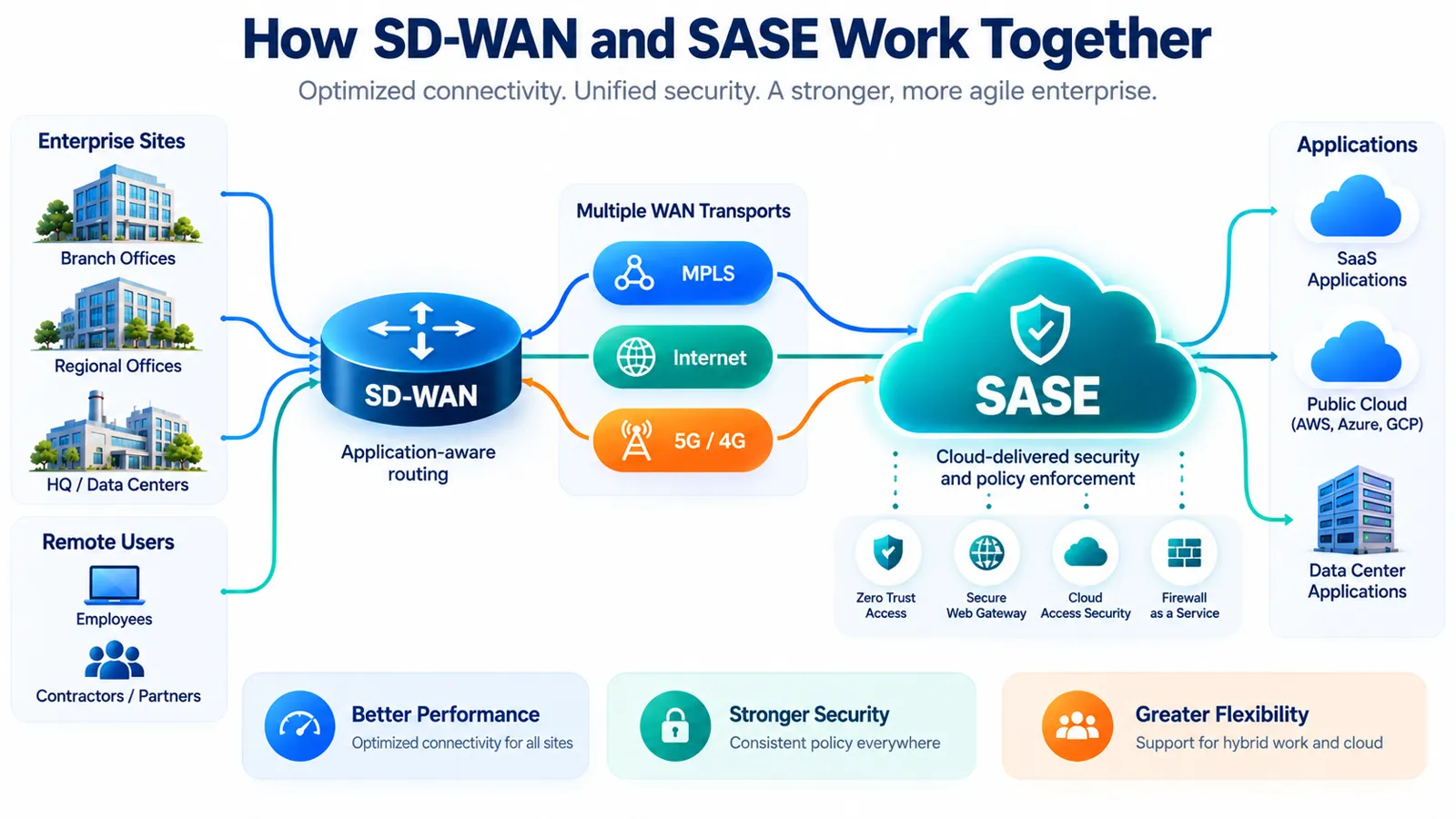
When both are used together, the branch architecture may look like this:
Branch → SD-WAN → SASE PoP / Enforcement → SaaS / Cloud / Data Center
Here, SD-WAN optimizes branch connectivity and path selection, while the SASE layer applies security and access policy before traffic reaches the destination.
Where SSE Fits: SD-WAN vs SSE vs SASE
Security Service Edge, or SSE, is another term that often appears in the same discussion.
A useful simplified model is:
- SD-WAN = connectivity
- SSE = cloud-delivered security services
- SASE = convergence of networking and security
This model is intentionally simplified, but it helps distinguish the roles. SSE focuses on protecting access to web, cloud and private applications. SASE combines that security model with networking and connectivity services.
Therefore, an enterprise may start with SD-WAN for branch transformation, adopt SSE for distributed security and gradually converge the two into a broader SASE operating model.
Zero Trust: Why It Matters to SASE
Zero Trust and SASE are related, but they are not synonyms.
NIST SP 800-207 explains that Zero Trust shifts security away from implicit trust based on network location and toward users, devices, assets and resources. Authentication and authorization are evaluated before access to an enterprise resource is established.
That principle aligns naturally with SASE because SASE policies can consider identity, device context and the requested resource instead of relying only on whether traffic originated from a trusted branch network.
Identity → Device Context → Policy → Access Decision → Resource
However, deploying SASE does not automatically mean an enterprise has implemented a complete Zero Trust architecture. Zero Trust is a broader security strategy that also depends on identity, governance, telemetry, asset management and policy design.
When SD-WAN Alone May Be Enough
SD-WAN may be sufficient when the enterprise problem is primarily a WAN problem.
- improving branch connectivity;
- reducing dependence on a single WAN transport;
- combining Internet, MPLS and cellular services;
- improving application-aware path selection;
- simplifying WAN operations;
- building resilient hybrid WAN connectivity;
- supporting direct cloud and SaaS access where an existing security architecture already provides adequate protection.
This is especially relevant for enterprises modernizing traditional branch networks. See our comparison of SD-WAN vs traditional WAN and our analysis of whether MPLS is really dead.
When SASE Makes More Sense
SASE becomes more compelling when connectivity is only part of the challenge.
- employees work from many locations;
- SaaS and public cloud applications are dominant;
- remote-access VPN architecture is difficult to scale or operate;
- security policy must follow users and devices rather than physical locations;
- the organization needs stronger identity-aware access controls;
- branch and remote-user security should be managed consistently;
- Internet traffic no longer needs to backhaul through a central data center.
If remote access is a major concern, our VPN vs SASE comparison explains where traditional VPN access still fits and where SASE provides a broader model.
When You Need Both SD-WAN and SASE
For many distributed enterprises, the strongest answer to SD-WAN vs SASE is both.
Consider a company with:
- 50 branch offices;
- remote and hybrid employees;
- Microsoft 365 and other SaaS applications;
- private applications hosted in data centers;
- AWS or Azure workloads;
- Internet and MPLS connectivity;
- external contractors and partners.
SD-WAN can optimize how branches reach applications. SASE can apply consistent security and access policy to branch users, remote users and devices regardless of location.
The combination therefore addresses two different questions:
- SD-WAN: What is the best way to transport this traffic?
- SASE: Should this user or device be allowed to access this resource, and under which security controls?
Used together, the result is a more complete architecture for distributed enterprise access.
Practical Example: A Global Enterprise
Imagine a company with 40 branches, two data centers, Microsoft 365, public-cloud workloads, remote employees and external contractors.
Before Transformation
The original architecture may route branch traffic over MPLS to centralized firewalls before reaching the Internet:
Branch → MPLS → Data Center Firewall → Internet / SaaS
This model can work, but it may add latency for cloud applications and make the data center a dependency for Internet access.
Phase 1: Introduce SD-WAN
The company adds broadband Internet alongside MPLS and deploys SD-WAN at branches.
Now the SD-WAN policy can choose between transports based on application requirements and path quality.
Phase 2: Enable Direct Internet Access
Microsoft 365 and selected SaaS applications can use local Internet access rather than backhauling through the data center.
Performance improves, but a new question appears: how should security policy be enforced consistently across all branches and remote users?
Phase 3: Add SASE / SSE Capabilities
The company introduces cloud-delivered security and identity-aware access. Branch Internet traffic can pass through SASE enforcement, while remote users connect directly to the same security service.
The resulting design separates responsibilities clearly:
- SD-WAN optimizes branch transport and path selection;
- SASE applies access and security policy;
- identity systems provide user and device context;
- applications can reside in SaaS, public cloud or private infrastructure.
A Practical Migration Path from Traditional WAN to SASE
There is no single mandatory migration sequence. However, one common path is:
Traditional WAN → Hybrid WAN → SD-WAN → SSE / Cloud Security → SASE Operating Model
The exact order depends on business priorities. An organization with a major branch-connectivity problem may start with SD-WAN. A company dominated by remote users and SaaS may begin with SSE or Zero Trust access before changing its branch WAN.
Therefore, the migration roadmap should follow business and security requirements rather than a vendor product sequence.
SD-WAN vs SASE Decision Framework
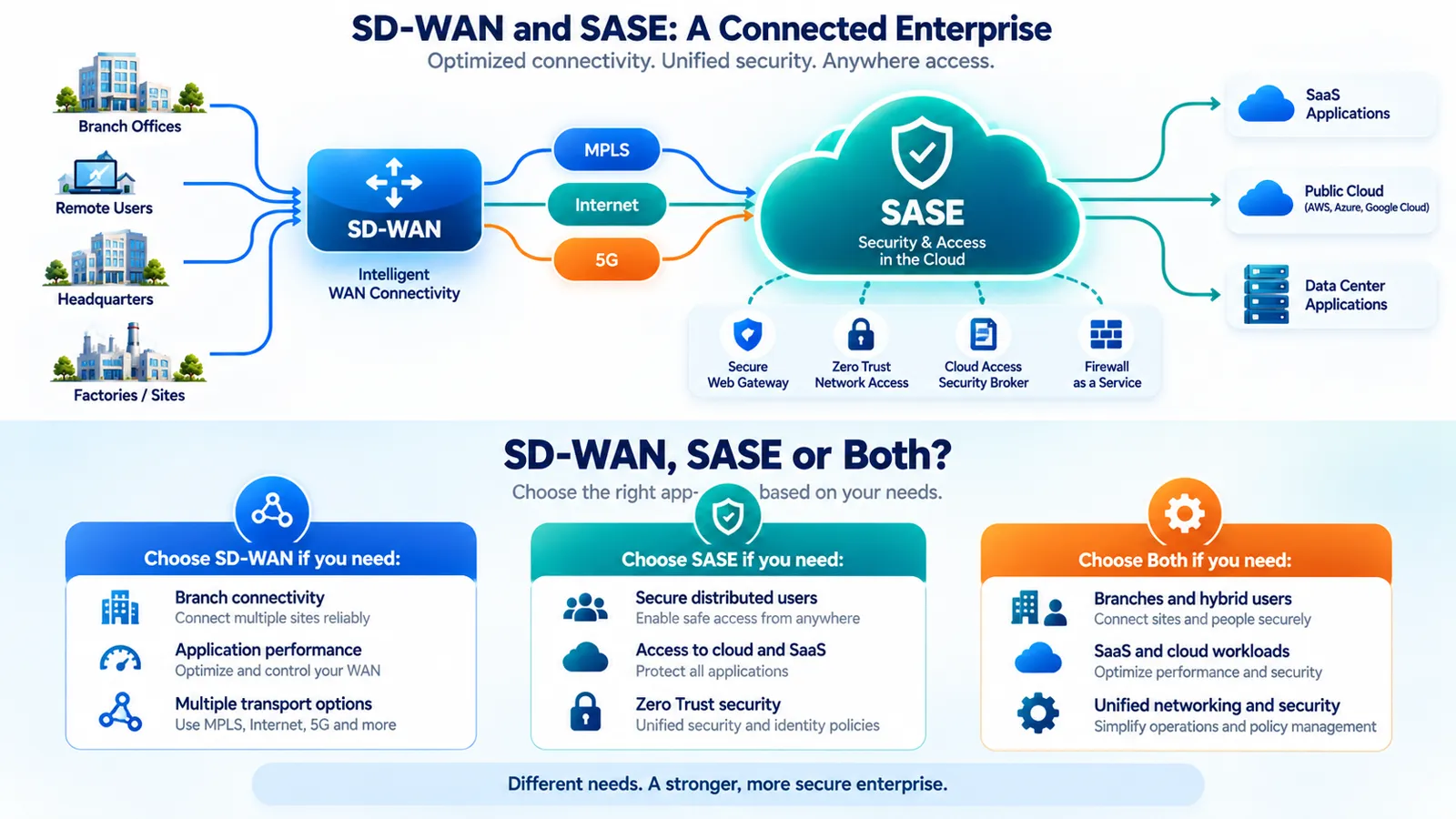
Use the following questions as a simple decision guide.
Is your main problem branch connectivity, path diversity or application performance?
→ Start with SD-WAN.
Is your main problem secure access for distributed users, devices and cloud applications?
→ Evaluate SASE / SSE.
Do you have branches, remote users, SaaS, cloud workloads and multiple WAN transports?
→ A combined SD-WAN + SASE architecture may be the best fit.
Can SASE Replace SD-WAN?
Sometimes a SASE offering includes SD-WAN capabilities, but SASE does not make WAN connectivity requirements disappear.
A branch still needs physical or logical connectivity to reach applications and security services. That may involve Internet, MPLS, Ethernet, 5G or another transport. SD-WAN can remain the technology that intelligently controls how those branch paths are used.
Therefore, the more accurate question is not whether SASE “replaces” SD-WAN. It is whether the SASE solution already includes the SD-WAN functionality the enterprise requires, or whether the organization will integrate separate networking and security platforms.
Operational Considerations Before Combining SD-WAN and SASE
Ownership
SD-WAN is often led by network teams, while SASE crosses network, security, identity and cloud responsibilities. The organization should define who owns architecture, policy and incident handling.
Policy Governance
Routing policy and access-control policy are different. A change that improves application performance may have security implications, while a security change may alter the traffic path. Governance should cover both.
Observability
Operations teams need visibility across network performance, user identity, application behavior and security events. Otherwise, troubleshooting becomes fragmented across multiple tools.
Vendor Model
Some organizations prefer a single-vendor SASE architecture. Others integrate SD-WAN and security platforms from different vendors. The right choice depends on operational skills, integration quality, commercial strategy and architectural requirements.
Managed vs Self-Managed Operations
The enterprise also needs to decide who operates the environment. Some teams retain direct control, while others use a provider for monitoring, incident handling and lifecycle operations. Our guide to SD-WAN vs Managed SD-WAN explains the operating-model trade-offs in more detail.
SD-WAN vs SASE: Frequently Asked Questions
Is SASE the same as SD-WAN?
No. SD-WAN primarily optimizes WAN connectivity and traffic steering. SASE is broader and combines networking with cloud-delivered security and policy-based access.
Does SASE include SD-WAN?
Many SASE architectures include SD-WAN capabilities, especially for branch connectivity. However, implementations differ, so enterprises should verify which networking functions are actually included.
Is SD-WAN part of SASE?
SD-WAN can be an important connectivity component within a SASE architecture, particularly for branch-heavy enterprises.
Can SASE replace SD-WAN?
Not automatically. If a SASE solution already provides the required SD-WAN capabilities, separate SD-WAN infrastructure may not be necessary. Otherwise, SD-WAN and SASE can operate together.
What is the difference between SD-WAN and SSE?
SD-WAN focuses on connectivity and traffic steering. SSE focuses on cloud-delivered security for access to web, cloud and private applications. SASE brings networking and security together in a broader architecture.
Do I need SASE if I already have SD-WAN?
Not necessarily. If your current security architecture already addresses users, devices, Internet access and cloud applications effectively, SD-WAN may be enough. SASE becomes more relevant when access and security must be delivered consistently across branches, remote users and cloud resources.
Is SASE better than SD-WAN?
They solve different problems, so “better” is not the right comparison. SD-WAN is better suited to WAN optimization; SASE addresses a broader secure-access architecture.
Can SD-WAN work without SASE?
Yes. SD-WAN can operate independently with existing enterprise security controls. Whether SASE is required depends on the organization’s users, applications, security model and cloud strategy.
Conclusion: SD-WAN, SASE or Both?
The simplest way to remember the relationship is:
- SD-WAN = optimize connectivity
- SASE = converge secure access and networking
- SD-WAN + SASE = strong fit for distributed enterprises with branches, cloud applications and hybrid users
SD-WAN remains valuable because enterprises still need resilient, policy-driven connectivity. SASE expands the architecture by adding identity-aware, cloud-delivered security and access controls.
For a branch-heavy enterprise, SD-WAN may be the starting point. For a cloud-first workforce, SASE may be more urgent. And for organizations operating both distributed sites and distributed users, the answer is often a coordinated architecture that uses both.
Continue Learning
Continue exploring the TechTeamSynergy enterprise networking cluster with these related guides:
Understand SD-WAN architecture, underlays, overlays, traffic steering and enterprise use cases.
Explore SASE architecture, SSE, Zero Trust and cloud-delivered security in more depth.
Compare traditional VPN access with a broader SASE approach for distributed users and applications.
See how enterprise networking is evolving from MPLS and SD-WAN toward SASE and more converged architectures.