Part 1: Introduction & The Waterfall Foundation
1.0 Introduction: Understanding Sequential Project Management
Project management methodologies dictate the structure, flow, and governance of a project life cycle. While the contemporary landscape is often dominated by adaptive frameworks like Agile, predictive, sequential models—specifically the Waterfall methodology and the V-Model (Cycle V)—remain essential tools, particularly in highly regulated or safety-critical industries.
Understanding these models is not merely an exercise in historical project management; it is crucial for knowing when to apply a linear approach and how to manage the inherent risks associated with fixed requirements. The successful execution of a project often hinges on selecting the right structure from the available Project Management Standards and Best Practices.
This comprehensive guide will define, dissect, and compare the foundational Waterfall model with its robust successor, the V-Model. For a deeper, specialized look at how the V-Model specifically structures validation and testing, consult a Detailed V-Model Process Explanation. Together, these two sequential models offer a powerful, document-driven framework for delivering predictable outcomes.
1.1 The Classic Waterfall Methodology (The Cascade Model)
The Waterfall methodology is arguably the oldest and most straightforward approach to project management. It is often referred to as the Cascade model because of its fundamental structure: progress flows steadily downwards (like a waterfall) through clearly defined phases.
- Core Philosophy: The key principle is that work must be completed and reviewed in one phase before proceeding to the next. There is little or no opportunity to go back to a prior phase without significant cost and scope impact.
- Historical Context: While not officially named ‘Waterfall’ by its initial proponent, the model was formalized by computer scientist Winston W. Royce in 1970, who presented it as a sequential model for software development. Ironically, Royce himself recognized the inherent flaws (mainly the late detection of defects) and proposed a more iterative approach, though the original sequential diagram is what stuck.
- The Linear Approach: This methodology thrives on fixed requirements. Scope, timeline, and budget are typically defined and locked down entirely at the beginning of the project. This makes it an ideal fit for projects where requirements are stable, well-understood, and unlikely to change.
1.2 The Traditional Phases of the Waterfall Model
The classic Waterfall structure breaks the project life cycle into distinct, non-overlapping stages. Successful execution hinges on the quality of the deliverables at the end of each stage.
1.2.1 Phase 1: Requirements Gathering and Analysis (The Foundation)
This is arguably the most critical stage. All stakeholder needs, functional requirements, and non-functional requirements must be completely documented and validated. The output is typically a Software Requirement Specification (SRS) or Business Requirements Document (BRD).
- Key Activity: Intensive stakeholder workshops, documentation, and sign-off.
- Risk: Any misunderstood or undocumented requirement will become a costly error later in the cycle.
- Internal Link Opportunity: For teams struggling with this initial step, learning 5 Effective Techniques for Requirements Elicitation and Documentation is crucial for Waterfall success.
1.2.2 Phase 2: System/Software Design
Once requirements are finalized, the project team designs the technical architecture. This stage is split into two primary activities:
- High-Level Design (HLD): Defines the overall system architecture, including major components, interfaces, and database structure.
- Low-Level Design (LLD): Focuses on the internal logic of individual modules, class design, data structure, and algorithms.
- Deliverable: Design documents that act as a blueprint for the development team.
1.2.3 Phase 3: Implementation and Coding
The design specifications are translated into working code by the developers. This phase focuses entirely on construction and conversion of design into functioning modules. It is the most resource-intensive phase, yet it is often the shortest in elapsed time in a well-managed Waterfall project.
1.2.4 Phase 4: Verification and System Testing
The completed system is tested to ensure it meets the requirements outlined in Phase 1. Testing occurs late in the cycle, which is the Waterfall model’s main flaw.
- Key Focus: Functional testing, performance testing, security testing, and integration testing of the entire system.
- Goal: Verification that the system works as designed.
1.2.5 Phase 5: Deployment, Installation, and Delivery
The final, tested product is installed and rolled out into the production environment. This includes data migration, environment setup, and final user training.
1.2.6 Phase 6: Maintenance and Operations
Post-deployment, the team focuses on supporting the delivered product, fixing post-release bugs, and managing system enhancements.
1.3 Advantages and Disadvantages of the Pure Waterfall Approach
The pure Waterfall model offers clarity but introduces major risks, often leading teams to seek alternative Sequential life cycle models.
| Advantages (The Clarity) | Disadvantages (The Rigidity) |
| Simplicity: Easy to understand and manage. | Late Error Discovery: Defects are found during testing (Phase 4), making them extremely costly to fix. |
| Documentation: Creates extensive documentation (a legal requirement for many industries). | Lack of Flexibility: Change requests are difficult, expensive, and can derail the entire project schedule. |
| Clear Milestones: Progress is easily measured by phase completion. | Limited Customer Involvement: Stakeholders only see the product late in the cycle. |
| Defined Roles: Ideal for stable teams and known technology. | The “Tunnel Effect”: Stakeholders have no visibility into project execution for long periods. |
Part 2: The V-Cycle (V-Model): Structure, Verification, and Validation
2.0 Introducing the V-Model (Cycle V)
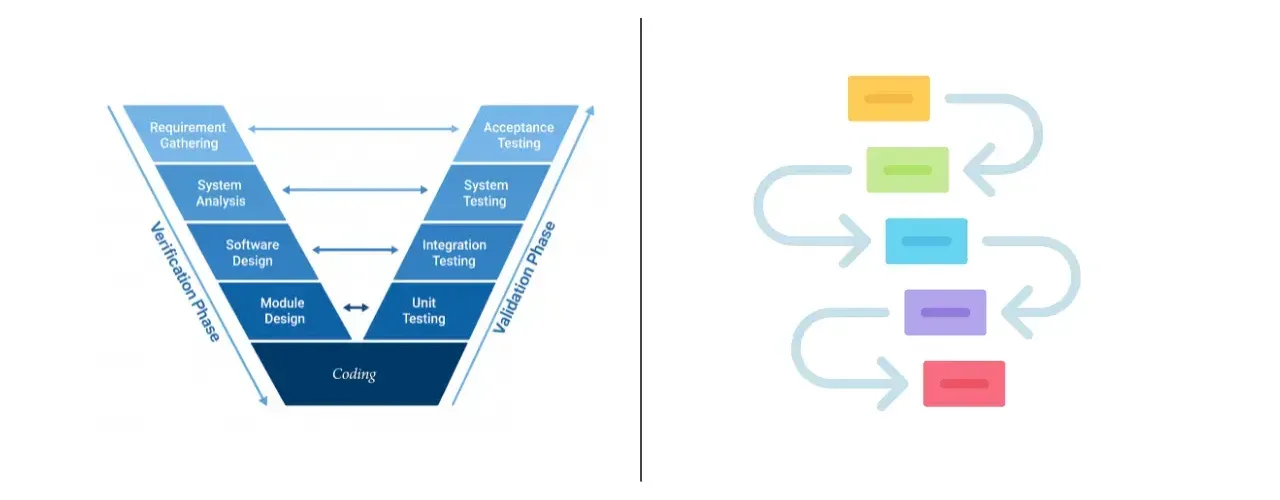
The V-Model, often referred to as Cycle V, is an extension of the Waterfall methodology that directly addresses its greatest weakness: the separation and postponement of testing until the end of the development life cycle.
The V-Model is one of the most significant SDLC V-Models used today. It maintains the sequential flow of the Waterfall but transforms the simple linear structure into a V-shape, dramatically changing when quality assurance activities occur.
2.0.1 Why the V-Model is a Waterfall Variant
It is still a predictive project management model because the entire project must start with fixed, comprehensive requirements. No phase begins until the preceding documentation is complete. The ‘V’ shape simply illustrates the crucial concept of corresponding phases.
2.0.2 Key Principles: The Direct Correspondence of Verification and Validation
The V-Model introduces the twin concepts of Verification and Validation (V&V) as the guiding principle.
- Verification: Are we building the product right? This happens on the descending (left) arm—design and build reviews.
- Validation: Are we building the right product? This happens on the ascending (right) arm—testing against user needs.
Crucially, for every phase on the left arm (design), a corresponding testing phase is planned on the right arm.
2.1 The Descending (Verification/Design) Arm of the V
The left arm represents the decomposition of the project requirements into detailed design specifications.
2.1.1 Business Requirements Analysis (Links to User Acceptance Testing)
This phase establishes what the business needs. The output defines the system’s external behavior and user requirements.
- Focus: Understanding the core problem and translating business goals into testable scenarios.
- Testing Counterpart: The test cases created here will form the basis of User Acceptance Testing (UAT).
- Documentation: User story documentation and detailed requirements traceability matrix.
2.1.2 High-Level Design (System Design – Links to System Testing)
The system is broken down into subsystems and modules. This is where the overall architecture and data flow are defined.
- Focus: How the system will interface with other systems and how components will interact.
- Testing Counterpart: System Test Plan and test cases are designed concurrently to validate the integrity of the entire system against the design.
2.1.3 Architectural Design (Links to Integration Testing)
This focuses on the detailed structure and interaction between the main modules defined in the HLD. This is where the interfaces and component interactions are specified.
- Focus: Internal structure of the system, including module interfaces and protocols.
- Testing Counterpart: Integration Testing plans are developed to ensure that these specific interfaces work correctly when modules are combined.
2.1.4 Detailed/Module Design (Links to Unit Testing)
This is the most granular level of design. Every individual program, function, class, or module is defined, including its internal logic, data structures, and algorithms.
- Focus: Internal logic and implementation details for a single unit of code.
- Testing Counterpart: Unit Testing plans are developed to ensure that each component functions correctly in isolation before assembly begins.
2.2 The Base of the V: Implementation and Coding Phase
The bottom of the ‘V’ is where the actual code construction takes place. Developers implement the logic defined in the Detailed/Module Design (2.1.4).
- Focus: Translating specifications into executable software.
- Key Requirement: The code must adhere strictly to the module design specifications to ensure testability and quality.
- Difference from Waterfall: In Waterfall, coding precedes testing plan creation. In the V-Model, the test plans for the validation arm are already designed before implementation begins.
2.3 The Ascending (Validation/Testing) Arm of the V
The right arm of the V-Model represents the execution of the validation and testing plans that were prepared concurrently with the design phases. This structured, early preparation of testing procedures is the core innovation of the V-Model.
- Internal Link Opportunity: Since testing is paramount in this model, project teams can benefit greatly by referencing Best Practices for Quality Assurance and Software Testing.
2.3.1 Unit Testing (Corresponding to Detailed/Module Design)
The first level of testing. Individual units of code are tested in isolation by developers.
- Goal: Verify that the smallest components of the system are free from logical and functional errors.
2.3.2 Integration Testing (Corresponding to Architectural Design)
Modules are combined and tested as a group to expose faults in the interaction between integrated units.
- Goal: Verify that the interfaces and communication paths between different modules work as specified in the Architectural Design.
2.3.3 System Testing (Corresponding to High-Level Design)
The complete and fully integrated software system is tested against the functional and non-functional requirements specified in the HLD.
- Goal: Verify that the system as a whole meets the technical specifications. This includes performance, security, volume, and recovery testing.
2.3.4 User Acceptance Testing (UAT) (Corresponding to Business Requirements)
The final test, executed by end-users or clients. It determines if the software is ready for release and if it satisfies the original Business Requirements Document (BRD).
- Goal: Validation that the delivered system meets the actual business needs and user expectations. This is the final sign-off before deployment.
Part 3: Comparative Analysis, Suitability, and Traceability
3.0 Waterfall vs. V-Model: A Detailed Examination
While both are sequential life cycle models, their approach to quality assurance creates a substantial functional difference for the project team and stakeholders.
3.0.1 The Fundamental Difference: Integrated Testing vs. End-of-Cycle Testing
| Feature | Waterfall Methodology | V-Model (Cycle V) |
| Testing Strategy | Testing is a separate, downstream phase. | Testing is integrated and concurrent with design. |
| Test Planning | Test plans often begin after coding starts. | Test plans begin immediately upon requirement/design sign-off. |
| Risk Mitigation | High risk; errors are found late and are expensive. | Lower risk; errors are found and corrected at the corresponding design level. |
| Focus | Document-driven development. | Design-driven validation. |
3.0.2 Enhanced Quality Assurance and Early Defect Identification
The V-Model’s strength lies in its rigor and quality control. By designing test cases for Unit Testing, Integration Testing, and System Testing early, the team is forced to think about how to verify the design long before coding begins. This proactive approach significantly reduces ambiguity and the likelihood of costly rework late in the process.
3.0.3 Cost Implications of Change Management
In both models, changes are difficult. However, in the V-Model, a change in Architectural Design immediately necessitates a review of the corresponding Integration Testing plan, making the impact clearer and more traceable than in a pure Waterfall environment.
3.1 Waterfall vs. Agile: The Fundamental Paradigm Shift
To truly appreciate the sequential models, it is essential to compare them to their modern counterpart: Agile. This comparison is a contrast between predictive project management and adaptive project management.
3.1.1 Documentation vs. Working Software
- Sequential (Waterfall/V-Model): Focuses heavily on comprehensive, detailed documentation (SRS, HLD, LLD) as the primary measure of progress.
- Agile: Emphasizes working software over comprehensive documentation, promoting rapid feedback loops.
3.1.2 Stakeholder Involvement and Feedback Loops
- Sequential: Stakeholder involvement is front-loaded (requirements) and end-loaded (UAT). Feedback is delayed.
- Agile: Continuous stakeholder involvement through daily stand-ups, reviews, and frequent deliveries.
3.1.3 Project Risk and Uncertainty Management
- Sequential: Assumes low uncertainty and fixed scope. Risk is managed by detailed planning. Fails when uncertainty is high.
- Agile: Designed to embrace uncertainty. Risk is managed by frequent inspection and adaptation in short iterations.
3.1.4 Defining Success in Predictive vs. Adaptive Environments
- Predictive (Sequential): Success is defined by delivering the entire, predefined scope on time and within budget.
- Adaptive (Agile): Success is defined by delivering the highest business value through continuous adaptation and learning.
- Internal Link Opportunity: When determining the best fit for a project, many teams must make a direct comparison. For this, one might consider Choosing Between Agile, Scrum, and Kanban for Your Tech Team.
3.2 When to Choose Which Model
The decision between methodologies must be based on the project’s characteristics and the environment’s stability.
3.2.1 Optimal Scenarios for Waterfall Methodology
Waterfall is still a viable choice when:
- Requirements are fixed and clearly defined: Projects with established technology and minimal ambiguity (e.g., standard reports, simple data migrations).
- Compliance and documentation are paramount: Projects where audit trails require every step to be signed off (e.g., construction projects).
- The technology is highly familiar: The development team has deep, established experience with the specific tools and architecture.
3.2.2 Optimal Scenarios for the V-Model
The V-Model is the preferred sequential approach for industries where failure is not an option.
- Safety-Critical and Regulated Industries: Aerospace, medical device software, automotive control systems, military applications, and nuclear systems. Here, the integrated Requirements Traceability Matrix is vital.
- Projects Requiring High Quality Assurance and Traceability: The V-Model provides a mandatory, systematic cross-reference between every requirement and the test case that validates it.
- Large-Scale Systems Integration: When integrating complex, predefined subsystems, the systematic Integration Testing planning becomes invaluable.
3.2.3 Projects Where Neither Model is Suitable
Both models fail miserably when:
- The customer cannot define the requirements upfront.
- The project involves new, highly volatile technology.
- There is a high likelihood of change during the development cycle.
Part 4: Implementation, Best Practices, and Management Challenges
4.0 Best Practices for Success in V-Cycle Projects
Successful implementation of the V-Model requires strict adherence to discipline, documentation, and foresight.
4.0.1 Comprehensive Upfront Planning and Risk Mitigation
Because the V-Model is resistant to change, robust planning is non-negotiable.
- Stakeholder Commitment: Ensure all key stakeholders commit to the documented requirements and designs at the outset.
- Contingency Planning: Plan for costly changes by allocating substantial contingency funds and time buffers.
- Technology Proving: All novel technologies must be prototyped and validated before the V-Model officially begins to eliminate technical risk.
4.0.2 Creating a Rigorous Traceability Matrix
The Requirements Traceability Matrix (RTM) is the lifeblood of the V-Model. It links every piece of design to a requirement and, crucially, to the test case that validates it.
- Purpose: To ensure 100% of requirements are tested and that no test is executed needlessly.
- Process: The RTM must be established during the Requirements Analysis phase and continuously updated during the design phases.
4.0.3 Freezing Requirements Early and Managing Scope Creep
The term ‘freezing requirements’ refers to formal sign-off. Once the design phase begins, any modification is a change request (CR) that must go through a formal change control board (CCB).
- Tool: Implement a formal, rigorous CCB process to control Scope creep. All changes must be evaluated for their impact on the design and corresponding test plans.
4.1 Essential Documentation and Deliverables
The sequential models are document-driven, meaning the documents are the definitive deliverables of each phase.
4.1.1 Requirements Specification Document (SRS/BRD)
This serves as the single source of truth for all system needs. It must be detailed, unambiguous, and testable.
- Content: Functional requirements, non-functional requirements (performance, security), constraints, and acceptance criteria.
4.1.2 High-Level and Low-Level Design Documents (HLD/LLD)
These documents transform ‘what’ (requirements) into ‘how’ (implementation). They define the system architecture and module logic.
- Importance: These documents are handed over from the design team to the implementation team, making them critical for successful communication.
4.1.3 Test Case Specification and Acceptance Criteria
For the V-Model, these documents are prepared early and define the expected outcomes for every test level (Unit, Integration, System, UAT).
- Acceptance Criteria: The specific conditions a deliverable must meet to be accepted by the customer.
4.2 Tools and Techniques for Sequential Project Management
Even in highly regulated environments, project managers rely on specific tools to manage the linear flow and resource allocation.
4.2.1 Using Work Breakdown Structure (WBS) and Gantt Charts
These are the fundamental tools for visualizing and managing the phases.
- Work Breakdown Structure (WBS): Decomposes the project scope into manageable, small tasks. This is essential for ensuring that every piece of the Sequential life cycle model is accounted for.
- Gantt Charts: Used to schedule these tasks sequentially, showing dependencies and duration.
4.2.2 Critical Path Method (CPM) and Dependency Management
The Critical Path Method (CPM) identifies the sequence of tasks that determines the earliest completion date of the project.
- Importance: In a sequential model, tasks are highly dependent. Delays on the critical path directly delay the final delivery. CPM helps the project manager focus resources where they are most needed.
4.2.3 Utilizing Documentation and Collaboration Platforms
While the models are old, the tools are modern. Platforms like Confluence or SharePoint are used for managing and version controlling the extensive project documentation required by the V-Model.
- Internal Link Opportunity: To better visualize and track task sequences, teams should master Gantt Charts and WBS: Essential Tools for Project Planning.
4.3 Common Pitfalls and Mitigation Strategies
While the V-Model is superior to Waterfall, it is not immune to management challenges.
4.3.1 The “Tunnel Effect” and Limited Customer Visibility
The long lead time between the requirements sign-off and the first delivery (UAT) can lead to disconnect.
- Mitigation: Schedule design reviews with key stakeholders to provide periodic visibility into the HLD and LLD, even if the code isn’t ready. This keeps the project from becoming a black box.
4.3.2 Staffing Issues and Phase Handoffs
The V-Model requires highly specialized roles that staff up and down drastically between phases (e.g., analysts up, then designers up, then coders up, then testers up).
- Mitigation: Implement strong quality gates at every phase transition (e.g., ‘Design complete’ sign-off) to ensure that the handoff to the next team is based on solid, agreed-upon deliverables.
4.3.3 Addressing Technical Debt in Legacy Systems
When integrating new components (built using the V-Model) with older, poorly documented systems, the Integration Testing phase can become unexpectedly difficult.
- Mitigation: Allocate dedicated time and budget within the design phases to reverse-engineer and document the interfaces of existing legacy systems before the new development begins.
Part 5: Keywords, Linking, and Conclusion
5.0 Frequently Asked Questions (FAQs)
Is the V-Model an iterative approach?
No. The V-Model is a sequential life cycle model and a form of predictive project management. While Agile is iterative (repeating the cycle to build functionality), the V-Model executes the full V-structure once. All requirements must be defined upfront, and the entire system is tested only after the full construction phase is complete.
What is the main difference between Waterfall and V-Model?
The main difference is the timing of quality assurance. Waterfall places all testing activities at the end of the development phases. The V-Model integrates testing by linking each design phase (Verification) to a corresponding test phase (Validation), forcing test planning to happen early. This greatly improves quality and reduces the risk of late error discovery.
What is the V-Model in simple terms?
In simple terms, the V-Model shows that for every step you take in defining and designing a system (going down the V), you must define a corresponding step for testing and validating that design (going up the V). It ensures that you know how you will test something before you even build it.
Why is the V-Model considered better than the Waterfall Model?
It is considered better primarily because of its focus on Verification and Validation (V&V). By introducing early test planning (for Unit Testing, System Testing, and UAT) it ensures higher quality assurance, better requirements traceability matrix creation, and faster detection and resolution of defects at their source.
Which industries use the V-Model most often?
Industries with stringent regulatory, safety, and quality requirements rely heavily on the V-Model. This includes aerospace, defense, automotive electronics, medical device manufacturing, and pharmaceutical R&D systems.
5.1 Long List of LSI and NLP Keywords
Methodology & Models: V-model (software development), SDLC V-Model, Cascade model, Sequential life cycle model, W-Cycle, Iterative model, Predictive project management, Incremental waterfall, Linear approach, Traditional project management.
Phases & Deliverables: Verification and Validation (V&V), Business Requirements Document (BRD), System Design, High-Level Design (HLD), Low-Level Design (LLD), Module design, Unit Testing, Integration Testing, System Testing, User Acceptance Testing (UAT), Acceptance testing, Coding phase, Requirements traceability matrix, Fixed requirements, Document-driven.
Concepts & Tools: Rigorous planning, Quality control, Risk mitigation, Change control, Scope creep, Gantt chart, Work Breakdown Structure (WBS), Critical Path Method (CPM), Project charter, Costly changes, Quality assurance.
These resources provide authoritative context for further reading on methodologies and development cycles.
- Project Management Standards and Best Practices
- Detailed V-Model Process Explanation
- Software Development Life Cycle (SDLC) Overview
5.2 Conclusion: The Enduring Relevance of Structured Methodologies
The journey from the foundational Waterfall approach to the rigorous V-Model (Cycle V) illustrates a continuous effort to bring structure and discipline to project execution. While the world of technology continues to accelerate, making adaptive methodologies like Agile often the preferred choice, the V-Model proves that there is still a powerful, necessary role for predictive project management.
For projects where the cost of failure is astronomical, where requirements are known, and where regulatory compliance is paramount, the V-Model provides an unmatched framework for quality assurance and traceability. It ensures that every step of the design is accounted for and validated, making it an enduring and essential tool in the modern project manager’s arsenal. Mastery of these sequential models is key to successfully managing the most critical and complex systems development projects.