
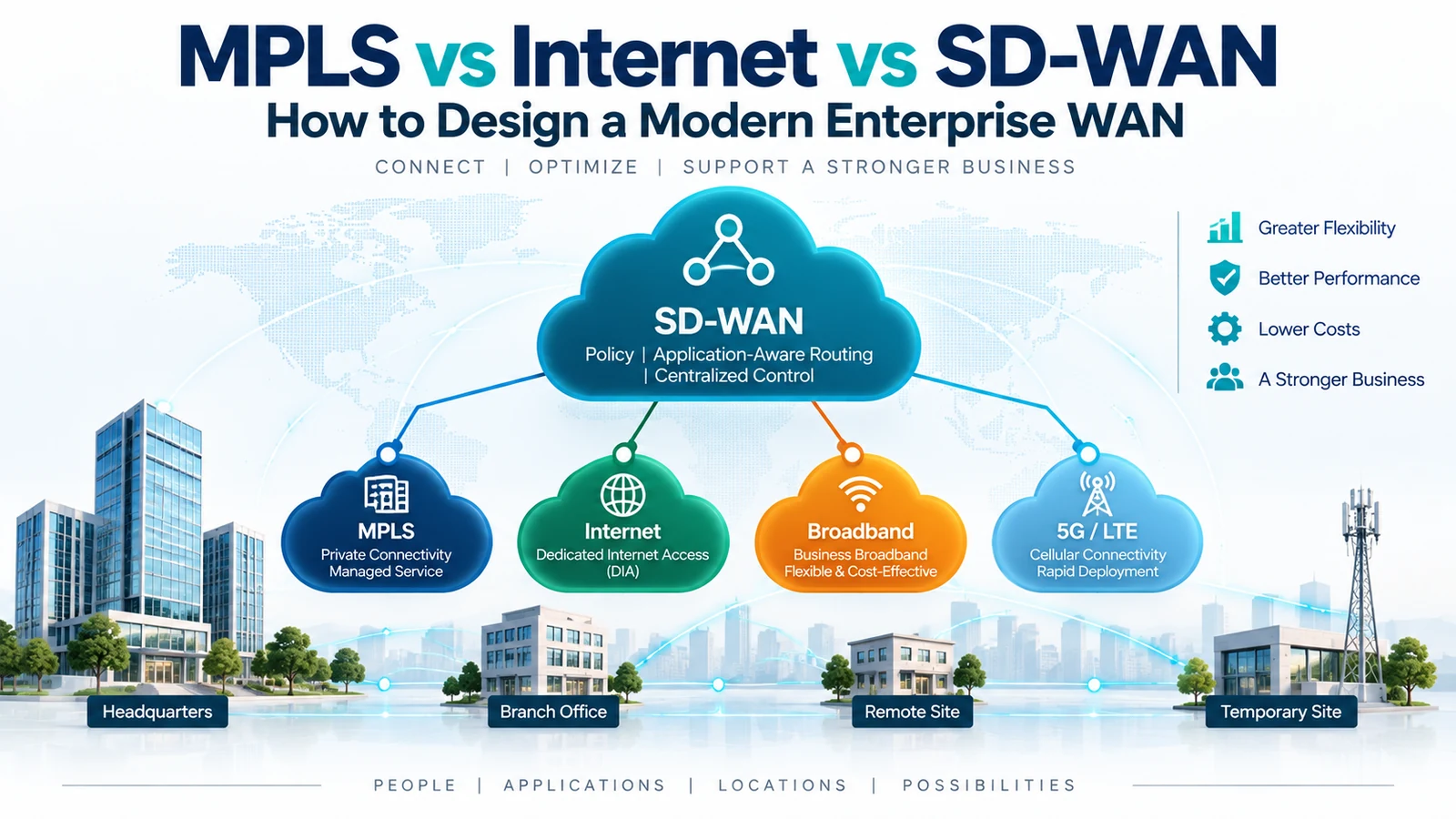
MPLS vs Internet vs SD-WAN is not really a three-way technology contest. MPLS and Internet services such as DIA or business broadband provide WAN connectivity; SD-WAN is an overlay that can control one or more of those transports.
That distinction changes the enterprise WAN design question.
Instead of asking whether MPLS, Internet or SD-WAN is “best,” network teams should determine which underlays meet each site’s application, SLA, resilience, cloud, security and geographic requirements, then decide whether SD-WAN should manage those paths through a unified policy layer.
In practice, a modern enterprise WAN may be MPLS-only, Internet-first, hybrid MPLS plus Internet, or a multi-underlay SD-WAN combining MPLS, DIA, broadband and cellular connectivity.
MPLS vs Internet vs SD-WAN at a Glance
The quickest way to compare these technologies is to separate connectivity from control.
| Technology / Role | What It Does | Strengths | Limitations | Best Fit |
|---|---|---|---|---|
| MPLS — underlay | Provides managed private IP connectivity between enterprise locations | Predictable service characteristics, provider QoS options, managed SLAs, mature enterprise operations | Cost, provisioning time, carrier dependency, less natural fit for direct SaaS access | Critical sites, private applications, locations needing managed performance characteristics |
| DIA / Business Internet — underlay | Provides dedicated or business-grade Internet connectivity | Direct Internet/cloud reach, high bandwidth options, business service characteristics | Quality and SLA depend on provider, service and geography | Enterprise Internet access, cloud-heavy sites, primary or secondary WAN connectivity |
| Broadband — underlay | Provides shared or business broadband Internet access | Availability, economics, deployment speed | Greater variability, contention or weaker SLA depending on service | Standard/small branches, secondary circuits, locations with strong broadband options |
| SD-WAN — overlay | Applies WAN policy across one or more connectivity services | Application-aware path control, multi-transport use, centralized policy, failover, visibility | Cannot create physical diversity or an underlay SLA that does not exist | Distributed enterprises using multiple transports, cloud/SaaS and centralized WAN policy |
MEF 70.2 defines an SD-WAN service framework and distinguishes the SD-WAN service from the connectivity over which it operates. That is why treating SD-WAN as simply a third physical circuit alongside MPLS and Internet leads to poor architecture decisions. Mplify / MEF 70.2
For a broader introduction to the technology itself, start with the complete TechTeamSynergy guide to SD-WAN.
MPLS vs Internet vs SD-WAN: Underlay vs Overlay
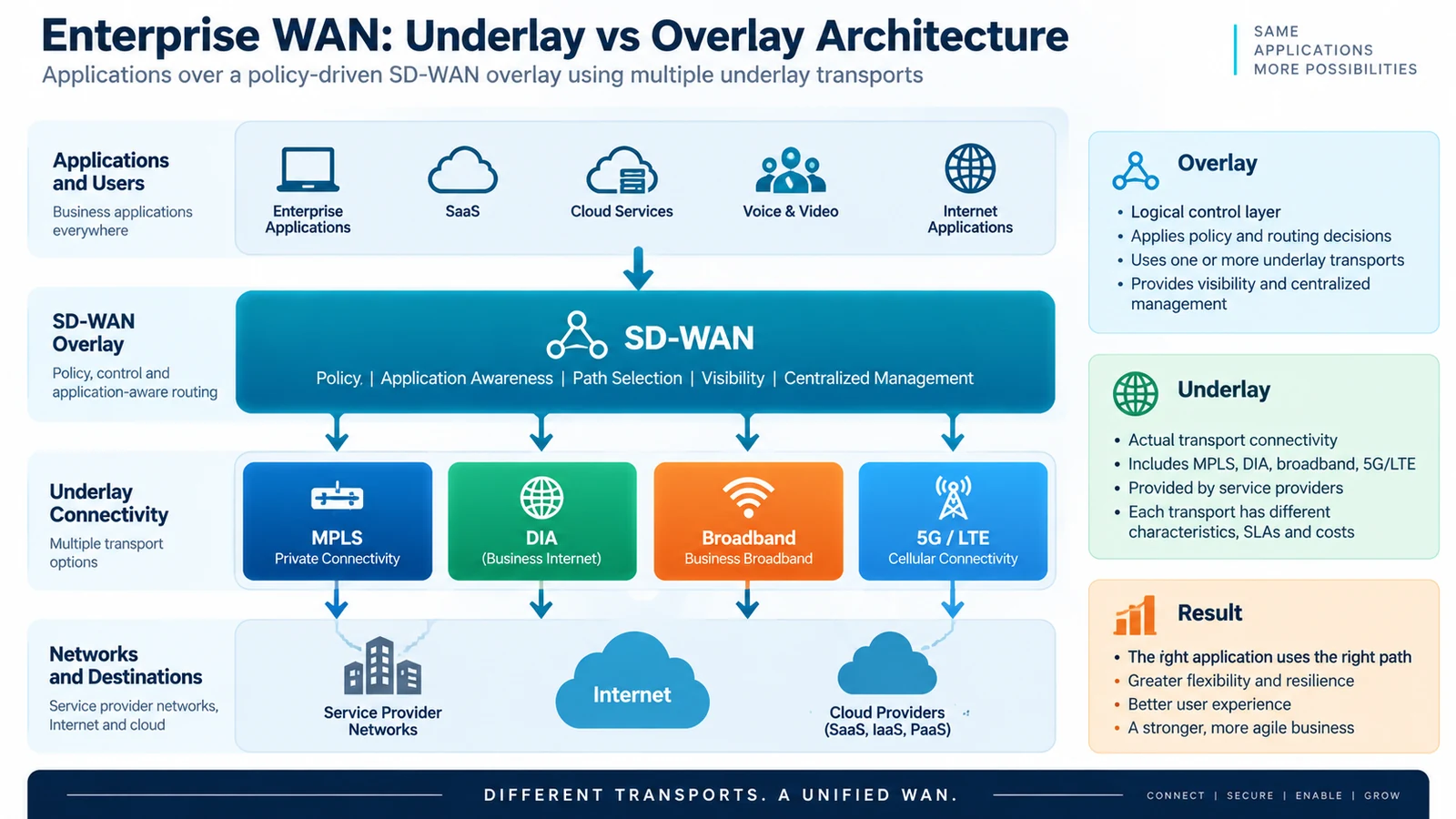
An underlay is the connectivity carrying traffic between sites and destinations. Depending on geography and provider availability, that may include MPLS, dedicated Internet access, business broadband, Ethernet services or 4G/5G.
An overlay creates a logical policy and control layer over those connections.
A simplified enterprise SD-WAN model therefore looks like this:
Applications and users
↓
SD-WAN overlay and WAN policy
↓
MPLS | DIA | Broadband | 5G
↓
Provider networks / public Internet
The overlay can monitor available paths and apply application-aware policy, but it still depends on those underlays actually delivering usable connectivity.
This distinction is central to MPLS vs Internet vs SD-WAN design: an enterprise may retain MPLS, add Internet, and place both under SD-WAN control rather than replacing one technology with another in a single step.
The deeper mechanics of edges, controllers, overlays and traffic flow belong in a dedicated SD-WAN architecture guide; here, the focus stays on choosing the right enterprise WAN design.
MPLS: Where It Still Fits
MPLS remains relevant when the value of a managed WAN service matches the business requirement.
Provider-managed MPLS VPNs can offer contractual service characteristics, traffic classes and operational accountability that are useful for critical private applications or sites where predictable connectivity matters. BGP/MPLS IP VPNs are a well-established provider architecture for connecting customer sites through a service-provider backbone. RFC 4364
MPLS may therefore fit environments where:
- important traffic needs managed QoS treatment;
- application connectivity remains heavily private;
- the enterprise values a provider-operated WAN model;
- local Internet alternatives are weak or inconsistent;
- existing MPLS economics and contracts remain reasonable.
The trade-off is that managed private services can be slower to provision and may offer less attractive bandwidth economics than local Internet access. Traditional designs can also create inefficient traffic patterns when cloud and SaaS traffic is backhauled through central locations.
This is not an argument that MPLS is obsolete. It is a question of where its service characteristics justify its role.
For the strategic relevance discussion, see Is MPLS Dead?. This article focuses instead on how MPLS can fit into the wider WAN architecture.
Internet Connectivity: DIA, Broadband and Business Internet
“Internet” is too broad a term for architecture decisions.
A dedicated business service, a business broadband connection and a best-effort consumer-style connection may all reach the public Internet, but their commercial and technical characteristics can be very different.
Mplify’s Internet Access standard formalizes Internet-access product attributes between buyers and sellers, reinforcing that Internet connectivity should be evaluated by the attributes of the actual service rather than treated as one uniform product. Mplify 164
Dedicated Internet Access
Dedicated Internet Access, or DIA, is commonly used when an enterprise wants business-grade Internet connectivity with defined provider service characteristics.
Depending on the provider and market, a DIA service may include contractual service objectives, symmetrical bandwidth options, support commitments and greater predictability than shared broadband.
DIA can be particularly useful for direct SaaS and public-cloud access, major offices with significant Internet traffic, SD-WAN underlay connectivity, and Internet breakout combined with enterprise security controls.
The important qualifier is depending on the service. “DIA” does not mean every provider offers identical performance, diversity or SLA terms.
Business Broadband
Business broadband can provide attractive economics and broad availability, making it useful for standard branches, small sites, secondary links and locations where rapid deployment matters.
However, contention, repair commitments, routing quality and provider support may differ substantially across markets and service tiers.
A design should therefore evaluate the specific circuit rather than assume that broadband is automatically unsuitable for enterprise traffic or automatically equivalent to DIA.
Internet Is Not Automatically Less Secure Than MPLS
Private connectivity and cybersecurity are related, but they are not the same thing.
An MPLS VPN can provide traffic separation within a provider service, but the MPLS VPN architecture does not by itself provide end-to-end encryption. RFC 4364 explicitly distinguishes VPN separation from cryptographic privacy.
Likewise, using Internet connectivity does not automatically mean accepting an insecure architecture.
Security still depends on controls such as encryption where required, firewalls, identity and access controls, segmentation, monitoring and secure management.
NIST’s Zero Trust Architecture makes the broader principle clear: network location alone should not create implicit trust. NIST SP 800-207
This guide keeps the focus on WAN architecture selection rather than detailed SD-WAN security design and operations.
What SD-WAN Changes
SD-WAN changes how an enterprise can use its available transports.
Instead of operating each WAN circuit as an isolated path with largely static routing decisions, an SD-WAN design can apply centralized policies across multiple underlays.
- multi-transport connectivity;
- application-aware traffic policy;
- dynamic path selection;
- path-quality monitoring;
- automated failover;
- centralized visibility.
For example, an application can prefer one path while conditions meet policy and move to another available path when the first no longer satisfies the required conditions.
SD-WAN does not remove the importance of the underlay. It makes the underlay portfolio more flexible to operate.
Readers deciding between conventional and software-defined WAN control models can also review SD-WAN vs Traditional WAN.
MPLS-Only Architecture
Branch → MPLS → Data center / enterprise network
This model may still fit an organization with highly centralized private applications, mature provider operations and limited need for distributed Internet breakout.
Its strengths can include operational familiarity, provider-managed connectivity and predictable service characteristics when the contracted service supports them.
The trade-offs become more visible as application traffic moves toward SaaS and public cloud. Sending Internet-bound traffic from branches through a central data center can consume private WAN capacity and extend the traffic path.
MPLS-only should therefore be selected because its characteristics fit the application architecture, not simply because it is the incumbent WAN.
Internet-First WAN Architecture
Branch → DIA / broadband → Internet / SaaS / cloud
This model can fit cloud-oriented offices, smaller locations and markets with strong business Internet availability.
It can provide direct access to Internet-hosted applications without automatically routing those sessions through a centralized private backbone.
The design still needs to address resilience, routing, security inspection, access control and operational support. An Internet-first WAN is not the absence of architecture; it simply changes which connectivity services form the WAN.
Organizations should also assess whether one circuit is enough. A location running critical cloud applications over Internet access may require diverse secondary connectivity rather than depending on a single inexpensive link.
Hybrid MPLS + Internet WAN
For many enterprises, the most practical design is not a clean replacement. It is coexistence.
A hybrid WAN combines private connectivity such as MPLS with Internet access such as DIA or business broadband.
MPLS → selected private or performance-sensitive traffic
Internet → SaaS, cloud and general Internet traffic
That is an example, not a mandatory rule. The preferred path should follow application and service requirements.
Hybrid designs let an enterprise introduce Internet capacity without immediately removing a private WAN service that still has operational value, improve resilience when the paths are genuinely diverse, and separate traffic according to application requirements instead of forcing every application onto the same service.
A hybrid design also supports gradual transformation. MPLS capacity or coverage can be retained at critical sites while other branches move toward Internet-led connectivity.
Multi-Underlay SD-WAN Architecture
SD-WAN overlay
↓
MPLS + DIA + broadband + 5G/LTE
The important architectural change is transport abstraction.
The WAN policy can describe how applications should behave without requiring every branch to have the same physical services.
A headquarters location might use MPLS plus DIA. A standard branch might use two Internet providers. A small site might use broadband plus cellular backup. All can still participate in the same logical SD-WAN policy framework.
That flexibility is particularly valuable for multinational networks because carrier availability and economics vary significantly by country.
The result is not “SD-WAN instead of connectivity.” It is SD-WAN controlling the connectivity portfolio.
MPLS vs Internet vs SD-WAN: Decision Criteria
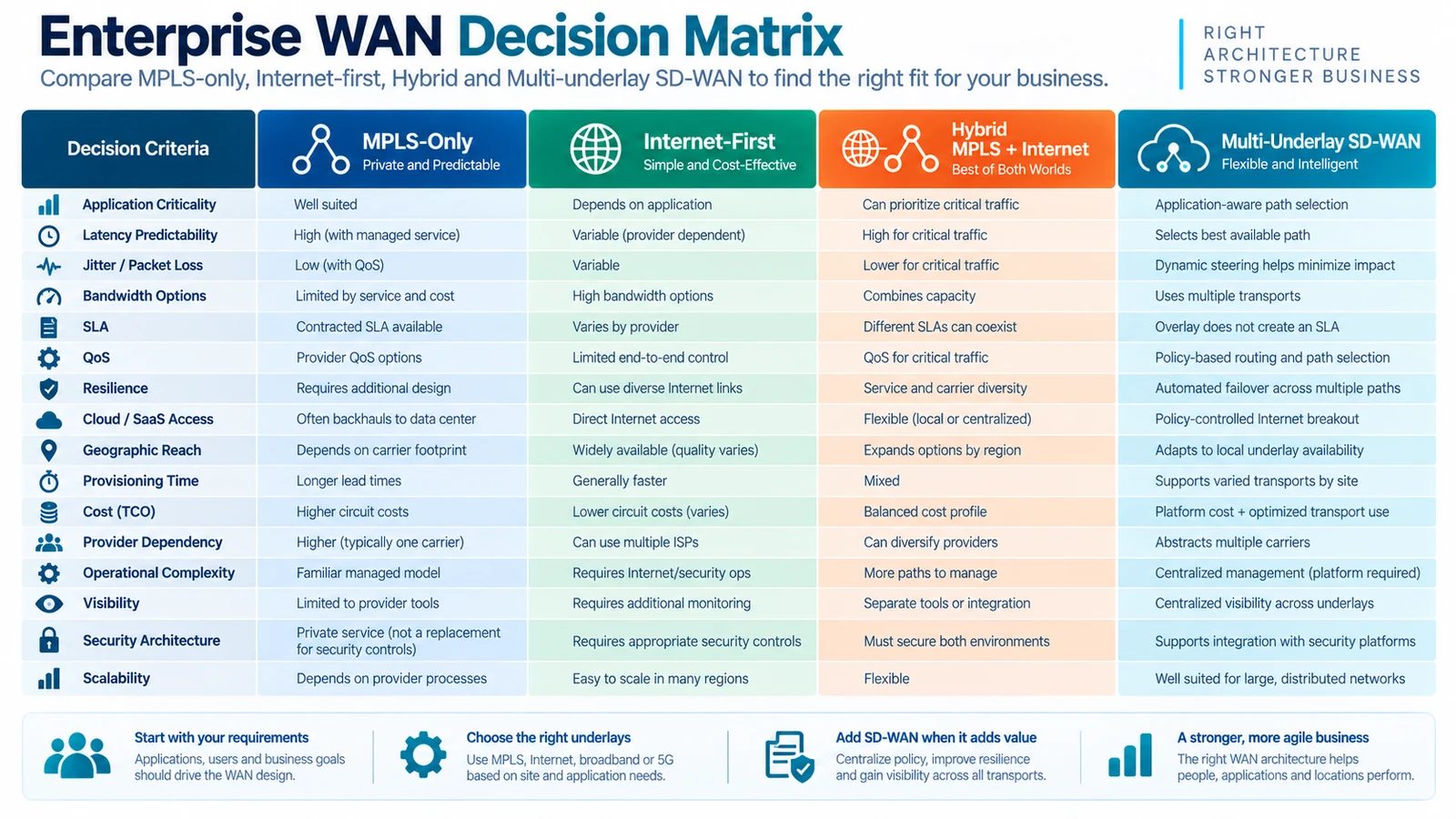
The following matrix provides a more useful architecture comparison than asking which single technology “wins.”
| Decision criterion | MPLS-only | Internet-first | Hybrid MPLS + Internet | Multi-underlay SD-WAN |
|---|---|---|---|---|
| Application criticality | Can suit critical private applications | Depends strongly on local Internet service | Allows traffic separation across service types | Adds application-driven path policy across available links |
| Latency predictability | Can be strong with an appropriate managed service | Depends on provider and Internet path | Critical applications can retain managed path options | Can select among available paths but cannot remove underlay limitations |
| SLA / QoS | Managed service can be a differentiator | Varies by service and provider | Different service characteristics can coexist | Overlay policy does not create an underlay SLA |
| Resilience | Requires appropriate redundant design | Multiple diverse Internet services may improve resilience | Combines different access/service types | Adds automated policy and failover across available paths |
| Cloud / SaaS access | Central backhaul may be inefficient | Direct access can be natural | Supports private plus local Internet access | Supports policy-controlled breakout |
| Geographic reach | Depends on carrier footprint | Broad but quality varies by market | Can adapt by geography | Useful when underlays differ by location |
| Operations | Familiar managed model | Requires Internet/security operations | More paths to coordinate | Centralized visibility can simplify policy but adds an SD-WAN platform |
| TCO | Must include circuits and provider services | Must include security and operations | Includes parallel services | Adds platform/licensing but may improve use of transport portfolio |
The most important takeaway is that these outcomes are context-dependent. Architecture should follow application and site requirements rather than a global rule that every location needs the same connectivity.
Application Requirements Should Drive the WAN
Voice and Video
Real-time applications can be sensitive to delay variation, loss and congestion. A managed service with suitable QoS may be appropriate in some environments, while an SD-WAN design may use path measurements to choose the better of multiple qualified transports.
ERP and Private Applications
A business-critical ERP platform hosted in a private data center may justify different connectivity from an Internet-native SaaS application. The decision should consider where the application is hosted, its criticality, path requirements and recovery expectations.
SaaS and Public Cloud
SaaS traffic naturally depends on Internet reachability. Public-cloud applications may use Internet connectivity, dedicated cloud connectivity, private WAN integration or combinations of these. The WAN architecture needs to reflect the actual cloud network design.
Backup and Bulk Transfer
High-volume, less latency-sensitive traffic can consume significant WAN capacity. An organization may therefore assign different path preferences to bulk transfers than to interactive business applications.
Application → requirement → preferred path policy
SLA and QoS: Where MPLS Can Still Matter
One reason MPLS remains useful in some environments is the ability to purchase managed service characteristics from a provider.
Where the service offers appropriate traffic classes, QoS and contractual commitments, that predictability may be valuable for selected critical applications.
If one path deteriorates, an SD-WAN platform may steer a suitable application to another available transport. If every available path is congested, unstable or poorly provisioned, there is no healthy alternative to select.
SD-WAN can choose among available paths. It cannot manufacture an underlay SLA.
Cloud and SaaS Access
Cloud and SaaS adoption changes the economics of centralized WAN backhaul.
For Microsoft 365 specifically, Microsoft recommends local Internet egress and avoiding unnecessary WAN hairpins so users can reach appropriate Microsoft network entry points more directly. That guidance is Microsoft-specific, but it illustrates why application location matters in WAN architecture. Microsoft 365 network connectivity principles
A modern design may therefore use centralized backhaul where the business or security model requires it, direct Internet access for suitable cloud applications, or SD-WAN policy-controlled breakout to apply different treatment by application.
Where connectivity and cloud-delivered security need to converge, the related SD-WAN vs SASE guide explains the boundary between the two architectures.
Resilience: One Premium Circuit or Multiple Diverse Paths?
Resilience is not simply a question of purchasing the most expensive circuit.
A single high-quality MPLS connection is still a single access path unless additional resilience has been engineered. Two Internet circuits can improve availability, but only when their failure domains are sufficiently independent. A hybrid MPLS plus Internet design introduces service-type diversity, while a multi-underlay SD-WAN can add automated monitoring and failover across those available paths.
Carrier Diversity
Do both circuits rely on the same service provider or upstream infrastructure?
Physical Diversity
Do they enter the building through separate routes, ducts or access infrastructure?
Access Diversity
Are the links based on different access technologies where that improves resilience?
Failure-Domain Diversity
Can a single provider, exchange, power, access or regional failure still remove both paths?
Purchasing two circuit identifiers is not proof of true diversity.
Security Considerations
WAN connectivity should be selected together with, but not confused with, the security architecture.
An Internet-facing branch may require encryption, firewall policy, secure Internet breakout, segmentation and security inspection. An MPLS-connected branch still requires access control, segmentation and appropriate protection for the applications it reaches.
When enterprises combine SD-WAN with cloud-delivered security, SASE or SSE may become relevant. The SD-WAN vs SASE comparison covers that relationship in more depth.
Geographic Availability and Carrier Strategy
A multinational enterprise should be cautious about forcing one connectivity standard onto every country.
MPLS availability, DIA pricing, local broadband quality, fiber coverage, cellular reliability, provider support and regulatory conditions can all vary by location.
A useful global design can standardize application classes, resilience expectations, security policy, routing principles, monitoring and operational governance while allowing different physical underlays by country or site.
The objective is consistent service intent, not identical carrier products everywhere.
Cost and TCO: Avoid Comparing Circuit Price Alone
Comparing only the monthly circuit price can produce the wrong WAN decision.
An enterprise WAN TCO model should consider access circuits, WAN-edge hardware or appliances, SD-WAN licensing, managed-service fees, security services, monitoring, internal operations, provider management, deployment costs, parallel services during transformation, support, outage risk and carrier contract commitments.
If operating ownership becomes a key TCO factor, the SD-WAN vs Managed SD-WAN guide compares internal and provider-managed operating models.
The meaningful question is not “Which circuit is cheapest?” It is “Which complete architecture provides the required service at an acceptable lifecycle cost?”
MPLS vs Internet vs SD-WAN: Practical Decision Framework
- Identify application requirements. Determine which applications are private, cloud-based, SaaS, Internet-native, real-time or bandwidth-intensive.
- Classify sites. Separate headquarters, critical branches, standard offices, small locations, data centers and temporary sites.
- Define SLA and QoS requirements. Identify where managed performance commitments or traffic treatment genuinely matter.
- Assess available underlays. Evaluate MPLS, DIA, broadband, Ethernet and cellular services available at each location.
- Define resilience requirements. Determine acceptable failure domains and required carrier, route or access diversity.
- Define cloud and SaaS access. Decide which traffic should use local Internet access, centralized routing or private connectivity.
- Define the security model. Determine encryption, segmentation, Internet-edge security and inspection requirements.
- Compare end-to-end TCO. Include connectivity, platform, security, managed services, operations and contract impacts.
- Select the transport mix. Choose appropriate underlays by site and application rather than applying one circuit model everywhere.
- Decide whether SD-WAN adds enough value. Assess whether centralized policy, multi-path steering, visibility and operational consistency justify the overlay.
Possible outcomes include MPLS-only, Internet-first, Hybrid MPLS + Internet, Dual-Internet SD-WAN, or MPLS + Internet + 5G SD-WAN. None is inherently the universal target architecture.
Once the target architecture is selected, implementation belongs in a separate workstream. Use the SD-WAN Migration Checklist for assessment, pilot, cutover and operational-readiness planning.
MPLS vs Internet vs SD-WAN by Site Type
| Site Type | Possible Underlays | SD-WAN? | Why |
|---|---|---|---|
| Headquarters | MPLS + DIA, diverse DIA, private/cloud connectivity | Often valuable with multiple paths | High application concentration and resilience requirements |
| Data Center | Private WAN, Internet, cloud/interconnect services | Depends on architecture | Routing, application hosting and connectivity concentration matter more than branch patterns |
| Critical Branch | MPLS + Internet or diverse Internet | Often appropriate when multiple paths exist | Can combine path diversity with application-aware policy |
| Standard Branch | Dual Internet or MPLS + Internet | Often useful | Balances availability, cost and centralized policy |
| Small Branch | Broadband/DIA + cellular | May fit | Simplicity, economics and rollout speed may dominate |
| Cloud-First Office | Diverse Internet services | Often appropriate | Most application destinations are Internet/cloud based |
| Remote / Temporary Site | Cellular plus Internet when available | Depends on duration and complexity | Rapid deployment may matter more than carrier standardization |
Example: Global Enterprise WAN Transformation
Consider a fictional enterprise with a headquarters, two data centers, more than 100 branches across several countries, a SaaS-heavy workforce and a critical private ERP environment.
Its major locations might use MPLS plus DIA. Standard branches in markets with mature provider options might use dual Internet services. Smaller offices might use business Internet plus 5G.
The enterprise can place those different transports beneath a common SD-WAN overlay, applying consistent application policy, segmentation, path-selection logic and monitoring where the platform supports them.
The key lesson is that policy can be standardized without standardizing every physical connection.
When Should You Keep MPLS?
Keeping MPLS can make sense where its service characteristics continue to solve a real business problem, including critical sites requiring predictable managed service, environments with important private applications, countries with poor Internet alternatives, favorable existing contracts or locations where changing connectivity would add risk without sufficient benefit.
The deeper strategic question of MPLS relevance belongs in Is MPLS Dead?.
When Does Internet-First Make Sense?
Internet-first architecture may fit cloud-oriented locations where reliable business Internet services are readily available and dependence on private WAN applications is limited. It can be especially relevant for smaller or standard branches, offices dominated by SaaS traffic and locations where rapid circuit deployment matters.
When Does SD-WAN Make Sense?
SD-WAN becomes more compelling as the WAN gains multiple transports, more locations and more application-specific routing requirements. It can be useful when an enterprise needs centralized WAN policy, application-aware steering, multi-path use, consistent visibility and a common operating model across sites whose physical underlays differ.
Frequently Asked Questions
Is SD-WAN better than MPLS?
They perform different roles. MPLS provides connectivity; SD-WAN controls connectivity across one or more underlays. An enterprise can therefore use MPLS beneath SD-WAN rather than selecting one as a direct substitute for the other.
Can SD-WAN replace MPLS?
SD-WAN can support a design in which MPLS is reduced or removed, provided suitable alternative underlays exist. It can also operate over MPLS. Whether MPLS should remain depends on the application’s connectivity, SLA and geographic requirements.
Does SD-WAN use the public Internet?
It can. SD-WAN can use public Internet services such as DIA or broadband, but it can also use MPLS, Ethernet, cellular and other supported transports.
Is MPLS faster than Internet?
Not universally. Performance depends on the actual service, routes, congestion, geography and application destination.
Is MPLS more reliable than Internet?
A managed MPLS service may offer strong availability commitments, but reliability depends on the specific service and architecture. A resilient design can also use diverse Internet paths or combine MPLS and Internet.
Can MPLS and Internet be used together?
Yes. Hybrid WANs commonly combine private and Internet connectivity. SD-WAN can add policy-driven control across those paths.
Do you need MPLS with SD-WAN?
No. SD-WAN can operate across Internet and cellular underlays without MPLS. However, enterprises may retain MPLS where its characteristics remain valuable.
What is the difference between MPLS and DIA?
MPLS VPN services provide private provider-managed connectivity between enterprise locations or resources. DIA provides dedicated connectivity to the public Internet. They solve different connectivity requirements and can coexist at the same site.
Is dual Internet enough for an enterprise WAN?
Sometimes. The answer depends on application requirements, provider quality and whether the circuits are genuinely diverse.
What is the best WAN architecture for cloud applications?
There is no universal architecture. Cloud-heavy environments often benefit from efficient Internet or cloud access, appropriate resilience and security controls. Multi-site enterprises may use SD-WAN to apply consistent policy across those paths.
Conclusion
The strongest enterprise WAN designs do not begin with a preferred technology.
Applications → SLA and performance requirements → Resilience → Geography → Security → Cost and operations
Those requirements determine the appropriate underlays. Only then should the organization decide whether SD-WAN should control those transports through a unified overlay.
That is the practical answer to MPLS vs Internet vs SD-WAN. The decision is usually not MPLS or Internet or SD-WAN. It is which combination of connectivity services best supports each part of the business, and whether a common SD-WAN policy layer improves how those services are operated.
Once that target architecture has been selected, move to implementation planning with the SD-WAN Migration Checklist.
Continue Learning
What Is SD-WAN? The Complete Guide
Learn what SD-WAN is, how it uses multiple WAN transports and where it fits in enterprise networking.
Compare router-centric WAN design with software-defined policy, multiple transports and application-aware path control.
Understand where MPLS can still provide strategic value and how its role is changing in enterprise WANs.
Move from target WAN architecture to assessment, pilot, migration, cutover and operational validation.