
SAFe PI Planning is a cadence-based event where everyone on an Agile Release Train (ART) comes together to align around a shared mission, understand priorities, identify dependencies and risks, and create a plan for the upcoming Planning Interval.
For organizations using the Scaled Agile Framework (SAFe), PI Planning is much more than a large planning meeting. It creates a shared connection between business priorities and the teams responsible for turning those priorities into working solutions. At enterprise scale, that alignment can support enterprise business agility by shortening the distance between strategy, decisions and execution. If you need the underlying methods and principles first, start with our complete Agile guide.
In Core SAFe, a typical PI Planning event takes place over two days and involves the entire Agile Release Train. Teams work together to understand the vision, plan upcoming work, identify cross-team dependencies, define PI Objectives, address risks, and assess confidence in the resulting plan. For responsibilities or major decisions that cross organizational boundaries, additional responsibility and decision frameworks can provide useful clarity without replacing SAFe accountabilities. AI-Native SAFe uses a different one-day event called PI Outcome Planning, explained later in this guide.
This guide explains how SAFe PI Planning works from preparation through execution and follow-up. It covers the current Planning Interval terminology, the two-day PI Planning agenda, roles, PI Objectives, ART Planning Board, dependencies, ROAM risks, confidence voting, distributed PI Planning, common mistakes, and practical ways to improve your next event.
What Is SAFe PI Planning?
PI Planning is a cadence-based event for the entire Agile Release Train that aligns teams and stakeholders around a shared mission, vision, and plan for the upcoming Planning Interval.
It is facilitated by the Release Train Engineer (RTE) and normally involves all the Agile Teams on the ART together with Product Management, Business Owners, System Architects and other important stakeholders.
Current SAFe guidance typically places PI Planning within the Innovation and Planning (IP) Iteration, providing dedicated time for planning without consuming the capacity of normal development iterations.
The event normally lasts two days, although distributed organizations may adapt the schedule across time zones while preserving the collaborative intent of the event.
For the official definition and current framework guidance, see the Scaled Agile Framework’s PI Planning documentation.
Planning Interval vs Program Increment: What Changed?
If you have worked with SAFe for several years, you may know PI as Program Increment.
Current SAFe terminology uses Planning Interval.
This distinction is important because older training material, articles, organizational processes and experienced practitioners may still use Program Increment.
Therefore, you may encounter both terms in real organizations.
In current SAFe terminology, a Planning Interval (PI) is a cadence-based timebox during which Agile Teams on an ART deliver value in alignment with PI Objectives.
A PI commonly lasts approximately 8 to 12 weeks and contains several development iterations together with an Innovation and Planning iteration.
The terminology has evolved, but the core idea remains: the ART works according to a common cadence that creates regular opportunities to plan, execute, learn and adapt.
Core SAFe PI Planning vs AI-Native SAFe PI Outcome Planning
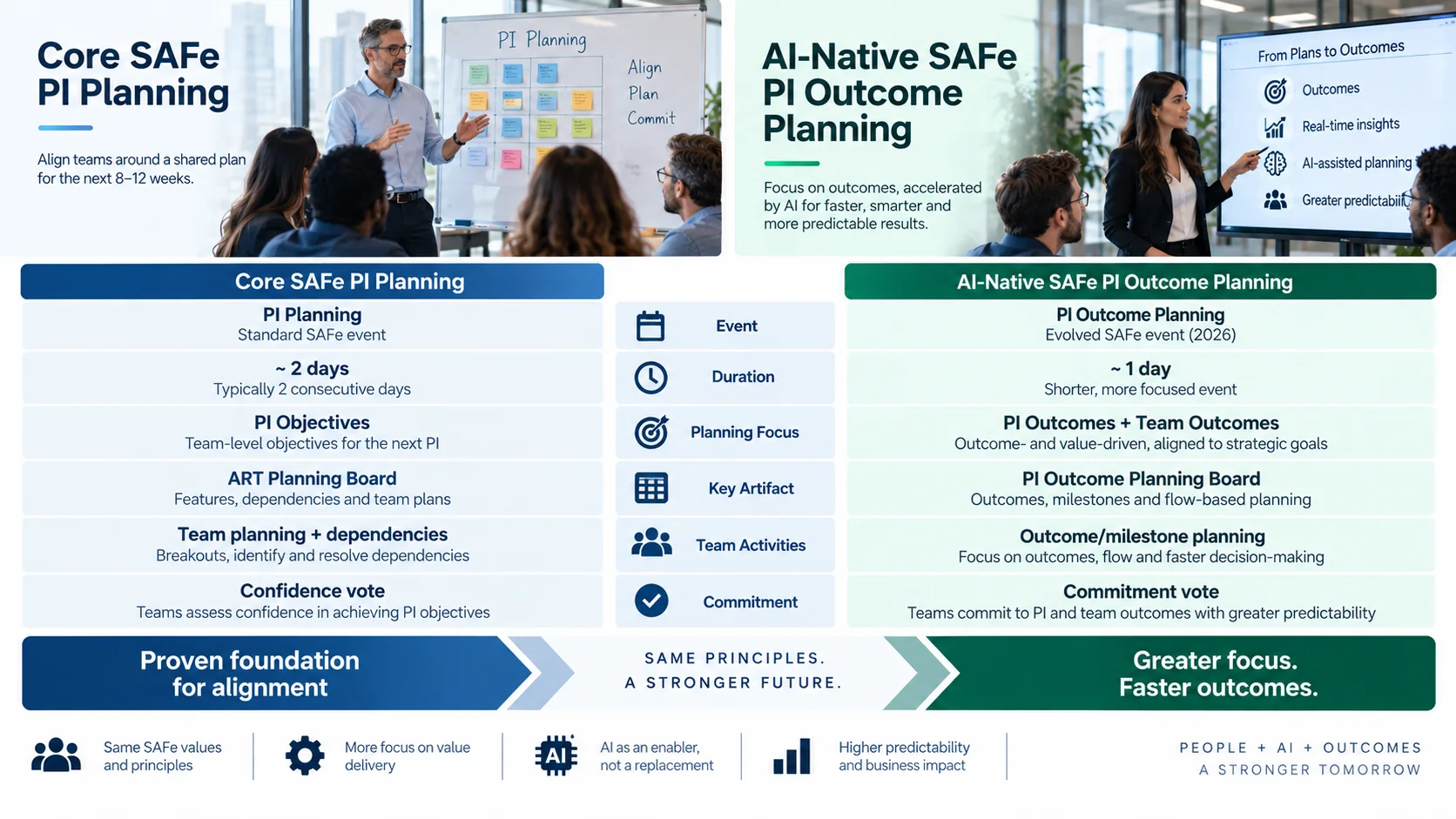
In 2026, Scaled Agile introduced an important distinction for organizations adopting AI-Native SAFe. The familiar two-day PI Planning event remains part of Core SAFe, while AI-Native SAFe introduces a different event called PI Outcome Planning.
According to Scaled Agile’s official guidance, PI Outcome Planning is a one-day event for the AI-Native Agile Release Train. It is designed around outcomes and milestones rather than simply compressing the traditional two-day PI Planning agenda. Its purpose is to align the ART on the PI Outcomes that best advance strategy, formulate Team Outcomes that contribute to those PI Outcomes, and identify the milestones needed to create an executable plan. See Scaled Agile’s official AI-Native SAFe guidance on PI Outcome Planning.
| Area | Core SAFe PI Planning | AI-Native SAFe PI Outcome Planning |
|---|---|---|
| Event | PI Planning | PI Outcome Planning |
| Typical duration | Two days | One day |
| Primary planning focus | PI Objectives, features, dependencies, risks and team plans | PI Outcomes, Team Outcomes and milestones |
| Central cross-team artifact | ART Planning Board | PI Outcome Planning Board |
| Breakout emphasis | Team planning and cross-team dependency coordination | Outcome Breakouts plus Team Breakouts |
| End-of-event alignment | Final plan review, risk discussion and confidence vote | Final plan presentation and commitment vote |
The practical takeaway is that organizations should first identify which SAFe operating model they are using. Teams working with Core SAFe should continue to use the established PI Planning guidance described in this article. AI-Native ARTs should follow the newer outcome-centered event design rather than treating it as a simple shorter version of traditional PI Planning.
This guide therefore focuses primarily on Core SAFe PI Planning, while highlighting the AI-Native alternative where the distinction matters.
Why Is PI Planning Important?
As organizations scale Agile practices across multiple teams, coordination becomes significantly more difficult.
One team may depend on another team’s API. A platform team may need to deliver infrastructure before an application team can proceed. A security requirement may affect several products. Product Management may need capabilities from multiple teams to deliver one customer outcome.
If these relationships are discovered only during execution, they can create delays and rework.
PI Planning provides a structured environment for discovering and discussing these relationships before teams enter the next Planning Interval.
It helps an ART:
- Align teams around business priorities and product vision
- Connect planned work with business goals
- Identify cross-team dependencies
- Balance demand against available capacity
- Identify risks before execution begins
- Enable teams to participate directly in planning
- Create transparency across the ART
- Support faster decisions
- Establish PI Objectives
- Build shared confidence in the plan
The result should not be a perfect prediction of everything that will happen over the next several weeks.
Instead, PI Planning creates an aligned and transparent starting point from which teams can execute and adapt.
PI Planning at a Glance
| Area | Typical SAFe Approach |
|---|---|
| Scope | Entire Agile Release Train |
| Cadence | Once per Planning Interval |
| PI duration | Typically 8–12 weeks |
| Planning event duration | Typically two days |
| Facilitator | Release Train Engineer |
| Participants | Agile Teams, Business Owners, Product Management, architecture roles and relevant stakeholders |
| Primary focus | Alignment and planning for the upcoming PI |
| Important outputs | PI Objectives and ART Planning Board, together with identified dependencies and risks |
What Is an Agile Release Train?
To understand PI Planning, you first need to understand the Agile Release Train (ART).
An ART is a long-lived team of Agile Teams and stakeholders that develops and delivers solutions together.
Instead of individual teams operating independently, teams within the ART work toward common business and technology objectives.
This creates the need for coordination beyond normal team-level events.
PI Planning provides one of the most important synchronization points for that coordination.
Who Participates in PI Planning?
PI Planning works because the people who understand the business, architecture, products and delivery challenges participate together.
Important participants typically include:
- Release Train Engineer
- Business Owners
- Product Management
- System Architect or Engineering
- Product Owners
- Scrum Masters or Team Coaches
- Developers and other Agile Team members
- Relevant stakeholders
Each group brings a different perspective.
Business Owners bring strategic and business context. Product Management brings product priorities. Architects bring technical direction. Teams bring detailed delivery knowledge. The RTE facilitates the overall planning process.
PI Planning therefore works best when these perspectives interact directly rather than passing plans from one organizational layer to another.
Sprint Planning vs PI Planning
PI Planning and Sprint Planning both involve planning, but they operate at very different levels.
| Area | PI Planning | Sprint / Iteration Planning |
|---|---|---|
| Level | Agile Release Train | Individual Agile Team |
| Horizon | Entire Planning Interval | One iteration |
| Participants | ART teams and stakeholders | Individual team |
| Focus | ART alignment, objectives, features, dependencies and risks | Detailed iteration work |
| Typical duration | Two-day event | Much shorter team-level event |
PI Planning does not replace iteration planning.
Instead, the PI establishes broader direction and objectives. Teams continue performing detailed planning throughout the PI as they learn and adapt.
How to Prepare for PI Planning
The quality of PI Planning depends heavily on preparation. Use our PI Planning readiness checklist to validate the key inputs, capacity, dependencies, risks and logistics before the event.
A two-day event involving an entire ART represents a significant investment. Bringing dozens of people together without sufficient preparation can waste considerable time.
SAFe organizes preparation around three broad readiness areas:
- Organizational readiness
- Content readiness
- Logistics readiness
1. Organizational Readiness
Organizational readiness ensures that the people and teams required for planning are prepared to participate.
Before the event, confirm:
- ART structure
- Team membership
- Required Agile roles
- Availability of Business Owners
- Availability of Product Management
- Architecture participation
- RTE facilitation
- Relevant stakeholders
Missing decision-makers can create significant delays.
For example, if teams discover an important scope question but nobody with sufficient business context can resolve it, the dependency may remain open throughout the event.
2. Content Readiness
Content readiness ensures teams have enough information to make useful planning decisions.
Typical preparation includes:
- Business context
- Product or solution vision
- Prioritized features
- Architecture vision
- Relevant technical guidance
- Known dependencies and constraints
The goal is not to create the entire plan before PI Planning.
Doing that would undermine one of the central purposes of the event: enabling the people who will perform the work to participate in planning it.
Instead, leadership and product roles should bring enough context and priorities for teams to build a realistic plan collaboratively.
3. Logistics Readiness
PI Planning can involve many participants, rooms, tools and communication channels.
Logistics therefore deserve serious attention.
Check:
- Meeting rooms
- Team breakout spaces
- Remote conferencing
- Digital collaboration boards
- Planning tools
- Time-zone constraints
- Access permissions
- Audio and video equipment
- Facilitation materials
- Backup communication channels
For distributed ARTs, perform a technical dry run before the event.
Discovering access or conferencing problems after PI Planning begins wastes time and reduces participation.
AI can also assist teams with preparation activities such as reviewing PI Objectives, identifying dependencies and challenging risks before the event. See our AI prompts for project managers for practical PI Planning examples, including readiness, dependencies, PI Objectives and ROAM risk review.
What Are the Main Inputs to PI Planning?
Teams need context before they can create a meaningful plan.
Important PI Planning inputs can include:
- Business context
- Product or solution vision
- Prioritized features
- Architecture vision
- Development practices
- Team capacity
- Known dependencies
- Existing constraints
- Relevant milestones
- Previous PI learning
These inputs establish the boundaries within which teams plan.
The Two-Day SAFe PI Planning Agenda
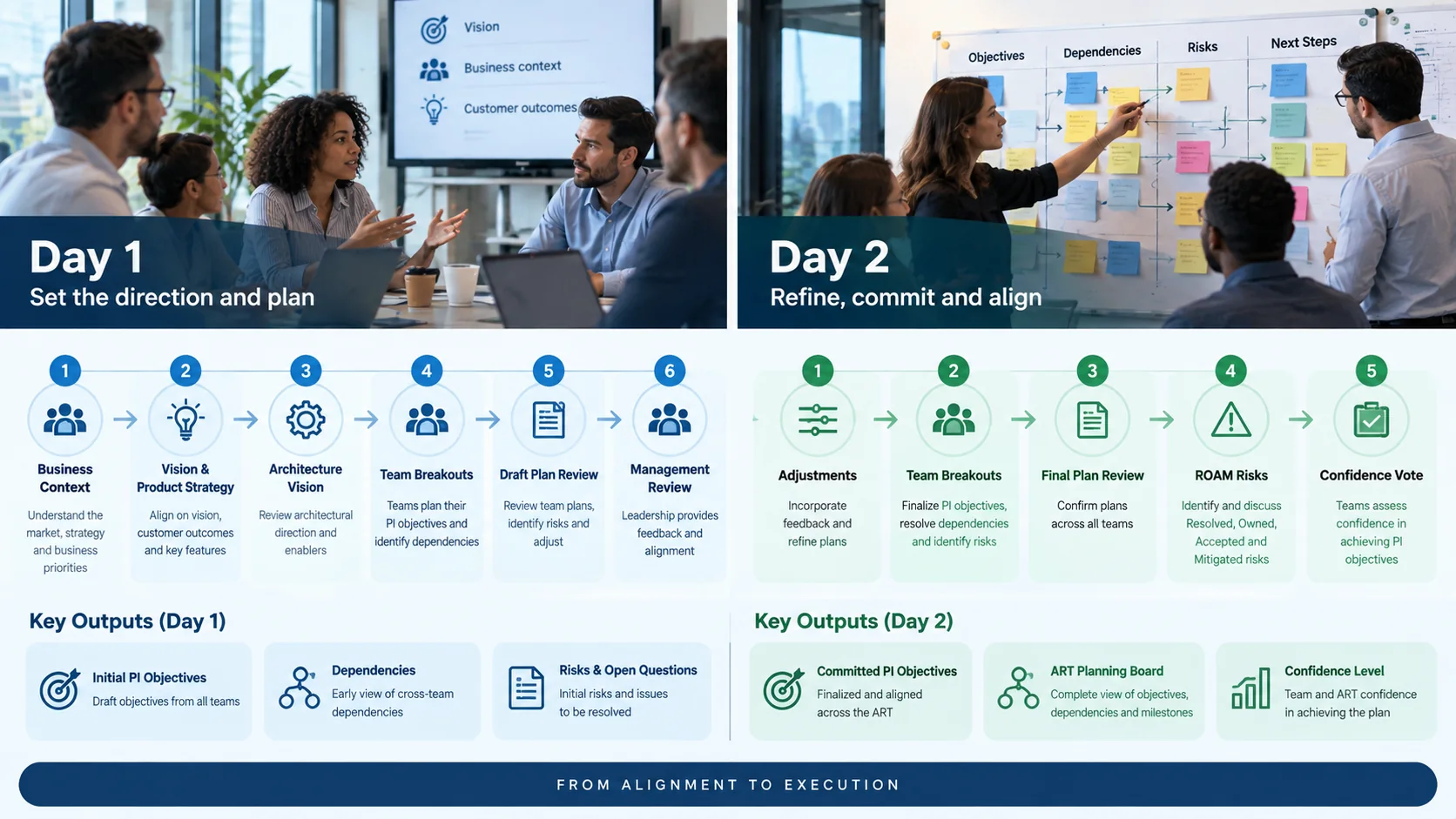
SAFe uses a structured two-day PI Planning agenda with defined sessions, timing, participants, and expected outputs.
The precise timing may vary, particularly for globally distributed ARTs, but the sequence creates a progression from context to team planning, alignment, problem solving and final confidence.
PI Planning Day 1
1. Business Context
Leadership provides an overview of the current business environment.
This may include:
- Business performance
- Customer needs
- Market changes
- Strategic priorities
- Competitive context
- Important constraints
This gives teams the “why” behind the upcoming work.
2. Product or Solution Vision
Product Management presents the current vision and priorities for the upcoming PI.
Teams should understand which outcomes and features matter most before beginning detailed planning.
3. Architecture Vision and Development Practices
Architecture and engineering leaders provide relevant technical direction.
The purpose is not to dictate every technical decision.
Instead, teams receive enough guidance to make plans that fit the broader architecture and technology strategy.
4. Planning Context
The RTE establishes the planning process, expectations, timing, constraints and important logistics.
Teams should know what they need to produce and when cross-team synchronization will occur.
5. Team Breakout #1
Teams now begin building their draft plans.
This is where high-level priorities become concrete planning conversations.
During the breakout, teams:
- Review features
- Consider team capacity
- Break work into appropriate elements
- Build high-level iteration plans
- Identify dependencies
- Identify risks
- Draft PI Objectives
- Coordinate with other teams
Dependencies should be discussed directly rather than merely recorded.
If Team A needs something from Team B, both teams need a common understanding of the dependency and its expected timing.
6. Draft Plan Review
Teams present their emerging plans.
Important information includes:
- Capacity and load
- Draft PI Objectives
- Dependencies
- Risks
- Important planning assumptions
The purpose is not to approve a final plan yet.
Instead, the review creates transparency and exposes issues that require broader resolution.
7. Management Review and Problem Solving
After draft plans have exposed constraints, leadership and relevant stakeholders work through problems that teams cannot solve independently.
Examples include:
- Scope exceeding capacity
- Conflicting priorities
- Resource constraints
- Major dependencies
- Architecture concerns
- Missing capabilities
This step is critical.
If every team is overloaded, asking everyone to “work harder” does not create a realistic plan. Management may need to adjust scope, priorities, resources or expectations.
PI Planning Day 2
1. Planning Adjustments
The second day begins by communicating adjustments resulting from the previous day’s draft plans and management problem-solving discussions.
Teams need to understand what changed before finalizing their plans.
2. Team Breakout #2
Teams return to planning with the updated context.
They refine their iteration plans, dependencies and PI Objectives.
Business Owners also work with teams on the business value associated with objectives.
3. Final Plan Review
Each team presents its final plan to the ART.
The review provides visibility into what the team intends to accomplish, important dependencies and the risks associated with the plan.
Business Owners can raise concerns and teams can make necessary adjustments.
4. ART PI Risks
Risks that affect the broader ART are discussed openly.
Rather than allowing these risks to disappear into meeting notes, PI Planning provides a structured way to decide how each risk should be handled.
This is commonly done using ROAM.
5. Confidence Vote
Once the plan has been presented and risks addressed, participants assess their confidence in the plan.
This is not intended as a ceremonial approval.
The vote provides feedback about whether the people responsible for delivery believe the plan is achievable.
6. Plan Rework When Necessary
If confidence is insufficient, the ART should understand why.
Low confidence can indicate:
- Too much scope
- Unresolved dependencies
- Unrealistic assumptions
- Resource constraints
- Architecture uncertainty
- Unaddressed risks
The plan can then be reworked before another confidence assessment.
7. Planning Retrospective
Before finishing, participants should identify ways to improve future PI Planning events.
This applies the same continuous-improvement mindset used elsewhere in Agile development to the planning process itself.
What Are PI Objectives?
PI Objectives summarize the business and technical goals that teams and trains intend to achieve during the upcoming Planning Interval.
They are important because a list of features or backlog items does not always communicate the actual business outcome a team intends to create.
A good objective translates planned work into language that business and technology stakeholders can understand.
For example, instead of an objective that simply says:
Implement authentication stories 145–162.
a more outcome-oriented objective might be:
Enable customers to authenticate securely using the new identity platform.
The second version communicates intent rather than merely referencing backlog items.
Committed vs Uncommitted PI Objectives
PI Objectives can be committed or uncommitted.
This distinction is frequently misunderstood.
Committed Objectives
Committed objectives represent goals the team plans to deliver based on the plan and available information.
Uncommitted Objectives
An uncommitted objective is not simply optional extra work that a team attempts only if everything else finishes early.
It is part of the plan, but uncertainty or risk prevents the team from making the same level of commitment.
Using uncommitted objectives can make uncertainty visible instead of hiding it inside an apparently certain plan.
That transparency gives stakeholders earlier information about areas where delivery may be less predictable.
What Is Business Value in PI Planning?
Business Owners assign business value to team PI Objectives during planning.
This creates an important conversation between teams and business stakeholders.
The purpose is not simply to produce a score.
The conversation helps clarify:
- Which outcomes matter most
- Whether teams understand business priorities
- Whether technical work has clear business relevance
- Where stakeholders may have different expectations
PI Objectives can later contribute to assessing ART predictability by comparing planned business value with the value achieved.
What Is the ART Planning Board?
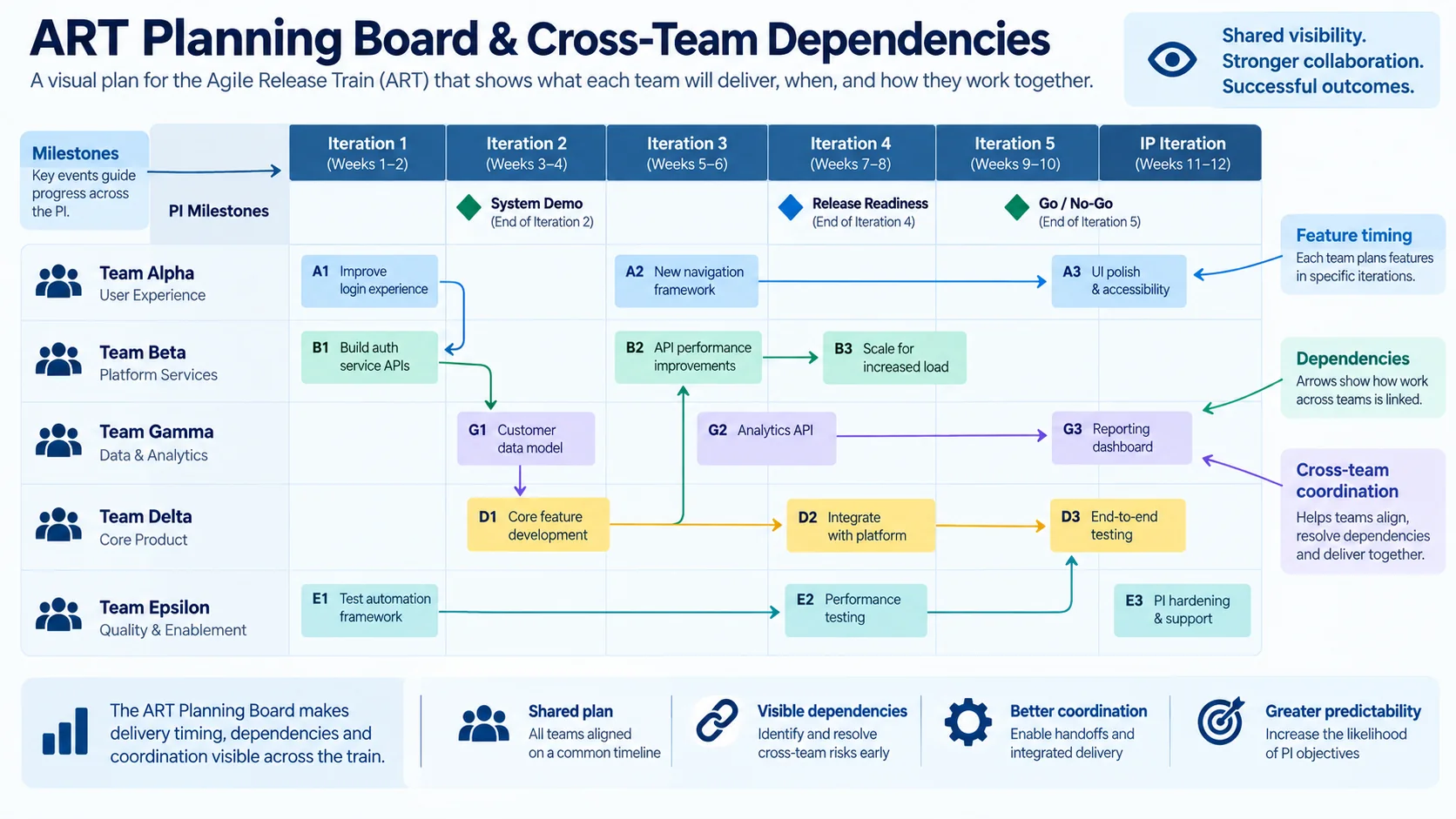
The ART Planning Board visualizes important elements of the emerging PI plan across teams.
Older SAFe material and many practitioners refer to this artifact as the Program Board, so you may encounter both terms.
The board typically makes visible:
- Feature delivery timing
- Dependencies between teams
- Relevant milestones
Its real value is visibility.
Consider an example:
Team A plans to deliver a customer application feature during Iteration 3, but it depends on an API from Team B that is not scheduled until Iteration 4.
Without cross-team visualization, both plans may look reasonable independently.
When placed together on the ART Planning Board, the conflict becomes obvious.
The teams can then negotiate timing before execution begins.
ART Planning Board vs Team Board
These should not be confused.
A team board helps an individual Agile Team manage its own work.
The ART Planning Board focuses on information that matters across teams—especially features, dependencies and milestones.
Trying to put every team-level task onto the ART Planning Board usually creates unnecessary complexity.
How to Manage Dependencies During PI Planning
Dependencies are one of the most important reasons for bringing the entire ART together.
A useful dependency discussion should answer:
- Which teams are involved?
- What exactly is needed?
- When is it needed?
- Who owns the coordination?
- What happens if the dependency is delayed?
Simply drawing a line between two items on a board is not enough.
The teams involved should understand and agree on the dependency.
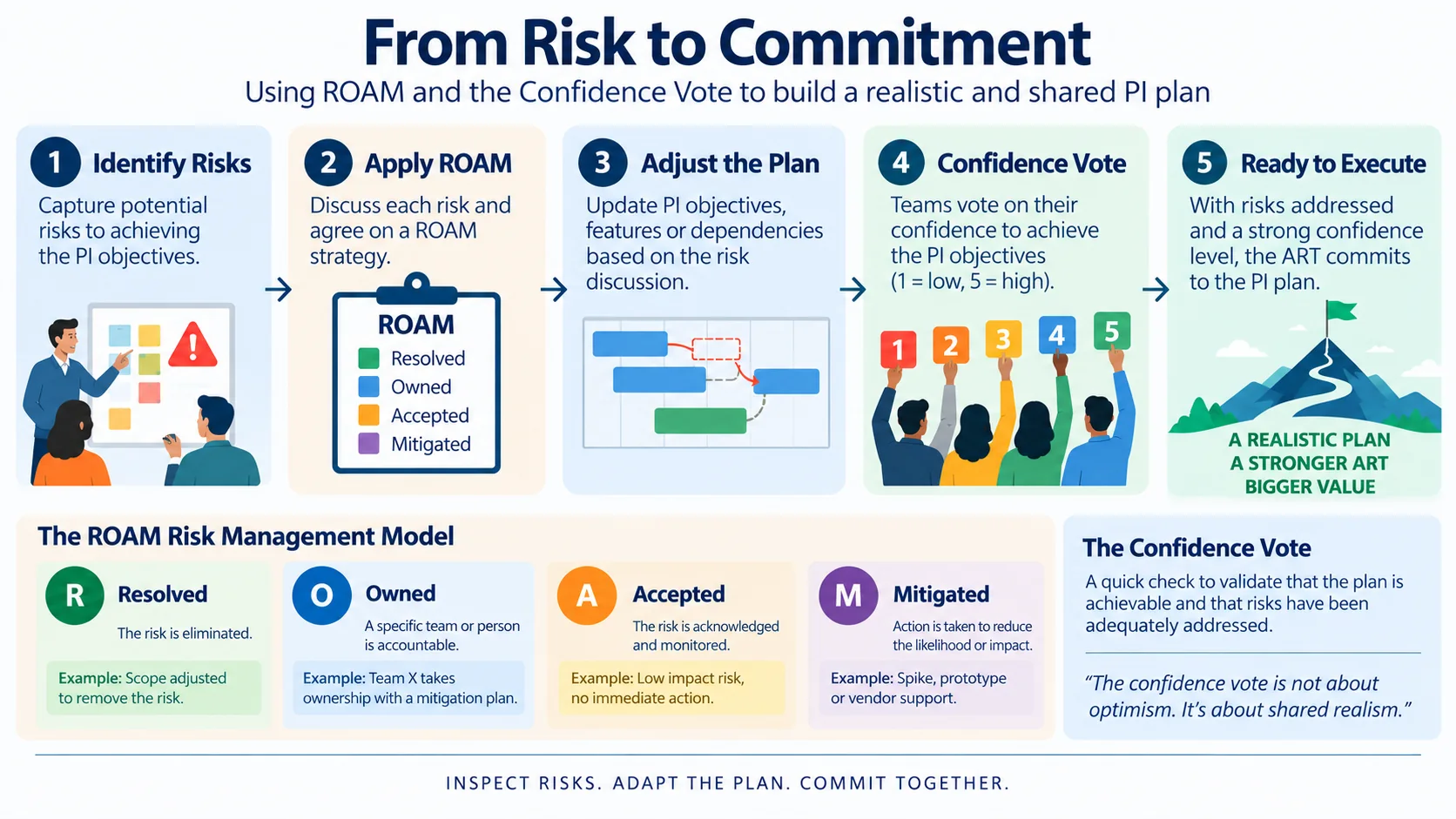
Managing ART PI Risks with ROAM
PI Planning exposes risks that may affect objectives or the broader ART.
SAFe commonly uses the ROAM approach to categorize these risks.
| ROAM | Meaning |
|---|---|
| Resolved | The risk has been addressed and no longer requires active management |
| Owned | Someone takes responsibility for managing the risk |
| Accepted | The risk is understood and accepted |
| Mitigated | Actions have been identified to reduce the probability or impact of the risk |
The value of ROAM is not the acronym itself.
Its value comes from preventing important risks from remaining ambiguous.
A risk should leave the discussion with a clear status rather than simply being recorded and forgotten.
What Is the PI Planning Confidence Vote?
The confidence vote measures how strongly teams and the ART believe they can deliver the established PI Objectives.
A common technique is a five-finger vote.
The precise mechanics matter less than the underlying principle: participants need a safe way to express genuine concerns.
A high confidence score obtained because people are afraid to disagree is less useful than a lower score that exposes a real planning problem.
What Happens If the Confidence Vote Is Low?
A low confidence vote should trigger investigation rather than pressure to vote differently.
The RTE should help uncover the reasons behind low confidence.
For example:
- Is capacity unrealistic?
- Are critical dependencies unresolved?
- Is the scope too large?
- Are objectives unclear?
- Are technical assumptions uncertain?
- Is an external dependency outside the ART’s control?
Once the causes are understood, teams and stakeholders can adjust the plan.
That might mean changing scope, sequencing work differently, resolving a dependency or turning an uncertain objective into an uncommitted objective.
The goal is not to force a high score.
The goal is to create a plan people genuinely believe is workable.
What Are the Outputs of PI Planning?
A successful PI Planning event should leave the ART with concrete planning outputs rather than simply two days of discussion.
Important outputs include:
- Team PI Objectives that communicate intended business and technical outcomes
- Committed and uncommitted objectives that make different levels of uncertainty visible
- ART Planning Board showing important feature timing, dependencies and milestones
- Identified ART risks with appropriate ROAM decisions
- High-level iteration plans developed by teams
- Shared understanding of dependencies across teams
- Confidence in the plan assessed through confidence voting
These artifacts create a common starting point for execution during the PI.
Role of the Release Train Engineer in PI Planning
The Release Train Engineer (RTE) facilitates PI Planning.
The RTE helps:
- Prepare the event
- Coordinate participants
- Manage the agenda
- Facilitate cross-team communication
- Surface impediments
- Coordinate risk discussions
- Facilitate confidence voting
- Keep planning focused on outcomes
The RTE should not create the entire plan for the teams.
Effective facilitation enables teams to build and coordinate their own plans within the broader ART context.
Role of Product Management
Product Management provides critical product context for planning.
Responsibilities include communicating the product vision and helping teams understand the features and priorities expected for the upcoming PI.
Product Management also participates throughout planning as teams discover questions, constraints and trade-offs.
Role of Business Owners
Business Owners connect PI Planning to business priorities.
They provide business context, participate in important planning decisions, collaborate with teams and assign business value to PI Objectives.
Their active participation matters because teams need access to people who can clarify business priorities while the plan is being created.
Role of System Architect and Engineering
Architecture roles provide the technical context teams need to plan coherently across the ART.
This can include:
- Architecture vision
- Technical constraints
- Enablers
- Nonfunctional requirements
- Technology evolution
- Cross-team technical dependencies
The objective is to create enough architectural alignment without removing team-level technical decision-making.
Role of Scrum Masters and Team Coaches
Scrum Masters and Team Coaches facilitate planning at the team level and help teams collaborate across the ART.
They can help teams:
- Stay within the planning timebox
- Identify risks
- Surface dependencies
- Resolve impediments
- Coordinate with other teams
- Create realistic plans
Role of Product Owners
Product Owners help teams understand and refine the work associated with upcoming objectives and features.
During team breakouts, they work closely with team members to connect backlog details with the broader product priorities presented by Product Management.
How to Run Remote or Distributed PI Planning
PI Planning does not always happen with everyone in one physical location.
Global organizations may have ART members distributed across countries and time zones.
Remote PI Planning can work effectively, but it requires deliberate design.
Use a Shared Digital Planning Environment
Everyone should work from the same source of planning information.
A digital environment should make objectives, features, dependencies, risks and changes visible to participants.
Design Around Time Zones
A schedule that is convenient for headquarters but consistently places another team outside reasonable working hours can damage participation.
Consider rotating inconvenience or adapting the agenda when necessary.
Create Effective Breakout Rooms
Teams need private working spaces as well as easy ways to communicate with other teams.
Cross-team conversations should not require complicated meeting administration.
Use Strong Facilitation
Remote meetings make it easier for participants to become passive.
RTEs and team facilitators should deliberately encourage participation and regularly surface unresolved issues.
Test Everything Beforehand
Check conferencing, permissions, boards, screen sharing and breakout functionality before Day 1.
PI Planning Tools
PI Planning can be performed with physical boards, digital collaboration platforms, Agile lifecycle-management systems or specialized PI Planning tools.
The tool should support the process rather than define it.
Useful capabilities include:
- Team planning
- PI Objective tracking
- Dependency visualization
- Feature planning
- Risk tracking
- Milestone visibility
- Remote collaboration
A sophisticated platform cannot compensate for unclear priorities, missing stakeholders or unrealistic capacity.
Common PI Planning Mistakes
1. Creating the Plan Before the Event
If leadership arrives with every team assignment already finalized, PI Planning becomes a presentation rather than collaborative planning.
2. Bringing Too Much Work
Demand that significantly exceeds capacity creates unrealistic plans and weak confidence.
3. Missing Business Owners
Teams need access to people who can resolve business questions during planning.
4. Ignoring Dependencies
Teams can individually create excellent plans that collectively fail because dependencies do not align.
5. Treating Uncommitted Objectives as Bonus Work
Uncommitted objectives should reflect uncertainty in the plan. They should not simply become a bucket for optional tasks.
6. Treating the Confidence Vote as a Formality
If everyone is expected to vote five regardless of concerns, the exercise loses its value.
7. Overloading the ART Planning Board
The ART Planning Board should make cross-team coordination easier. Filling it with every task can hide the dependencies it was designed to expose.
8. Forgetting the Plan After PI Planning
The PI plan is not a document to archive immediately after the event.
Objectives, risks and dependencies should remain visible during execution.
9. Confusing Alignment with Rigidity
A PI plan creates alignment, but Agile teams still need to respond to learning and changing conditions during execution.
How to Improve Your Next PI Planning Event
Improving PI Planning does not necessarily require adding more meetings.
Focus on the quality of preparation and decision-making.
Before the next event:
- Review feedback from the previous planning retrospective.
- Check that priorities are sufficiently clear.
- Confirm stakeholder availability.
- Review known dependencies early.
- Validate team capacity.
- Prepare the architecture and product context.
- Test collaboration tools.
- Make uncertainty visible instead of hiding it.
- Protect time for cross-team discussion.
- Use the confidence vote as real feedback.
What Happens After PI Planning?
PI Planning creates the initial aligned plan, but execution begins immediately afterward.
During the Planning Interval, teams continue delivering, learning and adapting.
The ART uses its regular events and synchronization mechanisms to maintain alignment.
Teams should continue monitoring:
- PI Objective progress
- Dependencies
- Risks
- Feature progress
- Milestones
- Capacity changes
- New information
A plan created during PI Planning should provide direction without preventing teams from responding intelligently to change.
How to Measure PI Planning Effectiveness
A successful PI Planning event should not be judged solely by whether it finished on time.
Consider questions such as:
- Did teams understand the business priorities?
- Were major dependencies identified?
- Were important risks addressed?
- Were objectives understandable to business and technology stakeholders?
- Did teams believe the plan was achievable?
- How much unexpected dependency work appeared later?
- Were Business Owners actively involved?
- Did teams achieve the intended PI Objectives?
- Did the next planning retrospective show improvement?
These indicators provide more useful information than simply measuring meeting attendance.
PI Planning vs Other Agile Planning Events
| Event | Primary Level | Main Purpose |
|---|---|---|
| PI Planning | ART | Align teams and plan the upcoming Planning Interval |
| Iteration Planning | Team | Plan work for the upcoming iteration |
| Daily Stand-up | Team | Coordinate daily execution |
| System Demo | ART | Evaluate the integrated solution increment |
| Inspect and Adapt | ART | Evaluate results and identify improvements |
Frequently Asked Questions About SAFe PI Planning
What does PI stand for in SAFe?
In current SAFe terminology, PI stands for Planning Interval. Older versions of SAFe used Program Increment, which is why both terms still appear in organizations and older material.
How long is a Planning Interval?
A Planning Interval typically lasts 8 to 12 weeks. It commonly includes several development iterations and an Innovation and Planning iteration.
How long does PI Planning take?
In Core SAFe, PI Planning typically takes two days. Organizations working across multiple time zones may adapt or extend the schedule while maintaining the collaborative planning process. In AI-Native SAFe, the corresponding event is PI Outcome Planning, designed as a one-day outcome-centered planning event.
Who leads PI Planning?
The Release Train Engineer (RTE) facilitates PI Planning and helps coordinate the ART throughout the event.
Who attends PI Planning?
The event involves the Agile Teams on the ART together with relevant leadership and stakeholders, including the RTE, Business Owners, Product Management and architecture roles.
What are the main outputs of PI Planning?
Important outputs include team PI Objectives and an ART Planning Board that provides visibility into feature delivery timing, dependencies and milestones. The planning process also identifies risks and creates shared understanding of the plan.
What is an ART Planning Board?
The ART Planning Board visualizes feature delivery timing, dependencies between teams and relevant milestones across the Planning Interval. It was commonly referred to as the Program Board in earlier SAFe terminology.
What is ROAM in PI Planning?
ROAM is a way of categorizing risks as Resolved, Owned, Accepted or Mitigated. It helps ensure important ART risks receive an explicit decision rather than simply being recorded.
What are uncommitted PI Objectives?
Uncommitted objectives are objectives included in the plan but not committed to at the same level because of uncertainty or risk. They should not be treated simply as optional work to attempt if extra time becomes available.
What is the confidence vote in PI Planning?
The confidence vote measures teams’ and the ART’s belief in their ability to deliver the established PI Objectives. Low confidence should lead to discussion and, when necessary, changes to the plan.
Can PI Planning be done remotely?
Yes. Distributed PI Planning can work effectively when teams have appropriate collaboration tools, shared planning information, strong facilitation and schedules designed carefully around time zones.
Is PI Planning the same as Sprint Planning?
No. PI Planning coordinates an entire Agile Release Train over a broader Planning Interval. Sprint or iteration planning focuses on the work of one Agile Team during a much shorter iteration.
Is PI Planning only about creating a plan?
No. The event also creates alignment, exposes dependencies and risks, connects teams with business stakeholders, establishes PI Objectives and assesses collective confidence in the resulting plan.
Conclusion: Effective PI Planning Creates Alignment, Not Just a Plan
SAFe PI Planning brings an entire Agile Release Train together to transform business priorities, product vision and technical direction into an aligned plan for the upcoming Planning Interval.
Its value does not come simply from gathering everyone for two days.
The value comes from the conversations the event makes possible.
Teams discover dependencies before those dependencies become delivery problems. Business Owners and teams clarify priorities directly. Risks become visible. Capacity is compared with demand. PI Objectives translate planned work into outcomes. The ART Planning Board creates cross-team transparency. Finally, confidence voting tests whether the people responsible for execution actually believe in the plan.
Successful PI Planning therefore depends on three things: strong preparation, genuine collaboration and realistic planning.
Organizations that treat PI Planning as a large status meeting miss much of its value. Organizations that use it as a collaborative planning and alignment event create a much stronger foundation for execution throughout the PI.
Continue Learning
Continue exploring SAFe, PI Planning and Agile delivery with these related TechTeamSynergy guides.
What Is SAFe?Understand the Scaled Agile Framework, its core concepts and how Agile delivery is coordinated at scale.
What Is Agile?Review Agile principles, methods and ways of working that underpin iterative planning and delivery.
AI Prompts for Project ManagersUse practical AI prompts for PI readiness, dependencies, objectives, risks and project decision support.
Business Agility GuideConnect Agile delivery with strategy, leadership, governance, technology and organizational adaptability.
How to Build Agile TeamsBuild collaborative teams with the autonomy, skills and practices needed for effective Agile execution.
Get Practical Insights from TechTeamSynergy
Join TechTeamSynergy Weekly for practical insights, frameworks, templates and resources covering Technology, Team and Transformation.