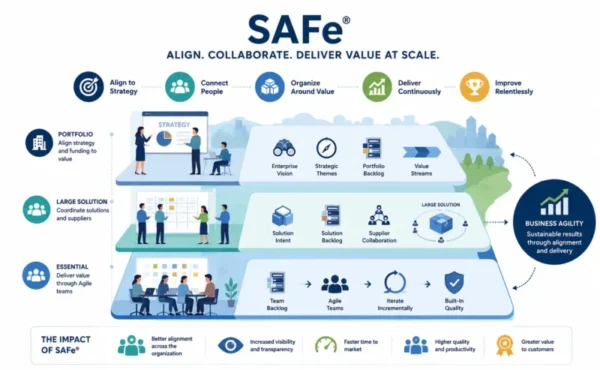
SAFe, or the Scaled Agile Framework, is a framework for applying Lean and Agile principles across multiple teams, value streams and portfolios. It helps larger organizations coordinate strategy, product development, planning, delivery, governance and continuous improvement when a single Agile team is no longer enough.
At the center of SAFe is the idea that organizations should organize people and work around the continuous flow of value rather than relying only on traditional project structures and functional silos.
SAFe introduces concepts such as Agile Release Trains (ARTs), Planning Intervals (PIs), PI Planning, Development Value Streams, Lean Portfolio Management, flow, DevOps and continuous learning.
This guide explains how those elements fit together, when SAFe can be useful, its benefits and limitations, and how the framework is evolving in 2026 as artificial intelligence changes how organizations plan and deliver value.
New to Agile? Start with our complete guide to Agile principles and methods before exploring Agile at enterprise scale.
What Is SAFe?
SAFe stands for Scaled Agile Framework.
It provides principles, practices and guidance for organizations that need to coordinate Agile delivery beyond a single team.
Imagine an organization where dozens of teams contribute to the same products, platforms or customer journeys.
Individual teams may work effectively using Scrum, Kanban or other Agile practices, but larger questions remain:
- How should teams align around common business objectives?
- How should dependencies between teams be managed?
- How should strategy connect with execution?
- How should investment decisions be made?
- How should architecture evolve across multiple products and systems?
- How should risks and governance be managed?
- How can value flow faster through the organization?
The Scaled Agile Framework attempts to address these broader coordination problems. Where governance extends beyond established ART roles, project responsibility and decision frameworks can help clarify cross-organizational ownership without replacing SAFe accountabilities.
Why Do Organizations Use the Scaled Agile Framework?
Agile practices often begin at team level.
A small cross-functional team can prioritize work, deliver frequently, gather feedback and adapt relatively quickly.
The challenge becomes more complicated when many teams contribute to interconnected solutions.
Large organizations frequently have:
- Shared platforms
- Complex dependencies
- Legacy systems
- Multiple suppliers
- Security requirements
- Regulatory obligations
- Portfolio-level investment decisions
- Long-term architecture concerns
- Hundreds or thousands of people contributing to related solutions
The Scaled Agile Framework creates coordination mechanisms intended to connect these different levels of work.
The objective should not be to make every team follow more process.
The objective is to improve the organization’s ability to turn strategy into valuable outcomes while coordinating work at scale.
SAFe vs Agile: What Is the Difference?
Agile and SAFe are related but they are not the same thing.
Agile is a broader way of working rooted in values and principles.
SAFe is a specific framework designed to apply Lean and Agile thinking across larger organizational environments.
| Agile | SAFe |
|---|---|
| Broad values and principles | Specific scaling framework |
| Often begins at team level | Coordinates teams, trains and portfolios |
| Does not prescribe one universal structure | Provides defined roles, events and organizational constructs |
| Focuses on adaptability and value delivery | Extends these ideas into enterprise coordination |
For the broader foundation, see our What Is Agile? guide.
The Foundations of SAFe
SAFe combines ideas from several management and delivery disciplines.
These include:
- Lean thinking
- Agile development
- Systems thinking
- Product development flow
- DevOps
- Continuous learning
- Customer centricity
Rather than viewing these as isolated techniques, SAFe attempts to integrate them into an enterprise operating model.
Scaled Agile Framework Core Values
SAFe identifies four core values that guide how the framework should be applied:
- Alignment
- Transparency
- Respect for People
- Relentless Improvement
Alignment
Large organizations need mechanisms for keeping teams, products, investments and strategy moving in compatible directions.
Alignment does not mean every decision must be centralized.
It means teams understand the broader objectives and constraints well enough to make effective local decisions.
Transparency
Problems are difficult to solve when information is hidden.
Transparency makes progress, risks, dependencies and constraints easier to understand.
Respect for People
Lean and Agile systems depend on capable people being trusted, supported and given appropriate responsibility.
Respect also means considering customers, partners, suppliers and the people operating the system.
Relentless Improvement
Organizations should continuously examine their products, processes, structures and ways of working.
SAFe therefore treats improvement as an ongoing capability rather than a one-time transformation initiative.
Scaled Agile Framework Principles
SAFe includes ten principles intended to guide decisions when applying the framework. The official SAFe Lean-Agile Principles provide the current reference for these ten decision-making principles.
They address ideas such as:
- Taking an economic view
- Applying systems thinking
- Preserving options when uncertainty exists
- Building incrementally with fast learning cycles
- Evaluating progress through working systems
- Making value flow without unnecessary interruptions
- Using cadence and synchronization
- Unlocking the motivation of knowledge workers
- Decentralizing appropriate decisions
- Organizing around value
These principles are more important than mechanically copying every practice.
When organizations understand the principles, they are better positioned to adapt practices without losing the reasoning behind them.
Organizing Around Value
Traditional organizations are frequently organized around functions such as:
- Business analysis
- Development
- Testing
- Operations
- Security
- Architecture
Work then moves between departments through queues and handoffs.
SAFe encourages organizations to also understand how value flows from an idea or customer need to an operational solution.
This leads to the concept of value streams.
What Is a Development Value Stream?
A Development Value Stream represents the sequence of activities needed to convert a business hypothesis or customer need into a digitally enabled solution.
Development Value Streams help organizations identify the people and systems involved in delivering value.
Agile Release Trains are typically organized within these value streams.
What Is an Agile Release Train?
The Agile Release Train (ART) is one of the central constructs in SAFe.
An ART is a long-lived team of Agile teams that develops, delivers and often operates one or more solutions within a Development Value Stream. See the official Scaled Agile guidance on Agile Release Trains for the current framework definition.
Instead of repeatedly assembling temporary project teams and then disbanding them, the ART provides a more persistent delivery structure.
Why Is It Called a Train?
The metaphor represents teams moving together on a shared cadence toward common objectives.
The intention is synchronization without requiring every team to perform identical work.
What Does an ART Include?
An ART typically brings together the people necessary to deliver value, including Agile teams and people performing product, architecture, coordination and other responsibilities.
Specific responsibilities depend on the context and SAFe implementation.
Agile Teams Inside an ART
An Agile Release Train is made up of multiple Agile teams.
SAFe describes an Agile Team as a cross-functional group, typically ten or fewer people, with the skills required to define, build, test and deliver value.
Teams may use Scrum, Kanban or other appropriate Agile practices.
The ART adds synchronization and alignment mechanisms across those teams.
What Is a Planning Interval?
A Planning Interval (PI) is a cadence-based timebox during which Agile Release Trains deliver continuous value aligned with PI Objectives. The official SAFe Planning Interval guidance describes the current PI construct and cadence.
This terminology is important.
PI currently means Planning Interval.
Older SAFe material and many older articles use the term Program Increment. When updating current SAFe content, use the current terminology unless discussing historical versions of the framework.
What Is PI Planning?
PI Planning is a cadence-based event for the entire Agile Release Train.
It aligns teams and stakeholders around a shared mission and vision for the upcoming Planning Interval.
Teams use PI Planning to understand priorities, identify dependencies and risks, establish objectives and coordinate their plans. A practical PI Planning agenda template helps translate that alignment into a clear two-day sequence of sessions and outputs.
Important outputs include PI Objectives and the ART Planning Board.
PI Planning should not be interpreted as creating a rigid long-term commitment where learning and adaptation stop.
It provides alignment and a planning baseline while teams continue learning and delivering throughout the interval.
Because this is a substantial topic on its own, see our complete SAFe PI Planning guide for the agenda, preparation, roles, objectives, risks, confidence vote and outputs.
Project managers and Agile leaders can also use our project management AI prompts to support dependency analysis, PI Objective reviews, risk preparation and cross-team coordination.
What Are PI Objectives?
PI Objectives summarize the business and technical goals teams and the ART intend to achieve during the upcoming Planning Interval.
They help translate planned work into understandable outcomes.
Objectives can be committed or uncommitted.
An uncommitted objective should not simply be interpreted as optional work that teams perform if they have spare time.
It remains part of the plan but carries uncertainty that makes commitment inappropriate.
What Is the ART Planning Board?
The ART Planning Board provides a visual representation of important delivery dates, dependencies and milestones across the train.
Its value comes from making cross-team coordination visible.
If one team’s work depends on another team’s feature or capability, identifying that dependency during planning can reduce surprises later.
Cadence and Synchronization in SAFe
Cadence creates a predictable rhythm for important activities.
Synchronization brings related activities together at useful points.
In complex environments, this can reduce the cost of repeatedly negotiating when planning, integration and feedback should happen.
However, cadence should support delivery rather than become bureaucracy for its own sake.
SAFe and Flow
Modern SAFe places substantial emphasis on flow.
Flow describes how value moves through a development system.
Organizations can have highly productive individuals while still experiencing poor overall flow because work spends significant time waiting in queues, approvals, dependencies or handoffs.
This is why optimizing utilization alone can be misleading.
A better question is:
How efficiently does valuable work move from idea to customer outcome?
The Six SAFe Flow Metrics
SAFe uses six flow metrics to help organizations understand their delivery system.
| Metric | What It Helps Understand |
|---|---|
| Flow Distribution | The types of work moving through the system |
| Flow Velocity | How many flow items are completed over time |
| Flow Time | How long a flow item takes to move through the system |
| Flow Load | How much work is currently in progress |
| Flow Efficiency | The relationship between active work time and total flow time |
| Flow Predictability | How consistently the system delivers expected results |
Metrics should help teams understand and improve the system rather than become simplistic performance targets for individuals.
Why Work in Progress Matters
When organizations start too much work simultaneously, work queues grow.
People switch context more frequently.
Dependencies accumulate.
Feedback arrives later.
SAFe therefore incorporates Lean concepts such as limiting work in progress and reducing batch sizes to improve flow.
SAFe and Product Development
Modern SAFe increasingly emphasizes products, customers and outcomes rather than treating Agile simply as a faster project-delivery method.
Teams need to understand:
- Who the customer is
- What problem needs to be solved
- What value the solution creates
- How success will be measured
- What evidence supports continued investment
Delivering more features is not automatically equivalent to delivering more value.
Customer Centricity
Customer centricity means putting the customer at the center of product decisions.
Teams should develop a deep understanding of customer needs and continuously test whether their solutions address those needs.
This creates an important connection between Agile delivery and product management.
Design Thinking in SAFe
Design Thinking can help teams explore problems before committing heavily to solutions.
Typical activities include:
- Understanding customers
- Defining problems
- Exploring possible solutions
- Building prototypes
- Testing assumptions
This helps reduce the risk of efficiently building something customers do not actually need.
SAFe and DevOps
Planning faster does not create business agility if releasing a change still requires months of manual coordination.
SAFe therefore incorporates DevOps and continuous delivery concepts.
DevOps focuses on improving collaboration and flow between development, operations and other groups involved in delivering and operating digital products.
Automation can support:
- Continuous integration
- Automated testing
- Security checks
- Deployment
- Infrastructure provisioning
- Monitoring
For a broader explanation, see our complete DevOps guide.
What Is Lean Portfolio Management?
Lean Portfolio Management (LPM) connects strategy and execution across a portfolio.
This is important because team-level agility has limited value if investment decisions remain disconnected from strategy.
A SAFe Portfolio contains value streams that deliver solutions within a common funding and governance model.
LPM helps leaders determine where investment should go and how portfolio work should evolve.
Strategy and Investment in SAFe
Traditional annual project funding can make adaptation difficult when priorities change.
Lean Portfolio Management encourages organizations to think about funding value streams and strategically important outcomes rather than treating every initiative as an isolated temporary project.
This does not eliminate financial governance.
It changes how governance and adaptability can work together.
Portfolio Kanban
Portfolio Kanban provides a mechanism for visualizing and managing significant portfolio initiatives as they move from ideas toward implementation.
The Portfolio Backlog captures and manages business and enabler epics associated with evolving portfolio products, services and solutions.
The objective is to make strategic work visible and avoid pushing unlimited initiatives into delivery simultaneously.
Lean Governance
Enterprise agility does not mean eliminating governance.
Organizations still need appropriate controls for areas such as:
- Investment
- Compliance
- Security
- Audit
- Architecture
- Risk
Lean governance aims to provide necessary oversight while reducing unnecessary delays and bureaucracy.
SAFe and Architecture
Large digital solutions require architectural thinking.
Agility does not mean architecture disappears.
Instead, architecture should support the ability to evolve systems over time.
Architectural work may include:
- Platforms
- APIs
- Cloud infrastructure
- Security
- Integration
- Data architecture
- Technical standards
- System quality
Architecture and delivery therefore need continuous collaboration.
Built-In Quality
Quality cannot simply be inspected into a product at the end of development.
When teams repeatedly defer quality work, technical debt accumulates and future changes become slower and riskier.
Practices that support built-in quality may include:
- Automated testing
- Continuous integration
- Peer review
- Security automation
- Clear acceptance criteria
- Appropriate architectural practices
Quality supports speed over the long term.
SAFe and Continuous Learning
A transformation cannot remain static while markets and technology continue changing.
Continuous learning encourages organizations to develop people, improve processes, experiment and learn from evidence.
This applies at multiple levels:
Individual → Team → ART → Portfolio → Enterprise
Inspect and Adapt
SAFe incorporates structured opportunities to evaluate results and improve.
Teams and trains should examine both:
- What they delivered
- How effectively their system delivered it
The goal is to identify systemic improvements rather than simply blame individuals when outcomes fall short.
Benefits of the Scaled Agile Framework
When SAFe is appropriate and implemented effectively, potential benefits include:
- Greater alignment between strategy and delivery
- Better coordination across teams
- Improved visibility of dependencies
- More regular planning and feedback
- Greater focus on customer value
- Better portfolio-level prioritization
- Improved flow
- More systematic continuous improvement
These are potential benefits rather than guaranteed results.
Introducing SAFe terminology and events does not automatically improve organizational performance.
Challenges and Criticisms of the Scaled Agile Framework
SAFe is a substantial framework, and that creates legitimate challenges.
Complexity
The number of concepts, responsibilities and practices can initially appear overwhelming.
Organizations can make this worse by attempting to implement every visible framework element simultaneously.
Process Over Outcomes
Teams can become focused on whether events occurred correctly rather than whether customers and the business received better outcomes.
Too Much Centralization
If scaling creates additional approval layers, teams may actually become less Agile.
Mechanical Implementation
Copying SAFe terminology without changing decision-making, funding, architecture or organizational behavior produces limited transformation.
Change Fatigue
Large transformations affect roles, responsibilities and established habits.
Leaders should treat SAFe adoption as organizational change rather than simply a training program.
SAFe vs Scrum
Scrum and SAFe operate at different levels.
| Scrum | SAFe |
|---|---|
| Lightweight framework | Enterprise scaling framework |
| Primarily team focused | Team, ART, solution and portfolio concerns |
| Sprints | Iterations plus Planning Intervals |
| Product Owner, Scrum Master, Developers | Includes additional ART and portfolio responsibilities |
| Product Backlog | Multiple interconnected backlogs and Kanban systems |
SAFe Agile teams may use Scrum, but SAFe is not simply “Scrum with more teams.”
SAFe vs Kanban
Kanban emphasizes visualizing work, managing flow and limiting work in progress.
SAFe incorporates many Lean and flow concepts and uses Kanban systems at different levels.
Therefore, Kanban and SAFe are not necessarily competing choices.
Kanban practices can operate inside a SAFe environment.
SAFe vs Traditional Project Management
Traditional project management often organizes work around temporary projects with defined scope, budget and schedules.
SAFe places greater emphasis on long-lived value streams, ARTs, adaptive planning and continuous delivery.
However, organizations may still need project-management capabilities for specific initiatives, contracts, infrastructure programs or regulatory commitments.
The goal should be selecting an operating model appropriate to the work rather than declaring one model universally superior.
When Does the Scaled Agile Framework Make Sense?
SAFe may be worth considering when:
- Many teams contribute to shared solutions.
- Cross-team dependencies are substantial.
- Strategy and execution are poorly connected.
- Portfolio priorities change faster than traditional funding processes.
- Products require coordination across business and technology groups.
- Enterprise governance must coexist with adaptive delivery.
- Organizations need a common model for aligning multiple Agile teams.
When Might SAFe Be Too Much?
A small independent product team may not need an enterprise scaling framework.
SAFe may also provide limited value when an organization’s primary problems are basic team-level issues that have not yet been addressed.
If one team cannot:
- Prioritize effectively
- Deliver working results
- Collaborate with customers
- Maintain quality
- Manage its work
adding enterprise-level coordination will not automatically solve those problems.
15-Minute SAFe Fit & Readiness Review
Before launching a SAFe transformation, use one short review to confirm that the organization has a scaling problem rather than a team-level problem.
- Minutes 0–3 — Define the scaling problem. Name the concrete issue: cross-team dependencies, weak strategy-to-execution alignment, slow portfolio decisions, excessive work in progress, poor flow or another measurable constraint.
- Minutes 3–6 — Check team fundamentals. Confirm that the underlying teams can prioritize, deliver working results, maintain quality and collaborate effectively. If not, fix the team system first.
- Minutes 6–9 — Test the need for an ART. Ask whether multiple teams genuinely share a value stream, dependencies and outcomes that require recurring coordination.
- Minutes 9–12 — Check leadership and portfolio readiness. Determine whether leaders are willing to change funding, priorities, decision rights, governance and work-in-progress limits—not just add SAFe events.
- Minutes 12–15 — Choose the next step. Assign an owner, one evidence-based action and a review date.
Decision outputs: TEAM-LEVEL IMPROVEMENT FIRST / PILOT SAFe / PREPARE ART & PORTFOLIO CHANGES / INVESTIGATE FURTHER.
How to Start a SAFe Transformation
A SAFe transformation should begin with business problems rather than framework implementation for its own sake.
1. Define the Business Problem
Examples might include:
- Slow time to market
- Too many dependencies
- Weak strategy-to-execution alignment
- Low delivery predictability
- Too much work in progress
- Slow customer feedback
2. Establish Leadership Alignment
Leadership behavior matters because many constraints exist outside Agile teams.
Leaders influence:
- Funding
- Organizational structure
- Decision rights
- Governance
- Priorities
- Culture
3. Identify Value Streams
Understand how value moves from customer need to delivered solution.
This helps determine where long-lived delivery structures may be appropriate.
4. Build the Agile Release Train
Organize the people and capabilities necessary to deliver within the Development Value Stream.
5. Establish the Backlogs and Vision
Teams need enough strategic and product context to understand what they are trying to achieve.
6. Prepare for PI Planning
Successful PI Planning requires preparation. A practical PI Planning checklist helps teams verify readiness before the event and follow through on objectives, dependencies and risks afterward.
Teams need context, priorities, vision and sufficient backlog readiness to have productive planning conversations.
7. Deliver, Measure and Learn
The launch of an ART is not the end of the transformation.
Measure flow, outcomes, quality and customer value.
Use evidence to improve the operating system.
How Should SAFe Success Be Measured?
Do not measure success only by counting:
- Certified employees
- ARTs launched
- PI Planning events completed
- Features delivered
Those are activities or outputs.
Better questions include:
- Are customers receiving more value?
- Is time to market improving?
- Is work flowing more efficiently?
- Are quality problems decreasing?
- Are strategic priorities reaching delivery faster?
- Are teams able to adapt when evidence changes?
- Are investments producing measurable outcomes?
SAFe and Business Outcomes
This distinction between outputs and outcomes is increasingly important.
An output might be:
- A feature
- A new application
- An API
- A platform capability
An outcome describes what changed because that output existed.
Examples include:
- Higher customer adoption
- Reduced processing time
- Improved conversion
- Reduced operational cost
- Improved reliability
Producing more features is not valuable if those features do not improve meaningful outcomes.
Scaled Agile Framework and AI in 2026
Artificial intelligence is changing how knowledge work, product development and software delivery operate.
In 2026, Scaled Agile introduced AI-Native SAFe, an evolution of the framework intended for organizations operating in an AI-driven environment.
The important idea is not simply adding AI tools to existing SAFe processes.
The emerging guidance examines how AI changes the operating model itself.
From Outputs to Outcomes
AI can accelerate the production of code, documents, prototypes and other outputs.
But producing more outputs faster does not guarantee better business results.
This increases the importance of:
- Customer feedback
- Outcome measurement
- Strategic alignment
- Fast experimentation
- Responsible governance
AI-Native Teams and ARTs
AI may change how teams perform analysis, development, testing, operations and knowledge work.
However, cross-team coordination remains important for complex products and systems.
Scaled Agile’s 2026 AI-Native guidance therefore continues to treat the Agile Release Train as an important organizational construct while evolving how teams and ARTs operate.
Core SAFe PI Planning vs AI-Native PI Outcome Planning
AI-Native SAFe does more than add AI tools to the traditional planning event. It introduces a different event model called PI Outcome Planning, designed around outcomes and milestones rather than simply compressing the established Core SAFe PI Planning agenda.
In Core SAFe, PI Planning typically aligns the ART around PI Objectives, team plans, dependencies, risks and the ART Planning Board. In AI-Native SAFe, PI Outcome Planning is a one-day event centered on defining PI Outcomes, translating them into Team Outcomes, and identifying the milestones needed to create an executable outcome-oriented plan.
| Area | Core SAFe | AI-Native SAFe |
|---|---|---|
| Planning event | PI Planning | PI Outcome Planning |
| Typical duration | Two days | One day |
| Primary focus | PI Objectives, team plans, dependencies and risks | PI Outcomes, Team Outcomes and milestones |
| Cross-team artifact | ART Planning Board | PI Outcome Planning Board |
| Planning emphasis | Team planning and coordination | Outcome breakouts plus team breakouts |
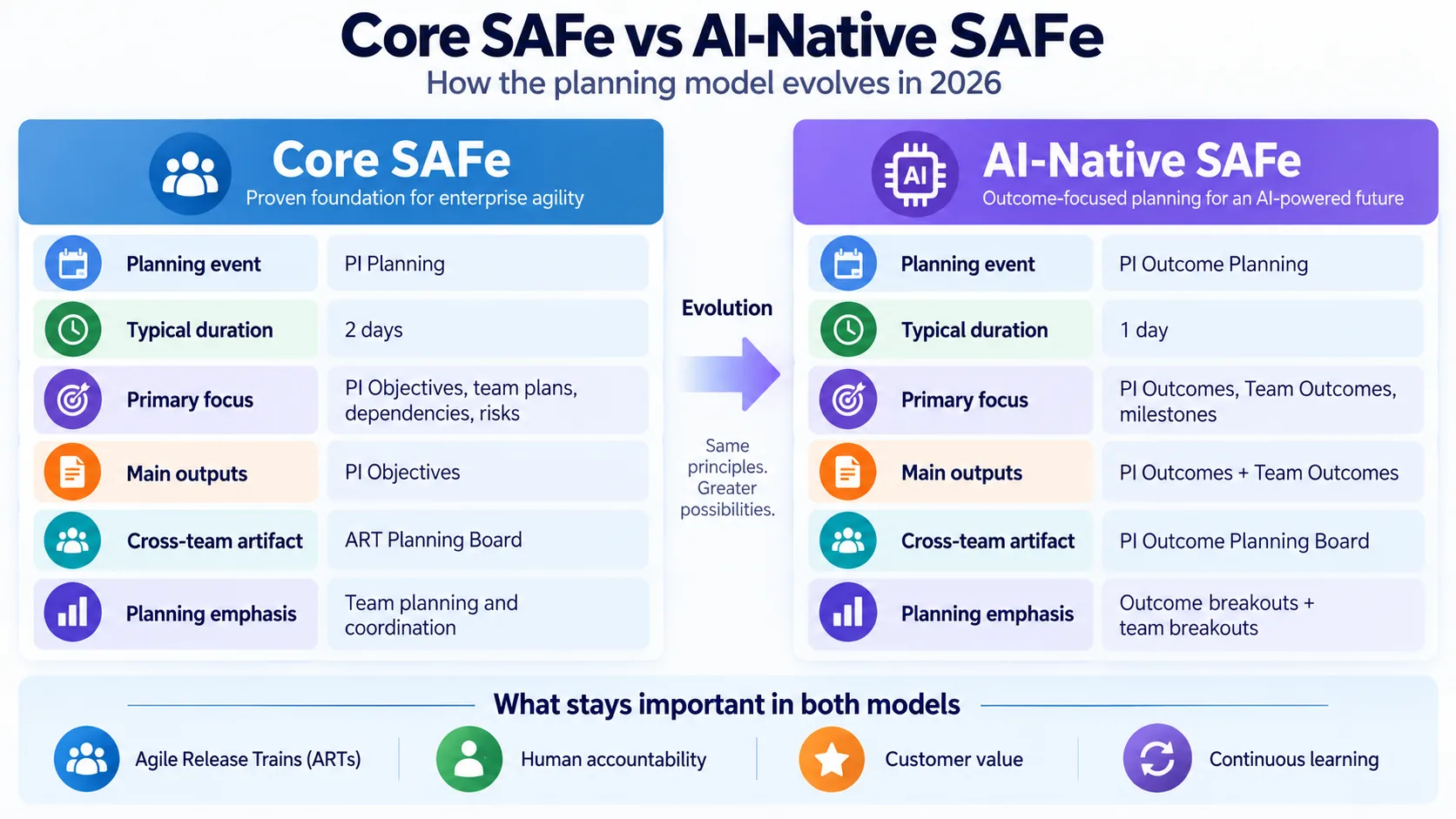
This distinction matters because organizations should first identify which SAFe operating model they are using rather than treating AI-Native SAFe as a shorter version of traditional PI Planning. See Scaled Agile’s official guidance on PI Outcome Planning for the current AI-Native event model.
AI can still assist with analysis, preparation and pattern detection, but customer understanding, strategic choices, risk decisions, dependencies and trade-offs remain human-accountable decisions.
Does AI Make SAFe Obsolete?
No conclusion that AI automatically eliminates the need for organizational coordination is supported by the current evolution of SAFe.
In fact, faster delivery may increase the importance of deciding:
- What should be built?
- Why should it be built?
- What outcome should it create?
- How will that outcome be measured?
- What risks are acceptable?
The bottleneck can shift from producing outputs to selecting and validating the right outcomes.
Common SAFe Implementation Mistakes
1. Treating SAFe as a Checklist
The framework should help solve business problems, not become a compliance exercise.
2. Launching Too Much Work
More initiatives can reduce flow rather than increase output.
3. Ignoring Portfolio Transformation
Team agility has limited impact if funding and strategic prioritization remain rigid.
4. Turning PI Planning Into Big-Batch Project Planning
PI Planning should create alignment while preserving learning and adaptation throughout the Planning Interval.
5. Measuring Teams by Utilization
Keeping everyone busy does not guarantee that value flows quickly through the system.
6. Measuring Success Only by Velocity
Local activity metrics do not necessarily represent customer or business value.
7. Ignoring Culture
A new framework cannot compensate for low trust, slow decision-making or leadership behaviors that prevent teams from adapting.
8. Copying the Framework Without Context
Organizations should understand why practices exist and adapt intelligently to their environment.
Frequently Asked Questions About SAFe
What does SAFe stand for?
SAFe stands for Scaled Agile Framework. It provides guidance for applying Lean and Agile principles across multiple teams, value streams and portfolios.
What is the main purpose of SAFe?
SAFe helps larger organizations align strategy and execution, coordinate multiple Agile teams and improve the flow of value across complex development environments.
What is an Agile Release Train?
An Agile Release Train is a long-lived team of Agile teams that incrementally develops, delivers and often operates one or more solutions within a Development Value Stream.
What does PI mean in SAFe?
In current SAFe terminology, PI means Planning Interval. It is a cadence-based timebox in which an Agile Release Train delivers continuous value aligned with PI Objectives.
What is PI Planning?
PI Planning is a cadence-based event for the entire Agile Release Train that aligns teams and stakeholders around a shared mission and vision for the upcoming Planning Interval.
Is SAFe the same as Scrum?
No. Scrum is a lightweight framework primarily focused on a Scrum Team. SAFe addresses coordination across multiple teams, Agile Release Trains, value streams and portfolios. Scrum can be used by teams operating within SAFe.
Can Kanban be used with SAFe?
Yes. SAFe incorporates Kanban and flow concepts at different levels of the framework, and Agile teams can use appropriate flow-based practices.
What is Lean Portfolio Management?
Lean Portfolio Management connects strategy and execution through portfolio-level investment, operations and governance practices.
Is SAFe only for software companies?
SAFe has strong roots in digital product and software-intensive systems development, but its principles and practices are also used in broader enterprise and government environments where many teams need to coordinate complex solution delivery.
Is SAFe difficult to implement?
It can be. SAFe addresses complex organizational problems and contains many concepts. Organizations should focus on their business problems and develop the necessary competencies rather than attempting to introduce every framework element at once.
What is AI-Native SAFe?
AI-Native SAFe is a 2026 evolution of the framework intended to address how AI changes strategy, product development, teams, Agile Release Trains, planning and outcome management.
Does SAFe guarantee faster delivery?
No. SAFe provides principles and practices that may help organizations improve alignment and flow, but results depend on leadership, implementation quality, architecture, skills, culture and the broader organizational system.
Conclusion
SAFe is best understood not as “Agile with more meetings,” but as a framework for addressing the coordination challenges that appear when Lean and Agile delivery extends across many teams and organizational levels.
Its major concepts connect:
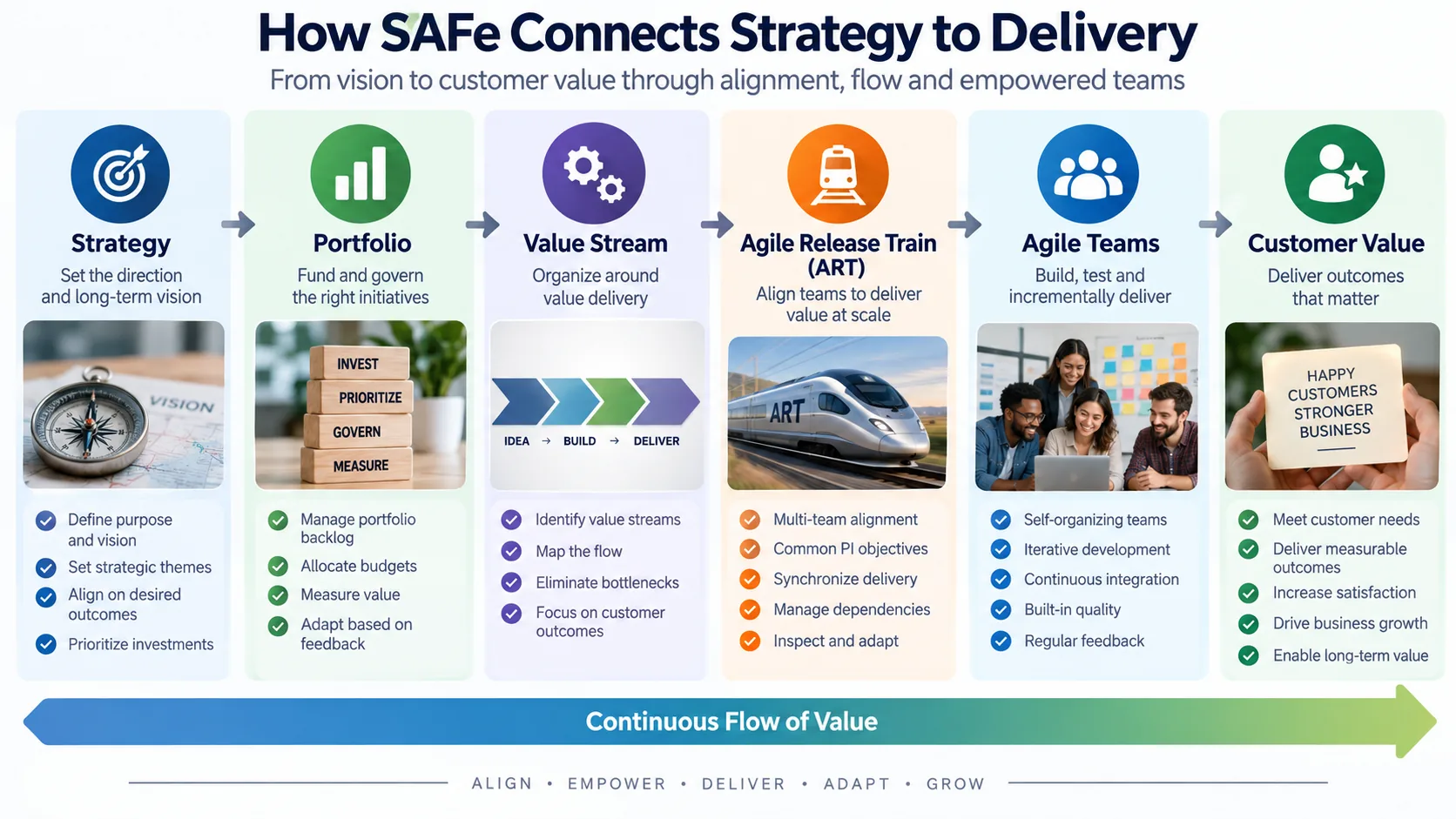
Strategy → Portfolio → Value Streams → Agile Release Trains → Agile Teams → Continuous Delivery → Customer Outcomes.
Agile Release Trains create long-lived structures for delivery.
Planning Intervals and PI Planning provide cadence and alignment.
Lean Portfolio Management connects investment with strategy.
Flow practices help organizations identify delays and excessive work in progress.
DevOps supports faster and more reliable delivery.
Continuous learning enables the organization to improve its system over time.
And the emerging AI-Native SAFe guidance reinforces an increasingly important principle: producing more output is not the same as creating more value.
The most useful question for leaders is therefore not:
“Have we implemented SAFe?”
It is:
“Are we improving our ability to turn strategy into measurable customer and business outcomes?”
SAFe is one approach to scaling change, while business agility across the organization also depends on leadership, culture, governance and fast decision-making beyond the framework itself.
Continue Learning
Continue exploring TechTeamSynergy with these related guides.
Comments are closed.