
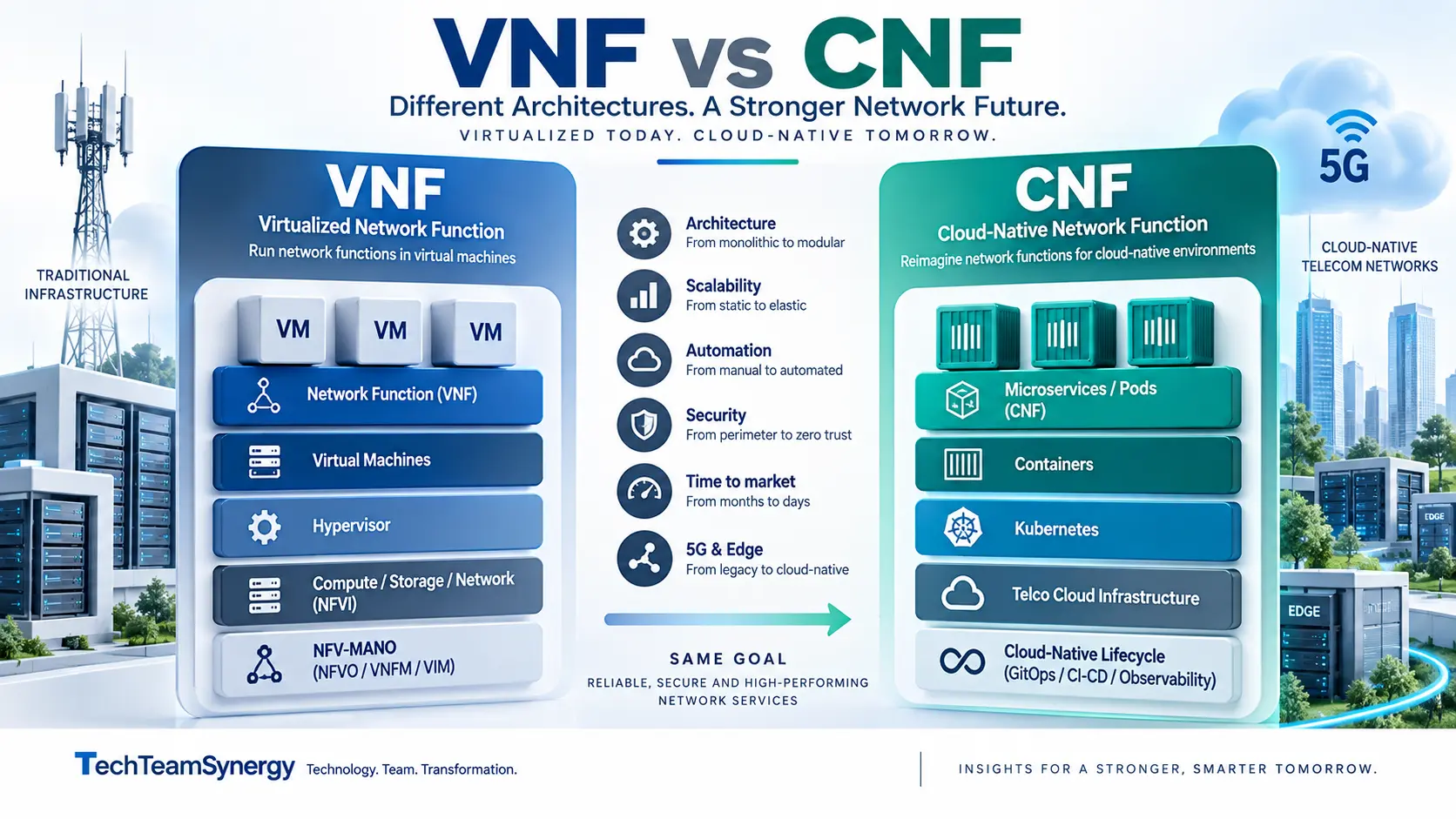
VNF vs CNF describes two different approaches to implementing network functions as software, but the difference goes much deeper than virtual machines versus containers.
A Virtualized Network Function (VNF) moves network functionality traditionally delivered by dedicated appliances into a virtualized software environment. A Cloud-Native Network Function (CNF) goes further by applying cloud-native design principles such as modularity, loose coupling, automation, elasticity, resilience, declarative management and modern software lifecycle practices.
VNFs remain widely deployed across telecom and enterprise networks, while CNFs are increasingly important in 5G, edge computing and Telco Cloud architecture, where virtual machines, containers, Kubernetes, automation and telecom orchestration increasingly coexist across distributed infrastructure.
If you want to strengthen the scripting skills behind API-driven network automation and cloud-native operations, start with our Python beginner guide.
This guide compares VNF vs CNF architecture, infrastructure, orchestration, scalability, performance, resilience, security and lifecycle management. It also explains why VNFs and CNFs are likely to coexist rather than treating cloud-native transformation as a simple replacement of one technology by another.
VNF vs CNF: Quick Answer
VNF: A Virtualized Network Function implements a network function as software in a virtualized NFV environment, commonly using virtual machines.
CNF: A Cloud-Native Network Function is designed around cloud-native architectural principles and commonly runs using containers and Kubernetes.
Key difference: VNF vs CNF is primarily an architectural and lifecycle-management distinction—not simply a comparison between virtual machines and containers.
Containers alone do not make a network function cloud-native. Cloud-native design also involves characteristics such as modularity, loose coupling, resilience, automation, declarative management and observability.
VNF vs CNF Comparison
| Area | VNF | CNF |
|---|---|---|
| Full name | Virtualized Network Function | Cloud-Native Network Function |
| Primary concept | Virtualize a network function | Design a network function using cloud-native principles |
| Common deployment model | Virtual machines | Containers / Kubernetes |
| Application architecture | Can retain appliance-like or larger software components | Typically more modular and cloud-native |
| Infrastructure | NFVI / virtualized infrastructure | Cloud-native or Telco Cloud infrastructure |
| Lifecycle management | Traditionally NFV-MANO oriented | Cloud-native lifecycle plus telecom orchestration |
| Typical orchestration | NFV-MANO and VNF/VM lifecycle management | Kubernetes/cloud-native lifecycle combined with telecom orchestration |
| Scaling | Depends on VNF architecture and lifecycle support | Designed to make elasticity and automation easier |
| Software delivery | Often release-oriented | Better aligned with CI/CD and modern software delivery |
| Typical role | Established NFV deployments | Modern cloud-native telecom environments |
This table describes common implementation patterns rather than absolute technical rules. A VNF is not required to be monolithic, and a CNF is defined by more than its packaging technology.
What Is a Virtualized Network Function (VNF)?
A Virtualized Network Function is a software implementation of a network function designed to run in a virtualized NFV environment.
Examples can include:
- Virtual routers
- Virtual firewalls
- Virtual session border controllers
- Virtual load balancers
- Virtual EPC components
- Virtual IMS components
- Virtual security functions
Before NFV, many of these functions were tightly associated with dedicated physical appliances. Virtualization helped separate network-function software from the underlying hardware.
A VNF can therefore run on shared compute, storage and networking infrastructure rather than requiring a dedicated appliance for every function. This architectural transition is part of the broader Network Functions Virtualization (NFV) model.
How Does a VNF Work?
In a traditional NFV deployment, a VNF commonly runs inside one or more virtual machines on NFV Infrastructure (NFVI).
The infrastructure provides resources such as:
- CPU
- Memory
- Storage
- Networking
- Virtualization
The VNF can contain multiple components known as VNF Components (VNFCs). Depending on the implementation, lifecycle operations may include instantiation, configuration, scaling, healing, updating and termination.
These activities can be coordinated through NFV management and orchestration mechanisms such as the NFV Orchestrator (NFVO), VNF Manager (VNFM) and Virtualized Infrastructure Manager (VIM).
What Is a Cloud-Native Network Function (CNF)?
A Cloud-Native Network Function is a software implementation of a network function designed according to cloud-native architectural and operational principles.
These principles commonly include:
- Loose coupling
- Modular or microservice-oriented design
- Elasticity
- Resilience
- Automation
- Declarative management
- Immutability where appropriate
- Modern software delivery practices
- Observability
CNFs are frequently implemented using containers and orchestrated with Kubernetes. However, the architectural principles matter more than simply whether an application runs inside a container.
This broader view is consistent with the ETSI work on network virtualisation and telecom cloud infrastructure and the CNCF Cloud Native Definition, which emphasizes loosely coupled, resilient, manageable and observable systems rather than one specific packaging technology.
Does CNF Mean Containerized Network Function?
Important: CNF means Cloud-Native Network Function, not simply “Containerized Network Function.”
Containers are extremely common in cloud-native environments, which explains why CNF is sometimes informally interpreted as “containerized network function.”
However, putting an existing monolithic network application inside a container does not automatically transform it into a cloud-native application. Cloud-native design concerns application architecture, lifecycle, resilience, automation and operational characteristics.
This distinction becomes increasingly important as telecommunications moves from basic virtualization toward broader Telco Cloud architectures.
PNF vs VNF vs CNF: The Evolution of Network Functions
The evolution of telecom infrastructure can be simplified into three broad stages.
1. Physical Network Functions (PNFs)
A Physical Network Function typically combines network software with dedicated or tightly coupled hardware. Examples historically included physical routers, firewalls, mobile-core appliances and session border controllers.
2. Virtualized Network Functions (VNFs)
NFV introduced greater separation between network-function software and physical infrastructure. Network functions could operate as virtualized software, commonly using virtual machines.
3. Cloud-Native Network Functions (CNFs)
Cloud-native architecture takes the transformation further by redesigning network applications around cloud principles rather than simply virtualizing an existing appliance architecture.
This can improve modularity, automation, lifecycle management, resilience and elasticity when the application and infrastructure are designed appropriately.
The progression from PNF to VNF to CNF should therefore be understood as an evolution from hardware-centric networking toward increasingly software-driven and cloud-native operating models—not as three technologies where each one immediately eliminates the previous one.
VNF vs CNF Architecture
The architectural difference between VNFs and CNFs is more significant than the packaging difference.
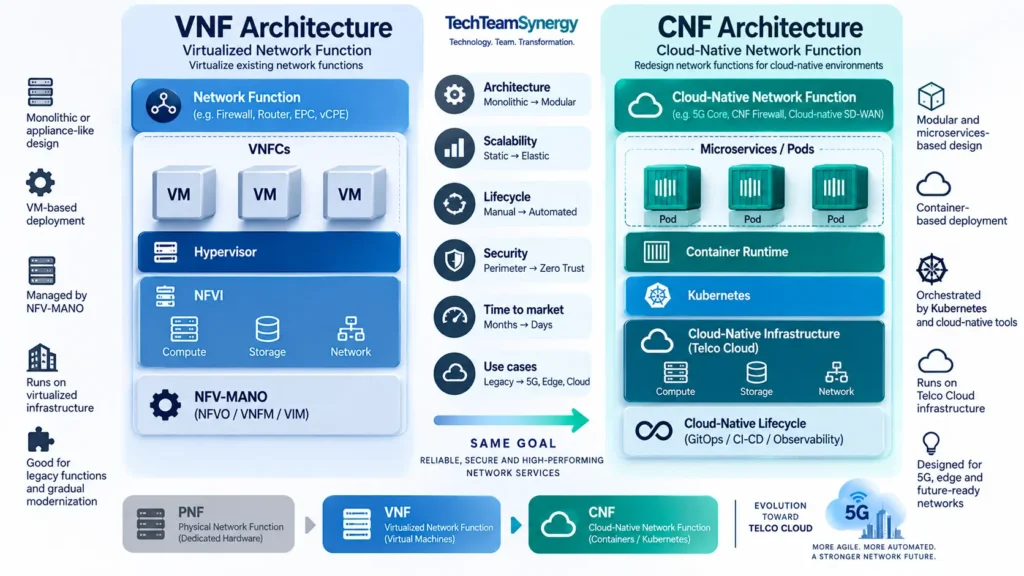
Typical VNF Architecture
A VNF may preserve architectural characteristics inherited from a physical network appliance. A traditional application can be adapted to run inside one or several virtual machines while retaining relatively large software components.
This approach made NFV migration practical because vendors did not necessarily need to redesign every application from the beginning.
Typical CNF Architecture
A CNF is designed around cloud-native principles. Functionality can be divided into smaller, more independently manageable components.
This architecture can make it easier to:
- Scale selected components
- Automate lifecycle operations
- Deploy updates more frequently
- Improve fault isolation
- Use declarative configuration
- Integrate with cloud-native platforms
These advantages depend on application design. They do not appear automatically simply because containers or Kubernetes are present.
In other words, a VNF strategy primarily virtualizes network-function software, while a CNF strategy goes further by redesigning how the application is built, deployed, scaled, updated and operated.
Virtual Machines vs Containers
The most familiar VNF vs CNF comparison concerns virtual machines and containers.
Virtual Machines
A virtual machine provides a virtualized computing environment with its own guest operating system. VMs offer strong isolation and remain appropriate for many telecommunications workloads.
Containers
Containers provide process isolation while sharing the host operating-system kernel. They are generally more lightweight than full virtual machines and integrate naturally with cloud-native orchestration platforms.
The official Kubernetes documentation describes containers as a way to package an application with its runtime dependencies while decoupling it from the underlying host infrastructure, helping make deployment more repeatable across environments.
But the Boundary Is Not Absolute
Telecom environments increasingly support hybrid architectures. Containers may run inside virtual machines. Different components of a network service may use different infrastructure models. Cloud-native principles can also be applied beyond a simple “container equals CNF” definition.
VM versus container is therefore useful for understanding common implementations, but it should not be treated as the complete definition of VNF versus CNF.
VNF Orchestration vs CNF Orchestration
VNFs have traditionally been managed within the ETSI NFV-MANO framework.
Important functional areas include:
- NFV Orchestrator (NFVO) — orchestration of network services and lifecycle processes
- VNF Manager (VNFM) — lifecycle management of virtualized network functions
- Virtualized Infrastructure Manager (VIM) — management of virtualized infrastructure resources
Cloud-native environments add another important orchestration layer. Kubernetes can manage container scheduling, desired state, service discovery, workload restart, resource allocation and other cloud-native lifecycle processes.
In modern Telco Cloud environments, these lifecycle systems increasingly need to operate together. Kubernetes can manage cloud-native workloads, while telecom orchestration may coordinate network services spanning CNFs, VNFs, physical functions, transport networks, edge infrastructure and multiple technology domains.
Does Kubernetes Replace NFV-MANO?
No. Kubernetes does not simply replace NFV-MANO. The two technologies operate at different—although increasingly connected—layers of modern telecom architecture.
Kubernetes is highly effective at scheduling and operating containerized workloads, maintaining desired state and supporting cloud-native application lifecycle processes.
NFV-MANO addresses broader telecom management and orchestration concerns, including coordination of network services, VNFs, infrastructure resources and lifecycle processes across heterogeneous environments.
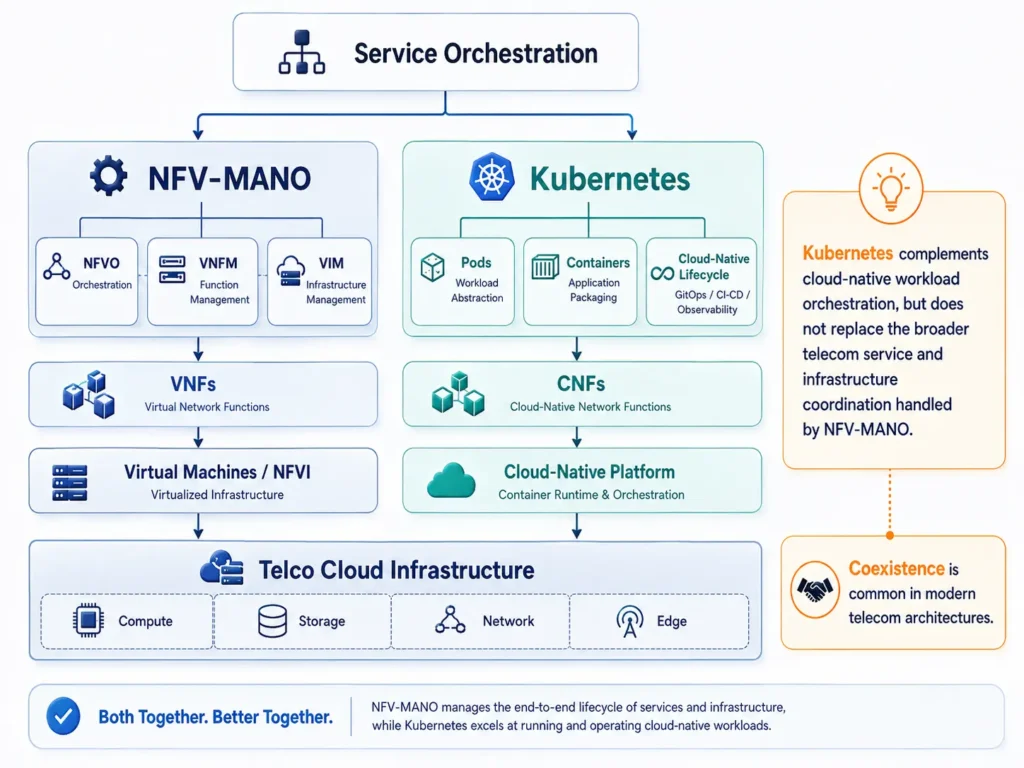
Telecommunications service orchestration may need to coordinate a much broader environment, including:
- Multiple Kubernetes clusters
- Virtual machines
- Physical network functions
- Transport networks
- Edge infrastructure
- Multiple vendors
- OSS/BSS systems
- End-to-end network services
Modern Telco Cloud architecture therefore increasingly requires integration between cloud-native workload orchestration and telecom-level service orchestration rather than choosing one model and eliminating the other.
ETSI continues to develop an open and interoperable NFV ecosystem for lifecycle management of virtualized and cloud-native services. See the ETSI ICT infrastructure and network virtualisation overview.
VNF vs CNF Scalability
CNFs are often described as inherently more scalable than VNFs. The reality is more nuanced.
Both VNFs and CNFs can scale. The important difference is how the application was designed and how its lifecycle is managed.
VNF Scaling
A VNF may support vertical scaling, horizontal scaling or a combination of both.
Scaling behavior depends on factors such as:
- Application architecture
- State management
- VNFC design
- Infrastructure resources
- Traffic distribution
- Lifecycle-management capabilities
CNF Scaling
Cloud-native architectures are typically designed to make horizontal elasticity and automated lifecycle management easier.
Individual components may be scaled according to workload requirements when the application architecture supports it.
However, Kubernetes cannot make a stateful or poorly designed network application infinitely elastic. Application architecture still determines what is realistically possible.
VNF vs CNF Performance
There is no universal rule that a CNF always has lower latency or higher throughput than a VNF. Performance depends on the complete system.
Important factors include:
- Application architecture
- CPU architecture
- NUMA topology
- Memory allocation
- Network I/O
- Container or VM configuration
- Kernel configuration
- Acceleration technologies
- Workload placement
- Traffic characteristics
High-performance telecom workloads may use technologies such as SR-IOV, DPDK, SmartNICs or other acceleration mechanisms regardless of whether the application is classified as a VNF or CNF.
Claims such as “CNFs are always faster than VNFs” should therefore be avoided. Performance should be validated using the actual application, infrastructure and traffic profile.
VNF vs CNF Resilience
Cloud-native architecture emphasizes resilience and automated recovery.
Applications can be designed so that individual components fail without causing the entire network function to fail. Kubernetes can also monitor workload state and recreate failed workloads.
However, infrastructure recovery is not the same as application-level service continuity.
A network function may maintain sessions, subscriber state, routing information or other important data. Effective resilience therefore requires deliberate application architecture, state management and infrastructure design.
VNF vs CNF Security
VNFs and CNFs both require security, but their attack surfaces and operational controls differ.
VNF Security
Security considerations can include:
- Hypervisor hardening
- VM image security
- Guest operating-system patching
- Management API security
- Network segmentation
- Identity and access management
- NFV-MANO security
CNF Security
Cloud-native environments add security concerns across:
- Container images
- Container registries
- Kubernetes API access
- RBAC
- Secrets
- Namespaces
- Pod security
- Network policies
- Software dependencies
- CI/CD pipelines
- Software supply chains
Modern Kubernetes environments should use current Pod Security Standards and appropriate admission controls rather than relying on older PodSecurityPolicy mechanisms.
Because CNF delivery increasingly relies on automated software pipelines, many of these controls also intersect with DevOps and CI/CD practices, including automated testing, image management, observability and continuous feedback.
CNF Security and Zero Trust Principles
Cloud-native environments benefit from applying least privilege and strong identity controls throughout the architecture.
Security teams should avoid assuming that internal workloads can automatically be trusted simply because they operate inside the same cluster.
Depending on the environment, controls can include:
- Strong workload identity
- Least-privilege RBAC
- Network segmentation
- Encryption
- Image scanning
- Signed artifacts
- Admission controls
- Secrets management
- Runtime monitoring
VNF vs CNF Observability
Observability becomes particularly important as applications become more distributed.
A monolithic application may produce logs and metrics from a relatively small number of components. A cloud-native network function can involve many distributed services and workloads.
Operations teams therefore need visibility across:
- Metrics
- Logs
- Events
- Application health
- Infrastructure health
- Network performance
- Dependencies
- Service-level indicators
Observability should be designed into the platform and application architecture rather than added only after deployment.
This makes observability a shared concern between networking, platform engineering and modern DevOps practices, where operational feedback is continuously used to improve reliability and delivery.
CNFs, CI/CD and GitOps
Cloud-native networking is not only about runtime infrastructure. It also changes how network software can be built, tested and delivered.
Modern practices can include:
- Continuous integration
- Automated testing
- Continuous delivery
- Declarative configuration
- Infrastructure as code
- GitOps workflows
- Automated security checks
This can shorten software feedback cycles and improve repeatability.
Telecommunications environments still need appropriate validation, change control, resilience and regulatory processes, particularly for critical network functions. Adopting CI/CD does not mean deploying every change immediately into a production mobile network.
VNF vs CNF in 5G Networks
5G has accelerated the adoption of cloud-native network architectures.
The 5G Core uses a service-based architecture that aligns well with modular software and cloud-native deployment models. CNFs are therefore increasingly associated with modern 5G Core implementations.
However, real telecommunications environments remain heterogeneous.
An operator may simultaneously operate:
- Physical network functions
- Legacy VNFs
- Modernized VNFs
- CNFs
- Multiple infrastructure platforms
5G transformation should therefore be viewed as an architectural and operational evolution rather than an immediate replacement of every VNF.
This coexistence is a defining characteristic of modern Telco Cloud architecture, where physical functions, VNFs and CNFs may operate simultaneously across centralized and edge infrastructure.
VNF vs CNF at the Edge
Edge computing creates additional requirements for network functions.
Edge locations may have:
- Limited compute resources
- Limited physical space
- Distributed operations
- Strict latency requirements
- Intermittent connectivity constraints
Lightweight and automated cloud-native architectures can be attractive in these environments.
However, workload placement should depend on application requirements rather than assuming that every CNF belongs at the edge.
Do CNFs Replace VNFs?
No. CNFs are not a universal replacement for VNFs.
CNFs represent an important direction for telecom architecture, but replacing every existing VNF is neither technically necessary nor economically justified in every environment.
VNFs can remain appropriate when:
- The existing function is stable and performs well
- Cloud-native redesign offers limited business value
- The vendor does not yet provide a mature CNF
- Migration risk is high
- VM isolation characteristics are desirable
- The existing operational model is effective
CNFs become particularly attractive when:
- Elasticity is important
- Frequent software evolution is required
- Automation is a major objective
- Cloud-native infrastructure already exists
- The application is designed for distributed operation
- Modern CI/CD practices are required
For many telecom operators, the practical architecture is therefore a hybrid VNF and CNF environment.
VNF and CNF Coexistence
Coexistence is not merely a temporary failure to complete cloud migration. It can be a rational architecture.
Different network functions have different:
- Lifecycle requirements
- Performance characteristics
- Vendor roadmaps
- State-management requirements
- Regulatory constraints
- Business priorities
A telecom cloud can therefore support VM-based and cloud-native functions simultaneously.
The architectural challenge becomes creating consistent infrastructure, orchestration, observability, security and automation across these different workload types.
For telecom operators, this hybrid operating model is increasingly part of a broader Telco Cloud strategy rather than simply a temporary intermediate stage.
How to Migrate from VNF to CNF
A successful VNF-to-CNF migration is not simply a VM-to-container conversion. It usually requires coordinated changes across application architecture, infrastructure, orchestration, operations, security and software delivery.
1. Assess the Existing VNF Portfolio
Identify which VNFs are strategically important, nearing end of life, difficult to scale, costly to operate or already targeted for modernization.
2. Evaluate Vendor Roadmaps
Determine whether existing vendors provide genuinely cloud-native implementations and understand their lifecycle and infrastructure requirements.
3. Define the Target Telco Cloud Architecture
Decide how virtual machines, containers, Kubernetes, networking, storage, acceleration and orchestration will work together.
4. Build the Cloud-Native Platform
A CNF strategy requires more than deploying Kubernetes.
Consider:
- Cluster architecture
- Networking
- Storage
- Observability
- Security
- Automation
- Image management
- Lifecycle management
- High availability
5. Adapt Operations
Teams may need new capabilities across Linux, Kubernetes, networking, APIs, automation, DevSecOps and observability.
6. Pilot Representative Network Functions
Choose workloads that test realistic requirements rather than only demonstrating that a container can start successfully.
Validate:
- Performance
- Resilience
- Scaling
- Upgrades
- Security
- Observability
- Operational processes
7. Migrate Incrementally
A phased approach reduces operational risk and allows teams to improve the platform as they gain experience.
VNF vs CNF: Which Should You Choose?
The answer depends on the workload.
| Requirement | VNF May Fit Better | CNF May Fit Better |
|---|---|---|
| Established mature workload | Strong fit | Depends on modernization value |
| Existing VM infrastructure | Strong fit | Requires cloud-native platform |
| Rapid software evolution | Possible | Typically stronger fit |
| Fine-grained elasticity | Architecture dependent | Typically stronger fit |
| Cloud-native automation | Possible with integration | Core architectural objective |
| Kubernetes ecosystem | Not normally primary environment | Common environment |
| Legacy vendor function | Often appropriate | Depends on vendor roadmap |
Do not choose CNF simply because it is newer.
Choose an architecture that fits the network function, operational model, infrastructure strategy and business requirements.
10-Minute VNF vs CNF Decision Review
Use this short review before deciding whether to keep a workload as a VNF, modernize it toward a CNF, or operate both models in parallel.
- Check workload maturity. Is the current VNF stable, supported and meeting performance targets, or is it already creating lifecycle, scaling or operational pain?
- Check platform readiness. Do you already have a production-ready Kubernetes/Telco Cloud platform with networking, storage, security, observability and HA capabilities suitable for this workload?
- Check lifecycle value. Would cloud-native automation, CI/CD, declarative configuration, independent component scaling or faster upgrades create measurable operational value?
- Check state and performance requirements. Validate packet-processing needs, state management, acceleration, latency, resilience and recovery behavior using the real traffic profile.
- Check the vendor roadmap and support model. Confirm CNF maturity, release lifecycle, migration support, interoperability and long-term support before making the architecture decision.
Decision outcome: KEEP VNF when the existing function remains effective and modernization value is limited; MIGRATE TO CNF when the application and platform are genuinely cloud-native ready; use HYBRID VNF + CNF when workloads have different maturity or requirements; choose INVESTIGATE FURTHER when performance, state, security or vendor dependencies are still uncertain.
Next action: pilot one representative function and measure deployment time, upgrade effort, resilience, scaling behavior, observability and operational workload before expanding the migration.
VNF, CNF and the Evolution Toward Telco Cloud
The VNF vs CNF discussion is ultimately part of a larger transformation.
Telecommunications infrastructure is evolving from appliance-centric networking toward software-driven Telco Cloud.
This environment can combine:
- PNFs
- VNFs
- CNFs
- Virtual machines
- Containers
- Kubernetes
- Edge infrastructure
- Automation
- CI/CD
- Observability
- AI-assisted operations
Modern Telco Cloud architecture therefore needs to manage heterogeneity rather than assuming one workload model will immediately replace every other model.
For the architectural foundation behind VNFs, read our complete guide to Network Functions Virtualization (NFV).
For the broader target architecture connecting NFV, VNFs, CNFs, Kubernetes, edge computing, automation and 5G, see our complete Telco Cloud guide.
Frequently Asked Questions About VNF vs CNF
What is the main difference between VNF and CNF?
A VNF implements a network function in a virtualized NFV environment, traditionally using virtual machines. A CNF implements a network function according to cloud-native architectural principles and commonly uses containers and Kubernetes.
Does CNF stand for Cloud-Native Network Function?
Yes. CNF means Cloud-Native Network Function. The term describes the architectural and operational characteristics of the network function rather than simply indicating that it has been packaged inside a container.
Are all CNFs containerized?
Containers are common in CNF implementations, but cloud-native design is broader than container packaging. The important characteristics include architecture, lifecycle, resilience, automation and operational practices.
Is a VNF always a virtual machine?
No. VNFs are strongly associated with VM-based NFV deployments, but modern network-function implementations can use different infrastructure models. The VNF/CNF distinction should not be reduced to one packaging technology.
Are CNFs faster than VNFs?
Not automatically. Performance depends on application design, infrastructure, networking, CPU architecture, acceleration, workload placement and configuration. Benchmark the actual network function rather than assuming performance from its VNF or CNF classification.
Can VNFs scale horizontally?
Yes. VNF scaling depends on application architecture and lifecycle capabilities. Horizontal scaling is not exclusive to CNFs.
Does Kubernetes replace NFV-MANO?
No. Kubernetes manages cloud-native workloads and infrastructure, while telecom orchestration may coordinate services across Kubernetes clusters, virtual machines, physical infrastructure, transport networks and multiple operational domains.
Are CNFs required for 5G?
Cloud-native architectures are highly relevant to modern 5G deployments, particularly 5G Core. However, real operator networks can contain a mixture of PNFs, VNFs and CNFs.
Should every VNF be migrated to a CNF?
No. Migration should be based on business value, vendor maturity, lifecycle requirements, performance, operational capabilities and target architecture. Some existing VNFs can remain appropriate for years.
Can VNF and CNF coexist?
Yes. Hybrid environments are common and are a practical feature of modern NFV and Telco Cloud architectures.
What is the difference between NFV, VNF and CNF?
NFV is the broader architectural approach for implementing and managing network functions as software on virtualized or cloud infrastructure. A VNF is a virtualized network function operating within an NFV environment, traditionally associated with virtual machines. A CNF is a network function designed around cloud-native architectural and operational principles.
For the complete architecture, see our NFV guide.
What is the future of VNF and CNF?
The broader direction is toward increasingly cloud-native Telco Cloud infrastructure, but VNFs and CNFs are likely to coexist as operators modernize different network functions at different speeds.
Conclusion: VNF vs CNF Is an Evolution, Not a Simple Replacement
VNFs helped transform telecom networks by separating network-function software from dedicated hardware. CNFs extend that transformation by applying cloud-native architecture, automation and modern lifecycle-management principles to network software.
The key distinction should not be reduced to “VNF equals VM and CNF equals container.” The deeper difference involves application architecture, orchestration, elasticity, resilience, software delivery and operational practices.
VNF virtualizes the network function. CNF redesigns it around cloud-native principles.
Modern Telco Cloud increasingly needs to support both.
Continue Learning
Continue exploring the TechTeamSynergy telco cloud and network virtualization cluster with these related guides.
Comments are closed.