

Workplace burnout is associated with chronic workplace stress that has not been successfully managed. It is more specific than simply feeling tired after a demanding day or experiencing temporary pressure during a busy project.
The World Health Organization (WHO) includes burnout in the International Classification of Diseases (ICD-11) as an occupational phenomenon, not as a medical condition. WHO describes it through three dimensions related to exhaustion, increased mental distance or cynicism toward work, and reduced professional efficacy.
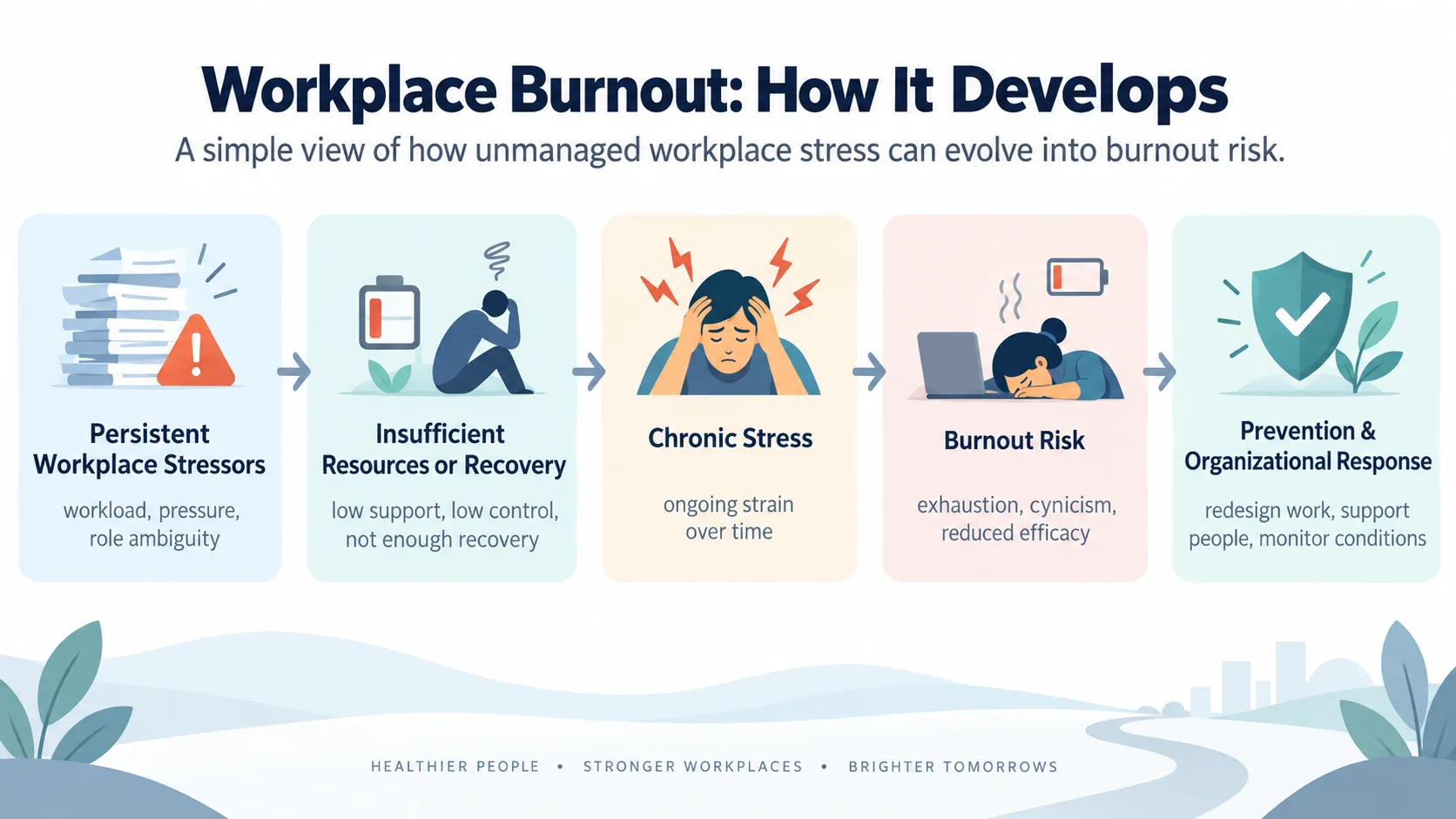
A practical way to understand workplace burnout is:
Persistent Workplace Stressors → Insufficient Resources or Recovery → Chronic Stress → Burnout Risk → Prevention & Organizational Response
This guide explains what workplace burnout means, how it differs from ordinary workplace stress, the workplace conditions that can contribute to it, warning signs organizations and individuals may notice, and how leaders and organizations can focus on prevention and sustainable work design.
The World Health Organization’s explanation of burnout in ICD-11 provides the authoritative starting point for understanding the concept.
What Is Workplace Burnout?
Workplace burnout is an occupational phenomenon associated with chronic workplace stress that has not been successfully managed.
This distinction matters.
Burnout should not become a general label for:
- Having a difficult day
- Feeling temporarily tired
- Working through a short busy period
- Disliking a particular task
- Experiencing pressure before an important deadline
These experiences can be challenging, but they are not automatically burnout.
WHO also specifies that burnout refers to the occupational context. The term should therefore not simply be extended to every difficult or exhausting situation in life.
Is Workplace Burnout a Medical Condition?
According to WHO’s ICD-11 classification, burnout is an occupational phenomenon rather than a medical condition.
This is an important distinction for employees, managers and organizations.
Managers should not attempt to clinically diagnose employees based on changes in behavior or work performance.
Instead, managers can focus on what they are responsible for:
- Workload
- Priorities
- Working conditions
- Role clarity
- Available resources
- Team relationships
- Communication
- Organizational support
If someone has concerns about their health or wellbeing, appropriate professional support may be more suitable than attempting to self-diagnose from an online checklist.
What Are the Three Dimensions of Workplace Burnout?
WHO describes burnout through three dimensions.
1. Energy Depletion or Exhaustion
The first dimension concerns a persistent sense of depleted energy associated with work.
This is different from the temporary tiredness that can follow an unusually demanding day.
2. Increased Mental Distance or Cynicism Toward Work
The second dimension involves greater mental distance from the job or increasingly negative or cynical feelings related to work.
Someone who previously engaged actively with work may become increasingly detached from it.
3. Reduced Professional Efficacy
The third dimension concerns reduced professional efficacy.
People may feel less effective in their work or experience greater difficulty sustaining their previous level of contribution.
These three dimensions provide a more precise framework than using the word “burnout” to describe every form of workplace pressure.
Workplace Stress vs Burnout: What Is the Difference?
Workplace stress and workplace burnout are related, but they are not interchangeable.
| Workplace Stress | Workplace Burnout |
|---|---|
| Broad response to workplace pressures and demands | Specific occupational phenomenon |
| Can occur during temporary or persistent pressure | Associated with chronic workplace stress that has not been successfully managed |
| Can have many workplace causes | Characterized by the three dimensions identified by WHO |
| Focus on managing stressors and demands | Focus on prevention, chronic workplace conditions and appropriate response |
For practical strategies addressing workload, priorities, control, support and workplace pressure, see our How to Manage Stress at Work guide.
What Causes Workplace Burnout?
There is no single workplace condition that explains every experience of burnout.
However, chronic workplace stress can be influenced by how work is designed, organized and managed.
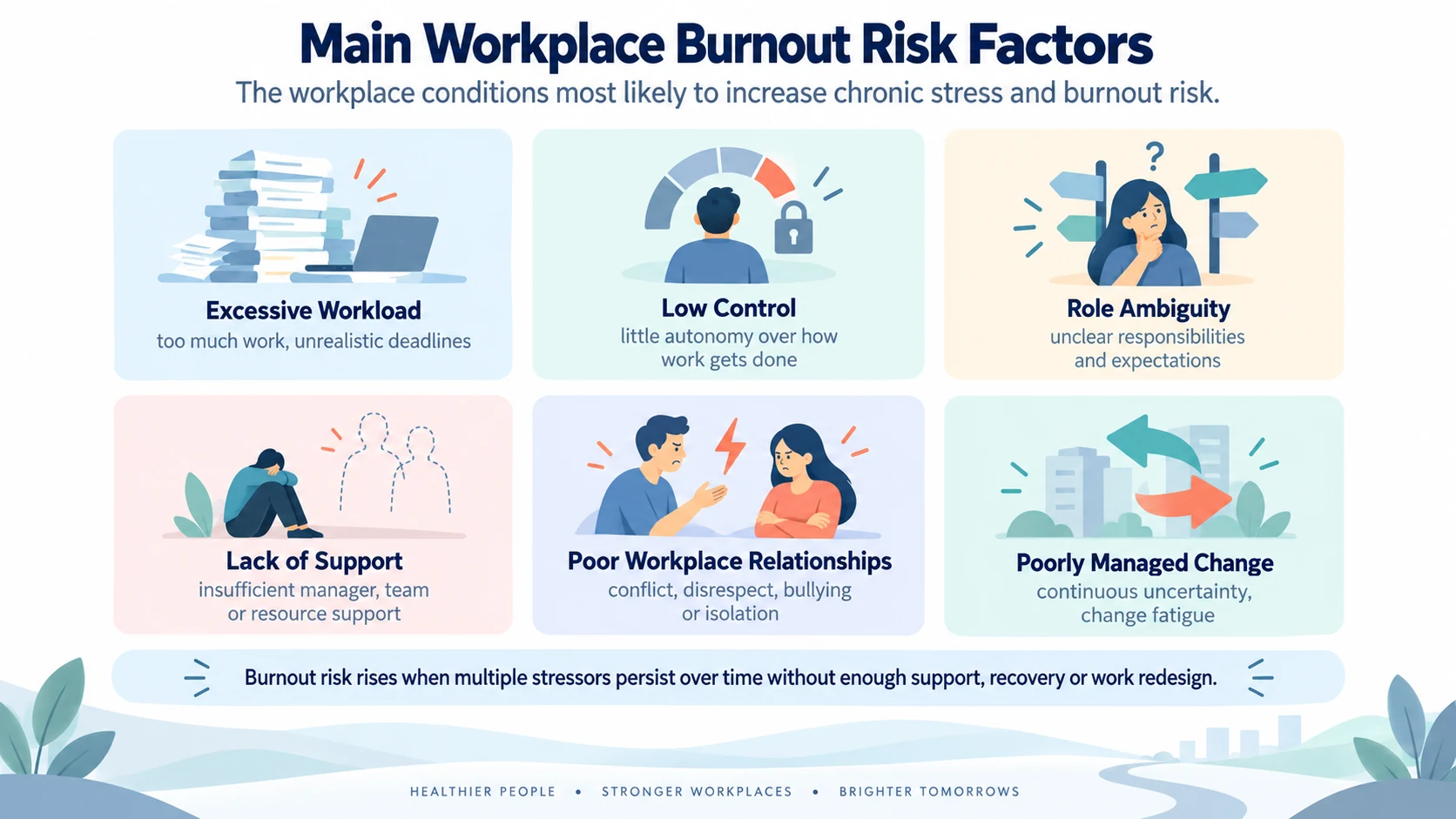
Potential workplace stressors include:
- Excessive workload
- Persistent time pressure
- Long or inflexible working hours
- Understaffing
- Low control over work
- Unclear roles
- Insufficient support
- Poor workplace relationships
- Bullying or harassment
- Job insecurity
- Poorly managed organizational change
- Conflicting work and personal demands
The International Labour Organization guidance on psychosocial risks and stress at work identifies many of these factors as psychosocial workplace risks.
Workplace Burnout and Workload
Workload deserves particular attention because it is more complex than simply counting the number of tasks assigned to an employee.
Workload is influenced by:
- Volume of work
- Task complexity
- Available time
- Staffing
- Dependencies
- Interruptions
- Meeting load
- Available skills
- Resources
- Changing priorities
A recurring mismatch between demands and available capacity can create persistent workplace pressure.
Organizations should therefore examine:
Demand → Capacity → Priorities → Resources → Recovery
rather than assuming employees simply need to become more efficient.
Low Control and Workplace Burnout
Demanding work can become harder to manage when employees have very little influence over how they perform it.
Appropriate control can include flexibility over:
- Task sequencing
- Work methods
- Scheduling
- Problem-solving
- Decision-making within defined responsibilities
This does not mean eliminating accountability.
Healthy autonomy combines:
Clear Objectives + Appropriate Decision Authority + Accountability
Role Clarity and Workplace Burnout
Unclear roles can create unnecessary pressure.
Problems may occur when employees:
- Receive conflicting instructions
- Do not know who owns a decision
- Have unclear responsibilities
- Are accountable for outcomes they cannot influence
- Repeatedly duplicate other people’s work
Clear responsibility does not eliminate demanding work, but it can remove unnecessary ambiguity.
Our RACI Matrix guide explains one method for clarifying responsibility and accountability in project environments.
Workplace Relationships and Burnout
Work is also a social environment.
Persistent interpersonal problems can add pressure to an already demanding workload.
Examples can include:
- Repeated conflict
- Poor communication
- Exclusion
- Disrespectful behavior
- Bullying
- Harassment
- Lack of cooperation
Professional disagreement should not automatically be treated as harmful. Teams need to be able to challenge ideas and discuss different perspectives.
The concern is persistent behavior or unresolved conflict that makes effective work more difficult.
See our How to Manage Difficult People at Work guide for a practical framework focused on communication, boundaries and conflict resolution.
Lack of Support and Workplace Burnout
Support can influence how manageable workplace demands become.
Employees may need:
- Clear priorities
- Information
- Training
- Resources
- Manager feedback
- Help resolving blockers
- Cooperation from colleagues
Support does not mean removing responsibility.
It means creating reasonable conditions in which people can carry out their responsibilities effectively.
Organizational Change and Burnout Risk
Transformation can create additional workplace pressure when employees face prolonged uncertainty.
Examples include:
- Restructuring
- New technology
- Automation
- New leadership
- Process transformation
- Changes in responsibilities
Organizations cannot eliminate all uncertainty.
But leaders can reduce unnecessary uncertainty by communicating:
What Is Changing → Why → When → Who Is Affected → What Happens Next
Warning Signs of Workplace Burnout
There is no simple online checklist that managers should use to diagnose burnout.
However, changes in how work is experienced or performed can indicate that a conversation about working conditions may be useful.
Examples might include persistent changes in:
- Energy related to work
- Engagement
- Connection with the job
- Perceived effectiveness
- Communication
- Ability to manage normal work demands
These observations do not prove that someone has burnout.
Similar changes can have many different explanations.
The appropriate management response is therefore not:
“I think you have burnout.”
It is more useful to ask:
“I’ve noticed that work seems particularly difficult at the moment. Is there anything about the workload or working conditions that we should review?”
How to Prevent Workplace Burnout
Because workplace burnout is associated with chronic workplace stress, prevention should include attention to the conditions creating persistent stress.
A practical prevention framework is:
Identify → Assess → Reduce → Support → Recover → Monitor
Step 1: Identify Persistent Workplace Stressors
Start with the work rather than assumptions about the person.
Ask:
- Where is workload consistently excessive?
- Which deadlines repeatedly create problems?
- Where are responsibilities unclear?
- Which dependencies create recurring pressure?
- Where is decision-making unnecessarily slow?
- Are employees receiving sufficient support?
Step 2: Assess Demands Against Capacity
Teams should compare actual demand with realistic capacity.
Capacity planning should consider:
- Existing commitments
- Operational work
- Planned projects
- Staffing
- Available skills
- Dependencies
- Leave
- Unexpected work
If demand continually exceeds capacity, prioritization becomes an organizational responsibility.
Step 3: Reduce Avoidable Workplace Stressors
Not every source of pressure can be eliminated.
But avoidable pressure can often be reduced.
Examples include:
- Removing unnecessary meetings
- Reducing duplicated reporting
- Clarifying priorities
- Resolving ownership problems
- Simplifying approvals
- Improving staffing where appropriate
- Reducing unnecessary interruptions
The objective is not a workplace without demanding work.
It is a workplace where demands are managed sustainably.
Step 4: Strengthen Support
Support should be practical rather than symbolic.
Managers can help by:
- Listening
- Clarifying priorities
- Removing blockers
- Providing resources
- Reviewing workload
- Making appropriate adjustments
- Connecting employees with available organizational support
Step 5: Protect Opportunities for Recovery
Demanding work sometimes occurs in cycles.
A major release, transformation milestone or critical incident may require a temporary increase in effort.
The problem is when exceptional intensity becomes the permanent operating model.
Organizations can examine:
- Working-hour expectations
- Breaks
- Meeting load
- After-hours communication
- Workload after major milestones
- Whether teams move immediately from one crisis to another
Recovery opportunities should complement sustainable work design, not compensate for permanently excessive demands.
Step 6: Monitor and Improve
Organizations should review whether interventions are actually changing working conditions.
Questions can include:
- Has workload improved?
- Are priorities clearer?
- Has overtime reduced?
- Are employees receiving more support?
- Are recurring blockers being resolved?
- Are the same problems returning?
Recurring problems may indicate a systemic issue rather than an isolated employee problem.
How Managers Can Help Prevent Workplace Burnout
Managers influence many of the everyday conditions that affect workplace stress.
They can:
- Set realistic priorities
- Review workload
- Clarify responsibilities
- Provide appropriate autonomy
- Remove unnecessary work
- Address conflict
- Communicate organizational change
- Provide feedback and support
- Escalate structural resource problems
WHO recommends manager training as one component of protecting mental health at work, alongside organizational interventions addressing workplace risks.
Our Modern Leadership guide explores leadership, communication, decision-making and team support in greater detail.
How Organizations Can Prevent Workplace Burnout
Organizations have influence over the design and management of work.
The WHO guidance on mental health at work recommends organizational interventions that directly target working conditions and workplace risks.
A prevention strategy can examine:
- Workload
- Working time
- Staffing
- Job control
- Role clarity
- Manager capability
- Workplace relationships
- Organizational culture
- Change management
- Employee participation
This creates an important principle:
Burnout prevention should address work design, not only individual coping.
Workplace Burnout and Employee Wellbeing
Burnout prevention is one part of a broader employee wellbeing strategy.
Employee wellbeing also involves:
- Working conditions
- Leadership
- Psychological safety
- Support
- Employee experience
- Workplace relationships
Our Employee Wellbeing and Mental Health at Work guide uses the broader organizational framework:
Prevent → Protect → Support → Measure
This article remains specifically focused on workplace burnout.
Workplace Burnout and Employee Experience
Employee experience provides another useful perspective because workplace conditions are experienced across the employee journey.
Employees interact with:
- Managers
- Teams
- Technology
- Processes
- Workload
- Career opportunities
- Organizational culture
Repeated friction across these areas can contribute to workplace pressure.
See our Employee Experience guide for the broader employee-journey perspective.
Workplace Burnout in Remote and Hybrid Work
Remote and hybrid work can change how workplace pressure is experienced.
Potential challenges include:
- Blurred work boundaries
- Digital overload
- Too many virtual meetings
- Communication gaps
- Difficulty disconnecting
- Isolation
But remote work should not automatically be described as a cause of burnout.
The impact depends on factors such as work design, workload, autonomy, communication, support and individual circumstances.
Digital Overload and Burnout
Technology can improve collaboration while also increasing the number of interruptions employees experience.
Common sources of digital overload can include:
- Constant notifications
- Too many communication channels
- Excessive virtual meetings
- Unclear response expectations
- After-hours messaging
Teams can reduce unnecessary digital pressure by establishing clearer communication norms.
AI, Automation and Workplace Burnout
Artificial intelligence and automation are changing how work is performed.
These technologies can reduce repetitive tasks, accelerate information processing and support employees.
But organizations should avoid assuming that every productivity gain should immediately become additional workload.
AI adoption can also create questions about:
- Changing roles
- New skill requirements
- Job security
- Performance expectations
- Human accountability
Organizations should combine automation with clear communication, training and thoughtful work design.
Can AI Prevent Workplace Burnout?
AI cannot independently prevent workplace burnout.
It may help reduce certain work demands by:
- Automating repetitive activities
- Summarizing information
- Supporting documentation
- Reducing some administrative tasks
But technology does not automatically solve:
- Unrealistic deadlines
- Understaffing
- Poor leadership
- Role ambiguity
- Workplace conflict
- Constant organizational change
The better question is:
Does AI remove unnecessary work and improve work design, or does it simply allow more work to be added?
Does Resilience Prevent Burnout?
Individual capabilities can help people navigate demanding periods, but burnout prevention should not be reduced to resilience training.
If the work system continually creates excessive or poorly managed demands, asking employees to become more resilient does not address the source of the problem.
A stronger model combines:
Individual Skills + Manager Support + Sustainable Work Design + Organizational Prevention
Does Taking Time Off Solve Workplace Burnout?
Time away from work can provide an opportunity to rest, but time off does not automatically change the workplace conditions that contributed to persistent stress.
If someone returns to exactly the same:
- Workload
- Priorities
- Staffing problems
- Role ambiguity
- Conflict
- Working-hour expectations
the underlying workplace issues may remain.
This is why organizational prevention matters alongside opportunities for recovery.
Workplace Burnout and Psychological Safety
Psychological safety can make it easier for employees to raise concerns, acknowledge mistakes, ask for clarification and discuss workload problems.
It does not mean eliminating accountability or difficult conversations.
Teams still need:
- Performance standards
- Clear expectations
- Constructive feedback
- Professional disagreement
The objective is to make it possible to raise legitimate work concerns before problems become harder to address.
How to Talk to an Employee About Possible Burnout
Managers should focus on observable workplace changes rather than making a diagnosis.
A useful conversation can focus on:
- Workload
- Priorities
- Deadlines
- Available resources
- Role clarity
- Workplace relationships
- Support
For example:
“I’ve noticed the workload has been particularly intense recently. Is there anything about the work or priorities that we should review?”
This keeps the conversation within the manager’s role and creates space to discuss working conditions.
When Additional Support May Be Appropriate
Workplace changes can address many organizational stressors, but they are not a substitute for appropriate professional support when someone has concerns about their health or wellbeing.
Employees can use appropriate workplace, occupational-health or professional support available to them when concerns are persistent or significantly affecting daily life.
Managers should avoid attempting to diagnose or treat employees themselves.
Common Workplace Burnout Prevention Mistakes
1. Treating Burnout as an Employee Weakness
Burnout is associated with workplace stress, so working conditions matter.
2. Calling Every Difficult Week Burnout
Temporary workplace pressure and burnout are not automatically the same thing.
3. Relying Only on Resilience Training
Individual skills cannot permanently compensate for unsustainable work design.
4. Ignoring Workload
Organizations should examine actual demand and capacity.
5. Offering Wellness Activities Without Fixing Work
Wellbeing activities can complement prevention but should not substitute for addressing workplace stressors.
6. Treating Time Off as the Complete Solution
Rest does not automatically correct the workplace conditions someone returns to.
7. Asking Managers to Diagnose Burnout
Managers should focus on working conditions, observable changes and appropriate support.
8. Ignoring Role Ambiguity
Unclear responsibility can create avoidable stress and conflict.
9. Ignoring Organizational Change
Continuous poorly communicated change can add unnecessary uncertainty. Our Workforce Transformation guide explains how organizations can manage change, skills and evolving ways of working more systematically.
10. Measuring Burnout Without Acting
Surveys have limited value if organizations identify workplace problems but take no meaningful action.
A Practical Workplace Burnout Prevention Framework
The overall approach can be summarized as:
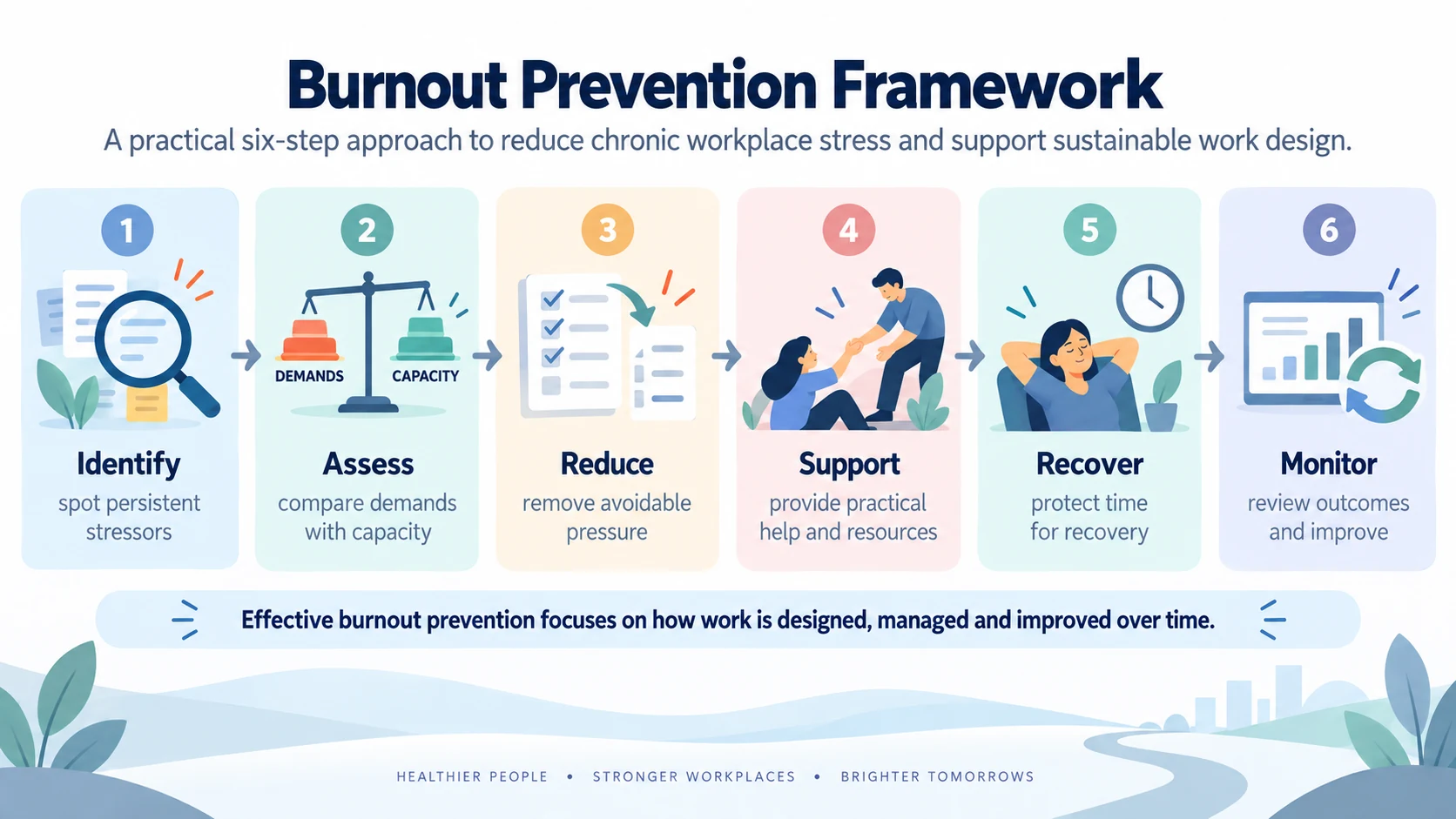
Identify → Assess → Reduce → Support → Recover → Monitor
| Stage | Key Question |
|---|---|
| Identify | What persistent workplace stressors exist? |
| Assess | Where do demands exceed available resources or capacity? |
| Reduce | Which avoidable stressors can be removed or redesigned? |
| Support | What practical manager or organizational support is needed? |
| Recover | Are there reasonable opportunities to recover from demanding work? |
| Monitor | Are working conditions actually improving? |
IT Project Example: Managing Burnout Risks in a Network Delivery Team
Consider an illustrative network delivery team responsible for customer migrations, production changes and out-of-hours incident response. Over several release cycles, the same engineers are assigned overlapping critical tasks, face repeated urgent requests and have limited opportunities to recover after demanding on-call periods. These work conditions warrant review without assuming that any individual has burnout or asking managers to make a medical judgment.
The delivery manager and operations lead review committed workload, incident history, escalation frequency and the team’s realistic availability. They agree which changes can be rescheduled, protect essential service coverage, clarify handoff ownership and consult the team on workable rota arrangements. Functional leadership addresses capacity or staffing gaps that individual engineers cannot resolve.
A four-week trial could reduce simultaneous non-critical changes, introduce clearer escalation thresholds and make coverage more predictable. The next review examines aggregate overtime trends, quality outcomes, unplanned disruptions and employee feedback. The aim is to address preventable workplace risk factors while preserving privacy and using appropriate professional support when needed.
Burnout Risk Prevention and Ownership Matrix
A practical action register helps managers convert recurring workplace risks into preventive controls. Review points are examples rather than universal deadlines: adapt them to operational risk, legal duties, local employee consultation and the organization’s processes.
| Risk Factor | Preventive Control | Owner | Review |
|---|---|---|---|
| Competing change deliveries and on-call incidents | Reserve incident coverage and renegotiate lower-priority change windows | Operations lead and project manager | Next weekly planning review |
| Repeated late-night escalation and limited recovery | Review rota capacity, backup coverage and realistic recovery windows | Service owner and line manager | After two rota cycles |
| Unclear responsibility across engineering teams | Agree decision owners, handoff criteria and escalation routes | Delivery manager | At the next delivery retrospective |
| Continuous urgent requests with insufficient staffing | Prioritize demand against funded capacity; stop or defer low-value work | Functional leadership | Monthly capacity and risk review |
| Uncertainty during technical transformation | Explain role changes, provide feedback channels and update resource plans | Transformation sponsor and HR | At the next change checkpoint |
Ownership matters: leaders are responsible for resources and systemic decisions; managers coordinate day-to-day priorities and supportive conversations; HR and qualified specialists maintain suitable support pathways. A RACI matrix can clarify project ownership, while psychological safety at work can help teams raise concerns early. These controls are about better work design, not monitoring individuals for a clinical condition.
15-Minute Burnout Prevention Review
This short review helps a manager or team turn the prevention framework into one concrete workplace action without trying to diagnose anyone.
- Minutes 0–3 — Identify the persistent stressor. Name one recurring work condition creating pressure: workload, changing priorities, unclear roles, repeated interruptions, staffing gaps, decision bottlenecks or after-hours expectations.
- Minutes 3–6 — Compare demand with realistic capacity. Check current commitments, deadlines, dependencies, staffing, skills and recovery time. Avoid planning from ideal capacity.
- Minutes 6–9 — Choose one controllable work-design change. Examples include removing low-value work, changing a deadline, simplifying an approval, clarifying ownership, reducing meeting load or protecting recovery time after a major milestone.
- Minutes 9–12 — Assign ownership. Record who can make the change, who needs to be consulted and what support or escalation is required.
- Minutes 12–15 — Set the review point. Define what evidence would show improvement—for example lower overtime, fewer urgent escalations, clearer priorities, reduced rework or more predictable workload—and schedule a follow-up.
Finish with one outcome: ACT NOW, MONITOR, or ESCALATE. If the issue is structural, such as chronic understaffing or persistent demand above capacity, escalation is more appropriate than asking individuals to absorb the problem.
Frequently Asked Questions About Workplace Burnout
What Is Workplace Burnout?
Workplace burnout is an occupational phenomenon associated with chronic workplace stress that has not been successfully managed.
Is Burnout a Medical Condition?
WHO classifies burnout in ICD-11 as an occupational phenomenon rather than a medical condition.
What Are the Three Dimensions of Burnout?
WHO describes burnout through three dimensions related to energy depletion or exhaustion, increased mental distance or cynicism toward work, and reduced professional efficacy.
Is Workplace Stress the Same as Burnout?
No. Workplace stress is broader. Burnout is a more specific occupational phenomenon associated with chronic workplace stress that has not been successfully managed.
What Can Contribute to Workplace Burnout?
Persistent workplace stressors can include excessive workload, low job control, insufficient support, unclear roles, difficult workplace relationships, long working hours, job insecurity and poorly managed organizational change.
Can Managers Diagnose Burnout?
Managers should not attempt to make clinical diagnoses. They can focus on observable workplace issues, discuss workload and working conditions, provide appropriate support and use relevant organizational processes.
Can Better Time Management Prevent Burnout?
Time management can help organize work, but it cannot fully address burnout risk when underlying problems involve unrealistic workload, insufficient resources, low control or other persistent workplace stressors.
Does Working From Home Cause Burnout?
Remote work does not automatically cause burnout. Its effects depend on workload, work design, autonomy, communication, boundaries, support and individual circumstances.
Can AI Reduce Workplace Burnout?
AI may reduce some repetitive work, but it cannot independently prevent burnout. Sustainable workload, appropriate resources, role clarity, leadership and work design remain important.
How Can Organizations Prevent Workplace Burnout?
Organizations can identify psychosocial workplace risks, review workload and capacity, improve role clarity and support, address harmful workplace behavior, manage change effectively and monitor whether working conditions improve.
How Does Burnout Relate to Employee Wellbeing?
Burnout prevention is one component of employee wellbeing. Employee wellbeing is broader and also includes leadership, workplace conditions, employee experience, psychological safety and organizational support.
Conclusion: Prevent Workplace Burnout by Improving How Work Works
Workplace burnout should not be reduced to an individual employee’s ability to cope with pressure.
WHO’s occupational framing points toward a more useful starting point: chronic workplace stress and how effectively it is managed.
A practical prevention model is:
Identify → Assess → Reduce → Support → Recover → Monitor
Employees can communicate concerns and use available support.
Managers can clarify priorities, review workloads, remove blockers and create appropriate opportunities for employees to raise problems.
Organizations can examine the wider system: workload, staffing, autonomy, working time, role clarity, relationships, leadership and organizational change.
This creates an important distinction:
Do not focus only on helping people survive an unsustainable work system. Improve the work system itself.
That is where workplace burnout prevention connects directly with sustainable employee wellbeing.
Continue Learning
Continue exploring TechTeamSynergy with these related guides.